Thesis by
Ajay Brian Sanjay Limaye
In Partial Fulfillment of the Requirements for the degree of
Doctor of Philosophy
CALIFORNIA INSTITUTE OF TECHNOLOGY Pasadena, California
2015
© 2015
“None show more clearly than the Seine the special features of an invigorated river. The
great curves around which it swings fit in nearly all cases close to the bluff on their outer
side. It is an able-bodied river, a river of a robust habit of life.”
ACKNOWLEDGEMENTS
I would like to thank my adviser Mike Lamb for his engagement and creativity, and for his guidance in developing an ethics in science. Mike was incredibly generous with his time, ideas, and enthusiasm in all phases of my time as a student. Several other faculty members have contributed to my growth here. Thanks in particular to Jean-Philippe Avouac for field insights; Andy Ingersoll, for encouraging me to return observations frequently while developing a numerical model; Andrew Thompson, especially for introducing me to sinuous ocean currents; and Bethany Ehlmann, for the opportunity to assist in an exciting new class on planetary surfaces. I thank Oded Aharonson for co-advising me in my first years here, for the opportunity to dive into data from the Mars Reconnaissance Orbiter, and for fostering a group that helped shape my experiences at Caltech. I had the opportunity to learn from many talented students and postdocs, especially Alex Hayes, Kevin Lewis, Paul Hayne, Meg Rosenburg, Antoine Lucas, Edwin Kite, Jeff Prancevic, Joel Scheingross, Mathieu Lapôtre, Luca Malatesta, Vamsi Ganti, Ben Mackey, Ryan Ewing, Roman DiBiase and Dirk Scherler.
Erickson, and Dr. Edward Helfand offered invaluable perspectives when I needed them most. Thomas Schwei and Jeremy Till have been great friends throughout a decade in California.
ABSTRACT
TABLE OF CONTENTS coupled models of meandering and landscape evolution Abstract ... 4
1. Introduction... 5
2. Modeling goal... 8
3. Grid-based approaches to bank-material tracking ... 9
3.1. Review of existing grid-based models... 10
3.2. Demonstration of resolution dependence in grid-based models... 11
3.2.1. Meandering model implementation ... 11
3.2.2. Grid-based model application and results ... 17
4. A new vector-based method for modeling meandering-landscape interactions ... 20
5. Case studies... 25
5.1. Bank strength effects on floodplain evolution... 26
5.2. Bank strength effects on channel body geometry... 30
5.3. Bedrock valley widening ... 32
5.4. Floodplain evolution with a bank height-dependent channel lateral migration rate ... 35
2. Modeling goals and hypotheses ... 56
3. Model formulation... 62
3.1. Meandering model implementation... 62
3.2. Bank-material tracking... 64
4. Controls on bedrock valley type under constant forcing ... 68
4.1. Temporal evolution ... 68
4.2. Non-dimensional initial alluvial-belt width (wab*) ... 71
4.3. Non-dimensional vertical incision rate with sediment banks (EVs*) ... 74
4.4. Non-dimensional vertical incision rate with bedrock banks (EVb*)... 75
4.5. Summary of model predictions for valley type ... 75
5. Valley-type transitions by pulses of vertical incision... 79
6. Comparison to natural river valleys ... 82
7. Discussion... 85
8. Conclusions... 91
Acknowledgments ... 92
4 Numerical model predictions of intrinsically generated fluvial terraces and comparison to climate-change expectations Abstract ... 106
1. Introduction... 107
2. Hypotheses and non-dimensionalization... 112
3. Model formulation... 116
3.1. Meandering and landscape evolution ... 117
3.2. Automated terrace detection ... 119
3.3. Modeled parameter space... 122
4. Results for intrinsically generated terraces ... 124
4.1. Types of terraces formed by the numerical model
4.7. Summary of constant bank-strength simulations ... 135
5. Effects of variable bank-strength on simulations... 136
6. Effect of pulses of vertical incision on simulation results ... 141
7. Comparison to natural river valleys ... 143
5 Detailed stratigraphy and bed thickness of the Mars north and south polar layered deposits
Abstract ... 182
1. Introduction... 183
2. Stratigraphy of the polar layered deposits... 184
3. Bed thickness measurement methods... 190
3.1. Bed identification ... 190
3.2. Image processing and DEM extraction... 192
3.3. Correction for non-horizontal bed orientation... 193
3.4. Bed thickness measurement error ... 193
4. Stratigraphy and bed thickness within the PLD... 195
4.1.1 Site NP2... 195
4.1.2. Site NP3... 197
4.2.1. Site SP1 ... 198
4.2.2. Site SP2 ... 198
4.2.3. Site SP3 ... 199
5. Spectral estimates of PLD periodicity... 200
5.1. Methods ... 200
5.2. North polar layered deposit power spectra ... 202
5.3. South polar layered deposit power spectra ... 202
6. Discussion... 203
7. Conclusions... 208
6 Conclusion... 229
LIST OF FIGURES AND TABLES
Chapter 1 Page
Figure 1: A variety of meandering forms ... 1
Chapter 2 Page
Figure 1: A commonly used technique for representing
bank-material properties ... 42 Figure 2: Comparison of rules for determining which grid cells are
considered inside the channel banks ... 43 Figure 3: Simulations of a meandering river using grid-based
bank-material tracking ... 44 Figure 4: The new, vector-based method for erodibility and
topography tracking... 45 Figure 5: Meander-belt evolution with variable erosion susceptibility
for meander cutoff loops relative to point bar sediment ... 46 Figure 6: Cross-valley cross-sections of stratigraphy formed by an
aggrading, meandering channel...47 Figure 7: Valley widening in a bedrock landscape using grid-based
and vector-based bank-material tracking ... 48 Figure 8: Simulated landscapes formed by channel migration and
floodplain deposition ... 49 Figure 9: Updated bank area for variable grid resolution ... 50
Chapter 3 Page
Table 1: Model parameters ... 92 Table 2: Estimated parameters for field sites shown in Figures 1 and
Figure 2: Model procedure for setting initial alluvial-belt width
and channel planform geometry ... 95 Figure 3: Valley evolution under constant vertical incision... 96 Figure 4: Valley topography formed for different initial alluvial-belt
widths... 98 Figure 5: Topography of valleys formed by initially high-sinuosity
channels for different values of non-dimensional vertical
incision rate with sediment banks (EVs*)...100 Figure 6: Valley topography formed for different values of
non-dimensional channel vertical erosion rate with bedrock
banks (EVb*) ...101 Figure 7: Model predictions for bedrock valley type ...102 Figure 8: Valley topography during evolution from an alluvial state
following a relatively small pulse of vertical incision ...103 Figure 9: Valley topography during evolution from an alluvial state
following a relatively large pulse of vertical incision...104 Supplemental Movies 1-4: See online repository.
Chapter 4 Page
Table 1: Model variables and statistics for terrace age and geometry ...160 Table 2: Simulation parameters ...162 Table 3: Estimated parameters for rivers shown in Figure 1 and the
San Juan River ...163 Figure 1: A variety of river terrace morphologies...164 Figure 2: Schematic of river terrace formation by vertical erosion and
unsteady lateral erosion ...165 Figure 3: Surface morphologies produced by the model for constant
bank-strength cases ...166 Figure 4: Dimensionless time interval between formation of unique terrace
Figure 5: Terrace slope ...168
Figure 6: Terrace dip direction ...169
Figure 7: Terrace length...170
Figure 8: Terrace pairing...171
Figure 9: Surface morphologies produced by the model for variable bank-strength cases ...172
Figure 10: Terrace formation frequency and geometry for variable bank-strength cases ...174
Figure 11: Examples of terrace formation by pulses of vertical incision and constant vertical incision...175
Figure 12: Terrace elevation for natural river valleys ...177
Figure 13: Terrace slope for natural river valleys ...178
Figure 14: Terrace dip direction for natural river valleys ...179
Figure 15: Maximum terrace length and fraction of paired terraces for natural river valleys ...180
Figure 16: Summary of model predictions for terrace occurrence, pairing and length ...181
Chapter 5 Page Table 1: Summary of bed thickness and orientation data ...210
Table 2: Contributions to bed thickness measurement error at each site ...211
Figure 1: Locations of study sites ...212
Figure 2: Bed thickness measurement technique ...213
Figure 3: Stratigraphic section of site NP2...214
Figure 4: Stratigraphic section of site NP3...215
Figure 5: Relative stratigraphic height versus bed thickness for NPLD stratigraphic sections...216
Figure 7: Relative stratigraphic height versus bed thickness for
site SP3...218
Figure 8: Spectral analysis for site NP3 ...219
Figure 9: Spectral analysis for fine beds at sites NP2 and NP3 ...220
Figure 10: Spectral analysis for site SP1 ...221
Figure 11: Summary of bed thickness measurements...222
Figure S1: Site NP2...223
Figure S2: Site NP3...224
Figure S3: Site SP1 ...225
Figure S4: Site SP2 ...226
Figure S5: Site SP3 ...227
Chapter 1: Introduction
Meandering is one of nature’s most common and captivating patterns. The sinuous arc of a meander loop is cast in many forms, from a water droplet’s path down a glass pane [Nakagawa and Scott, 1984] to a river canyon cut through bedrock and a sedimentary outcrop on Mars (Fig. 1). Meanders have long inspired scientific interest [e.g., Thomson, 1876; Einstein, 1926; Langbein and Leopold, 1966; Seminara, 2006], and, as noted by William Morris Davis, one can recognize a vital spirit in a meandering form. The constant turning path of a meandering river evokes its natural tendency to migrate, and meandering rivers are one of the rare large-scale features of Earth’s surface that commonly evolve over a human lifetime. The consequences of meandering river evolution extend over geologic timescales, but in ways that remain poorly understood.
Figure 1. Meanders in different forms. (A) Water flowing over a glass pane, from Nakagawa and Scott [1984]. (B) Meander cut into a bedrock canyon at Horseshoe Bend, Arizona (image: Wikipedia). (C) Meandering forms in sedimentary rock, Aeolis Dorsa, Mars, from Howard [2009] (MRO/HiRISE image PSP_006683_1740).
A
B
Meandering channels shape surrounding landscapes, and are shaped by them—but quantitative predictions of meandering patterns developed over geologic timescales are rare and often schematic. Meandering is perhaps the most common channel form on Earth [Ikeda and Parker, 1989], and understanding how meandering rivers generate their own patterns is critical to distinguishing signals from other Earth systems—including climate and tectonics—preserved in landscapes and sedimentary deposits.
The studies that comprise this dissertation take new steps to quantitatively characterize landscape patterns that form as a natural consequence of meandering. Chapter 2 identifies a numerical artifact that hampers numerical model predictions of meandering river evolution over geologic timescales, and presents a new method for tracking the co-evolution of meandering and bank-strength. This method carries the greatest advantages for landscapes with large contrasts in bank-strength, as commonly occurs in bedrock river valleys. Chapter 3 applies this numerical technique to explore generic controls on the evolution of bedrock river valleys, whose form has been suggested to record environmental history. Chapter 4 applies numerical simulations and a new topographic analysis technique to identify controls on the formation and geometry of river terraces, which in many landscapes are considered the primary indicator of landscape response to climate change.
Chapter 2: A vector-based method for bank-material tracking in coupled models of meandering and landscape evolution
Originally published in:
Limaye, A. B. S., and Lamb, M. P., 2013, A vector-based approach to bank-material tracking in coupled models of meandering and landscape evolution, Journal of Geophysical Research – Earth Surface 118, doi: 10.1002/2013JF002854.
Abstract
and (4) the effect of a bank-height dependent lateral-erosion rate for a meandering river in an aggrading floodplain. In all cases the vector-based approach overcomes numerical artifacts with the grid-based model. Because of its geometric flexibility, the vector-based material tracking approach provides new opportunities for exploring the co-evolution of meandering rivers and surrounding landscapes over geologic timescales.
1. Introduction
channel meandering on Mars, Venus, the Moon [Komatsu and Baker, 1996], and Titan [Burr et al., 2013].
A variety of factors can influence bank strength, including lithology or soil type, vegetation, and susceptibility to weathering from freeze-thaw and wet-dry cycles [Howard, 1992; Montgomery, 2004]. Differences in bank strength in turn exert first-order controls on channel kinematics in meandering rivers. For example, valley confinement can distort smoothly curving meander bends into sharp bends at valley walls [Lewin, 1976; Lewin and Brindle, 1977; Allen, 1982]. Meandering rivers deposit sediments on the trailing bank and
overbank which typically have different strength properties than the preexisting sediment or rock substrate—for example, when erosion-resistant, fine-grained sediment accumulates in abandoned meander loops [Fisk, 1947; Ikeda, 1989; Thorne, 1992].
To model meandering river and landscape evolution, there is a need to accurately couple channel migration with bank-material evolution. Relatively short-timescale models have detailed the influence of stochastic floodplain bank strength on alluvial channel geometry [Güneralp and Rhoads, 2011; Motta et al., 2012b; Posner and Duan, 2012]. Forward models of river meandering over geologic timescales have generated predictions for the planform evolution meander belts [Howard, 1996; Sun et al., 1996; Camporeale et al., 2005; Karssenberg and Bridge, 2008], feedbacks between channel migration and
[Sylvester et al., 2011]. Despite this diversity of work, incorporating channel migration in landscape evolution models poses continuing challenges. River banks are commonly steep and mobile, and representing their geometry and erodibility with a grid in numerical models can be problematic [Tucker and Hancock, 2010]. While techniques for evolving channel centerlines have been critically assessed [Crosato, 2007], to our knowledge no systematic sensitivity tests have been performed for models that represent bank strength in environments influenced by channel migration.
and disadvantages of grid- and vector-based approaches to bank-material tracking in Section 6, and present conclusions in Section 7.
2. Modeling goal
Our modeling goal is to develop a numerical framework that can be used to track bank-material properties in a landscape evolution model of a meandering river in the absence of grid-resolution dependencies. In their review of modeling approaches to alluvial river evolution, Van De Wiel et al. [2011] identified three principal fronts for progress in modeling meandering rivers and landscape evolution: (1) conceptual: relating to understanding underlying physical processes; (2) structural: relating to algorithms and mathematical formulations within models; and (3) computational resources. Accurate tracking of bank-material properties represents a fundamental structural component of channel migration models because bank strength strongly influences the channel trajectory [Seminara, 2006]. In this way, numerical artifacts in tracking bank strength may shape simulated landscapes in subtle but fundamental ways, obscuring the links between physical models and natural process and form [Dietrich et al., 2003].
2002; Duan and Julien, 2010; Parker et al., 2011; Motta et al., 2012a], but are computationally intensive to implement. More commonly, local feedbacks between cut-bank erosion and point-bar growth are approximated as a continuous process [Seminara, 2006] and channel width is assumed to be constant [Parker et al., 2011a], consistent with field observations [e.g., Leopold and Wolman, 1957; Parker et al., 2011]. Some channel models explicitly represent hydraulics and bed topography [e.g., Blondeaux and Seminara, 1985; Johannesson and Parker, 1989], while others employ physically motivated rules [e.g., Howard and Knutson, 1984; Lancaster and Bras, 2002] to predict local bank migration rates. Computational costs increase with the complexity of the hydraulic and morphodynamic models, so given our interest in landscape evolution over geomorphic timescales herein we employ a relatively simple model (constant channel width, rule-based) that has been shown to produce realistic meandering to represent lateral migration [Howard and Knutson, 1984; Howard and Hemberger, 1991]. We use this model as the driver of landscape evolution and focus our efforts on properly representing bank-material properties and topography. The landscape-evolution framework we develop is generic, however, so that it can be used in conjunction with a wide range of models for meandering river channels [e.g., Johannesson and Parker, 1989; Zolezzi and Seminara, 2001].
3. Grid-based approaches to bank-material tracking
3.1. Review of existing grid-based models
Existing approaches to bank-material tracking over geomorphic timescales all utilize a grid—regularly spaced and fixed, or irregularly spaced and deformable. Two-dimensional grids are used in scenarios with only lateral differences bank-material properties [Howard, 1996; Sun et al., 1996, 2001; Lancaster, 1998; Finnegan and Dietrich, 2011] whereas three-dimensional grids are used to additionally track vertical variations in these properties [Clevis et al., 2006; Karssenberg and Bridge, 2008; Sylvester et al., 2011]. In some cases the grid stores elevation or bank-material properties which alter the channel trajectory [Howard, 1996; Sun et al., 1996; Lancaster, 1998; Güneralp and Rhoads, 2011; Motta et al., 2012b], while in other cases the grid is solely a framework for recording
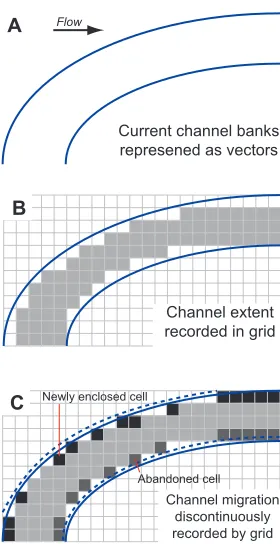
channel-influenced topography [Finnegan and Dietrich, 2011] or stratigraphy [Clevis et al., 2006; Karssenberg and Bridge, 2008; Sylvester et al., 2011]. Most commonly, active channel banks are represented using high-resolution vectors tracked independent of the grid (Fig. 1A) [Howard, 1992, 1996; Sun et al., 1996; Finnegan and Dietrich, 2011], which we follow here. Grid-resolution dependencies come into play when areas previously occupied by the channel are recorded in the landscape by mapping the bank vectors onto a discrete grid of comparatively low resolution (Fig. 1B). Consequently, as the banks smoothly migrate, some grid cells are abandoned while others are newly enclosed within the channel, but the process of updating the grid is discontinuous (Fig. 1C). Therefore, past bank positions are incompletely recorded in the grid, and the maximum resolution for differentiating successive bank positions is the grid cell size.
using an adaptive irregular grid within the Channel-Hillslope Integrated Landscape Development model [Tucker et al., 2001]. In this framework, the channel centerline is explicitly tracked using nodes, but bank migration is incorporated by adding nodes in the point bar region and removing nodes in the cutbank region after the channel migrates more than a threshold distance. The finest horizontal resolution attainable by this scheme is the wetted channel width [Lancaster, 1998], and reducing the re-meshing threshold can be computationally expensive [Udaykumar et al., 1999; Clevis et al., 2006; Liu, 2010]. Thus, as with fixed regular grids, bank positions are discontinuously recorded.
3.2. Demonstration of resolution dependence in grid-based models
3.2.1. Meandering model implementation
To illustrate spatial resolution controls on bank interactions in grid-based models, we use a bank-material tracking model similar to Howard [1996] and Sun et al. [1996, 2001], which is briefly reviewed here. In this implementation a channel with a rectangular cross-section scours the land surface to the bed elevation as it migrates laterally. The channel is forced to maintain a fixed width by balancing cutbank erosion with point bar deposition. As in Howard [1996], Sun et al. [1996, 2001], Lancaster [1998] and Finnegan and Dietrich [2011], fluxes of sediment are not tracked explicitly; thus all eroded sediment
€
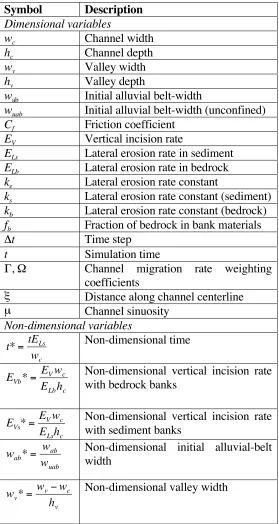
where s is the node index, the dimensionless channel curvature is Ro = (r/w)
-1, r is the local
centerline radius of curvature and w is channel width. The dimensionless weighting parameters Γ and Ω are set to 1 and -2.5, respectively, after Ikeda et al. [1981]. ξ is the upstream distance, and G is an exponential weighting function
. (2)
Here k is a dimensionless scaling parameter equal to 1 [Ikeda et al., 1981], Cf is a friction coefficient (set as 0.01 after Stølum [1996]), and h is the channel depth. The curvature integration proceeds upstream to the distance ξmax, where the normalized value of the
weighting function G falls below 1%. The local lateral erosion rate (EL(s)) is then computed for the sinuosity (µ) and the bank erodibility coefficient (ke) as
EL(s) = keR1(s)µε, (3)
where ε =-2/3 [Howard and Knutson, 1984]. The bank erodibility coefficient ke is set to yield the user-defined, space-averaged lateral migration rate.
bank-material erodibility coefficient (ke) is assigned to each intersected grid cell, and is a
linear function of the fraction of the bank comprised by each material of differing erodibility
€
ke =∑kifi, (4a)
where fi is the fraction of the bank (from the channel bed to the bank-full elevation) that has an erodibility ki. For example, in the common case of differences in bank strength between bedrock and sediment, Eq. 4a becomes
ke = ks (1 - fb) + kbfb, (4b)
where fb is the fraction of the bank (from the channel bed to the bank-full elevation) that is bedrock and ks and kb are the erodibilities of sediment and bedrock, respectively. The linear dependence of bank strength is similar to the parameterization of bank height influences on channel migration rates used by Lancaster [1998].
The bank bedrock fraction is recalculated for each cell intersected by a test vector extended from the cutbank node in the direction of bank migration. The test vector length (dmax) is calculated for each node as
dmax(s) = ke,max R1(s)µεΔt, (5)
to node and through time. Thus the length of the test vector is set before any information about the local bank composition has been ascertained.
The erodibility can vary with distance from the channel banks in a given time step, so channel migration would proceed too far or not far enough if erodibility were only considered right at the banks. Therefore to determine the appropriate bank migration distance, we define a “cost” for each increment of bank migration through material of constant erodibility. The cost represents the time required to migrate through that area relative to the time required to migrate through an area with the highest erodibility. For example, areas with relatively low erodibility take longer for the channel to migrate through and incur relatively high cost. The cost of bank migration through each cell intersected by the test vector is recorded, and is equal to the ratio of the distance traveled within the cell (dn) to the length of the test vector (dmax), divided by of the erodibility for that grid cell (ke,n). The channel bank node is moved incrementally until the cost function sums to 1, i.e.,
where N is the number of cells traversed by the test vector. This formulation ensures that the actual bank migration distance properly accounts for the erodibility of all materials encountered in that time step. For example, the actual bank migration distance only equals the maximum possible bank migration distance (dmax) when all of the material encountered by the search vector has the highest erodibility found in the model domain.
direction specified by the sign of EL(s) (positive to the left, looking downstream). Node-to-node distances along the centerline change as meander bends evolve; consequently, nodes are added and removed following rules similar to Howard [1984]. When two consecutive nodes (A and B) become separated by 2l, an intervening node is added. When a node B is less than 0.5l from its upstream neighbor A but greater than 0.5l from its downstream neighbor C, B is shifted to a point equidistant from A and C. When any three consecutive nodes (A, B, and C) are oriented such that the distances from A to B and B to C are both less than 0.5l, B is removed.
the local interpolation approach adopted here places looser constraints on the centerline node-to-node distance than would a global interpolation approach, it allows for slowly migrating reaches to undergo centerline interpolation less frequently than quickly migrating reaches, and thus does not inhibit meander bend growth.
A periodic boundary condition is employed in three respects. First, the channel planform is periodic along the valley axis, such that meander bends that migrate across the downstream edge of the model domain reappear on the upstream side, and vice versa. No channel centerline nodes are fixed, so the channel axis can drift freely. The extent of the model domain parallel to the valley axis scales with the average meander wavelength, and is long enough that the channel curvature integration never spans the entire channel centerline. Second, the channel curvatures are computed in a periodic fashion, in accordance with the periodicity of the channel planform. Third, longitudinal profile elevations are periodic. Just as the channel centerline repeats with a lateral offset equal to the valley-parallel centerline distance range within the domain, the vertical component of the longitudinal profile repeats with a vertical offset equal to the vertical range of the long profile within the model domain. This ensures that reaches that enter the model domain on the upstream side are no lower than reaches downstream, and vice versa.
within the channel, and (2) a liberal case, in which any cell partially contained by the banks is also considered within the channel. Both cases are illustrated in Figure 2; the conservative case is adopted here to illustrate the resulting strong grid-resolution dependence of landscape evolution. The liberal case could also be adopted; it would consistently over-predict the area affected by channel migration because even partial bank migration across a cell boundary would result in alteration of bank-material properties for the entire cell.
3.2.2. Grid-based model application and results
meter-scale noise. Channel bed elevation is set to be constant for simplicity and there is neither aggradation nor vertical incision.
Three simulations were performed where the only difference between simulations was the grid resolution (Fig. 3). A number of phenomena are common to all three simulations. The channel migrates, and the bank-material tracking grid records areas visited by the channel. Meander bends elongate, and several experience neck cutoffs. The bank material evolves in time as the channel erodes bedrock and deposits sediment, commonly on the inside of growing meander bends. The evolving bank materials also influence channel planform development: straightened reaches form because bedrock banks slow bend growth in reaches that have experienced neck cutoffs. In places the channels turn sharply where they transition from primarily sediment to primarily bedrock cutbank materials.
shows that finer grid resolutions result in more area recorded as visited by the channel. Despite starting with the same channel planform, the channel trajectory differs for all three simulations because the different grid resolutions cause different spatial distributions of bank strength to evolve. These differing bank-material properties cause reaches with similar geometries to migrate at different rates, which quickly causes the channel planform shapes to diverge. This implies that in general, model predictions for short-term channel trajectory and large-scale landscape evolution depend strongly on the grid resolution. Depending on the model outcome considered, the resolution artifact may greatly distort the influence of bank-material properties.
One solution to remove the dependency of landscape evolution on grid resolution is to decrease the grid cell size so that it is much smaller than any incremental change in the river channel location. To illustrate this point, the cell width (Δx) can be non-dimensionalized (Δx’) using the migration length scale
,
(7)
exclusively used in practice. For example, the cell width in the Howard [1992, 1996] and Sun et al. [1996, 2001] models and the threshold distance for node addition in Lancaster [1998] are approximately one channel width. Alluvial meandering rivers
typically migrate at less than one tenth of a channel width per year [e.g., Nanson and Hickin, 1983; Hudson and Kesel, 2000]. Taking this as an upper bound for the bank
migration rates and assuming an annual time step yields approximate values of Δx’ = 10 (for extremely rapid migration at 0.10 widths per year) to 100 (for a more typical migration rate of 0.01 widths per year) for the aforementioned studies.
Because lateral erosion rates vary spatially for meandering channels [Nanson and Hickin, 1983; Hudson and Kesel, 2000], bends that migrate relatively slowly may be
affected by grid resolution even if other bends are not. Consequently, existing frameworks for landscape evolution in meandering environments with bank strength differences generally yield grid-resolution dependent results except for cases with very large lateral migration rates. The grid-resolution issue is especially significant for rivers with bedrock banks, which have lateral migration rates of millimeters to centimeters per year even in relatively weak rock [Hancock and Anderson, 2002; Montgomery, 2004; Fuller et al., 2009a; Finnegan and Dietrich, 2011].
4. A new vector-based method for modeling meandering-landscape interactions
[2009], which use a channel’s extent and longitudinal profile as reference objects for identifying simultaneously formed fluvial deposits. In these studies, modeled stratigraphy is formed by assembling channel extents from different points in its trajectory. We extend this approach by including interactions between the channel trajectory and the properties of the bank material. In contrast to the method of recording bank-material properties with grids, in our new approach topography and bank-material properties are recorded using initial valley geometry and the full history of channel positions, which are stored as vector data. As the channel migrates and encounters areas it has previously visited, the new algorithm queries a database of previous channel positions to reconstruct these bank-material properties instead of querying a bank-material grid. The database of channel positions is used to define polygonal regions of bank material formed during the simulation where the node spacing along the polygon boundaries is set by the channel boundaries themselves. Therefore there is no data degradation with respect to the geometry produced by the underlying meandering model, as occurs in mapping the channel boundaries onto a grid.
applied to the longitudinal profile. To introduce the bank interaction algorithm, we discuss a case with only lateral differences in bank-material properties. The general principles used for bank-material tracking also extend to cases with vertically stratified bank materials, however, and we present one such example in Section 5.3.
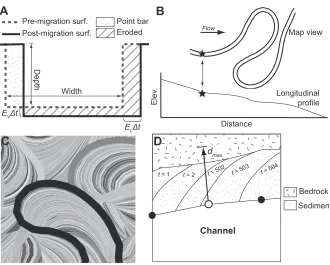
The bank interaction algorithm proceeds as follows. A meandering model is used to compute a preliminary, bank strength-independent lateral migration rate for each centerline node. The channel banks are tracked as separate vectors, and each left and right bank node is associated with a centerline node. The local channel migration direction determines which bank node represents the trailing bank and which represents the cutbank. At each time step the bank vectors are used to construct the planform extent of the channel. The local elevation of the channel bed within this extent is calculated by interpolating along the channel longitudinal profile (Fig. 4B), and can be refined using vector-based cross-section data that is also stored. The channel bed elevation represents the elevation to which the channel bed scoured the land surface (zscour) at the time the channel extent occupied that location. Thus, whereas the grid-based method would look up zscourfrom a grid of elevation values that spans the model domain, the vector-based method determines zscour using only the past positions of the channel. The channel planform extents from different time steps collectively characterize the areas of a valley scoured by channel migration (Fig. 4C).
Rather than search the entire channel geometry database, we use an indexing system that associates each channel extent with an approximate time interval and spatial location. We query this database to find the most recent time of channel occupation in order to determine local bank-material properties. The most recent time is used because when the channel migrates across an area, it updates the landscape properties set during earlier instances of channel occupation. The spatial and temporal indexing increments are user-defined, can vary during the simulation, and do not affect the model results; they only affect the efficiency of the bank-material look-up operations.
To account for variable strength material in the calculation of local lateral migration distance, we use the test vector approach as described in Section 3.2.1 (Eq. 5; Fig. 4D). Bank-material properties are reconstructed at points along this test vector separated by an interval distance of ELΔt. Parts of the model domain beyond the channel-visited area are represented by a valley-bounding polygon which is user-defined and can represent an arbitrary topography and bank-material composition. In the example in Figure 4D, the test vector encounters sediment and bedrock, and therefore the local migration distance is adjusted according to these different erodibilities (Eq. 6).
Once the original channel scour depth is determined, it is used to calculate the land surface elevation (z)
z = zscour + Δzpoint bar + Δzoverbank, (8)
mantle of point bar deposits. Equation 8 applies only outside of the channel; within the channel, the elevation is equal to zscour. Overbank deposition can be incorporated using different models. Here we choose the model of Howard [1996]
,
(9)
where dzoverbank/dt is the rate of elevation change within the floodplain; η is a constant deposition term; and the second term is a spatially dependent overbank deposition rate, where Ds is the deposition rate of overbank sediment at the channel banks, dc is the minimum distance to the active channel, and λ is a decay length scale. Within the vector-based framework, the local sediment cover due to overbank deposition is determined by calculating the overbank sediment contribution from the channel at each time step after the channel abandoned the point
,
(10)
where t is time, tfis the current model time, ta is the time the channel abandoned the point, and dc(t) is the minimum distance from the point to the channel at time t. A gridding procedure, used to visualize the final topography, can be performed at arbitrary resolution. This is because the elevation at any particular point is not stored explicitly, but rather is calculated as needed to determine bank-material height. To do this, the algorithm uses the channel polygon that contains the point of interest, retrieves the time step associated with the channel polygon from the database of previous channel positions, and projects the point onto the longitudinal profile associated with that time step to reconstruct the original channel scour depth. Adding contributions from point bar and overbank sedimentation
€
Δzoverbank = (η+Dse−dc(t)/λ
t=ta+Δt
tf
yields the exact elevation.
The channel scour and land surface elevations are bank-material properties that can be used to define an effective bank erodibility, which is a user-defined function (e.g., of bank elevation and composition) and can vary with the application as in Section 3.2.1 (Eq. 4a). A unique erodibility value is calculated for each interval between checkpoints along the test vector. The final lateral migration distance for each centerline node is calculated using the erodibility in each interval until the cost condition (Eq. 6) is met. Once the final migration distance is calculated for each centerline node, the nodes are moved perpendicular to the local centerline azimuth by this distance, and the bank nodes track along with them.
The memory required by the vector-based approach depends on the channel trajectory, which determines the size of the channel geometry indexing data structure. In trial simulations of bedrock river valley evolution, we noted a memory savings of at least two orders of magnitude over a grid-based model of equivalent resolution, because in the vector-based approach, areas with similar bank-material properties can be stored using their boundary coordinates instead of a grid of contiguous pixels. This is analogous to the efficiency offered by boundary element models as compared to finite element models used widely in engineering [Katsikadelis, 2002; Li and Liu, 2002; Liu, 2010].
5. Case studies
floodplain evolution for a scenario in which a channel bed neither aggrades nor degrades, and material that accumulates in oxbows (abandoned meander cutoffs) has a different strength than point bar sediments that accumulate by channel lateral migration. Second, we extend the floodplain development scenario to a case with channel aggradation and floodplain deposition to analyze the resulting stratigraphy. Third, we model topographic evolution by a meandering river incising a bedrock valley with mixed alluvial and bedrock banks that evolve in the simulation. Fourth, we model a case of overbank deposition by an alluvial river in which bank height rather than bank material determines erodibility. We begin by discussing aspects of the initial conditions and the model domain common to all four case studies.
Grid- and vector-based tests within each case study use the same initial conditions, and the underlying meandering model is identical to that described in Section 3.2.1. The channel bed is initially inset by one channel depth into a planar landscape with constant slope. The initial channel centerline is straight, with random perturbations of order 0.01 channel widths to seed meander development. The initial channel slope matches the landscape slope.
5.1. Bank strength effects on floodplain evolution
1982; Ikeda, 1989]. For example, Hudson and Kesel [2000] argued that fine-grained sediments in oxbows account for large spatial variability in bank migration rates along the Mississippi River, USA. This mechanism implies a feedback between meander growth, cutoff, and overbank sedimentation, and was simulated in Howard [1996] and Sun et al. [1996]. Both studies suggested that oxbow sediments could steer the trajectory of subsequent meanders and potentially facilitate self-confinement of meander belts. However, given the relatively coarse grids used in these studies, the grid resolution itself could have caused greater meander belt confinement. Thus, determining the relative importance of these confinement mechanisms requires accurate modeling of bank-material properties.
bank-material strength due to progressive infilling of oxbows with relatively resistant sediments. Though not implemented for this case study, such scenarios could similarly be modeled using vector-based bank-material tracking because surface or deposit age is saved along with bank-material polygon geometry.
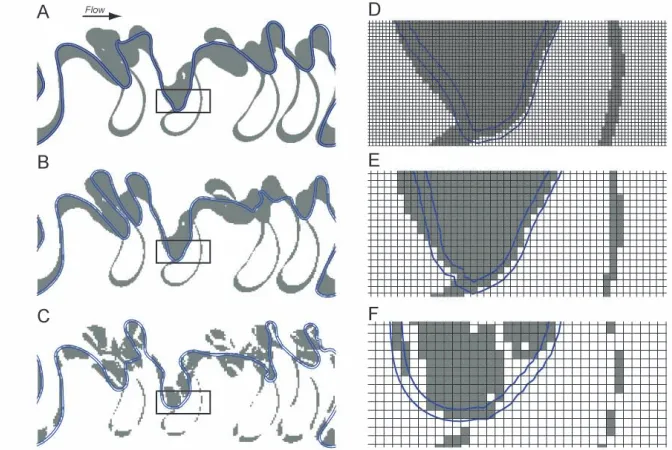
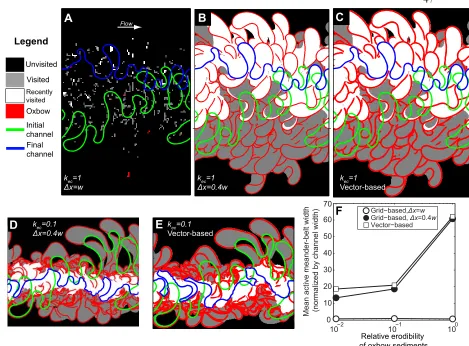
Figure 5 compares the resulting topography for simulations using grid-based and vector-based bank-material tracking. In Figure 5A-C, kec = 1, so there are no bank strength contrasts. Consequently, these three panels show identical final planform geometries because only bank strength differences that arise during these simulations can cause the geometries to diverge. Except for the coarse grid case (Fig. 5A), all simulations show an active record of meander bend growth and cutoff, and that the channel axis drifts. Abandoned meander cutoffs are numerous and distributed across the area and commonly intersect one another, similar to Johnson Creek, Yukon Territory, Canada [Camporeale et al., 2005], for example. In cases with resistant oxbow-filling sediments (kec = 0.1; Fig.
5D-E), the portion of the meander belt that was recently visited by the channel is confined to the center of the valley where oxbow remnants are relatively rare. In the cases with no bank strength differences (kec = 1; Fig. 5B-C), the recently visited area tends to the top half of the model domain, and the numerous oxbows in this area have no influence on the channel migration.
vector-based case (Fig. 5C) and the final channel planform extents coincide. Cutoff loops are thinner in the grid-based cases (Fig. 5B and 5D) than in the vector-based cases (Fig. 5C and 5E) because the channel width spans some cells incompletely in the grid-based case, and the bank-material in these cells is not recorded as cutoff loop-filling sediments. The floodplains are expected to be the same in these two cases because the channel migration does not interact with evolving bank-material properties.
Topography differs in subtle but potentially important ways between the fine grid- and vector-based simulations when kec = 0.1 (Fig. 5D-E) and spatially variable bank materials are allowed to evolve. Most importantly, despite beginning with the same channel planform extent, the two cases differ in the final channel planform extent and the geometry of the active meander belt. This occurs because the finite resolution at which the grid-based case stores bank-material composition leads to divergent bank-material properties and channel trajectories.
Calculation of the mean active width of the meander belts in these simulations allows for more quantitative comparisons (Fig. 5F). We define the mean active meander-belt width as the area modified by the channel in the last 10% of simulation time divided by the left-to-right length of the model domain. The coarse grid resolution simulations (Δx = w) record only fragments of the channel migration regardless of the relative erodibility of
< 1, the vector-based method yields a larger mean active meander-belt width than the grid-based case (Δx = 0.4w), and this discrepancy increases as the erodibility contrast between oxbow and other sediments increases. The meander belt in the grid-based case is about 40% narrower than for the vector-based case when kec = 0.01. Mean active meander-belt width decreases with decreasing kec because the channel migrates more slowly through oxbow sediments and thus becomes confined to a narrower area. The vector-based case shows less narrowing than the grid-based case (Δx = 0.4w), however, because in the grid-based case the channel must sweep entirely across a cell in order to reset its bank strength. This makes channel-confining oxbow sediments more persistent than in the vector-based case, for which there is no such threshold for updating bank strength. As a result, the channel can reset bank strength more easily in the vector-based case and can maintain a wider mean active meander-belt width.
Vector-based simulation results demonstrate that oxbow sediments that are less erodible than other floodplain sediments can indeed confine the active width of meandering. Thus, while cutoffs play a role in confining the meander belt [Camporeale et al., 2005], bank strength differences established by channel migration should result in
narrower meander belts than would be predicted based on cutoff-driven confinement alone (i.e., when kec = 1). A significant proportion of the meander-belt narrowing predicted using grid-based models is due, however, to a numerical artifact.
5.2. Bank strength effects on channel body geometry
reservoir analysis including the connectivity of porous and permeable sand bodies [Henriquez et al., 1990; Hirst et al., 1993]. To illustrate the potential for differential bank strength to influence deposit geometry, we model a scenario equivalent to the floodplain evolution case in Section 5.2, but here we force the river to aggrade at a constant rate. Sylvester et al. [2011] presented a similar model scenario, but without variable bank strength. As in the previous case study, oxbows are set to instantly fill with sediment whose erodibility is a fraction (kec) of the erodibility of point bar sediment. Outside of oxbows, overbank sediments must accumulate in order to maintain channel confinement. For consistency with Howard [1996] and Sun et al. [1996], which for the relevant simulations did not track overbank sediments that accumulated outside of oxbows, such overbank sediments are assumed to have no effect on bank strength (i.e., only fine sediments that accumulate in oxbows alter bank strength). While this is a highly idealized model for floodplain sedimentation, it allows isolating the kinematic role of oxbow-filling sediments in aggrading environments. We extend the two-dimensional approach to bank-material tracking used in previous examples to three dimensions by tracking the lateral and vertical extent of resistant sediments, in order to account for multiple layers of channel deposits.
aggradation with no bank strength contrast, channel bodies record channel axis drift (Fig. 6A), which leads to spatial clustering of channel bodies similar to that commonly observed at larger scale in alluvial basins [e.g., Hajek et al., 2010]. The case with aggradation and a strong bank strength contrast results in a deposit with more tightly constrained lateral excursions (Fig 6B). This occurs because when deposits that accumulate in oxbows have a low relative erodibility, they impede channel lateral migration and hence overall deposit width. Taken together, these simulations indicate that vector-based bank-material tracking may be useful for constructing reservoir models when there are bank strength differences between sedimentary units, e.g., due to grain size differences [e.g., Sylvester et al., 2011]. 5.3. Bedrock valley widening
Bank strength in upland rivers varies strongly between sediment and bedrock and in these environments the vector-based method is well suited to represent the relatively slow erosion rates in bedrock. Extensive research has focused on quantifying rates and controls on river vertical incision in bedrock (see Whipple [2004] and references therein) and more recently bedrock channel width [Finnegan et al., 2005; Wobus et al., 2006b; Turowski et al., 2008; Yanites and Tucker, 2010]. Processes that cause channel widening also contribute
within the valley. Here we model a 100-fold bank strength contrast between bedrock and sediment, as is likely common in bedrock-walled valleys where valley widening rates of 1 cm/yr or less predominate [Montgomery, 2004].
The longitudinal profile node farthest downstream in the model domain is lowered at a constant rate to drive relative base-level fall and vertical incision. The vertical erosion rate (EV) is set to be proportional to the local bed shear stress [Howard and Kerby, 1983]
EV = kvρghS. (11)
The rate constant kV is set to 0.003 to achieve an average incision rate of 1 mm/yr; ρ is the density of water; g is gravitational acceleration; h is the channel depth; and S is the local bed slope, calculated as a first-order, forward finite-difference. In order for a channel reach to remain confined during downstream translation, its rate of vertical incision must match or exceed the rate of elevation loss due to translation if the landscape slopes downstream, i.e., EV ≥ ELSs, where Ss is the mean slope of the surface over which the node migrates.
Consequently, we limit our analysis to a case where EV ≥ ELSs to avoid cases where the channel loses confinement through lateral migration on a tilted landscape.
the valley walls, meander bends preferentially drift down-valley rather than across-valley. This causes frequent planation of the entire valley floor, which lowers the sediment-bedrock interface and permits the channel to remain mobile and unentrenched within the valley. At the valley margins where there is a large contrast in bank strength between sediment and bedrock, the grid- and vector-based bank-material tracking schemes yield divergent behaviors.
When bank material is modeled with a grid of 2 m (0.08w) resolution (Fig. 7A), the channel is fully restricted to the initial valley width and meander bends only propagate down-valley. This occurs because the channel must advance a full cell width beyond the initial valley wall before updating the bank-material grid. Any bank advance less than a cell width is not recorded, so that these minor advances leave no record of erosion and subsequent channel migration always encounters a fully intact valley wall unless the bank cumulatively advances through an entire cell.
With the vector-based approach the valley more than doubles in width as compared to the grid-based approach (Fig. 7B and 7C). Lateral erosion, which is suppressed by the implicit erosion threshold in the grid-based case, occurs steadily in the vector-based case. The channel widens both sides of the valley, but erodes more material from the top side of the model domain because channel axis drift—an inherent behavior in the underlying meandering model—can cause asymmetric erosion patterns.
understanding the evolution of bedrock landscapes. Vector-based material tracking could enable the incorporation of physical models of channel width and meandering dynamics into larger-scale landscape evolution models. Consequently, the long-term behavior of different channel evolution models could be directly evaluated without the confounding effects introduced by grid-based bank-material representation. At a larger scale, the influence of channel migration on bedrock valley width and the formation of strath terraces [e.g., Finnegan and Dietrich, 2011] can be more accurately ascertained with vector-based bank-material tracking. Finally, links between external drivers—including climate, tectonics, and base-level—and large-scale channel characteristics such as sinuosity [Stark et al., 2010] and entrenchment [Harden, 1990] can be more rigorously evaluated.
5.4. Floodplain evolution with a bank height-dependent channel lateral migration rate
,
(12)
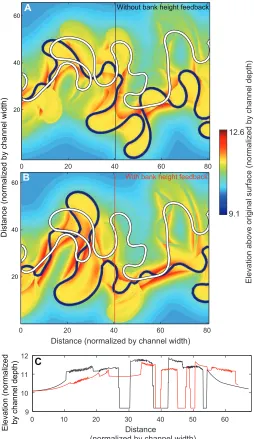
where zchannel is the local elevation of the channel bed. Equation 12 is applied so that bank height can only reduce lateral erosion rate (i.e., cases with (z - zchannel)/h < 1 do not cause lateral erosion rate to increase). The channel bed is set to aggrade at a constant rate equivalent to the aggradation rate at a distance of 4 channel widths from the channel (i.e., the e-folding distance for distance-dependent overbank deposition) (Eq. 9). Consequently, the levee tops aggrade faster than the channel bed. Levee growth is paced by the competition between overbank deposition that builds the levees and lateral channel migration that causes the channel to erode existing levees and shift the locus of deposition. This causes spatial differences in bank height that modulate channel lateral migration rates. Both cases show a highly sinuous channel that has undergone meander bend growth and cutoff, and cutoff loops are preserved in the floodplain topography, similar for example to the Sacramento River, California, USA [Constantine and Dunne, 2008]. Although both cases start with the same planform channel geometry, the modulation of lateral channel migration rate by bank height in Figure 8B causes the channel trajectories to diverge. Because topographic evolution is governed by channel scour and overbank deposition, these different channel lateral migration patterns result in differing topography. In both cases, topographic profiles (Fig. 8C) show higher elevations near the active channel and abandoned channel segments in cutoff loops because overbank sedimentation declines with distance from the channel (Eq. 9).
topography due to overbank deposition—even though floodplain elevations are not explicitly stored in memory during the simulation (see Section 4). Moreover, unlike a grid-based formulation for tracking topography, which applies the same overbank deposition rate across the area of an entire grid cell, the vector-based approach allows calculation of the exact local elevation during the simulation and hence more precise topographic tracking. Such precise tracking is needed when, for example, local differences in bank height alter channel lateral migration rates (Eq. 12) or the quantity of sediment entrained from the eroding bank [e.g., Parker et al., 2011].
6. Discussion
Model results using the grid- and vector-based bank-material tracking schemes should converge in the limit of high grid resolution (Eq. 7), because when the grid cells are small enough to record all bank migration there is no threshold for updating bank-material properties. To assess the degree to which grid-based model predictions approach a vector-based prediction as grid resolution increases, we analyze the landscape area altered by bank migration in each time step using the channel trajectory from Figure 5A-C. Figure 9 shows the mean bank area updated in each time step using grids of different resolutions, normalized by the value for the vector-based approach. These simulations demonstrate that the mean area updated using the grid-based approach asymptotes to the value for the vector-based approach when small non-dimensional grid resolutions are computationally feasible.
channel bank and the topography itself are represented in vector form. Given memory constraints which limit the practical resolution of grid-based methods, the vector-based framework is advantageous in landscapes with high variability in bank strength, which may occur in depositional environments with variable grain sizes and in net-erosional landscapes with mixed bedrock and sediment banks. Simulations show the new framework to be flexible to track meander belt topographic (Fig. 5 and 8) and stratigraphic evolution (Fig. 6), and channel incision (Fig. 7). Phenomena not discussed here—such as asymmetric channel cross-sections and overbank deposition with different grain sizes—could also be incorporated using vector-based techniques.
Bank migration simulations involving grids are more likely to be resolution-independent for cases of constant bank resistance, and for cases where the characteristic bank migration distance in one time step is larger than the cell width. In the vector-based scheme presented here, bank-material properties are determined by computations based on stored data (e.g., interpolation of past channel longitudinal profiles to determine elevation). In contrast, when the memory cost is feasible, grid-based frameworks eliminate some computation time because bank-material properties are directly accessed. Therefore in cases, computation time may be an important subsidiary consideration in selecting a method for bank-material tracking, particularly when algorithms for reconstructing erodibility are complex.
in which channel banks are ephemeral. Consequently, connecting vector-based and grid-based frameworks for topographic representation may represent an important next step in advancing landscape evolution modeling for meandering channels. In such a framework, grid elements could continue to represent hillslopes as in current landscape evolution models [e.g., Tucker et al., 2001], and to route sediment within active channels. Vector elements would be used to track sharp discontinuities in elevation or bank-material composition related to channel migration, as presented here, as well as drainage divides because their precise locations are often between grid nodes [Castelltort et al., 2012]. The cut-cell method [Beyer and LeVeque, 1992], which temporarily slices cells crossed by a boundary, could also be used with an Eulerian grid to represent hillslopes. In this way, an extended time series of bank advance could be used to create a complex valley boundary shape within a rectangular grid [Udaykumar and Shyy, 1995; Udaykumar et al., 1996, 1999]. As with using an adaptive mesh to track moving
boundaries, however, using the cut-cell technique could be computationally intensive [Udaykumar et al., 1999]—in this case because sediment fluxes would have to be tracked across cells with complicated geometries.
distribution of freezing and melting [Parker, 1975; Kerr, 2001; Karlstrom et al., 2013]. As these channels migrate, they may reset the local temperature field, just as river channels alter topography as they migrate, which implies interaction between channel migration and bank-material properties. Vector-based channel extent tracking could be useful for recording the kinematics of these channels.
The similarities between subaerial rivers and submarine channels formed by turbidity currents suggest more direct applications of the present framework. In deposits formed by submarine channels, the spatial distribution of grain size is determined by channel migration and aggradation [Sylvester et al., 2011]. Cohesive fine-grained sediments [Panagiotopoulos et al., 1997] may inhibit channel migration, as suggested for clay plugs in subaerial oxbows [Fisk, 1947; Allen, 1982; Ikeda, 1989]. While grid-based methods exist for tracking stratigraphy formed by meandering channels [e.g., Clevis et al., 2006], such methods would be susceptible to grid resolution-scale erosion thresholds. Therefore the vector-based approach could advance modeling of channel-bank interactions for stratigraphic development.
7. Conclusions
resolution-dependence found in grid-based techniques. For areas the channel has migrated across, bank-material properties are reconstructed using vector-based channel geometric data. This approach can treat sloping longitudinal profiles, overbank deposition, and stratigraphic development, and may be adapted to a variety of environments in which channel migration interacts with topography or stratigraphy. This enables more accurate modeling of the co-evolution of channels and bank-material properties, particularly where there are large contrasts in bank strength.
Case studies show that erodibility differences due to bank-material properties or bank height can strongly influence the co-evolution of channels and the surrounding topography and stratigraphy. Oxbow-filling sediments that are less erodible than other floodplain sediments can narrow the width of meander belts and stacked channel deposits; grid-based methods may artificially enhance this narrowing effect if the grid resolution is coarse. A simulation of meandering river evolution in a bedrock valley indicates that meandering kinematics and patterns of valley widening respond strongly to bank strength differences between bedrock and sediment; grid-based methods can artificially restrict valley widening by implicitly imposing a threshold to update bank properties. Finally, simulations suggest that elevation differences due to spatial variations in overbank deposition across a floodplain strongly influence channel trajectory and floodplain topography when the channel lateral migration rate responds to bank height.
Acknowledgments
Figure 1. A commonly used technique for representing bank-material properties in models of landscape evolution with a migrating channel. (A) The channel boundary is represented explicitly by vectors. Arrow indicates general flow direction for all panels. (B) The plan view channel extent is recorded by mapping the bank locations onto a grid, which may represent topography or material composition and is altered during channel migration. Cells fully contained within the channel extent are shaded light gray. (C) When the channel banks shift (dashed lines), some cells are abandoned (medium gray) while other cells become enclosed by the channel (black). The process of updating the grid is spatially discontinuous, such that bank migration is not fully recorded with the grid.
A
Current'channel'banks' represened'as'vectors
B
C
Channel'extent'' recorded'in'grid
Channel'migration' discontinuously' recorded'by'grid Abandoned'cell Newly'enclosed'cell
Figure 2. Comparison of rules for determining which grid cells are considered inside the channel banks, after Howard [1996]. Dark shaded cells are completely within the channel, meeting the conservative in-channel definition. Light shaded cells meet the conservative and liberal definitions, for which any cell partially traversed by the bank is also considered within the channel. Arrow indicates general flow direction.
Outside Inside*(liberal) Inside*(conservative)
Channel*bank
Figure 4. The new, vector-based method for erodibility and topography tracking. (A) Lateral channel migration and vertical incision of a rectangular channel during one time step is viewed in cross-section. Dashed line indicates the pre-migration surface. During each time step, the channel cross-section is shifted laterally and vertically to form the post-migration surface (thick black line) and erode material from the bed and cutbank (hatched area). In order to maintain constant channel width, point bar sediment (dotted area) is deposited over the abandoned surface with a thickness equal to the channel depth. (B) The channel map view extent and longitudinal profile from each time step are used to reconstruct bank-material properties. (C) After subsequent iterations, the pattern of channel scour is recorded by the current channel extent (black polygon) and the collection of abandoned channel-extent polygon remnants preserved from earlier in the simulation, with channel extents shaded to highlight their different formation times. (D) Map view of the bank-material inspection procedure. A meandering model is used to calculate the maximum centerline migration distance (dmax) assuming the most erodible bank material. A test vector with length equal to dmax is extended perpendicular to the cutbank node and is used to identify regions with different bank-material properties and adjust the actual migration distance accordingly. In this example, the test vector encounters sediment-mantled surfaces from different time steps (t = 503, 502, and 2, in order) followed by a bedrock valley wall.
Figure 5. Meander-belt evolution with variable erosion susceptibility for meander cutoff loops (kec) relative to point bar sediment. Panels A-E are at the same scale; their width is 100w. In all simulations, Δt = 2 yr, simulation time is 1000 yr, w = 25 m, and h = 1 m. Areas recorded as visited by the channel are shaded gray (first 90% of simulation time) and white for recently visited areas (last 10% of simulation time). Unvisited areas, as recorded in the grid- or vector-based tracking schemes, are black. Initial (green) and final (blue) channel extents are indicated, as are remnants of oxbow sediments (red). Panels (A-C) represent the case of kec = 1, i.e., constant bank composition. (A) The coarse grid resolution (Δx = w) results in small area recorded as visited. Arrow indicates general flow direction for all panels. (B) With a finer grid resolution (Δx = 0.4w), the visited area more closely resembles that using vector-based tracking (C). Panels (D-E) represent kec = 0.1, i.e., erosion resistant material stored in cutoff loops. (D) Grid-based case, with Δx = 0.4w. (E) Vector-based case. (F) Mean active meander-belt width (normalized by channel width, w), versus the relative erodibility of oxbow sediments (kec) for grid- and vector-based schemes.
Figure 6. Cross-valley cross-sections of stratigraphy formed by an aggrading, meandering channel. As the channel migrates it deposits channel body material (black) and distinct sediments in oxbows (red). Other overbank deposits, not shown, accumulate at a rate sufficient for the channel to remain confined, and have a material strength equal to that of channel body material. For all simulations, w = 25 m; h = 1; the maximum lateral migration rate is 1 m/yr for erosion of channel body deposits; Δt = 2 yr; and simulation time is 10 kyr. Vertical axes are scaled to channel depth and horizontal axes are scaled to channel width. kec is the relative erodibility of oxbow sediments. (A) Fast aggradation (0.001 channel depths/yr), kec= 1. (B) Fast aggradation, kec= 0.01. (C) Slow aggradation (0.0002 channel depths/yr), kec= 1. (D) Slow aggradation, kec= 0.01.
Figure 9. Bank area updated for the same channel trajectory as in Fig. 5A-C, but with variable grid resolution. The mean area updated by the channel banks in a single time step, normalized by the value for vector-based bank material tracking, is plotted for a range of non-dimensional grid cell widths (Δx’ = Δx/(ELΔt)). The finest resolution corresponds to a dimensional cell width of 0.5 meters. The area updated asymptotes to the value obtained using vector-based bank-material tracking.
10 100 101
0 0.1 0.2 0.3 0.4 0.5 0.6 0.7 0.8 0.9 1
Chapter 3: Numerical simulations of bedrock valley evolution by meandering rivers with variable bank material
Originally published in:
Limaye, A. B. S., and Lamb, M. P., 2014, Numerical simulations of bedrock valley evolution by meandering rivers with variable bank material, Journal of Geophysical Research – Earth Surface 119, doi:10.1002/2013JF002997.
Abstract
![Figure 1. Meanders in different forms. (A) Water flowing over a glass pane, from Nakagawa and Scott [1984]](https://thumb-us.123doks.com/thumbv2/123dok_us/780260.1090991/14.612.154.300.392.664/figure-meanders-different-forms-water-flowing-nakagawa-scott.webp)