Information Bottleneck Inspired Method For Chat Text Segmentation
S Vishal1,?, Mohit Yadav2,?,$, Lovekesh Vig1 and Gautam Shroff1 1TCS Research New Delhi, India
2University of Massachusetts, Amherst
[email protected], [email protected], [email protected], [email protected]
Abstract
We present a novel technique for segment-ing chat conversations ussegment-ing the infor-mation bottleneck method (Tishby et al.,
2000), augmented with sequential conti-nuity constraints. Furthermore, we utilize critical non-textual clues such as time be-tween two consecutive posts and people mentions within the posts. To ascertain the effectiveness of the proposed method, we have collected data from public Slack conversations and Fresco, a proprietary platform deployed inside our organiza-tion. Experiments demonstrate that the proposed method yields an absolute (rel-ative) improvement of as high as 3.23% (11.25%). To facilitate future research, we are releasing manual annotations for seg-mentation on public Slack conversations.
1 Introduction
The prolific upsurge in the amount of chat con-versations has notably influenced the way peo-ple wield languages for conversations. Moreover, conversation platforms have now become preva-lent for both personal and professional usage. For instance, in a large enterprise scenario, project managers can utilize these platforms for various tasks such as decision auditing and dynamic re-sponsibility allocation (Joty et al., 2013). Logs of such conversations offer potentially valuable information for various other applications such as automatic assessment of possible collaborative work among people (Rebedea et al.,2011).
?indicates that both authors contributed equally.$ indi-cates that the author was at TCS Research New-Delhi during the course of this work.
It is thus vital to invent effective segmentation methods that can seperate discussions into small granules of independent conversational snippets. By ’independent’, we meant a segment should as much as possible be self-contained and discussing the same topic, such that a segment can be sug-gested if any similar conversation occurs again. As an outcome of this, various short text simi-larity methods can be employed directly. Seg-mentation can also potentially act as an empower-ing preprocessempower-ing step for various down-streamempower-ing tasks such as automatic summarization (Dias et al.,
2007), text generation (Barzilay and Lee, 2004), information extraction (Allan,2012), and conver-sation visualization (Liu et al.,2012). It is worth noting that chat segmentation presents a number of gruelling challenges such as, the informal na-ture of the text, the frequently short length of the posts and a significant proportion of irrelevant in-terspersed text (Schmidt and Stone).
Research in text segmentation has a long his-tory going back to the earliest attempt of Koz-ima (1993). Since then many methods, includ-ing but not limited to, Texttilinclud-ing (Hearst, 1997), Choi’s segmentation (Choi, 2000), representation learning based on semantic embeddings (Alemi and Ginsparg,2015), and topic models (Du et al.,
2015a) have been presented. Albeit, very little re-search effort has been proposed for segmenting in-formal chat text. For instance,Schmidt and Stone
have attempted to highlight the challenges with chat text segmentation, though they have not pre-sented any algorithm specific to chat text.
The Information Bottleneck (IB) method has been successfully applied to clustering in the NLP domain (Slonim and Tishby, 2000). Specifically, IB attempts to balance the trade-off between accu-racy and compression (or complexity) while clus-tering the target variable, given a joint probability distribution between the target variable and an
served relevant variable. Similar to clustering, this paper interprets the task of text segmentation as a compression task with a constraint that allows only contiguous text snippets to be in a group.
The focus of this paper is to develop text seg-mentation methods for chat text utilizing the IB framework. In the process, this paper makes the following major contributions:
(i) We introduce an IB inspired objective func-tion for the task of text segmentafunc-tion.
(ii) We develop an agglomerative algorithm to optimize the proposed objective function that also respects the necessary sequential conti-nuity constraint for text segmentation. (iii) To the best of our knowledge, this paper is a
first attempt that addresses segmentation for chat text and incorporates non-textual clues.
(iv) We have created a chat text segmentation dataset and releasing it for future research. The remainder of this paper is organized as fol-lows: we present a review of related literature in Section 2. Then, we formulate the text segmen-tation problem and define necessary nosegmen-tations in Section3. Following this, we explain the proposed methodology in Section4. Section5presents periments and provides details on the dataset, ex-perimental set-up, baselines, results, and effect of parameters. Finally, conclusions and potential di-rections for future work are outlined in Section6.
2 Related Work
The IB method (Tishby et al., 2000) was origi-nally introduced as a generalization of rate distor-tion theory which balances the tradeoff between the preservation of information about a relevance variable and the distortion of the target variable. Later on, similar to this work, a greedy bottom-up (agglomerative) IB based approach (Slonim and Tishby,1999,2000) has been successfully applied to NLP tasks such as document clustering.
Furthermore, the IB method has been widely studied for multiple machine learning tasks, in-cluding but not limited to, speech diarization (Vijayasenan et al., 2009), image segmentation (Bardera et al., 2009), image clustering (Gordon et al.,2003), and visualization (Kamimura,2010). Particularly, similar to this paper, image segmenta-tion has considered segmentasegmenta-tion as the
compres-sion part of the IB based method. But, image seg-mentation does not involve continuity constraints as their application can abolish the exploitation of similarity within the image. Yet another similar attempt that utilizes information theoretic terms as an objective (only the first term of the IB ap-proach) has been made for the task of text segmen-tation and alignment (Sun et al.,2006).
Broadly stating, a typical text segmentation method comprises of a method that: (a) con-sumes text representations for every independent text snippet, and (b) applies a search procedure for segmentation boundaries while optimizing objec-tives for segmentation. Here, we review literature of text segmentation by organizing them into 3 cat-egories based on their focus:Category1- (a), Cat-egory2- (b), andCategory3- both (a) and (b).
Category1 approaches utilize or benefit from a great amount of effort put in developing robust topic models that can model discourse in natural language texts (Brants et al.,2002). Recently,Du et al.(2013,2015b) have proposed a hierarchical Bayesian model for unsupervised topic segmen-tation that integrates a point-wise boundary sam-pling algorithm used in Bayesian segmentation into a structured (ordering-based) topic model. For a more comprehensive view of classical work on topic models for text segmentation, we refer to
Misra et al. (2009); Riedl and Biemann (2012). This work does not explore topic models and is left as a direction for future research.
Category2 approaches comprise of different search procedures proposed for the task of text segmentation, including but not limited to, divi-sive hierarchical clustering (Choi,2000), dynamic programming (Kehagias et al., 2003), and graph based clustering (Pourvali and Abadeh, 2012;
Glavas et al., 2016; Utiyama and Isahara, 2001). This work proposes an agglomerative IB based hi-erarchical clustering algorithm - an addition to the arsenal of the approaches that falls in this category. Similar to the proposed method,Category3cuts across both of the above introduced dimensions of segmentation. Alemi and Ginsparg (2015) have proposed the use of semantic word embed-dings and a relaxed dynamic programming proce-dure. We have also argued to utilize chat clues and introduced an IB based approach augmented with sequential continuity constraints. Yet an-other similar attempt has been made byJoty et al.
conversa-tional clues and introduce an unsupervised random walk model for the task of text segmentation.
Beyond the above mentioned categorization, a significant amount of research effort has been put up in studying the evaluation metric for text seg-mentation (Pevzner and Hearst,2002;Scaiano and Inkpen, 2012). Here, we make use of the classi-cal and most widely utilized metric introduced by
Beeferman et al. (1999). Also, there have been attempts to track topic boundaries for thread dis-cussions (Zhu et al., 2008; Wang et al., 2008). While these methods look similar to the proposed method, they differ as they attempt to recover thread structure with respect to the topic level view of the discussions within a thread community.
The most similar direction of research to this work is on conversation trees (Louis and Cohen,
2015) and disentangling chat conversations ( El-sner and Charniak, 2010). Both of these direc-tions cluster independent posts leading to topic la-belling and segmentation of these posts simulta-neously. It is important to note that these methods do not have a sequential continuity constraint and consider lexical similarity even between long dis-tant posts (Elsner and Charniak,2011). Moreover, if these methods are applied only for segmenta-tion then they are very likely to produce segments with relatively very smaller durations; as reflected in the ground truth annotations of correspondingly released dataset (Elsner and Charniak,2008). It is worth noting thatElsner and Charniak(2010) have also advocated to utilize time gap and people men-tions similar to the proposed method of this work.
3 Problem Description And Notations Let C be an input chat text sequence C = {c1, ..., ci, ..., c|t|}of length|C|, whereci is a text snippet such as a sentence or a post from chat text. In a chat scenario, text postci will have a corre-sponding time-stamp ct
i. A segment or a subse-quence can be represented asCa:b = {ca, ..., cb}. A segmentation of C is defined as a segment se-quence S = {s1, ..., sp}, wheresj = Caj:bj and
bj + 1 = aj+1. Given an input text sequenceC, the segmentation is defined as the task of finding the most probable segment sequenceS.
4 Proposed Methodology
This section firstly presents the proposed IB in-spired method for text segmentation that conforms to the necessary constraint of sequential
continu-ity, in Section4.1. Next, in Section4.2, the pro-posed IB inspired method is augmented to incor-porate important non-textual clues that arise in a chat scenario. More specifically, the time between two consecutive posts and people mentions within the posts are integrated into the proposed IB in-spired approach for the text segmentation task.
4.1 IB Inspired Text Segmentation Algorithm
The IB introduces a set of relevance variables R
which encapsulate meaningful information about
Cwhile compressing the data points (Slonim and Tishby,2000). Similarly, we propose that a seg-ment sequence S should also contain as much information as possible about R (i.e., maximize
I(R, S)), constrained by mutual information be-tweenSandC(i.e., minimizeI(S, C)). Here,C
is a chat text sequence, following the notation in-troduced in the previous section. The IB objective can be achieved by maximizing the following:
F =I(R, S)−β1 ×I(S, C) (1)
In other words, the above IB objective function attempts to balance a trade-off between the most informative segmentation ofRand the most com-pact representation of C; where β is a constant parameter to control the relative importance.
Similar toTishby et al.(2000), we modelR as word clusters and optimizeF in an agglomerative fashion, as explained in Algorithm 1. In simple words, the maximization ofF boils down to ag-glomeratively merging an adjacent pair of posts that correspond to least value ofd. In Algorithm
1,p(s)is equal top(si) +p(si+1)andd(si, si+1) is computed using the following definition:
d(si, si+1) =JSD[p(R|si), p(R|si+1)]− 1
β ×JSD[p(C|si), p(C|si+1)]
(2)
Here, JSD indicates Jensen-Shannon-Divergence. The computation ofR and p(R, C) is explained later in Section 5.2. Stopping crite-rion for Algorithm 1 is SC > θ, where SC is computed as follows:
SC= I(R, S)
I(R, C) (3)
Algorithm 1:IB inspired text segmentation
Input :Joint distribution:p(R, C),
Tradeoff parameter:β
Output :Segmentation sequence:S
Initialization:S←C
Calculate∆F(si, si+1) =
p(s)×d(si, si+1)∀si∈S
1 whileStopping criterion is falsedo 2 {i}=argmini0∆F(si0, si0+1); 3 Merge{si, si+1} ⇒s∈S;
4 Update∆F(s, si−1)and∆F(s, si+2); 5 end
more dissimilar clusters are merged. Therefore,
SC provides strong clues to terminate the pro-posed IB approach. The inspiration behind this specific computation of SC has come from the fact that it has produced stable results when exper-imented with a similar task of speaker diarization (Vijayasenan et al.,2009). The value ofθis tuned by optimizing the performance over a validation dataset just like other hyper-parameters.
The IB inspired text segmentation algorithm (Algorithm 1) respects the sequential continuity constraint, as it considers merging only adjacent pairs (see step 2, 3, and 4 of Algorithm1) while optimizingF; unlike the agglomerative IB cluster-ing (Slonim and Tishby,2000). As a result of this, the proposed IB based approach requires a limited number of involved computations, more precisely, linear in terms of number of text snippets.
4.2 Incorporating Non-Textual Clues
As mentioned above, we submit that non-textual clues (such as time between two consecutive posts and people mentions within the posts) are critical for segmenting chat text. To incorporate these two important clues, we augment Algorithm1, devel-oped in the previous section. More precisely, we modifydof Equation2todas follows:
d(si, si+1) =w1×d(si, si+1) +w2× (ct
ai+1−ctbi) +w3× ||s
p
i −spi+1|| (4)
Here,ct
ai+1, ctbi andspi represent time-stamp of
the first post of segment si+1, time-stamp of last post of segmentsi, and representation for poster information embedded in segmentsi, respectively. The spi representation is computed as a bag of posters counting all the people mentioned in the
posts and posters themselves in a segment.w1,w2,
w3 are weights indicating the relative importance of distance terms computed for all three different clues.||.||in Equation4indicates euclidean norm. It is important to note that Algorithm1utilizes
dof Equation 2 to represent textual dissimilarity between a pair of posts in order to achieve the op-timal segment sequence S. Following the same intuition,din Equation4measures weighted dis-tances based not only on textual similarity but also based on information in time-stamps, posters and people mentioned. The intuition behind the sec-ond distance term indis that if the time difference between two posts is small then they are likely to be in the same segment. Additionally, the third distance term indis intended to merge segments that involve a higher number of common posters and people mentions. Following the same intu-ition, in addition to the changes ind, we modify the stopping criterion as well while the rest stays the same as in Algorithm1. The stopping criterion is defined asSC > θ, whereSCis as follows:
SC=w1×II((R, CR, S))+w2×
(1− GG(S)
max) +w3×
H(S)
Hmax
(5)
Here, theG(S)andH(S)mentioned in Equa-tion5are computed as follows:
G(S) = X si∈S
ct
bi−ctai (6)
H(S) =
|S|
X
i=1
||spi −spi+1|| (7)
Slack Fresco
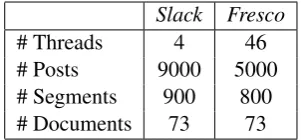
# Threads 4 46
# Posts 9000 5000 # Segments 900 800 # Documents 73 73
Table 1: Statistics of the chat datasets.
inter segment distances in terms of poster infor-mation normalized by the maximum distance of similar terms (i.e. when each post is a segment).
5 Experiments
This section starts with a description of the datasets collected from the real world conversa-tion platforms in Subsecconversa-tion5.1. Later in Subsec-tion5.2, we explain the evaluation metric utilized in our experiments. Subsection5.3 describes the meaningful baselines developed for a fair compar-ison with the proposed IB approach. Next in Sub-sections5.4 and5.5, we discuss the performance accomplished by the proposed approach on both of the collected datasets. Lastly, we analyse the stability of the proposed IB approach with respect to parametersβandθin Subsection5.6.
5.1 Dataset Description
We have collected chat text datasets, namely, Slack and Fresco, respectively from http://slackarchive.io/ and http://talk.fresco.me/. After that, we have manually annotated them for the text segmentation task. We have utilized the annotations done by 3 workers with problematic cases resolved by consensus. Datasets’ statistics is mentioned in Table1. The collected raw data was in the form of threads, which was later divided into segments. Further, we have created multiple documents where each document contains N
continuous segments from the original threads.N
was selected randomly between 5 and 15. 60% of these documents were used for tuning hyper-parameters which include weights (w1, w2, w3),
θ, andβ; and the remaining were used for testing. A small portion of one of the documents from theSlackdataset is depicted in Figure1(a). Here, manual annotations are marked by a bold black horizontal line, and also enumerated as1),2), and 3). Every text line is a post made by one of the users on theSlackplatform during conversations. As mentioned above, in a chat scenario, every post has following three integral components:
1) poster (indicated by corresponding identity in Figure1, from beginning till ‘-=[*says’),
2) time-stamp (between ‘-=[*’ and ‘*]=-)’, and 3) textual content (after ‘*]=-::: ’till end). One must also notice that some of the posts also have people mentions within the posts (indicated as ‘<@USERID>’ in Figure1).
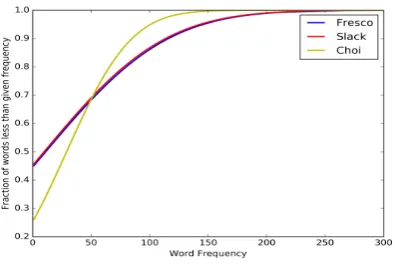
To validate the differences between the col-lected chat datasets and traditional datasets such as Choi’s dataset (Choi, 2000), we computed the fraction of words occurring with a frequency less than a given word frequency, as shown in Figure2. It is clearly evident from the Figure2that chat seg-mentation datasets have a significantly high pro-portion of less frequent words in comparison to the traditional text segmentation datasets. The pres-ence of large infrequent words makes it hard for textual similarity methods to succeed as it will in-crease the proportion of out of vocabulary words (Gulcehre et al., 2016). Therefore, it becomes even more critical to utilize the non-textual clues while processing chat text.
5.2 Evaluation and Setup
For performance evaluation, we have employed
Pk metric (Beeferman et al., 1999) which is widely utilized for evaluating the text segmenta-tion task. A sliding window of fixed sizek (usu-ally half of the average of length of all the seg-ments in the document) slides over the entire doc-ument from top to bottom. Both inter and intra segment errors for all posts k apart is calculated by comparing inferred and annotated boundaries.
We model the set of relevance variables R as word clusters estimated by utilizing agglomera-tive IB based document clustering (Slonim and Tishby,2000) where posts are treated as relevance variables. Consequently, R comprises of infor-mative word clusters about posts. Thus, each en-tryp(ri, cj)in matrixp(R, C)represents the joint probability of getting a word cluster ri in post
cj. We calculatep(ri, cj)simply by counting the common words inri andcj and then normalizing.
5.3 Baseline Approaches
effec-Figure 1: (a) Manually created ground truth forSlackpublic conversations. Black color lines represents segmentation boundaries. (b) Results obtained for multiple approaches. Text best read magnified.
Methods Span of Weights Slack Fresco
Random – 60.6 54
No Boundary – 36.76 45
Average Time – 32 35
C-99 – 35.18 37.75
Dynamic Programming – 28.7 35
Encoder-Decoder Distance – 29 38
LDA Distance – 36 44
IB Variants:
Text w1= 1,w2= 0,w3= 0 33 42
TimeDiff w1= 0,w2= 1,w3= 0 26.75 34.25
Poster w1= 0,w2= 0,w3= 1 34.52 41.50
Text + TimeDiff ∀w∈ {w1, w2}, w∈(0,1);w3 = 0;w1+w2 = 1 26.47 34.68
Text + Poster ∀w∈ {w1, w3}, w∈(0,1);w2 = 0;w1+w3 = 1 28.57 38.21
Figure 2: Fraction of words less than a given word frequency.
tive baseline Average Timeis prepared, in which boundaries are inserted after a fixed amount of time has elapsed. Fixed time is calculated from a certain separate portion of our annotated dataset. Next baseline utilized in our experiments is
Encoder-Decoder Distance. In this approach, we have trained a sequence to sequence RNN encoder-decoder (Sutskever et al.,2014) utilizing 1.5 million posts from the publicly availableSlack
dataset excluding the labelled portion. The net-work comprises of 2 hidden layers and the hid-den state dimension was set to 256 for each. The encoded representation was utilized and greed-ily merged in an agglomerative fashion using Eu-clidean distance. The stopping criterion for this approach was similar to the third term in Equa-tion 5 corresponding to poster information. The optimization of hidden state dimension was com-putationally demanding hence left for further ex-ploration in future. Similar to Encoder-Decoder Distance, we have developedLDA Distancewhere representations have come from a topic model (Blei et al.,2003) having 100 topics.
5.4 Quantitative Results
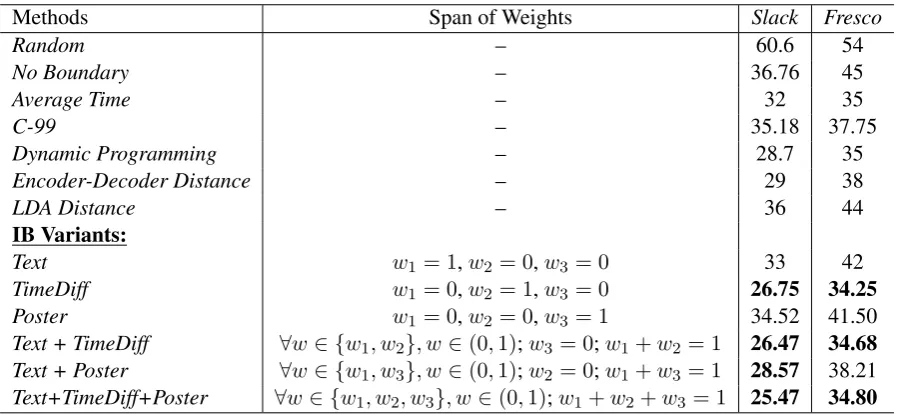
The results for all prepared baselines and vari-ants of IB on both Slack and Fresco datasets are mentioned in Table 2. For both Slack and
Frescodatasets, multiple variants of IB yield su-perior performance when compared against all the developed baselines. More precisely, for Slack
dataset, 4 different variants of the proposed IB based method achieve higher performance with an absolute improvement of as high as3.23%and a relative improvement of11.25%, when compared against the baselines. In case ofFrescodataset, 3
Figure 3: Normalized frequency distribution of segment length for both the collected chat datasets.
different variants of the proposed method achieve superior performance but not as significantly in terms of absolutePkvalue, as they do for theSlack dataset. We hypothesize that such a behaviour is potentially because of the lesser value of posts per segment forFresco (5000/800=6.25) in com-parison to Slack (9000/900=10). Also, note that just the time clue in IB framework performs best on Fresco dataset indicating that the relative im-portance of time clue will be higher for a dataset with smaller lengths of segments (i.e. low value of posts per segment). To validate our hypothesize further, we estimate the normalized frequency dis-tribution of segment length (number of posts per segment) for both datasets, as shown in Figure3.
It is worth noting that the obtained empirical re-sults support the major hypothesis of this work. As variants of IB yield superior performance on both the datasets. Also, on incorporation of in-dividual non-textual clues, superior improvements of 3.23% and 7.32% are observed from Text to
Text+TimeDiff forSlackandFresco, respectively; similarly, fromTexttoText+Posterimprovements of 4.43% and 3.79% are observed forSlack and
Fresco, respectively. Further, the best perfor-mance is achieved for both the datasets on fusing both the non-textual clues indicating that clues are complementary as well.
5.5 Qualitative Results
Results obtained for multiple approaches, namely, Average Time, IB:TimeDiff, and
IB:Text+TimeDiff+Poster, corresponding to a small portion of chat text placed in part (a) of Figure 1 are presented in part (b) of Figure 1.
managed to find three boundaries, albeit one of the boundary is significantly off, potentially due to the constraint of fixed time duration.
Similarly, the next IB:TimeDiff approach also manages to find first two boundaries correctly but fails to recover the third boundary. Results seem to indicate that the time clue is not very effec-tive to reconstruct segmentation boundaries when segment length varies a lot within the document. Interestingly, the combination of all three clues as happens in the IB:Text+TimeDiff+Poster ap-proach, yielded the best results as all of three seg-mentation boundaries in ground truth are recov-ered with high precision. Therefore, we submit that the incorporation of non-textual clues is criti-cal to achieve superior results to segment chat text.
5.6 Effect Of Parameters
To analyse the behaviour of the proposed IB based methods, we compute the average performance metricPkofIB:Textwith respect toβandθ, over the test set ofSlackdataset. Also, to facilitate the reproduction of results, we mention optimal val-ues of all the parameters for all the variants of the proposed IB approach in Table5.5.
Figure4shows the behaviour of the average of performance evaluation metricPkover the test set of Slack dataset with respect to hyper-parameter
β. As mentioned above also, the parameterβ rep-resents a trade-off between the preserved amount of information and the level of compression. It is clearly observable that the optimal value ofβdoes not lie on extremes indicating the importance of both the terms (as in Equation1) of the proposed IB method. The coefficient of the second term (i.e.
1
β equals to10−3) is smaller. One could interpret the behaviour of thr second term as a regulariza-tion term because 1
β controls the complexity of the learnt segment sequenceS. Furthermore, optimal values in Table5.5for variants with fusion of two or more clues indicate complementary and relative importance of the studied non-textual clues.
The average performance evaluation metricPk over test set of the Slack dataset with respect to hyper-parameterθis depicted in Figure5. Figure
5 makes the appropriateness of the stopping cri-terion clearly evident. Initially, the average ofPk value decreases as more coherent posts are merged and continues to decrease till it is less than a partic-ular value ofθ. After that, the average ofPkvalue starts increasing potentially due to the merging of
Figure 4: Average evaluation metricPkoverSlack dataset with respect to hyper-parameterβ.
Figure 5: Average evaluation metricPkoverSlack dataset with respect to hyper-parameterθ.
more dissimilar segments. The optimal values of
θvaries significantly from one variant to another requiring a mandatory tuning over the validation dataset, as mentioned in Table5.5, for allIB vari-ants proposed in this work.
6 Discussion And Future Work
incorporat-IB Variants: Slack Fresco
β (w1, w2, w3) θ β (w1, w2, w3) θ
Text 1000 (1,0,0) 0.4 1000 (1,0,0) 0.5
TimeDiff 750 (0,1,0) 0.9 750 (0,1,0) 0.9
Poster 750 (0,0,1) 0.09 750 (0,0,1) 0.1
Text+TimeDiff 750 (0.3,0.7,0) 0.75 750 (0.3,0.7,0) 0.75
Text+Poster 750 (0.1,0,0.9) 0.2 ∞ (0.3,0,0.7) 0.2
Text+TimeDiff+Poster 750 (0.24,0.58,0.18) 0.65 750 (0.10,0.63,0.27) 0.65 Table 3: Optimal values of parameters corresponding to results obtained by IB variants in Table2.
ing semantic word embeddings in the proposed IB method (Alemi and Ginsparg,2015).
References
Alexander A Alemi and Paul Ginsparg. 2015. Text segmentation based on semantic word embeddings. arXiv preprint arXiv:1503.05543.
James Allan. 2012. Topic detection and tracking: event-based information organization, volume 12. Springer Science & Business Media.
Anton Bardera, Jaume Rigau, Imma Boada, Miquel Feixas, and Mateu Sbert. 2009. Image segmentation using information bottleneck method. IEEE Trans-actions on Image Processing, 18(7):1601–1612. Regina Barzilay and Lillian Lee. 2004. Catching the
drift: Probabilistic content models, with applications to generation and summarization. arXiv preprint arXiv: 0405039.
Doug Beeferman, Adam Berger, and John Lafferty. 1999. Statistical models for text segmentation. Ma-chine Learning, 34(1-3):177–210.
David M Blei, Andrew Y Ng, and Michael I Jordan. 2003. Latent dirichlet allocation. Journal of ma-chine Learning research, 3(Jan):993–1022.
Thorsten Brants, Francine Chen, and Ioannis Tsochan-taridis. 2002. Topic-based document segmentation with probabilistic latent semantic analysis. In Pro-ceedings of the Eleventh International Conference on Information and Knowledge Management, CIKM ’02, pages 211–218.
Freddy Y. Y. Choi. 2000. Advances in domain indepen-dent linear text segmentation. InProceedings of the 1st North American Chapter of the Association for Computational Linguistics Conference, pages 26– 33.
Ga¨el Dias, Elsa Alves, and Jos´e Gabriel Pereira Lopes. 2007. Topic segmentation algorithms for text sum-marization and passage retrieval: An exhaustive evaluation. In Proceedings of the 22Nd National Conference on Artificial Intelligence - Volume 2, AAAI’07, pages 1334–1339. AAAI Press.
Lan Du, Wray L. Buntine, and Mark Johnson. 2015a. Topic segmentation with a structured topic model. InHLT-NAACL. The Association for Computational Linguistics.
Lan Du, John K Pate, and Mark Johnson. 2013. Topic segmentation with a structured topic model. In Pro-ceedings of the North American Chapter of the As-sociation for Computational Linguistics Conference, pages 190–200.
Lan Du, John K Pate, and Mark Johnson. 2015b. Topic segmentation with an ordering-based topic model. In Proceedings of the Twenty-Ninth AAAI Confer-ence on Artificial IntelligConfer-ence, pages 2232–2238.
Micha Elsner and Eugene Charniak. 2008. You talk-ing to me? a corpus and algorithm for conversation disentanglement. pages 834–842.
Micha Elsner and Eugene Charniak. 2010. Disentan-gling chat. Computation Linguistics, 36:389–409.
Micha Elsner and Eugene Charniak. 2011. Disentan-gling chat with local coherence models. In Proceed-ings of the 49th Annual Meeting of the Association for Computational Linguistics: Human Language Technologies - Volume 1, pages 1179–1189.
Goran Glavas, Federico Nanni, and Simone Paolo Ponzetto. 2016. Unsupervised text segmentation us-ing semantic relatedness graphs. InProceedings of the Fifth Joint Conference on Lexical and Computa-tional Semantics (*SEM 2016), pages 125–130. Shiri Gordon, Hayit Greenspan, and Jacob Goldberger.
2003. Applying the information bottleneck princi-ple to unsupervised clustering of discrete and con-tinuous image representations. InProceedings of the Ninth IEEE International Conference on Computer Vision - Volume 2, ICCV ’03, pages 370–, Washing-ton, DC, USA. IEEE Computer Society.
Caglar Gulcehre, Sungjin Ahn, Ramesh Nallap-ati, Bowen Zhou, and Yoshua Bengio. 2016. Pointing the unknown words. arXiv preprint arXiv:1603.08148.
Shafiq Joty, Giuseppe Carenini, and Raymond T Ng. 2013. Topic segmentation and labeling in asyn-chronous conversations. Journal of Artificial Intelli-gence Research, 47:521–573.
Ryotaro Kamimura. 2010. Information-theoretic en-hancement learning and its application to visual-ization of self-organizing maps. Neurocomputing, 73(13):2642–2664.
Athanasios Kehagias, Fragkou Pavlina, and Vassilios Petridis. 2003. Linear text segmentation using a dy-namic programming algorithm. In Proceedings of the tenth conference on European chapter of the As-sociation for Computational Linguistics-Volume 1, pages 171–178. Association for Computational Lin-guistics.
Hideki Kozima. 1993. Text segmentation based on similarity between words. In Proceedings of the 31st Annual Meeting on Association for Computa-tional Linguistics, ACL ’93, pages 286–288. Shixia Liu, Michelle X Zhou, Shimei Pan, Yangqiu
Song, Weihong Qian, Weijia Cai, and Xiaoxiao Lian. 2012. Tiara: Interactive, topic-based visual text summarization and analysis. ACM Transac-tions on Intelligent Systems and Technology (TIST), 3(2):25.
Annie Louis and Shay B. Cohen. 2015. Conversa-tion trees: A grammar model for topic structure in forums. In Proceedings of the Empirical Methods on Natural Language Processing, pages 1543–1553. The Association for Computational Linguistics. Hemant Misra, Franc¸ois Yvon, Joemon M. Jose, and
Olivier Cappe. 2009. Text segmentation via topic modeling: An analytical study. In Proceedings of the 18th ACM Conference on Information and Knowledge Management, CIKM ’09, pages 1553– 1556.
Lev Pevzner and Marti A Hearst. 2002. A critique and improvement of an evaluation metric for text seg-mentation.Computational Linguistics, 28:19–36. Mohsen Pourvali and Ph D Mohammad Saniee
Abadeh. 2012. A new graph based text segmenta-tion using wikipedia for automatic text summariza-tion. Editorial Preface, 3(1).
Traian Rebedea, Mihai Dascalu, Stefan Trausan-Matu, Gillian Armitt, and Costin Chiru. 2011. Automatic assessment of collaborative chat conversations with polycafe. In European Conference on Technology Enhanced Learning, pages 299–312. Springer. Martin Riedl and Chris Biemann. 2012. Text
segmen-tation with topic models. In Journal for Language Technology and Computational Linguistics, volume 27.1, pages 47–69.
Martin Scaiano and Diana Inkpen. 2012. Getting more from segmentation evaluation. InProceedings of the 2012 conference of the North American Chapter of
the Association for Computational Linguistics: Hu-man Language Technologies, pages 362–366. Asso-ciation for Computational Linguistics.
Alan P Schmidt and Trevor KM Stone. . De-tection of topic change in irc chat logs. http://www.trevorstone.org/school/ircsegmentation.pdf. Noam Slonim and Naftali Tishby. 1999.
Agglomera-tive information bottleneck. InAdvances in Neural Information Processing Systems, pages 617–623. Noam Slonim and Naftali Tishby. 2000. Document
clustering using word clusters via the information bottleneck method. InProceedings of the 23rd an-nual international ACM SIGIR conference on Re-search and development in information retrieval, pages 208–215. ACM.
Bingjun Sun, Ding Zhou, Hongyuan Zha, and John Yen. 2006. Multi-task text segmentation and align-ment based on weighted mutual information. In Proceedings of the 15th ACM International Confer-ence on Information and Knowledge Management, CIKM ’06, pages 846–847.
Ilya Sutskever, Oriol Vinyals, and Quoc V Le. 2014. Sequence to sequence learning with neural net-works. InAdvances in neural information process-ing systems, pages 3104–3112.
Naftali Tishby, Fernando C. N. Pereira, and William Bialek. 2000. The information bottleneck method. arXiv preprint arXiv: 0004057.
Masao Utiyama and Hitoshi Isahara. 2001. A statis-tical model for domain-independent text segmenta-tion. In Proceedings of the 39th Annual Meeting on Association for Computational Linguistics, ACL ’01, pages 499–506.
Deepu Vijayasenan, Fabio Valente, and Herv´e Bourlard. 2009. An information theoretic approach to speaker diarization of meeting data. IEEE Trans-actions on Audio, Speech, and Language Process-ing, 17(7):1382–1393.
Yi-Chia Wang, Mahesh Joshi, William W. Cohen, and Carolyn Penstein Ros. 2008. Recovering implicit thread structure in newsgroup style conversations. InProceedings of The International Conference on Weblogs and Social Media, pages 152–160. The AAAI Press.