Improving Neural Text Normalization with Data Augmentation at
Character- and Morphological Levels
Itsumi Saito1 Jun Suzuki2 Kyosuke Nishida1 Kugatsu Sadamitsu1∗ Satoshi Kobashikawa1 Ryo Masumura1 Yuji Matsumoto3 Junji Tomita1 1NTT Media Intelligence Laboratories,2NTT Communication Science Laboratories
3Nara Institute of Science and Technology
{saito.itsumi, suzuki.jun, nishida.kyosuke}@lab.ntt.co.jp,
{masumura.ryo, kobashikawa.satoshi, tomita.junji}@lab.ntt.co.jp [email protected], [email protected]
Abstract
In this study, we investigated the effec-tiveness of augmented data for encoder-decoder-based neural normalization mod-els. Attention based encoder-decoder models are greatly effective in generat-ing many natural languages. In general, we have to prepare for a large amount of training data to train an encoder-decoder model. Unlike machine transla-tion, there are few training data for text-normalization tasks. In this paper, we propose two methods for generating aug-mented data. The experimental results with Japanese dialect normalization indi-cate that our methods are effective for an encoder-decoder model and achieve higher BLEU score than that of baselines. We also investigated the oracle perfor-mance and revealed that there is sufficient room for improving an encoder-decoder model.
1 Introduction
Text normalization is an important fundamental technology in actual natural language processing (NLP) systems to appropriately handle texts such as those for social media. This is because social media texts contain non-standard texts, such as ty-pos, dialects, chat abbreviations1, and emoticons;
thus, current NLP systems often fail to correctly analyze such texts (Huang, 2015; Sajjad et al., 2013; Han et al., 2013). Normalization can help correctly analyze and understand these texts.
One of the most promising conventional ap-proaches for tackling text normalizing tasks is
∗
Present affiliation: Future Architect,Inc.
1short forms of words or phrases such as “4u” to represent
“for you”
using statistical machine translation (SMT) tech-niques (Junczys-Dowmunt and Grundkiewicz, 2016; Yuan and Briscoe, 2016), in particular, utilizing the Moses toolkit (Koehn et al., 2007). In recent years, encoder-decoder models with an attention mechanism (Bahdanau et al., 2014) have made great progress regarding many NLP tasks, including machine translation (Luong et al., 2015; Sennrich et al., 2016), text summariza-tion (Rush et al., 2015) and text normaliza-tion (Xie et al., 2016; Yuan and Briscoe, 2016; Ikeda et al., 2017). We can also simply apply an encoder-decoder model to text normalization tasks. However, it is well-known that encoder-decoder models often fail to perform better than conventional methods when the availability of training data is insufficient. Unfortunately, the amount of training data for text normalization tasks is generally relatively small to sufficiently train encoder-decoder models. Therefore, data utilization and augmentation are important to take full advantage of encoder-decoder models. Xie et al. (2016) and Ikeda et al. (2017) reported on improvements of data augmentation in er-ror correction and variant normalization tasks, respectively.
Following these studies, we investigated data-augmentation methods for neural normalization. The main difference between the previous stud-ies and this study is the method of generat-ing augmentation data. Xie et al. (2016) and Ikeda et al. (2017) used simple morphological-level or character-morphological-level hand-crafted rules to gen-erate augmented data. These predefined rules work well if we have sufficient prior knowledge about the target text-normalization task. However, it is difficult to cover all error patterns by simple rules and predefine the error patterns with certain text normalization tasks, such as dialect normal-ization whose error pattern varies from region to
region. We propose two-level data-augmentation methods that do not use prior knowledge.
The contributions of this study are summarized as follows: (1) We propose two data-augmentation methods that generate synthetic data at charac-ter and morphological levels. (2) The experimen-tal results with Japanese dialect text normalization demonstrate that our methods enable an encoder-decoder model, which performs poorly without data augmentation, to perform better than Moses, which is a strong baseline method when there is a small number of training examples.
2 Text Normalization using Encoder-Decoder Model
In this study, we focus on the dialect-normalization task as a text-dialect-normalization task. The input of this task is a dialect sentence, and the output is a “standard sentence” that corresponds to the given input dialect sentence. A “standard sentence” is written in normal form.
We model our dialect-normalization task by us-ing a character-based attentional encoder-decoder model. More precisely, we use a single layer long short-term memory (LSTM) for both the encoder and decoder, where the encoder is bi-directional LSTM. Lets = (s1, s2, . . . , sn) be the character
sequence of the (input) dialect sentence. Similarly, lett = (t1, t2, . . . , tm) be the character sequence
of the (output) standard sentence. The notations
nandmare the total lengths of the characters in
s and t, respectively. Then, the (normalization) probability of t given dialect sentence s can be written as
p(t|s, θ) =∏m j=1
p(tj|t<j,s), (1)
where θrepresents a set of all model parameters in the encoder-decoder model, which are deter-mined by the parameter-estimation process of a standard softmax cross-entropy loss minimization using training data. Therefore, givenθands, our dialect normalization task is defined as finding t
with maximum probability:
ˆ
t= argmaxt{p(t|s, θ)}, (2)
wheretˆrepresents the solution.
3 Proposed Methods
This section describes our proposed methods for generating augmented-data. The goal with
aug-standard morphs (mt) dialect morphs (ms) p(ms|mt)
/ (shinai) (sen) 0.767
/ / (nodesuga) / / (njyakedo) 0.553 (kudasai) / / (tukasai) 0.517
Table 1: Examples of extracted morphological conversion patterns
mented data generation is to generate a large amount of corresponding standard and dialect sen-tence pairs, which are then used as additional training data of encoder-decoder models. To gen-erate augmented data, we construct a model that converts standard sentences to dialect sentences since we can easily get a lot of standard sentences. Our methods are designed based on different per-spectives, namely, morphological- and character-levels.
3.1 Generating Augmented Data using Morphological-level Conversion
Suppose we have a small set of standard and di-alect sentence pairs and a large standard sentences. First, we extract morphological conversion pat-terns from a (small) set of standard and dialect sen-tence pairs. Second, we generate the augmented data using extracted conversion patterns.
Extracting Morphological Conversion Patterns
For this step, both standard and dialect sentences, which are basically identical to the training data, are parsed using a pre-trained morphological ana-lyzer. Then, the longest difference subsequences are extracted using dynamic programming (DP) matching. We also calculate the conditional gener-ative probabilitiesp(ms|mt)for all extracted mor-phological conversion patterns, wheremsis a
di-alect morphological sequence andmtis a standard
morphological sequence. We set p(ms|mt) =
Fms,mt/Fmt, whereFms,mt is the joint frequency
of (ms, mt) and Fmt is the frequency of mt in
the extracted morphological conversion patterns of training data. Table 1 gives examples of extracted patterns from Japanese standard and dialect sen-tence pairs, which we discuss in the experimental section.
Generating Augmented Data using Extracted
Morphological Conversion Patterns After we
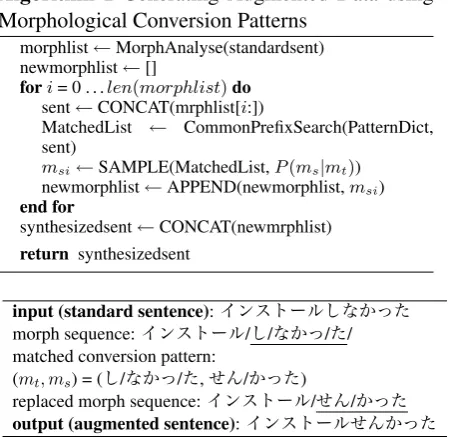
ex-Algorithm 1 Generating Augmented Data using Morphological Conversion Patterns
morphlist←MorphAnalyse(standardsent) newmorphlist←[]
fori= 0 . . .len(morphlist)do sent←CONCAT(mrphlist[i:])
MatchedList ← CommonPrefixSearch(PatternDict, sent)
msi←SAMPLE(MatchedList,P(ms|mt)) newmorphlist←APPEND(newmorphlist,msi)
end for
synthesizedsent←CONCAT(newmrphlist) return synthesizedsent
input (standard sentence):
morph sequence: / / / /
matched conversion pattern:
(mt, ms) = ( / / , / )
replaced morph sequence: / / output (augmented sentence):
Table 2: Example of generated augmentation data using morphological conversion patterns
tracted morphological conversion patterns. Algo-rithm 1 shows the detailed procedure of generating augmented data.
More precisely, we first analyze the standard sentences with the morphological analyzer. We then look up the extracted patterns for the seg-mented corpus from left to right and replace the characters according to probabilityp(ms|mt).
Ta-ble 2 shows an example of generated augmentation data. When we sample dialect pattern ms from
MatchedList, we use two types ofp(ms|mt). The
first type is fixed probability. We setp(ms|mt)=
1/len(MatchedList) for all matched patterns. The second type is generative probability, which is cal-culated from the training data (see the previous subsection). The comparison of these two types of probabilities is discussed in the experimental sec-tion.
3.2 Generating Augmented Data using Character-level Conversion
For our character-level method, we take advantage of the phrase-based SMT toolkit Moses for gen-erating augmented data. The idea is simple and straightforward; we train a ‘standard-to-dialect’ sentence SMT model at a character-level and ap-ply it to a large non-annotated standard sentences. This model converts the sentence by using char-acter phrase units. Thus, we call this method “character-level conversion”.
3.3 Training Procedure
We use the following two-step training proce-dure. (1) We train model parameters by using both human-annotated and augmented data. (2) We then retrain the model parameters only with the human-annotated data, while the model pa-rameters obtained in the first step are used as ini-tial values of the model parameters in this (second) step. We refer to these first and second steps as “pre-training” and “fine-tuning”, respectively. Ob-viously, the augmented data are less reliable than human-annotated data. Thus, we can expect to im-prove the performance of the normalization model by ignoring the less reliable augmented data in the last-mile decision of model parameter training.
4 Experiments
4.1 Data
The dialect data we used were crowdsourced data. We first prepared the standard seed sentences, and crowd workers (dialect natives) rewrote the seed sentences as dialects. The target areas of the di-alects were Nagoya (NAG), Hiroshima (HIR), and Sendai (SEN), which are major cities in Japan. Each region’s data consists of 22,020 sentence pairs, and we randomly split the data into train-ing (80%), development (10%), and test (10%). For augmented data, we used the data of Yahoo chiebukuro, which contains community QA data. Since the human-annotated data are spoken lan-guage text, we used the community QA data as close-domain data.
4.2 Settings
For the baseline model other than encoder-decoder models, we used Moses. Moses is a tool of training statistical machine translation and a strong baseline for the text-normalization task (Junczys-Dowmunt and Grundkiewicz, 2016). For such a task, we can ignore the word reordering; therefore, we set the distortion limit to 0. We used MERT on the development set for tuning. We confirmed that using both manually annotated and augmented data for building LM greatly degraded its final BLUE score in our preliminary experiments and used only manually annotated data as the training data of LM.
method BLEU
NAG HIR SEN
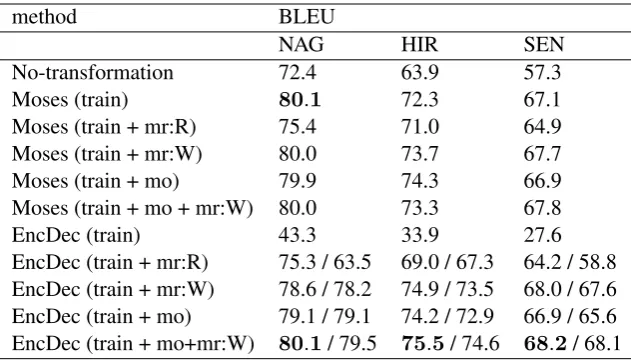
No-transformation 72.4 63.9 57.3 Moses (train) 80.1 72.3 67.1 Moses (train + mr:R) 75.4 71.0 64.9 Moses (train + mr:W) 80.0 73.7 67.7 Moses (train + mo) 79.9 74.3 66.9 Moses (train + mo + mr:W) 80.0 73.3 67.8 EncDec (train) 43.3 33.9 27.6 EncDec (train + mr:R) 75.3 / 63.5 69.0 / 67.3 64.2 / 58.8 EncDec (train + mr:W) 78.6 / 78.2 74.9 / 73.5 68.0 / 67.6 EncDec (train + mo) 79.1 / 79.1 74.2 / 72.9 66.9 / 65.6 EncDec (train + mo+mr:W) 80.1/ 79.5 75.5/ 74.6 68.2/ 68.1
Table 3: BLEU scores of normalization. “/” indicates with (left) and without (right) fine tuning. 200,000 pairs of augmented data were used.
method BLEU
NAG HIR SEN
Moses (oracle) 80.2 75.7 68.3 Moses (best) 80.1 74.3 67.8 EncDec (oracle) 84.8 81.6 73.1 EncDec (best) 80.1 75.5 68.2
Table 4: Evaluation of oracle sentences
S(t, s) =log(p(t|s, θ))/|t|. We maximizeS(t, s)
to find normalized sentence. We set the em-bedding size of the character and hidden layer to 300 and 256, respectively. We used ”mr-phaug (mr)” as the augmented data gener-ated from morphological-level conversion and ”mosesaug (mo)” as augmented data generated from character-level conversion (Moses). The “mr:R” and “mr:W” represent the difference in generative probability p(ms|mt), which is used when generating augmented data; “mr:R” indi-cates fixed generative probability and “mr:W” in-dicates weighted generative probability. For the evaluation, we used BLEU (Papineni et al., 2002), which is widely used for machine translation.
4.3 Results
Table 3 lists the normalization results. No-transformation indicates the result of evaluating input sentences without transformation. Moses achieved a reasonable BLEU score with a small amount of human-annotated data. However, the improvement of adding augmented data was lim-ited. On the other hand, the encoder-decoder model showed a very low BLEU score with a small amount of human-annotated data. With this amount of data, the encoder-decoder model
gen-erated a sentence that was quite different from the reference. When adding augmented data, the BLEU score improved, and fine tuning was effec-tive for all cases.
When comparing our augmented-data-generation methods, generating data according to fixed probability (mr:R) degraded the BLEU score both for Moses and the encoder-decoder model. When generating data with fixed probability, the quality of augmented data becomes quite low. However, by generating data according to generative probability (mr:W), which is estimated with training data, the BLEU score improved. This indicates that when generating data using morphological-level Conversion, it is important to take into account the generative probability. Combining “mr:W” and “mo” (train+mo+mr:W) achieves higher BLEU scores than that of other methods. This suggests that combining different types of data will have a positive effect on normalization accuracy.
When comparing three difference regions, the BLUE scores of Moses (train) and EncDec (train+mo+mr:W) for NAG (Nagoya) were the same score, while there were improvements for HIR (Hiroshima) and SEN (Sendai). It is inferred that the effect of the proposed methods for NAG were limited because the difference between in-put (dialect) sentences and correct (standard) sen-tences was small.
5 Discussion
top 10 candidates of normalized sentences from Moses and proposed method, extracted the candi-dates that were the most similar to the reference, and calculated the BLEU scores. Table 4 shows the results of oracle performance. Interestingly, the oracle performances of the encoder-decoder model with augmented data was quite high, while that of Moses was almost the same as the best score. This implies that there is room for improve-ment for the encoder-decoder model by just im-proving the decoding or ranking function.
Other text normalization task In this study, we evaluated our methods with Japanese dialect data. However, these methods are not limited to Japanese dialects because they do not use dialog-specific information. If there is prior knowledge, the combination of them will be more promising for improve normalization performance. We will investigate the effectiveness of our methods for other normalization tasks for future work.
Limitation Since our data-augmentation meth-ods are based on human-annotated training data, the variations in the generated data depend on the amount of training data. The variations in aug-mented data generated with our data-augmentation methods are strictly limited within those appear-ing in the human-annotated trainappear-ing data. This es-sentially means that the quality of augmented data deeply relies on the amount of (human-annotated) training data. We plan to develop more general methods that do not deeply depend on the amount of training data.
6 Conclusion
We investigated the effectiveness of our augmented-data-generation methods for neu-ral text normalization. From the experiments, the quality of augmented data greatly affected the BLEU score. Moreover, a two-step training strategy and fine tuning with human-annotated data improved this score. From these results, there is possibility to improve the accuracy of normalization if we can generate higher quality data. For future work, we will explore a more advanced method for generating augmented data.
References
Dzmitry Bahdanau, Kyunghyun Cho, and Yoshua Ben-gio. 2014. Neural machine translation by jointly learning to align and translate. CoRR.
Bo Han, Paul Cook, and Timothy Baldwin. 2013. Lex-ical normalization for social media text. ACM Trans. Intell. Syst. Technol., pages 5:1–5:27.
Fei Huang. 2015. Improved arabic dialect classifi-cation with social media data. In Proceedings of the 2015 Conference on Empirical Methods in Nat-ural Language Processing, pages 2118–2126, Lis-bon, Portugal. Association for Computational Lin-guistics.
Taishi Ikeda, Hiroyuki Shindo, and Yuji Matsumoto. 2017. Japanese text normalization with encoder-decoder model. InProceedings of the 2nd Workshop on Noisy User-generated Text (WNUT).
Marcin Junczys-Dowmunt and Roman Grundkiewicz. 2016. Phrase-based machine translation is state-of-the-art for automatic grammatical error correction. InProceedings of the 2016 Conference on Empirical Methods in Natural Language Processing.
Philipp Koehn, Hieu Hoang, Alexandra Birch, Chris Callison-Burch, Marcello Federico, Nicola Bertoldi, Brooke Cowan, Wade Shen, Christine Moran, Richard Zens, Chris Dyer, Ondrej Bojar, Alexandra Constantin, and Evan Herbst. 2007. Moses: Open source toolkit for statistical machine translation. In Proceedings of the 45th Annual Meeting of the ACL on Interactive Poster and Demonstration Sessions.
Thang Luong, Hieu Pham, and Christopher D. Man-ning. 2015. Effective approaches to attention-based neural machine translation. In Proceedings of the 2015 Conference on EMNLP.
Kishore Papineni, Salim Roukos, Todd Ward, and Wei-Jing Zhu. 2002. Bleu: A method for automatic eval-uation of machine translation. InProceedings of the 40th Annual Meeting on Association for Computa-tional Linguistics.
Alexander M. Rush, Sumit Chopra, and Jason Weston. 2015. A neural attention model for abstractive sen-tence summarization. In Proceedings of the 2015 Conference on Empirical Methods in Natural Lan-guage Processing.
Hassan Sajjad, Kareem Darwish, and Yonatan Be-linkov. 2013. Translating dialectal arabic to english. InProceedings of the 51st Annual Meeting of the As-sociation for Computational Linguistics (Volume 2: Short Papers), pages 1–6, Sofia, Bulgaria. Associa-tion for ComputaAssocia-tional Linguistics.
Rico Sennrich, Barry Haddow, and Alexandra Birch. 2016. Improving neural machine translation mod-els with monolingual data. In Proceedings of the 54th Annual Meeting of the Association for Compu-tational Linguistics (Volume 1: Long Papers).