An Unsupervised Parameter Estimation Algorithm
for a Generative Dependency N-gram Language Model
Chenchen Ding and Mikio Yamamoto Department of Computer Science
University of Tsukuba
1-1-1 Tennodai, Tsukuba, 305-8573, Japan {tei@mibel.,myama@}cs.tsukuba.ac.jp
Abstract
We design a language model based on a generative dependency structure for sen-tences. The parameter of the model is the probability of a dependency N-gram, which is composed of lexical words with four kinds of extra tags used to model the dependency relation and valence. We fur-ther propose an unsupervised expectation-maximization algorithm for parameter es-timation, in which all possible dependency structures of a sentence are considered. As the algorithm is language-independent, it can be used on a raw corpus from any lan-guage, without any part-of-speech annota-tion, tree-bank or trained parser. We con-ducted experiments using four languages: English, German, Spanish and Japanese. The results illustrate the applicability and the properties of the proposed approach.
1 Introduction
Statistical language models are a fundamental component of speech recognition systems, ma-chine translation systems, and so forth. Presently, the N-gram language model is the most widely used approach. This model focuses on sequences of neighboring lexical words (Fig. 1), and uses the probabilities of these sequences as model parame-ters. Due to the full lexicalization of the N-gram language model, local features of word sequences can be well modeled. However, an N-gram lan-guage model cannot capture relatively long-range features, because it regards a sentence as a flat string and ignores its structure.
Figure 1: The N-gram language model treats the English sentence “all things pass” composed of (all, things) and (things, pass), forN = 2.
Figure 2: The constituency-based parsing (A) and the dependency-based parsing (B)1 for the English sentence “all things pass”.
On the other hand, revealing the structure of a sentence is the task of parsing, which is based on linguistically oriented formulations and focuses on generating the likeliest structure for a given sen-tence. For this purpose, there are constituency-based and dependency-constituency-based formulations (Fig. 2). The former organizes continuous word se-quences in a hierarchy of small range to large range groups with linguistically oriented labels; the latter links words with dependency relations2.
Figure 3: All possible dependency structures for the English sentence “all things pass”. (I) is the linguistically correct structure while the original N-gram language model handles the sentence as if it has the structure labeled (II). We consider all these structures in our unsupervised estimation algorithm.
In this paper, we focus on introducing sentence structure into language modeling. We propose a generative dependency N-gram language model that integrates a generative dependency structure of a sentence into the original N-gram language model. We prefer the dependency-based
formula-1For the illustrations in this paper, we use the
follow-ing representation to show the dependency structure. If two aligned words are on different levels, the upper one is the head of the lower one; if they are on the same level, they are siblings.
2In general, the dependency relations can be further
clas-sified using linguistically oriented labels. However, they are not indispensable and we do not use them in our approach.
tion because it can directly model the relations be-tween words. In the proposed model, the parame-ter is the probability of the dependency N-gram, which is a sequence of words along the depen-dency structure rather than along a flat left-to-right string. The proposed model is thus as fully lexical as the original N-gram language model. We fur-ther propose an expectation-maximization (EM) algorithm for estimating the probability of arbi-trary order3 dependency N-grams, by considering all possible dependency structures4 of a sentence (Fig. 3). The proposed algorithm is unsupervised, language-independent and needs no linguistic in-formation.
2 Related Work
The technical report by Chen and Goodman (1998) has compared various approaches to the N-gram language model and the modified Kneser-Ney discounting proposed in it is still the state-of-the-art approach. Since the N-gram language model only captures local lexical features, there have been proposals to generalize the lexical N-gram by word-class (Brown et al., 1992) or to model long-range word co-occurrences by word triggers (Tillmann and Ney, 1997). However, these models are unaware of the sentence structure and basically take a sentence as a flat string.
Many approaches have been proposed for constituency-based parsing (Collins, 1998; Klein and Manning, 2003; Klein and Manning, 2004) and for dependency-based parsing (Eisner, 1996; Lee and Choi, 1997; Kudo and Matsumoto, 2002; Klein and Manning, 2004; Nivre, 2008). Presently, discriminative approaches (Kudo and Matsumoto, 2002; Nivre, 2008) are used more than generative ones for dependency-based pars-ing, because a generative model is usually re-stricted to being bi-lexical (i.e., the components are bi-grams of head-modifier pairs) and it is hard to handle more lexical information.
There have been some attempts to inte-grate sentence structure into language model-ing. Chelba and Jelinek (2000) have pro-posed a constituency-based approach, but the use of language-dependent non-terminals cannot be avoided. There are also dependency-based ap-proaches (Stolcke et al., 1997; Gao and Suzuki, 2003; Graham and van Genabith, 2010). However,
3
“Order” here means the number of lexical words (N).
4Only projective dependency structures are considered.
these approaches need a trained dependency parser because they construct a language model based on the decisive best structure produced by the parser. In our approach, we utilize a generative depen-dency model to guarantee the constituency of a language model5, but our model and algorithm can handle arbitrary numbers of lexical words. Fur-thermore, our approach needs no extra parser to generate the best structure of a sentence but, in-stead, takes all possible dependency structures into consideration.
3 Generative Dependency Model
We model the marginal probability of a sentence
Sover the setDof all possible dependency struc-tures of S, P(S) = ∑d∈DP(S, d). As de-scribed in Klein and Manning (2004), if we sep-arate the dependency structure and lexicalization, then ∑d∈DP(S, d) = ∑d∈DP(d)P(S|d). The term P(S|d) is given by a model of fully lexical word sequences with dependency relations. How-ever, the termP(d)is difficult to model and is usu-ally taken to be a constant, as in Paskin (2002). To deal with this problem, the dependency model with valence (DMV)6proposed by Klein and Manning (2004) introduces a special mark STOP. However, it is necessary to distinguish two kinds of param-eters, PSTOP and PCHOOSE in the bi-gram
esti-mation, which makes it difficult to extend the ap-proach to higher orders.
In a similar approach to that used in the DMV, we introduce four kinds of tags to normalize the distribution of modifier numbers (the valence) of a head word. In this paper, we use⟨L⟩,⟨/L⟩,⟨R⟩
and⟨/R⟩to show the start and end of the left and right modifier word sequences of a head word, re-spectively. The dependency structure can thus be organized as nested word sequences. Specifically, a modifier word sequences of a head word is in a form of M = mϕ0+1 ≡ m0, m1,· · ·, mϕ+1,
wherem0 ≡ ⟨O⟩,mϕ+1 ≡ ⟨/O⟩(O ∈ {L, R})
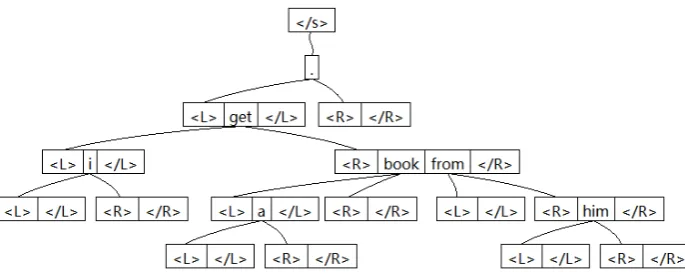
and mϕ1 is a lexical ϕ-word sequence. We show an example of the dependency structure in Fig. 4. On the other hand, in contrast to the DMV, we treat the tags as ordinary words in the parameter estimation. So the parameters of our model have a uniform representation, by which our approach can be easily extended to arbitrary high orders.
5∑
S∈LP(S) = 1for the setLcomposed of all the
sen-tencesSin a language.
Figure 4: A dependency structure for the English sentence “i get a book from him .”, with⟨L⟩,⟨R⟩,
⟨/L⟩, ⟨/R⟩ tags. The root of the sentence is marked as ⟨/s⟩ and for a word without modifiers, its modifier word sequences are⟨O⟩⟨/O⟩whereO∈ {L, R}.
Because our model is essentially equivalent to the generative Model C in Eisner (1996), the con-sistence of the language model can be guaran-teed. That is,⟨O⟩mϕ1⟨/O⟩(O ∈ {L, R}) is gen-erated as a Markov sequence to serve as the mod-ifier word sequences (left/right separately) of the head word. The “start tag” ⟨O⟩ always satisfies
P(m0 = ⟨O⟩) ≡ 1to represent the nested
struc-ture. The “end tag” ⟨/O⟩ terminates the genera-tion process, so: the larger P(mϕ+1 = ⟨/O⟩) is,
the smaller ϕ, which is the number of generated words, becomes, and vice versa.
Without loss of generality, the probability of
mκ+1 (0 ≤ κ ≤ ϕ) inM = mϕ0+1 can be
rep-resented byP(mκ+1|mκ0, H), whereHis the
his-tory ofM along the generated path7. We use the independent assumption that the probability of a word in the generation process depends on only its direct ancestors and the orientation between them. So, the general probability can be simplified to:
P(h0|o1, h1, . . . , on−1, hn−1) (1)
wherehkis a lexical word,hk+1 is the head word ofhk, andok ∈ {⟨L⟩,⟨R⟩}is retained in the his-tory to show the dependency orientation.⟨/L⟩and
⟨/R⟩tags can and only can8take the place ofh0. The sequence (h0, o1, h1, . . . , on−1, hn−1) in Exp. (1) is referred as a dependency N-gram in this paper. For example, a dependency N-gram is (⟨/L⟩,⟨L⟩, him,⟨R⟩, from,⟨R⟩, get,⟨L⟩, .,⟨/s⟩) in the dependency structure illustrated in Fig. 4. Exp. (1) is the probability of the dependency N-gram and thus the parameter of our model, where the dependency relation and valence are modeled uniformly for arbitrary order parameters.
7
The generation process can be realized in a depth-first or a breadth-first way but the distinction is unessential.
8Because they cannot have further modifiers.
4 Parameter Estimation
4.1 Notation
For a sentence S = w0l+1 ≡ w0, w1,· · · , wl+1,
wherew0 ≡ ⟨s⟩andwl+1 ≡ ⟨/s⟩, a dependency
N-gram (h0, o1, h1, . . . , on−1, hn−1) can be de-noted byd= (d0, d1, . . . , dn−1)wherehk=wdk.
That is, a dependency N-gram can be denoted by an N-tuple of the absolute positions of words in a given sentence. As the magnitudes ofdkanddk+1
show the orientation,ok+1can be omitted.9 Lee and Choi (1997) propose the complete-link set and complete-sequence set for head-modifier pair (i.e., a dependency bi-gram in our model) to handle all possible projective dependency struc-tures of a sentence in a recursive manner. We fol-low the terms they use and extend their definitions to adapt them to our dependency N-gram model. We use Link(d) to denote the complete-link set of an N-tuple d, and Seq(d) for the complete-sequence set.
In Lee and Choi (1997), the complete-link set of a span [i, j] in a sentence is composed of all possible dependency structures within the span, with the directional dependency link of the two wordswi andwj. The complete-sequence set of a span[i, j]is defined as the set of all possible se-quences with any number (including zero) of ad-jacent complete-link sets having the same direc-tion within the span. By our notadirec-tion, i.e. the word at d1 is the direct head of the word at d0
for Link(d0, d1); but the word atd1 is an
ances-tor (not only a direct head) of the word atd0 for Seq(d0, d1). The two kinds of sets can be defined
recursively and the set of all possible dependency
9Ifh0
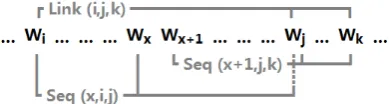
Figure 5: Link(d = (i, j)). In Lee and Choi (1997), for a span[i, j],Link(i, j)is composed of the dependency link ofwiandwj, and all pos-sible pairs of complete-sequence setsSeq(x, i) andSeq(x+ 1, j).
Figure 6: Seq(d = (i, j)). In Lee and Choi (1997), for a span[i, j], Seq(i, j) is composed of all possible pairs of complete-sequence set
Seq(i, x)and complete-link setLink(x, j).
structures of a sentenceS=w0l+1is the complete-sequence set over the span[1, l+ 1]. We illustrate these recursive relations in Fig. 5 and Fig. 6.
Because more than two words are involved in the proposed dependency N-gram, we generalize the two kinds of sets for the N-tuples d rather than just spans. The generalization still retains the properties ofd0andd1inLink(d)andSeq(d), as
well as the recursive properties of the two kinds of sets. We show examples of a dependency tri-gram in Fig, 7 and Fig. 8.
4.2 Recursive Definition
Here, we give the formulation of the recursive definition of the link set and complete-sequence set for an arbitrary order dependency N-gram. First, due to the properties of the projective dependency structure, anydk(k∈[1, n−1]) in the N-tuple d = (d0, d1, . . . , dn−1) needs to satisfy
the following constraint to guarantee that a head word is outside of the range covered by a chain of its descendants.
dk>max(d0,· · · , dk−1), or
dk<min(d0,· · ·, dk−1)
(2)
Trivially, we take⟨/s⟩as therootmark of a sen-tenceS = w0l+1, and the⟨s⟩as the head of itself or the⟨/s⟩. So, we have the following constraints.
dk+1 = 0, ifdk=l+ 1, ordk= 0 (3)
For convenience, we introduce three kinds of operations, Push, Cover, and Insert over an
in-Figure 7:Link(d = (i, j, k)). In our model, an extended high-order (3 is shown here) complete-link setLink(i, j, k)is composed of the N-tuple d, and all possible pairs of complete-sequence setsSeq(x, i, j)andSeq(x+ 1, j, k).
Figure 8: Seq(d = (i, j, k)). In our model, an extended high-order (3 is shown here) complete-sequence setSeq(i, j, k)is composed of all pos-sible pairs of complete-sequence setSeq(i, x, j) and complete-link setLink(x, j, k).
dex x (absolute word position) and an N-tuple d= (d0, d1, . . . , dn−1):
Push(x,d) = (x, d0, d1, . . . , dn−2) (4)
Cover(x,d) = (x, d1, d2, . . . , dn−1) (5) Insert(x,d) = (d0, x, d2, . . . , dn−1) (6)
Then, theLink(d)andSeq(d) can be defined by Exp. (7) and Exp. (9) below, where “×” indicates the direct product of sets.
Link(d) = ∪
if d1=l+1,theni=d1−1; elsei∈[min(d0,d1),max(d0,d1)−1] {Seq(Left(i,d))×
Seq(Right(i+ 1,d))×d} (7)
where
(Left,Right) =
{
(Push,Cover), ifd0 < d1
(Cover,Push), ifd0 > d1
(8)
Seq(d) = ∪
i∈[min(d0,d1),max(d0,d1)] andi̸=d1
{Seq(Insert(i,d))×
Exp. (7) shows that a complete-link set is re-cursively composed of the direct product of all possible complete-sequence set pairs, with the N-tupled itself.10 Exp. (9) shows that a complete-sequence set is recursively composed of the direct product of all possible pairs of a complete-link set and a smaller complete-sequence set.
To start the recursive definition, we replaced0
by⟨/L⟩and⟨/R⟩for allSeq(d)withd0=d111.
According to the recursive definition, it is natu-ral to derive an inside-outside algorithm (Lari and Young, 1990), which is an adaption of the EM al-gorithm (Dempster et al., 1977) to tree structures, to conduct parameter re-estimation by calculating the inside and outside probabilities of all complete sets in sentences.
We generalize the expressions in Exp. (7) and Exp. (9) to Exp. (14) and Exp. (15) respectively, where the notation ⟨·,·⟩ stands for an unordered 2-tuple of a complete-set pair.
Link(d) = ∪
is a relation for Seq(d), ⟨Sub1,Sub2⟩ satisfying Exp. (15). Then, the inside probabilityβand out-side probability α of the two kinds of complete sets can be calculated by Exp. (16) to Exp. (19),
10We further restrict the root mark⟨/s⟩to take only one
modifier (the situation whend1=l+ 1in Exp. (7)),
accord-ing to the general restrictions of the dependency grammar.
11From the restriction in Exp. (2),d
0should not be equal
tod1. This is only possible for thoseSeq(d)at the start of the
recursive definition, where the word atd0is actually a⟨/L⟩
tag or a⟨/R⟩tag, which does not have an absolute position in a sentence.
wherep(d)is the probability of the lexical depen-dency N-gram represented bydin a sentence.
β(Link(d)) =
Specifically, Exp. (16) and Exp. (17) can be di-rectly derived from the definitions of Exp. (7) and Exp. (9), respectively. Further, a complete-link set can only be a component of a complete-sequence set from Exp. (9), while a complete-sequence set can be both a component of a complete-link set from Exp. (7), and a component of a complete-sequence set from Exp. (9). As a result, Exp. (18) and Exp. (19) can be derived respectively.
For allSeq(d)with⟨/L⟩or⟨/R⟩, we use:
β(Seq(d)) =p(d) (20)
as the start of the calculation. At the end of the calculation, the probability of the whole sentence
S =wl0+1can be obtained as:
P(S) =β(Seq(d= (1, l+ 1,0,· · ·,0))) (21)
For the re-estimation, we can get the probabilis-tic counts12 of a dependency N-gram represented bydin a sentence using:
β(Link(d))·α(Link(d))·P(S)−1 13 (22)
according to the inside-outside algorithm. Finally, all the counts of a dependency N-gram in the train-ing corpus are added and normalized ustrain-ing Exp. (1), to update the model parameters.
12
They are no longer integers.
13For the situation in Exp. (20), we useβ(Seq(d))·α(Seq(d))
5 Experiments
5.1 Experiment Setting
Corpus
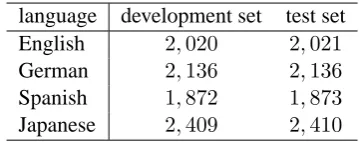
As the proposed dependency N-gram model and estimation algorithm are language-independent, we conduct experiments using four different lan-guages: English, German, Spanish and Japanese. The corpora we use for English, German, and Spanish are the sets of sentences with5–15words from the corresponding single-language corpora of Europarl14 (Koehn, 2005). The corpus for Japanese is the set of sentences with5–20words from the Japanese side of the NTCIR-8 corpus (Fujii et al., 2010). We take one two-hundredth of the sentences from a corpus to form each of the development and test sets used in experiments, and the remaining sentences are used for training. The details of training, development and test sets are shown in Tables 1 and 2.
language sentences types tokens English 400,100 40,913 4,355,333 German 422,951 105,303 4,545,263 Spanish 370,791 58,314 4,007,816 Japanese 477,118 47,930 7,758,437
Table 1: The training sets.
language development set test set
English 2,020 2,021
German 2,136 2,136
Spanish 1,872 1,873
Japanese 2,409 2,410
Table 2: The numbers of sentences in develop-ment and test sets.
Parameter Collection and Initialization
In order to investigate the fundamental properties of the model and algorithm, we do not use any pruning or approximating methods in the param-eter estimation. Specifically, we collect from the raw corpora all possible lexical dependency N-grams15without any cut-off thresholds for models of every order. Before estimation, we use relative frequency to initialize the probabilities.
14
http://www.statmt.org/europarl/
15As Japanese is a typical head-final language, that is, the
head word always comes after its modifiers, we only take the left-oriented (from head to modifier) dependency links into account. For the other three languages, dependency links of both two orientations are considered. The parameter collec-tion and initializacollec-tion do not take the structure into account.
5.2 Results
Algorithm Convergence
Figure 9: The English training set perplexities before each iteration. (The y-axis is logarith-mic.)
Figure 9 shows the change of English training set perplexities before each iteration by the pro-posed estimation algorithm, for2(bi-) and3(tri-) order dependency N-gram models. The conver-gence trend along with the iteration times can be observed. For the dependency bi-gram, the train-ing set perplexity becomes nearly stable after 5 it-erations. However, for the dependency tri-gram, the first iteration already reaches a very low train-ing set perplexity and it does not change much in further iterations. This phenomenon suggests that the non-pruned dependency tri-gram model may already be too complex a model with too many pa-rameters, so the features of the training set are rep-resented well, resulting in a low perplexity. This suggests the model is over-fitting the data. We dis-cuss this in Sec. 5.3.
Test Set Perplexity
Fur-language dev-ppl (bi / tri) test-ppl (bi / tri) iterbi itertri λuni λbi λtri
English 145/143 159/156 6 1 0.93 0.99 0.13
German 268/256 265/261 12 1 0.88 0.98 0.04
Spanish 165/164 159/158 7 1 0.92 0.99 0.04
Japanese (left-only) 88/67 88/67 4 1 0.86 0.99 0.70
Table 3: The development set perplexities (dev-ppl) and test set perplexities (test-ppl) of dependency N-gram models (N =2(bi),3(tri)). The iteration times in dependency bi- and tri-gram model training areiterbi anditertri, respectively. The weights of uni-gram, dependency bi- and tri-gram models are
λuni,λbi andλtri. (1−λbi)and(1−λtri)are assigned to the interpolated lower order models and
(1−λuni)is assigned to the⟨/L⟩and⟨/R⟩tags.
thermore, as the ⟨/L⟩ tag and⟨/R⟩tag are taken as general words but they never really appear in a training set, we treat them separately, and interpo-late them with the uni-gram model.
language MLE (bi / tri) MKN (bi / tri) English 162/457 157/86 German 396/1371 252/139 Spanish 176/499 161/86
Japanese 62/87 91/39
Table 4: The test set perplexities of the original N-gram models. MLE is the maximum likeli-hood estimation realized by setting the adding delta to0in adding smoothing. MKN is the in-terpolated modified Kneser-Ney discounting.
In Table 3, we show the development and test set perplexities of the linear-interpolated depen-dency bi- and tri-gram models. For comparison, we used SRILM16 (Stolcke, 2002) to build two original N-gram language models on the same training sets: one is constructed by maximum likelihood estimation without any smoothing, the other one is constructed by state-of-the-art inter-polated modified Kneser-Ney discounting. We calculate the test set perplexities of the two N-gram language models on the same test sets. The results are listed in Table 4. In both Table 3 and Table 4, the perplexities are calculated according to the number of lexical words, and the tags used for normalization are not counted17. We discuss these results in Sec. 5.3.
16http://www.speech.sri.com/projects/
srilm/
17
That is, we do not count the⟨/s⟩tag in the original N-gram language models, or⟨/L⟩and⟨/R⟩in our models. If they are included, the perplexities decrease. In the original N-gram model, this is because a⟨/s⟩tag nearly always appears after the period mark. The effect is even more dramatic in our model, as each word in a sentence has a⟨/L⟩and a⟨/R⟩
tag to normalize its modifier numbers, so the token number in a sentence is multiplied by. Therefore, we only count the lexical words in perplexity calculation for fairness.
5.3 Discussion
Parameter Number
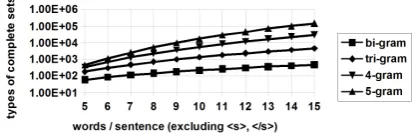
For a sentence with l words, the number of de-pendency N-gram that can be collected increases exponentially asO(lN)if we consider all possible combinations. Although for a given N, the pro-posed algorithm takes a time which is polynomial in the sentence lengthl, a largeN will be practi-cally intractable, especially for long sentences. In Fig. 10, we show the numbers of complete sets of different order dependency N-gram models for different sentence lengths.
Figure 10: The numbers of complete sets. (The y-axis is logarithmic.)
Figure 11: The best dependency structure of the English sentence “i would , however , add one important caveat .”
Figure 12: The best dependency structure of the German sentence “trotzdem m¨ochte ich der kom-mission einige fragen stellen .”
Test Set Perplexity
Comparing the test set perplexities in Tables 3 and 4, we can see the dependency bi-gram model achieves the same, or sometimes better perfor-mance of the original N-gram language models. However, when we look at the tri-grams, the in-terpolated modified Kneser-Ney (KN) discount-ing method, which is state-of-the-art, shows its strength and our dependency model does not pro-duce much improvement for the reasons we de-scribed above18. As the modified KN method uses an efficient discounting to avoid the over-fitting problem, and our model has no smoothing, the dif-ference in performance is reasonable for complex models. On the other hand, the generally com-petitive results of our bi-gram model and its per-formance on Japanese show that our model is a promising one, particularly if the number of pa-rameters can be reduced.
Model Preference
In Fig. 11 to Fig. 14, we present examples of the best dependency structures generated by our ap-proach of sentences in test sets. We used the set-tings in Table 3 and generated them by the Viterbi algorithm (Viterbi, 1967). It can be seen the pro-posed approach can reveal features of specific lan-guages even though it is unsupervised: e.g. the final-position verb “stellen” and its relation with the second-position auxiliary verb “m¨ochte” in the German sentence. The results also show a prefer-ence for associating semantic relations and mak-ing the function words19 of a language the mod-ifiers of the content words. For example, in the Spanish sentence, syntactically the preposition “a”
18
For Japanese, the result is improved by the dependency tri-gram model, but the original tri-gram model with interpo-lated modified KN discounting method performs much better.
19Articles, prepositions, etc.
Figure 13: The best dependency structure of the Spanish sentence “la comisi´on est´a haciendo muchas cosas a este respecto .”
Figure 14: The best dependency structure of the Japanese sentence “ 3
”
is the head of the noun “respecto”, but in unsu-pervised training, our model prefers to assign “a” to be the modifier of “respecto” and directly link two content words: “respecto” and the verb “ha-ciendo”. We think this is because the probabili-ties of ⟨/L⟩ and ⟨/R⟩ tags have large estimates, especially when they appear after function words, which prevents them from having modifiers20.
6 Conclusion and Future Work
In this paper, we proposed a generative depen-dency N-gram language model and the definition of the complete sets for arbitrary order, by which an unsupervised parameter estimation algorithm is facilitated. The experimental results demonstrate the applicability and the properties of the proposed approach. In future work, we will develop meth-ods of parameter pruning and discounting to han-dle the over-fitting problem. As the the proposed dependency language model is intrinsically com-plex, we also plan to do more fundamental sim-plifications. On the other hand, although our pro-posed algorithm is unsupervised, the output of a trained parser, which can provide clear and lexical heuristics, can be integrated in it. We will investi-gate this possibility and evaluate the performance by linguistically motivated criteria.
Acknowledgment
We would like to thank anonymous reviewers for their valuable comments and suggestions. This work was supported by JSPS KAKENHI Grant Number 24650063.
20This tendency, however, is correct for articles, such as
References
Peter F. Brown, Peter V. deSouza, Robert L. Mercer, Vicent J. Della Pietra, and Jenifer C. Lai. 1992. Class-based n-gram models of natural language. Computational Linguistics, 18(4):467–479.
Ciprian Chelba and Frederick Jelinek. 2000. Struc-tured language modeling. Computer Speech and Language, 14(4):283–332.
Stanley F. Chen and Joshua Goodman. 1998. An em-pirical study of smoothing techniques for language modeling. Technical report, TR-10-98, Computer Science Group, Harvard Univ.
Michael Collins. 1998. Three generative, lexicalised models for statistical parsing. In Proc. of ACL 1998, pages 16–23.
Arthur P. Dempster, Nan M. Laird, and Donald B. Ru-bin . 1977. Maximum likelihood from incomplete data via the EM algorithm. Journal of the Royal Sta-tistical Society. Series B (Methodological), 39(1):1– 38.
Jason M. Eisner. 1996. Three new probabilistic mod-els for dependency parsing: an exploration. In Proc. of COLING 1996, pages 340–345.
Atsushi Fujii, Masao Utiyama, Mikio Yamamoto, Takehito Utsuro, Terumasa Ehara, Hiroshi Echizen-ya, and Sayori Shimohata. 2010. Overview of the patent translation task at the NTCIR-8 workshop. In Proc. of NTCIR-8, pages 371–376.
Jianfeng Gao and Hisami Suzuki. 2003. Unsupervised learning of dependency structure for language mod-eling. In Proc. of ACL 2003, pages 521–580.
Yvette Graham and Josef van Genabith. 2010. Deep syntax language models and statistical machine translation. In Proc. of SSST at COLING 2010, pages 118–126.
Dan Klein and Christopher D. Manning. 2003. Ac-curate unlexicalized parsing. In Proc. of ACL 2003, pages 423–430.
Dan Klein and Chirstopher D. Manning. 2004. Corpus-based induction of syntactic structure: mod-els of dependency and constituency. In Proc. of ACL 2004, pages 478–485.
Philipp Koehn. 2005. Europarl: a parallel corpus for statistical machine translation. In Proc. of MT sum-mit 2005, pages 79–86.
Taku Kudo and Yuji Matsumoto. 2002. Japanese dependency analysis using cascaded chunking. In Proc. of COLING 2002, pages 1–7.
K. Lari and S. J. Young. 1990. The estimation of stochastic context-free grammars using the inside-outside algorithm. Computer Speech and Language, 4(1):35–56.
Seungmi Lee and Key-Sun Choi. 1997. Reestimation and best-first parsing algorithm for probabilistic de-pendency grammars. In Proc. of WVLC 1997, pages 41–55.
Joakim Nivre. 2008. Algorithms for deterministic in-cremental dependency parsing. Computational Lin-guistics, 34(4):513–553.
Mark A. Paskin. 2002. Grammatical digrams. Ad-vances In Neural Information Processing Systems 14, 1:91–97.
Andreas Stolcke, Ciprian Chelba, David Engle, Victor Jimenez, Lidia Mangu, Harry Printz, Eric Ristad, Roni Rosenfeld, Dekai Wu, Frederick Jelinek, and Sanjeev Khudanpur. 1997. Dependency language modeling.
Andreas Stolcke. 2002. SRILM–an extensible lan-guage modeling toolkit. In Proc. of ICSLP 2002, pages 901–904.
Christoph Tillmann and Hermann Ney. 1997. Word triggers and the EM algorithm. In Proc. of CoNNL 1997, pages 117–124.