Predicting Users’ Negative Feedbacks in Multi-Turn
Human-Computer Dialogues
∗Xin Wang1, Jianan Wang2, Yuanchao Liu1, Xiaolong Wang1,
Zhuoran Wang3 and Baoxun Wang3 1Harbin Institute of Technology, Harbin, China 2Shanghai Jiao Tong University, Shanghai, China 3Tricorn (Beijing) Technology Co., Ltd, Beijing, China
1{xwang,lyc,wangxl}@insun.hit.edu.cn 2{wangjianan}@sjtu.edu.cn
3{wangzhuoran, wangbaoxun}@trio.ai
Abstract
User experience is essential for human-computer dialogue systems. However, it is impractical to ask users to provide explicit feedbacks when the agents’ responses dis-please them. Therefore, in this paper, we explore to predict users’ imminent dissat-isfactions caused by intelligent agents by analysing the existing utterances in the di-alogue sessions. To our knowledge, this is the first work focusing on this task. Sev-eral possible factors that trigger negative emotions are modelled. A relation se-quence model (RSM) is proposed to en-code the sequence of appropriateness of current response with respect to the ear-lier utterances. The experimental results show that the proposed structure is effec-tive in modelling emotional risk (possi-bility of negative feedback) than existing conversation modelling approaches. Be-sides, strategies of obtaining distance su-pervision data for pre-training are also dis-cussed in this work. Balanced sampling with respect to the last response in the dis-tance supervision data are shown to be re-liable for data augmentation.
1 Introduction
As an ideal interaction mode, the human-computer conversation technology has gradually been con-ducted into the practical systems, among which the automatic agents adopting the task-oriented conversation and open-domain chatting abilities have developed rapidly and even come to commer-cial application stage (see Duer1 and XiaoIce2).
∗
The work was done when the first author was an intern at Tricorn (Beijing) Technology Co., Ltd.
1http://duer.baidu.com/ 2http://www.msxiaoice.com/
ㄒ⎍䐸䗇⋌ℇㅌᶇ
澽澔濞濩濧濨澔濧濤濠濝濨澔濩濤澔濫濝濨濜澔濡濭澔濖濣濭濚濦濝濙濢濘
ℬḥ⻄漕ḛ廈⊼䖅
澸濣濢澛濨澔濖濙澔濧濕濘澠澔濝濨澛濠濠澔濕濠濠澔濫濣濦濟澔濣濩濨澢
⋰ㄒ⺉䄲ᷗ
澶濩濨澔澽澔濦濙濕濠濠濭澔濠濣濪濙澔濜濝濡
㓷擵ḛ㆛ᴁ℈
濈濝濡濙澔濜濙濕濠濧澔濙濪濙濦濭濨濜濝濢濛
⏉⏉漕徤⹔䀷漕ㄒ⋰㔰岆䶨㕻俾㘻╩ᶻ
澼濕濜濕澠澔濣濚澔濗濣濩濦濧濙澠澔澽澛濡澔濕澔濧濩濤濙濦濝濢濨濙濠濠濝濛濙濢濨澔澵澽
ṡ嫵䖅⫺
濍濣濩澔濕濦濙澔濦濝濛濜濨
澼濩濡濕濢 澵濛濙濢濨
濅澡澦
濅澡澥
濅澤
濆澡澦
濆澡澥
濆澤
濃濆 澺澥
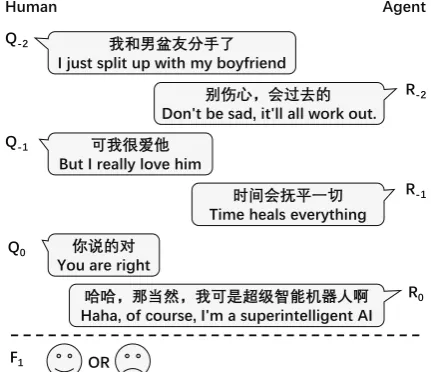
Figure 1: A example of multi-turn human-computer dialogue. The responses are readable and relevant to the corresponding queries, but the user in bad mood probably feel antipathy towards the computer’s cheer.
Basically, the essence of such commercial dia-logue agents is keeping user active, and for this purpose, it is critical to improve users’ satisfaction in non-task oriented chatting services.
The reasons of users’ displeasure lies in the sessions. As shown in Figure 1, the emotional conflict between the last agent’s response and the user’s mood leads to the dissatisfaction. There-fore, the negative feedback from user could be pre-dicted according to the context utterances. Indeed, such prediction is of great necessity for improv-ing users’ satisfaction, since it is possible to ad-dress problems within systems only if there exist methodologies to locate problems and summarize reasons behind. Ideally, if a dialogue agent antic-ipates the occurrence of the user’s negative feed-back, it is able to avoid such situations by tak-ing any possible actions, e.g., switchtak-ing to
[image:1.595.309.525.224.410.2]other topic actively. Moreover, user satisfaction can be taken as a metric for evaluating the qual-ity of a given dialogue session and the overall per-formance of a dialogue agent. In practice, user satisfaction could also be considered as the addi-tional criterion for response selection or genera-tion, which tend to intuitively take semantic rel-evance oriented features for model training. The adoption of user satisfaction is possible to provide a different view to optimize the models, so as to further improve user experience along the road be-yond relevance, e.g., avoiding the responses that are relevant but lack of sociality (Higashinaka et al.,2015).
It is not a trivial task to predict negative feed-backs in the conversation flows between human being and dialogue agents. Generally, people tend to not express their dissatisfaction explicitly, thus, there are generally no clear signals before users turn angry and terminate dialogues, or people con-tinue the conversations although they are not satis-fied already. Apparently, it is unwise to introduce rating or other explicit feedback mechanisms into the dialogue flows considering the user experience issues. Meanwhile, this problem cannot be cov-ered by classical sentiment analysis task because users’ sentiment intention tends to be not obvious, and more importantly, the facts causing negative feedbacks are much more complicated than sen-timent polarities as shown by Figure 1, in which the appropriateness of a certain response might be decided not only by itself, but also by the context. In order to estimate the risk of dissatisfaction occurring in the human-computer dialogue ses-sions, in this work, we explore the feasibility of predicting users’ emotional negative feedback caused by the dialogue agents’ replies based on the dialogue contexts. To our knowledge, this is the first work attempting to discover the implicit factors causing users’ dissatisfaction in dialogue agents’ logs with deep learning models. Noticing that the occurrence of negative feedbacks depends on a complicated semantic mechanism and conver-sational contexts play an important role in this is-sue, this paper proposes to address the problem by learning to represent the possible determinant with different models. Especially, the proposed archi-tecture based on Gated Convolutional Recurrent Neural Networks (GCRNN) is used to represent sequence of relations between the last response and the earlier utterances. Experimentally, it
out-performs existing conversational models, which indicates that the sequence of relation between ut-terances encodes the possibility of user’s dissatis-faction. Besides, data augmentation with distance supervision method is also discussed in this work.
2 Related Work 2.1 Emotion prediction
Predicting sentiment category of text has been extensively studied. Most works focus on the sentiment orientations expressed by the writers in movie/product reviews or tweets (Pang et al., 2002;Hu and Liu,2004;Go et al.,2009). How-ever, the reader’s emotion is not always consistent with that of the writer’s (Yang et al.,2007). Thus, Lin et al. (2007) explore to predict the feelings that readers may have after reading particular ar-ticles. However, in this dissatisfaction prediction task, the user is not only the reader of the session text, but also the writer of some utterances. There-fore, some clues of the particular user’s emotion may be contained in the context.
Modelling emotion in human-human conver-sation has been explored (Herzig et al., 2016; Tokuhisa and Terashima, 2006). However, trig-gers for negative emotion in human-computer di-alogue might be different (e.g., low readability or relevance). The works of Tokuhisa et al. (2009) and Yu et al.(2016)’s analysed the emotion of a particular utterance in human-computer dialogue based on the textual features containing in the very sentence. Different from their studies analysing the explicit textual feedback, this work predicts the impending emotion based on the context because the cause of emotion of readers contains in the ex-isting text (Li and Xu,2014).
2.2 Conversation Modelling
Traditional conversation modelling mainly focuses on the one-turn conversations (aka. message-response pairs) (Banchs and Li, 2012; Ameixa et al., 2014; Ritter et al., 2011;Ji et al., 2014), while recent works show more interest in multi-turn dialogues.
or intention in a dialogue session is relatively con-stant. In this perspective, all the utterances in the same session is homogenous and could be com-posed within RNNs. However, the influences of user’s queries and the agent’s responses are dif-ferent in predicting user’s emotion. Therefore, a targeted structure considering such heterogenicity is proposed in this work.
Wu et al. (2016) represent the relevance be-tween utterances with CRNN architecture. Differ-ent from their work focusing on word-level match-ing with attention poolmatch-ing on the convolutional re-sult, we leverage a gate operation to simulate the sentence-level interaction.
3 Predicting Methodology
The task of predicting impending dissatisfaction could be formulated as: given the existing utter-ances (EU) that contain no agent-cause dissatis-faction, predicting the agent-cause dissatisfaction
D1 ∈ {0,1} of user at impending turn (r = 1), given the existing utterances (EU) that contain no agent-cause dissatisfaction.
EU ={Q−n+1, R−n+1, ..., Q−1, R−1, Q0, R0}
(1) where Q−n and R−n respectively represent the
user’s query and computer response n round be-fore current turn. For this work focusing on the agent-caused dissatisfaction, those queries Q−n
with negative emotion not related to the robot are not considered as negative feedback.
There are several possible factors influencing the emotion of the users, such as (1) the last re-sponse of the robotR0, (2) the relation ofQ0 and R0, (3) the sequence of context in the conversa-tional sessions EU and (4) the sequence of rela-tions betweenR0 and the other utterancesUE − {R0}. In this session, we will discuss the factors above and learn the representation of them with deep neural network.
3.1 Utterance Modelling
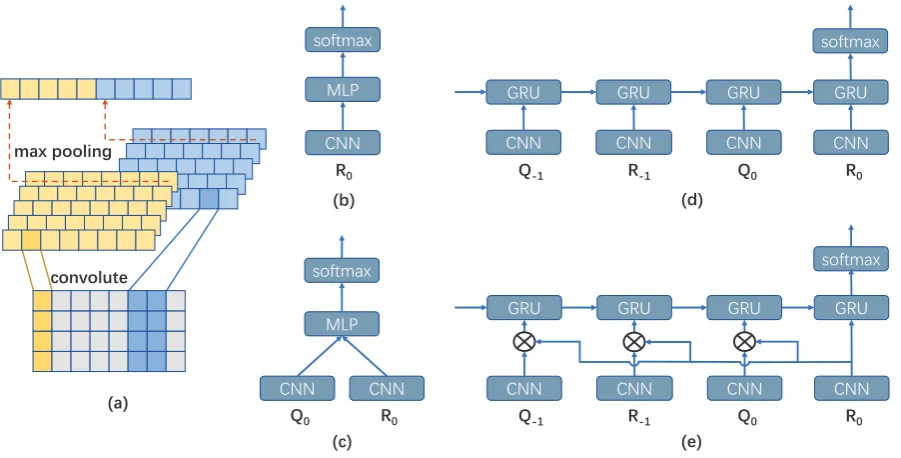
The last response of the robot R0 is the most straightforward factor that may cause the antipathy towards the agent. Predicting the negative emo-tions according to the latest response can be con-sidered as reader-side emotion classification. In this work, such single sentence is modelled with convolutional neural network (CNN) with max pooling, and then classified in the full-connected
softmax layer (Kim,2014). The illustration of the utterance model forR0is shown in Figure 2(b).
In this paper, all representations of utterances are attracted with CNN structure described in Fig-ure 2(a). Ann-word utterance can be represented as:
e1:n=e1⊕e2⊕...⊕en (2)
whereenis the embedding ofnth word in the
ut-terance and⊕refers to concatenation operator. In the convolutional process, the word window start-ing with theith word and scanned by as-width fil-terjcan be representedei:i+s−1. And the
activa-tions corresponding with filterj in convolutional layer can be computed as:
cji =fwj·ei:i+s−1+bj
(3)
where f is the non-linear activation function (ReLU is utilized in this work). And wj and bj
represent the weight matrix and bias respectively. Finally, max-over-time pooling is leveraged. The activations corresponding with filterjin the pool-ing layer can be computed as:
ˆ
cj =maxncj1, cj1, ..., cjn−s+1o (4)
3.2 Utterance Pair Modelling
Recent works improve response ranking by model the semantic matching of query-response pairs (Qiu and Huang,2015;Yin et al.,2015). The assumption implied in these works is that user ex-perience is influenced by the relation of Q0 and R0. We model such relation with Architecture-I in
Hu et al.’s (2014) work, where the representations of the query and the response are learned with two CNNs respectively and the concatenation of the representations is used as input of a multi-layer perceptron (MLP) classifier that measures the ap-propriateness.
3.3 Utterance Sequence Modelling
濡濕濬澔濤濣濣濠濝濢濛
濗濣濢濪濣濠濩濨濙
濖濡濡
濠濟濣 瀆瀂濹瀇瀀濴瀋
濖濡濡
瀆瀂濹瀇瀀濴瀋
濖濡濡 濖濡濡 濖濡濡 濖濡濡 濖濡濡
濚濥濨 濚濥濨 濚濥濨
濠濟濣 瀆瀂濹瀇瀀濴瀋
濚濥濨 瀆瀂濹瀇瀀濴瀋
濖濡濡 濖濡濡 濖濡濡 濖濡濡
濚濥濨 濚濥濨 濚濥濨 濚濥濨
澜濖澝 澜濘澝
澜濗澝
濆澤 濅澡澥 濆澡澥 濅澤 濆澤
濅澤 濆澤
澜濙澝
濅澡澥 濆澡澥 濅澤 濆澤
[image:4.595.76.527.62.291.2]澜濕澝
Figure 2: Structures for modelling different influential factors of negative feedbacks.
Li et al., 2016; Zhou et al., 2015). Thus, in this work, the sequence of existing utterances EU is modelled with CRNN, and the output of last time stepR0is considered as the final representation of
the sequence to be input to softmax classifier. The structure is shown in Figure 2(d), and Gated Re-current Units (GRUs) are used in the structure.
A GRU stores context information in the in-ternal memory structure. It performs compara-bly with long short-term memory (LSTM) and has lower complexity (Chung et al.,2014). There are two gates in thejth GRU structure, the update gate
zjt and reset gate rtj, both gates are decided by the current inputxtand previous hidden activation ht−1:
ztj =σ(Wzxt+Uzht−1)j (5) rtj =σ(Wrxt+Urht−1)j (6)
where W andU is the weight matrices, whileσ
refers to the sigmoid function. The hidden acti-vationhjt of the GRU at time tcan be computed as:
hjt =1−zjthjt−1+ztjh˜jt (7) wherehjt−1 refers to the hidden activation of pre-vious time step and˜hjt is the current candidate ac-tivation:
˜
hjt =tanh(Wxt+U(rtht−1))j (8)
GRUs compose the current and previous informa-tion with the gated units, and store the sequence representation in the memory.
3.4 Relation Sequence Modelling
Different from the intentions or topics of ut-terances being relatively constant in dialogue sessions, emotional influence of each utterance varies. For instance, the queries and responses are heterogeneous in a session. Queries are ex-pressions of dissatisfaction, while responses are the reason of displeasure. The relations between particular response and context queries (or other responses) influence the user’s emotion.
As shown in the example in Figure 1, the last responseR0conveys conflicting emotion with the
earlier utterancesQ−2,R−2andQ−1. The human
user is probably unprepared for such rapid change in emotion and exhibits dissatisfaction. The con-sistency of mood is a kind of relation between sen-tences and the sequence of such consistency be-tween sentence pairs can be treated as the emo-tional consistency of the whole conversation.
However, traditional RNNs are not adequate to represent such consistency. Therefore, we attempt to model the sequence of relation between utter-ances. As mentioned in the beginning of Section 3, the existing utterances EU contain no agent-cause dissatisfaction, which meansQ0and the
are gated by representation ofR0:
xt=ctmt (9)
wherectis the output of convolutional neural
net-work sentence model. And the matching gatemt
is influenced by the particular utterancectand the
latest responsec0.
mt=σ(Wmct+Umc0) (10)
While the input of the last time step is the rep-resentation of R0 itself (x0 = c0). Gating
op-eration has been shown effective in further map-ping abstract feature of convolutional result by in-volving additional information (Wang et al.,2015; Dauphin et al., 2016). With such structure, the emotional consistency of utterances could be ex-tracted and the influence of latest response on neg-ative feedback could be encoded.
4 Experiments 4.1 Dataset
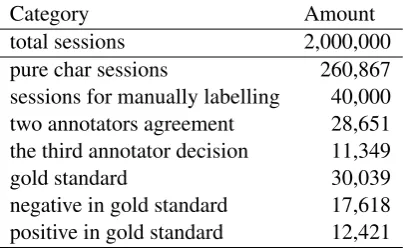
The anonymized multi-turn dialogue session data is provided by a Chinese commercial intelligent agent service. There are 2 million sessions in the dataset, most of which contain task-oriented dia-logues. However, we focus on those only includ-ing chat, and the amount of such pure chat sessions is 260,867.
As described in the introduction, the task is to predict the impending dissatisfaction givenn+ 1 round context. Thus, a sample in the dataset should contains utterances and label of following emotional polarity. In fact, the lengths of human-computer dialogue sessions vary within relatively wide range. To eliminate the influences from ses-sion length,nis set to 2 in this work. The appear-ance of dissatisfaction will be predicted based on 3 turns (0, 1 and 2) of dialogue (as shown in Fig-ure 1). 40,000 of the non-task-oriented sessions are manual annotation to construct the data set. If a session has a negative feedback, the 3 turns of utterances before this feedback will be treated as positive (with dissatisfaction) sample. Other-wise, if there’s no negative feedback, we randomly select continuous 3-turn utterances as a negative (without dissatisfaction) sample.
Two experienced annotators (long term em-ployed for text annotation) are scheduled to la-bel the sessions independently. If disagreement appears, a third senior annotator is invited to de-cide the final tag. Finally, 30,034 sessions meeting
Category Amount
total sessions 2,000,000
pure char sessions 260,867
sessions for manually labelling 40,000 two annotators agreement 28,651 the third annotator decision 11,349
gold standard 30,039
[image:5.595.316.519.62.186.2]negative in gold standard 17,618 positive in gold standard 12,421 Table 1: Statistical information of the dataset.
the requirements (non-negative sessions or nega-tive sessions with 3 three turns or more utterances before the negative expressions) are used as gold-standard dataset. Some statistical information of the dataset is shown in Table 1.
4.2 Pre-training
4.2.1 Fragment Extraction
The manually labelled gold standard dataset might be insufficient for learning deep neural models. Thus, a distance supervision strategy is designed to obtain augmented data. We summarize 56 pat-terns of highly probable negative expressions as strict patterns (SP) and 86 patterns of possible or ambiguous negative feedbacks as uncertain pat-terns (UP). It is noted that the SP is a subset of UP. The sessions containing no utterances match-ing UP are considered as non-negative. While the utterances (1)containing any SP and (2)with no ut-terances in the above 3 turns match any UP are treated as negative feedbacks and the fragments are tagged as dissatisfaction ones. In this way, both positive and negative samples of dissatisfac-tion are automatically detected.
Besides the pure chat sessions, those task-oriented ones also contain multi-turn chat frag-ment. Therefore, the augmentation strategy is carried out on all available sessions and obtains 1,612,426 distance supervised labelled fragments. It is worthy to note that there may be multiple available fragments in a single session, those frag-ments (without overlap) are all extracted in the augmentation process.
4.2.2 Balanced Dataset Construction
In fact, the extraction strategy above may lead to a different distribution with the real-world data. Taking the cheerful responseR0in Figure 1 as an
tend to express dissatisfaction towards the agents and the dissatisfactions are detected with designed patterns. While in the situations where the users are happy, the cheerful response result in a virtu-ous cycle and may not be selected asR0 (may be
selected asR−1orR−2). Therefore, such cheerful
response is likely to closely related to the dissatis-faction.
To avoid such false association rules, we select the same number of positive and negative samples ifR0 is the same and obtain 335,314 fragments as
balanced distance supervised labelled data.
4.3 Experimental Settings
All the neural network models are implemented with TensorFlow toolkit3. The max length of the input sentence is set to 10 and all sentences are padded to the max length with zero vectors. 32 fil-ters are used for each filter size, while the sizes of word embeddings, hidden layer in RNN and full-connected layer are all set to 64.
The weights between full-connected layers are initialized with Xavier initializer (Glorot and Ben-gio, 2010), while the weights and biases in the convolutional layer are initialized with random numbers on uniform distribution U {−0.2,0.2}. Word embeddings are randomly initialized with uniform distributionU {−0.1,0.1}and fine-tuned during training.
Batch learning is conducted with a batch size of 500. The learning rate of the training pro-cess is 0.001 while that of pre-training propro-cess is 0.005. 10-fold cross validation are implemented with 80% data as training set, and validation and test set divide equally the rest 20% samples. Early stopping is carried out on validation set during training. Training process stops when there’s no better validation result within 5 epochs.
4.4 Competitor Models
SVM-R0: Support vector machine (SVM) are wildly used as classifiers for sentiment analysis tasks (Pang et al., 2002). In this work, TF-IDF features based on uni-grams inR0are involved to build baseline model.
SVM-Q0R0andSVM-EU: To make use of more
context information, we involve Q0-R0 pair by
connecting them into a whole and uni-gram TF-IDF features of the connection result are used as
3www.tensorflow.org/
input of a SVM classifier. In the same way, the all sentences inEU are also used in the SVM model. UM-Q0R0 andUM-EU: Similar to SVM,
utter-ance model (UM) shown in Figure 2(b) is also de-signed to analyse a single sentence (or document). Thus, we leverage connection results of Q0-R0
pair andEU to introduce context utterance. UPM-EU:BesidesQ0-R0pair, the utterance pair model (UPM) could also be used to encode all sen-tences inEU. Each sentence is modelled by CNN respectively and the representations are concate-nated in the hidden layer.
4.5 Experimental Results
4.5.1 Comparison with Baselines
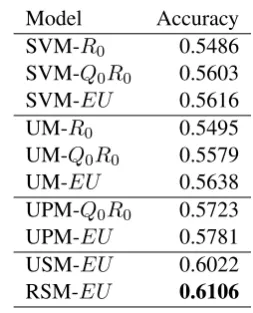
We compare the models corresponding to the fac-tor assumptions describe in section 3, including ut-terance model (UM), utut-terance pair model (UPM), utterance sequence model (USM) and relation se-quence model (RSM) with the competitor sys-tems. The numbers in Table 2 show the proportion of the particular model accurately predicting the emotional polarities. The neural models are pre-trained with balanced distance supervised labelled data, and tuned with the manually annotated sam-ples.
Model Accuracy
SVM-R0 0.5486
SVM-Q0R0 0.5603
SVM-EU 0.5616
UM-R0 0.5495
UM-Q0R0 0.5579
UM-EU 0.5638
UPM-Q0R0 0.5723
UPM-EU 0.5781
USM-EU 0.6022
[image:6.595.350.477.430.587.2]RSM-EU 0.6106
Table 2: Accuracies of different models.
Firstly, the last computer’s response R0 is the
basic feature that makes the prediction effective. Comparing the models involvingQ0-R0 pair and EU with those only use R0, we can easily find
that the context provides more information about the trend of emotion.
and EU. UPM connects the abstract represen-tation in the hidden layer, while UM connects the sentences into a whole as input. Although their structures are similar as shown in Figure 2, the logic depths of the two models are differ-ent. UM composes word embedding of all sen-tences in the convolutional process to learn an emotional representation, while UPM gets emo-tion features in two steps (composing word rep-resentation in convolutional layer and then adding mapped the sentence embedding after pooling). In practice, UPM works as a hierarchical composi-tional model. Such strategy makes the internal compositional process more flexible and expres-sive. In this way, the hidden layer simulates the relation between sentences in a more appropriate manner.
The CRNN based models (USM-EUand
RSM-EU) achieve a significant improvement over other approaches including UPM (according to the two-sided paired t-test with a confidence level ofα = 0.05). UPM maps the representation of sentences to the same space and adds up the mapping result as the conversation representation. However, such process is less expressive than CRNN. In the test process, the weight matrix that mapping sentence representations in UPM is constant after training and the contribution of each sentence to the con-versation is relatively fixed. While the GRUs in the CRNN could select the information resource flexibly through the reset gaterand update gatez, controlling the influence of particular sentence ac-cording to the context (Chung et al.,2014). More-over, the gating process is a kind of multiplicative operation between sentence embeddings. Such multiplicative compositional functions are more expressive in simulating interaction between ab-stract features than additive ones (Socher et al., 2013; ˙Irsoy and Cardie, 2015). Thus, CRNN based models handle the interaction between ut-terances in a more flexible way than UPM.
RSM is more effective than USM according to the results in Table 2. This is due to the fact that the gated operation makes it possible to adjust sentence representation according to R0.
There-fore, besides the interaction between adjacent ut-terances handled by the recurrent structure, the in-fluence of interaction betweenR0and other
utter-ances can be involved into the final representation and distance relation and consistency could be en-coded.
4.5.2 Case Study
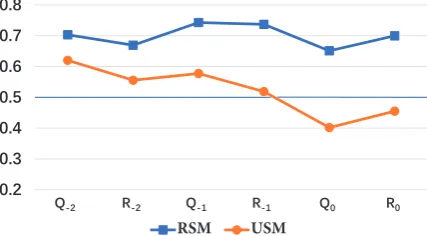
In order to illustrate the difference between USM and RSM in an intuitive way, we calculate the risk of negative feedback for each time step in these two recurrent models with the input of the ses-sion shown in Figure 1. The outputs of recurrent layer of each time step are used as inputs of the full-connection layer and the softmax regression results are considered as the probabilities of user’s dissatisfaction.
澤澢澦 澤澢澧 澤澢澨 澤澢澩 澤澢澪 澤澢澫 澤澢澬
34. 64.
[image:7.595.309.523.213.331.2]濅澡澥 濆澡澥 濅澤 濆澤 濅澡澦 濆澡澦
Figure 3: The probabilities of negative feedback for each utterance in sessions in Figure 1.
The line chart of the sequence of probabilities of the two models are shown in Figure 3. The ten-dencies of these two line are similar. It is due to the fact that the gates controlled byR0 shrink the activations of recurrent layer and adjust the scales of values without changing the quadrant or feature space.
For the same utteranceQ−2, there’s a difference
between the probabilities of these two models, and the gap between the two line get more obvious after Q−1 is input. BothQ−2 andQ−1 contains
negative emotions and possibly lead to dissatisfac-tion. Thus, the probabilities of negative feedback increase at the corresponding time step. However, the gated activations in RSM change more sharply. It indicates that the emotional inconsistency be-tween R0 and these two user messages lead to a
further increasing of risk through the gated adjust-ment.
Finally, the RSM predicts that the negative feed-back will occur in the next time step (with the probabilities larger than 0.5), which is true accord-ing to the corpus. However, the USM fails to make the correct prediction.
Models NPT UPT BPT
UM-R0 0.5365 0.5232 0.5495
UPM-Q0R0 0.5619 0.5547 0.5623
USM-EU 0.5865 0.5808 0.6022
[image:8.595.87.280.61.131.2]RSM-EU 0.5939 0.5782 0.6106
Table 3: Comparison of accuracies with no pre-training (NPT), unbalanced pre-pre-training (UPT) and balanced pre-training (BPT)
training process. The comparison of accuracy of these strategies are shown in Table 3.
Unbalanced pre-training strategy leads to a worse performance than only using manually la-belled data. As discussed in 4.2.2, when a false rule is learned, a particularR0 is associated with
a wrong label, which hurts the performance obvi-ously. Moreover, during the experimental process of unbalanced pre-training, it is observed that the models involving more context achieve better re-sult than those only usingR0 as input. It is due to that the existence of the strong correlation be-tweenR0 and the label itself is an inaccurate
pat-tern, no matter whether the label is correct. The pre-training data encoding such strong correlation will makes the models ignore the context utterance and convergence to the local optimum only related toR0.
However, the balanced pre-training dataset is effective in initializing the networks. The experi-mental results show that the balanced pre-training improves the performance of the networks. The underlying reason is that the pre-training process provides a better initialization for the networks, and the converging process of tuning continues based on an initial optimization.
4.5.4 Other Discussions
Directionality: Bi-directional and backward-directional recurrent networks are tested. Both structures lead to drop in accuracy (about 1%). We see that the last response R0 is the essential determinant of emotion, the basic forward RNN structure has a bias on the last time steps for be-ing free from the influence of small recurrent con-nection weight matrix. While adding backward-directional processing involving more parameters and weaken the influence ofR0andQ0-R0pair.
Filter Size:Inspired by the SVM baseline mod-els performing not worse than the utterance model, we introduce1×1 filters, working together with 2×1ones, and such setting achieves an
improve-ment by about 1% than only using 2 × 1 ones (from 0.6019 to 0.6106 with RSM). In practice, the larger filter size (e.g. 3, 4 or 5) leads to insta-bility in the prediction. It is due to the fact that the utterances conversations are relatively short. Fea-tures within a uni-gram or bi-gram window is el-igible for representing the emotional information. Although covering some sparse features, involving more larger filters results in risk of over-fitting.
5 Conclusion and Future Work
In this paper, we propose the problem of predict-ing users impendpredict-ing negative feedbacks by mod-elling the context queries and replies in human-agent conversation. Four kinds of influencing fac-tors, (1) the computer’s last responseR0, (2) the
relation of last turn dialogue pair Q0-R0, (3) the
sequence of all utterance and (4) the sequence of relation between utterances, are modelled with deep neural networks. The experimental results show that these factors indeed influence the emo-tional trend. We have encoded the possibility of dissatisfaction by representing the sequence of re-lation between utterances with a gated convolu-tional recurrent neural network. Tested on the real-world human-agent dialogue dataset, the proposed architecture outperforms the existing conversation models. Besides, balanced sampling on distance supervision labelled data are shown to be reliable in network pre-training.
The accuracies of prediction is only about 60%, we see that different users show different emo-tional feedbacks towards the same context. Thus, there are a few potential explorations: (1) build corpus on fine-grained emotional categories and (2) predict the emotional distribution on these cat-egories instead of classifying into a certain one. Moreover, we would like to apply the emotional risk to the response ranking to improve the user experience of dialogue system.
Acknowledgments
References
David Ameixa, Luisa Coheur, Pedro Fialho, and Paulo Quaresma. 2014. Luke, I am Your Father: Dealing with Out-of-Domain Requests by Using Movies Sub-titles.
Rafael E. Banchs and Haizhou Li. 2012. Iris: a chat-oriented dialogue system based on the vector space model. InACL 2012 System Demonstrations, pages 37–42.
Junyoung Chung, Caglar Gulcehre, Kyung Hyun Cho, and Yoshua Bengio. 2014. Empirical evaluation of gated recurrent neural networks on sequence model-ing. Eprint Arxiv.
Yann N. Dauphin, Angela Fan, Michael Auli, and David Grangier. 2016. Language modeling with gated convolutional networks.
Xavier Glorot and Yoshua Bengio. 2010. Understand-ing the difficulty of trainUnderstand-ing deep feedforward neural networks. Journal of Machine Learning Research, 9:249–256.
Alec Go, Richa Bhayani, and Lei Huang. 2009. Twit-ter sentiment classification using distant supervision.
CS224N Project Report, Stanford, pages 1–12. Jonathan Herzig, Guy Feigenblat, Michal
Shmueli-Scheuer, David Konopnicki, Anat Rafaeli, Daniel Altman, and David Spivak. 2016. Classifying emo-tions in customer support dialogues in social media. In Meeting of the Special Interest Group on Dis-course and Dialogue.
Ryuichiro Higashinaka, Kotaro Funakoshi, Masahiro Araki, Hiroshi Tsukahara, Yuka Kobayashi, and Masahiro Mizukami. 2015. Towards taxonomy of errors in chat-oriented dialogue systems. In Meet-ing of the Special Interest Group on Discourse and Dialogue, pages 87–95.
Baotian Hu, Zhengdong Lu, Hang Li, and Qingcai Chen. 2014. Convolutional neural network architec-tures for matching natural language sentences. In In-ternational Conference on Neural Information Pro-cessing Systems, pages 2042–2050.
Minqing Hu and Bing Liu. 2004. Mining opinion fea-tures in customer reviews. InAAAI, volume 4, pages 755–760.
Ozan ˙Irsoy and Claire Cardie. 2015. Modeling compo-sitionality with multiplicative recurrent neural net-works. In International Conference on Learning Representations (ICLR).
Zongcheng Ji, Zhengdong Lu, and Hang Li. 2014. An information retrieval approach to short text conver-sation. Computer Science.
Nal Kalchbrenner and Phil Blunsom. 2013. Recurrent convolutional neural networks for discourse compo-sitionality.Computer Science.
Yoon Kim. 2014. Convolutional neural networks for sentence classification. Eprint Arxiv.
Linchuan Li, Zhiyong Wu, Mingxing Xu, Helen Meng, and Lianhong Cai. 2016. Combining cnn and blstm to extract textual and acoustic features for recogniz-ing stances in mandarin ideological debate competi-tion. InINTERSPEECH, pages 1392–1396. Weiyuan Li and Hua Xu. 2014. Text-based
emo-tion classificaemo-tion using emoemo-tion cause extracemo-tion.
Expert Systems with Applications An International Journal, 41(4):1742–1749.
Hsin Yih Lin, Changhua Yang, and Hsin Hsi Chen. 2007. What emotions do news articles trigger in their readers? InSIGIR 2007: Proceedings of the International ACM SIGIR Conference on Research and Development in Information Retrieval, Amster-dam, the Netherlands, July, pages 733–734. Bo Pang, Lillian Lee, and Shivakumar Vaithyanathan.
2002. Thumbs up?: sentiment classification using machine learning techniques. InAcl-02 Conference on Empirical Methods in Natural Language Pro-cessing, pages 79–86.
Xipeng Qiu and Xuanjing Huang. 2015. Convolutional neural tensor network architecture for community-based question answering. InInternational Confer-ence on Artificial IntelligConfer-ence, pages 1305–1311. Alan Ritter, Colin Cherry, and William B Dolan. 2011.
Data-driven response generation in social media. In
Conference on Empirical Methods in Natural Lan-guage Processing, pages 583–593.
Iulian V. Serban, Alessandro Sordoni, Yoshua Bengio, Aaron Courville, and Joelle Pineau. 2016. Building end-to-end dialogue systems using generative hier-archical neural network models. Computer Science, (4).
Lifeng Shang, Zhengdong Lu, and Hang Li. 2015. Neural responding machine for short-text conversa-tion. Computer Science.
Richard Socher, Alex Perelygin, Jean Y Wu, Jason Chuang, Christopher D Manning, Andrew Y Ng, and Christopher Potts. 2013. Recursive deep mod-els for semantic compositionality over a sentiment treebank. InProceedings of the Conference on Em-pirical Methods in Natural Language Processing (EMNLP), pages 1631–1642.
Ryoko Tokuhisa, Kentaro Inui, and Yuji Matsumoto. 2009. Emotion classification using massive exam-ples extracted from the web. InCOLING 2008, In-ternational Conference on Computational Linguis-tics, Proceedings of the Conference, 18-22 August 2008, Manchester, Uk, pages 881–888.
Oriol Vinyals and Quoc Le. 2015. A neural conversa-tional model. Computer Science.
Mingxuan Wang, Zhengdong Lu, Hang Li, Wenbin Jiang, and Qun Liu. 2015. gencnn: A convolutional architecture for word sequence prediction. Com-puter Science.
Bowen Wu, Baoxun Wang, and Hui Xue. 2016. Rank-ing responses oriented to conversational relevance in chat-bots.
Zhen Xu, Bingquan Liu, Baoxun Wang, Chengjie Sun, and Xiaolong Wang. 2016. Incorporating loose-structured knowledge into conversation modeling via recall-gate lstm.
Changhua Yang, Hsin Yih Lin, and Hsin Hsi Chen. 2007. Emotion classification using web blog cor-pora. InWeb Intelligence, IEEE/WIC/ACM Interna-tional Conference on, pages 275–278.
Wenpeng Yin, Hinrich Schtze, Bing Xiang, and Bowen Zhou. 2015. Abcnn: Attention-based convolutional neural network for modeling sentence pairs. Com-puter Science.
Zhou Yu, Leah Nicolich-Henkin, Alan W Black, and Alex I. Rudnicky. 2016. A wizard-of-oz study on a non-task-oriented dialog systems that reacts to user engagement. In Meeting of the Special Interest Group on Discourse and Dialogue, pages 55–63. Chunting Zhou, Chonglin Sun, Zhiyuan Liu, and