Revisions that Improve Cohesion in Multi-document Summaries:
A Preliminary Study
Jahna C. Otterbacher, Dragomir R. Radev and Airong Luo
School of Information
University of Michigan
Ann Arbor, MI 48109-1092
{clear, radev, airongl}@umich.edu
Abstract
Extractive summaries produced from multiple source documents suffer from an array of prob-lems with respect to text cohesion. In this pre-liminary study, we seek to understand what problems occur in such summaries and how of-ten. We present an analysis of a small corpus of manually revised summaries and discuss the feasibility of making such repairs automati-cally. Additionally, we present a taxonomy of the problems that occur in the corpus, as well as the operators which, when applied to the summaries, can address these concerns. This study represents a first step toward identifying and automating revision operators that could work with current summarization systems in order to repair cohesion problems in multi-document summaries.
1
Introduction
With the increasing availability of online news sources, interest in automatic summarization has continued to grow in recent years. Many systems have been developed for this purpose, including those that can produce summaries based on several documents (Multi-document summarization, or MDS). Generally speaking, most of these systems work by extracting sentences from the original texts. Although significant improvements continue to be made to such summarizers, they still cannot produce summaries that resemble those written manually by humans. One area in particular in which the automatically produced summaries dif-fer markedly is text cohesion.
Whether a summary is produced from one or more documents, important context may be ex-cluded from the summary that disrupts its
readabil-ity. A text is not a random collection of sentences, but rather, each sentence plays a role in conveying the ideas the author wants to express. Selecting sentences from multiple texts one at a time disre-gards this interdependence between sentences. As a result, summaries often suffer from problems of cohesion.
1.1
Text cohesion and coherence[Halliday & Hasan, 1976] offer a clear definition for text cohesion:
[The concept of cohesion] refers to relations of meaning that exist within the text, and that define it as a text. Cohesion occurs where the interpretation of some element in the discourse is dependent on that of another (p.2).
It is this property of cohesion that allows the reader to comprehend the overall meaning of a text, and to understand the author’s intentions. Therefore, in automatically produced summaries, cohesion problems should be resolved. Otherwise, the resulting text may be unintelligible, or worse, misleading.
1.2
Problems of cohesion in automatically pro-duced summariesThe following is an example of a summary pro-duced automatically from one source document.
[1] More than 130 bodies are reported to have been recovered after a Gulf Air jet carrying 143 people crashed into the Gulf off Bahrain on Wednesday. [2] Distraught relatives also gathered at Cairo airport, demanding information. [3] He also declared three days of national mourning. [4] He said the jet fell “sharply, like an arrow.”
The most obvious problem with this summary is that in the last two sentences, the pronouns have no
antecedents; as a result, the reader does not know who the subjects of the sentences are. In addition, the adverb ‘also,’ used in both the second and third sentences, makes reference to previous events not described in the summary. Another concern is that there seems to be no transition between the sen-tences. The context from the source article neces-sary to make the text cohesive is missing from the summary. As a result, the summary is unintelligi-ble.
1.3
Text cohesion in MDSUsing multiple documents to generate a summary further complicates the situation. As contended by [Goldstein et al, 2000] a multi-document summary may contain redundant messages, since a cluster of news articles tends to cover the same main point and shared background. In addition, articles from various sources could contradict one another, as to how or when an event developed. Finally, since the source articles are not all written simultane-ously, they may describe different stages of the development of an event. Not only do news stories come to different conclusions at various stages in an event, but also the attitudes of writers may change.
Multi-document summaries may suffer further from problems of cohesion since their source arti-cles may be written by different authors. Not only do writers have their own styles, they have the overarching structure of the article in mind when producing it. As a result, in MDS we are more likely to encounter text that is not cohesive.
Previous research has addressed revision in single-document summaries [Jing & McKeown, 2000] [Mani et al, 1999] and has suggested that revising summaries can make them more informa-tive and correct errors. We believe that a generate-and-revise strategy might also be used in creating better multiple-document summaries, within the framework of current extractive summarization systems. However, as mentioned previously, there is reason to believe that multi-document summa-ries suffer from many different coherence prob-lems and that such probprob-lems occur more often than in single-document summaries. Therefore, an im-portant preliminary step in determining how we might revise such summaries is to closely examine the cohesion problems that occur in multi-document summaries.
In the current paper we analyze a small corpus of manually revised multi-document summaries. We present a taxonomy of pragmatic concerns with respect to cohesion in the summaries, as well as the operators that can address them. Finally, we will discuss the feasibility of implementing such revisions automatically, which we hope to address in our future work.
2
Background and previous work
2.1
Theories on discourse structureRhetorical Structure Theory (RST) [Mann & Thompson, 1988] has contributed a great deal to the understanding of the discourse of written documents. RST describes the coherence nature of a text and is based on the assumption that the ele-mentary textual units are non-overlapping text spans. The central concept of RST is the rhetorical relation, which indicates the relationship between two spans.
RST can be used in sentence selection for sin-gle document summarization [Marcu, 1997]. However, it cannot be applied to MDS. In RST, text coherence is achieved because the writer in-tentionally establishes relationships between the phrases in the text. This is not the case in MDS, where sentences are extracted from different source articles, written by various authors.
Inspired by RST, [Radev, 2000] endeavored to establish a Cross-document Structure Theory (CST) that is more appropriate for MDS. CST fo-cuses on the relationships between sentences that come from multiple documents, which vary sub-stantially from those between sentences in the same text. Such relationships include identity, paraphrase and subsumption (one sentence con-tains more information than the other).
2.2
Computational models of text coherencealgorithms that generate the cohesion structure of texts represented by a lexical path.
[Hovy, 1993] summarized previous work that focused on the automated planning and generation of multi-sentence texts using discourse relation-ships. Text generation is relevant to MDS, as we can view MDS as an attempt to generate a new text by reusing sentences from different sources. The systems discussed in [Hovy, 1993] relied on a knowledge base and a representation of discourse structure. The dependency of text generation on knowledge of discourse structure was emphasized.
2.3
Revision of single-document summaries[Mani et al, 1999] focused on the revision of sin-gle-document summaries in order to improve their informativeness. They noted that such revision might also fix ‘coherence errors.’ Three types of revision operators were identified: sentence com-paction, sentence aggregation and sentence smoothing. To contrast, [Jing & McKeown, 2000] concentrated on analyzing human-written summa-ries in order to determine how professionals con-struct summaries. They found that most sentences could be traced back to specific cut-and-paste op-erations applied to the source document. They identified six operations and used them to imple-ment an automatic revision module.
2.4
Temporal ordering of events[Filatova & Hovy, 2001] addressed the issue of resolving temporal references in news stories. Al-though events in articles are not always presented in chronological order, readers must be able to re-construct the timeline of events in order to com-prehend the story. They endeavored to develop a module that could automatically assign a time stamp to each clause in a document. Using a syn-tactic parser, patterns were discovered as to which syntactic phrases tend to indicate the occurrence of a new event. In MDS, the correct temporal rela-tionships between events described in the extracted sentences often needs to be reestablished, since they may be incorrect or unclear.
[Barzilay et al, 2001] evaluated three algo-rithms for sentence ordering in multi-document summaries. One algorithm implemented was the Chronological Ordering algorithm. However, the resulting summaries often suffered from abrupt changes in topic. After conducting an experiment
in which they studied how humans manually or-dered sentences in a summary, they concluded that topically related sentences should be grouped to-gether. The Chronological Ordering algorithm was augmented by introducing a cohesion constraint. The evaluation of the output summaries demon-strated a significant improvement in quality.
3
Revision-based system architecture
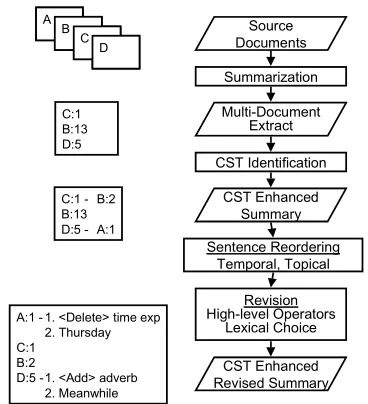
The proposed architecture of our system, which would implement the generate-and-revise approach to summarization, is depicted in Figure 1. Input to this system is a cluster of source documents related to the same topic. Next, sentence extraction takes place, in which important sentences in the articles are identified. The output of this module is an ex-tract, which lists the sentences to be included in the summary.
In the next stage, Cross-document Structure Theory (CST) relationships are established. Spe-cific relationships between sentences are identified. Here, a CST-enhancement procedure [Zhang et al, 2002] may take place, ensuring that interdependent sentences appear together in a summary. Sen-tences may also be reordered in the summary with respect to their temporal relations, topic, or other criteria.
The next stage in the process is the revision module. First, high level revision operators are chosen, with respect to the cohesion problems that need repair. Afterwards, the specific lexical items to be added, deleted or modified are chosen. The output of this module is the revised, enhanced summary.
3.1
The MEAD summarizerSummarization
CST Identification
C:1 - B:2 B:13 D:5 - A:1
Sentence Reordering Temporal, Topical
Revision High-level Operators
Lexical Choice
A:1 - 1. <Delete> time exp 2. Thursday C:1
B:2
D:5 -1. <Add> adverb 2. Meanwhile
Multi-Document Extract
CST Enhanced Summary
CST Enhanced Revised Summary
Source Documents
A B
C D A
B C
D
[image:4.612.92.276.63.265.2]C:1 B:13 D:5
Figure 1: Revision-based MDS architecture: Letters denote documents; numbers denote sen-tence numbers (within documents)
4
Data and procedure
We generated a corpus of summaries using the MEAD summarizer. The original documents come from three sources – DUC 2001, the Hong Kong News corpus, and the GA3-11 data set. One clus-ter of related news articles was chosen from each source. The DUC 2001 articles describe the 1991 eruption of Mount Pinatubo in the Philippines. This cluster, which is not typical of the DUC data, focuses on this single event and its subevents over a 2-week time period. Those taken from the HK corpus are about government initiatives surround-ing the problem of drug rehabilitation. Due to the expense and labor involved in the generation and revision of multi-document summaries, we have used a subset of 15 summaries from our corpus in order to develop our revision taxonomy and to pre-sent some initial findings. Our future revision studies will employ a much larger set of data.
The summaries were revised manually by the first author. This was a three-step process that in-volved identifying each problem, choosing an operator that could address the problem and then selecting the lexical items to which the operator should be applied. It is important to note that mul-tiple lexical choices are possible in some cases.
Since we were interested in identifying all types of cohesion problems as well as considering all possibilities for addressing these problems, the reviser was permitted to make any revision neces-sary in order to correct problems in the summaries.
Obviously, a module that makes revisions auto-matically would be much more restricted in its set of revision operators. However, since a major goal for this paper was to establish a taxonomy of prob-lems specific to multi-document summarization and to consider the complexities involved in mak-ing repairs in MDS, we did not place such restric-tions on the reviser. Rather, she applied corrections to the summaries as to make them as intelligible as possible, given the sentences chosen by the summarizer.
Source Length
(sentences) #Source documents
DUC 2001 3 3 DUC 2001 3 3 DUC 2001 5 3 DUC 2001 6 5 DUC 2001 9 5
GA3-11 3 3
GA3-11 3 5
GA3-11 6 5
GA3-11 8 3
GA3-11 7 3
HK-125 3 3
HK-125 5 3
HK-125 6 5
HK-125 5 5
[image:4.612.330.520.215.407.2]HK-125 8 3
Table 1: Summaries from training data
4.1
Revision example<DELETE-place stamp> Cairo, Egypt – </DELETE> The crash of a Gulf Air flight that killed 143 people in Bahrain <ADD-time exp-day>Wednesday </ADD> is a disturbing déjà vu for Egyptians: It is the second plane crash within a year to devastate this Arab country. Egypt, which lacks the oil wealth of the Gulf and has an economy struggling to re-vive from decades of socialist stagnation, has a long tradi-tion of sending workers to the Gulf to fill everything from skilled to menial jobs. <DELETE-place stamp> Manama, Bahrain (AP) – </DELETE> <ADD-time exp-day> On Fri-day, </ADD> three bodies wrapped in cloth, one the size of a small child, were lain before the faithful in the Grand Mosque during a special prayer for the dead in honor of the <DELETE-redundancy> 143 </DELETE> victims of the <DELETE-overspecified entity> Gulf Air </DELETE> crash. Bahrain’s Prime Minister Sheik Khalifa bin Salman Al Khalifa and other top officials stood side-by-side with 2,000 Muslins reciting funeral prayers before the bodies, <DELETE-redundancy> which were among the 107 adults and 36 children killed in Wednesday’s air disaster, </DELETE> said Information Ministry spokesman Syed el-Bably.
Figure 2: Revised multi-document summary
arti-cles from the GA3-11 corpus. The news stories were collected live from the web, and come from two different sources www.foxnews.com and www.abcnews.com. The revision operator used and the corresponding pragmatic concern precede the modified text in pointed brackets. This type of markup scheme was used because it enables us to use simple Perl scripts to move between the origi-nal and revised versions of the summaries.
5
Taxonomy of revision strategies
Based on our corpus of revised summaries, we have identified five major categories of pragmatic concerns related to text cohesion in multi-document summaries:
1) Discourse – Concerns the relationships be-tween the sentences in a summary, as well as those between individual sentences and the overall summary.
2) Identification of entities – Involves the reso-lution of referential expressions such that each entity mentioned in a summary can eas-ily be identified by the reader.
3) Temporal – Concerns the establishment of the correct temporal relationships between events.
4) Grammar – Concerns the correction of grammatical problems, which may be the re-sult of juxtaposing sentences from different sources, or due to the previous revisions that were made.
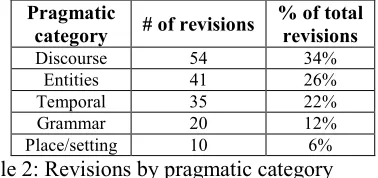
5) Location/setting – Involves establishing where each event in a summary takes place. Explanations of the specific pragmatic concerns in each category, as well as their corresponding op-erator(s), are detailed in the appendix. Overall, 160 revisions were made across the 15 summaries.
Pragmatic
category # of revisions % of total revisions
[image:5.612.89.278.596.685.2]Discourse 54 34% Entities 41 26% Temporal 35 22% Grammar 20 12% Place/setting 10 6%
Table 2: Revisions by pragmatic category
The majority (82%) of the revisions fall into the first three categories. This is not surprising, as
in MDS, we expect to find many problems relating to discourse – such as abrupt topic shifts or redun-dant messages. Additionally, concerns relating to the identification of entities in the text are likely to occur when the sentence from the original docu-ment that introduced an entity is not included in the resulting summary, but sentences that make reference to the entity are included. Finally, it may not be clear when events described in a summary occurred. This could be because sentences which stated when the event occurred were left out of the summary or because the sentences include relative time expressions such as ‘today’ even though the stories were written at different times or on differ-ent days.
Revisions relating to grammar or to establish-ing where an event occurred were less frequently used, accounting for only 12% and 6% of the total repairs, respectively. Sentences extracted from the original news stories are usually grammatical. However, problems related to grammar may arise from previous revisions. In our corpus, the place or setting of an event was typically obvious in the summary and rarely required repair.
Next, we present the analysis of revisions within each of the five categories. We are inter-ested in revising our summaries to be as coherent as possible, without having to implement compli-cated and knowledge-intensive discourse models. Therefore, we will discuss the feasibility of im-plementing the revisions in our taxonomy auto-matically.
5.1
Discourse-related concerns in MDSIt is intuitive that problems relating to discourse are abundant in our summaries and, at the same time, that such repairs would be the most difficult to make. The first obstacle is the detection of each of these concerns, which requires knowledge of the rhetorical relations of the sentences in the sum-mary.
Problem Number (%)
1) Topic shift 24 (45%) 2) Purpose 18 (33%) 3) Contrast 6 (11%) 4) Redundancy 6 (11%) 5) Conditional 0
[image:5.612.343.510.604.692.2]Total 54
Table 3: Discourse-related revisions
was added to provide a transition or motivation for the troublesome sentence. Therefore, our module would require the ability to generate text, in order to repair these problems, which occur often in our summaries.
5.2
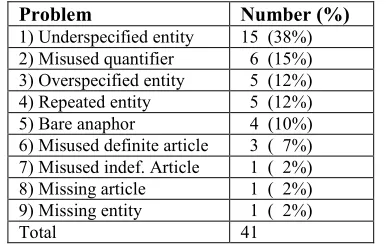
Identification of entities in MDSNine specific problems were found that concern the reader’s ability to identify each entity men-tioned in a summary. Most of these revisions could be made using rewrite rules. For example, if it can be determined that a definite article is used when a (non-proper noun) entity is mentioned for the first time, the misused definite article could be replaced with the corresponding indefinite article.
The most frequent problem, underspecified en-tity, is the most difficult one to correct. This dis-fluency typically occurs where an entity is referred to by a proper noun or other noun phrase, such as the name of a person or organization, but has no title or further description. In such cases, the miss-ing information may be found in the source docu-ment only.
Problem Number (%)
1) Underspecified entity 15 (38%) 2) Misused quantifier 6 (15%) 3) Overspecified entity 5 (12%) 4) Repeated entity 5 (12%) 5) Bare anaphor 4 (10%) 6) Misused definite article 3 ( 7%) 7) Misused indef. Article 1 ( 2%) 8) Missing article 1 ( 2%) 9) Missing entity 1 ( 2%)
[image:6.612.336.511.162.254.2]Total 41
Table 4: Revisions concerning entity identification Therefore, to correct the underspecified entity problem, a revision module might require a knowl-edge source for the profiles of entities mentioned in a summary. When an entity is introduced for the first time in a summary, it should be associated with its description (such as a title and full name for a person).
Discourse information would be useful for solving problems such as a bare anaphor or miss-ing subject. In revismiss-ing smiss-ingle-document summa-ries, [Mani et al, 1999] employed rules such as the referencing of pronouns with the most recently mentioned noun phrase. However, this might be inappropriate in MDS, where the use of multiple documents increases the number of possible enti-ties with which an anaphor could be referenced.
5.3
Temporal relationships in MDSAn important aspect of revision in MDS is the es-tablishment of the correct temporal relationships between the events described in a summary. We have identified five types of problems that fall into this category.
Problem Number (%)
1) Temporal ordering 31 (89%) 2) Time of event 2 (6%) 3) Event repetition 1 (2.5%) 4) Synchrony 1 (2.5%) 5) Anachronism 0
[image:6.612.90.284.377.499.2]Total 35
Table 5: Temporal relationships revisions
The most frequent revision in this category for our multi-document summaries was temporal or-dering. This is an important consideration for the summarization of news articles, which typically describe several events or a series of events in a given news story.
A revision module might use metadata, includ-ing the time stamps of source documents, in addi-tion to surface properties of sentences in addressing this problem. Temporal relations were typically established by adding a time expression to one or more sentences in a summary. Therefore, our module will require a dictionary of such ex-pressions as well as a set of rules for assigning an appropriate expression to a given sentence. For example, if the time stamps of two source docu-ments from which two adjacent summary sen-tences come indicate that they were written one day apart, an appropriate way to order them might be: add a time expression indicating the day to the first sentence, and a relative time expression such as ‘the following day’ to the second sentence. Our dictionary will require both relative and absolute time expressions at different levels of granularity (hour, day, etc.).
5.4
Grammatical concerns in MDSThe majority of grammatical problems in our cor-pus resulted from previous revisions performed on the text. For example, the addition of information to a sentence can result in it becoming too long. Such concerns can also occur because the grammar of one sentence, such as verb tense, does not match that of the next sentence.
Problem Number (%)
1) Run-on sentence 7 (35%) 2) Mismatched verb 3 (15%) 3) Missing punctuation 3 (15%) 4) Awkward syntax 3 (15%) 5) Parenthetical 2 (10%) 6) Subheading/titles 1 ( 5%) 7) Misused adverb 1 ( 5%)
[image:7.612.97.273.190.302.2]Total 20
Table 6: Grammatical revisions
A revision module should be able to correct the above concerns using rules applied after other revisions are made and without any discourse knowledge.
5.5
Location/setting concernsThe least frequent type of revision made in our corpus related to establishing the correct locations of events in a summary. Occasionally, a sentence in a summary retains the place/source stamp that appears at the beginning of a news article. This appears ungrammatical unless the sentence is the first in the summary.
Problem Number (%)
1) Place/source stamp 6 (60%) 2) Place of event 4 (40%) 3) Collocation 0 4) Change of location 0
Total 10
Table 7: Location/setting concerns
In addition, such stamps might be inappropriate for a summary, since not all the sentences may share the same location. In order to promote cohesion in the summary, our module could move the stamp information into the body of the summary.
Sentences could be missing location informa-tion altogether. In such cases, the revision module might require information from the source docu-ments in order to repair this problem. Overall, the revisions related to establishing the location of events should not require knowledge of discourse in the summary. Adding location information can
usually be performed with the addition of a prepo-sitional phrase, usually at the beginning of the sen-tence.
6
Conclusions and future work
This paper represents preliminary work in our ef-forts to address problems of text cohesion and co-herence in multi-document summaries via revision. As a first step, we need to identify the specific problems that occur in MDS and consider how we might address such concerns. To this end, we have investigated the optimal revisions that were per-formed on a small set of summaries. From this analysis, we have formulated a taxonomy of prag-matic concerns and their operators for repairing multi-document summaries.
Knowledge of discourse and text generation
<ADD> transitional phrase or sentence;
<ADD> motivational phrase or sentence;
Knowledge of discourse
Knowledge source (entity descriptions)
Meta data and dictionary of expressions
Sentence surface structure
<DELETE> Redundant information
<ADD/MODIFY> discourse markers
<ADD/MODIFY> description of entity mentioned for first time
<ADD/MODIFY> Time expression
Grammar corrections; <MODIFY/ADD/DELETE> definite or indefinite articles;
<MODIFY/ADD/DELETE> location of event
Op
er
a
tion C
o
mplexit
[image:7.612.331.525.290.497.2]y
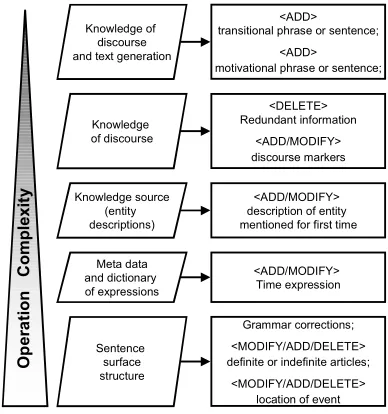
Figure 3: Continuum of revision operations
[image:7.612.88.278.488.562.2]CST since revision required in a given summary depends on the relationships between sentences. Finally, we would like use the corpus of data we have collected to learn revision automatically.
Acknowledgments
The authors would like to thank Naomi Daniel, Hong Qi, Adam Winkel, Zhu Zhang and three anonymous reviewers for their helpful comments and feedback on this paper. This work was par-tially supported by the National Science Founda-tion’s Information Technology Research program (ITR) under grant IIS-0082884.
The version of MEAD that we used was de-veloped at the Johns Hopkins summer workshop in 2001 under the direction of Dragomir Radev. We want to thank the following individuals for their work on MEAD: Sasha Blair-Goldensohn, John Blitzer, Arda Celebi, Elliott Drabek, Wai Lam, Danyu Liu, Hong Qi, Horacio Saggion and Simone Teufel.
References
[Barzilay et al, 2001] Regina Barzilay, Noemie Elhadad, and Kathleen R. McKeown. Sentence ordering in multi-document summarization. In Proceedings of HLT, San Diego, CA, 2001.
[Filatova & Hovy, 2001] Elena Filatova and Edu-ard Hovy. Assigning time-stamps to event-clauses. In Proceedings, ACL Workshop on Temporal and Spatial Information Processing, Toulouse, France, July 2001.
[Goldstein et al, 2000] Jade Goldstein, Mark Kan-trowitz, Vibhu Mittal, and Jamie Carbonell. Sum-marizing text documents: sentence selection and evaluation metrics. In Proceedings of the 22nd ACM SIGIR Conference on Research and Devel-opment in Information Retrieval, Berkeley, CA, 1999.
[Halliday & Hasan, 1976] M. Halliday and R. Hasan. Cohesion in English. London: Longman, 1976.
[Harabagiu, 1999] Sanda M. Harabagiu. From lexical cohesion to textual coherence: a data driven perspective. Journal of Pattern Recognition and Artificial Intelligence, 13(2): 247-265, 1999. [Hovy, 1993] Eduard Hovy. Automated discourse generation using discourse structure relations.
Ar-tificial Intelligence 63, Special Issue on Natural Language Processing, 1993.
[Jing & McKeown, 2000] Hongyan Jing and Kathleen R. McKeown. Cut and paste based text summarization. In Proceedings of the 1st Confer-ence of the North American Chapter of the Asso-ciation for Computational Linguistics (NAACL'00), Seattle, WA, May 2000.
[Mani et al, 1999] Inderjeet Mani, Barbara Gates, and Eric Bloedorn. Improving summaries by re-vising them. In Proceedings of the 37th Annual Meeting of the ACL ’99, pages 558-565, Mary-land, 1999.
[Mann & Thompson, 1988] William C. Mann and Sandra A. Thompson. Rhetorical structure theory: toward a functional theory of text organization. Text, 8(3), 1988.
[Marcu, 1997] Daniel Marcu. From discourse structure to text summaries. In Proceedings of the ACL ’97 EACL ’97 Workshop on Intelligent Scal-able Text Summarization, pages 82-88, Madrid, Spain, July 1997.
[Marcu, 2000] Daniel Marcu. The theory and practice of discourse parsing and summarization, The MIT Press, November 2000.
[Radev, 2000] Dragomir Radev. A common the-ory of information fusion from multiple text sources, step one: cross-document structure. In Proceedings, 1st ACL SIGDIAL Workshop on Discourse and Dialogue, Hong Kong, October 2000.
[Radev et al, 2000] Dragomir R. Radev, Hongyan Jing and Malgorzata Budzikowska. Centroid-based summarization of multiple documents: sentence, extraction, utility-based evaluation, and user stud-ies. In ANLP/NAACL Workshop on Summariza-tion, Seattle, WA, April 2000.
[Radev et al, 2002] Dragomir Radev, Simone Teu-fel, Horacio Saggion, Wai Lam, John Blitzer, Arda Celebi, Hong Qi, Daniu Liu and Elliot Drabek. Evaluation challenges in large-scale multi-document summarization: the MEAD project. Submitted to SIGIR 2002, Tampere, Finland, Au-gust 2002.
Appendix - Taxonomy of revisions in MDS
Description Operator(s) Example
I. Discourse
1) Topic shift In moving from one sentence to another, the topic shifts suddenly
ADD transitional sen-tence or phrase
In a related story, the government of Hong Kong announced a proposal to require all drug rehabilitation centers.... 2) Purpose Sentence lacks purpose
in the context of the summary
ADD a sentence or phrase that motivates the problematic seg-ment
In order to assist the ongoing investiga-tion as to the cause of the crash, the U.S. team from the National Transporta-tion Safety Board will join experts… 3) Contrast Information in a given
sentence contrasts with that in one or more previous sentences
ADD a discourse marker such as ‘how-ever’ or ‘to contrast’ MODIFY existing dis-course marker
However, according to reports on CNN, the control tower was concerned with the velocity and altitude of the plane, and had discussed these concerns with the pilot.
4) Redundancy Sentence contains in-formation that was pre-viously reported
DELETE the redundant constituent (non-head element of NP, PP or an entire relative clause or phrase)
The crash of flight 072 that killed 143 people…The plane, which was carrying the 143 victims, washeaded to Bahrain from Egypt.
5) Conditional Events in a given sen-tence are conditioned on events in another sentence
MODIFY the two sen-tences: IF (sentence one), (sentence two). Change verb tenses to conditional.
If the proposed measure were imple-mented, it would ensure broadly the same registration standard to be applied to all drug treatment centers.
II. Entities
1) Underspecified
entity A newly mentioned entity has no descrip-tion or title; acronym is used with no name
ADD full name, de-scription or title for new entity; MODIFY acro-nym by expanding
Mrs. Clarie Lo, the Commissioner of Narcotics, said the proposal would be introduced for non-medical drug treat-ment centers.
2) Overspecified
entity A noun phrase referring to an entity contains redundant information (full name and title, etc.)
DELETE the redundant non-head elements of the NP; MODIFY alias a name
Scientists around the world have been monitoring Mount Pinatubo…David Harlow, a ‘guerrilla seismologist,’ made accurate predictions of the eruptions of
the volcano.
3) Repeated entity A noun phrase describ-ing an entity occurs too often in a given context.
MODIFY replace NP with a pronoun; MODIFY use acronym
In April 2000, Mrs. Lo announced that the number of young people abusing drugs fell in 1999. She said, “The num-ber of drug abusers aged below 21…” 4) Missing entity Sentence is missing
subject/agent (perhaps as result of previous revision)
ADD noun phrase or pronoun
…the 28,000 Americans, who work at nearby naval bases. They crowded into Subic Bay Naval Base as a bizarre tropi-cal blizzard…
5) Misused
indefi-nite article An indefinite article is used with a previously introduced entity
MODIFY change in-definite article to defi-nite.
The government of announced a pro-posal…One year later, it announced that it intends to implement the proposed scheme.
6) Misused definite
article A definite article is used with a new entity MODIFY change defi-nite article to indefinite article if entity is new.
On Thursday, a second eruption ap-peared to be smaller than anticipate.
7) Missing article Entity is missing an article
ADD definite article if entity has already been mentioned; ADD in-definite article if entity is new
The newspapers of Bahrain include: Al-Ayam; Akhbar al-Khaleej (daily in Ara-bic); Bahrain Tribune…
8) Bare anaphor An anaphor has no an-tecedent
MODIFY change ana-phor to its referential noun phrase
Description Operator(s) Example 9) Misused
quanti-fier
Quantifier used with an entity is inappropriate
MODIFY quantifier to match with its antece-dent; ‘these’ and ‘those’ must have plural ante-cedent; ‘such’ can have a singular antecedent
Mount Pinatubo erupted
Satur-day…Such volcanoes arise where one of the earth’s crust plates is slowly diving beneath another…
III. Temporal relations concerns
1) Temporal order-ing
Establish correct tempo-ral relationships be-tween events (or relative to a previous event)
ADD time expression; ADD ordinal number; DELETE inappropriate time expression; MODIFY existing time expression
Two days later, a second eruption ap-peared to be smaller than scientists had anticipated.
2) Absolute time of an event
Indicate when an indi-vidual event occurs
ADD time expression (time, day, date, month, year)
Lt. Col. Ron Rand announced at 5 a.m.
Monday that the base should be evacu-ated.
3) Event repetition Indicate the repetition
of an event ADD an adverb such as ‘again’ Mount Pinatubo is likely to explode again in the next few days or weeks. 4) Synchrony Two (or more) events
occur at the same time
ADD an adverb such as ‘meanwhile’ or ‘as’; MODIFY an existing adverb
…all non-essential personnel should begin evacuating the base. Meanwhile,
dawn skies over central Luzon were filled with gray ash and steam… 5) Anachronism Indicate that an event
happened in the past (‘flashback’)
ADD a time expression Pinatubo’s last eruption, over six hun-dred years ago, yielded as much molten rock as the eruption of Mt. St. Helens...
IV. Grammar concerns
1) Run-on sentence Sentence is too long MODIFY split long sentence into two sepa-rate sentences; DELETE conjunction
Lt. Col. Ron Rand announced at 5 a.m. Monday that all personnel should begin evacuating the base. Meanwhile, dawn skies over central Luzon were filled… 2) Mismatched verb Verb tenses in the
sen-tences do not match MODIFY change verb tense; ADD aux verb The scheme control on drug treatment centers. would also impose uniform 3) Missing
punctua-tion
Punctuation is missing ADD appropriate punc-tuation mark
The ‘guerrilla seismologist’ from Menlo Park, who helped save thousands of lives in the Philippines,is right where… 4) Awkward syntax Sentence is unclear due
to its awkward syntax MODIFY syntactic transformation Since 1999, the ruling Emir Sheikh Hamad Bin-Isa Al-Khalifah has been , who was born on 28 January 1950. 5) Parenthetical A parenthetical is
inap-propriate
DELETE entire paren-thetical; DELETE pa-rentheses
[ ( ]Volcanoes such as Pinatubo arise where one of the earth’s crust plates is slowly diving beneath another. [ ) ] 6) Misused adverb An adverb is
inappro-priate DELETE adverb The scheme will [control on drug treatment… also]impose uniform 7)
Subhead-ings/subtitles
Subheadings or subtitles appear in summary and are not sentences
DELETE subhead-ings/subtitles; MODIFY to be grammatical
[Smaller than anticipated;] On Thurs-day a second eruption appeared to be smaller than anticipated by scientists…
V. Location/setting concerns
1) Location of event Establish where an
event takes place ADD – prepositional phrase indicating place (city, state, country)
Three bodies were lain before the faith-ful in the Grand Mosque in Manama, Bahrain during a special prayer… 2) Collocation Two (or more) events
occur in the same place
ADD – prepositional phrase or adverb that indicates collocation
Meanwhile, in the same area, search teams sifted through the wreckage.
3) Change of loca-tion
Summary moves from one event to another in a different location
ADD – prepositional phrase indicating place for both events
Three bodies were lain before the faith-ful in the Grand Mosque in Manama, Bahrain during a prayer…Meanwhile in Cairo, relatives of passengers waited... 4) Place/source
stamp
Place/source stamp from original article ends up in summary
DELETE – stamp (but cache information for later use)