Two-Phase Biomedical NE Recognition based on SVMs
Ki-Joong Lee Young-Sook Hwang and Hae-Chang Rim Department of Computer Science & Engineering
Korea University
1, 5-ka, Anam-dong, SEOUL, 136-701, KOREA {kjlee, yshwang, rim}@nlp.korea.ac.kr
Abstract
Using SVMs for named entity recogni-tion, we are often confronted with the multi-class problem. Larger as the num-ber of classes is, more severe the multi-class problem is. Especially, one-vs-rest method is apt to drop the performance by generating severe unbalanced class distri-bution. In this study, to tackle the prob-lem, we take a two-phase named entity recognition method based on SVMs and dictionary; at the first phase, we try to identify each entity by a SVM classifier and post-process the identified entities by a simple dictionary look-up; at the sec-ond phase, we try to classify the seman-tic class of the identified entity by SVMs. By dividing the task into two subtasks, i.e. the entity identification and the semantic classification, the unbalanced class distri-bution problem can be alleviated. Further-more, we can select the features relevant to each task and take an alternative classi-fication method according to the task. The experimental results on the GENIA cor-pus show that the proposed method is ef-fective not only in the reduction of train-ing cost but also in performance improve-ment: the identification performance is about 79.9(Fβ = 1), the semantic clas-sification accuracy is about66.5(Fβ = 1).
1 Introduction
Knowledge discovery in the rapidly growing area of biomedicine is very important. While most knowl-edge are provided in a vast amount of texts, it is im-possible to grasp all of the huge amount of knowl-edge provided in the form of natural language. Re-cently, computational text analysis techniques based on NLP have received a spotlight in bioinformat-ics. Recognizing the named entities such as proteins, DNAs, RNAs, cells etc. has become one of the most fundamental tasks in the biomedical knowledge dis-covery.
Therefore, Kazama and his colleagues tackled the problems by tuning SVMs(Kazama, 2002). They splitted the class with unbalanced class distribution into several subclasses to reduce the training cost. In order to solve the data sparseness problem, they explored various features such as word cache fea-tures and HMM state feafea-tures. According to their re-port, the word cache and HMM state features made a positive effect on the performance improvement. But, not separating the identification task from the semantic classification, they tried to classify the named entities in the integrated process.
By the way, the features for identifying the biomedical entity are different from those for se-mantically classifying the entity. For example, while orthographical characteristics and a part-of-speech tag sequence of an entity are strongly related to the identification, those are weakly related to the seman-tic classification. On the other hand, context words seem to provide useful clues to the semantic classifi-cation of a given entity. Therefore, we will separate the identification task from the semantic classifica-tion task. We try to select different features accord-ing to the task. This approach enables us to solve the unbalanced class distribution problem which often occurs in a single complicated approach. Besides, to improve the performance, we will post-process the results of SVM classifiers by utilizing the dictionary. That is, we adopt a simple dictionary lookup method to correct the errors by SVMs in the identification phase.
Through some experiments, we will show how separating the entity recognition task into two sub-tasks contributes to improving the performance of biomedical named entity recognition. And we will show the effect the hybrid approach of the SVMs and the dictionary-lookup.
2 Definition of Named Entity Classification Problem
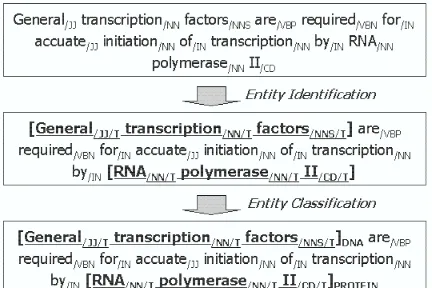
[image:2.612.319.535.72.216.2]We divide the named entity recognition into two subtasks, the identification task which finds the re-gions of the named entities in a text and the semantic classification which determines the semantic classes of them. Figure 1 illustrates the proposed method, which is called two-phase named entity recognition method.
Figure 1: Examples of Biomedical Named Entity Recognition
The identification task is formulated as classifica-tion of each word into one of two classes, T or O that represent region information. The region infor-mation is encoded by using simple T/O representa-tion: T means that current word is a part of a named entity, and O means that the word is not in a named entity. With the representation, we need only one binary SVM classifier of two classes, T, O.
The semantic classification task is to assign one of semantic classes to the identified entity. At the semantic classification phase, we need to classify only the identified entities into one of theN seman-tic classes because the entities were already identi-fied. Non-entity words are ignored at this phase. The classes needed to be classified are just only theN se-mantic classes. Note that the number of total classes,
N+ 1is remarkably small compared with the num-ber,2N+ 1required in the complicated recognition approaches in which a class is represented by com-bining a region information B/I/O with a semantic class C. It can considerably reduce workload in the named entity recognition.
Here,O(Lwords)stands for the number of words in a training corpus andO(Lentities)for the number of entities. It is a considerable reduction in the training cost. Ultimately, it affects the performance of the entity recognizer.
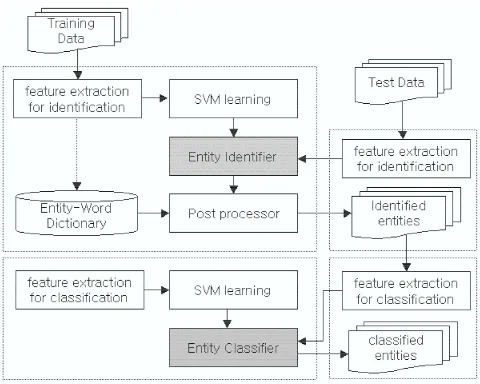
To achieve a high performance of the defined tasks, we use SVM(Joachims, 2002) as a machine learning approach which has showed the best perfor-mance in various NLP tasks. And we post-process the classification results of SVMs by utilizing a dic-tionary. Figure 2 outlines the proposed two-phase named entity recognition system. At each phase, each classifier with SVMs outputs the class of the best score. For classifying multi-classes based on a binary classifier SVM, we use the one-vs-rest clas-sification method and the linear kernel in both tasks. Furthermore, for correcting the errors by SVMs, the entity-word dictionary constructed from a train-ing corpus is utilized in the identification phase. The dictionary is searched to check whether the bound-ary words of an identified entity were excluded or not because the boundary words of an entity might be excluded during the entity identification. If a boundary word was excluded, then we concatenate the left or the right side word adjacent to the iden-tified entity. This post-processing may enhance the capability of the entity identifier.
3 Biomedical Named Entity Identification
The named entity identification is defined as the classification of each word to one of the classes that represent the region information. The region infor-mation is encoded by using simple T/O representa-tion: T means that the current word is a part of a named entity, and O means that the current word is not in a named entity.
The above representation yields two classes of the task and we build just one binary SVM classifiers for them. By accepting the results of the SVM classifier, we determine the boundaries of an entity. To correct boundary errors, we post-process the identified enti-ties with the entity-word dictionary.
3.1 Features for Entity Identification
An inputxto a SVM classifier is a feature represen-tation of a target word to be classified and its context. We use a bit-vector representation. The features of
the designated word are composed of orthographi-cal characteristic features, prefix, suffix, and lexiorthographi-cal of the word.
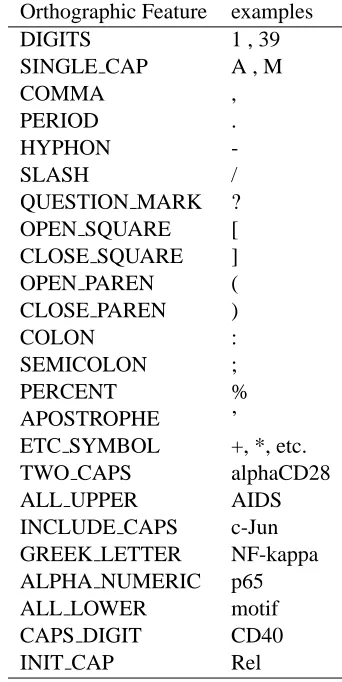
[image:3.612.339.510.271.612.2]Table 1 shows all of the 24 orthographical tures. Each feature may be a discriminative fea-ture appeared in biomedical named entites such as protein, DNA and RNA etc. Actually, the name of protein, DNA or RNA is composed by combining alpha-numeric string with several characters such as Greek or special symbols and so on.
Table 1: Orthographical characteristic features of the designated word
Orthographic Feature examples
DIGITS 1 , 39
SINGLE CAP A , M
COMMA ,
PERIOD .
HYPHON
-SLASH /
QUESTION MARK ? OPEN SQUARE [ CLOSE SQUARE ]
OPEN PAREN (
CLOSE PAREN )
COLON :
SEMICOLON ;
PERCENT %
APOSTROPHE ’
ETC SYMBOL +, *, etc. TWO CAPS alphaCD28
ALL UPPER AIDS
INCLUDE CAPS c-Jun GREEK LETTER NF-kappa ALPHA NUMERIC p65 ALL LOWER motif CAPS DIGIT CD40
INIT CAP Rel
And the suffix/prefix, the designated word and the context word features are as follows:
wi =
Figure 2: System Configuration of Two Phase Biomedical NE Recognition System
posi =
1 if the word is assigned theith POS tag in the POS tag list 0 otherwise
sufi =
1 if the word contains the
ithsuffix in the suffix list 0 otherwise
prei =
1 if the word contains the
ithprefix in the prefix list 0 otherwise
wki =
1 if a word at k is theithword in the vocabulary V
0 otherwise
poski=
1 if a word at k is assigned the
ithPOS tag in the POS tag list 0 otherwise
In the definition, k is the relative word position from the target word. A negative value represents a preceeding word and a positive value represents a following word. Among them, the part-of-speech tag sequence of the word and the context words is a kind of a syntactic rule to compose an entity. And lexical information is a sort of filter to identify an entity which is as possible as semantically cohesive.
3.2 Post-Processing by Dictionary Look-Up
After classifying the given instances, we do processing of the identified entities. During the
post-processing, we scan the identified entities and exam-ine the adjacent words to those. If the part-of-speech of an adjacent word belongs to one of the group, ad-jective, noun, or cardinal, then we look up the dic-tionary to check whether the word is in it or not. If it exists in the dictionary, we include the word into the entity region. The dictionary is constructed of words consisting of the named entities in a training corpora and stopwords are ignored.
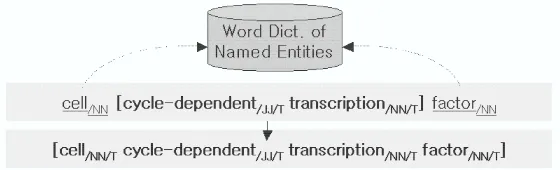
Figure 3 illustrates the post-processing algorithm. In Figure 3, the word cell adjacent to the left of the identified entity cycle-dependent transcription, has the part-of-speech NN and exists in the dictionary. The word factor adjacent to the right of the entity has the part-of-speech NN. It exists in the dictionary, too. Therefore, we include the words cell and factor into the entity region and change the position tags of the words in the entity.
By taking the post-processing method, we can correct the errors by a SVM classifier. It also gives us a great effect of overcoming the low coverage problem of the small-sized entity dictionary.
4 Semantic Classification of Biomedical Named Entity
Figure 3: An example of the post-processing of an entity identification
4.1 Features for Semantic Classification
For semantically tagging an entity, an inputx to a SVM classifier is represented by a feature vector. The vector is composed of following features:
f wi =
1 if a given entity contains one of the functional words 0 otherwise
inwi=
1 if one of the words in the entity is in the inside word list 0 otherwise
lcwi=
1 if noun or verb word in the left context is theithword in the left context word list 0 otherwise
rcwi =
1 if noun or verb word in the right context is theithword in the right context word list 0 otherwise
Of the above features, f wi checks whether the entity contains one of functional words. The func-tional words are similar to the feature terms used by (Fukuda, 1998). For example, the functional words such as factor, receptor and protein are very help-ful to classifying named entities into protein and the functional words such as gene, promoter and motif are very useful for classifying DNA.
In case of the context features of a given entity, we divide them into two kinds of context features, inside context features and outside context features. As in-side context features, we take at most three words from the backend of the entity1. We make a list of the inside context words by collecting words in the
1
The average length of entities is about 2.2 in GENIA cor-pus.
range of the inside context. If one of the three words is theithword in the inside context word list, we set theinwi bit to 1. The outside context features are grouped in the left ones and the right ones. For the left and the right context features, we restrict them to noun or verb words in a sentence, whose position is not specified. This grouping make an effect of al-leviating the data sparseness problem when using a word as a feature.
For example, given a sentence with the entity, RNA polymerase II as follows:
General transcription factor are required for accurate initiation of transcription by
RNA polymerase IIP ROT EIN.
The nouns transcription, factor, initiation and the verbs are, required are selected as left context fea-tures, and the words RNA, polymerase, II are se-lected as inside context features. The bit field cor-responding to each of the selected word is set to 1. In this case, there is no right context features. And since the entity contains the functional word RNA, the bit field of RNA is set to 1.
For classifying a given entity, we build SVM clas-sifiers as many as the number of semantic classes. We take linear kernel and one-vs-rest classification method.
5 Experiments
5.1 Experimental Environments
and RNA’s subclasses on the GENIA ontology 2. The corpus was transformed into a B/I/O annotated corpus to represent entity boundaries and a semantic class.
We divided 2000 abstracts into 10 collections for 10-fold cross validation. Each collection contains not only abstracts but also paper titles. The vo-cabularies for lexical features and prefix/suffix lists were constructed by taking the most frequent 10,000 words from the training part only.
Also, we made another experimental environ-ment to compare with the previous work by (Kazama, 2002). From the GENIA corpus, 590 abstracts(4,808 sentences; 20,203 entities; 128,463 words) were taken as a training part and 80 ab-stracts(761 sentences; 3,327 entities; 19,622 words) were selected as a test part. Because we couldn’t make the experimental environment such as the same as that of Kazama’s, we tried to make a com-parable environment.
We implemented our method using the SVM-light package(Joachims, 2002). Though various learning parameters can significantly affect the performance of the resulting classifiers, we used the SVM system with linear kernel and default options.
The performance was evaluated by precision, re-call andFβ=1. The overallFβ=1for two models and
ten collections, were calculated using 10-fold cross validation on total test collection.
5.2 Effect of Training Data Size
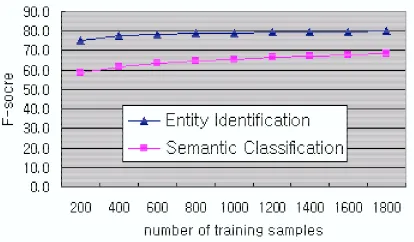
In this experiment, varying the size of training set, we observed the change ofFβ=1in the entity
identi-fication and the semantic classiidenti-fication. We fixed the test data with 200 abstracts(1,921 sentences; 50,568 words). Figure 4 shows that the performance was improved by increasing the training set size. As the performance of the identification increases, the gap between the performance of the identification and that of the semantic classification is gradually de-creased.
5.3 Computational Efficiency
When using one-vs-rest method, the number of negative samples is very critical to the training in
2
[image:6.612.322.529.73.194.2]That is, All of the protein’s subclass such as tein molecule, protein family or group were regarded as pro-tein.
Figure 4: Perfomance shift according to the increase of training data size w/o post-processing
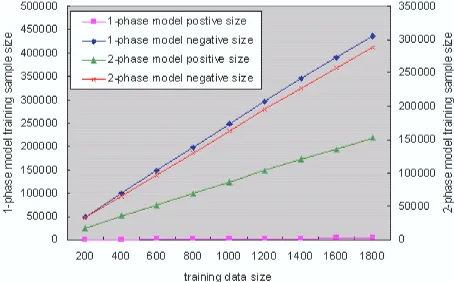
the aspect of training time and required resources. The SVM classifier for entity identifiation deter-mines whether each word is included in an entity or not. Figure 5 shows there are much more nega-tive samples than posinega-tive samples in the identifica-tion phase. Once entities are identified, non-entity words are not considered in next semantic classifi-cation phase. Therefore, the proposed method can effectively remove the unnecessary samples. It en-ables us effectively save the training costs.
Furthermore, the proposed method could effec-tively decrease the degree of the unbalance among classes by simplifying the classes. Figure 6 shows how much the proposed method can alleviate the un-balanced class distribution problem compared with 1-phase complicated classification model. However, even though the unbalanced class distribution prob-lem could be alleviated in the identification phase, we are still suffering from the problem in the seman-tic classification as long as we take the one-vs-rest method. It indicates that we need to take another classification method such as a pairwise method in the semantic classification(Krebel, 1999).
5.4 Discriminative Feature Selection
We subsequently examined several alternatives for the feature sets described in section 3.1 and section 4.1.
Figure 5: training size vs. positive and negative sam-ple size in identification phase and semantic classi-fication phase
Figure 6: 2-phase model vs. 1-phase model : change of the negative and the positive sample size accord-ing to the trainaccord-ing data size
( A ) ( B )
FeatSet F-score FeatSet F-score base 74.6 base(inw) 65.8
pos 77.4 (+2.8) fw 67.9 (+2.1) pre 75.0 (+0.4) lcw 67.9 (+2.1) suf 75.2 (+0.6) rcw 67.0 (+1.2) pre+suf 75.6 (+1.0) lcw+rcw 66.4 (+0.6) pos+pre 77.9 (+3.3) fw+lcw 68.1(+2.3)
pos+suf 77.9 (+3.3) fw+rcw 67.1 (+1.3)
all 77.9 (+3.3) all 66.9 (+1.1)
Table 2: Effect of each feature set(training with 900 abstracts, test with 100 abstracts): (A) identification phase, (B) semantic classification phase
Table 2, we can see that part-of-speech information certainly improves the identification accuracy(about +2.8). Prefix and suffix features made a positive ef-fect, but only modestly(about +1.2 on average).
The column (B) in Table 2 shows semantic clas-sification cases with the identification phase of the best performance. We took the feature set composed of the inside words of an entity as a base feature set. And we made several alternatives by adding another features. The experimental results show that func-tional words and left context features are useful, but right context features are not. Furthermore, part-of-speech information was not effective in the seman-tic classification while it was useful for the entity identification. That is, when we took the part-of-speech tags of inside context words instead of the inside context words, the performance of the seman-tic classification was very low(Fβ=1.0was 25.1).
5.5 Effect of PostProcessing by Dictionary Lookup
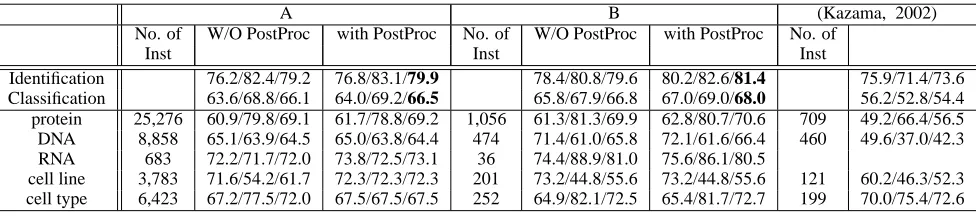
Our two-phase model has the problem that identifi-cation errors are propagated to the semantic classi-fication. For this reason, it is necessary to ensure a high accuracy of the boundary identification by adopting a method such as post processing of the identified entities. Table 3 shows that the post pro-cessing by dictionary lookup is effective to improv-ing the performance of not only the boundary identi-fication accurary(79.2 vs. 79.9) but also the seman-tic classification accuracy(66.1 vs. 66.5).
When comparing with the (Kazama, 2002) even though the environments is not the same, the pro-posed two-phase model showed much better per-formance in both the entity identification (73.6 vs. 81.4) and the entity classification (54.4 vs. 68.0). One of the reason of the performance improvement is that we could take discriminative features for each subtask by separating the task into two subtasks.
6 Conclusion
[image:7.612.73.299.501.641.2]Table 3: Performance comparison with or w/o post-processing(Fβ=1): (A)10-fold cross validation(1800
abstracts, test with 200 abstracts), (B)training with 590 abstracts, test with 80 abstracts
A B (Kazama, 2002)
No. of W/O PostProc with PostProc No. of W/O PostProc with PostProc No. of
Inst Inst Inst
Identification 76.2/82.4/79.2 76.8/83.1/79.9 78.4/80.8/79.6 80.2/82.6/81.4 75.9/71.4/73.6 Classification 63.6/68.8/66.1 64.0/69.2/66.5 65.8/67.9/66.8 67.0/69.0/68.0 56.2/52.8/54.4 protein 25,276 60.9/79.8/69.1 61.7/78.8/69.2 1,056 61.3/81.3/69.9 62.8/80.7/70.6 709 49.2/66.4/56.5 DNA 8,858 65.1/63.9/64.5 65.0/63.8/64.4 474 71.4/61.0/65.8 72.1/61.6/66.4 460 49.6/37.0/42.3 RNA 683 72.2/71.7/72.0 73.8/72.5/73.1 36 74.4/88.9/81.0 75.6/86.1/80.5
cell line 3,783 71.6/54.2/61.7 72.3/72.3/72.3 201 73.2/44.8/55.6 73.2/44.8/55.6 121 60.2/46.3/52.3 cell type 6,423 67.2/77.5/72.0 67.5/67.5/67.5 252 64.9/82.1/72.5 65.4/81.7/72.7 199 70.0/75.4/72.6
phase, we tried to classify the identified entity into its semantic class by voting the SVMs. By dividing the task into two subtasks, the identification and the semantic classification task, we could select more relevant features for each task and take an alternative classification method according to the task. This is resulted into the mitigation effect of the unbalanced class distribution problem but also improvement of the performance of the overall tasks.
References
N. Collier, C. Nobata, and J. Tsujii 2000. Extracting the Names of Genes and Gene Products with a Hidden Markov Model. In Proc. of Coling2000, pages 201-207.
K. Fukuda, T. Tsunoda, A. Tamura, and T. Takagi. 1998. Information extraction: identifying protein nmes from biological papers. In Proc. of the Pacific Symposium
on Biocomputing ’98(PSB’98).
GENIA Corpus 3.0p. 2003. available at http://www-tsujii.is.s.u-tokyo.ac.jp/ ge-nia/topics/Corpus/3.0/GENIA3.0p.intro.html
V. Hatzivalssiloglou, P. A. Duboue, and A. Rzhetsky. 2001. Disambiguating proteins, genes, and RNA in text: a machine learning approach. Bioinformatics. 17
Supple 1.
C. Hsu and C. Lin. 2001. A comparison on methods for multi-class support vector machines. Technical report, National Taiwan University, Taiwan.
T. Joachims. 1998. Making Large-Scale SVM Learning Practical. LS8-Report, 24, Universitat Dortmund, LS VIII-Report.
T. Joachims. 2000. Estimating the generalization per-formance of a SVM efficiently. In Proc. of the
Seven-teenth International Conference on Machine Learning. Morgan Kaufmann, pages 431-438.
SVM Light. 2002. available at http://svmlight.joachims.org/
Jun’ichi Kazama, Takaki Makino, Yoshihiro Ohta and Jun’ichi Tsujii. 2002. Tuning support vector machines for biomedical named entity recognition. In Proc. of
ACL-02 Workshop on Natural Language Processing in the Biomedical Domain, pages 1-8.
U. H.-G Krebel 1999. Pairwise Classification and Sup-port Vector machines. In B. Scholkopf, C.J.C. Burges,
Advances in Kernel Methods: Support Vector Learn-ing, pp. 255-268, The MIT Press, Cambridge, MA.
C. Nobata, N. Collier, and J. Tsujii. 1999. Automatic term identification and classification in biology texts. In Proc. of the 5th NLPRS, pages 369-374.
B.J. Stapley, L.A. Kelley, and M.J.E. Sternberg. 2002. Predicting the Sub-Cellular Location of Proteins from Text Using Support Vector Machines. In Proc. of
Pa-cific Symposium on Biocomputing 7, pages 374-385.