Recognition Using A Hybrid Method
Seonho Kim1, Juntae Yoon2, Kyung-Mi Park1, and Hae-Chang Rim1 1
Dept. of Computer Science and Engineering, Korea University, Seoul, Korea 2 NLP Lab. Daumsoft Inc. Seoul, Korea
Abstract. Biomedical named entity recognition (NER) is a difficult problem in biomedical information processing due to the widespread am-biguity of terms out of context and extensive lexical variations. This pa-per presents a two-phase biomedical NER consisting of term boundary detection and semantic labeling. By dividing the problem, we can adopt an effective model for each process. In our study, we use two exponential models, conditional random fields and maximum entropy, at each phase. Moreover, results by this machine learning based model are refined by rule-based postprocessing implemented using a finite state method. Ex-periments show it achieves the performance of F-score 71.19% on the JNLPBA 2004 shared task of identifying 5 classes of biomedical NEs.
1
Introduction
Due to dynamic progress in biomedical literature, a vast amount of new infor-mation and research results have been published and many of them are available in the electronic form - for example, like the PubMed MedLine database. Thus, automatic knowledge discovery and efficient information access are strongly de-manded to curate domain databases, to find out relevant information, and to integrate/update new information across an increasingly large body of scien-tific articles. In particular, since most biomedical texts introduce specific no-tations, acronyms, and innovative names to represent new concepts, relations, processes, functions, locations, and events, automatic extraction of biomedical terminologies and mining of their diverse usage are major challenges in biomed-ical information processing system. In these processes, biomedbiomed-ical named entity recognition (NER) is the core step to access the higher level of information.
In fact, there has been a wide range of research on NER like the NER task on the standard newswire domain in the Message Understanding Conference (MUC-6). In this task, the best system reported 95% accuracy in identifying seven types of named entities (person, organization, location, time, date, money, and per-cent). While the performance in the standard domain turned out to be quite good as shown in the papers, that in the biomedical domain is not still satisfactory, which is mainly due to the following characteristics of biomedical terminologies: First, NEs have various naming conventions. For instance, some entities have descriptive and expanded forms such as “activated B cell lines, 47 kDa sterol R. Dale et al. (Eds.): IJCNLP 2005, LNAI 3651, pp. 646–657, 2005.
c
regulatory element binding factor”, whereas some entities appear in shortened or abbreviated forms like “EGFR” and “EGF receptor” representing epidermal growth factor receptor. Second, biomedical NEs have the widespread ambiguity out of context. For instance, “IL-2” can be doubly classified as “protein” and “DNA” according to its context. Third, biomedical NEs often comprise a nested structure, for example “DNAproteinTNF alpha/proteingene/DNA”. Ac-cording to [13], 16.57% of biomedical terms in GENIA have cascaded construc-tions. In the case, recognition of the longest terms is the main target in general. However, in our evaluation task, when the embedded part of a term is regarded as the meaningful or important class in the context, the term is labeled only with the class of embedded one. Thus, identification of internal structures of NEs is helpful to recognize correct NEs. In addition, more than one NE often share the same head noun with a conjunction/disjunction or enumeration structure, for instance, “IFN-gamma and GM-CSF mRNA”, “CD33+, CD56+, CD16- acute leukemia”or “antigen- or cAMP-activated Th2 cell”. Last, there is a lot of inter-annotator disagreement. [7] reported that the inter-inter-annotator agreement rate of human experts was just 77.6% when performing gene/protein/mRNA classifica-tion task manually.
Thus, a lot of term occurrences in real text would not be identified with sim-ple dictionary look-up, despite the availability of many terminological databases, as claimed in [12]. That is one of the reasons why machine learning approaches are more dominant in biomedical NER than rule-based or dictionary-based ap-proaches [5], even though existence of reliable training resources is very critical. Accordingly, much work has been done on biomedical NER, based on ma-chine learning techniques. [3] and [13] have used hidden Markov Model (HMM) for biomedical NER where state transitions are made by semantic trigger fea-tures. [4] and [11] have applied maximum entropy plus Markovian sequence based models such as maximum entropy markov model (MEMM) and conditional ran-dom fields (CRFs), which present a way for integrating different features such as internal word spellings and morphological clues within an NE string and con-textual clues surrounding the string in the sentence.
These works took an one-phase based approach where boundary detection of named entities and semantic labeling come together. On the other hand, [9] proposed a two-phase model in which the biomedical named entity recognition process is divided into two processes of distinguishing biomedical named entities from general terms and labeling the named entities with semantic classes that they belong to. They use support vector machines (SVM) for each phase. How-ever, the SVM does not provide an easy way for labeling Markov sequence data like B following O and I following B in named entities. Furthermore, since this system is tested on the GENIA corpus rather than JNLPBA 2004 shared task, we cannot confirm the effectiveness of this approach on the ground of experiments for common resources.
select separately a discriminative feature set for each subtask, and moreover can measure effectiveness of models at each phase. We use two exponential models for this work, namely conditional random fields for boundary detection having Markov sequence, and the maximum entropy model for semantic labeling. In ad-dition, results from the machine learning based model are refined by a rule-based postprocessing, which is implemented using a finite state transducer (FST). The FST is constructed with the GENIA 3.02 corpus. We here focus on identification of five classes of NEs, i.e. “protein”, “RNA”, “DNA”, “cell line”, and “cell type” and experiments are conducted on the training and evaluation set provided by the shared task in COLING 2004 JNLPBA.
2
Training
2.1 Maximum Entropy and Conditional Random Fields
Before we describe the features used in our model, we briefly introduce the ME and CRF model which we make use of. In the ME framework, the conditional probability of predicting an outcomeogiven a historyhis defined as follows:
pλ(o|h) =
wherefi(h, o) is a binary-valued feature function,λi is the weighting parameter
of fi(h, o), k is the number of features, and Zλ(h) is a normalization factor
forΣopλ(o|h)=1. That is, the probabilitypλ(o|h) is calculated by the weighted
sum of active features. Given an exponential model with k features and a set of training data, empirical distribution, weights of the k features are trained to maximize the model’s log-likelihood:
L(p) =
o,h
˜
p(h, o)log(o|h) (2)
Although the maximum entropy model above provides a powerful tool for classification by integrating different features, it is not easy to model the Markov sequence data. In this case, the CRF is used for a task of assigning label sequences to a set of observation sequences. Based on the principle of maximum entropy, a CRF has a single exponential model for the joint probability of the entire sequence of labels given the observation sequence. The CRF is a special case of the linear chain that corresponds to conditionally trained finite-state machine and define conditional probability distributions of a particular label sequences
wheres=s1 . . . sn, ando=o1 . . . on,Z(o) is a normalization factor, and each
feature is a transition function [8]. For example, we can think of the following feature function.
fj(si−1, si,o, i) = ⎧ ⎨ ⎩
1 ifsi−1=B and si=I,
and the observation word at position i is “gene 0otherwise
(4)
Our CRFs for term boundary detection have a first-order Markov dependency between output tags. The label at positioni,si is one of B, I and O. In contrast
to the ME model, since B is the beginning of a term, the transition from O to I is not possible. CRFs constrain results to consider only reasonable paths. Thus, total 8 combinations are possible for (si−1,si) and the most likelyscan be found
with the Viterbi algorithm. The weights are set to maximize the conditional log likelihood of labeled sequences in the training set using a quasi-Newton method called L-BFGS [2].
2.2 Features for Term Boundary Detection
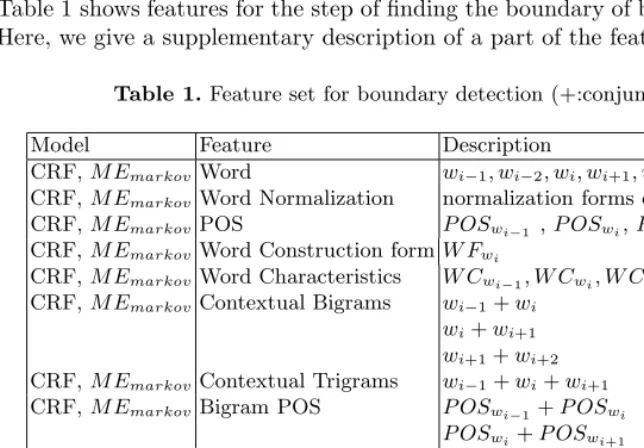
Table 1 shows features for the step of finding the boundary of biomedical terms. Here, we give a supplementary description of a part of the features.
Table 1.Feature set for boundary detection (+:conjunction)
Model Feature Description
CRF,M EmarkovWord wi−1, wi−2, wi, wi+1, wi+2
CRF,M EmarkovWord Normalization normalization forms of the 5 words
CRF,M EmarkovPOS P OSwi−1 ,P OSwi,P OSwi+1
CRF,M EmarkovWord Construction formW Fwi
CRF,M EmarkovWord Characteristics W Cwi−1, W Cwi, W Cwi+1
CRF,M EmarkovContextual Bigrams wi−1+wi wi+wi+1
wi+1+wi+2 CRF,M EmarkovContextual Trigrams wi−1+wi+wi+1 CRF,M EmarkovBigram POS P OSwi−1+P OSwi
P OSwi+P OSwi+1
CRF,M EmarkovTrigram POS P OSwi−1+P OSwi+P OSwi+1
CRF,M EmarkovModifier MODI(wi)
CRF,M EmarkovHeader HEAD(wi)
CRF,M EmarkovSUFFIX SUFFIX(wi)
CRF,M EmarkovChunk Type CT ypewi
CRF,M EmarkovChunk Type + Pre POSCT ypewi+P OSwi−1
M Emarkov Pre label labelwi−1
M Emarkov Pre label + Cur Word labelwi−1+wi
– word and POS: 5 words(target word(wi), left two words, and right two
– word normalization:This feature contributes to word normalization. We attempt to reduce a word to its stem or root form with a simple algorithm which has rules for words containing plural, hyphen, and alphanumeric let-ters. Specifically, the following patterns are considered.
(1) “lymphocytes”, “cells”→“lymphocyte”, “cell” (2) “il-2”, “il-2a”, “il2a”→“il”
(3) “5-lipoxygenase”, “v-Abl”→“lipoxygenase”, “abl”
(4) “peri-kappa” or “t-cell” has two normalization forms of “peri”and“kappa” and “t” and “cell” respectively.
(5) “Ca2+-independent” has two roots of “ca” and “independent”. (6) The root of digits is “D”.
– informative suffix:This feature appears if a target word has a salient suffix for boundary detection. The list of salient suffixes is obtained by relative entropy [10].
– word construction form: This feature indicates how a target word is or-thographically constructed. Word shapes refer to a mapping of each word on equivalence classes that encodes with dashes, numerals, capitalizations, lower letters, symbols, and so on. All spellings are represented with combina-tions of the attributes1. For instance, the word construction form of “IL-2” would become “IDASH-ALPNUM”.
– word characteristics: This feature appears if a word represents a DNA sequence of “A”,“C”,“G”,“T” or Greek letter such as beta or alpha, ordinal index such as I, II or unit such as BU/ml, micron/mL. It is encoded with “ACGT”, “GREEK”, “INDEX”, “UNIT”.
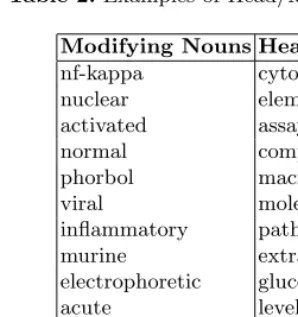
– head/modifying information: If a word prefers the rightmost position of terminologies, we regard it has the property of a head noun. On the other hand, if a word frequently occurs in other positions, we regard it has the property of a modifying noun. It can help to establish the beginning and ending point of multi-word entities. We automatically extract 4,382 head nouns and 7,072 modifying nouns from the training data as shown in Table 2.
– chunk-type information:This feature is also effective in determining the position of a word in NEs, “B”, “I”, “O” which means “begin chunk”, “in chunk” and “others”, respectively. We consider the chunk type of a target word and the conjunction of the current chunk type and the POS of the previous word to represent the structure of an NE.
We also tested an ME-based model for boundary detection. For this, we add two special features : previous state (label) and conjunction of previous label
1
Table 2.Examples of Head/Modifying Nouns
Modifying Nouns Head Nouns nf-kappa cytokines nuclear elements activated assays normal complexes phorbol macrophages viral molecules inflammatory pathways murine extracts electrophoretic glucocorticoids
acute levels
intracellular responses epstein-barr clones cytoplasmic motifs
and current word to considerstate transition. That is, a previous label can be represented as a feature function in our model as follows:
fi(h, o) =
1if pre label+tw=B+gene,o=I
0otherwise (5)
It means that the target word is likely to be inside a term (I), when the word is “gene” and the previous label is “B”. In our model, the current label is de-terministically assigned to the target word with considering the previous state with the highest probability.
2.3 Features for Semantic Labeling
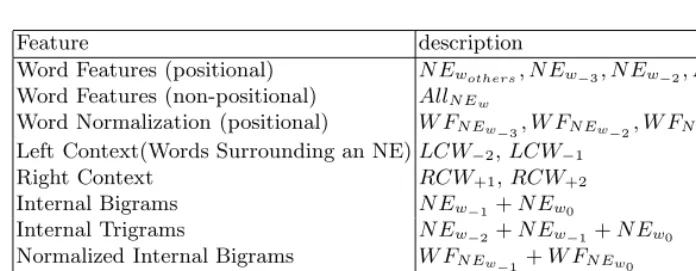
Table 3 shows features for semantic labeling with respect to recognized NEs.
– word contextual feature:We make use of three kinds of internal and ex-ternal contextual features: words within identified NEs, their word normal-ization forms, and words surrounding the NEs. In Table 3, N Ew0 denotes
the rightmost word in an identified NE region. Moreover, the presence of specific head nouns acting as functional words takes precedence when de-termining the term class, even though many terms do not contain explicit term category information. For example, functional words, such as “factor”, “receptor”, and “protein” are very useful in determining protein class, and “gene”, “promoter”, and “motif” are clues for classifyingDNA[5]. In gen-eral, such functional words are often the last word of an entity. This is the reason we consider the position where a word occurs in NEs along with the word. For inside context features, we use non-positional word features as well. As non-positional features, all words inside NEs are used.
Table 3.Feature Set for Semantic Classification
Feature description
Word Features (positional) N Ewothers, N Ew−3, N Ew−2, N Ew−1, N Ew0
Word Features (non-positional) AllN Ew
Word Normalization (positional) W FN Ew−3, W FN Ew−2, W FN Ew−1, W FN Ew0
Left Context(Words Surrounding an NE)LCW−2,LCW−1 Right Context RCW+1,RCW+2 Internal Bigrams N Ew−1+N Ew0
Internal Trigrams N Ew−2+N Ew−1+N Ew0
Normalized Internal Bigrams W FN Ew−1+W FN Ew0
Normalized Internal Trigrams N Ew−2+N Ew−1+N Ew0
IDASH-word related Bigrams/Trigrams
Keyword KEYWORD(N Ei)
– IDASH-word related bigrams/trigrams:This feature appears ifN Ew0
or N Ew−1 contains dash characters. In this case, the bigram/trigram are
additionally formed by removing all dashes from the spelling. It is useful to deal with lexical variants.
– keywords: This feature appears if the identified NE is informative key-word with respect to a specific class. The keykey-words set comprises terms obtained by the relative entropy between general and biomedical domain corpora.
3
Rule-Based Postprocessing
A rule-based method can be used to correct errors by NER based on machine learning. For example, the CRFs tag “IL-2 receptor expression” as “B I I”, since the NEs ended with “receptor expression” in training data almost belong to “other name” class even if the NEs ended with “receptor” belong to “ pro-tein” class. It should be actually tagged as “B I O”. That kind of errors is caused mainly by the cascaded phenomenon in biomedical names. Since our sys-tem considers all NEs belonging to other classes in the recognition phase, it tends to recognize the longest ones. That is, in the term classification phase, such NEs are classified as “other” class and are ignored. Thus, the system losts embedded NEs although the training and evaluation set in fact tends to consider only the embedded NE when the embedded one is more meaningful or important.
This error correction is conducted by the rule-based method, i.e. If condi-tion THEN action. For example, the rule ‘IF wi−2=IL-2, wi−1=receptor and
wi=expressionTHENreplace the tag ofwiwith O’ can be applied for the above
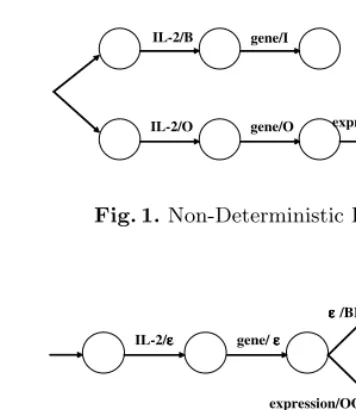
IL-2/B gene/I
IL-2/O gene/O expression/O
Fig. 1.Non-Deterministic FST
IL-2/εεεε gene/εεεε
expression/OOO
εεεε/BI
Fig. 2.Deterministic FST
the outputs of all other classes except the target 5 classes to O. That is, the input of FST is a sequence of words in a sentence and the output is categories corresponding to the words.
Then, we removed the rules in conflict with NE information from the training corpus. These rules are non-deterministic (Figure 1), and we can change it to the deterministic FST (Figure 2) since the lengths of NEs are finite. The deter-ministic FST is made by defining the final output function for the deterdeter-ministic behavior of the transducer, delaying the output. The deterministic FST is de-fined as follows: (Σ1, Σ2, Q, i, F,⊗,∗, ρ), whereΣ1is a finite input alphabet;Σ2 is a finite output alphabet; Q is a finite set of states or vertices; i ∈ Q is the initial state;F ⊆Qis the set of final states;⊗is the deterministic state transi-tion functransi-tion that maps Q×Σ1 onQ; ∗ is the deterministic emission function that maps Q×Σ1 onΣ2∗ andρ: F →Σ2∗ is the final output function for the deterministic behavior of the transducer.
4
Evaluation
4.1 Experimental Environments
Table 4.Number of training examples
RNA DNA cell line cell type protein other 472 5,370 2,236 2,084 16,042 11,475
GENIA. As a consequence, we find all biomedical named entities in text at the term detection phase. Then, biomedical NEs classified asother class are changed toO at the semantic labeling phase. The total words that belong toother class turned out to be 25,987. Table 4 shows the number of NEs with respect to each class on the training data. In our experiments, a quasi-Newton method called the L-BFGS with Gaussian Prior smoothing is applied for parameter estimation [2].
4.2 Experimental Results
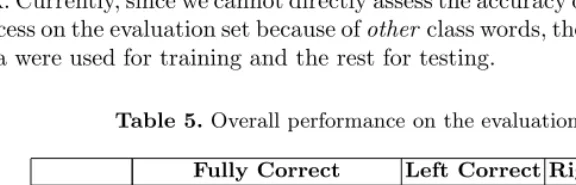
Table 5 shows the overall performance on the evaluation data. Our system achieves an F-score of 71.19%. As shown in the table, the performance of NER for cell line class was not good, because its boundary recognition is not so good as other classes. Also, Table 6 shows the results of semantic classification. In par-ticular, the system often confusesprotein withDNA, andcell line withcell type. Among the correctly identified 7,093 terms, 790 terms were misclassified.
Table 7 shows the performance of each phase. Our system obtains 76.88% F-score in the boundary detection task and, using 100% correctly recognized terms from annotated test data, 90.54% F-score in the semantic classification task. Currently, since we cannot directly assess the accuracy of the term detection process on the evaluation set because ofother class words, the 75% of the training data were used for training and the rest for testing.
Table 5.Overall performance on the evaluation data
Fully Correct Left Correct Right Correct Class Recall Precision F-score F-score F-score protein 76.30 69.71 72.85 77.60 79.15 DNA 67.80 64.91 66.33 68.36 74.57 RNA 73.73 63.04 67.97 71.09 74.22 cell line 57.40 54.88 56.11 59.04 65.69 cell type 70.12 77.64 73.69 74.89 81.51 overall 72.77 69.68 71.19 74.75 78.23
Table 6.Confusion matrix over evaluation data
gold/sys protein DNA RNA cell line cell type other
protein 0 72 3 1 4 267
DNA 97 0 0 0 0 49
RNA 11 0 0 0 0 0
cell line 10 1 0 0 63 37
Table 7.Performance of term detection and semantic classification
Recall Precision F-score term detection (M EM arkov) 74.03 75.31 74.67
term detection (CRF) 76.14 77.64 76.88 semantic classification 87.50 93.81 90.54
overall NER 72.77 69.68 71.19
Table 8.Performance of NE recognition methods (one-phase vs. two-phase)
method Recall Precision F-score
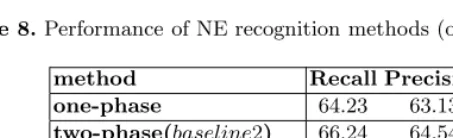
one-phase 64.23 63.13 63.68
two-phase(baseline2) 66.24 64.54 65.38 (only 5 classes)
two-phase(baseline2) 68.51 67.58 68.04 (5 classes+other class)
Also, we compared our model with the one-phase model. The detailed results are presented in Table 8. Both of them have pros and cons. The best-reported system presented by [13] uses one-phase strategy. In our evaluation, the two-phase method shows a better result than the one-two-phase method, although direct comparison is not possible since we tested with a maximum entropy based expo-nential models in all cases. The features for one-phase method are identical with the recognition features except that the local context of a word is extended as previous 4 words and next 4 words. In addition, we investigate whether the con-sideration of “other” class words is helpful in the recognition performance. Table 8 shows explicit annotations of other NE classes much improve the performance of existing entity types.
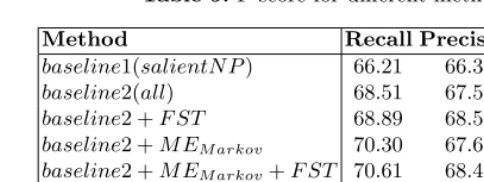
In the next experiment, we test how individual methods have an effect on the performance in the term detection step. Table 9 shows the results obtained by com-bining different methods in the NER process. At the semantic labeling phase, all methods employed the ME model using the features described in 2.3. Baseline1 is the two-phase ME model which restrict the inspection of NE candidates to the NPs which include at least one biomedical salient word. Baseline2 is the two-phase ME model considering all words. In order to retrieve domain salient words, we utilized a relative frequency ratio of word distribution in the domain corpus and that in the general corpus [10]. We used the Penn II raw corpus as out-of-domain corpus. Both models do not use the features related to previous labels. As a re-sult, usage of salient words decrease the performance and it only speeds up the training process. Baseline2+FST indicates boundary extension/contraction using FST are applied as postprocessing step in baseline2 recognition. In addition, we compared use of CRFs and ME with Markov process features. For this, we added features of previous labels to the feature set for ME. Baseline2+M EM arkovis the
Table 9.F-score for different methods
Method Recall Precision F-score
baseline1(salientN P) 66.21 66.34 66.27
baseline2(all) 68.51 67.58 68.04
baseline2 +F ST 68.89 68.53 68.71
baseline2 +M EM arkov 70.30 67.65 68.95
baseline2 +M EM arkov+F ST 70.61 68.40 69.49
baseline2 +CRF 72.44 68.77 70.56
baseline2 +CRF+F ST 72.77 69.68 71.19
Table 10.Comparisons with other systems
System Precision Recall F-score Zhou et. al (2004) 69.42 75.99 72.55 Our system 72.77 69.68 71.19 Finkel et. al (2004)71.62 68.56 70.06 Settles (2004) 70.0 69.0 69.5
model outperforms the ME based model. Our system reached F-score 71.19% on thebaseline2 +CRF +F ST model.
Table 10 shows the comparison with top-ranked systems in JNLPBA 2004 shared task. The top-ranked systems made use of external knowledge from gazetteers and abbreviation handling routines, which were reported to be ef-fective. Zhou et. al reported the usage of gazetteers and abbreviation handling improves the performance of the NER system by 4.8% in F-score [13]. Finkel et. al made use of a number of external resources, including gazetteers, web-querying, use of the surrounding abstract, abbreviation handling, and frequency counts from BNC corpus [4]. Settles utilized semantic domain knowledge of 17 kinds of lexicons [11]. Although the performance of our system is a bit lower than the best system, the results are very promising since most systems use external gazetteers, and abbreviation and conjunction/disjunction handling scheme. This suggests areas for further work.
5
Conclusion and Discussion
of biomedical NEs. The experimental results are quite promising. The system achieved 71.19% F-score without Gazetteers or abbreviation handling process. The performance could be improved by utilizing lexical database and testing various classification models.
Acknowledgements
This work was supported by Korea Research Foundation Grant, KRF-2004-037-D00017.
References
1. Thorten Brants. TnT A Statistical Part-of-Speech Tagger. In Proceedings of the 6th Applied Natural Language Processing.; 2000.
2. Stanley F. Chen and Ronald Rosenfeld. A Gaussian prior for smoothing maximum entropy models.Technical Report CMUCS-99-108, Carnegie Mellon University.
3. Nigel Collier, Chikashi Nobata and Jun-ichi Tsujii. Extracting the Names of Genes and Gene Products with a Hidden Markov Model. InProceedings of COLING 2000; 201-207.
4. Jenny Finkel, Shipra Dingare, and Huy Nguyen. Exploiting Context for Biomedical Entity Recognition From Syntax to thw Web. InProceedings of JNLPBA/BioNLP 2004; 88-91.
5. K. Fukuda, T. Tsunoda, A. Tamura, and T. Takagi. Toward information extrac-tion: identifying protein names from biological papers. InProceedins of the Pacific Symposium on Biocomputing 98; 707-718.
6. Junichi Kazama, Takaki Makino, Yoshihiro Ohta and Junichi Tsujii. Tuning Sup-port Vector Machines for Biomedical Named Entity Recognition,Proceedings of the ACL Workshop on Natural Language Processing in the Biomedical Domain2002; 1-8.
7. Michael Krauthammer and Goran Nenadic. Term Identification in the Biomedical literature. Journal of Biomedical Informatics. 2004; 37(6):512-526.
8. John Lafferty, Andrew McCallum, and Fernando Pereira. Conditional Random Fields: probabilistic models for segmenting and labeling sequence data. In Proceed-ings of ICML-01; 282-289.
9. Ki-Joong Lee, Young-Sook Hwang, Seonho Kim, Hae-Chang Rim. Biomedical named entity recognition using two-phase model based on SVMs. Journal of Biomedical Informatics2004; 37(6):436-447.
10. Kyung-Mi Park, Seonho Kim, Ki-Joong Lee, Do-Gil Lee, and Hae-Chang Rim. Incorportating Lexical Knowledge into Biomedical NE Recognition. InProceedings of Natural Language Processing in Biomedicine and its Applications Post-COLING Workshop2004; 76-79.
11. Burr Settles. Biomedical Named Entity Recognition Using Conditional Random Fields and Rich Feature Sets. InProceedings of JNLPBA/BioNLP2004; 104-107. 12. Olivia Tuason, Lifeng Chen, Hongfang Liu, Judith A. Blake, Carol Friedman. Bi-ological Nomenclatures: A Source of Lexical Knowledge and Ambiguity. InPacific Symposium on Biocomputing2004; 238-249.
13. GuoDong Zhou, Jie Zhang, Jian Su, Chew-Lim Tan. Exploring Deep Knowledge Resources in Biomedical Name Recognition. In Proceedings of JNLPBA/BioNLP