Finding Recurrent Features of Image Schema Gestures: the FIGURE corpus
Andy L ¨ucking, Alexander Mehler, D´esir´ee Walther, Marcel Mauri, Dennis Kurf ¨urst
Goethe University FrankfurtText Technology Lab
[email protected], [email protected], [email protected], [email protected], [email protected]
Abstract
TheFrankfurtImageGestUREcorpus (FIGURE) is introduced. The corpus data is collected in an experimental setting where 50 na¨ıve participants spontaneously produced gestures in response to five to six terms from a total of 27 stimulus terms. The stimulus terms have been compiled mainly from image schemata from psycholinguistics, since such schemata provide a panoply of abstract contents derived from natural language use. The gestures have been annotated for kinetic features. FIGURE aims at finding (sets of) stable kinetic feature configurations associated with the stimulus terms. Given such configurations, they can be used for designing HCI gestures that go beyond pre-defined gesture vocabularies or touchpad gestures. It is found, for instance, that movement trajectories are far more informative than handshapes, speaking against purely handshape-based HCI vocabularies. Furthermore, the mean temporal duration of hand and arm movements associated vary with the stimulus terms, indicating a dynamic dimension not covered by vocabulary-based approaches. Descriptive results are presented and related to findings from gesture studies and natural language dialogue.
Keywords:gestures, human-computer interaction, kinetic features
1.
Introduction
Gestures forHuman Computer Interaction(HCI) are usu-ally confined to navigation commands or task-oriented hand and arm movements. Thus, HCI gestures either come as manipulators or as part of a specific gesture lexicon (semaphores) (Quek et al., 2002) (cf. the touchpad ges-tures that became popular with the proliferation of touch-screens). While manipulator gestures are highly effective due to providing direct feedback (Brennan, 1998), they are strongly bound to imperative, system-controlling com-mands. Semaphores can in principle be designed as an in-put for presumably any kind of operation. However, such semaphores has to be learned in advance, hence they im-pose a high memorising demand on side of the user. In applications where more abstract declarative interaction is called for (e.g., in the context of education or museums (Mehler and L¨ucking, 2012)), rich and intuitive interac-tion means are needed. In order to meet this requirement, Mehler et al. (2014) proposed a conceptual approach to HCI gestures based on the notion ofimage schema propa-gated in cognitive sciences (Lakoff, 1987). This approach assumes that predicational information can be enacted by an image schema-triggering gesture whose “meaning” is derived from the underlying schema, giving rise to a kind of sign language called “gestural writing” (Mehler et al., 2014). Note that this approach is conceived for touchless HCI, as accomplished by controllers like Kinect or Leap-Motion.1 Gestural writing can be an efficient means for HCI only if there is an association between certain hand and arm movements and concepts (Grandhi et al., 2011) beyond idiosyncrasies in gesture production (Bergmann and Kopp, 2010).
With regard to the coverbal use of gestures in natural lan-guage dialogues, an association has been observed between the function of akindof gesture and certain of theform
fea-1See https://dev.windows.com/en-us/kinect
andhttps://www.leapmotion.com/, respectively.
tures of itstokens (Ladewig, 2007; M¨uller, 2004). These “morphological”, i.e. feature-based, invariants induce so called gesture families or gesture fields (Kendon, 2004; Fricke et al., 2014). In this paper, we adopt a quantitative approach to detect correspondences between kinetic fea-tures and image-schematic expressions (Bressem, 2007). In contrast to related field-working studies, we experiment with a controlled vocabulary of image schema-related de-scriptor terms that are required in more advanced contexts of HCI and employ both a fine-grained feature-based an-notation schema and a coarse-grained classification to de-tect gestures as candidate manifestations of the descriptor terms. This is done to detect “median” gestures that are commonly associated by users with certain descriptors: the stronger the association, the more reliably they are used in HCI, the lower the burden of users to learn an appropriate gesture lexicon. Since it is still unknown to which degree this association holds, our approach is a first effort in de-tecting them by means of an experimental, corpus-based approach.
The corpus of gestures that is build following the above-given rationale is called theFrankfurtImageGestURE cor-pus (FIGURE). The corcor-pus is derived from a user study, in which users were asked to spontaneously manifest im-age schema-related terms by means of hand and arm move-ments. We describe the study, the annotation of the ges-tures (Section 2.) and provide quantitative results describ-ing them (Section 3.). The annotation manual and the an-notation data will be made availableviahucompute.org under thecreative commons share alikelicense (cba). FIGURE explores the not fully conventionalized space between spontaneous gesticulation and conventionalized languages. According to Kendon’s continuum (McNeill, 1992), hand and arm movements can be ordered accord-ing to their increasaccord-ing degree of conventionality along the following lines:gesticulation→language-like gestures→
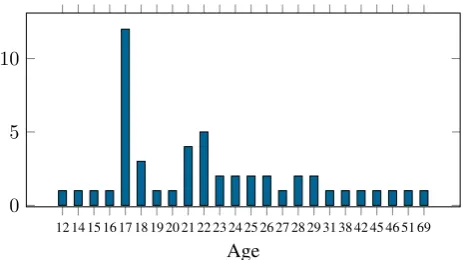
12 14 15 16 17 18 19 20 21 22 23 24 25 26 27 28 29 31 38 42 45 46 51 69
0 5 10
[image:2.595.56.288.67.197.2]Age
Figure 1: Age range of participants.
based on highly conventionalized emblems according to Kendon’s continuum (sign language processing being a special topic in its own (S´af´ar and Marshall, 2002)). Hence, FIGURE aspires to increase the expressive power of HCI gestures by exploring the rather unconventionalized realm of gesticulations and pantomime. However, the results re-ported below are also related to comparable findings from gesture studies in Section 4., connecting FIGURE to multi-modal interaction research. But to start with, in Section 2., data gathering, data annotation and reliability assessment is described. Exploratory and descriptive facts and figures are subsequently presented in Section 3..
2.
Data and Annotation
2.1.
Data Collection
The study proceeds in an interview-like manner, where each subject is asked to depict a number of terms by ges-tures (i.e., hand and arm movements). We started with cre-ating a catalog of 27 terms, consisting of the image-schema terms collected in Mehler et al. (2014) (e.g.,Equilibrium, Contact), basic navigational terms (likeLeftandRight), and evaluative expressions (Bad/Good).2 This list of terms has been subdivided into five groups, each comprises five to six words. 50 subjects took part in the study. Participants are from Germany, England, Russia, South Korea, the Kurdish area, China, Indonesia, Italy, Spain, Poland and the Nether-lands. The predominant mother tongue was German with 66%, the remaining 33% are roughly equally distributed between languages of the above-given countries. Their age ranges from 12 to 69 years (see Figure 1 for a details). Right-handedness predominates in the study; only two sub-jects are left-handed. That is, the proportion of left-handed people in the study is 4%and thereby at the lower bound of, but still in accordance with, what would be expected according to geographical variation (Llaurens et al., 2009, p. 882). Each subject depicts one of the five sets of stimulus terms, so that each term is depicted about 10 times.
2.2.
Annotation
In order to get at kinetic features describing gestures, we developed an annotation scheme based on established ges-ture annotation formats. Basically, a gesges-ture is represented
2See Mehler et al. (2014) for further literature on image
schemata.
as a feature vector between a starting position and an end position (Gibbon et al., 2003). The start- and endpoint of every gesture is annotated according to its location in ges-ture space (McNeill, 1992) and its handshape (ASL hand-shapes, extended by “thumbs up”). The trajectory of a dy-namic gesture is captured in terms of its path (line, arc, zigzag, etc. – cf. (Bressem, 2007; Lausberg and Sloetjes, 2009)) – and its orientation (away from body,up,left, etc. (L¨ucking et al., 2010)). In order to account for pointing gestures, the valuepointinghas been added as a path. Furthermore, the relations between the participants’ hands are annotated as well as the extension of a gesture in terms of the hands’ distance to the body. Eventual contact be-tween fingers or fingers and arms both at the start and at the end of a gesture is also considered. The temporal relation-ship between movements of the left and the right hand can be explicitly annotated. Additionally, repetitions of move-ments are captured by counting. Finally, by annotating se-quences of gestures we capture that people combine a num-ber of consecutive gestures in order to depict a term. Note that the kinetic feature-vector annotation is largely in-dependent from the actual timing of a gesture. For this rea-son, the temporal features of a gesture are explicated on a separate annotation level called “phases” with respect to the video signal. Here, the canonic three-fold partition of a gesture into apreparation, a “stroke” and aretractionphase is annotated (Kendon, 1980; McNeill, 1992). Additionally, we delimited the time span from the presentation of a stim-ulus term to the onset of gestural movement in the prepa-ration phase aspresentation phase. The presentation phase gives a temporal cue to the processing difficulties with re-gard to the term in question.
Annotation has been carried out usingELAN.3
2.3.
Reliability
In order to assess the reliability of the annotation scheme, three annotators independently annotated 12 experimental videos, containing 66 gestures in total. For each anno-tation level, a matching of annoanno-tation values is assessed in terms of both raw percentage agreement and chance-adjusted generalized Kappa coefficient (Fleiss, 1971). All calculations were carried out with the the R environment for statistical computing (R Core Team, 2013). The re-sults are detailed in Table 1. In particular, the annotation of start and end locations of gestures within the gesture space (Start.Pos,End.Pos) turned out to be difficult, with percentage agreement values ranging from about 60% to 80%. This seems to be partly due to the underlying being designed for sitting subjects, while in our study participants were standing so that distance reference information like knee position is not applicable. However, the remaining annotations proved to be highly consistent, with percentage agreements ranging from over 80%to about 98%. Averag-ing over all 33 annotation layers, the three annotators reach a pairwise percentage agreement of 90.81%, 91.64%and 86.50%. The mean Kappa coefficient for all raters on all layers is 0.84, meaning that the reliability of the annotation can be regarded as substantial (Krippendorff, 1980) or even “almost perfect” (Rietveld and van Hout, 1993).
Table 1: Overview of agreement re-sults.
,
%-Agree Kappa
Gesture.Type 100.00 1.00 R.Start.HS 92.42 0.93 R.Start.Pos 43.94 0.57 R.Start.Palm 86.36 0.89 R.Start.BoH 86.36 0.88 R.Start.Dist 80.30 0.75 R.End.HS 90.91 0.92 R.End.Pos 53.03 0.64 R.End.Palm 81.82 0.84 R.End.BoH 87.88 0.90 R.End.Dist 81.82 0.74 R.Path 75.76 0.77 R.Orient 81.82 0.85 R.Move 98.48 0.96 R.Repeat 84.78 0.72 L.Start.HS 90.91 0.90 L.Start.Pos 66.67 0.69 L.Start.Palm 87.88 0.88 L.Start.BoH 87.88 0.89 L.Start.Dist 86.36 0.85 L.End.HS 86.36 0.86 L.End.Pos 66.67 0.69 L.End.Palm 86.36 0.88 L.End.BoH 90.91 0.92 L.End.Dist 86.36 0.84 L.Path 86.36 0.82 L.Orient 90.91 0.90 L.Move 98.48 0.98 L.Repeat 91.49 0.80 BH.Sym 50.00 0.54 BH.Start.Contact 69.70 0.42 BH.End.Contact 68.18 0.43 BH.Temp.Rel 98.48 0.98
Note that assessing agreement of the temporal markings of the gesture phase segmentation follows a quite differ-ent rationale than percdiffer-entage agreemdiffer-ent or Kappa statistics (L¨ucking et al., 2012). Since the segmentation agreement of the three phases involved (viz., preparation, stroke and retraction) has been evaluated by L¨ucking et al. (2013), we can safely expect the phase annotation to be “substantially better than what would be expected by accidental coinci-dences of segmentations” (p. 11).
3.
Some Results
In the following subsections, descriptive figures of FIG-URE with regard to HCI are reported. Statistical calcu-lations and data plots (except for pie charts) were carried out with the the R environment for statistical computing (R Core Team, 2013) and the Grammar of Graphics library (Wickham, 2009).
3.1.
Frequent Form Features
The subjects’ gestures mainly describe four kinds of paths: we found 60.2%straight line trajectories, 13.1%pointing gestures, 11.9%arc-shaped paths, and 10.3%full curves – see Figure 2, where other paths includeZigzagorU-shaped trajectories.
line
60.2%
pointing 13.1%
arc
11.9% curve 10.2%
rest 4.6%
Figure 2: Most commonly used paths (percentages).
With regard to handshapes we get similar results. The mostly used handshapes at the beginning of a gestures were (using ASL notation)5(56.4%),d,c(each 8.9%) and the newly introduced10(thumbs up, 6.2%).
The same handshapes are also the most frequent hand-shapes at the end of gestures, with the exception of a higher usage of a terminalbhandshape. The most frequent “end handshapes” are: 5 (54.2%), d (12.8%), c (7.3%), 10 (6.6%) andb(4.6%).
All in all, there is a trend to perform simple, geometrical paths and plain handshapes, which is manifested in the high usage of the pathlineand the open hand (5) as handshape. The linear complexity of the gestures also tends to be low: sequences were an exception. Only 1.5% of the gestures wereright-handed sequencesand 4.2%werecomplex se-quences (there is no gesture sequence performed by only the left hand (though there are single gestures)). The lion’s share of FIGURE gesture (94.2%) is made up ofsimplex gestures.4
3.2.
Simplex Gesture Types
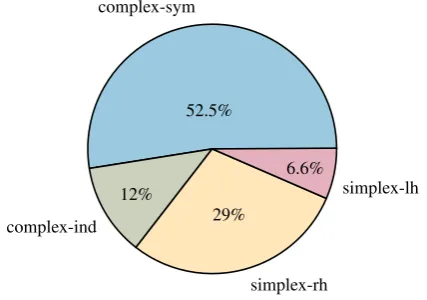
Each gesture from a non-sequence was classified accord-ing to the mutual relation of the hands. If only one hand was used, the gesture is said to be of type simplex, with a suffix indicating which hand was involved (i.e., -lhfor left hand and-rhfor right hand). In case of two-handed gestures, two possibilities obtain: firstly, both hands inter-act, often in a symmetric way, in order to depict a single entity; or secondly, each hand depicts a separate entity in-dividually, which are related in a more complex scene de-piction. The first case is called complex-sym, the second is calledcomplex-ind. The most common gesture type was complex-sym, which comprised about half of all gestures. The proportions of gesture types are displayed in Figure 4.
3.3.
Recurrent Forms
It turned out that most subjects tend to perform similar ges-tures as response for some stimulus terms. The most strik-ing example are gesture produced to depictGood/Likeand Bad/Dislike. 80%of the subjects performed a thumbs up gesture (handshape 10) for Good/Likeand even 100% of the subjects usedthumbs downforBad/Dislike. These ges-tures are found to occur in one of two variations,
distin-4
[image:3.595.93.247.101.485.2]5 56.4%
d 8.9% c
8.9% 10 6.2%
rest
19.6%
5
54.2%
d 12.8% c
7.3% 10 6.6%
b 4.6%
rest
[image:4.595.118.470.73.207.2]14.5%
Figure 3: Most commonly used ASL handshapes (percentages): start position (left) and end position (right).
complex-sym
52.5%
complex-ind 12%
simplex-rh 29%
simplex-lh 6.6%
Figure 4: Proportion of gesture types for simplex gestures.
guished by using one hand or both hands. This stable result is presumable due to the emblematic nature of thethumbs up/downgestures.
In response to the keywordEquilibrium, 70%of the sub-jects stretch out their arms horizontally by slightly swing-ing them. This depiction obviously is influenced by the im-age of an artist balancing on a high wire.
To our surprise, we found a common frequent gesture for Source-Path-Goal. This was insofar surprising as this term has been rated as one of the most difficult concepts in a pre-study evaluation of the keyword catalog among four raters. However, the subjects tend to move an invisible ob-ject through the space. There were two variants, a one-hand version and two-hand parallel one. The gesture presumably mimics the “drag and drop” action known from graphical user interfaces of operating systems.
As regards the gestures for the stimulus terms Left and Rightwe find that 60%of theLeft-gestures are performed with the left hand only, while 70%of the Right-gestures were produced using the right hand. Since only 4%of our subjects are left-handed, this result indicates a lateral bias of such “egocentric” terms.
3.4.
Stroke Duration
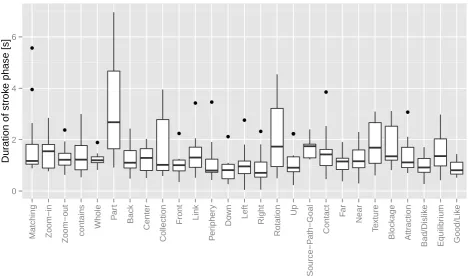
The length of the stroke phase is a hint for the complex-ity of the gestural movement. Given the inclination to use simplex gestures when possible (see the findings reported in Section 3.2.), participants can also be assumed to prefer
short gesture. In this line of thinking, longer stroke phases point to a greater extent of depiction demands on side of the participant. A respective visual data inspection, displayed in Figure 5, shows thatPartis the most demanding notion in our set of stimulus terms, followed byRotationandTexture (CollectionandBlockageshow larger standard deviations, but smaller means).
Whether such findings have to be explained in terms of in-trinsic structure of notions or in terms of possible recency effects of presentation of the notions cannot be decided on the basis of such exploratory data. However, the data facil-itates to generate a hypotheses concerning depiction strate-gies which can be tested in specifically designed experi-ments.
4.
Discussion
We provided a data set consisting of “morphological” an-notations of gestures, which in turn have been produced by na¨ıve participants in response to a controlled set of stimulus terms mainly drawn from the cognitive paradigm of image schemata. Our results show that the depiction of stimulus terms does not rest on the handshape parameter in a cru-cial way. This an interesting difference to co-speech ges-tures from free speech, where it is found to be highly man-ifold (Bressem, 2007). Previous findings (Bressem, 2007) demonstrating the significance of paths have been corrob-orated. These results provide a number of conclusions for HCI, since they suggest that gestural interaction going be-yond manipulator gestures relies mainly on the recognition of trajectories rather than on exact hand recognition. HCI gesture vocabularies tend to be oriented at static hand pos-tures. Such static vocabularies should be extended by dy-namic vocabularies formulated in terms of temporal move-ment pattern. The dynamics of gestures is also highlighted by differences in the mean durations of movements per stroke phase.
[image:4.595.63.277.253.403.2]● ●
●
●
●
● ●
● ●
● ●●
●
●
0 2 4 6
Matching Zoom−in Zoom−out contains
Whole
P
ar
t
Back
Center
Collection
Front Link
P
er
ipher
y
Do
wn Left
Right
Rotation
Up
Source−P
ath−Goal Contact
F
ar
Near
T
e
xture
Blockage Attr
action
Bad/Dislik
e
Equilibr
ium
Good/Lik
e
Stimulus term
Dur
ation of strok
[image:5.595.60.529.78.355.2]e phase [s]
Figure 5: Mean duration of stroke phases for the stimulus terms.
5.
Acknowledgements
We gratefully acknowledge the support of theFrankfurter Goethe-Haus / Freies Deutsches Hochstift in conducting the study. As representatives, we thank in particular Dr. Petra Maisak and Prof. Dr. Anne Bohnenkamp-Renken.
6.
References
Bergmann, K. and Kopp, S. (2010). Systematicity and idiosyncrasy in iconic gesture use: Empirical analysis and computational modeling. In Stefan Kopp et al., edi-tors,Gesture in Embodied Communication and Human-Computer Interaction, volume 5934 ofLecture Notes in Computer Science, pages 182–194. Springer, Berlin. Brennan, S. E. (1998). The grounding problem in
con-versations with and through computers. In Susan R. Fussell et al., editors,Social and cognitive psychological approaches to interpersonal communication, chapter 9, pages 201–225. Lawrence Erlbaum, Hillsdale, NJ. Bressem, J. (2007). Recurrent form features in coverbal
gestures. www.janabressem.de/Downloads/ Bressem-recurrentformfeatures.pdf. Fleiss, J. L. (1971). Measuring nominal scale agreement
among many raters. Psychological Bulletin, 76:378– 382.
Fricke, E., Bressem, J., and M¨uller, C. (2014). Gesture families and gestural fields. InHandb¨ucher zur Sprach-und Kommunikationswissenschaft / Handbooks of Lin-guistics and Communication Science (HSK), volume 2, chapter 123, pages 1630–1640. De Gruyter, Berlin and Boston.
Gibbon, D., Gut, U., Hell, B., Looks, K., Thies, A., and Trippel, T. (2003). A computational model of arm ges-tures in conversation. In Proceedings of the 8th Euro-pean Conference on Speech Communication and Tech-nology, EUROSPEECH 2003, pages 813–816.
Grandhi, S. A., Joue, G., and Mittelberg, I. (2011). Under-standing naturalness and intuitiveness in gesture produc-tion: insights for touchless gestural interfaces. In Pro-ceedings of the SIGCHI Conference on Human Factors in Computing Systems, CHI ’11, pages 821–824. Hostetter, A. B. and Alibali, M. W. (2008). Visible
em-bodiment: Gestures as simulated action. Psychonomic Bulletin & Review, 15(3):495–514.
Kendon, A. (1980). Gesticulation and speech: Two aspects of the process of utterance. In Mary Ritchie Key, editor, The Relationship of Verbal and Nonverbal Communica-tion, volume 25 ofContributions to the Sociology of Lan-guage, pages 207–227. Mouton, The Hague.
Kendon, A. (2004). Gesture: Visible Action as Utterance. Cambridge University Press.
Krippendorff, K. (1980). Content Analysis, volume 5 of The SAGE KommTexT Series. SAGE Publications. Ladewig, S. (2007). The crank gesture – systematic
varia-tion of form and context. Talk given at the third congress of the ISGS, Chicago, Northwestern University, USA. Lakoff, G. (1987). Women, Fire, and Dangerous Things:
What Categories Reveal about the Mind. University of Chicago Press.
Research Methods, 41(3):841–849.
Llaurens, V., Raymond, M., and Faurie, C. (2009). Why are some people left-handed? An evolutionary perspec-tive. Philosophical Transactions of the Royal Society of London B: Biological Sciences, 364(1519):881–894. L¨ucking, A., Ptock, S., and Bergmann, K. (2012).
As-sessing agreement on segmentations by means of Stac-cato, theSegmentation Agreement Calculator according to Thomann. In Eleni Efthimiou, et al., editors, Ges-ture and Sign Language in Human-Computer Interaction and Embodied Communication, volume 7206 ofLecture Notes in Artificial Intelligence, pages 129–138. Springer, Berlin and Heidelberg.
L¨ucking, A., Bergman, K., Hahn, F., Kopp, S., and Rieser, H. (2013). Data-based analysis of speech and gesture: The Bielefeld Speech and Gesture Alignment Corpus (SaGA) and its applications. Journal on Multimodal User Interfaces, 7(1-2):5–18.
L¨ucking, A., Bergmann, K., Hahn, F., Kopp, S., and Rieser, H. (2010). The Bielefeld Speech and Gesture Align-ment Corpus (SaGA). In Multimodal Corpora: Ad-vances in Capturing, Coding and Analyzing Multimodal-ity, LREC 2010, pages 92–98. 7th International Confer-ence for Language Resources and Evaluation.
McNeill, D. (1992). Hand and Mind–What Gestures Re-veal about Thought. Chicago University Press.
Mehler, A. and L¨ucking, A. (2012). WikiNect: Towards a gestural writing system for kinetic museum wikis. In Proceedings of the International Workshop On User Ex-perience in e-Learning and Augmented Technologies in Education, UXeLATE 2012, pages 7–12, Nara, Japan. Mehler, A., L¨ucking, A., and Abrami, G. (2014).
WikiNect: Image schemata as a basis of gestural writ-ing for kinetic museum wikis. Universal Access in the Information Society, pages 1–17.
M¨uller, C. (2004). Forms and uses of the Palm Up Open Hand: A case of a gesture family? In Cornelia M¨uller et al., editors,The semantics and pragmatics of everyday gestures, volume 9 ofK¨orper – Zeichen – Kultur, pages 233–256. Weidler. Proceedings of the Berlin conference 1998.
Quek, F. K. H., McNeill, D., Bryll, R. K., Duncan, S., Ma, X.-F., Kirbas, C., McCullough, K. E., and Ansari, R. (2002). Multimodal human discourse: Gesture and speech. ACM Transactions on Computer-Human Inter-action, 9(3):171–193.
R Core Team, (2013). R: A Language and Environment for Statistical Computing. R Foundation for Statistical Computing, Vienna, Austria.
Rietveld, T. and van Hout, R. (1993). Statistical techniques for the study of language and language behaviour. Mou-ton de Gruyter.
S´af´ar, E. and Marshall, I. (2002). Sign language transla-tion via DRT and HPSG. InComputational Linguistics and Intelligent Text Processing, volume 2276 of Lec-ture Notes in Computer Science, pages 58–68. Springer, Berlin and Heidelberg.