Phrase Detectives Corpus 1.0
Crowdsourced Anaphoric Coreference
Jon Chamberlain, Massimo Poesio, Udo Kruschwitz
School of Computer Science and Electronic EngineeringUniversity of Essex
{jchamb,poesio,udo}@essex.ac.uk
Abstract
Natural Language Engineering tasks require large and complex annotated datasets to build more advanced models of language. Corpora are typically annotated by several experts to create a gold standard; however, there are now compelling reasons to use a non-expert crowd to annotate text, driven by cost, speed and scalability. Phrase Detectives Corpus 1.0 is an anaphorically-annotated corpus of encyclopedic and narrative text that contains a gold standard created by multiple experts, as well as a set of annotations created by a large non-expert crowd. Analysis shows very good inter-expert agreement (κ =.88−.93) but a more variable baseline crowd agreement (κ=.52−.96). Encyclopedic texts show less agreement (and by implication are harder to annotate) than narrative texts. The release of this corpus is intended to encourage research into the use of crowds for text annotation and the development of more advanced, probabilistic language models, in particular for anaphoric coreference.
Keywords:anaphoric coreference, anaphora, annotation, crowdsourcing, gwap, games-with-a-purpose, phrase detectives, corpora
1.
Introduction
A revolution in the way tasks can be completed occurred when it was proposed to take a job traditionally performed by a designated employee and outsource it to an undefined large group of Internet users. This approach, called crowd-sourcing(Howe, 2008), changed traditional thinking be-hind methods for language resource creation and made new tasks possible that were previously inconceivable due to cost or labour limitations. For example,microworkingis now a common crowdsourcing approach to create small to medium-sized language resources by engaging a crowd us-ing small payments (Snow et al., 2008). An alternative ap-proach is to use agame-with-a-purpose (GWAP) to ag-gregate data from non-expert players, who are motivated by entertainment, to create collective decisions similar to those from an expert (von Ahn, 2006).
Phrase Detectives, an interactive online game for creating anaphorically-annotated corpora, is an illustration of the GWAP approach for creating large-scale resources. The Phrase Detectives corpus differs from existing corpora for anaphora in two key respects: (i) it covers genres for which no other data are available, including encyclopedic and nar-rative text; and (ii) multiple solutions (or interpretations) are collected per task. This paper briefly describes the game and annotation scheme, before describing in more detail the measures of quality used and an analysis of a subset of the corpus which has been made available to the language re-source community.
2.
Related Work
Generally speaking, a game-based crowdsourcing approach uses entertainment rather than financial payment to moti-vate participation. GWAPs come in many forms; they tend to be graphically rich, with simple interfaces, and give the player an experience of progression by scoring points, be-ing assigned levels and recognisbe-ing their effort. Systems are required to control the behaviour of players: to
encour-age them to concentrate on the tasks and to discourencour-age them from malicious behaviour.
1001 Paraphrases (Chklovski, 2005), one of the first GWAPs with the aim of collecting corpora, was developed to collect training data for a machine translation system. TheOpen Mind Common Senseproject also led to the de-velopment of a game for collecting commonsense knowl-edge, calledLEARNER(Chklovski and Gil, 2005). Perhaps the most successful GWAP that brought the ap-proach into the mainstream wasThe ESP Gamewhich at-tracted over 200,000 players who produced over 50 million labels for images (von Ahn, 2006). Since then GWAPs have been developed for numerous tasks, including image and video annotation, natural language processing, biomedical research and search refinement (Chamberlain et al., 2013). Several GWAPs have attempted anaphoric coreference in-cluding PlayCoref, a two-player game in which players mark coreferential pairs between words in a text (Hladk´a et al., 2009), andPhraTris, a GWAP for syntactic annota-tion using a general-purpose development platform called GALOAP (Attardi and the Galoap Team, 2010).1 PackPlay was another attempt to build semantically-rich annotated corpora (Green et al., 2010). The two game variantsEntity DiscoveryandName That Entityuse slightly different ap-proaches in multi-player games to elicit annotations from players. A more unified attempt at creating a gaming plat-form, namedWordrobe2, targeted different linguistic tasks including part-of-speech tagging, named entity tagging, co-reference resolution, word sense disambiguation and com-pound relations (Venhuizen et al., 2013).
More recently, GWAPs integrated into social networking sites such as Sentiment Quiz (Rafelsberger and Scharl, 2009) and TypeAttack (Jovian and Amprimo, 2011) on Facebook show that social interaction within a game envi-ronment also motivates players to participate in corpus
an-1
http://galoap.codeplex.com 2
Figure 1: A task presented in Annotation Mode.
Figure 2: A task presented in Validation Mode.
notation. DigiTalkoot’s gamesMole HuntandMole Bridge, released on Facebook by the National Library of Finland and Microtask to help digitise old Finnish documents, at-tracted 110,000 participants who completed over 8 million word fixing tasks in 22 months3, highlighting the potential for large-scale annotation efforts using a GWAP approach.
3.
The Phrase Detectives Game
Phrase Detectives4is primarily a GWAP designed to collect data about English (and subsequently Italian) anaphoric co-reference (Poesio et al., 2013; Chamberlain et al., 2008).5 A Facebook version of the game6 maintained the overall architecture whilst incorporating a number of new features developed specifically for the social network platform. The game uses two styles of text annotation for players to complete a linguistic task. Initially text is presented in
3
http://www.digitalkoot.fi 4
http://www.phrasedetectives.com 5
Anaphoric coreference is a type of linguistic reference where one expression depends on another referential element. An exam-ple would be the relation between the entity‘Jon’and the pronoun ‘his’in the text ’Jon rode his bike to school.’
6
https://apps.facebook.com/phrasedetectives
ID Gold Standard D W M
GN Consensus+1 5 874 274
W2 2 experts 5 495 185
G2 2 experts 1 180 69
W1 1 expert 30 12,106 3,953
G1 1 expert 4 6,231 1,971
45 19,886 6,452
Table 1: Summary of corpora from Phrase
Detectives Corpus 1.0 showing total documents (D), total words (W) and total markables (M).
Annotation Mode(called Name the Culprit in the game, see Figure 1). This is a straightforward annotation mode in which the player makes aninterpretation(annotation de-cision) about a highlightedmarkable(section of text). If different players enter different interpretations for a mark-able then each interpretation is presented to more players inValidation Mode(called Detectives Conference in the game, see Figure 2). The players in Validation Mode have to agree or disagree with the interpretation. Players may also make comments about the task and/or skip the task if they do not want to provide an interpretation.
Training texts show the players whether their decisions agree with the gold standard. Once the player has com-pleted all of the training tasks they are given a user rating (the percentage of correct decisions out of the total number of training tasks). The user rating is recorded with every future annotation or validation decision. Players are given training texts until the rating is sufficiently high enough to be given real text from the corpus.7
In the first six years of operation (1 Dec 2008 to 30 Nov 2014) over 38,000 players have registered, 2,746 of which went beyond the initial training phase. 524 documents have been fully annotated, for a total completed corpus of 302,224 words, 25% of the total size of the collection cur-rently uploaded for annotation in the game (1.2M words in 839 documents).
4.
Phrase Detectives Corpus 1.0
The documents in the corpus are from collections not subject to copyright restrictions including Wikipedia arti-cles and narrative text from Project Gutenberg.8 PhraseDetectives Corpus 1.09(Chamberlain et al., 2016) contains a subset of documents from the main corpus that have been fully annotated and also have a gold standard:
• The GNOME corpus (GN) which already had a docu-mented gold standard (Poesio, 2004a) and was anno-tated by an additional expert;
• Documents from the Wikipedia (W2) and Gutenberg corpora (G2) that have a gold standard created by two experts;10
7
A minimum rating threshold of 50% is set for the game. 8
http://www.gutenberg.org
9Available from http://anawiki.essex.ac.uk
Corpus W/S W/M %M del %M edit Readability
GN 19.4 sd(7.3) n(45) 3.4 sd(1.0) n(45) 0 0 52.3 sd(10.7) n(5)
W2 16.5 sd(7.2) n(30) 2.9 sd(0.6) n(29) 4.3 4.3 53.6 sd(5.6) n(5)
G2 18.0 sd(8.1) n(10) 3.2 sd(1.1) n(10) 7.2 0 88.2 n(1)
W1 21.3 sd(10.0) n(592) 3.5 sd(1.0) n(586) 3.9 9.1 50.7 sd(10.4) n(30)
[image:3.595.96.497.67.144.2]G1 25.0 sd(17.9) n(249) 3.5 sd(1.0) n(248) 3.9 4.5 84.3 sd(3.5) n(4)
Table 2: Descriptive analysis of the corpora showing words per sentence (W/S), active markables per word (M/W), the proportion of markables that were deleted (%M del) and edited (%M edit) and the readability measured as the average (mean) Flesch Reading Ease Score.
• Documents selected at random from completed docu-ments in the Wikipedia (W1) and Gutenberg (G1) cor-pora with a gold standard created by one expert.
The Phrase Detectives Corpus 1.0 contains 19,886 words in 45 documents (see Table 1). The format for this corpus has been previously detailed (Poesio et al., 2012) and a further release of completed documents following these guidelines will be made in the future.
4.1.
Preprocessing pipeline
A text preprocessing pipeline to convert text and html docu-ments was developed by combining existing tools with ad-hoc modules for correcting the output in the case of fre-quent errors:
1. A pre-processing step normalised the input, applied a sentence splitter and ran a tokeniser over each sen-tence (developed from theopenNLPtoolkit11);
2. A custom-developed processing step was carried out to clean systematic errors made by the tokeniser and sentence splitter;
3. Each sentence was then analysed by the Berkeley Parser (Petrov et al., 2006);
4. The parser output was used to identify markables in the sentence. As a result an XML-like representation was created which preserved the syntactic structure of the markables (including nested markables, e.g. noun phrases within a larger noun phrase);
5. A heuristic processor identified additional features as-sociated with markables such as person, case, number, etc. The output format was MAS-XML (see section 5.2.).
Once the text had been processed and uploaded into the game, an administrator could edit the markables (charac-ter length and charac(charac-ter start position), as well as selecting markables to be deleted.12
4.2.
Descriptive analysis of the corpora
The corpora were analysed for syntactic and structural dif-ferences (see Table 2):
11http://opennlp.apache.org
12No markables were actually deleted, to ensure database in-tegrity they were instead flagged to be ignored by system outputs.
• The number of words per sentence (W/S) as calcu-lated by PHP word count (str word count) on sen-tences chunked by the pre-processing;
• The number of words per active (not deleted) mark-able (W/M) where the total number of words in each sentence (as calculated by a PHP word count) is di-vided by the total active markables per sentence. Sen-tences with no active markables were ignored;
• The average (mean) proportion of markables that were deleted (%M del) or edited (%M edit) per document;
• The average (mean) readability of each document’s content as calculated by an online assessment13of the Flesch Reading Ease Score (FRES) (Kincaid et al., 1975). The score is calculated as weighted averages of words per sentence and syllables per word:
206.835−1.015total sentencestotal words −84.6total syllablestotal words
The two largest corpora (G1 and W1) were then compared (the three other corpora were considered too small to show any significant differences).
G1 had a significantly longer average sentence length than W1 (25.0 words compared to 21.3; unpaired t-test, p<0.01) but was significantly easier to read (FRES=84.3 compared to 50.7; unpaired t-test, p<0.01). They had the same num-ber of words per markable: 3.5 sd(1.0).
There was no difference between the proportion of mark-ables with errors that needed deleting; however, G1 re-quired fewer markables per document to be edited (4.5% compared to 9.1%; z-test, p<0.01).
It might be reasonable to assume that documents that are easier to read are also easier to process using automatic parsing; however, readability in this context only weakly correlates to the proportion of markables deleted (n=34 R=0.16 R2=0.024; Pearson, weak positive correlation) and edited (n=34 R=0.28 R2=0.077; Pearson, weak positive correlation).
5.
Annotations
5.1.
Coding scheme
The corpus was annotated according to the linguistically-oriented approach to anaphoric annotation that is currently prevalent, having been adopted in OntoNotes (Pradhan et al., 2007), the ARRAU corpus (Poesio and Artstein, 2008)
13
and in all the corpora used in the 2010 SEMEVAL anaphora evaluation (Recasens et al., 2010).
Markables can be assigned four types of interpretation:
• DN (discourse-new): this markable refers to a newly introduced entity;
• DO (discourse-old): this markable refers to an entity already mentioned in the text;
• NR (non-referring): this markable does not refer to anything (e.g. pleonasticit);
• PR (property attribute): this markable represents a property of a previously mentioned entity (e.g. a teacherin ‘He is a teacher’).
Annotations can be examined at three levels of granularity: class; entity or specific. At theclasslevel a markable can be assigned one of the four definitions above. At the en-titylevel the two classes DO and PR allow for a referring entity to be selected, for example,hereferring to the entity
Davein ‘Dave was the best he could be.’ At thespecific level the closest mention of the entity in terms of charac-ter distance is considered correct, which allows for linear anaphoric chaining to occur. An example would beshe re-ferring to the markable herin ‘Kate wondered if her suit was the best she had.’ which are both mentions of the en-tityKate.
Analysis of specific annotations are presented in this paper and represent the most difficult of the three levels of anno-tation.
5.2.
Export format
The PD-MAS-XML format used to export Phrase Detec-tives data is a modified version of the Minimum Anaphoric Syntax (MAS-XML) format, a form of inline XML in which the basic information required to carry out resolu-tion is marked (Poesio, 2004b).
As an example, the representation in MAS-XML of the noun phrasefour little rabbitsis as follows:
1 <ne id="ne4" AAcat="num-np" AAgen="neut" AAnum="plur" AAper="per3">
2 <mod id="AAm2" AAcat="AApre">
3 <W Lpos="CD">four</W>
4 <W Lpos="JJ">little</W>
5 </mod>
6 <nphead id="AAh4">
7 <W Lpos="NNS">rabbits</W>
8 </nphead>
9 </ne>
PD-MAS-XML allows all interpretations for the markables to be stored, leaving it to subsequent processes to select which interpretations to use. The PD-MAS-XML file in-cludes:
• the original text;
• the markup of sentences, NPs, their features and con-stituents as automatically computed by the import pipeline (MAS-XML format);
[image:4.595.316.532.76.310.2]• the gold standard expert annotations;
Figure 3: Screenshot showing the expert annotation admin-istration interface.
• the annotations produced by the players including the user ID, the user rating, the time it took to make the de-cision, whether the decision is an agreement, in what mode the decision occurred (annotation or validation), timestamp, and the interface that was used;
• any player comments about the markable;
• and any time a player skipped the markable.
The following is a simplified example of how player anno-tations are appended to the MAS-XML to create PD-MAS-XML:
1 <PDante id="ne14817">
2 <interpretation>
3 <anchor type="DN" user_id="281" user_rating="75" annotation_time="2" agree="y" mode="a" timestamp ="2009-02-07 17:16:46"/>
4 <anchor type="DO" user_id="728" user_rating="58" annotation_time="2" agree="y" mode="a" ante=" ne18253" timestamp="2009-02-07 17:14:46"/>
5 <anchor type="PR" user_id="718" user_rating="60" annotation_time="5" agree="y" mode="a" ante=" ne18253" timestamp="2009-02-07 17:14:46"/>
6 <anchor type="DN" user_id="1364" user_rating="59" annotation_time="4" agree="y" mode="v" timestamp ="2009-02-07 17:12:46"/>
7 <anchor type="DN" user_id="163" user_rating="80" annotation_time="2" agree="y" mode="v" timestamp ="2009-02-07 17:11:46"/>
8 <anchor type="DN" user_id="165" user_rating="85" annotation_time="2" agree="n" mode="v" timestamp ="2009-02-07 17:10:46"/>
9 <anchor type="DN" favoured="y" user_id="2" mode="e" timestamp="2009-04-07 17:10:46"/>
10 <anchor type="DN" favoured="y" user_id="18" mode="e" timestamp="2009-05-02 12:11:42"/>
11 </interpretation>
12 <comment timestamp="2011-07-22 04:23:59" user_rating=" 92" user_id="123" type="not_selectable" type_id=" 1"/>
13 <skip timestamp="2011-07-22 04:23:59" annotation_time= "8" user_rating="92" user_id="123"/>
GNn(59) W2n(154) G2n(57)
DN - 99.0% 85.7%
DO 93.2% 84.8% 91.6%
NR - 100%
-PR - 72.7%
-Overall 93.2% 94.1% 89.4%
[image:5.595.67.274.68.157.2](κ=0.93) (κ=0.88) (κ=0.88)
Table 3: Inter-expert agreement between e2 and e18 (DN = discourse-new, DO = discourse-old, NR = non-referring, PR = property attribute).
6.
Gold Standard
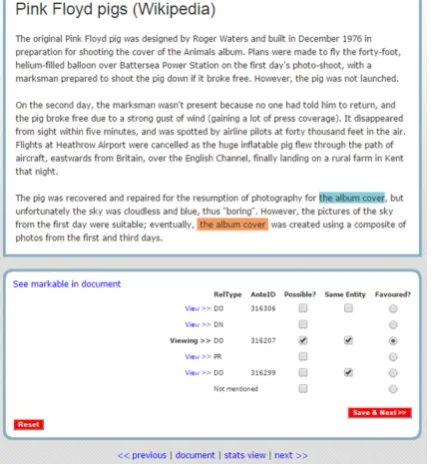
In order to create the gold standard, the expert annotator was shown a list of all markable interpretations that had been entered by the players for a particular markable and could view each interpretation as if in Validation Mode (see Figure 3). By default the expert could not see how many annotations or validations each interpretation had scored. The markables were annotated in order of appearance in the text.
The expert selected the best interpretation for the mark-able (the ‘favoured’ radio button) and selected the check-box of any possible interpretations due to ambiguity. Addi-tionally, if the markable was referring, the expert selected the checkboxes of any other interpretation that was for the same entity. If the most appropriate interpretation was not mentioned in the list submitted by the players the expert could indicate the best markable interpretation as ‘Not men-tioned’. Markables that were marked as deleted did not re-quire an expert annotation.
Complete instructions and examples for experts on how to annotate apposition, discourse diexsis, out-of-context er-rors, questions, names, compound entities, bridging enti-ties, temporal revelations, numerators and dates are detailed in the supplementary files attached to the resource.
6.1.
Inter-expert agreement
Five documents from the Wikipedia corpus, containing 154 active markables (W2), and one document from the Gutenberg corpus, containing 57 active markables (G2), were manually annotated by two experts operating indepen-dently, called e2 and e18.14
Five documents from the GNOME (GN) corpus were anno-tated by e2 and compared to the consolidated annotations of the GNOME corpus (in which e18 was the main annota-tor).15DN and PR annotations were not recorded and there were no instances of NR markables. The GNOME anno-tations were manually converted into the Phrase Detectives corpus scheme under the expert ID e39181. In total there
14
The two experts were Jon Chamberlain (e2), who developed the game and wrote the instructions, and Massimo Poesio (e18), a linguistic expert in anaphoric coreference.
15The GNOME annotation scheme records DO annotations as ‘ident’ variables. Plural DO was only annotated once (as an ‘element-inv’ variable) and was not imported here to avoid ad-ditional conflict in the annotation instructions.
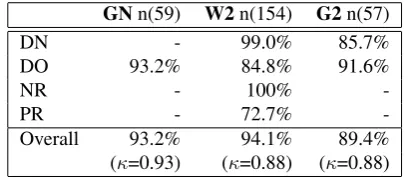
were 59 markables that e2 and GNOME produced an anno-tation for (see Table 3).
Overall, agreement between experts in the three corpora was very high although not complete: 93.2% (GN), 94.1% (W2) and 89.4% (G2), for a chance-adjustedκvalue (Art-stein and Poesio, 2008) ofκ=.93,κ=.88andκ=.88 respectively, which is extremely good. This value can be seen as an upper boundary on what we might expect to get out of a crowdsourcing system.
There was no significant difference between the inter-expert agreement of the three corpora (GN n(59) 93.2%; W2 n(154) 94.1%; G2 n(57) 89.4%; p=0.810, p=0.238, p=0.465, z-test). This indicates that the expert annotations created by e2 are what could be considered a gold stan-dard between document domains and when compared to an existing gold standard or another linguistic expert. Expert annotator e2 also created the gold standard for W1 and G1.
6.2.
Baseline crowd agreement
Traditional methods of measuring annotation accuracy gen-erally assume a singularity of correct answers and for com-parative purposes the baseline agreement is presented in this way. Measuring accuracy of a multi-dimensional anno-tation set is more complex and is the subject of future work.
Qualityis measured as the level of agreement between an expert and the highest scoring system answer. Noiseis de-fined as the average (mean) number of wrong interpreta-tions per markable.
The annotations and validations of each markable from each corpus were analysed and either aggregated to pro-duce a best answer or were excluded because:
• the markable has been marked by an administrator to be deleted;
• the expert did not provide an answer (therefore an an-swer was not possible);
• the markable was skipped by enough players (the markable did not have eight annotations when consid-ered complete).
All annotations and validations for each interpretation of a markable were combined:
A+Va−Vd
whereAis the number of players initially choosing the in-terpretation in Annotation Mode,Vais the number of play-ers agreeing with that interpretation in Validation Mode, andVdis the number of players disagreeing with it in Val-idation Mode. This formula is used to score each interpre-tation of a markable, with the highest scoring interpreta-tion called the ‘best’ or game interpretainterpreta-tion (Chamberlain, 2014).
GN W2 G2 W1 G1
e2 e39181 e2 e18 e2 e18 e2 e2
Markables 264 61 176 160 63 58 3,729 1,844
Agreement 93.9% 85.2% 84.0% 81.8% 96.8% 93.1% 79.1% 86.6%
Kappaκ 0.86 0.85 0.63 0.59 0.96 0.92 0.52 0.85
N oisemean 1.6 2.7 2.6 1.3 1.4
[image:6.595.105.485.70.157.2]sd(2.0) sd(3.4) sd(2.1) sd(1.6) sd(1.3)
Table 4: Baseline agreement between experts and the best answer from the game.
DN DO NR PR NM
GN n(275) 189 (68.7%) 65 (23.6%) 0 4 (1.4%) 17 (6.1%)
W2 n(176) 128 (72.7%) 33 (18.7%) 1 (0.5%) 13 (7.3%) 1 (0.5%)
G2 n(63) 27 (42.8%) 36 (57.1%) 0 0 0
W1 n(3,729) 2,502 (67.0%) 912 (24.4%) 23 (0.6%) 108 (2.8%) 184 (4.9%) G1 n(1,884) 638 (33.8%) 1,160 (61.5%) 25 (1.3%) 21 (1.1%) 40 (2.1%)
Table 5: Summary of the distribution of interpretations for active markables.
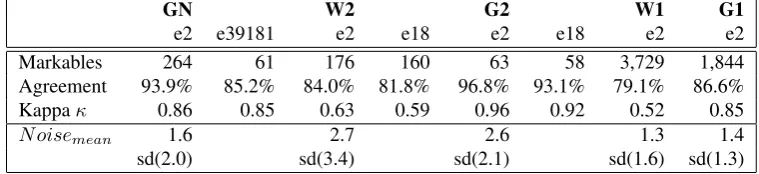
agreement (quality) than W2 and G2, significantly so in the Gutenberg corpus (G1-G2, z-test, p=0.02; W1-W2, z-test, p=0.12) which may be because the latter documents were worked on by more linguists, rather than the former docu-ments which were worked on by a non-expert crowd.16 The Gutenberg corpus had a higher agreement than the Wikipedia corpus (G1 n(1,844) 86.6%, W1 n(3,729) 79.1%, p<0.01, z-test) showing that the narrative texts of Gutenberg are perhaps easier to annotate.
The prevalence of genuinely ambiguous interpretations is low (0.5% in G1 and 0.8% in W1); however, learning to identify these cases automatically may be of most interest to linguists (see Section 8.).
7.
Task distribution and difficulty
During the data collection all markables were treated in the same way; however, it is clear that some markables are eas-ier to annotate than others, either because of the text itself (contextual difficulty) or because of the type of relation it has with the other markables (interpretation difficulty).
7.1.
Contextual difficulty
It could be assumed that the more complex the text, the more difficult the players would find the task of annotating the markables, and therefore the quality would be lower. However, agreement per document shows a weak positive correlation to readability (n(45) R=0.19 R2=0.037; Pear-son, weak positive correlation) implying readability has lit-tle impact on the user’s ability to perform annotation tasks. The documents in the corpus were not complex and other documents might show different results.
To investigate whether document length had an impact on difficulty the W1 corpus was split into two groups, one with long documents (WL1,>700 words, n(8) mean=819.4 sd(199.3)) and one with short documents (WS1, <700
16The intial deployment of the game was publicised at language conferences, forums and linguist blogs.
words, n(22) mean=272.6 sd(50.2)). There was no dif-ference between the agreement in the Wikipedia long and short corpora (WL1 n(1,947) 79.9%; WS1 n(1,782) 78.1%; z-test, p=0.18) which suggests that document length also does not seem to impact on a player’s ability to annotate the text.
7.2.
Interpretation difficulty
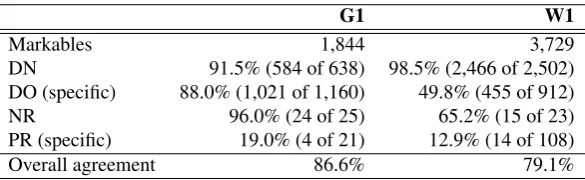
In order to explore whether some types of interpretation are harder to detect and annotate than others, first we looked at how the classes of interpretation are distributed through the corpora, then looked at the agreement of each class. The distribution of annotation class was calculated as a pro-portion of interpretations of active markables as determined by an expert (e2). When there was no correct interpretation the markable interpretation would be classed as NM (Not Mentioned), see Table 5.
The documents in G1 have more coreferring DO markables (61.5%) than in the documents in W1 (24.4%), with the reverse being true for DN markables. NR and PR mark-ables are rare in both corpora (W1 n(3,729); G1 n(1,884); χ2=763.6, p<0.01). One explanation might be that as Wikipedia articles, which are explanatory in nature, be-come longer they introduce more entities to explain the topic of the document. The reverse could be true for Guten-berg documents, which are mainly narratives, that will in-troduce entities and continue to refer to them throughout the discourse.
G1 W1
Markables 1,844 3,729
DN 91.5% (584 of 638) 98.5% (2,466 of 2,502)
DO (specific) 88.0% (1,021 of 1,160) 49.8% (455 of 912)
NR 96.0% (24 of 25) 65.2% (15 of 23)
PR (specific) 19.0% (4 of 21) 12.9% (14 of 108)
[image:7.595.150.443.67.157.2]Overall agreement 86.6% 79.1%
Table 6: Breakdown of agreement between each interpretation type (as determined by e2) and the best game answer on the Wikipedia and Gutenberg corpora, showing a difference in all classes of interpretation (p<0.01, z-test).
8.
Discussion
Despite the high performance of annotators, it is worth dis-cussing the types of errors that were made during the anno-tation of the corpus.
Annotators make genuine errors caused by a slip of at-tention or fatigue. Experts could review and rectify their mistakes, but players were not allowed to go back and cor-rect annotations they knew they had made incorcor-rectly (as this would have influenced the scoring of the game). Other errors were introduced because annotators were not sure of the correct way to mark up the text and numerous examples ofmarkup ambiguitywere added to the guide-lines. Whilst expert annotators were expected to read and understand all types of markup, most players only had a general understanding of what was required.
Of the 12 markables on which the experts did not agree in the W2 and G2 corpora, only one was a genuine error in which the entity had been correctly identified but not the closest mention. The remaining disagreements fell into four categories of markup ambiguity:
The first category was thespecificityof the antecedent. The preprocessing chunks markables in a way that allows dif-ferent levels of specificity to be selected, for example, in
Henry the Hexapus (Wikipedia) the markable the Black-pool Centre refers to an earlier mention ofthe Blackpool Sea Life Centre in North West England; however, a less spe-cific markable within this markable was also selectable:the Blackpool Sea Life Centre.
The second category relates to assumptions the reader makes regarding the role of entities, for example in Gay Fuel (Wikipedia) it could be assumed that the acronym
LLCandIts makerrefer to the manufacturer of the drink
Florida-based Speciality Spirits; however, this is not ex-plicitly stated in the context so the reader has to make an assumption about the role of the entity.
A further example of this type of markup ambiguity was for temporal revelations. Revelations that are made dur-ing the context of the document should have been marked up at the point of revelation and not retrospectively marked throughout the text, for example,the bridegroomwould not be marked up as also beingthe robberthroughoutThe Rob-ber Bridegroom (The Brothers Grimm)when it is only re-vealed at the end of the text.
The third category was confusion over what constitutes a propertyof another markable and what is in fact another entity, for example, inGay Fuel (Wikipedia)whetherbright pink and elderberry flavoredis a property ofthe liquidin
‘...the liquid was dyed bright pink and elderberry flavored.’ Examples of this type of ambiguity explain why property markables are more difficult to annotate.
The final category was for entitygeneralisations, in which perhaps coreference is not an appropriate annotation, for example, inHuman Mail (Wikipedia)the mentions ofa per-sonin the sentences ‘Human mail is the transportation of a person through the postal system.’ and ‘...is the mailing of a part of a person...’
Examples ofgenuine ambiguity, where there are truly two (or more) indistinguishable interpretations for a markable were quite rare in this corpus (as indicated by the expert gold standard showing there to be at least two interpreta-tions possible for a markable). Developing ways to iden-tify true linguistic ambiguity from other forms of error and noise is a key goal for future research.
It is our hope that the overall quality of the crowd decisions in this corpus are high enough to use this data in more so-phisticated models of annotation (Raykar et al., 2010) to understand annotator bias and automatically identify gen-uine ambiguity over poor decisions. Next steps include de-veloping methods for cleaning up the data with filtering and optimisation and for using the data to train anaphoric mod-els. A larger corpus will also be released in the future.
9.
Conclusion
Phrase Detectives was one of the first GWAPs applied to language resource creation and in quantitative terms has been one of the most successful, collecting over three mil-lion judgements in six years. The baseline figures for the five gold standard corpora show high quality at near-expert annotator performance. Analysis of the corpus also sug-gests that factors such as document length and readability do not impact agreement; however, users find it harder to detect and annotate different types of interpretation. Phrase Detectives, and other GWAPs for language resource creation, have shown that for large-scale, persistent anno-tation efforts, a game-based crowdsourcing approach could be considered based on factors such as cost and scalability.
Acknowledgments
10.
Bibliographical References
Artstein, R. and Poesio, M. (2008). Inter-coder agreement for computational linguistics. Computational Linguis-tics, 34(4):555–596.
Attardi, G. and the Galoap Team. (2010). Phratris. Demo presented at the 9th International Semantic Web Confer-ence (ISWC’10) tutorial INSEMTIVES’10.
Chamberlain, J., Poesio, M., and Kruschwitz, U. (2008). Phrase Detectives: A web-based collaborative annotation game. InProceedings of the 2008 International Confer-ence on Semantic Systems (I-Semantics’08).
Chamberlain, J., Kruschwitz, U., and Poesio, M. (2009). Constructing an anaphorically annotated corpus with non-experts: Assessing the quality of collaborative annotations. In Proceedings of the 4th International Joint Conference on Natural Language Processing (IJC-NLP’09) Workshop on The People’s Web Meets NLP: Collaboratively Constructed Semantic Resources. Chamberlain, J., Fort, K., Kruschwitz, U., Mathieu, L.,
and Poesio, M. (2013). Using games to create language resources: Successes and limitations of the approach. InACM Transactions on Interactive Intelligent Systems, volume The People’s Web Meets NLP: Collaboratively Constructed Language Resources. Springer.
Chamberlain, J. (2014). The Annotation-Validation (AV) model: Rewarding contribution using retrospective agreement. InProceedings of the 1st International Work-shop on Gamification for Information Retrieval (Gami-fIR’14).
Chklovski, T. and Gil, Y. (2005). Improving the design of intelligent acquisition interfaces for collecting world knowledge from web contributors. InProceedings of the 3rd International Conference on Knowledge Capture (K-CAP’05).
Chklovski, T. (2005). Collecting paraphrase corpora from volunteer contributors. InProceedings of the 3rd International Conference on Knowledge Capture (K-CAP’05).
Green, N., Breimyer, P., Kumar, V., and Samatova, N. F. (2010). Packplay: Mining semantic data in collaborative games. InProceedings of the 4th Linguistic Annotation Workshop (LAW IV).
Hladk´a, B., M´ırovsk`y, J., and Schlesinger, P. (2009). Play the language: Play coreference. InProceedings of the 4th International Joint Conference on Natural Language Processing (IJCNLP’09).
Howe, J. (2008). Crowdsourcing: Why the power of the crowd is driving the future of business. Crown Publish-ing Group.
Jovian, L. T. and Amprimo, O. (2011). OCR correction via human computational game. In Proceedings of the 44th Hawaii International Conference on System Sci-ences (HICSS’11).
Kincaid, J. P., Fishburne, R. P., Rogers, R. L., and Chissom, B. S. (1975). Derivation of new readability formulas (Automated Readability Index, Fog Count and Flesch Reading Ease Formula) for Navy enlisted personnel. Technical report.
Petrov, S., Barrett, L., Thibaux, R., and Klein, D. (2006).
Learning accurate, compact, and interpretable tree anno-tation. InProceedings of the 21st International Confer-ence on Computational Linguistics.
Poesio, M. and Artstein, R. (2008). Anaphoric annotation in the ARRAU corpus. InProceedings of the 6th Inter-national Conference on Language Resources and Evalu-ation (LREC’08).
Poesio, M., Chamberlain, J., Kruschwitz, U., Robaldo, L., and Ducceschi, L. (2012). The Phrase Detective multi-lingual corpus, release 0.1. InProceedings of LREC’12 Workshop on Collaborative Resource Development and Delivery.
Poesio, M., Chamberlain, J., Kruschwitz, U., Robaldo, L., and Ducceschi, L. (2013). Phrase Detectives: Utiliz-ing collective intelligence for internet-scale language re-source creation. ACM Transactions on Interactive Intel-ligent Systems.
Poesio, M. (2004a). Discourse annotation and semantic annotation in the GNOME corpus. InProceedings of the 2004 ACL Workshop on Discourse Annotation.
Poesio, M. (2004b). The MATE/GNOME scheme for anaphoric annotation, revisited. In Proceedings of the 5th SIGdial Workshop on Discourse and Dialogue (SIG-DIAL’04).
Pradhan, S. S., Ramshaw, L., Weischedel, R., MacBride, J., and Micciulla, L. (2007). Unrestricted coreference: Identifying entities and events in OntoNotes. In Pro-ceedings of the 1st IEEE International Conference on Semantic Computing (ICSC’07).
Rafelsberger, W. and Scharl, A. (2009). Games with a pur-pose for social networking platforms. InProceedings of the 20th ACM Conference on Hypertext and Hyperme-dia.
Raykar, V. C., Yu, S., Zhao, L. H., Valadez, G. H., Florin, C., Bogoni, L., and Moy, L. (2010). Learning from crowds. Journal of Machine Learning Research, 11:1297–1322.
Recasens, M., M`arquez, L., Sapena, E., Mart´ı, M. A., Taul´e, M., Hoste, V., Poesio, M., and Versley, Y. (2010). Semeval-2010 task 1: Coreference resolution in multi-ple languages. InProceedings of 5th International Work-shop on Semantic Evaluations (SEMEVAL’10).
Snow, R., O’Connor, B., Jurafsky, D., and Ng, A. Y. (2008). Cheap and fast - but is it good?: Evaluating non-expert annotations for natural language tasks. In Pro-ceedings of the 2008 Conference on Empirical Methods in Natural Language Processing (EMNLP’08).
Venhuizen, N., Basile, V., Evang, K., and Bos, J. (2013). Gamification for word sense labeling. InProceedings of the 10th International Conference on Computational Se-mantics (IWCS’13).
von Ahn, L. (2006). Games with a purpose. Computer, 39(6):92–94.