ISSN (Print) : 2320 – 3765 ISSN (Online): 2278 – 8875
I
nternational
J
ournal of
A
dvanced
R
esearch in
E
lectrical,
E
lectronics and
I
nstrumentation
E
ngineering
(An ISO 3297: 2007 Certified Organization)
Vol. 5, Issue 6, June 2016
Sparse Symbolization for Compressing a
Fingerprint
Pooja J K
PG Student, Dept. of CSE, UBDT College of Engineering, Davangere, Karnataka, India
ABSTRACT: Digital images are subject to awide variety of distortions during processing, compression, storage and reproduction any of which may result in a degradation of visual quality. Many practical and commercial systems use digital image compression when it is required to transmit or store the image over network bandwidth limitedresources.JPEG 2000 compression is the most popular image compression standard because it provides higher compression ratio but did not reconstruct edges of an image perfectly.A new fingerprint compression algorithm based on sparse representation is introduced. Obtaining an overcomplete dictionary from a set of fingerprint patches allows us to represent them as a sparse linear combination of dictionary atoms. In the algorithm, we first construct a dictionary for predefined fingerprint image patches. For a new given fingerprint images, represent its patches according to the dictionary by computing l0-minimization and then quantize and encode the representation. In this paper, we consider the effect of various factors on compression results. Three groups of fingerprint images are tested. The experiments demonstrate that our algorithm is efficient compared with several competing compression techniques (JPEG,JPEG 2000, andWSQ), especially at high compression ratios. The experiments also illustrate that the proposed algorithm is robust to extract minutiae.
KEYWORDS: Sparse Representation,JPEG,JPEG2000,WSQ,K-SVD,matching pursuit.
I. INTRODUCTION
We can recognize persons in a society with the help of biometric characteristics as they represent the individual’s bodily identity intrinsically and hence they can’t be shared. Some of the popular biometric technologies for personal identification are their uniqueness, universality, collectability and invariance. Fingerprints are the ridge and furrow patterns on the tip of the finger and are used for personal identification of the people [1]. An automatic recognition of people based on fingerprints requires that the input fingerprint be matched with candidates within a large number of fingerprints. Forensics and access control are collected in large volumes of fingerprints and stored every day in a wide range of applications. At first in 1995, there were only 200 million items in FBI fingerprint card archive and day by day it was increasing at the rate of 30,000 to
ISSN (Print) : 2320 – 3765 ISSN (Online): 2278 – 8875
I
nternational
J
ournal of
A
dvanced
R
esearch in
E
lectrical,
E
lectronics and
I
nstrumentation
E
ngineering
(An ISO 3297: 2007 Certified Organization)
Vol. 5, Issue 6, June 2016
is efficient compared with several competing compression techniques The main feature used to match two fingerprint images are minutiae. Therefore, the difference of the minutiae between pre and post compression is considered.
There are many image compression techniques available. JPEG, JPEG 2000, Wavelet Scalar Quantization (WSQ) are the existing image compression techniques. The JPEG, JPEG 2000 methods are for general image compression. WSQ is the commonly used fingerprint compression algorithm. Inspired by the WSQ algorithm, a few wavelet packet based fingerprint compression schemes have been developed. In addition to WSQ, there are other algorithms for fingerprint compression, such as Contourlet Transform. The fingerprint images are rarely of perfect quality. They may be degraded and corrupted with elements of noise due to many factors including variations in skin and impression conditions. This degradation can result in a significant number of spurious minutiae being created and genuine minutiae being ignored. A critical step in studying the statistics of fingerprint minutiae is to reliably extract minutiae from fingerprint images. Thus, it is necessary to employ image enhancement techniques prior to minutiae extraction [16] to obtain a more reliable estimate of minutiae locations.
Lossless and lossy are the two compression technologies. The compressed data is reconstructed from the exact original images in a lossless compression. If the original and decompressed data are same the lossless compression technologies are used. This avoids their distortion limits and compression efficiency. Slight distortion is acceptable in an image compression; we employed lossless compression technologies in the output coefficients of lossy compression. An image is transformed into another domain, quantize and encode its coefficients by lossy compression technologies. Lot of research has been done on transform-based image. Targeted at fingerprint images, there are special compression algorithms. The most common is WaveletScalar Quantization (WSQ)[2]. It became the FBI standard for the compression of 500 dpi fingerprint images. Motivated by the WSQ algorithm, a few wavelet packet based fingerprint compression schemes such as Contour let Transform (CT) have been developed. But, these algorithms have a common shortcoming namely, without the ability of knowledge. The fingerprint images can’t be compacted well now. They will not be compressed well later. In this paper, an innovative approach based on sparse representation is given [3]. The proposed method has the ability by updating the dictionary.
II. RELATED WORKS
Two most common options of transformation are the Discrete Cosine Transform (DCT) [4] and the Discrete Wavelet Transform (DWT) [5]. The DCT-based encoder can be thought of as compression of a stream of 8 × 8 small block of images. This transform has been adopted in JPEG [6]. The JPEG compression scheme has many advantages such as simplicity, universality and availability. However, it has a bad performance at low bit-rates mainly because of the underlying block-based DCT scheme. For this reason, as early as 1995, the JPEG-committee began to develop a new wavelet-based compression standard for still images, namely JPEG 2000 [7]. The DWT- ased algorithms include three steps: a DWT computation of the normalized image, quantization of the DWT coefficients and lossless coding of the quantized coefficients. The detail can be found in [7]. Compared with JPEG, JPEG 2000 provides many features that support scalable and interactive access to large-sized image. It also allows extraction of different resolutions, pixel fidelities, regions of interest, components and etc. There are several other DWT-based algorithms, such as Set Partitioning in Hierarchical Trees (SPIHT) Algorithm [8].
ISSN (Print) : 2320 – 3765 ISSN (Online): 2278 – 8875
I
nternational
J
ournal of
A
dvanced
R
esearch in
E
lectrical,
E
lectronics and
I
nstrumentation
E
ngineering
(An ISO 3297: 2007 Certified Organization)
Vol. 5, Issue 6, June 2016
1. JPEG
JPEG stands for Joint Photographic specialists cluster. `Joint Photographic specialists Group' or JPEG standard has been established by ISO (International Standards Organization) and IEC (International Electro-Technical Commission). The performance of those coders typically degrades at low bit-rates principally thanks to the underlying block-based separate trigonometric function Transform (DCT) theme. The JPEG customary specifies 3 modes specifically serial, progressive, and hierarchic for lossy secret writing, and one mode of lossless secret writing. It works well on photographic pictures. It is a lossy technique The DCT-based encoder will be thought of as primarily compression of a stream of 8x8 blocks of image samples. Each 8x8 block makes its method through every process step, and yields output in compressed kind into the data stream. as a result of adjacent image pixels are extremely correlative, the `forward' DCT (FDCT)processing step lays the inspiration for achieving knowledge compression by concentrating most of the signal within the lower abstraction frequencies. For a typical 8x8 sample block from a typical supply image, most of the abstraction frequencies have zero or near-zero amplitude and wish not be encoded. In principle, the DCT introduces no loss to the supply image samples; it simply transforms them to a website during which they will be a lot of expeditiously encoded. After output from the FDCT, every of the sixty four DCT coefficients is uniformly amount conjunction with a fastidiously designed 64-element division Table (QT). At the decode, the quantized values are increased by the corresponding QT parts to recover the first unquantized values. Once division, all of the amount coefficients are ordered into the "zigzag" sequence. This ordering helps to facilitate entropy encryption by inserting low frequency non-zero coefficients before high-frequency coefficients. The DC constant, that contains a significant fraction of the overall image energy, is differentially encoded. Entropy secret writing (EC) achieves extra compression lossless by secret writing the quintal DCT coefficients a lot of succinctly supported their applied math characteristics. The JPEG proposal specifies both Huffman secret writing and arithmetic secret writing. The baseline ordered codec uses Huffman coding, however codec’s with each strategies area unit fixed for all modes of operation. Arithmetic coding, although a lot of complicated, commonly achieves 5-10% higher compression than Huffman coding. The use of uniformly sized blocks simplified the compression system, however it doesn't take into account the irregular shapes inside the $64000 pictures as in fingerprint pictures .Degradation happens which is understood as interference result and it depends on the block size. a bigger block ends up in additional efficient secret writing however needs additional process power. Image distortion is a smaller amount annoying for small than for giant DCT blocks. Thus additional existing systems use blocks of 8x8 or 16x16 pixels as a compromise between secret writing potency and image quality.
2. JPEG 2000
Since the middle Nineteen Eighties, members from each the ITU and also the ISO are operating along to ascertain a joint international commonplace for the compression of grayscale and color still pictures, this effort has been referred to as JPEG, the Joint Photographic consultants cluster. With continual growth of transmission and Web application, the {requirements the wants} and requirements of the technologies used grew and evolved. In March 1997 a brand new concern contributions was launched for the event of a brand new commonplace for the compression of still pictures, the JPEG 2000 commonplace. This comes, JTC 1.29.14 was supposed to form afresh image writing for various kinds of still pictures (bi-level, gray level, color, multi component) , with totally different characteristics (natural pictures, scientific, medical, remote sensing, text, rendered graphics, etc,)permitting totally different imagine models(client /server , period transmission , image library depository , restricted buffer and information measure resources , etc.) ideally inside a unified system. The design of the quality follows after, with the outline of the covering multi component transformations, wavelets transforms, division and entropy cryptography. a number of the foremost vital options of the quality square measure conferred next, like region – of –interest cryptography, measurability, visual weight, and error resilience and file format aspects.
3. WSQ FINGERPRINT COMPRESSION
ISSN (Print) : 2320 – 3765 ISSN (Online): 2278 – 8875
I
nternational
J
ournal of
A
dvanced
R
esearch in
E
lectrical,
E
lectronics and
I
nstrumentation
E
ngineering
(An ISO 3297: 2007 Certified Organization)
Vol. 5, Issue 6, June 2016
bifurcations, area unit the options by that fingerprint patterns are distinguished from each other.The Wavelet Scalar Quantization algorithm (WSQ) is a compression algorithm used for grayscale fingerprint images. It is based on wavelet theory and has become a standard for the replace and storage of fingerprint images. WSQ was developed by the Federal Bureau ofInvestigation(FBI)[7] for the compression of 500 dpi fingerprint images.The WSQcompression technique developed by the FBI and alternative entities was designed tocompress fingerprint pictures between ratios of 10:1 and 20:1. At these compression ratios,sufficient friction ridge and pore detail is maintained for the needs of identification, byfingerprint matching hardware and by human latentfingerprint examiners.This compression method is chosen over standard compression method like JPEG because at the same compression ratios WSQ doesn't present the "blocking artifacts" and failure of fine-scale features that are not suitable for identification in financial environments and criminal justice
III. PROPOSED SYSTEM IMPLEMENTATION
In this section, we give the details about how to use K-SVD algorithm for fingerprintcompression based on spares representation. The part includes construction of the dictionary, compression of a given fingerprint, quantization and coding and analysis of the algorithm complexity as shown in figure (1).
Fig(1). Proposed System Block Diagram
It involves steps namely:Dividing the fingerprint into small patches, calculate the mean of each patch, minimization by MP method, Quantizing the coefficients, and encoding.
1 CREATING DICTIONARY
The dictionary will be constructed in three ways. First, we construct a training set. Then, the dictionary is obtained from the set. Choose the whole fingerprint images, cut them into fixed-size square patches. Given these patches after the initial screening, a greedy algorithm is employed to construct the training samples.
• The first patch is added to the dictionary, which is initially empty.
• Then we check whether the next patch is sufficiently similar to all patches in the dictionary. If yes, the next patch is tested; otherwise, the patch is added into the dictionary. Here, the similarity measure between two patches is calculated by solving the optimization problem (1).
ISSN (Print) : 2320 – 3765 ISSN (Online): 2278 – 8875
I
nternational
J
ournal of
A
dvanced
R
esearch in
E
lectrical,
E
lectronics and
I
nstrumentation
E
ngineering
(An ISO 3297: 2007 Certified Organization)
Vol. 5, Issue 6, June 2016
F is the Frobenius norm. P1 and P2 are the corresponding matrices of two patches. t, a parameter of the optimization problem (1), is a scaling factor.
• Repeat the second step until all patches have been tested.
Before the dictionary is constructed, the mean value of each patch is calculated and subtracted from the corresponding patch.
2. COMPRESSING A FINGERPRINT
Given a new fingerprint, slice it into square patches which have the same size with the training patches. The size of the patches has a direct impact on the compression efficiency. The algorithm becomes more efficient as the size increases. However, the computation complexity and the size of the dictionary also increase rapidly. The proper size should be chosen. In addition, to make the patches fit the dictionary better, the mean of each patch needs to be calculated and subtracted from the patch. After that, compute the sparse representation for each patch by solving the l0 problem. Those coefficients whose absolute values are less than a given threshold are treated as zero. For each patch, four kinds of information need to be recorded. They are the mean value, the number about how many atoms to use, the coefficients and their locations. The tests show that many image patches require few coefficients. Consequently, compared with the use of a fixed number of coefficients, the method reduces the coding complexity and improves the compression ratio.
3 CODING AND QUANTIZATION
Entropy coding of the atom number of each patch, the mean value of each patch, the coefficients and the indexes is carried out by static arithmetic coders [9]. The atom number of each patch is separately coded. The mean value of each patch is also separately coded. The quantization of coefficients is performed using the Lloyd algorithm [10], learnt off-line from the coefficients which are obtained from the training set by the MP algorithm over the dictionary. The first coefficient of each block is quantized with a larger number of bits than other coefficients and entropy-coded using a separate arithmetic coder. The model for the indexes is estimated by using the source statistics obtained off-line from the training set. The first index and other indexes are coded by the same arithmetic encoder. In the following experiments, the first coefficient is quantized with 6 bits and other coefficients are quantized with 4 bits.
Testing of the Algorithm Complexity
The algorithm includes two parts that is the training process and the compression process. Because the training process is off-line, simply the complexity of compression process is analyzed.
Algorithm 1 K-SVD algorithm for fingerprint compression based on sparse representation
1. For a given fingerprint cut it into small patches.
2. For each patch its mean is calculated and subtracted from the patch. 3. For each patch, solve the __-minimization problem by MP method.
4. Those coefficients whose absolute values are less than a given threshold are treated as zero. Record the remaining coefficients as well as there locations.
5. Encode the atom number of each patch, the mean value of each patch, and indexes; quantize and encode the coefficients.
6. Output the compressed stream.
Algorithm 1 summaries the entire compression process. The compressed stream doesn’t include the dictionary and the information about the models. It consistsexclusively of the encoding of the atom number of each patch, the mean value of each patch, the coefficients and also the indexes. In practice, only the compressed stream needs to be transmitted to restore the fingerprint. In both encoder as well as the decoder, the dictionary, the quantization tables of the coefficients and the statistic tables for arithmetic coding need to be stored.
IV. RESULTS
ISSN (Print) : 2320 – 3765 ISSN (Online): 2278 – 8875
I
nternational
J
ournal of
A
dvanced
R
esearch in
E
lectrical,
E
lectronics and
I
nstrumentation
E
ngineering
(An ISO 3297: 2007 Certified Organization)
Vol. 5, Issue 6, June 2016
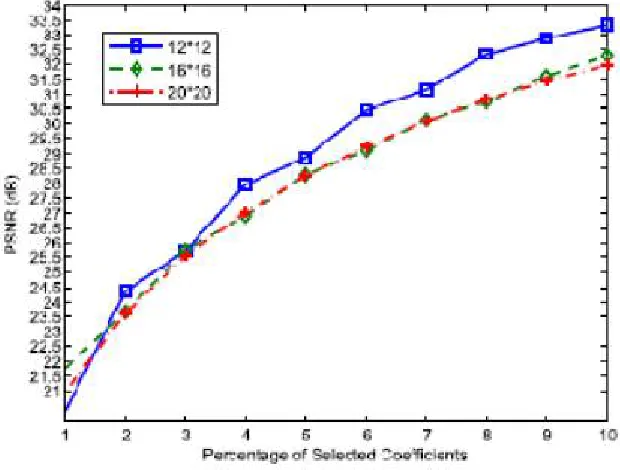
the higher the efficiency is. This causes more computational complexity. There for the proper size of patch should be chosen. So far, there is no good way to estimate the parameter. For our proposed system implementation we can chose the 12×12, 16×16 and 20×20 sizes of patches. There are two reasons that the size 8 × 8 is not tested. The patches of this size are too small to contain the structure of fingerprints and it’s difficult to compress such small patches at high compression ratios.
Fig (2). Performance of proposed algorithm with different sizes of patches
From Figure(2), it is seen that the size 12×12 has better performance when the number of atoms in the dictionary is 4096. In addition, to make the patches fit the dictionary superior, the mean of each patch is to be calculated and subtracted from the patch. After that, calculate the sparse representation for each patch by solving the l0minimisation problem. Those coefficients whose absolute values are less than a specified threshold are treated as zero.
V. CONCLUSION
The different compression techniques are adapted to compress the fingerprint images are studied and compared their Performance especially at high compression ratios. New compression algorithm based on sparse representation in introduced. Due to the block-by block processing mechanism, however, the algorithm has higher complexities. It shows that the K-SVD algorithm for fingerprint compression based on sparse representation is more efficient than other compression technique such as JPEG, JPEG2000,WSQ. One of the main problems in developing compression algorithms for fingerprints resides in the need for protection of the minutiae which are used in the identification. Our algorithm can be able to hold most of the minutiae forcefully during the compression and reconstruction. Further, we think the technique based on sparse representation do not work very well in the general image compression field. The reason are as follows: the content of the general images are so rich therefore there is no proper dictionary under which the given image can be characterize sparsely; still there is one, the size of the dictionary may be too large to be compute efficiently.
REFERENCES
ISSN (Print) : 2320 – 3765 ISSN (Online): 2278 – 8875
I
nternational
J
ournal of
A
dvanced
R
esearch in
E
lectrical,
E
lectronics and
I
nstrumentation
E
ngineering
(An ISO 3297: 2007 Certified Organization)
Vol. 5, Issue 6, June 2016
[2] T. Hopper, C. Brislawn, and J. Bradley, “WSQ gray-scale fingerprint image compression specification, Federal Bureau of Investigation Criminal Justice Information Services, Washington, DC, USA,Tech.Rep. IAFIS-IC-0110-V2, Feb. 1993.
[3] Guangqi Shao, Yanping Wu, Yong A, Xiao Liu, and TiandeGuo Fingerprint Compression Based on Sparse Representation, IEEE Trans. on Image Processing, vol. 23, no. 2, february 2014
[4] N. Ahmed, T. Natarajan, and K. R. Rao, “Discrete cosine transform,” IEEE Trans. Comput., vol. C-23, no. 1, pp. 90–93, Jan. 1974.
[5] C. S. Burrus, R. A. Gopinath, and H. Guo, Introduction to Wavelets and Wavelet Transforms: A Primer. Upper Saddle River, NJ, USA: Prentice-Hall, 1998.
[6] W. Pennebaker and J. Mitchell, JPEG—Still Image Compression Standard. New York, NY, USA: Van Nostrand Reinhold, 1993.
[7] A. Skodras, C. Christopoulos, and T. Ebrahimi, “The JPEG 2000 still image compression standard,” IEEE Signal Process. Mag., vol. 11, no. 5, pp. 36–58, Sep. 2001.
[8] A. Said and W. A. Pearlman, “A new, fast, and efficient image codec based on set partitioning in hierarchical trees,” IEEE Trans. CircuitsSyst. Video Technol., vol. 6, no. 3, pp. 243–250, Jun. 1996.