Voltage Security Constrained Unit
Commitment Using Extended Sequential
Truncation Technique
S.Silambarasi
1, Dr.T.Venkaresan
2PG Student [Power Systems Engineering], Dept. of EEE, K.S.Rangasamy College of Technology, Tiruchengode, Tamilnadu, India1
Professor, Dept. of EEE, K.S.Rangasamy College of Technology, Tiruchengode, Tamilnadu, India2
ABSTRACT: This paper presents a Voltage Security Constrained Unit Commitment based on Extended Sequential Truncation Technique which is based on the truncation technique. In the existing method, the production cost is very high and the voltage security is not taken into account. In the proposed method, the production cost is minimized and the voltage limit is taken into account. Extended Sequential Truncation Technique truncates the combination of units that does not obey the constraints. Truncation technique cut the combination based on the priority order. To maintain the voltage security when the voltage is high generation of reactive power is done and when the voltage is low absorption of reactive power is made. The simulation provides the production cost and the voltage security of the proposed method with IEEE 30 bus systems with 6 generating units and IEEE 14 bus systems with 5 generating units.
KEYWORDS: Unit Commitment (UC), Unit Commitment Problem (UCP), Voltage Security Constrained Unit commitment (VSCUC), Extended Sequential Truncation Technique (ESTT).
I.INTRODUCTION
Voltage security is one of the important aspectsin the power system. Stability, reliability and security of the system are important for the power system operation and control. C.K. Pang et al. [1] planned a truncated dynamic programming method for binding the thermal units for 48 hours. Dynamic programming method discovers the schedule having the least total cost. DP-TC method is a fixed search window. It shortens the priority list in which only the truncated combination are gauged. The disadvantage of the method is it wants a much longer processing time to complete the process. The selection list cuts the number of combinations of units. C.K. Pang et al. [2] planned the Search Sequence Dynamic Programming which observes a strict priority list search sequence to reduce the possible groupings. The disadvantage of the proposed method wants a much longer processing time to complete the process. Fred et al. [3] proposed the dynamic programming – sequential / truncated combination (DP-STC) which sequentially decides the optimal commitment order for the existing generating units. The proposed method wants to use a large state space truncation window to assure solution feasibility. W.L.Snyder et al. [4] proposed the units with similar features such as minimum up or down time, generation limits, start-up cost. Windows as well as their locations on priority lists are distinct and the units track the strict priority list commitment and de-commitment order. Hobbs et al. [5] had proposed a new method which creates several states from each unique combination and links each state to one of the possible paths to that combination. The disadvantage of the proposed method was increasing the minimum run time by several hours. Ouyang et al. [6] proposed a variable window dynamic program (DP-VW). It was an experimental improvement of the truncated window dynamic program. The proposed method employs a variable window size according to load demand increments. An iterative process for the number of strategies saved in every stage to fine tune the best solution. Disadvantage of this method was the probability of running DP-VW without achieving a feasible solution.
Xiaohong Guan et al. [8] proposed a stochastic model for the long term solution of Security Constrained Unit Commitment (SCUC). Chance disturbances which include outages of generation units and transmission lines as well as load forecasting inaccuracies had been modelled. Lagrangian relaxation technique was introduced to decompose sub problems with long-term SCUC. The scenario reduction method had been proposed for increasing a trade-off between calculation speed and accuracy of the SCUC solution. Singhal et al. [9] proposed a large scale Unit Commitment (UC) problem using Dynamic Programming (DP) and the test results for conventional DP, Sequential DP and Truncation DP are compared with other stochastic techniques. The commitment is such that the total cost is minimal. The total cost includes both the production cost and the costs associated with start-up and shutdown of units. DP is an optimization technique which gives the optimal solution. Tomonobu Senjyu et al. [10] proposed a new unit commitment problem adapting extended priority list (EPL) method. The EPL method consists of two steps, in the first step we get rapidly some initial unit commitment problem schedules by Priority List method. At this step, operational constraints are disregarded. In the second step unit schedule is modified using the problem specific heuristics to fulfil operational constraints. Danli Long et al. [11] proposed an Extended sequential Truncation Technique to explore the state space of the approach which is better to sequential Truncation in daily cost for unit commitment. Among the existed unit commitment methods dynamic programming is a classical optimization method which can deal with the 0/1 variables directly and get global optimum solution. But the calculation efficiency needs to be improved further for unit commitment due to the “curse of dimension” problem. In response to this situation the truncation technique is planned which cut combinations of 0 – 1 variables based on priority order. Then a heuristic improvement of adjusting truncated window size according to the incremental load demands in adjacent hours is offered.
This paper is organized as follows: Section 2 presents the problem formulation for Security Constrained Unit Commitment with voltage constraint. Extended Sequential Truncation method for voltage security constrained unit commitment is discussed in Section 3. Section 4 confers the results of the Voltage Security Constrained Unit Commitment. Conclusions are summarized in Section 5.
II.VSCUC PROBLEM FORMULATION
Voltage Security Constrained Unit Commitment (SCUC) finds a unit commitment schedule at minimum production cost considering the voltage security. The Unit Commitment algorithm designs the unit schedules. The scheduled units supply the load demands and maintain bus voltages within their permissible limits. VSCUC is treated as a truncation problem that minimizes perceived production costs of the generating units.
The objective function for the SCUC is given as
Ng 1 i N 1 t ti
(P(i,
t))I(i,
t)
S(i,
t)]
[C
(1)
where
Ci(P(i,t)) - Production Cost
S(i,t) - Start Up Cost
The constraint applied to the Voltage Security Constrained Unit Commitment problem includes real power, reactive power, fuel constraints, start-up cost, minimum up time and minimum down time and the voltage limits.
1. System real power balance
The system real power balance constraint is one of the most important constraints in the VSCUC. This is formulated as
(2)
where
P(i,t) - Generation of unit i at time t
PD (t) - Total system real power load demand at time t
(t)
Ng
1
2. Reactive Power Generation Limit The system reactive power is formulated as
(3)
where
Qmin - System reactive power lower limit vector Qmax - System reactive power upper limit vector
3. Fuel Constraint
Fuel supply planning for thermal units need to be coordinated with generation scheduling for significant reduction in the system cost. The fuel consumption is modelled as a function of power generated and unit start-up and constrained by a fixed availability over the planning horizon.
4. Minimum up time
For large thermal units, this constraint need to be satisfied to ensure minimum number of hours a unit must be on before it can be shut down.
5. Minimum down time
It is the minimum number of hours a unit must be off line before it can be brought on-line again.
6. Start-up Cost
The start-up cost is the cost incurred during the starting of the generating unit. Different units have different start up cost.
7. System Voltage Limits
The system voltage limits is formulated as
(4) where
Vmin - System voltage lower limit vector Vmax- System voltage upper limit vector
III.EXTENDEDSEQUENTIALTRUNCATIONTECHNIQUE
Extended Sequential Truncation Technique is a truncation technique It cut short the units that does not satisfies the constraints. The Truncation technique cut the 0-1 variables based on priority order. The EXSTT cut short the unit that does not obey the constraints in a sequence manner. While the Truncation Technique cut short the units in a random manner. Firstly, the truncated window is created by taking the units in the y-axis and hours in the x-axis. This technique creates the truncated window. The Truncated window is created based on the on/off status. The traditional sequential Truncation selects the truncated window values through a combination of priority order and load variation. The Extended Sequential Truncation Technique selects the truncated window not only through a combination of priority order and load variation but also considering through aggregation the units into groups according to the Min up/down time. After creating the truncated window the window units are created. The units with high number of zeroes are arranged first and so on. The units with all ones are cut out in a sequence manner. Check whether the window unit satisfies the reserves. If not cut off the units in a sequence manner in descending order and finally find the production cost of the window units. Although the production cost is calculated as the sum of the product of the heat rate and fuel cost with the start-up cost
It selects the truncated window not only through a combination of priority order and load variation, but also through aggregating the units into groups according to the minimum up or down time. After determining the unit up or down status selection, a set of composite states is available through the start-up of units that may be on or off in the order of highest to lowest in priority. The Extended Sequential Truncation Technique cut down the combination of units which does not obey the constraints and finds the production cost for the particular combination.
Q Q
Qmin max
V V
A. Flowchart for Extended Sequential Truncation Technique
The flowchart for the Extended Sequential Truncation Technique is explained in figure 1
Yes No
No
Yes
No
Yes
Fig.1Flowchart for Extended Sequential Truncation Technique
In Fig.1 the flowchart for the Extended Sequential Truncation Technique is given. The flow chart explains the step by step process of the Extended Sequential Truncation Technique briefly.
Start
Read the number of units, maximum power, minimum power, minimum on time, minimum off time, and fuel coefficients of the units
Considering the minimum up time/minimum down time and load variation formulate the power generation values for particular hour
Create the window units based on the on/off status of the units
Check whether the window units satisfies the constraints
Eliminate the window units that does not satisfies the constraints
Find the fuel cost for the window units
Find the start-up cost for the window units
Find the production cost for the window units
Stop
Calculate the reactive power
Voltage is high and absorption of reactive power is done to maintain the voltage security
If Q<0
Voltage is low and generation of reactive power is done to maintain the voltage security If
IV.RESULT AND DISCUSSION
A. 30-Bus Test System
The production cost has been investigated in this paper. The generating units production cost are calculated by and the voltage security are maintained. The generating units production cost is calculated as 6,88,646. The production cost of the units depends on the size of the number of the units and vice versa. During high voltage absorption of reactive power is made. When the voltage in the system is low generation of reactive power is done in order to maintain the security.
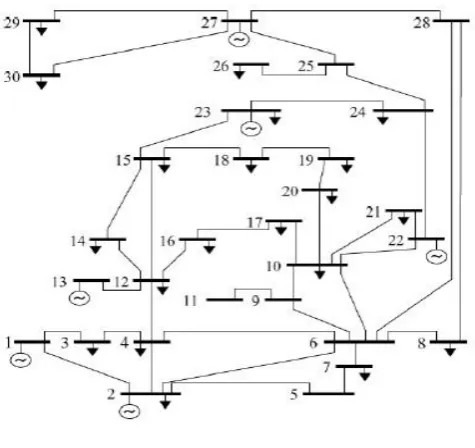
Fig. 2 IEEE 30 Bus Test System
In Fig 2 the data for IEEE Standard 30 Bus system is given. The Bus system consists of six generation units. The production cost for 30 bus system is low when compared with 39 bus and high when compared with 14 bus system.
Table. 1 Data for IEEE Standard 30 Bus system
In Table. 1 the unit and unit parameters such as maximum power, minimum power, minimum up time, minimum down time, voltage, reactance, hot cost, cold cost and fuel coefficients for IEEE 30 Bus System with six generating units are given.
Unit Pmax Pmin a B c mu md hcost ccost x v
1 200 50 0.00375 2.0 0 1 1 70 176 0.0478 1.06
2 80 20 0.01750 1.75 0 2 2 74 187 0.2983 1.03
3 50 15 0.0625 1.0 0 1 1 110 113 0.2160 1.01
4 35 10 0.00834 3.25 0 1 2 50 267 0.4080 1.06
5 30 10 0.02500 3.0 0 2 1 72 180 0.4400 1.07
B.14-Bus Test System
The production cost has been investigated in this paper. The generating units production cost are calculated by and the voltage security are maintained. The generating units production cost is calculated as 4,86,071. The production cost of the units depends on the size of the number of the units and vice versa. During high voltage absorption of reactive power is made. When the voltage in the system is low generation of reactive power is done in order to maintain the security
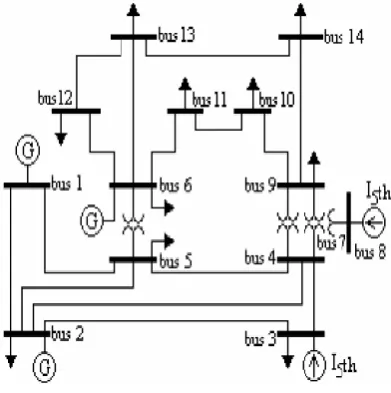
Fig. 3 IEEE 14 Bus Test System
In Fig 3 the data for IEEE Standard 14 Bus system is given. The Bus system consists of five generation units. The production cost for 14 bus system is low when compared with 30 bus and 39 bus system.
Table. 2 Data for IEEE Standard 14 Bus system
In Table.2 the unit and unit parameters such as maximum power, minimum power, minimum up time, minimum down time, voltage, reactance, hot cost, cold cost and fuel coefficients for IEEE 14 Bus System with six generating units are given.
V.CONCLUSION
Voltage security in the power system has been made to keep the voltage limits at standard operating conditions when it has been subjected to disruption. Security is difficult in power system which concerns due to the amount of faulted condition. The problem of security affects the whole system. As future work, Security Constrained Unit Commitment schedule can be formulated for units like hydro power generation plants, nuclear power plants, wind power generation
Unit Pmax Pmin a B c mu Md hcost ccost x V
1 250 10 0.00375 2.0 0 1 1 70 176 0.0575 1.06
2 139 20 0.01750 1.75 0 2 2 74 187 0.1983 1.04
3 100 15 0.0625 1.0 0 1 1 110 113 0.1160 1.01
4 120 10 0.00834 3.25 0 1 2 50 267 0.2080 1.08
plants and solar power plants etc. Voltage security is a problem in power systems operation which results due to the shortage of reactive power.
REFERENCES
[1] C.K. Pang, H.C. Chen , ”Optimal Short Term Thermal Unit Commitment”, IEEE Trans. Power Apparatus and System, vol.95, no.4, pp. 1336 - 1346, 1976.
[2] C.K. Pang, , G.B. Sheble, F. Albuyeh, “Evaluation of Dynamic Programming Based Method and Multiple Area Representation for Thermal Unit Commitment”, IEEE Trans. on Power Apparatus and Systems, vol.100, no.3, pp. 1212 –1218,Mar.2005
[3] J. Snyder , W, Powell , H.D, J.C. Rayburn,, “Dynamic Programming Approach to Unit Commitment”, IEEE Trans. on Power Systems, vol.2, no.2, pp. 339 – 347, May.1987.
[4] Fred N. LEE, “Short Term Thermal Unit Commitment”, IEEE Trans. Power Systems, vol. 3, no. 2, pp. 421-428, May.1988.
[5] Walter J. Hobbs, Gary Heron, Stephen Warner, Gerald B. Sheble, “An Enhanced Dynamic Programming Approach For Unit Commitment”, IEEE Trans. Power Systems, vol. 3, no.3, pp.1201 – 1205, Aug. 1988.
[6] Z. Loyang, S.M.Shahidehpour, “An Intelligent Dynamic Programming for Unit Commitment Application”, IEEE Trans Power Systems, vol. 6, no. 3, pp. 1203 – 1209, Aug.1991.
[7] Z. Ouyang , S.M.Shahidehpour, “A Hybrid Artificial Neural Network-Dynamic Programming Approach to Unit Commitment”, IEEE Trans. Power Systems, vol. 7, no. 1, pp. 236 – 242, Feb.1992.
[8] Xiaohong Guan, Sangang Guo, Qiaozhu Zhai, “The Conditions for Obtaining Feasible Solutions to Security Constrained Unit Commitment Problems”, IEEE Trans. Power Systems, vol. 20, no. 4, pp.1746-1756, Aug.2005.
[9] P.K Singhal, R.N. Sharma, “Dynamic Programming Approach for Large Scale Unit Commitment Problem ,” Communication Systems and Network Technologies,vol.6,no.3 pp. 714-717, Jun.2011.
[10] Tomonobu Senjyu, Kai Shimabukuro, Katsumi Uezat, Toshihisa Funabashi, “A Fast Technique for Unit Commitment Problem by Extended Priority List, ”IEEE Trans. Power System, vol.18 , pp. 882–888 , May 2003.