Cognitive Radio Spectrum Sharing for
Device-to-Device (D2D) Communication in Cellular
Network
P.D.Saraf1, N.G.Giradkar 2
Assistant Professor, Dept. of CSE, G. H. R. C. E. Nagpur, Maharashtra, India1 PG Student [MT], Dept. of CSE, G. H. R. C. E. Nagpur, Maharashtra, India2
ABSTRACT: This paper addresses the Spectrum sharing technique for Device to Device (D2D) communication which
provides efficient communication by allowing the under-utilized spectrum to be shared by other devices and interference management among D2D users. Spectrum sharing is a technique which involves simultaneous usage of a specific radio frequency band by a number of independent users for different applications or using different technologies. This paper first outlines the different challenges in implementing Spectrum sharing for D2D communication. Next there is a qualitative overview of the existing spectrum sharing and interference management techniques for cellular networks. The demonstration for device synchronization and data transfer takes between the devices is depicted. Also cognition along with limited information exchange between D2D users will be used to reduce interference and increase spectral efficiency of D2D users. Simulation results are provided to verify the analytical results. This proposed technique is implemented using LABVIEW 2013.
KEYWORDS: Cognitive Radio, Spectrum Sensing, Device-to-Device, Efficient Communication,
I. INTRODUCTION
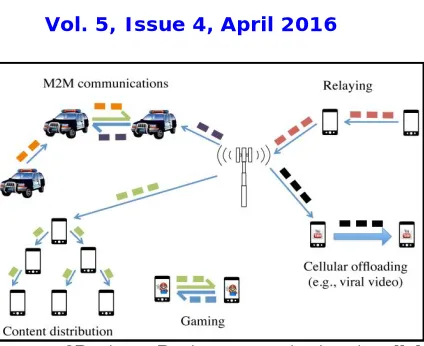
Device to Device (D2D) Communication is a direct communication between two devices without communicating to the Base Station (BS). It enables nearby wireless devices to exploit their propinquity and communicate directly with each other. By enabling single-hop communication instead of dual-hop uplink (UL) and downlink (DL) communication reduces communication delay and energy consumption and enhances the network capacity, reliability and spectrum utilization efficiency. However, device to device (D2D) links are generally established independently and cannot be controlled by the Base Station. In addition, choosing the wrong spectrum sharing pair of D2D links can result in high cross-interference, which may adversely affect the user communication. Also with the development of wireless networks there is a shortage of spectrum sharing resources which creates a situation of insufficient frequency spectrum. Commercial applications for D2D communication are localized social networking and data transfer, home automation, and commerce and advertising. Public safety is another application where local connectivity can be used in the absence of BSs or hazards at BSs.
Fig. 1: Ideal use-cases of Device to Device communications in cellular network.
Since D2D transmissions typically occur in propinquity, D2D terminals are expected to discover their companion or other communicating partners, select spectrum, schedule transmissions, and execute power control while averting interference from/to cellular transmissions in an efficient manner. For instance, a D2D user can perform licensed spectrum sensing (similar to a cognitive radio) to detect the inactivity of a given channel. Furthermore, the D2D user can sense the surrounding environment to determine the required channel state information (CSI), interference, mobility, and other information related to neighboring wireless devices. Using cognition in D2D communication thus enable the D2D users to make autonomous decisions and adjust their transmit power, operating frequency, and spectrum access policy opportunistically.
This paper first analyzes the different scenarios of D2D communication in cellular networks from an implementation perspective. Then the challenges related to interference management in D2D- enabled cellular networks are discussed, followed by a qualitative overview of the existing spectrum sharing and interference management techniques in cellular networks. A spectrum sharing technique is then proposed to demonstrate the impact of cognition and prioritized spectrum access for device in D2D cellular networks. The performance gains of the scheme are then analyzed quantitatively. Finally, several potential directions for future research are outlined.
II. CHALLENGES
The primary challenge for D2D communication includes interference management among coexisting D2D users, development of interference mitigation techniques with minimal signaling overheads.
MANAGEMENT OF INTERFERENCE AMONG D2D:
The introduction of D2D communication in cellular networks is challenging for both D2D and Cellular users due to the cross-tier interference coming from the synchronous transmission of cellular and D2D users. This issue is more challenging in multi-tier networks where low-power small cells are densely deployed over existing single-tier networks (as will be in the emerging fifth generation, 5G, cellular wireless networks). These small cells result in additional cross-tier interference on top of that from the macro Base station and Cellular users. Thus there is a need of an efficient interference management technique (e.g., power control, spectrum allocation, multiple antenna beam forming). Furthermore, an interference experienced by D2D receiver from neighboring D2D transmitters (referred to as inter-D2D interference) also needs to be mitigated through proper user pairing and frequency assignment techniques.
COGNITIVE SPECTRUM ACCESS:
of D2D terminals and the proportion of available spectrum for them. Thus with minimum control of base station Cognitive spectrum access methods can adapt to the traffic load intensities of Cellular users and D2D pairs.
III. TECHNIQUES
Device-to-device (D2D) communication becomes a hot research topic recently due to its benefits of offloading data traffic at base station in cellular networks.
Yong Xiao, Kwang-Cheng Chen [1] observed that the spectrum sharing problem is complex and there is not any availability of stable spectrum sharing structure. They have established a hierarchical matching market with incomplete information to evaluate the D2D spectrum sharing problem. In that model, each D2D link is selfish and independent. In this authors have used a Bayesian equilibrium that accomplishes a stable spectrum sharing structure among all the D2D links.
Chao Zhai, Wei Zhang and Guoqiang Mao[2] studied Spectrum sharing between cellular and ad-hoc networks. It is observed that weak range of signals and strong interferences at the cell-edge area causes severe reduction in performance. Thus to improve the performance quality of cell-edge users they have introduced a “Cooperative spectrum sharing” technique. In this technique, the ad-hoc users make use of cooperative diversity techniques to improve the cellular network downlink throughput. Thus to determine the allocation of spectrum, they maximize the transmission capacity of ad-hoc network
Yang Yang, Tao Peng [3] scrutinizes a spectrum access scheme based on division of regions for Device-to-Device (D2D) communication. They have analyzed the size of different regions in the cell which allows no of D2D pairs to access the frequency spectrum. So the D2D spectrum access scheme is proposed based on region division of the cell for users. We divide the cell is divided as inside and out into a series of regions which allows different number of D2D pairs to access the frequency spectrum. The D2D pairs can have access to the spectrum by sharing the cellular uplink (UL) frequency resources in the networks. So they figure out the solution with the help of Lambert W function and
obtain the distribution of regions in the whole cell when the cellular location are obtained.
Ekram Hossain, and Dong In Kim,[4] have figure out the challenges in resource allocation in the presence of both cellular and D2D users. They have determined that how cognition technique along with minimum information exchange between D2D users and the core network can be used to reduce interference and enhance spectral efficiency of both cellular and D2D users. So they proposed a CSA scheme that accomplishes interference-aware decision making and channel sensing at the D2D terminals.
Janis et al. [5] proposed an easy local peer-to-peer communication between the devices that operates as an underlay network [6]In later studies they have introduced three modes of D2D communication i.e., reuse mode (where common channel is shared by D2D links and cellular links), dedicated mode (where dedicated channels are used by D2D), and cellular mode (where all the communication is operated by the center station called as base station), and designed mode selection algorithm for a three-user (i.e. one D2D pair and a cellular user) cellular network
Kaufman et al. [7] have developed a distributed dynamic spectrum protocol, in which the spectrum which is in use by cellular users is accessed by ad-hoc D2D user. They have proposed a new interference management scheme to enhance the reliability of D2D communication. They have designed a mode selection algorithm to minimize outage probability.
S. Xu, H. Wang designed a new interference cancellation scheme based on the location of users. The authors set aside a dedicated control channel for D2D users. Cellular users listen to this channel and measure the Signal Interference Noise Ratio (SINR). If the measured SINR is higher than a pre depicted threshold, a report is sent to the eNB. Afterwards, the eNB stops all the cellular users on the resource blocks that are currently in use by D2D users. It also sends broadcast information about the location of the users and resource blocks allocated to them. Thus D2D users can escape these resource blocks which interfere with cellular users.
IV. PROPOSED WORK
This work leads towards the development of Cognitive Radio. A cognitive D2D user is capable of sensing the received interference level on a given transmission channel. With this knowledge, a D2D user can make a smart decision about utilizing a given channel while avoiding interference from adjacent cellular transmissions. The main aim of this project is to provide end user communication without using network access between two communicating devices. The communication between the end user will accomplish by the mean of Bluetooth communication or NFC, where each device makes use of the Bluetooth spectrum to identify and communicate with other devices. The main advantage of the proposed work is to implement the task on LabVIEW to enhance the D2D communication performance by using architectural design. LabVIEW support RF and Communication module play an important role to unite the task.
V. DESIGN METHODOLOGY WITH LABVIEW
The communication between the end user is accomplished by the mean of Bluetooth communication or NFC. Because Bluetooth is a proprietary wireless technology intended for short-range communication and the Bluetooth spectrum is available everywhere for all users. Bluetooth is based on frequency-hopping spread spectrum radio technology, making use of a packet-based structure i.e. the information is transmitted in discrete chunks known as packets,
Fig.2: Device Frequency synchronization to transfer data between devices
The first phaseprovides the Bluetooth communication interface. Here each device makes use of the Bluetooth spectrum to identify the other devices. It describes the different stages of establishment of connection between the two devices, after the connection data can be exchanged between devices.
keying (BPSK) modulation technique is be used to synchronize the communicating devices. The BPSK modulation is a very basic technique used in various wireless standards such as CDMA, WiMAX, WLAN, Satellite, DVB, Cable modem etc. It is considered to be more robust among all the modulation types due to difference of 180 degree between two constellation points. Hence it can withstand severe amount of channel conditions or channel fading. As we know different channels are used for specific data transmissions in cellular systems. The channels used to transmit system related information which are very essential are modulated using BPSK modulation.
The third phase mainly focuses on the synchronization of frequency between the devices to exchange the data between them. The signal frequency of devices are shown here which wants to transmit data to each other, the appended signal is the resultant signal which is the combination to both device 1 and device 2 signal. The module shows that the device 1 is sending data to device 2 and device2 is receiving exactly same data as send by the device 1. Also the rate at which device 1 is sending data to device 2 can be increased or decreased by using the signal frequency knob. The reception rate of device 2 will be same as the sending rate of device.
VI. CONCLUSION
In this paper cognitive radio spectrum sharing technique for Device to Device Communication in cellular network is introduced. The research work provides end user communication without using network access between two communicating devices. The communication between the end user will accomplish by the mean of Bluetooth communication or NFC, where each device makes use of the Bluetooth spectrum to identify and communicate with other devices. In the end, the simulation results demonstrate the effectiveness of the proposed spectrum sharing scheme. The proposed work is implemented on LabVIEW which enhance the D2D communication performance by using architectural design. LabVIEW support RF and Communication module play an important role to unite the task.
REFERENCES
[1]. Yong Xiao, Kwang-Cheng Chen, Chau Yuen , Luiz A. DaSilva, “Spectrum Sharing for Device-to-Device Communications in Cellular Networks: A Game Theoretic Approach”, 2014 IEEE International Symposium on Dynamic Spectrum Access Networks (DYSPAN)
[2]. Chao Zhai, Wei Zhang and Guoqiang Mao, “Cooperative Spectrum Sharing Between Cellular and Ad-Hoc Networks”, IEEE TRANSACTIONS ON WIRELESS COMMUNICATIONS, VOL. 13, NO. 7, JULY 2014
[3]. Yang Yang, Tao Peng, Bo Peng, Wenbo Wang, “Region Division based Spectrum Access of D2D Communication under Heterogeneous Networks”, 2014 IEEE
[4]. Ahmed Hamdi Sakr, Hina Tabassum, Ekram Hossain, and Dong In Kim, “Cognitive Spectrum Access in Device-to-Device-Enabled Cellular Networks”, IEEE Communications Magazine July 2015
[5]. P. Jänis, C.-H. Yu, K. Doppler, C. Ribeiro, C. Wijting, K. Hugl, O. Tirkkonen, V. Koivunen, Device-to-device communication underlaying cellular communications systems. Int. J. Commun. Netw. Syst. Sci. 2(3), 169–178 (2009)
[6]. K. Doppler, C.-H.Yu, C. Ribeiro, P. Janis, Mode selection for device-to-device communica- tion underlaying an lte-advanced network, in IEEEWireless Communications and Networking Conference (WCNC), pp. 1–6, 2010
[7]. B. Kaufman, J. Lilleberg, B. Aazhang, Spectrum sharing scheme between cellular users and ad-hoc device-to-device users. IEEE Trans.Wirel. Commun. 12(3), 1038–1049 (2013)
[8]. H. Min, J. Lee, S. Park, and D. Hong, “Capacity enhancement using an interference limited area for device-to-device uplink underlaying cellular networks,” IEEE Transactions on Wireless Communications ,vol. 10, no. 12, pp. 3995–4000, December 2011
[9]. S. Xu, H. Wang, T. Chen, Q. Huang, and T. Peng, “Effective interference cancellation scheme for device-to-device communication underlaying cellular networks,” in Proceedings of IEEE VTC-Fall, 2010, pp. 1–5
[10]. X. Wang et al., “Spectrum sharing in cognitive radio networks—An auction-based approach,” IEEE Trans. Syst., Man, Cybern. B, Cybern., vol. 40, no. 3, pp. 587–596, Jun. 2010.
[11]. I. F. Akyildiz, W.-Y. Lee, M. C. Vuran, and S. Mohanty, “A survey on spectrum management in cognitive radio networks,” IEEE Commun. Mag., vol. 46, no. 4, pp. 40–48, Apr. 2008.
[12]. X.Kang,Y.-C.Liang, H.K.Garg, and L.Zhang,“Sensing-based spectrum sharing in cognitive radio networks,” IEEE Trans. Veh. Technol., vol. 58, no. 8, pp. 4649–4654, Oct. 2009.