Maintaining Privacy Protection though firewall optimization
J.Naveen1&P.Praveen Kumar2
1. M-Tech CSE ,Vignana Bharathi Institute of Technology, Ghatkesar,Hyderabad . Telangana. 2. Associate Professor, Vignana Bharathi Institute of Technology, Ghatkesar , Hyderabad.
Telangana.
Abstract—
In Present days Firewalls have been broadly deployed on the Internet for protecting private networks. A firewall will checks each every incoming and outgoing packet to decide whether to accept or reject these packet is based on its policy. Optimizing firewall policies is essential for improving overall network performance. Prior work on firewall optimization should be focused on either intra firewall or inter firewall optimization within one managerial domain where the privacy protection of firewall policies is not a distress. In this paper we explores inter firewall optimization across the administrative domains for the first time .The key technical confront is that firewall policies cannot be shared across domains because a firewall policy contains secret information and even potential privacy security holes, that are be exploited by attackers. For this purpose, we propose a method cross domain privacy protection in cooperative firewalls policy optimization protocol. Mainly, for any of two adjacent firewalls belonging to two dissimilar managerial domains, our procedure can identify in each and every firewall the rules that can be detached because of the some other firewall. These optimization process involves in cooperative calculation between the two different firewalls without any third party disclosing its policy to the other party. We implemented our procedure and conducted widespread experiments.Our procedure incurs no extra online container processing overhead, and the offline handing out time is less than a few hundred seconds.
KEYWORDS—
Cross Domains; Intra and Inter Firewalls; VPN; Redundancy Detection; Efficiency
I.INTRODUCTION
1.1. Background and Motivation
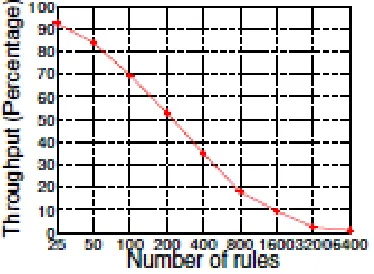
Fig 1. The effect of the number of rules on the throughput with frame size 128 bytes in
These various number of rules in a firewall significantly affects its throughput. These result of the performance test of iptables conducted by HPAC. That shows that increasing the number of rules in a firewall policy considerably reduces the firewall performance. Unfortunately, with the unstable growth of services deployed on the Internet ,firewall policies are growing quickly in size of networks.Thus, optimizing the firewall policies is critical for improving network performance.
1.2. Limitation of Prior Work
previous work on firewall optimization targets on either intrafirewall optimization, or interfrewall optimization, within the one managerial domain where the privacy protection of firewall policies is not a distress.Intrafirewall optimization means optimizing the single firewall. It is improved by either removing redundant rules, or rewriting policy rules. previous work on interfirewall optimization needs two firewall policies without any firewall privacy protection, and thus can only be used within one managerial domain. However, in actuality, it is frequent that two different firewalls that are belong to different managerial domains where that firewall policies are cannot be shared with each other firewall. Keeping firewall policies secret is important for two reasons. First one is a firewall policy may have more security
holes that can be exploited by attackers. Quantitative study have shown that the most firewalls are misconfigured and have security holes. And the second one is a firewall policy often that contains private information, e.g.,the IP addresses of a servers, which can be used by third party attackers to launch more exact and targeted attacks.
1.3. Cross-Domain firewall Optimization As we know our best knowledge, no previous work focuses on cross domain privacy protection interfirewall optimization techniques. In this paper represents the first step in explore this unknown space. exclusively, we spotlight on removing interfirewall policy duplicates in a privacy preserving manner. Let us Consider two adjacent firewalls1 and firewall2 that are belongs to different managerial domains and . Let denote the policy on firewall1’s outgoing interface to firewall2 and denote the policy on firewall2’s receiving interface from firewall1. For these rule in , if all these packets that are match but do not match any policy rule above in are discarded by ,rule that can be removed because those packets never come to .
Fig 2.Example for Interfirewall Redundant rules
from one to firewall2’s sending interface to firewall1’s receiving interface is guarded by other two different separate policies. For these simplicity, we suppose that and have no other intrafirewall redundancy as such redundancy that can be removed using the proposed solution.This can be illustrates interfirewall redundancy, where these two adjacent routers are belong to different managerial domains Cse and EE. The physical interfaces connecting two different routers are denoted as and ,respectively. The rules of the two different firewall policies and , that are used to filter the traffic flowing from Cse to EE, that are listed in two different tables following the format used in Cisco Access Control Lists.
1.4. Technical Challenges and Our Approach
The key aspect is to propose a protocol that allows two different adjacent firewalls to identify the interfirewall redundancy with respect to the other without knowing the policy rule of the other firewall. While through intrafirewall redundancy removal is so complex, interfirewall redundancy subtraction with the privacy protection requirement is even so hard. To conclude interfirewall redundant with respect to whether the rule in to positively needs some data about, cannot reveal from such data. yet,A straight forward solution is to perform some privacy protection comparison between two rules from two different adjacent firewalls. this solution have to checks whether particularly, for each polocy rule in this match a rule all available possible packets that match rule in with the abandon decision in. However, because all these redundants with respect to the firewalls follow the first match semantics rules and these rules in a firewall typically overlap, this explanation is not only incorrect and also incomplete. Incorrect means that incorrect redundant rules could. Suppose this solution
clarifies as a re identified in with respect to in different firewall.
However, if redundant policy rule in some packets that match rule also match rule with the accept decision in, these packet will pass, and then wants to rectify them with . In this case, is actually not redundant data. Incomplete means that, If all the portion of
redundant policy rules could be identified in are not needed by not possible packets that
match rule in , is also redundant. only one rule but multiple rules in However, the direct comparison solution cannot identify such duplicate results.
II. RELATED WORK
2.1. Removal of Firewall Redundancy Previous work on intrafirewall redundancy removal aims to notice redundant policy rules within a single firewall. Mr. Gupta identified backward as well as forward redundant policy rules in a firewall. Later, Mr. Liu et al. barbed out that the redundant policy rules identified by Mr. Gupta are incomplete and proposed two different methods for detecting all redundant policy rules .previous work on inter firewall redundancy removal needs the knowledge of two various firewall policies and therefore this only applicable within a administrative domain.
2.2 Firewall Enforcement in Virtual Private Networks
to one other. And the second is, their requirements are different. The former one preserves the privacy protection of the remote network’s policy, whereas the latter one preserves the privacy in both policies.
III. SYSTEM AND THREAT MODELS
3.1. System Model
Basically a firewall is an ordered list of semantic rules. These each rule has a decision for the packets predicate over the fields of that match the predicate value. Firewalls usually check five different fields, source IP address, destination IP address, source port number, destination port number, and protocol type. The length of these fields are 32b, 32b, 16b, 16b, and 8b bits, respectively. A packet over where each packet is a subset of domain results is a tupple where each the value is an element of the packet. A packet matches a policy rule if and holds. characteristic only if the condition firewall decisions include accept, reject, accept with logging, and reject with logging. Without loss of originality, we have to consider whether to accept or reject. In this paper. We identify a rule with the accept decision an accepting rule and a rule with the reject decision a discarding rule. In a firewall policy rule, a packet may match multiple rules whose decisions are dissimilar. To determine these problems, firewalls typically spend a first match semantics where the decision for a packet is the decision of ,is the first policy rule that matches. A matching set , is a set of all possible packets that match the rule. A result of a rule is the set of packets that match but solving set of conflicts ,do not match with any other any rule above, and is equal. And based on the above concepts, we declare interfirewall redundancy and, where redundant policy rules.
3.2. Threat Reproduction
We have to approve the semi honest model , For two adjacent different firewalls. And let we assume that they are semi honest,
.that is each firewall follows our protocol exactly, but each and every firewall may not try to reveal the policy rule of the other firewall. These semi honest model is practical and well adopted. For example, In this model is suitable for large organizations and industries that have many independent branches as well as for loosely connected alliances composed by multiple different parties. While we are confident that all manageable domains follow permission protocols, we may not provide guarantee for that no corrupted employees are trying to disclose the private firewall policy rules of other parties. Also, it may be possible for one party to issue the sequence of inputs to try and reveal the other party policy.
IV.PRIVACY PRESERVING
INTERFIREWALL
4.1. Privacy-Preserving Range Comparison
identified rules, we map them back to original rules of the polocies in and then identify the redundant ones.
The problem of checking whether the boils down to the problem of verifying whether one range in is contained by some another range in , which further boils down by the problem of checking whether each protocol for comparing a number and the range.Each number to the other firewall party, can first encrypt using secret key and sends to ; similarly, can first encrypt using key and sends to . Then, ether party checks. Note that if and only if . neither a party can learn anything about the numbers are being compared. It illustrates the process of checking whether to form is in estimated range.
4.2 A Multirule Coverage Redundancy Detection
To notice multiple rule coverage redundancy, our basic scheme is to merge all the non overlapping discarding policy rules from to a set of new policy rules so that for any subjective rule from , if it is covered by multiple non overlapping removal rules from , it is covered by a policy rule from these new rules. More formally, let we denote the non overlapping disposal rules from and denote the set f new policy rules generated. For any other rule from , if a non overlapping policy rule from is multirole coverage redundant, i.e., where from , there is a rule that covers, i.e.Thus, after compute the set of new policy rules from , we reduce the problem of multirule coverage redundancy detection to single rule coverage redundancy detection. Then, other two parties and can considerately run our protocol proposed in this section to identify the non overlapping single rule and multirule coverage redundant polocy rules from at the same time.
V. FIREWALL UPDATE AFTER PTIMIZATION
If or changes after in the inter firewall optimization, the interfirewall disused rules identified by the optimization may not be interfirewall deserted anymore. In this section, we discuss our solution to address firewall update. There are Main five possible cases under this scenario.
1) changes the decisions of some rules in . In this case, neither party desires to take actions because the interfirewall redundancy recognition does not consider the decisions of the rules in .
2) changes the decisions of some rules from reject to accept in . In this case, needs to notify which non rules indices of these rules from are changed. Using this in order, check if there were any rules in that were removed due to these rules, and then adds the affected rules back into .
3) changes the decision of some rules from accept to get rid of in . In this case, can run our supportive inter firewall unneeded rules in .
4) Adds or removes some rules in . In this case, since the resolving sets of some rules in may modify, a rule in that used to be inter firewall redundant maybe not redundant anymore. It is some main solution for to run our optimization protocol again.
5) Adds or removes a few rules in . Similar to the fourth case, since the resolving sets of some rules in may modify, it is significant for to run our protocol again.
VI. EXPERIMENTAL RESULTS
We estimate the effectiveness of our protocol on real firewalls and evaluate the capability of our protocol on both actual and synthetic firewalls. Our experiments were carried out on a PC running Linux with two Intel Xeon cores and 16 GB of memory.
6.1 Evaluation Setup
and protocol. The number of rules values from dozens to thousands In implementing the commutative encryption, we used the developing Pohlig Hellman algorithm with a 1024-bit prime modulus and 160-bit encryption keys. To consider the effectiveness, we conducted our experiments Result above these five groups of adjacent firewalls. To evaluate the efficiency, for two firewalls in each group, we considered the processing time, the comparison time, and the statement cost of both parties. Due to protection concerns, it is complex to obtain a large number of real adjacent firewalls. To further evaluate the efficiency, we managed a large number of synthetic firewalls based on Singh et al.’s. The synthetic firewalls also observe the same five fields as real firewalls. The number of rules in the synthetic firewalls ranges from 200 to 2000,and for every number, we generate 10 synthetic firewalls.To quantify the efficiency, we first processed each synthetic firewall as and then measured the processing time and communication cost of two parties. Second, for two firewalls in each group, we considered the processing time, the comparison time, and the statement cost of both parties. Third, we measured the comparison time for every two synthetic firewalls. We didn’t evaluate the effectiveness of our protocol on synthetic firewalls because they are generated at the random and independently without considering whether two firewalls are contiguous or not.
6.2. Methodology
In this section, we describe the metrics to determine the effectiveness of our protocol. Given our firewall optimization algorithm, and two adjacent firewalls and, we use to represent a set of interfirewall redundant rules in. Let denote the number of rules in and indicate the number of interfirewall redundant rules in. To assess the effectiveness, we define a redundancy ratio.
This ratio measures what proportion of rules are interfirewall redundant in.
VII. CONCLUSION AND FUTURE SCOPE
REFERENCES
[1] nf-HiPAC, “Firewall throughput test,” 2012 [Online]. Available: http://www.hipac.org/performance_tests/resu lts.html
[2] R. Agrawal, A. Evfimievski, and R. Srikant, across private databases,” in Proc. ACM SIGMOD, 2003, pp. 86–97.
[3] E. Al-Shaer and H. Hamed, “Discovery of policy anomalies in distributed firewalls,” in Proc. IEEE INFOCOM, 2004, pp. 2605– 2616.
[4] J. Brickell and V. Shmatikov, “Privacy-preserving graph algorithms in the semi-honest model,” in Proc. ASIACRYPT, 2010.
[5] Y.-K. Chang, “Fast binary and multiway prefix searches for packet forwarding,”
Comput. Netw., vol. 51, no. 3, pp. 588–605, 2007.
[6] J. Cheng, H. Yang, S. H.Wong, and S. Lu, “Design and implementation of cross-domain cooperative firewall,” in Proc. IEEE ICNP, 2007, pp. 284–293. [7] Q. Dong, S. Banerjee, J. Wang, D. Agrawal, and A. Shukla, “Packet classifiers in ternary CAMs can be smaller,” in Proc. ACM SIGMETRICS,
2006,.
[8] O. Goldreich, “Secure multi-party computations,” Working draft, Ver.1.4, 2002.
[9] O. Goldreich, Foundations of
Cryptography: Volume II (Basic
Applications).Cambridge, U.K.: Cambridge Univ. Press, 2004.
[10] M. G. Gouda and A. X. Liu, “Firewall design: Consistency, completeness and compactness,” in Proc. IEEE ICDCS, 2004, pp. 320–327.
[11] M. G. Gouda and A. X. Liu, “Structured firewall design,” Comput. Netw., vol. 51, no. 4, pp., 2007. [12] P. Gupta, “Algorithms for routing lookups and packet classification,” Ph.D. dissertation, Stanford Univ., Stanford, CA, 2000.
[13] A. X. Liu and F. Chen, “Collaborative enforcement of
firewall policies in virtual private networks,” in Proc. ACM PODC, 2008, pp. 95–104.
[14] A. X. Liu and M. G. Gouda, “Diverse firewall design,” IEEE Trans.Parallel Distrib. Syst., vol. 19, no. 8, pp. 1237–1251, Sep. 2008.
[15] A. X. Liu and M. G. Gouda, “Complete redundancy removal for packet classifiers in TCAMs,” IEEE Trans. Parallel Distrib. Syst., vol. 21, no.4, pp. 424–437, Apr. 2010.
[16] A. X. Liu, C. R. Meiners, and E., “TCAM Razor: A systematic approach towards minimizing packet classifiers in TCAMs,”IEEE/ACM Trans. Netw., vol. 18, no. 2, pp. 490–500, Apr. 2010.
[17] A. X. Liu, C. R. Meiners, and Y. Zhou, “All-match based completeredundancy removal for packet classifiers in TCAMs,” in
Proc..
[18] A. X. Liu, E. Torng, and C. Meiners, “Firewall compressor: An algorithm for minimizing firewall policies 2008.
[19] C. R. Meiners, A. X. Liu, and E. Torng, “TCAM Razor: A systematic approach towards minimizing packet classifiers in TCAMs,” in Proc. IEEE ICNP, 2007, pp. 266–275.
[20] C. R. Meiners, A. X. Liu, and E. Torng, “Bit weaving: A non-prefix approach to compressing packet classifiers in TCAMs,” in Proc. IEEE