Human Face Recognition under Pose
Variation with Composing Geometric
Methods
Hoda Ghaforiyan , Mehran Emadi
M.Sc Student, Dept. of Computer Engineering, Najaf Abad Branch Islamic Azad University, Najaf Abad, Iran2 Assistant Professor, Dept. of Electrical Engineering, Mobarake Branch Islamic Azad University, Mobarake, Iran
ABSTRACT: in recent years, face recognition has attracted significant attention from the research and commercial communities. This paper present a method for face recognition with composing geometric method for example (LBP, LPQ), composing this methods in front of be cause decrease contortion accounting and increase speed system. This method are categorized and briefly described that, it's a properly methods for increase face recognition balance. The performance of the proposed method is assessed in the face recognition problem under different challenges.
KEYWORDS: LBP, LPQ, Fusion, face recognition, composing images pattern
I. INTRODUCTION
One of the matter sense human is sightedness sense that its contortion human's sense for face recognition. Face recognition under pose variation needed dynamic biometrical course. Biometrical system include original component for example (face, eyes, signature, hand, voice, finger, etc.) that face verification is one of the matter biometrical system [1, 2]
Entirely, face recognition technics are include this cases: geometrical method, statistical method, hybrid but no one at this methods for face recognition aren't completely and efficient. Therefore this paper present method for face recognition under composing geometric methods. Inter-subject variation is limited due to the physical similarity among individuals: head pose, presence or absence of structural components (bears, glasses, etc.) facial expression, lighting condition, age, etc. in recent year, methods for face recognition but upper difficult impediment to reach purpose. Pose verification is one of the problems face recognition in to be accomplishment researches, to defeat this problem studying related work that accomplishment in post.
II. METHODS
For enjoying of all licenses images and ability analysis, using fusion. Indeed fusion is diagnostic on pixels
that have specifications like intensity, texture, neighborhood, etc. indeed purpose of image fusion, exact
detecting for increase ability comment image and increase subtilty comment. For doing fusion composing,
be diagnostic picture data, using geometrical correction, have every two image in similar features on system.
A. LBP(local binary pattern)
The LBP operator is one of the base performing texture descriptors and it has been widely used in various applications. The matter important specialty LBP, resistance in front of changes monotonous illuminating, simplicity accounts. [3, 4, 5, 7, 8, 9, 10]
B. Analysis images face LBP
The fit image face have two important specialty. First, have tolerably error changes in different classes, when do distinct different classes since each other. Second, speed processing, therefore LBP is a good description for analysis image face.
C. Face description with LBP
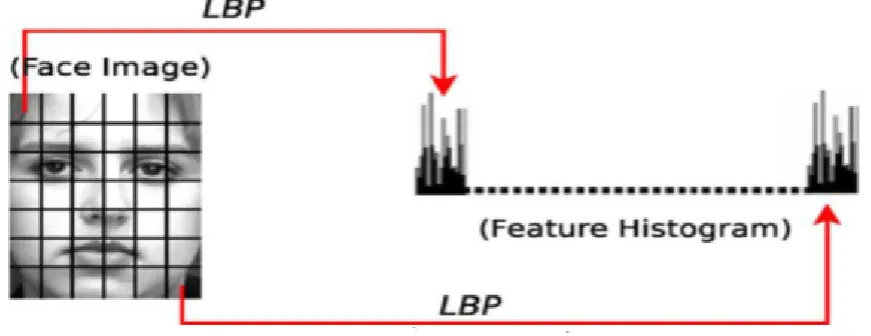
One image face can be compound shape from descriptive tiny pattern knowing agency LBP. Can create a calculate local binary histogram in images face, in attention shape information, sharing images face by several local area, be offer that create local binary histograms.
Fig 1. Description LBP image
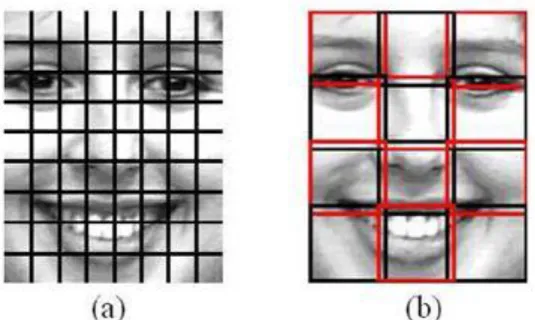
Fig 2. Four best selection of local areas
The purpose of face recognition, be fixing situation and sizes human's face in digital images. [Hadid et al][19, 20] using LBP for face recognition, for description faces with lower quality, a local binary operator vicinity four part, LBP (4, 1) using for overlapping small area. They for comparison, done experimental for MIT-CM databases and offer method recognition 221 faces without proving errors. Indeed to done studies, LBP to do steady about change monotonous shapes.
D. Pose variation face description with LBP:
The operator LBP assign a label to every pixel of an image by thresholding the 3*3-neighborhood of each pixel with the center pixel value and considering the result as binary number. Then the histogram of the labels can be used as a texture descriptor to be able to deal with textures and different scales, the LBP operator was later extended to use neighborhoods of different sizes. Defining the local neighborhood as a set of sampling points.
E. Localdescription for analysis image face:
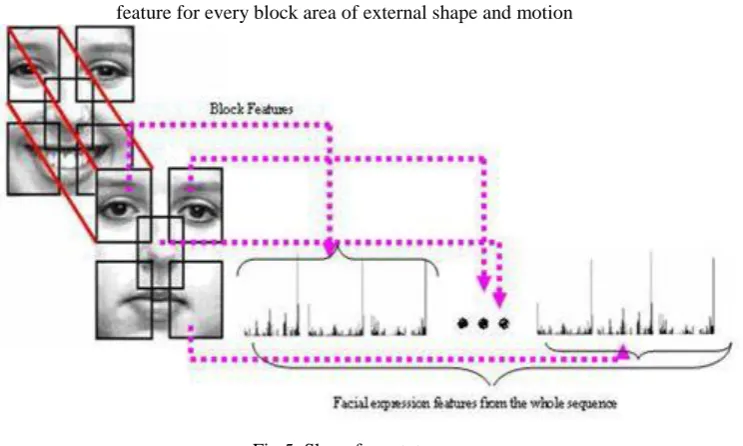
Create description face, result attention in section face analysis, showing resistance in front of changes illumination and situation in this method face image division in several block and since way LBP method, production specialties and joining internal a staff. A LBP decryption calculation all of the face conditions that labeled situation of small patterns conditions. For doper valence, for this method, to do produce a show that face image several internal none overlapping or overlapping block.
Fig 4.features in every block area,(a) block areas, (b)features LBP of three orthogonal area, (c)composing together feature for every block area of external shape and motion
Fig 5. Show face states
III. THE ANALYSIS LPQ HISTOGRAM FOR FACE VERIFICATION
In face recognition, thee faces have different condition of illumination or do experiment concentrate errors in different frames. For decrease this problems, can using increase quality standards for weak frame. LPQ operator using on image face then be extraction histograms from local area images and save in LDA space and create face area description. [Zhang et al][29] Propounded Gabor local and general phase pattern histogram for face recognition, in recent [Ojamsou et al] introduced LPQ, this algorithm comparison LBP, have a better benefit in texture and face recognition classes.
A. Discussion and conclusion
Completely, we having 3 parameter for better operation ours method: the first is all of the operator because a little operator cannot to show enough information for face recognition. Second parameter, a number of areas K that to be many small areas, increase time and reduce reality information. A little great areas, increase wasting space information. B. Conclusion:face recognitionin unlimited area being cause different amazements and changes face for an automatic system is very difficult. This section, offer a distinct face descriptor based on be production information from face image. This descriptor include transfer information locally phase face with using LPQ operator and inter LDA space. Face recognition to be do comparison similarity probe and gallery descriptors with using normalization test, in time that test on BANCA data base in MC, P, G is better than other methods. Composing this method's histograms and the show several way have better operation other than methods.
IV. COMPOSING LBP AND LPQ
Based on upper information, composing LBP, LPQ in comparison with which of LBP and LPQ have a better operation, they to be divide small rectangle area that haven't overlapping and to be decipher local histogram and conversion to a specialty expansion histogram and be earn space and frequency information.
A. Face refacing with using LBP and LPQ:
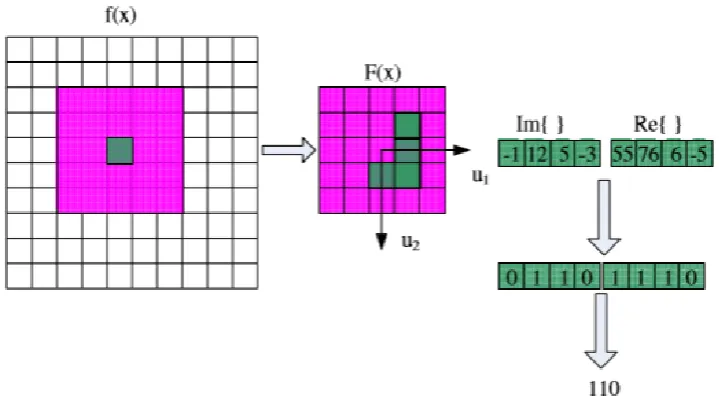
Fig 6.calculating LPQ histogram Therefore our refacing for commendation LBP and LPQ, include this follow:
1. Deride face to several local block
Fig 7. Composing histograms algorithm
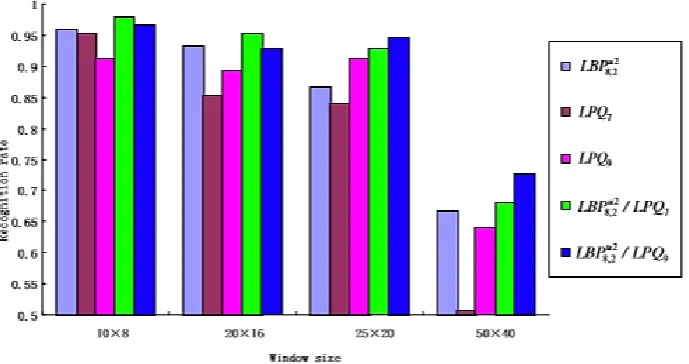
We do experiment in five different figure, AR data base include 4000 colored pictures of 126 individual that front facing face have a states and different illumination condition. Indeed graph LBP/LPQ, we have a better recognition conclusion.
Fig 8. Average of classes balance in every figuration with 50*40 pixel
If picture's face divided to small area and copulation weight vector for every this area, the weights show local information.
1) Table 1. Calculating conclusions of different algorithms
Rec.rate on AR Rec.rate on YALE
Method
0.880 0.960
LBP
0.816 0.953
LPQ
0.927 0.980
composing methods, decrease data area for pattern comparing or decrease the time of comparing. This
paper, show composing method for to revealed eye that is benefit for wrapper area. For this work, in state of
revealed face, of color specialty and revealed eye corns and then using to estimating pupil and Kalman filter.
Fig 9.result of tracing with Kalman's filter in different frames
Fig 10.result of tracing a man with composing method
VI.CONCLUSION
In this section we present a new method with use LBP, LPQ operator for face recognition. In this method information be coding in frequency and space area. Experiment of YALE, AR data base show that composing LPQ, LBP algorithms is very benefit. At follow this section, present fusion method for tracing human's eye in different area. Therefore in this method have a good performance and a little accounts.
REFERENCES
[1] M.Sulc and J.MatasFast," Features Invariant to Rotation and Scale of Texture",CZECH TECHNICAL UNIVERSITY IN PRAGUE, July 31, 2014.
[2] L.Sifre,S.Mallat," Rotation, scaling and deformation invariant scattering for texture discrimination.", Computer Vision and Pattern Recognition IEEE Conference (CVPR), 2013.
[3] M.Sulc,J.Matas," Kernel-mapped histograms of multi-scale lbps for tree bark recognition.", Image and Vision Computing New Zealand International Conference (IVCNZ), 2013.
[4] A. Fathi, and A. R. Naghsh-Nilchi, “Noise tolerant local binary pattern operator for efficient texture analysis,” Pattern Recognition Letters, vol. 33, pp. 1093-1100., 2012.
[5] Ylioinas, J., Hadid, A., Pietik¨ainen, M."Combining contrast information and local binary patterns for gender classification Image Analysis" , 676–686 ,2011.
[6] Heikkil¨a, M., Pietik¨ainen, M., Schmid, C,"Description of interest regions with local binary patterns. Pattern Recognition",pp 425–436 ,2009. [7] B. Bi, L. Zeng, K. Shen, and H. Jiang, “An effective edge extraction method using improved local binary pattern for blurry digital radiography images,” NDT&E International, vol.53, pp. 26-30., 2013.
[8] C. Shan, “ Learning local binary patterns for gender classification on real-world face images,” Pattern Recognition Letters, vol. 33, pp. 431-437, 2012.
[9] D. Grangier, and S. Bengio, “A discriminative kernel-based approach to rank images from text queries,” IEEE Transaction on Pattern Anal.Mach. Intell., vol. 30, no. 8, pp. 1371–1384, 2008.
[10] L. Nanni, and A. Lumini, “Ensemble of multiple pedestrian representations,” IEEE Transaction on Intell. Transp. Syst., vol. 9, no. 2, pp. 365– 369, 2008.
[11] A. Franco and D. Maio, "Similarity searches in face databases", in International Conference on Image Analysis and Processing, Vietri sul Mare,Italy, pp. 443- 450, 2009.
[12] T. N. Nguyen, T. D. Ngo, D. D. Le, S. Satoh, B. H. Le, and D. A. Duong, "An efficient method for face retrieval from large video datasets", in Conference of Image and Video Retrieval, Xi'an, China, pp. 382-389,2010.
[13] G. Gunlu. and H.S. Bilge, “Feature extraction and discriminating feature selection for 3D face recognition”, IEEE, in Proc. 24th International Symposium on Computer and Information Sciences, pp. 44 – 49, Sept 2009.
[15] R. Kam-art, T. Raicharoen and V. Khera,“ Face recognition using feature extraction based on descriptive statistics of a face image”, IEEE Machine Learning and Cybernetics, International Conference on, Vol. 1, pp:193-197,2009.
[16] Amr Rashad and Alaa Hamdy, “3D face recognition using 2DPCA,” IJCSNS International Journal of Computer Science and Network Security, Vol. 9, No.12, December 2009.
[17] Y.L.Yu Zhujie ,“Face recognition With Eigenfaces”, IEEE, International Conference on Industrial Technology ,pp. 434–438, Dec. 1994. [18] Chen Pan and Feilong Cao, “Face Image Recognition Combining Holistic and Local Features”, in Proc. Of IEEE 6th International Symposium on Neural Networks, pp. 407- 415, 2009.
[19] Cheng Zhong, Zhenan Sun, Tieniu Tan and Zhaofeng He, “Robust 3D Face Recognition in Uncontrolled Environments,” in Proc. Of IEEE Conference on Computer Vision and Pattern Recognition.(CVPR), pp.1-8,2008.
[20] Andrea F. Abate, Michele Nappi, Daniel Riccio and Gabriele Sabatino,“2D and 3D face recognition: A survey,” Pattern Recognition Letters, Vol. 28, No.14, pp.1885-1906, 2007.
[21] P. J. Besl and N. D. McKay, “A method of registration of 3-D shapes,” IEEE Trnsactions on Pattern Analysis and Machine Intelligence, Vol.14, No.14, pp. 239–256, Feb 1992.
[22] N. Otsu, “A threshold selection method from gray-level histogram,” IEEE Transactions on systems Man and Cybernetics, Vol.8, No.1, pp.62-67, 1979.
[23] F Fitzgibbon, A. W., Pilu, M and Fischer, R. B “Direct least squares fitting of ellipses,” In Proc. of the 13th International Conference on Pattern Recognition, Vienna,pp.253–257, September 1996.
[24] Schnabel. R., R. Wahl and R. Klein “Efficient ransac for point-cloud shape detection,” Computer Graphics Forum Vol.26, No.2, pp.214-219, 1998
[25] P. Belhumeur, J. Hespanha and D. Kriegman, “Eigenfaces vs. Fisherfaces: Recognition Using Class Specific Linear Projection,” IEEE Trans. Pattern Analysis and Machine Intelligence, Vol. 19, No. 7, pp. 711-720, 1997.
[26] M. Savvides, R. J. Heo, S. Park, C. Xie, and B.V.K. Vijayakumar,“ Partial & Holistic Face Recognition on FRGC-II data using Support Vector Machine,” in Proc. Computer Vision and Pattern Recognition Workshop (CVPRW '06), pp.48-48, June 2006.
[27] Minghua Zhao, Zhisheng You, Yonggang Zhao and Zhifang Liu. “Face Recognition Method Combining 3D Face Model with 2D Recognition,” IEEE, in Proc. Fourth International Conference on Image and Graphics (ICIG2007), pp.655-660, 2007.
[28] N. Nitta, A. Usui, and N. Babaguchi, "Face image retrieval across age variation using relevance feedback", in Advances in Multimedia Modeling, Chongqing, China, pp. 152-162, 2010.
[29] H. Lee, Y. Chung, J. Kim, and D. Park, "Face image retrieval using sparse representation classifier with gabor-LBP histogram",in International Workshop on Information Security Applications, Jeju Island, Korea, pp. 273-280, 2011.
[30] W. Zhang, S. Shan, W. Gao, X. Chen, and H. Zhang, "Local Gabor binary pattern histogram sequence (LGBPHS): A novel non-statistical model for face representation and recognition", in International Conference on Computer Vision, Beijing, China, pp. 786-791, 2005.
[31] N. Kumar, P. Belhumeur, and S. Nayar, "FaceTracer: A search engine for large collections of images with faces", in Europe Conference on computer Vision, pp 340-353,2008.
[32] Zhen, L., Ahonen, T., Pietik¨ainen, M ," Local frequency descriptor for low resolution face recognition.",The Ninth IEEE International Conference on Automatic Face and Gesture Recognition, pp.161–166. IEEE Press, California, 2011.
[33] Lei, Z., Liao, S., Pietik¨ainen, M., Z.Li, S,"Face recognition by exploring information jointly in space, scale and orientation.", IEEE T-IP. 20, 247– 256 ,2011.
[34] ShengCai, L., XiangXin, Z., Zhen, L., Zhang, L., Stan Z, Li," Learning multi-scale block local binary patterns for face recognition.", ICB, pp. 828–837, 2007.