ISSN (Print) : 2320 – 3765 ISSN (Online): 2278 – 8875
I
nternational
J
ournal of
A
dvanced
R
esearch in
E
lectrical,
E
lectronics and
I
nstrumentation
E
ngineering
(A High Impact Factor, Monthly, Peer Reviewed Journal)
Website: www.ijareeie.com
Vol. 8, Issue 1, January 2019
Efficient Energy Ad-Hoc Network Routing
Using Energy Model and Link Stability in
MANETs
Akanksha Tomar1, Gaurav Bhardwaj 2
Research Scholar, Dept. of Electronics and Communication Engineering, RJIT, Gwalior, India1
Assistant Professor, Dept. of Electronics and Communication Engineering, RJIT, Gwalior, India2
ABSTRACT: An approach to improve the energy efficiency by using an ‘Efficient Energy AODV’ (EAODV) that increases the network lifetime of MANETS(Mobile Ad-Hoc network). For MANETS deployed in battlefield scenario/border management posture, reliability, survivability and self sustenance of the network. In such an environment there are two major reasons of a link breakage i.e. firstly, a node dying of energy exhaustion and secondly, a node moving out of the radio range of its neighboring node. The proposed energy efficient routing protocol for MANETS tries to reduce energy consumption by means of an energy efficient routing metric, used in routing table computation instead of the minimum-hop metric(Measurement). This way, a routing protocol can introduce energy efficiency while selection of routes. However, energy metric does not take a node moving out of radio range while making its calculation into consideration. Thus, it is further proposed to use an additional metric that takes stability/availability of a particular link in to account. The proposed approach in this paper adds two extra fields in the packet header as routing metrics which are ‘Energy Model’ and ‘Link Stability Parameter’ and both of these metrics are used in routing table computation.
KEYWORDS: AODV (Ad Hoc On-Demand Distance Vector), Residual energy (Remaining Energy), EAODV.
I.INTRODUCTION
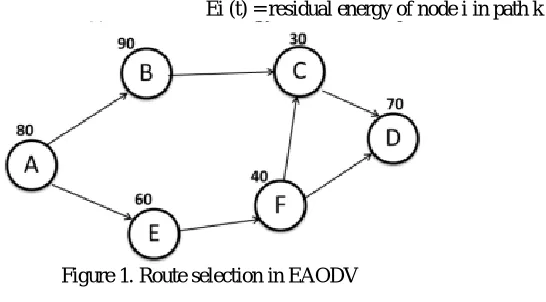
The energy model calculates the residual energy of a node by subtracting energy consumed by a node. There are various routing decisions for all packets sent, received, forwarded and dropped. while traversing from source to destination node. This residual energy of the node is added as a routing metric in the packet header and is used towards selection of an energy efficient path from the source to destination node. It is noted that this selected path may not be the minimum energy path but the path having maximum residual energy of the nodes since routing to maximize the lifetime of the network is different from minimum energy routing. Minimum energy routes attract more traffic flows, and the nodes along these routes suffer battery exhaustion and die very soon; hence causing a complete network failure. However, routes selected based on maximum residual energy results in increased network lifetime by balancing load through all the routes and nodes globally within a network.
II. DESIGN OBJECTIVE AND PROPOSED ALGORITHM
ISSN (Print) : 2320 – 3765 ISSN (Online): 2278 – 8875
I
nternational
J
ournal of
A
dvanced
R
esearch in
E
lectrical,
E
lectronics and
I
nstrumentation
E
ngineering
(A High Impact Factor, Monthly, Peer Reviewed Journal)
Website: www.ijareeie.com
Vol. 8, Issue 1, January 2019
Where,
Ek (t) = residual energy of path Ei (t) = residual energy of node i in path k
Figure 1. Route selection in EAODV
III. SIMULATION LAYOUT
Simulation has been carried out for a typical MANET deployment along border areas/battlefield scenario, with sensor/source nodes deployed at the edge of network (border) sending information to a control headquarters through various mobile nodes (number of nodes ranging from 30 to 60) forming the MANET.
Simulation Parameters:
Parameter Value
Channel Wireless Channel
Propagation Two Ray Channel
Antenna Omni directional Antenna
Terrain Area 1500 m x 1500 m
Simulation Time 60 s
MAC Type 802.11
Application Traffic CBR
Routing Protocol AODV
Data Pay load 512 Bytes/Packet
Number of Nodes 11
No of Destination/Control Nodes 1
Initial Energy of Nodes 100,00 Joules
Transmit Power 2.0 Watts
Receive Power 1.0 Watts
Idle Power 0.5 Watts
Table 1: Simulation parameters
ISSN (Print) : 2320 – 3765 ISSN (Online): 2278 – 8875
I
nternational
J
ournal of
A
dvanced
R
esearch in
E
lectrical,
E
lectronics and
I
nstrumentation
E
ngineering
(A High Impact Factor, Monthly, Peer Reviewed Journal)
Website: www.ijareeie.com
Vol. 8, Issue 1, January 2019
IV. SIMULATION RESULTS
Fig-2: Scenario of 11 nodes packet delivery (node 0-3-2) with full energy in AODV
Fig-3: Scenario of 11 nodes packet delivery (node 0-3-2) with partial energy node 3 in AODV
ISSN (Print) : 2320 – 3765 ISSN (Online): 2278 – 8875
I
nternational
J
ournal of
A
dvanced
R
esearch in
E
lectrical,
E
lectronics and
I
nstrumentation
E
ngineering
(A High Impact Factor, Monthly, Peer Reviewed Journal)
Website: www.ijareeie.com
Vol. 8, Issue 1, January 2019
In above results that life time of network is less because if energy of any node which participate in packet sending is lost than overall network get fail. So to overcome these problem we now apply new approach which shows the energy consumption for the protocols EAODV We want to send data from source node0 to node2 destination, firstly we apply algorithm to find minimum and maximum energy in between link of nodes. According to algorithm link from node (0-10-2) having maximum energy to deliver data as compare to other links.
Fig-5: Scenario of 11 nodes packet delivery (node 0-10-2) with full energy in EAODV
Now destination node 2 dynamically starts change position. But whenever node 2 lie in cluster range link will not change to transfer data.
ISSN (Print) : 2320 – 3765 ISSN (Online): 2278 – 8875
I
nternational
J
ournal of
A
dvanced
R
esearch in
E
lectrical,
E
lectronics and
I
nstrumentation
E
ngineering
(A High Impact Factor, Monthly, Peer Reviewed Journal)
Website: www.ijareeie.com
Vol. 8, Issue 1, January 2019
Fig-7: Scenario of 11 nodes packet delivery (node 0-3-2) with node 10 gets fully discharge in EAODV
Now, node 10 get fully discharge but our network will not fail. Here, by using algorithm, new link is established automatically to transfer data. If destination node is in range of source node than it can transfer data directly as we can see in figure below.
Fig-8: Scenario of 11 nodes packet delivery (node 0-9-2) with full energy in EAODV
ISSN (Print) : 2320 – 3765 ISSN (Online): 2278 – 8875
I
nternational
J
ournal of
A
dvanced
R
esearch in
E
lectrical,
E
lectronics and
I
nstrumentation
E
ngineering
(A High Impact Factor, Monthly, Peer Reviewed Journal)
Website: www.ijareeie.com
Vol. 8, Issue 1, January 2019
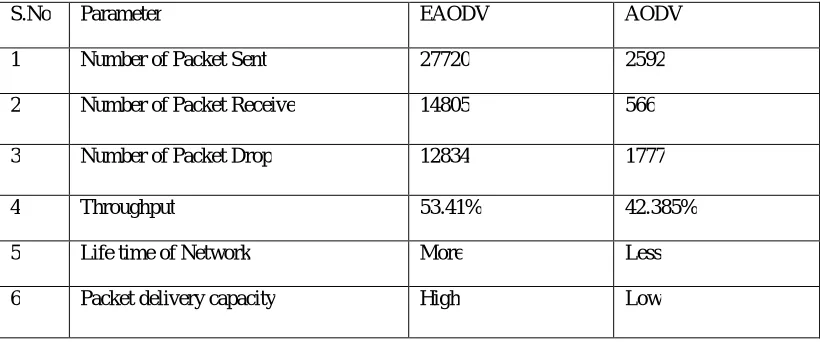
S.No Parameter EAODV AODV
1 Number of Packet Sent 27720 2592
2 Number of Packet Receive 14805 566
3 Number of Packet Drop 12834 1777
4 Throughput 53.41% 42.385%
5 Life time of Network More Less
6 Packet delivery capacity High Low
Table 1: Comparison between EAODV and AODV
VI.CONCLUSION
The results indicate that the technique provides robustness to mobility and enhances protocol performance. Its performance has been found much better than other existing protocols in dense medium as probability of finding active routes increases. In the discussed algorithm, the end to end delay is slightly increasing. Further improvement may be made to minimize this. The work includes simulation on only reactive AODV routing protocol.
REFERENCES
[1] Charles E Perkins, ‘Ad-hoc Networking’, Pearson Education, Nov-2000, Perkins 47190.
[2] Kartik Chawda and Deepmala Gorana, ‘A Survey of Energy efficient Routing Protocols in MANET’, IEEE sponsored 2nd ICECS, 2015. [3] C.Perkins,‘Adhoc On-demand Distance Vector (AODV) Routing’,RFC3561[S], 2003.
[4] D.Johnson, Y.Hu & D.Maltz, ‘The Dynamic Source Routing (DSR) Protocol for Mobile Ad-hoc Networking’, RFC 4728, Feb 2007.
[5] Hannan Xiao, ‘Energy consumption in Mobile Ad-hoc Networks’, National Conf on Recent Trend in Information, Telecommunication and Computing, 2010, pp. 23-27.
[6] Vidyarthi SS, Vijayalakshmi S, Simha GAV and Shekar, ‘Energy efficient Enhanced-AODV protocol for Multi-Rover systems’,Ultra Modern Telecommunications and Control Systems and Workshop (ICUMT), 2011 3rd International Congress 2011, pp 1-5.
[7] Utkarsh, Mukesh Mishra and Suchismita Chinara, ‘ESAR: An Energy Saving Ad hoc Routing Algorithm for MANET’,IEEE-Fourth International Conference on Advanced Computing, ICoAC 2012 MIT, Anna University, Chennai, 13-15 December 2012, pp 13-15.
[8] Shivashankar, Golla Varaprasad and Hosahalli Narayanagowda Suresh, ‘Implementing a new power aware routing algorithm based on existing dynamic Source routing protocol for mobile ad-hoc networks’ IET Networks, 2014, Vol.3, Issue 2, ISSN 2047-4954, pp 137-142.
[9] Shivashankar, Hosahalli Narayanagowda Suresh, Golla Varaprasad Guruswamy Jayanthi, ‘Designing Energy Routing Protocol with Power Consumption Optimization in MANET’ IEEE transactions on Emerging Topics in Computing, Vol. 2, Issue 2, July 2014, ISSN 2168-6750, pp 192-197.
[10] Pallavi S. Katkar and Prof. (Dr.) Vijay R. Ghorpade” A Survey on Energy Efficient Routing Protocol forWireless Sensor Networks” (IJCSIT) International Journal of Computer Science and Information Technologies, Vol. 6 (1) , 2015, 81-83.
[11] Samira Kalantary and Sara Taghipour ” A survey on architectures, protocols, applications, and management in wireless sensor networks” Journal of Advanced Computer Science & Technology, 3 (1) (2014) 1-11
[12] Zain ul Abidin Jaffri and Sundas Rauf” A Survey on “Energy Efficient Routing Techniques in Wireless Sensor Networks Focusing On Hierarchical Network Routing Protocols” International Journal of Scientific and Research Publications, Volume 4, Issue 2, February 2014 1 ISSN 2250-3153
[13] Ms.Pallavi R ,Shreya Animesh ,Preetesh Shivam ,Raghunandana Alse Airody and Niraj Kumar Jha” Energy Conservation in Wireless Sensor Networks Using Data Reduction Approaches: A Survey” International Journal of Computational Engineering Research,Vol, 03,Issue, 4 April 2013.
ISSN (Print) : 2320 – 3765 ISSN (Online): 2278 – 8875
I
nternational
J
ournal of
A
dvanced
R
esearch in
E
lectrical,
E
lectronics and
I
nstrumentation
E
ngineering
(A High Impact Factor, Monthly, Peer Reviewed Journal)
Website: www.ijareeie.com
Vol. 8, Issue 1, January 2019
[15] Edwin Prem Kumar Gilbert, Baskaran Kaliaperumal, and Elijah Blessing Rajsingh” Research Issues in Wireless Sensor Network Applications: A Survey” International Journal of Information and Electronics Engineering, Vol. 2, No. 5, September 2012.
[16] Zahra Rezaei and Shima Mobininejad” Energy Saving in Wireless Sensor Networks” International Journal of Computer Science & Engineering Survey (IJCSES) Vol.3, No.1, February 2012.
[17] Yoash Levron, Doron Shmilovitz, and Luis Martínez-Salamero” A Power Management Strategy for Minimization of Energy Storage Reservoirs in Wireless Systems With Energy Harvesting” IEEE transaction on circuit and system-I regular papers, vol.58, no.3, march 2011.
[18] M Pandey and S. Verma,(2011) “Performance Evaluation of AODV for different Mobility Conditions in WSN,” International Conference on multimedia, Signal Processing and Communication Technologies, pp.240-243 IEEE 2011.
[19] D. Y. Kwon, et al., (2009) “A Potential Based Routing Protocol for Mobile Ad hoc networks,” presented at the 11th IEEE International Conference on high Performance Computing and Communication, Seoul, Korea, 2009.
[20] B. Zhang and H. T. Mouftan, (2006) “Energy-aware on – demand routing protocols for wireless ad hoc networks,” Wireless Networks, vol. 12, pp. 481-494.
[21] L. Lin, et al., (2005) “Asymptotically Optimal Power aware routing for multihop Wireless Ad-hoc Networks with Renewable Energy Sources,” in 24th Joint Annual conference of the IEEE Computer and communications Socities, Miami, FL, USA, pp.1262-127.