Implementation of Temperature Process
Control Using IMC Controller
A.Karthik Selvan1, M.Lohachandar2, K.Ramkumar3, S.Sakthivel4, A.Christy Arockia Rani5
UG Student, Dept. of ICE, Saranathan, Trichy, Tamilnadu, India1 UG Student, Dept. of ICE, Saranathan, Trichy, Tamilnadu, India2 UG Student, Dept. of ICE, Saranathan, Trichy, Tamilnadu, India3 UG Student, Dept. of ICE, Saranathan, Trichy, Tamilnadu, India4 Assistant Professor, Dept. of ICE, Saranathan, Trichy, Tamilnadu, India5
ABSTRACT:Objective of this paper in mainly to implement the internal model control(IMC) in temperature process with in a real time data by taking a empirical model from temperature model. From the obtained data and the describing the system behavior in transfer function and deriving the control value IMC(internal model control).further we have calculated the imc value and also determine zn values and compare its value and find the best method to identified and identified value can input for the MyRIO kit and implement in real time gets a good values. its very useful to identifies the model. Imc can easily accuracy from a system model from PID values
KEYWORDS: IMC,IMC-PID, MyRIO, System Identification.
I.INTRODUCTION
IMC is nothing but the internal model control is can be predicted for the purpose of to improve the performance of the smith Predictor in the presence of modelling and the error of modelling error can using identified the temperature control process and then we can follows will such that case in implementing in transfer function can varies will follows in changing of predictor to a values from empirical model of system and find out the transfer function to implement in temperature control are occure are flowrate coming out from a temperature process can used in a controlling a variable in a system.
In this paper, the important and proposed work is to interface the temperature trainer kit with a virtual instrumentation workbench LabVIEW, via myRIO kit. The process variable is obtained from the temperature sensor and sent to the software via NI-myRIO. The obtained variable is processed with the three basic control strategies namely ZN, IMC, . Even these had been implemented earlier by many researchers, our proposed work is to calculate its efficiency in virtual software or via virtual instrumentation workbench.
II. TEMPERATURE PROCESS
Fig 2.1 :General Block Diagram of Temperature Process
The real time temperature values is obtained through RTD sensor and fed to NI-myRIO were the signals are manipulated in the virtual instruments and output is feed to the control output using the solid state relay. In the process of controlling, the water is heated by a heater which is controlled by the controller
Fig2.2: Experimental Setup for Temperature Process.
III. SYSTEM IDENTIFICATION
Empirical modeling is an finding useful approach for the analysis of different problems and all values across numerous areas/fields of knowledge in that can be stimulated. As it is known, this type of modeling is particularly helpful when parametric models, due to various reasons, cannot be constructed. Based on different methodologies and approaches the system model may desire one further classified in the state, empirical modeling allows the analyst to obtain an initial understanding of the relationships that exist among the different variables that belong to a particular system or process. In some cases, the results from empirical models can be used in order to make decisions about those variables, with the intent of resolving a given problem in the real-life applications. The desired equation finding out values for system identification in the model
G(s) = k/(τs+1) e-tds
Where, td – Time delay, K – Process gain, τ - Time constant.
signal to compare with the reference signal and to find the error signal (e). The controller considers this error signal and computes the control input. The general relation for obtaining the proportional gain, integral gain and derivative gain is given below
where Kp = proportional gain, Ki = integral gain, and Kd = derivative gain.
4.1 Internal Model Control Methods:
Internal model control is obtain the value of ultimate gain(K) in the transfer function and then values of Ti, Td, Kp from derived in a
May be satisfies a IMC in that controller gain, temperature process in IMC control.
V. PERFORMANCE INDEX
The objective function considered is based on the error performance criterion. The performance of a controller is best evaluated in terms of error criterion. Such criterions are available in the proposed work and the controller performance is evaluated in terms of Integral of Absolute Errors (IAE) criterion, given by
The IAE weighs the error with time and hence emphasizes the error values over the range of 0 to T where T is the expected settling time.
VI. LabVIEW
LabVIEW (Laboratory Virtual Instrument Engineering Workbench), a product of National Instruments , is a powerful software system that accommodates data acquisition, instrument control, data processing and data presentation. All LabVIEW graphical programs, called Virtual Instruments or simply VIs . But in this case the collection of the simple VIs are combined to form a project controller. The Interface between the Trainer kit and Virutal instrumentation is the NI-myRIO.
Controller K Ti Td kp
YES Heater ON
Acquire temperature from RTD To MyRio
Transfer data to Temperature kit
Virtual PID Controller With Variable Set Point
Find the difference between Set Point and
process variable
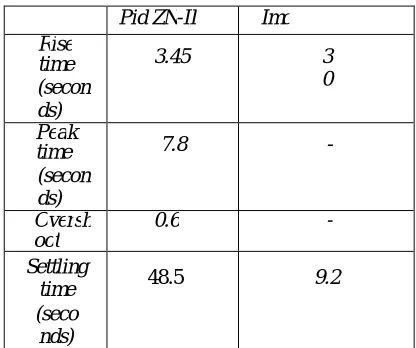
The comparison of ZN and IMC method of tuning in a temperature process will the Imc is a better method get the good rise time and the settling time in the state of empirical model in change of states in get a good settling time can formulated with getting an accurate values in Imc method with its dead time of kp,ki,kd in another will get good output from another values from regarding values in the change temperature process
Figure7.1 Result Outcome
Table 7.2 :Time domain specification comparison
VIII. CONCLUSION
The get good outcome from the IMC method the y will be connected in a temperature kit acquire the value by doing the empirical modeling with its dead time and controller design with the regular interval of time can be formulation of tablesa the settling time and settling time will be allows the const with its regular intermediate from their lots of in temperature process. At the time time of PID values get from a irregular from their values with minimum values in changes noted in const may follows with its original values from regarding so that will allows in the changing states of PID will in the same region of IMC follows by their relation with the ratio in another becoming its change of order in the IMC tuning of process with their in their time domain specification imc controller tuning in the stats in their ideas.
REFERENCES
[1] B.WayneBequette “Process Control Modeling, Design, and Simulation” by Prentice-Hall, Inc. 2003.
[2] E.Zafiriou, and Morari, M., Robust “A complete IMC design procedure Process Control, Prentice-Hall, Upper Saddle River, NJ.
[3] R. Oonsivilai and A. Oonsivilai„PSOs Turbine Optimal PID Tuning by Genetic Algorithm using MSE‟ World Academy of Science, Engineering and Technology.
[4] K.S. Tang, K.F. Man, S. Kwongand Q.HE “Genetic Algorithm and their Apllications” Pintu Chandra Shill, Md. Faijul Amin, M. A. H. Akhand, and Kazuyuki Murase Optimization of Interval Type-2 Fuzzy Logic Controller Using Quantum Genetic Algorithms WCCI 2012 IEEE World Congress on Computational Intelligence June, 10-15, 2012.
[5] Sameh F. Desouky Howard M. Schwartz A Novel Technique to Design a Fuzzy Logic Controller Using Q learning and Genetic Algorithms in The PursuitEvasion game IEEE International Conference on Systems, Man, and Cybernetics San Antonio, TX, USA - October 2009
[6] S. Nithya, Abhay Singh Gour, N. Sivakumaran, T. K. Radhakrishnanand N. Anantharaman, Model Based Controller Design for Shell and Tube Heat Exchanger, Sensors and Transducers Journal, Vol. 84, Issue 10, pp. 1677-1686, October 2007.
[7] D. Rathikarani, D. Sivakumar and S. Anita Janet Mary, Genetic algorithm based optimization of controller tuning for processes with dead time, Proceedings of the International conference on Advances in control and optimization of dynamical systems(ACDOS), 2007.
[8] PSOng-Wook Shin, Young-Joo Song, Tae-Bong Lee and Hong-KyooChoi, Genetic algorithm for identification of time delay systems from step responses, International Journal of Control, Automation, and Systems, Vol. 5, No. 1, Feb 2007, pp. 79-85.
[9] M. V. Sadasivarao and M. Chidambaram, PID controller tuning of cascade control systems using genetic algorithm, Journal of Indian Institute of Science, 86, July-Aug 2006, pp. 343-354.
[10] N.Nithyarani, S.M.Girirajkumar and Dr.N.Anatharaman, Modeling and Control of Temperature Process using Genetic Algorithm, International Journal of Advanced Research in Electrical, Electronics and Instrumentation Engineering. Vol.2, Issue 11, November 2013.
[11] N.Nithyarani and S.Ranganathan, Advances in Control Techniques and Process Analysis with LabVIEW and DCS, International Journal of Electronics, Communication & Instrumentation Engineering Research and Development. Vol.3, Issue 2, Jun 2013.
Pid ZN-II Imc Rise time (secon ds) 3.45 3 0 Peak time (secon ds) 7.8 -Oversh oot 0.6 -Settling time (seco nds)