Data Communication: Overview of
TCP/IP Protocol Suite in Security
Complication and their Safeguard
Naveen Panwar; Pankaj Kumar & Chakshu Raj
[email protected] & [email protected] ABSTRACT:
The Transmission Control Protocol/Internet Protocol (TCP/IP) is combination of different protocols at various layers.TCP/IP is the basic communication language or protocol of the Internet and private networks either an intranet or an extranet. The TCP/IP suite has many design weaknesses so far as security and privacy are concerned. Some of these are protocol design weaknesses, whereas rest is defects in the software that implements the protocols. In this paper, I focused mainly on protocol level issues, rather than implementation flaws. In this paper, we discuss about the security issues related to the some of the protocols in the TCP/IP suite.
KEYWORDS:
Internet Protocol; Routing Information Protocol; Transmission Control Protocol; User Datagram Protocol
INTRODUCTION:
This paper is an overview of security attacks in the core protocols (IP, UDP and TCP) and other protocols like EGP,BGP, RIP, ICMP and DNS. However, we do not address the exploits in various application
protocols. Some of these are protocol design weaknesses per se, whereas the rest are defects in the software that implements the protocols.
1.TCP SYS ATTACKS:
UDP is a connectionless protocol belongs to the transport layer. It is a thin protocol on top of IP providing high speed but low functionality.UDP does not guarantee the delivery of datagrams. Messages can be delivered out of order, delayed or even lost. Datagrams may get duplicated without being detected. The UDP protocol is used mostly by application services where squeezing the best performance out of existing IP network is necessary, such as trivial file transfer protocol (TFTP), NFS and DNS. Unfortunately, UDP cannot provide security and privacy of the data flow.
A UDP flood attack sends a large number of UDP packets to random ports. Such ports may be open or closed. If open, an application listening at that port may be open or closed. If closed, the network layer, replies with an ICMP Destination Unreachable Packet. Thus, the victim host will be forced into sending many ICMP packets and wasting computing cycles. If the flooding is large enough, the host will
eventually be unreachable by other clients. The attacker will also IP-spoof the UDP packets, both to hide and to ensure that the ICMP return packets do not reach him. Surprisingly, using legitimate applications or OS services an attacker can generate a storm of packets. On many systems, the standard services known as chargen that listens typically at port 19 and echo that listens typically at port 7 are enabled. Chargen sends an unending stream of characters intended to be used as test data for terminals. The echo service just echoes what it receives. It is intended to be used for testing reachability, identifying routing problems, and so on. An attacker sends a UDP packet to the port 19 with the source address spoofed to a broadcast address and the source port spoofed to 7.The chargen stream is sent to the broadcast address and hence reaching many machines on port 7.Each of these machine will echo back to the victims port 19.This ping-pong action generates a storm of packets. An attack called fraggle uses packets of UDP echo service in the same fashion as the ICMP echo packets
1.1:Defenses:
Both end-host and network-based solutions to the SYN flooding attack have merits. Both types of defense are frequently employed, and they generally do not interfere when used in combination. Because SYN flooding targets end hosts rather than attempting to exhaust the
network capacity, it seems logical that all end hosts should implement defenses, and that network-based techniques are an optional second line of defenses that a site can employ.
UDP is a connectionless protocol belongs
to the transport layer. It is a thin protocol on top of IP providing high speed but low functionality.UDP does not guarantee the delivery of datagrams. Messages can be delivered out of order, delayed or even lost. Datagrams may get duplicated without being detected. The UDP protocol is used mostly by application services where squeezing the best performance out of existing IP network is necessary, such as trivial file transfer protocol (TFTP), NFS and DNS. Unfortunately, UDP cannot provide security and privacy of the data flow.
A UDP flood attack sends a large number of UDP packets to random ports. Such ports may be open or closed. If open, an application listening at that port may be open or closed. If closed, the network layer, replies with an ICMP Destination Unreachable Packet. Thus, the victim host will be forced into sending many ICMP packets and wasting computing cycles. If the flooding is large enough, the host will eventually be unreachable by other clients. The attacker will also IP-spoof the UDP packets, both to hide and to ensure that the ICMP return packets do not reach him Surprisingly, using legitimate applications or OS services an attacker can generate a storm of packets. On many systems, the standard services known as chargen that listens typically at port 19 and echo that listens typically at port 7 are enabled. Chargen sends an unending stream of characters intended to be used as test data for terminals. The echo service just echoes what it receives. It is intended to be used for testing reachability, identifying routing problems, and so on. An attacker sends a UDP packet to the port 19 with the source address spoofed to a broadcast address and the source port spoofed to 7.The chargen stream is sent to the broadcast address and hence reaching many machines on port 7.Each of these machine will echo back to the victims port 19.This ping-pong action generates a storm of packets. An attack
called fraggle uses packets of UDP echo service in the same fashion as the ICMP echo packets.
2.1 : Defenses:
To defend, most host disable many UDP services such as the chargen and echo mentioned above. Because UDP is better suited for streaming applications, there are suggestions to run UDP over SSL or even create a protocol immediately above UDP. Routing protocol is used. Some of these attacks succeed only if the remote host does source address-based authentication; others can be used for more powerful attacks. A number of these attacks described below can also be used to accomplish denial of service by confusing the routing tables on a host or gateway.
3.ROUTING INFORMATION PROTOCOL (RIP) ATTACKS:
The Routing Information Protocol (RIP) is used to propagate routing information on local networks, especially broadcast media. Typically, the information received is unchecked. This allows an intruder to send bogus routing information to a target host, and to each of the gateway along the way, to impersonate a particular host. The most likely attack of this sort would be to claim a route to a particular unused host, rather than to a network; this would cause all packets destined for that host to be sent to the intruder’s machine.(Diverting packets for an entire network might to be too noticeable; impersonating an idle work-station is comparatively risk-free).Once this is done, protocols that rely on address-based authentication are effectively compromised.
possible alteration. They are then resent,
using IP source address routing, to the intended destination. An outsider may thus capture passwords and other sensitive data. This mode of attack is unique in that it affects outbound calls as well; thus, a user calling out from the targeted host can be tricked into divulging a password. Most of the earlier attacks discussed are used to forge a source address; this one is focused on the destination address. This and are the earliest mentions of routing attacks in the literature. The attacks described here-abusing the routing protocols for eavesdropping and/or packet modification-remain a very serious threat. Indeed, a National Research Council study identified routing attacks as one of the two major threats to the internet. While there are proposals to solve this problem, nothing has been implemented; all of the proposed solutions have their drawbacks. Defense against routing attacks must still be considered a research problem.
Routing attacks have happened frequently by accident. In the most famous case, known as the “AS 7007” incident, an ISP started advertising that it had the best routes to most of the internet. Even after they powered down their router, it took more than four hours for the global routing tables to stabilize. As suggested here, most subtle routing problems are harder to diagnose. AT&T’s dial up internet service knocked off the air for many hours when another ISP started advertising a route to small, internal network. There are many other such incidents as well. Are malicious routing attacks happening? Yes, they are, and the culprits are a very low life form: the spammers. In some cases, they are hijacking a route, injecting spam and then withdrawing a route. The attack is hard to trace, because by the time someone notices it the source addresses of the email are either non-existent or innocent.
3.1 Defenses:
supposed to originate on link, send it with
a TTL of 255, and verify that on receipt .Any off-link packets will have passed through at least one router which would have decremented the TTL.
Even if the local routers don’t implement defense mechanisms, RIP attacks carry another risk: the bogus routing entries are visible over a wide area. Any router (as opposed to host) that receives such data will rebroadcast it; a suspicious administrator almost everywhere on local collection of networks could notice the anomaly. Good log generation would help, but it is hard to distinguish a genuine intrusion from the routing instability that can accompany a gateway crash.
4.THE INTERNET CONTROL MESSAGE PROTOCOL(ICMP):
The Internet Control Message Protocol (ICMP) is used by the IP layer to send one-way informational messages to a host .There is no authentication in ICMP, which leads to attacks using ICMP that can result in a denial of service, or allowing the attacker intercept packets. Denial of service attacks primarily use either the ICMP “Time exceeded” or Destination unreachable” messages, which can cause a host to immediately drop a connection. An attacker can forge one of these ICMP messages, and send it to one or both of the communicating hosts to disconnect their connection. ICMP “Redirect” message which is commonly used by gateways when a host has mistakenly assumed the destination is not on the local network. If
an attacker forges an ICMP “Redirect” message, it can cause another host to send packets for certain connections through the attacker’s host. This attack is similar to a RIP attack, except that ICMP messages only apply to existing connections, and the attacker (the host receiving redirected packets must be on local network.
5.IP ADDRESS SPOOFING:
Fig.IP Address Spoofing
5.1.DETECTION OF IP SPOOFING: We can monitor packets using network-monitoring software. A packet on an external interface that has both its source and destination IP addresses in the local domain is an indication of IP spoofing. Another way to detect IP spoofing is to compare the process accounting logs between systems on your internal network. If the IP spoofing attack has succeeded on one of your systems, you may get a log entry on the victim machine showing a remote access; on the apparent source machine, there will be no corresponding entry for initiating that remote access.
5.2. PREVENTION OF IP SPOOFING: All routers must employ proper IP filtering rules. They should only route packets from source that could legitimately come from the interface the packet arrives on. Most routers now have options to turn off the ability to spoof IP source address by checking the source address of a packet against the routing table to ensure the return path of the packet is through the interface it was received on.
6. DOMAIN NAME SYSTEM:
The Domain Name System (DNS) provides for a distributed database mapping host names to IP addresses. An
6.1SECURITY THREATS OF THE
DNS:
DNS zone transfers questioning the
legitimacy of a zone transfer request is left out of the protocol. It is also possible to include a zone transfer gratuitously as part of response to a legitimate query.
DNS Cache Poisoning Cache poisoning
happens whenever a DNS server does not have the answer to a query within its
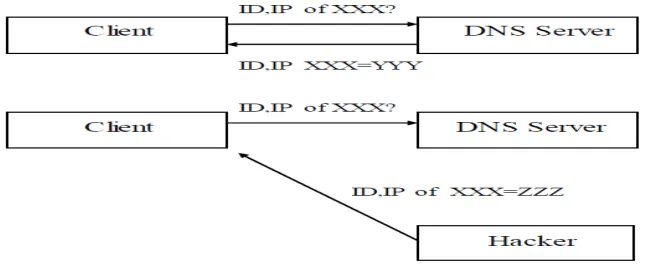
cache, the DNS server can pass the query onto another DNS server on behalf of the client. If the server passes the query onto another DNS server that has the incorrect information, whether placed there intentionally or unintentionally, then cache poisoning can occur. Malicious cache poisoning is commonly referred to as DNS spoofing.
Fig. Cache Positioning
DNS Forgery the DNS answers that a host
receives may have come from an attacker who sniffs a query between the victim resolver and the legitimate name servers and responds to it with misleading data faster than the legitimate name server does. The attacked host may in fact be a DNS server.DNS forgery is also called spoofing.
Domain Hijacking A domain is hijacked
when an attacker is able to redirect queries to servers that are under the control of the attacker. This can happen because of cache poisoning, forgery or a domain server has been compromised.DNS hijacking is also known as redirection.
6.2 Defenses:
In 1994, the IETF formed a working group to provide security extensions to the DNS protocol in response to the security issues surrounding to the DNS i.e, DNSSEC. DNSSEC provides authentication and integrity to the DNS.With the exception of
controlling access, which is beyond scope
of coverage for DNSSEC. Adequate protection against information leakage is already provided through such things as split DNS configuration.
CONCLUSION:
The TCP/IP suite has many design weaknesses so far as security and privacy are concerned, all perhaps because in the era (1970s) when the development took place network attacks were unknown. The flaws present in many implementations exacerbate the problem. A number of these are due to the infamous buffer overflow which is preventable by better programming practices. However, considerable blame belongs to the many ambiguous RFCs. In this paper, we highlighted the protocol attacks and their defenses.
REFERENCES:
[1]. S.M.Bellovin. A look back at “Security problems in the TCP/IP Protocol suite”.
[2]. S.M.Bellovin, security problems in the TCP/IP protocol suite.
http://www.research.att.com/~smb/papers/i pext.pdf.
[3]. Larson, M.and Liu, C.,” Using BIND: Don’t get spoofed again”.
http://www.sunworld.com/swol-11-1997/swol-11-bind.html
[4]. I.Arce, Attack trends: More bang for the bug: AN account of 2003’s attack trends, IEEE Security & Privacy
[5]. R.Barden, editor.Requirements for Internet hosts-communication layers.RFC 1122, Internet Engineering Task Force, oct.1989.