DOI:
Abstr into e diffic We a requi 38 U from the n Toolk Keyw 1.IN Opti techn typew that for a loss The in it chara More recog line segm scrip chall singl featu comp repre proc word imag statis on d samp Cha main fonts posit playe : http://dx.doi.
SEGME
Lecturer Govt. Collract: All the U electronic libra cult task becaus are describing ire segmentation Urdu letters). Th
each sliding w number of states kit) for training
words:Naskh, O
NTRODUCTI
cal character nique that co written or pri
can be proce an unlimited n of information
cursive natur ts automatic acters is ve eover, it alw gnition rates. recognition of mentation into
pt, where liga lenges to the le hidden Ma ures extracted posed of mul esents one le essed line by ds or charact ge is used as a
stical features different fonts ples extracted aracter recogn nly due to its c s, context-dep tion with resp ed an importa
.org/10.26483/
Interna
ENTATIO
Prabjot r, Dept. of Com
ege of Engine Jammu,
rdu literature is aries. Various O se Urdu is highl a technique fo n into character his paper prese window thereby s of HMM, diffe g, recognition an
OCR, HMM, HT
ION
recognition, onverts scann inted text into essed, edited, number of time n using a com re of Urdu lan recognition. ery difficult ways generat
We are prese f Urdu script. o characters an atures, overla
recognition s arkov model from the man ltiple characte etter of the a y line withou ters. The hor an independen s. The perform s of Urdu Na from a histor nition for U characteristics pendent shap pect to the ba ant role in de
/ijarcs.v9i1.550
Volu
ational Jou
Av
ON-FREE
Singh mputer Engin eering and Tec , IndiaAssis Go
s in the form o OCRs have been
ly cursive langu r automatic rec rs and consider ents a novel fea
eliminating the ferent sizes of h
nd result analys
TK
abbreviated ned images o the machin searched, sav es without any mputer.
nguage is the Segmenting
and comp es errors, re enting a new The method nd is applied aps and style system. The m
(HMM) with nuscript image er models wh alphabet. The ut segmentin rizontal posit nt variable to mance of the p askh script is rical typewritte Urdu script fa s like cursive pes of chara aseline. These elaying chara
00
ume 9, No.
urnal of Ad
RESE
vailable On
E RECOG
neering chnology J stant professor ovt. College of manuscripts a n developed fo uage, where liga
cognition of of rs each shape of ature extraction e need for segm hierarchical win
sis.
as OCR, is t of handwritte ne-encoded for ved, and copi y degradation
main challen the script in plex procedu
esulting in lo method for o does not requ to cursive Ur e variation po
method trains h the structu es. The HMM here each mod
e text image ng the line in tion at the li
generate simp proposed meth assessed usi en manuscript aces challeng nature, multip acters and th
e obstacles ha acter recogniti
1, January
dvanced Re
EARCH PA
nline at ww
GNITION
Jyoti Mahaja r, Dept. of Com
f Engineering Jammu, India
and typewritten or different lang atures overlap a ff-line printed U f Urdu characte n method based mentation of Urd ndow and differe
the en, rm ied n or nge nto ure. ow off-uire rdu ose s a ural M is del is nto ine ple hod ing t. ges ple heir ave ion sy lik to ha w In re th si M th tra fo du ho an Th ch [2 di se re an fo 2. Th de th
y-February
esearch in C
APER
ww.ijarcs.in
N OF URD
Lec
an
mputer Engin g and Technolo
a
n books.There i guages and are and style variati Urdu text usin er as different cl d on sliding win
du text. The de ent fonts is pres
ystem for the ke Latin and C o be a difficu
ave proposed without segmen
n 2007, M.S ecognizing the he document im
mple statistic Markov Toolki
he technique aining sample or Arabic sam uring recognit owever, this m nd time during
he research haracters is di 2]. Moreover, ifficult to re egmentation f esearchers, yie nd Chandan S or printed text
.PROPOSED
his section pr etail. Figure: 1 he text page is
y 2018
Computer
nfo
DU SCRIP
Kulje cturer, Dept. o Universit Jamm
neering ogy
is a need for co widely used. B ion poses challe ng Hidden Mark lass resulting in ndow techniqu pendency of Re sented. We are
Urdu languag Chinese. Segm ult and error-p
a Global app nting the word
S Khorsheed e handwritten
mage into text cal features it (HTK) for tr
of character es and achiev mples. It is lex
tion.This offe method is exp g feature extra reveals that ifficult in lang
if the segme ecognize the free techniqu elding encoura Singh presente
with an accur
DSYSTEM
resents our p 1 shows a blo s scanned, the
Science
ISSN N
PT USIN
eet Singh of Computer S
ty of Jammu mu, India
onverting all the Building a comp enges to the rec kov Models. O n a total of 196 ue, using only 1
ecognition rate using HTK (Hi
ge compared mentation of U prone task so
roach for cha ds or ligatures
[1] propose Arabic text im t images. It th that are inje raining. The S r models an ved the recogn
xicon free an er open vocab pensive in term action and trai
segmentatio guages such a entation is pe ese segmente ueshave been
aging results
.
I ed a multi-fonracy of more t
roposed Reco ck diagram of preprocessing
o. 0976-5697
G HMM
Science,
ese physical lib plete Urdu OC cognition system Our method doe
classes (compa 16 statistical fe of Urdu script idden Markov M
to other langu Urdu text is pr many resear aracter Recogn s into characte
ed a method mages. He div hen extracts a ected into Hi
System depen nd grammar
nition rate of nd uses basic bulary recogn ms of comput ining.
on of words as Arabic and erformed it is
ed parts, so used by va In 2006, G.S L nt Gurumukhi
than 97% [3].
ognition syste f this system. g stage reduce
Prabjot Singh et al, International Journal of Advanced Research in Computer Science, 9 (1), Jan-Feb 2018,827-833
© 2015-19, IJARCS All Rights Reserved 828
noise from the text image. The lines of text are located from the text image and simple features are extracted from each line image. The preprocessing and feature extraction stages are identical for training and recognition procedures. In training procedure, the system takes as input, the sequence of symbols coupled with the corresponding ground truth and estimates the parameters of character models. In the recognition procedure, the system takes the sequence of symbols as input to find the character sequence that has the highest likelihoods.
Figure1: OCR System Design
1. Data Corpus:
To train and test the OCR System, we built a data corpus consisting 4250 lines of Urdu text. Building data corpus is an important step to assess the performance of the recognition system.
2. Data Labeling:
This is also known as Transcription. Once the softcopy of data corpus is built, each Urdu character is then represented by two hexadecimal numbers. Urdu characters are context sensitive. A character can have up to four different shapes depending upon their position within a word. The total number of labels in the system equals to 196 and it includes Urdu characters, numbers, space character and punctuation marks. Labeling procedure is done manually.
3. Pre-processing:
Once the data corpus is built, the next step is to convert this data corpus into text images using a scanner or an image processing tool. The main function of this stage is to enhance the text images by reducing noise before any further processing.
4. Noise Reduction:
Noise is an important challenge to any OCR system. It may come from bad scanners or from poor documents. To minimize noise a scanner of high quality should be used. When the noise is detected in text image filter can be used to minimize the noise, but if there is still a noise in the image the image is rescanned again or discarded from data corpus.
5. Feature Vector Extraction Method:
In feature extraction phase, each segmented line of the text image is divided into a number of frames. In our approach, we take the frame width and height to be 3-7 and 64-80 respectively. The frame width and height are chosen according to our statistical analysis.
In order to use the stochastic procedure such as HMM, the feature vector should be extracted as a function of an independent variable. In speech recognition, the feature vectors are extracted from speech signals using time as an independent variable [4]. However, in offline text recognition system, the whole page needs to be recognized at a time; hence time cannot be treated as an independent variable in this case. Now assuming the horizontal axis along the text line is the independent variable, sliding window is scanned over the line from right to left as shown in Figure 2.
Figure2: Sliding window and overlapping cells [4]
As already mentioned, there are several methods of feature extraction such as statistical (DCT, DWT, Sliding window), structural andglobal methods [5]. In these methods, statistical features are extracted from each segmented image. These types of features are easy to compute and take a short processing time as compared to structural features. However, using this technique we are extracting only 16 simple features (of one type) per vertical strip (window) as shown in fig. 3. As the line image is already converted into the binary image (0&1). A virtual window of variable width and constant height (height of the image) slides over the entire length of the image from left to right. Each window consists of eight vertical cells dividing it into eight parts. Features (F1-F8) are then converted into sixteen features (F1-F16) as shown in fig. 3.
F13= F14= F15= F16=
In m wind and are i the H recog
6. H
We punc show Diffe same To b way Hidd diffe we chara =F9+F10, =F11+F12, =F10+F11, =F13+F14. Figur many experim dow size (wid horizontal). T njected into th HMM is train
gnized are use
HMMStructur
are represen ctuation mark wn in fig. 4 ferent shapes o
e character mo build an HMM
a) The Num
to define th den Markov M erent number
used the sam acter models.
e 3: Feature ext
ments, we tri dth and heigh These feature he HMM duri ned, the featur ed as input to
re:
nting each U k is by a dis
. The total of an Urdu ch
odel. M, following p
mber of States he best numb Model (HMM
of states per me number o
traction method
ied different ht) and overl
vectors of th ing the trainin re vectors of
HTK.
Urdu charact stinct left-to-r number of H aracter are rep
arameters are
s: There is n ber of states M). The only w each HMM. of states per
d
values for t apping (vertic he entire ima ng process. On the image to
ter, number right HMM, HMMs is 19 presented by t
required:
no mathematic to represent way is to try t For simplici r HMM for
the cal age nce be or as 96. the cal t a the ity, all Ea to m b) ‘j ob th po W in ge ta sy co c) as be va 7. D th st M pr pr do un oc pr al da of th ou Th W of st di de Fig
ach label in th o-right HMM m model [6].
) Discrete pro ’ in a discret bservation pro he probability osition x in th
Where v(ox) is nput vector ‘o
enerating sym able giving th ymbol at eac odebook index
) Transition M ssociated tran etween two st alue in the tran
Training Pr
Defining the st he first step to
ep is to estim Model(HMM)
rocess is calle Trainin robabilities an one in three niformly segm ccurrences of rovide the ou lgorithm [8] d ata and the pa f this step dep he observation utput of the H
he second ste Welch re-estim f Viterbi train ate at each tim iscussed earli ecision; the tr
gure 4: Hidden
he data corpus model with th
obabilities for te Hidden M obability distr y of generati e line image[7
bj (ox) =
s the output of ox’ and Pj[v mbol v. The o he probability ch state. Eac x in the range
Matrix: Each nsition proba tates i and j i nsition matrix
rocedure:
tructure of Hi owards buildi mate the para from exampl d training pro ng procedur nd the discre e steps: first mented. Each each symbol. utput distribut discussed earli arameters are r pends on the c ns. Every trai HMM, whose p ep of the train mation algorith
ning to find th me t using th ier. The Vit raining vector
n Markov mo
s is represente he same numb
r each emittin Markov Model ribution ‘bj(ox ing an obser 7]:
= Pj [v(ox)]
f the vector q v] is the prob output distribu y of each po
ch symbol is 1 to M.
h pair of state ability as aij.
if aij represen x.
idden Markov ing the recog ameters of th les of the dat ocedure.
re initialize ete output dis t, the traini segment cou These counts tion of each ier, is applied recomputed. T concept that a ining example parameters has ning procedur hm [9] discuss he probability he Forward-Ba terbi algorith r was generat
del
d by a single l er of states pe
g state: Each lhas an assoc x)’ that determ rvation ox a
quantizer, give bability of st ution consists ossible observ s identified
es i and j ha There is a nted by a non
v Model(HMM gnizer. The se he Hidden Ma ta sequences.
s the tran stributions. Th
ng examples unts the numb s are normaliz state. The V d to re-segmen
The basic prin an HMM gene e is viewed a s to be estima re is to use B sed earlier, in y of being in
ackward algo m makes a ed by which
Prabjot Singh et al, International Journal of Advanced Research in Computer Science, 9 (1), Jan-Feb 2018,827-833
© 2015-19, IJARCS All Rights Reserved 830
Baum-Welch re-estimation algorithm takes a soft decision; the probabilities of being in each state at each time as discussed. The previous two steps are applied to Hidden Markov Model(HMM). This HMM, will be used in the last step as a seed for all character HMMs. In the last step, each line image is trained with the associated label file which gives the transcriptions in this line. The associated transcription constructs a composite HMM, which covers all the models in the line. The Forward-Backward algorithm is then applied and new parameter estimates are computed and a new updated HMMis outputted.
7. Recognition Procedure:
Once the OCR system is built and tuned with training examples, it can be used to decode unknown feature vectors to the corresponding Urdu characters. The recognition network includes a set of nodes which are connected by arcs. Each node is represented by an HMM which is itself a network of states connected by arcs. The output of the recognition system is a sequence of Urdu characters. The system is lexicon-free where the set of characters between two consecutive spaces is represented by Urdu word without searching in any lexicon. This level is chosen because of following reasons:
1) The system can recognize any Urdu word while if present in the dictionary, some Urdu words not belonging to the dictionary may occur. This problem is named in recognition: Out of Vocabulary problem (OOV) [10]. At the HMM models level, this problem will not appear because any Urdu word consists of a limited set of Urdu characters. These characters are represented by a set of HMMs.
2) The processing unit in our OCR system is the line image. Each line image consists of a limited set of Urdu characters which is represented by a set of HMMs.
To recognize an input line image, the line image is transferred into a sequence of observations. If the number of observations in the line image is T, then every path from the start node to the end node in the recognition network, which passes through exactly T HMM states, may represent the target line. These paths have a probability which is computed by summing the probabilities of each state generating the corresponding observation and the probability of the transition from one HMM model to another. The probability of states is determined from the HMM parameters and the probabilities between HMMs are determined by the language model likelihoods.
The recognizer has to find those paths through the network which have the highest probability. These paths are found using a Token Pass Algorithm. This algorithm works as follows:
1. At horizontal position 0 in the line image, a token is placed at the start of every HMM model in the network.
2. At each horizontal position step, propagate the token along connecting transitions and stop at an emitting HMM state. If there is more than one exit from the node, copy a new token for every path
3. Increment the probability of each token by aij + bj (Ox), where aij is the transition probability from the state ‘i’ to state j, and bj (Ox) is the discrete probability of observation Ox in state j.
4. At the end of each transition step, all tokens are discarded except the token with the highest probability
5. Each token that passes through the recognition network must save a history recording its route.
When the token comes to the last transition, the route of the token with the highest probability is the output of the recognizer.
This comparison is performed using dynamic programming to align the two transcriptions and then count the number of:
1. Substitution Errors (S): The number of wrong labels that substitutes correct labels in the recognizer output sequence 2. Deletion Errors (D): The number of correct labels deleted from the recognizer output sequence.
3. Insertion Errors (I): The number of wrong labels inserted between two consecutive correct labels in the recognizer output sequence.
4. Total labels (N): The total number of labels in recognizer output sequence.
Once the optimal alignment has been found the Correction rate (% Correction) is then:
% Corr = N−D−S ×100 N
If H is the number of correct labels, then H = N – S – D. Then the correction rate becomes:
%Corr = / × 100
The accuracy (Acc.) is then defined as:
Acc = (H−I)/N = (N – S –(D –I))/N
3.EXPERIMENTALRESULTS
In this section, the performance of the Urdu character recognition system presented is evaluated. The effect of various parameters like the number of states of HMM, number of horizontal and vertical overlaps during feature extraction phase on the recognition rate of Urdu text has been discussed. Moreover, the performance of the system on Naskh (Naskh-Andalus, Naskh-Arial, Tahoma fonts) font in the same data corpus, codebook size and on different training and testing sets are also assessed.
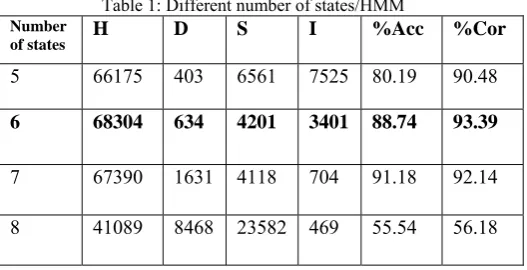
1) The Number of States/HMMs:Once the best
combination of frame width and number of cells per frame is selected using sliding window, the next important parameter to determine if the number of states/HMM. There is no mathematical way to find the best number of states/HMM. In this experiment, the different number of states/HMM are tested, namely: 4, 5, 6, 7, 8 and 10 states/HMM. For simplicity, all HMMs have these same number of states. From Table 1, 6–states/HMM is the best number of states/HMM. It gives the best correction rate = 93.39%.Arial font is used in this experiment for determining the best combination of States/HMM. It is being observed that system performance falls drastically when 8 states or more are used.
2) Cells of different Size and type:To study this
Table 1: Different number of states/HMM Number
of states H D S I %Acc %Cor
5 66175 403 6561 7525 80.19 90.48
6 68304 634 4201 3401 88.74 93.39
7 67390 1631 4118 704 91.18 92.14
8 41089 8468 23582 469 55.54 56.18
Here, there are twotypes of cells: with and without overlap. The overlap between cells is in the vertical direction while the overlap between frames is in the horizontal direction. The overlap operation increases the number of frames (i.e., data) generated from the line image. The disadvantage is that ittakes more time to generate the feature vectors. The
different combination of cell size and type that are used in this approach are as follows:
a) Window without any type of overlap (H0V0). b) Window with one horizontal pixel overlap and one
vertical pixel overlap (H1V1).
c) Window with one horizontal pixel overlap and
three vertical pixels overlaps (H1V3).
d) Window with two horizontal pixels overlaps and
one vertical pixel overlap (H2V1).
e) Window with two horizontal and verticalpixels
overlaps (H2V2.).
[image:5.595.25.575.319.474.2]From the experiment, we note that when the frame width increases the system performance decreases. This is because the use of large frame width leads to a low number of frames and hence low data to HMM model. Further, we also concluded that the system gives optimum performance when frame width is 3with 1 horizontal and 3 vertical overlaps.The Table 2. Below show the performance of each type of overlap when the number of states of HMM is 6.
Table 2: Performance with different overlapping
Frame width Overlap (horizontal vertical)
H D S I N %Acc. %Correction
3 H1V0 9755 103 996 749 10854 82.97 89.87
3 H1V2 9760 96 96 726 10854 83.5 90.20
3 H1V3 13419 126 1092 958 14637 85.13 91.68
4 H2V2 9825 94 935 708 10854 84.00 90.52
3 H2V3 10769 152 3716 3770 14637 47.82 73.57
3) Performance on different Training: In this section,
we studied the effect of the number of training set on the performance of the recognition system. Here we try different training sets consisting of 1500, 2500, 3200 and 4000 text line images. The ‘Andalus’ font with the window size of 3 pixels, 1 horizontal and 3 vertical overlaps (w3_H1V3) are used.Table 3 showed that performance of system increases when the training sets are increased. The highest performance occurs when the system was trained with 3200 line images. It gives a correction rate equal to 92.11% and Accuracy of 85.93%.
Table3: System Performance when different numbers of training samples were used.
Trainin g set
H D S I %Acc %Cor
1500 3917 1645 5292 820 28.53 36.09
2500 13419 126 1092 958 85.13 91.68 3200 13483 128 1126 905 85.93 92.11 4000 13250 126 1261 898 84.00 90.52 4250 9760 96 96 726 83.5 90.20
4) Results on different Fonts: Five different Urdu fonts
were used for recognition and testing (viz. Arial, Tahoma, Akhbar, Naskh, and Andalus).Table4 summarizes the results of Akhbar, Andalus, Naskh and Arial fonts.
Table 4: Summary of results on different fonts (N= 73139)
Font H D S I %Acc %Cr
Akhbar 68300 368 4471 1798 90.93 93.38
Andalus 65238 533 7368 5278 81.98 89.20
Naskh 66704 485 7121 4233 85.41 90.79
Arial 68305 638 4196 3404 88.74 93.39
4.ERRORANALYSIS
Prabjot Singh et al, International Journal of Advanced Research in Computer Science, 9 (1), Jan-Feb 2018,827-833
© 2015-19, IJARCS All Rights Reserved 832
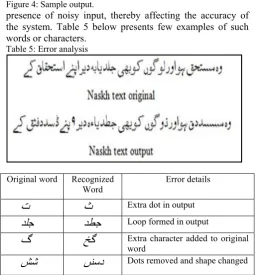
[image:6.595.30.287.101.377.2]system.Wehave seen there are differences in case of the word and more common characters. The placement of single dot canchange the entire meaning. Even dots are increased by the
Figure 4: Sample output.
presence of noisy input, thereby affecting the accuracy of the system. Table 5 below presents few examples of such words or characters.
Table 5: Error analysis
Original word Recognized Word
Error details
ت
ث
Extra dot in outputﺪﻠﺟ
ﺪﻄﺟ
Loop formed in outputگ
ﺦﮔ
Extra character added to original wordﺶﺷ
ﮟﻨﺳد
Dots removed and shape changed5.FUTUREWORKANDCONCLUSION
1. Future Work:
There are many extensions that can be done either to enhance the performance of the system or to make the approach applicable to a wider range of tasks related to Urdu text Recognition. These extensions are as under:
a) Switch to handwritten Urdu script:The
implemented system recognizes typewritten Urdu script. If a data corpus of handwritten Urdu script is built, the training and recognition procedures implemented here will be applied to recognize handwritten script. The only difference will be at the preprocessing stage.
b) Using different types of HMMs:Since the
implemented recognition system uses discrete HMMs because it is a fast system, continuous HMMs or tied-mixture HMMs can be used instead. The use of HTK makes this job very easy because HTK supports all those types.
c) Using new novel features: The statistical features
that were used here gave good results, but new novel statistical features can be used instead to reduce the confusion between different characters.
d) Using degraded and noisy data:Instead of using
printed pages, we plan to test the system using noisy data such as fax and nth-generation photocopies.
e) Multi-language system: Since the implemented
system is segmentation-free, this system can be extended to recognize other language words inside the Urdu text.
2. Conclusion:
In our work, we addressed the problem of automatic reading of Urdu typewritten script. Urdu script presents important challenges such as cursiveness and the Urdu characters are
context sensitive to their location within the word. The segmentation of Urdu words into characters is a hard job and always is a point of failure in the segmentation-based systems. We proposed a segmentation-free system to improve the recognition performance especially when the Urdu words are not easily separable.
The central model of the proposed system is the hidden Markov models. Each character, with its different shapes and from, was represented by a distinct HMM. The system was built on Hidden Markov Models Toolkit (HTK) which had been designed primarily for speech recognition research.
The system presented in this paper is the Urdu OCR system built on the HTK. The preprocessing and feature extraction were performed outside the HTK while the training and recognition procedures were performed inside HTK. The implemented system is a lexicon-free system. It can handle unlimited Urdu vocabularies since the system works on the character level. The output of the recognizer is a sequence of characters (Unicode).
In order to use HMMs, the horizontal position at the line image was assumed to be the independent variable to extract the statistical features. Each line image was scanned from right-to-left with a narrow vertical window which was divided horizontally into eight cells and at each horizontal position; simple statistical features were computed from pixels falling within that window. These features are then injected into the HTK for training.
The System is trained with 4250 lines from the data corpus and tested with 150 images randomly chosen from data corpus. The system showed the correctness of 92.11% and Accuracy of 85.93% when experimented with Andalus Font. Experimental results showed the dependence of system performance on the number of states per HMM. We also observed that the performance increases when it is trained with more data. But increasing the test cases does not affect the system performance.
REFERENCES
[1] Khorsheed, Mohammad S. "Offline recognition of omnifont Arabic text using the HMM ToolKit (HTK)." Pattern Recognition Letters 28.12 (2007): 1563-1571.
[2] AL-MUHTASEB, H.A., MAHMOUD, S.A. and QAHWAJI, R.S., 2008. “Recognition of off-line printed Arabic text using Hidden Markov Models.” Signal Processing, Elsevier (12), pp. 2902-2912, 2008.
[3] Lehal, Gurpreet S. "A Complete Machine-Printed Gurmukhi OCR System." In Guide to OCR for Indic Scripts, pp. 43-71. Springer, London, 2009.
[4] Khorsheed, Mohammad S."Recognising handwritten Arabic manuscripts using a single hidden Markov model." Pattern Recognition Letters 24.14 , 2235-2242. (2003).
[5] Nefian, A. V., & Hayes, M. H. (1998, May). Hidden Markov models for face recognition. In Acoustics, Speech and Signal Processing, 1998. Proceedings of the 1998 IEEE International Conference on (Vol. 5, pp. 2721-2724). IEEE.
[6] Bazzi, Issam, Richard Schwartz, and John Makhoul. "An omnifont open-vocabulary OCR system for English and Arabic." Pattern Analysis and Machine Intelligence, IEEE Transactions on 21.6 (1999): 495-504.
[8] Forney GD. The viterbi algorithm. Proceedings of the IEEE. 1973 Mar;61(3):268-78.
[9] Baggenstoss, Paul M. "A modified Baum-Welch algorithm for hidden Markov models with multiple observation spaces." IEEE Transactions on speech and audio processing 9, no. 4 (2001): 411-416.