Volume 5, No. 7, September-October 2014
International Journal of Advanced Research in Computer Science
RESEARCH PAPER
Available Online at www.ijarcs.info
ISSN No. 0976-5697
Detection of Connectivity Disruption in Wsn using Edcd Method
T.Selva Priya1, N.Sudha2Research scholar1, Asst.Professor2 Dept.of Computer Science
Bishop Appasamy College of arts and science Coimbatore.TamilNadu India
Abstract- Wireless sensor Networks (WSNs) typically suffer from noncontiguous property caused by its varied aspects like restricted battery power of a node and unattended operation vulnerable to hostile meddling. This property ends up in unknown route selec tion, waste of resources and loss of knowledge. Wireless Sensor network will get splitted into multiple connected parts in line for the crash of a number of its nodes that is referred as a “cut”. Complications like unfit for dynamic network re -arrangement, Single path routing technique occur in existing state of affairs. In this paper, EDCD method is proposed as the solution for cut detection problem in destination-node, in which cuts are identified based on a given set of destinations. Here cut detection procedures are introduce d for WSN applications and then expand the number of target destinations and proposed the Enhanced Distributed Cut Detection.
Keywords- Wireless Sensor networks, cut detection, EDCD, DSSD, MINCUT, internet protocol
I. INTRODUCTION
Wireless Sensor Networks (WSNs) typically suffer from noncontiguous property caused by its varied aspects like restricted battery power of a node and unattended operation vulnerable to hostile meddling. The disruption of property, typically remarked as network cut, ends up in ill-informed routing choices, data loss, and waste of energy. Variety of protocols is planned to expeditiously sight network cuts; they focus only on a cut that disconnects nodes from the bottom station. However, a cut detection theme is actually helpful once a cut is outlined with reference to multiple destinations instead of one base station. Thus, we tend to extend the prevailing notion of cut detection, associated propose an algorithmic rule that allows device nodes to autonomously monitor the property to multiple target nodes. we tend to introduce a unique reactive cut detection answer, the Point-to-Point Cut Detection, wherever given any combine of supply and destination, a supply is ready to regionally verify whether or not the destination is approachable or not.
A wireless Sensor network will get separated into multiple connected parts attributable to the failure of a number of its nodes that is termed a “cut”. We tend to propose associate algorithmic rule that enables (i) each node to sight once the property to a specially selected node has been lost, and (ii) one or a lot of nodes to sight the incidence of the cut. The algorithmic rule is distributed and asynchronous: each node must communicate with solely those nodes that are at intervals its communication varies. The algorithmic rule relies on the reiterative computation of a fictitious “electrical potential” of the nodes. The convergence rate of the underlying reiterative theme is freelance of the scale and structure of the network.
The drawback of their cut detection algorithm is square measure that they see solely the direct cuts, that unable to find willy-nilly formed failure. Furthermore the algorithmic program could be a centralized method that desires international ranked information. It additionally addresses
the complications of existing cut detection ways. The Distributed supply Separation Detection technique is absolutely distributed and detects willy-nilly formed cuts.
The problem of network partitioning in WSN is not entirely new although to this point has received restricted attention [1]. In [2] propose ways to self-configuring WSNs topologies. Though they mention the matter of network partitions as a very important one, however, they leave such ways to future work. Finally, [1] propose an occasional overhead theme to find network partitioning, “cuts” in their idiom, however they are doing not propose any technique to repair them [1]. With relevance the tunnel situation, we have a tendency to propose a technique that uses autonomous mobile nodes. Once the bottom station determines the network partitioning, One or lot of mobile nodes square measure sent within the tunnel. A mobile node is supplied with a radio transmitter receiver in order to communicate with the detector nodes. Moreover, it maintains property with the bottom station through the wireless detector network. By reasoning upon the degree of property with neighbors, a mobile node navigates within the tunnel till it reaches the best position to re-establish property.
II. LITERATURE REVIEW
between two dissimilar outcomes of a cut for a particular node.
Cut is deliberately created in an exceedingly adverse atmosphere, and nodes should realize them. The cut detection drawback was first measured in an exceedingly certain network. The construct of cut was introduced, that is referred as a network partition of nodes, that aims to cut back the quantity of sentinels supported the hypothesis that in device networks, direct-shaped cuts area unit a lot of doable to occur, instead than the cut with freelance edge disconnects.
The drawbacks of the cut detection algorithmic program area unit that they appreciate solely the direct cuts, that unable to sight indiscriminately formed failure. Furthermore the algorithmic program may be a centralized. It conjointly addresses the complications of existing cut detection ways. The Distributed supply Separation Detection methodology is totally distributed and detects indiscriminately formed cuts.
WSN extremely depends on the energy consumption of sensors. just like the different wireless networks, the position of sensing element nodes has nice impact on the performance of WSNs in terms of coverage, communication price, network„s period of time and resource management, owing to the randomness of sensors preparation, there would possibly exist some nodes connecting two or a lot of partitions with none backup nodes. This causes a delay of message propagation between the partitions. it would conjointly cause a message loss and within the case once one in every of the nodes dies out, the complete network are divided. These nodes square measure referred to as bottleneck nodes, and it's necessary to find the Network cuts so as to forestall network partitioning or message transmission delay, that may cause retransmission of messages within the future. A lot of formal definition of bottleneck is found [3].
Objective is a way to save and balance the energy consumption to prolong the time period of the full network. Therefore the connected work for alternative networks might not be suited to WSNs.Here several existing system, survey two of the most recent net bottlenecks detection tools[4]-[7] and that we will conclude with the distributed device network bottleneck detection rule DBND [8].
Graph property is one in all the classical subjects in graph theory and has several sensible applications in chip, Finding the minimum cut of a footing weighted graph may be an elementary algorithmically downside exactly it consists to find a nontrivial partition of the graphs vertex set V into two components such the total of the weights of the perimeters connecting the two components is minimum. [4]The Max-Flow-Min-Cut-Theorem by Ford and Fulker Son FF showed the duality of the utmost flow.They need to completely different components of the partition till recently all cut algorithms were basically flow algorithms.
[4]The maximum flow drawback is intimately associated with the minimum cut drawback. A cut is hymenopterans insect set of directed arcs containing a minimum of one arc in each path from the origin node to the destination node. In different words, if the arcs within the cut area unit removed then be due the origin to the destination is totally interrupted. The cut worth is that the total of the flow capacities within the origin-to-destination direction over all of the arcs within the cut. The minimum cut drawback is to search out the cut that has the minimum
cut worth over all doable cuts within the network. so as to search out the minimum cut we are going to create use of the max-flow / min-cut theorem.For any network having one origin node and one destination node, the most doable be due origin to destination equals cut worth for all cuts within the network. To know the relation between the max-flow and also the minimum cut we are able to see that the most flow through a series of connected pipes equals the most flow within the smallest pipe within the series, i.e. the flow is proscribed by the bottleneck pipe. The minimum cut is simply a sort of distributed bottleneck, a bottleneck for a full network as against astraightforward bottleneck for a series of pipes called MINCUT was proposed by [7]. In MINCUT algorithm, the course of execution can be divided into two phases: (a) Global information collection. All the nodes in the network have to broadcast their position information to sink node, this course can be as messages flooding. (b) After getting the global information, the sink node will compute and find the bottleneck node using MINCUT algorithm.
Path neck is a vigorous inquisitor tool given by [3] that permits finish users to expeditiously and accurately find the bottleneck link on a web path. Path neck is predicated on a completely unique inquisitor technique known as Recursive Packet Train (RPT), which mixes load and measure packets. The load packets square measure UDP packets that square measure wont to act with background traffic and to get obtainable information measure information.
Wireless Sensor Networks (WSN) have emerged as a crucial new technology for incrementing and observant the physical world. The fundamental building block of those networks could be a small chip integrated with one or additional MEMS sensors, actuators, and a wireless transceiver. These devices will be embedded or scattered in massive quantities in an exceedingly physical house, wherever they self-organize into an advertisement hoc multi-hop wireless network, permitting US to watch associated monitor the globe at an unprecedented special and temporal resolution. a fashionable sort of scientific, commercial, and military applications [9], [10], [11], [12] has been projected for device networks.
III. ENHANCED DISTRIBUTED CUT DETECTION
In this paper, we tend to plan a distributed rule to seek out cuts, named the Enhanced Distributed Cut Detection (EDCD) rule. The rule permits every node and sub nodes to notice the cuts occurred. The rule here planned is distributed and scattered that takes in communication between adjacent nodes, and is tough to short or acting affiliation failure between nods. a serious issue of the EDCD rule may be a distributed relevant to evolution step through that the nodes compute their potentials. Thesensing element network is at the start and therefore the communication between the sensing element nodes is bidirectional. Some sensing element nodes might fail or be blocked owing to lack of power, have physical harm or environmental interference. The failure of sensing element nodes shouldn't have an effect on the general task of the sensing element network. This is often the fault tolerance issue. Fault tolerance is that the ability to sustain sensing element network functionalities with none interruption owing to sensing element.
An Enhanced Distributed Cut Detection (EDCD) is provided that places stress on the amount of messages sent throughout that method. This section can handle the bestowed answer and discuss intimately the various method, beginning with the network inner and outer boundaries detection and listing, continues with finding the medial axis and concludes with network cut detection in keeping with the sensing element network characteristics.
The supply node detects cuts by management whether or not it will acquire messages from the sentinels. In distinction to the rule within the EDCD rule planned during this paper isn't restricted to linear cuts; it will notice cuts that divide the network into multiple parts of random shapes.
A. Various routes:
The first criterion in wireless medium is to get the out there routes and establish them before sending. To grasp this higher allow us to cross-check the instance below. The below design consists of eleven nodes within which two being supply and destination others are going to be used for knowledge transmission. The choice of path for knowledge transmission is completed supported the provision of the nodes within the region victimization the ad-hoc on demand distance vector routing rule. By victimization the EDCD, the routes square measure created on demand, i.e. only if a route is required that there is no “fresh” record within the routing table. So as to facilitate determination of the freshness of routing data, EDCD maintains the time since once associate entry has been last utilized. A routing table entry is “expired” when a precise preset threshold of your time. Think about all the nodes to be within the position.
When a node u is disconnected from the supply, it's assumed that it's disconnected from supply node. The planned technique permits every node to find disconnected or separated node as a result of cut. The nodes use the computer analysis to find if cut have occurred. The approach here is to take advantage of the very fact that if the state is near zero then the node is disconnected from the supply, otherwise not. So as to scale back sensitivity of the rule to variations in network size and structure, we tend to use a normalized state. DOS detection half consists of steady-state detection, normalized state computation, and
connection/separation detection. A node keeps track of the positive steady states seen within the past victimization the subsequent technique.
a. EDCD algorithm:
It includes 3 stages as explained below:
Start purpose = 50%; success = 0; cutoff = 100 percent EDCD := S;
Repeat If (EDCD) >= start point then B := EDCD;
Let A be near of B that minimizes
pc(B,A) = power-cost(B,EDCD) + v(s)f„(EDCD); Send message to EDCD;
success = 1;
Until EDCD = D (* Destination reached *) or if success <> one then
if threshold > cutoff then threshold = threshold /2;
or EDCD = B ( * Delivery unsuccessful *);
Node formatting includes formatting of real time parameters related to every node like distance,
c. Broadcasting: The communication vary of every
node, neighbor node detection and change of every node with its nearest neighbor are done. Transmit by selecting completely different sources and destination node so as to make the routing table and select routing within the shortest attainable path.
Figure.1 Route control
B. Advantage of proposed algorithm:
Even though the planned algorithmic program is repetitive and involves solely nearest neighbor communication, the convergence rate of the algorithmic program is kind of quick and is freelance of the dimensions of the network.
The assumptions area unit that the supply node never fails, the detector network is at first connected, and therefore the communication between the detector nodes is two-way. The failure of detector nodes should not have an effect on the general task of the detector network. This is often the reliableness or fault tolerance issue.
C. Implementation:
We describe the code implementation and analysis of the DCD algorithmic rule. In code the algorithmic rule was enforced victimization the Dot Net language running on windows XP software package. The system executes in 2 sections: the Reliable Neighbor Discovery (RND) section and also the DCD algorithmic rule phase. Within the RND section every node is connected to the supply node. Upon receiving the message, the molecule updates the amount of beacons received from that specific sender.
To determine whether or not a communication on link is established, every molecule 1st computes for its neighbors the Packet Reception magnitude Relation (PRR). Once receiving state data from neighbors, a node updates its state in step with [2] in associate asynchronous manner and broadcasts its new state. The state is keep within the information.
The EDCD formula we have a tendency to propose here allows each node of a wireless sensor network to notice disconnection from supply nodes if they occur and it allows a sub nodes that have connected, however to notice the prevalence of cut and assess the calculable spot of the cut within the sort of a listing of vigorous nodes that exists at the boundary of the cut/ failure.
Figure.2 data sending using WSN
Fig.2 describes that nodes are selected during the communication. If any cuts occurred during the communication that cuts are detected and separated then the information is passed through the destination by a sensor networks.
Numerical simulations, also an experimental analysis on a true WSN system consisting of nodes, show that the formula works effectively with giant categories of graphs of varied size and arrangement, while not exacting changes within the limits. Sure state of affairs, the formula is ensured to seek out communication and disconnection to the supply node while not bug. An important strength of the EDCD formula is that the convergence rate of the underlying repetitive theme is fast and self-sufficing or autonomous of the dimensions and network arrangement that identifies simply and quickly. If an element that's separated due to a cut gets once more connected later, the nodes will notice such reconnection from their things.
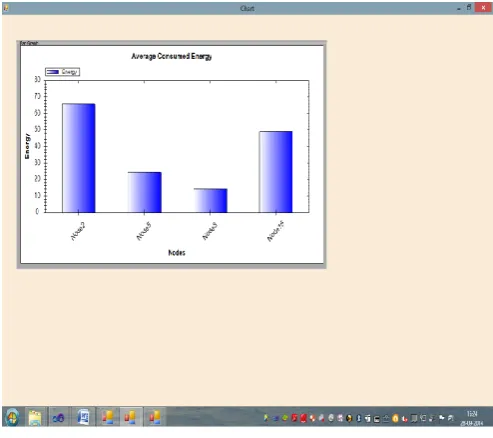
Fig.3 describes the time display how the messages are passed one node to another the energy level (time) is calculated.
Table1.Accuracy and error calculation:
S.no Metric Accuracy Error rate
1 DSSD
Algorithm
92.5 0.321
2 EDCD
Algorithm
96.5 0.235
From the table1- shows that the comaprison of the accuracy and error calulation from existing system and proposed system.
IV. CONCLUSION AND FUTURE WORK
In this paper, EDCD method is proposed as the solution for cut detection problem in destination-node, in which cuts are identified based on a given set of destinations. In EDCD the source node is able to determine if any destination node is accessible or not. In future research, planned to develop a EDCD that does not rely on nodes locations which enables us to employ other types of routing protocols than location based and also discover node disconnect and reconnection to the source node in mobile networks. Future work might include committing simulations and experiments in the real world with a large number of sensors, in order to examine the accuracy of the medial axis discovery and the bottleneck detection suggested in this article. Furthermore, new mathematical models can be suggested and investigated upon given the medial axis and network boundaries to better address the problem.
V. REFERENCES
[1]. Shrivastava, N., Suri, S., T´oth, C.D.: Detecting cuts in sensor networks. In: IPSN,pp. 210–217. IEEE, Los Alamitos (2005
[2]. A. Cerpa and D. Estrin.ASCENT: Adaptive Self-Configuring sEnsor Networks Topologies. IEEE Transactions on Mobile Computing, 3, 2004
[3]. N. Hu, L. E. Li, Z. M. Mao, P. Steenkiste, and J. Wang. Locating internet bottlenecks: Algorithms, measurements, and implications.In Proc. ACM SIGCOMM, August 2004
[4]. LR_ Ford ,DRFulkerson Maximal flow through a network Canadian Journal on mathematics]
[5]. A. Akella, S. Seshan, and A. Shaikh, An Empirical Evaluation of Wide-Area Internet Bottlenecks, in IMC, 2003.
[6]. F. Zhao, J. Liu, J. Liu, L. Guibas and J. Reich.Collaborative signal and information processing: An information directed approach.Proc. of the IEEE, 2003
[7]. MechthildStoer, Frank Wagner, A Simple Min-Cut Algorithm, Journal of the ACM, Vol. 44, No. 4, July 1997, pp. 585–591.
[8]. Haosong Gou, YounghwanYoo, Distributed Bottleneck Node Detection in Wireless Sensor Network. 10th IEEE International Conference on Computer and Information Technology (CIT 2010).Busan, Korea, 2010.
[9]. D. Culler, D. Estrin and M. Srivastava. Overview of Sensor Networks.IEEE Computer, 41–49, 2004.
[10]. D. Estrin, R. Govindan, J. Heidemann, and S. Kumar. Next century challenges: Scalable coordination in sensor networks.Proc. of 5th Annual Mobicom, ACM, 1999.
[11]. G. J. Pottie and W. J. Kaiser.Wireless integreated network sensors. Communications of the ACM 43, 51–58, 2000.