Volume 5, No. 2, March 2014 (Special Issue)
International Journal of Advanced Research in Computer Science
RESEARCH PAPER
Available Online at www.ijarcs.info
© 2010-14, IJARCS All Rights Reserved CONFERENCE PAPER 21
Two day National Conference on Advanced Trends and Challenges in Computer Science and Applications
Organized by: Shree Vishnu Engineering College for Women, Bhimavaram A.P.
A Survey and Analysis of the Properties of various Interconnection Networks
K. Karthik Associate Professor CSE Department BVRIT, Narsapur
Dr. Sudarson Jena Associate Professor
IT Department Gitam University, Hyderabad [email protected]
Dr. T. Venu Gopal Associate Professor
CSE Department JNTUHCEJ, Kondagattu [email protected]
Abstract: In this paper, different types of interconnection networks are investigated and some of their properties are analyzed to summarize the differences in their network cost. The various properties of the interconnection networks such as connectivity, routing algorithm, diameter and broadcasting technology are investigated. This analysis gives a framework for the construction of more efficient interconnection networks in future.
Key words- Interconnection networks, network cost, routing algorithms, broadcasting technology
I. INTRODUTION
In Parallel computing, to achieve parallelism various techniques can be employed. One technique of achieving parallelism is using MIMD (Multiple Instruction Multiple Data stream). Machines using MIMD have a number of processor that functions At any time, different processors may be executing different instructions on different pieces of data. MIMD architectures may be used in a number of application areas such
as
or based on how MIMD processors access memory. Shared memory machines may be of the or have
An interconnection network system which can be used to link multicomputer processors together greatly influences performance and scalability of the whole system. Based on the number of nodes, Interconnection networks are classified into meshes (n×k), hypercube (2n) and star (n!), and network scales to evaluate interconnection networks are degree, connectivity, scalability, diameter, network cost [4-10].
In an interconnection network, degree related to hardware cost and diameter related to message passing time is correlated with each other. In general, as degree of an interconnection network is increased, diameter is decreased, which can increase throughput in the interconnection network, however, it increases hardware cost with the increased number of pins of the processor when a parallel computer is designed. An interconnection network with less degree reduces hardware cost but increases message passing time, which adversely affects latency or throughput of an
interconnection network. Network scales being typically used for comparative evaluation of an interconnection network due to the said characteristic include network cost [4-10] defined as degree x diameter of an interconnection network. By virtue of its merit of easily providing a communication network system required in applications of all kinds. Hypercube is node-symmetric and edge-symmetric, has a simple routing algorithm with maximal fault tolerance and a simple reflexive system, and also has a merit that it may be readily embedded with the proposed interconnection networks [11,12]. However, it involves weak points that network cost increases due to increase of degree with the increased number of nodes, and that a mean distance between diameter and node is not short as compared with degree.
To improve such weak points, Reduced Hypercube[13] that reduced the number of edges of a hypercube interconnection network, Gaussian Hypercube[14], and Exchanged Hypercube[15] have been suggested, and in addition, Crossed Cube[5] that improved diameter of a hypercube interconnection network, Folded Hypercube[6], MRH[7], HFN[4], MRH[1] etc. have been proposed. Many interconnection networks that have been proposed until now demonstrated that they have superior network cost to hypercube by reducing just one network scale of degree or diameter of hypercube. Also, this paper demonstrates that network cost of MRH (n) is superior through comparative analysis of network cost between the hypercube-class interconnection networks and MRH (n).
II. TYPES OF INTERCONNECTION NETWORKS
We have different types of interconnection networks. Some of them are given below:
a. Hypercube Network. b. Folded Hypercube Network.
c. Multiply Twisted Hypercube Network. d. Recursive Circulant Hypercube Network. e. Multiple Reduced Hypercube Network.
A. Hypercube Network:
four processors; a processor and a memory module are placed at each vertex of a square. The diameter of the system is the minimum number of steps it takes for one processor to send a message to the other processor that is the farthest away. So, for example, the diameter of a 2-cube is 1. In a hypercube system with eight processors and each processor and memory module being placed in the vertex of a cube, the diameter is 3. In general, a system that contains 2^N processors with each processor directly connected to N other processors, the diameter of the system is N. One disadvantage of a hypercube system is that it must be configured in powers of two, so a machine must be built that could potentially have many more processors than is really needed for the application.
Dimension –2: If one moves this line segment its length in
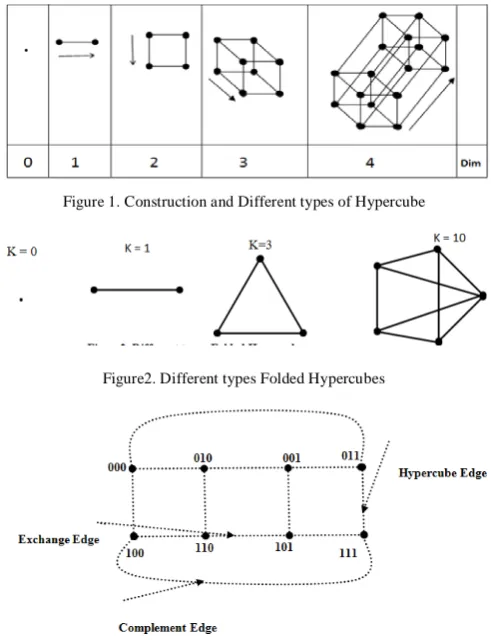
Construction and different types of Hypercube are shown in Figure 1 [1].
Figure 1 shows below how to create a tesseract from a point.
Dimension – 0: A point is a hypercube of dimension zero.
Dimension –1: If one moves this point one unit length, it will sweep out a line segment, which is a unit hypercube of dimension one.
dimensional square.
Dimension – 3: If one moves the square one unit length in the direction perpendicular to the plane it lies on, it will generate a 3-dimensional cube.
Dimension – 4: If one moves the cube one unit length into the fourth dimension, it generates a 4-dimensional unit hypercube (a unit
This can be generalized to any number of dimensions. This process of sweeping out volumes can be formalized
mathematically asd-dimensional
hypercube is the Minkowski sum of d mutually perpendicular unit-length line segments, and is therefore an example of a a
In H(n), for degree ‘n’ and if number of nodes is ‘n’, diameter ‘n’, and network cost will be ‘n2
B. Folded Hypercube Network:
’.
Folded Hypercube is an connects opposite pairs of hypercube vertices. The folded cube graph of order k (containing 2k− 1 vertices) may be formed by adding edges between opposite pairs of vertices in a hypercube graph of order k− 1. (In a hypercube with 2n
vertices, a pair of vertices are opposite if the shortest path between them has length n.) It can, equivalently, be formed
from a hypercube graph (also) of order k, which has twice as
many vertices, by
opposite pair of vertices. An order-k folded cube graph is k k− 1 vertices and 2k− 2k edges. Th k folded cube graph is two when k is even (that is, in this case, the graph is
when k is odd. The
k, so for odd k greater than three the folded cube graphs provide a class number four and arbitrarily large odd girth. As a
k and diameter (k− 1)/2, the
folded cubes of odd order are examples of
k is odd, the
order-k folded cube is the order-k cube from which it was formed.
When k is even, the order-k cube is a
Construction of Folded Hypercube is shown in Fig. 2. not the bipartite double cover. In this case, the folded cube is itself already their hypercube sub-graphs the property of having a cover them the property of being a When k is odd, the order-k folded cube contains as a
sub-graph ak
C. Multiply Twisted Cube Network:
− 1 nodes. However, when k is even, this is not possible, because in this case the folded cube is a bipartite graph with equal numbers of vertices on each side of the bipartition, very different from the nearly two-to-one ratio for the bipartition of a complete binary tree.
An n -dimensional multiply-twisted hypercube Qn has
the same structural complexity as n-dimensional hypercube Q. That is, it has the same number of nodes and links, and each node has the same degree n, as Qn
An n -dimensional multiply twisted cubehas the same structural complexity as n -dimensional hypercube. That is they have the same number of nodes and links, and each node has the same degree n. However, previous investigations indicate that the multiply-twisted hypercube has some properties better than that of hypercube. The multiply-twisted hypercube is recursively defined, and it has a relative structure. It has observed that the diameter of Q is [n+1]/2 which is about half of the diameter n of the n-dimensional hypercube Q. In addition, the average distance between nodes in Q is about 3/4 of the average distance between nodes in Q. In conjunction with the regularity, these properties can be used to design simple data communication algorithms for Q
. However, previous investigations indicate that due to some of its properties better than hypercube, the multiply-twisted hypercube is a good alternative for constructing multiprocessor systems. It is known that hypercube machines can simulate many multiprocessor systems based on other topologies such as trees, meshes, linear arrays and rings.
n that are more efficient than those for conventional hypercube Q. It is known that the dimensional hypercube can be embedded onto the n-dimensional hypercube, and vice-versa, with dilation and congestion. Also, many efficient hypercube algorithms can be directly modified to fit the twisted-hypercube without simulations by embedding so that undesirable overheads in such simulations can be avoided. It has been conjectured that the (2" -1)-node complete binary tree is a sub-graph of
nodes); but this is not true for the n dimensional hypercube. Since there is more and more evidence that multiply-twisted hypercube is a good alternative for the hypercube, it is important to further investigate the combinatorial structure and computational aspect of this architecture [1].
D. Recursive Circulant Hypercube Network:
Recursive Circulant Hypercube Network considered in this paper is the recursive circulant graph G(N, d) proposed by Park and Chwa [19 ]\Definition: For two positive integers N and d, the recursive circulant graph G(N, d) has the vertex set V = {0, 1, . . .,N − 1}, and two vertices u and v are adjacent if and only if u−v =±di (mod N) for some 0≤i≤[logd N]-1. The family of recursive circulant graphs is
proposed as a network topology for multicomputer systems [17]. Recursive circulant graph G(N, d) is known to have a recursive structure for N = dm, m≥1 and N = cdm, 2 ≤ c < d, m≥ 0 [18]. induced by vertices {v | v ≡ j (mod d)}. Then, for very 0 ≤j < d, Gj (cdm , d) is isomorphic to G(cdm-1 , d), that
is, G(cdm, d) contains d disjoint copies of (cdm-1, d). Furthermore, the edges not contained in any Gj form a
Hamiltonian cycle. We call the Hamiltonian cycle with the edges of the form {i, i + 1}, i = 0, 1, . cdm-1, the basic cycle.
Hence, G(cdm, d) is constructed recursively from d copies of G(cdm-1, d) and the basic cycle. G(cd0, d), c≥3, and G(d, d) are isomorphic to the cycle of length c and d, respectively. For c = 2, G(2d0, d) is K2. Cycles in networks are useful in applications such as embedding linear arrays and rings. We call a graph G with n vertices pancyclic if G contains cycles of every length k, 3≤k≤n. Since bipartite graphs have no odd cycles, a bipartite graph G is called bipancyclic if G has cycles of every even length. It is easy to see that n-dimensional hypercube is bipancyclic for n≥2. Pancyclic properties on cube-connected cycles, arrangement graphs and butterfly graphs have been investigated. It is known that G(2m, 4), a special case of recursive circulant graphs, is pancyclic [18]. We study in this paper the existence of cycles of given length in G(cdm, d), and prove a necessary and sufficient condition for G(cdm
E. Multiple Reduced Hypercube Network:
, d) to be pancyclic or bipancyclic [19].
According to [1], the nodes of a Multiple Reduced Hypercube MRH(n) are expressed as n bit strings sn s n-1...si...s2 s1 consisting of binary numbers {0,1} (1≤i≤n). The
edges of MRH(n) are expressed in three forms according to connection method, they are called hypercube edge, exchange edge, and complement edge, respectively, and are indicated as h-edge, x-edge, and c-edge, respectively ([n / 2]+1≤h≤n). Each edge is defined into when n is an even number and n is an odd number.
Case 1: When n is an even number, it is assumed that for edge definition, sn sn-1 ...si+1 is α and a bit string si ...s2
s1 is β in the bit string of a node U(=sn sn-1 ..si ...s2 s1).
Therefore the bit string of a node U(=sn sn-1 ..si ...s2 s1
a. Hypercube edge : This edge indicates an edge linking two nodes U(=s
) can be simply expressed as αβ. Assuming that the nodes U and V are adjacent with each other, adjacent edges are as follows.
n sn-1 ..si ...s2 s1) and V(=sn sn-1
...si+1 si ...s2 s1
b. Exchange edge : This edge indicates an edge linking two nodes U(=αβ ) and V(=βα) of MRH(n) if α≠β in the bit string of the nodes.
) of MRH(n) (n/2≤j≤n).
c. Complement edge : This edge indicates an edge linking two nodes U(=sn α'β') and V(=sn
Case 2: When n is an odd number. It is assumed that for edge definition, s
α'β' ) of MRH(n) if α≠β in the bit string of the nodes.
n-1...si+1 is α’ and a bit string si...s2 s1 is β’
in the bit string of a node U(=sn sn-1...si...s2 s1). Then the
number of bit strings of α’ and β’ is eachn / 2. Therefore a node U can be indicated as U (=sn
a. Hypercube edge: This edge indicates an edge linking two nodes U (=snsn-1....sj...si+1si...s2s1) and V(=s
α'β')
n
sn-1... sj ....si+1 si...s2 s1
b. Exchange edge: This edge indicates an edge linking two nodes U(=s
) of MRH(n)
n α'β') and V(=sn
c. Complement edge: This edge indicates an edge linking two nodes U(=s
β’α’) of MRH(n) in the bit string of a node.
n α'β') and V(=sn
Node (edge) connectivity is the least number of nodes (edges) that are required to be eliminated to divide an interconnection network into two or more parts without common nodes. Even if k-1 or less nodes are eliminated from a given interconnection network, an interconnection network is linked, and once the interconnection network is separated when proper k nodes are eliminated, connectivity of the interconnection network is called k. An interconnection network having the same node connectivity and degree means that it has maximal fault tolerance [2]. It is known that node connectivity, edge connectivity, and degree of an interconnection network G are called k(G),
λ(G), and d(G), respectively, and k(G)=λ(G)=d(G) [2]. This paper demonstrates that node connectivity and degree of MRH(n) are same in order to prove that MRH(n) has maximal fault tolerance, and based on the result, MRH(n) has maximal fault tolerance.
α'β') of MRH(n) if
α'= β' in the bit string of a node.
Figure 1. Construction and Different types of Hypercube
Figure2. Different types Folded Hypercubes
III. ANALYSIS OF PROPERTIES OF INTERCONNECTION NETWORKS:
Assuming that in MRH(n), a certain node of the initial node U(=unun-1....uj...ui+1ui...u2u1
IV. RESULTS AND DISCUSSIONS
) is having the same node connectivity and degree [1]. It means that it has maximal fault tolerance [2]. It is known that node connectivity, edge connectivity, and degree of an interconnection network G are called k(G), λ(G), and d(G), respectively, and k(G)=λ(G)=d(G)[1]. In paper [1], it is considered that node connectivity and degree of MRH(n) are same in order to prove that MRH(n) has maximal fault tolerance, and based on the result of the theorem, it is proved that MRH(n) has maximal fault tolerance.
Network cost is indicated by a multiple of diameter and degree. Diameter indicates a maximum distance of the shortest route linking two nodes.
Table1. Hypercube variants vs Modified Hypercubes Interconnection Network Diameter and Network Costs
Interconnection Network Node
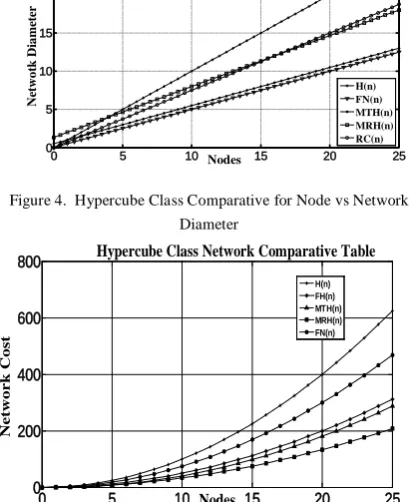
MRH(n) gives best performance then other networks, which can be an effective reference to measure message passing as a lower limit of latency required to disseminate information in the whole interconnection network.
Hypercube class network comparative gives better analy
Figure 5. Hypercube Class Comparative for Node vs Network Cost
In the above figures 4 & 5, it gives the analysis for network cots and network diameter interconnection network as a factor to determine the complexity of routing control logic, which is a reference to measure the cost of hardware used to implement an interconnection network and degree is the number of pins composing the processor when a parallel computer is designed with a Therefore network cost is the most critical factor to measure an interconnection network.
MRH(n) based on the results of previous studies is suitable for implementation of a large scale system for parallel processing, it is proven to be superior to the previously proposed hypercube classes of Hypercube H(n), Folded Hypercube FH(n), Multiply twisted Cube, and Recursive Circulant class in terms of network cost as mentioned in above discussion and Table 1. For analysis of network cost for an interconnection network, cases of the same number of nodes are compared.
V. CONCLUSION
In this paper, different types of interconnection networks such as Hypercube H(n), Folded Hypercube FH(n), Multiply twisted Cube, and Recursive Circulant are investigated and some of their properties are analyzed to summarize the differences in their network cost. It has been observed that MRH(n) is a more superior interconnection network than the other mentioned hypercube networks through comparative analysis of network cost if hypercube classes have the same number of nodes. MRH(n) is a more superior interconnection network through comparative analysis of network cost if hypercube classes have the same number of nodes.
VI. REFERENCES
[1]. N S Murthy Sharma, Karthik kovuri, komira Yakaiah, B Srinivas: Analysis of multiple reduced hypercube interconnection network properties of both diameter and network cost. International Journal of Computer Applications in Engineering, Technology and Sciences.
[2]. Akers, S. B., Krishnamurthy, B.: A Group-Theoretic Model for Symmertric Interconnection Network. IEEE. Trans. Computers 38(4), 555{565 (1989)
[3]. Doty, K. W.: New Designs for Dense Processor Interconnection Networks. IEEE.Trans. Computers 33(5), 447{450 (1984)
[4]. Duh, D. R., Chen, G. H., Fang, J. F.: Algorithms and Properties of a New Two-Level Network with Folded Hypercubes as Basic Modules. IEEE. Trans. Parallel Distributed syst. 6(7), 714{723 (1995)
[5]. El-Amawy, A., Lati¯, S.: Properties and Performance of Folded Hypercubes. IEEE.Trans. Parallel Distributed syst. 2(1), 31{42 (1991)
[6]. Feng, T.-Y.: A Survey of Interconnection Networks. IEEE. Trans. Computers14(12), 12{27 (1981)
[7]. Ghose, K., Desai, K. R.: Hierarchical Cubic Networks. IEEE. Trans. Parallel Distributed syst. 6(4), 427{436 (1995)
[8]. Gupta, A. K., Hambrusch, S. E.: Multiple Network Embeddings into Hypercubes.J. Parallel and Distributed Computing 19, 73{82 (1993)
0 5 10 15 20 25
0 200 400 600
800 Hypercube Class Network Comparative Table
Nodes
Figure 4. Hypercube Class Comparative for Node vs Network Diameter
25 Hypercube Class Network Comparative Table
[9]. Harary, F., Hayes, J. P., Wu, H.-J.: A Survey of the Theory of Hypercube Graphs.Comput. Math. Appl. 15,
[10]. Leighton, F. T.: Introduction to Parallel Algorithms and Architectures: Arrays,Trees, Hypercubes. Morgan Kaufmann, San Francisco (1992)
[11]. Mendia, V. E., Sarkar, D.: Optimal Broadcasting on the Star Graph. IEEE. Trans.Parallel Distributed syst. 3(4), 389{396 (1992)
[12]. Park, J.-H.: Circulant Graphs and Their Application to Communication Networks.Ph.D. Thesis, Dept. of Computer Science, KAIST, Taejon Korea (1992)
[13]. Reed, D. A., Fujimoth, R. M.: Multicomputer Networks: Message-Based Parallel Processing. MIT Press (1987)
[14]. Vaidya, A. S., Rao, P. S. N., Shankar, S. R.: A Class of Hypercube-like Networks. In: Proc. of the 5th IEEE Symposium on Parallel and Distributed Processing, pp.800{803 (1993)
[15]. Wu, A. Y.: Embedding of Tree Networks into Hypercubes. J. Parallel and Dis-tributed Computing 2, 238{249 (1985)
[16]. Yun, S.-K., Park, K.-H.: Comments on 'Hierarchical Cubic Networks'. IEEE. Trans.Parallel Distributed syst. 9(4), 410{414 (1998)
[17]. Tucker, L. W., Robertson, G. G.: Architecture and Application of the Connection Machine. IEEE. Trans. Computers 21(8), 26{38 (1988)
[18]. J.-H. Park, K.-Y. Chwa, Recursive circulant: A new topology for multicomputer networks, in: Proc. Internat. Symp. Parallel Architectures, Algorithms and Networks (ISPAN’94), Kanazawa, Japan, December 1994, pp. 73–80.