Real-Time Web Text Classification and Analysis of Reading Difficulty
Eleni Miltsakaki
Graduate School of Education Universisty of Pennsylvania, Philadelphia, PA 19104, USA. [email protected]
Audrey Troutt
Computer and Information Science University of Pennsylvania Philadelphia, PA 19104, USA [email protected]
Abstract
The automatic analysis and categorization of web text has witnessed a booming interest due to the increased text availability of different formats, content, genre and authorship. We present a new tool that searches the web and performs in real-time a) html-free text extrac-tion, b) classification for thematic content and c) evaluation of expected reading difficulty. This tool will be useful to adolescent and adult low-level reading students who face, among other challenges, a troubling lack of reading material for their age, interests and reading level.
1 Introduction
According to the National Center for Education Statistics, 29% of high school seniors in public schools across America were below basic achieve-ment in reading in 2005 (U.S. Departachieve-ment of Edu-cation 2005). Once these students enter high school, their reading problems, which began much earlier in their education, are compounded by many fac-tors including a lack of suitable reading material for their age, interests and reading level. Most mate-rial written at a lower reading level is designed for much younger students; high-school students find it boring or embarrassing. On the other hand material designed for older students, while probably more in-teresting, is incomprehensible to such a student and leads to frustration and self-doubt. The internet is a vast resource for potential reading material and is often utilized by educators in the classroom, but it is not currently possible to filter the results of a search
engine query by levels of readability. Instead, the software that some schools have adopted restricts students to lists and directories of hand-selected edu-cational sites. This severely limits the content avail-able to students and requires near-constant mainte-nance to keep current with new information avail-able on the web.
We are developing a new system, Read-X, that searches the web and performs in real-time a) html-free text extraction, b) classification for thematic content and c) evaluation of expected reading dif-ficulty. For the thematic classification task we col-lected a manually labeled corpus to train and com-pare three text classifiers. Our system is part of larger research effort to improve existing readabil-ity metrics by taking into account the profile of the reader. As a first step in this direction, we computed vocabulary frequencies per thematic area. We use these frequencies to predict unknown words for the reader relative to her familiarity with thematic areas (Toreador). These tools (Read-X and Toreador) will be useful to adolescent and adult low-level reading students who face, among other challenges, a trou-bling lack of reading material for their age, interests and reading level.
of Read-X and Toreador, including our methods of evaluating the readability of texts, thematically clas-sifying the texts and modeling reader profiles into readability predictions, before concluding with an outline of future work.
2 Educational motivation
Low reading proficiency is a widespread problem evident in the performance of adolescents in U.S. schools. The National Center for Education Statis-tics (NCES) in 2005, the latest year for which data is available, reports that only 29% of eight graders in the United States achieved proficient or above reading, meaning the remaining 71% of students had only part of the reading skills needed for pro-ficient work at their level or less (Snyder et al., 2006). (Hasselbring and Goin, 2004) reported that ”as many as 20 percent of 17-year-olds have been estimated to be functionally illiterate, and 44 per-cent of all high-school students have been described as semi-literate”. Reading below grade level is a se-rious problem for adolescents as it may hinder com-prehension of textbooks and classroom materials in all fields. (Denti, 2004) mentions that ”most high school textbooks are written at the tenth through twelfth grade levels with some textbooks used for U. S. government written at the seventeenth grade level”. Reading skills are tied to academics suc-cess and are highly correlated with with ”higher in-come and less unemployment, increased access to lifelong learning, greater amounts of personal read-ing for pleasure, and increased civic participation” (Strucker et al., 2007).
Recent research has shown that it is possible to identify adult literacy students on the brink of achieving reading fluency in order to provide them with concentrated instruction, dramatically improv-ing their chances of attainimprov-ing a high quality of life (Strucker et al., 2007). (Weinstein and Walberg, 1993) studied the factors related to achievement in reading and found that ”frequent and extensive en-gagement in literacy-promoting activities as a young adult was associated with higher scores on literacy outcomes (independent of earlier-fixed characteris-tics and experiences),” which implies that through ample reading exercise students can achieve literacy regardless of their background.
The current and future versions of the system that we are developing uses natural language processing techniques to provide learning tools for struggling readers. The web is the single most varied resource of content and style, ranging from academic papers to personal blogs, and is thus likely to contain in-teresting reading material for every user and reading ability. The system presented here is the first to our knowledge which performs in real time a)keyword search, b)thematic classification and c)analysis of reading difficulty. We also present a second sys-tem which analyzes vocabulary difficulty according to reader’s prior familiarity with thematic content.
3 Related work
In this section we discuss two main systems that are most closely related to our work on text classifica-tion and analysis of readability.
NetTrekker is a commercially available search tool especially designed for K-12 students and ed-ucators.1 NetTrekker’s search engine has access to a database of web links which have been manually selected and organized by education professionals. The links are organized thematically per grade level and their readability level is evaluated on a scale of 1-5. Level 1 corresponds to reading ability of grades 1-3 and 5 to reading ability of grades 11-13. Net-trekker has been adopted by many school districts in the U.S., because it offers a safe way for K-12 students to access only web content that is age ap-popriate and academically relevant. On the other hand, because the process of web search and classi-fication is not automated, it is practically impossible for NetTrekker to dynamically update its database so that new material posted on the web can be included. However, Nettrekker’s manual classification of web links is a valuable resource of manually labeled data. In our project, we use this resource to build labeled dataset for training statistical classifiers. We discuss the construction and use of this corpus in more detail in Section 5.1).
The REAP tutor, developed at the Language Tech-nologies Institute at Carnegie Mellon, is designed to assist second language learners to build new vocabu-lary and facilitates student specific practice sessions (Collins-Thompson and Callan, 2004), (Heilman et
1
al., 2006). The tutor allows the user to search for textual passages as well as other text retrieved from the web that contains specific vocabulary items. The educational gain for students practicing with the tu-tor has been shown in several studies (e.g., (Heil-man et al., 2006)). Like NetTrekker, REAP retrieves and classifies web text off-line. Unlike, Nettrekker, however, textual analysis is automated. REAP’s in-formation retrieval system (Collins-Thompson and Callan, 2004) contains material from about 5 million pages gathered with web crawling methods. The data have been annotated and indexed off-line. An-notations include readability level computed with an earlier version of the method developed by (Heilman et al., 2007), (Heilman et al., 2006) described be-low, rough topic categorizations (e.g., fiction, non-fiction) and some elements of grammatical structure (e.g., part-of-speech tagging).
(Heilman et al., 2007) experiment with a system for evaluation of reading difficulty which employs both grammatical features and vocabulary. The grammatical features built in the model were iden-tified from grammar books used in three ESL lev-els. (Heilman et al., 2007) find that while the vo-cabulary model alone outperformed the grammar-based model, the combined model performed best. All models performed better in English text and less well in ESL text. It would be very interesting to in-tegrate this system with Read-X and evaluate its per-formance.
To address issues specific to struggling read-ers, (Hasselbring and Goin, 2004) developed the Peabody Literacy Lab (PLL), a completely computer-based program, using a variety of tech-nologies to help students improve their ability to read. We will not elaborate further on this work because the PPL’s focus in not in developing new technologies. PLL develops experimental programs using existing technologies.
4 Read-X project overview
In the Read-X project, we have developed two tools which are currently independent of each other. The first tool Read-X, performs a web search and classi-fies text as detailed in (5.1). The second tool Tore-ador, analyzes input text and predicts vocabulary dif-ficulty based on grade or theme-specific vocabulary
frequencies. The vocabulary predicted to be unfa-miliar can be clicked on. This action activates a dic-tionary look-up search on Wordnet whose display is part of the tool’s interface. More details and screen-shots are given in (??).
5 Description of Read-X
Below we describe in detail the technical compo-nents of Read-X: internet search, text extraction and analysis of readability.
5.1 Read-X: Web search and text classification
Internet search. Read-X performs a search of the
internet using the Yahoo! Web Services. When the search button is clicked or the enter key de-pressed after typing in a keyword, Read-X sends a search request to Yahoo! including the keywords and the number of results to return and receives re-sults including titles and URLs of matching web-sites in an XML document. The Yahoo! Web Service is freely available for non-commercial use with a limit of 5000 requests per day. If Read-X is deployed for use by a wide number of users, it may be necessary to purchase the ability to process more requests with Yahoo or another search engine. Read-X is currently available at http://net-read.blogspot.com.
Text extraction. Read-X then retrieves the html,
xml, doc or PDF document stored at each URL and extracts the human-readable text.2 text is ex-tracted from html and xml documents using the scraper provided by Generation Java by Henri Yan-dell, see www.generationjava.com. The Microsoft Word document scraper is part of the Apache Jakarta project by the Apache Software Foundation, see www.apache.org. The PDF scraper is part of the Apache Lucene project, see www.pdfbox.org. All three of these external tools are available under a common public license as open source software un-der the condition that any software that makes use of the tools must also make the source code available to users.
2Being able to identify appopriate web pages whose content
Readability analysis. For printed materials, there
are a number of readability formulas used to mea-sure the difficulty of a given text; the New Dale-Chall Readability Formula, The Fry Readability Formula, the Gunning-Fog Index, the Automated Readability Index, and the Flesch Kincaid Reading Ease Formula are a few examples. Usually these for-mulas count the number of syllables, long sentences, or difficult words in randomly selected passages of the text. To automate the process of readabil-ity analysis, we chose three Readabilreadabil-ity algorithms: Lix, Rix, see (Anderson, 1983), and Coleman-Liau, (Coleman and Liau, 1975), which were best suited for fast calculation and provide the user with either an approximate grade level for the text or a readabil-ity classification of very easy, easy, standard, diffi-cult or very diffidiffi-cult. When each text is analyzed by Read-X the following statistics are computed: tal number of sentences, total number of words, to-tal number of long words (seven or more characters, and total number of letters in the text. Below we de-scribe how each of the three readability scores are calculated using these statistics. Steps taken to de-velop more sophisticated measures for future imple-mentations are presented in Section 7).
Lix readability formula: The Lix readability
al-gorithm distinguishes between five levels of read-ability: very easy, easy, standard, difficult, or very difficult. If W is the number of words, LW is the number of long words (7 or more characters), and S is the number of sentences, them the Lix index is LIX = W/S + (100 * LW) / W. An index of 0-24 corresponds to a very easy text, 25-34 is easy, 35-44 standard, 45-54 difficult, and 55 or more is consid-ered very difficult.
Rix readability formula: The Rix readability
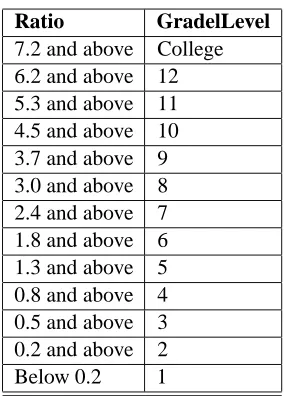
formula consists of the ratio of long words to sen-tences, where long words are defined as 7 or more characters. The ratio is translated into a grade level as indicated in Table (1).
Coleman-Liau readability formula: The Coleman-Liau readability formula is similar to the Rix formula in that it gives the approximate grade level of the text. Unlike the Lix and Rix formulas, the Coleman-Liau formula requires the random selection of a 100 word excerpt from the text. Before the grade level can be calculated, the cloze percent must be estimated for this selection. The
Ratio GradelLevel
7.2 and above College 6.2 and above 12 5.3 and above 11 4.5 and above 10 3.7 and above 9
Table 1: Rix translation to grade level
Classifier Supercategories Subcategories Naive Bayes 66% 30%
MaxEnt 78% 66%
MIRA 76% 58%
Table 2: Performance of text classifiers.
cloze percent is the percent of words that, if deleted from the text, can be correctly filled in by a college undergraduate. If L is the number of letters in the 100 word sample and S is the number of sentences, then the estimated cloze percent is C = 141.8491 - 0.214590 * L + 1.079812 * S. The grade level can be calculated using the Coleman-Liau formula, where grade level is -27.4004 * C + 23.06395. In the SYS display we round the final result to the nearest whole grade level.
6 Text classification
per-formance on this task.
We collected a corpus of approximately 3.4 mil-lion words and organized it into two sets of label-ing categories. We hand collected a subset of labels (most appropriate for a text classification task) from the set of labels used for the organization of web text in NetTrekker (see 3). We retrieved text for each category by following the listed web links in Net-Trekker and manually extracting text from the sites. Our corpus is organized into a small hierarchy, with two sets of labels: a)labels for supercategories and b)labels for subcategories. There are 8 supercate-gories (Arts, Career and business, Literature, Phi-losophy and religion, Science, Social studies, Sports and health, Technology) and 41 subcategories (e.g., the subcategories for Literature are Art Criticism, Art History, Dance, Music, Theater). Subcategories are a proper subset of supercategories but in the clas-sification experiments reported below the classifiers trained independently in the two data sets.
We trained three classifiers for this task: a Naive Bayes classifier, a Maximum Entropy classifier and MIRA, a new online learning algorithm that incor-porates a measure of confidence in the algorithm(for details see (Crammer et al., 2008)). 3 The perfor-mance of the classifiers trained on the supercate-gories and subcatesupercate-gories data is shown in Table (2). All classifiers perform reasonably well in the super-categories classification task but are outperformed by the MaxEnt classifier in both the supercategories and subcategories classifications. The Naive Bayes classifiers performs worst in both tasks. As ex-pected, the performance of the classifiers deterio-rates substantially for the subcategories task. This is expected due to the large number of labels and the small size of data available for each subcategory. We expect that as we collect more data the performance of the classifiers for this task will improve. In an ear-lier implementation of Read-X, thematic classifica-tion was a coarser three-way classificaiclassifica-tion task (lit-erature, science, sports). In that implementation the MaxEnt classifier performed at 93% and the Naive Bayes classifier performed at 88% correct. In future implementations of the tool, we will make available
3We gratefully acknowledge MALLET, a collection of
statistical NLP tools written in Java, publicly available at
http://mallet.cs.umass.edu and Mark Dredze for his help installing and running MIRA on our data.
all three levels thematic classification.
6.1 Runtime and interface
The first implementation of Read-X, coded in Java, has been made publicly available. The jar file is called from the web through a link and runs on Win-dows XP or Vista with Java Runtime Environment 6 and internet connection. Search results and analysis are returned within a few seconds to a maximum of a minute or two depending on the speed of the connec-tion. The Read-X interface allows the user to con-strain the search by selecting number of returned re-sults and level of reading difficulty. A screenshot of Read-X (cropped for anonymity) is shown in Figure (1). The rightmost column is clickable and shows the retrieved html-free text in an editor. From this editor the text can be saved and further edited on the user’s computer.
7 Description of Toreador
The analysis of reading difficulty based on standard readability formulas gives a quick and easy way to measure reading difficulty but it is problematic in several ways. First, readability formulas compute superficial features of word and sentence length. It is easy to show that such features fail to distin-guish between sentences which have similar word and sentence lengths but differ in ease of interpreta-tion. Garden path sentences, bountiful in the linguis-tic literature, demonstrate this point. Example (1) is harder to read than example (2) although the latter is a longer sentence.
(1) She told me a little white lie will come back to haunt me.
(2) She told me that a little white lie will come back to haunt me.
Secondly, it is well known that there are aspects of textual coherence such as topic continuity and rhetorical structure which are not captured in counts of words and sentences (e.g., (Higgins et al., 2004), (Miltsakaki and Kukich, 2004))
Figure 1: Search results and analysis of readability
any literature. In this section, we discuss the first step we have taken towards making more reliable predictions on text readability given the profile of the reader.
Readers who are familiar with specific thematic areas, are more likely to know vocabulary that is recurring in these areas. So, if we have vocabu-lary frequency counts per thematic area, we are in a better position to predict difficult words for specific readers given their reading profiles. Vocabulary fre-quency lists are often used by test developers as an indicator of text difficulty, based on the assumption that less frequent words are more likely to be un-known. However, these lists are built from a variety of themes and cannot be customized for the reader. We have computed vocabulary frequencies for all supercategories in the thematically labeled corpus. The top 10 most frequent words per supercategory are shown in Table (3). Vocabulary frequencies per grade level have also been computed but not shown here.
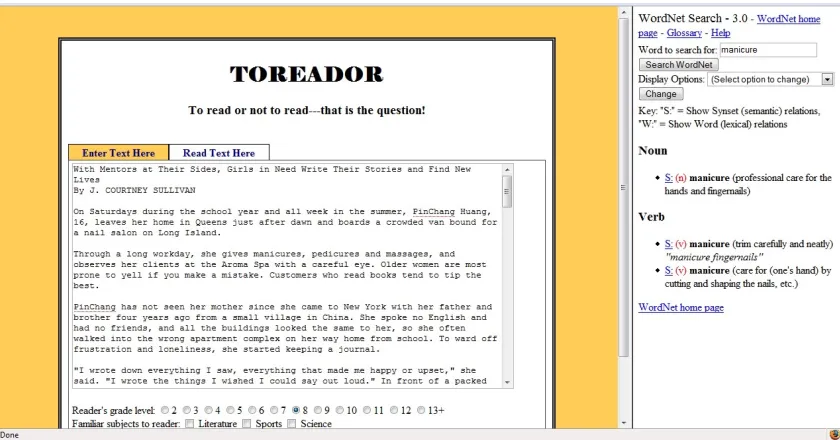
Toreador is a tool which runs independently of Read-X and it’s designed to predict unknown vocab-ulary for specific reader and grade profiles currently
specified by the user. A screenshot of Toreador is shown in Figure (2). The interface shows two tabs labeled “Enter text here” and “Read text here”. The “Enter text here” tab allows the user to customize vocabulary difficulty predictions by selecting the de-sired grade or theme.4Then, text can be copied from another source and pasted in the window of the tool. The tool will analyze the text and in a few seconds return the results fo the analysis in the tab labeled “Read text here”, shown in Figure (3). Toreador checks the vocabulary frequency of the words in the pasted text and returns the text highlighted with the words that do not rank high in the vocabulary fre-quency index for the chosen categories (grade or theme). The highlighted words are clickable. When they are clicked, they entry information from Word-Net appears on the right panel. The system has not been evaluated yet so some tuning will be re-quired to determine the optimal cut-off frequency point for highlighting words. An option is also avail-able to deactivate highlights for ease of read or read-ing for global meanread-ing. Words that the system has
4
Figure 2: Text analysis of vocabulary difficulty
Arts Career and Business Literature Philosophy Science Social Studies Sports, Health Technology
Word Freq Word Freq Word Freq Word Freq Word Freq Word Freq Word Freq Word Freq
musical 166 product 257 seemed 1398 argument 174 trees 831 behavior 258 players 508 software 584 leonardo 166 income 205 myself 1257 knowledge 158 bacteria 641 states 247 league 443 computer 432 instrument 155 market 194 friend 1255 augustine 148 used 560 psychoanalytic 222 player 435 site 333
horn 149 price 182 looked 1231 belief 141 growth 486 social 198 soccer 396 video 308
banjo 128 cash 178 things 1153 memory 130 acid 476 clemency 167 football 359 games 303
american 122 analysis 171 caesar 1059 truth 130 years 472 psychology 157 games 320 used 220 used 119 resources 165 going 1051 logic 129 alfalfa 386 psychotherapy 147 teams 292 systems 200 nature 111 positioning 164 having 1050 things 125 crop 368 united 132 national 273 programming 174
artist 104 used 153 asked 1023 existence 115 species 341 society 131 years 263 using 172
wright 98 sales 151 indeed 995 informal 113 acre 332 court 113 season 224 engineering 170
Table 3: 10 top most frequent words per thematic category.
not seen before, count as unknown and can be erro-neously highlighted (for example, the verb “give” in the screenshot example). We are currently running evaluation studies with a group of volunteers. While we recognize that the readability formulas currently implemented in Read-X are inadequate measures of expected reading difficulty, Toreador is not designed as an improvement over Read-X but as a component measuring expected vocabulary difficulty. Other factors contributing to reading difficulty such as syn-tactic complexity, propositional density and rhetor-ical structure will be modeled separately in the fu-ture.
8 Summary and future work
In this paper we presented preliminary versions of two tools developed to assist struggling readers iden-tify text that is at the desired level of reading
diffi-culty while at the same time interesting and relevant to their interests. Read-X is, to our knowledge, the first system designed to locate, classify and analyze reading difficulty of web text in real time, i.e., per-forming the web search and text analysis in seconds. Toreador analyzes the vocabulary of given text and predicts which words are likely to be difficult for the reader. The contribution of Toreador is that its pre-dictions are based on vocabulary frequencies calcu-lated per thematic area and are different depending on the reader’s prior familiarity with the thematic ar-eas.
Figure 3: Text analysis of vocabulary difficutly
Our goal in this research project is not to provide a single readability score. Instead, we aim at buidling models for multiple factors and provide individual evaluation for each, e.g., measures of syntactic com-plexity, ambiguity, propositional density, vocabu-lary difficulty, required amount of inference to iden-tify discourse relations and prior knowledge of the reader.
In future work, several studies are needed. To achieve satisfactory performance for the fine grained thematic categories, we are collecting more data. We also plan to run the subcategories classification not as an independent classificaition task but as subclas-sification task on supercategories. We expect that the accuracy of the classifier will improve but we also expect that for very fine thematic distinctions alter-native approaches may be be required (e.g., give spe-cial weights for key vocabulary that will distinguish between sports subthemes) or develop new classi-fication features beyond statistical analysis of word distributions.
More sophisticated textual, semantic and dis-course organization features need to be explored which will reflect the perceived coherence of the text beyond the choice of words and sentence level struc-ture. The recently released Penn Discourse
Tree-bank 2.0 (Prasad et al., 2008))5is a rich source with annotations of explicit and implicit discourse con-nectives and semantic labels which can be used to identify useful discourse features. Finally, more so-phisticated models are needed of reader profiles and how they impact the perceived reading difficulty of the text.
9 Acknowledgments
We are grateful to Mark Dredze for his help run-ning MIRA and Ani Nenkoca for useful discussions on readability. We thank the CLUNCH group at the Computer and Information Science department at the University of Pennsylvaniaand and two re-viewers for their very useful feedback. This work is partially funded by the GAPSA/Provosts Award for Interdisciplinary Innovation to Audrey Troutt, Uni-versity of Pennsylvania.
References
Jonathan Anderson. 1983. Lix and rix: Variations of a little-known readability index. Journal of Reading, 26(6):490–496.
M Coleman and T. Liau. 1975. A computer readabil-ity formula designed for machine scoring. Journal of
Applied Psychology, 60:283–284.
5
K. Collins-Thompson and J. Callan. 2004. Informa-tion retrieval for language tutoring: An overview of the REAP project. In Proceedings of the Twenty
Sev-enth Annual International ACM SIGIR Conference on Research and Development in Information Retrieval (poster descritpion.
Koby Crammer, Mark Dredze, John Blitzer, and Fer-nando Pereira. 2008. Batch performance for an on-line price. In The NIPS 2007 Workshop on Efficient
Machine Learning.
Lou Denti. 2004. Introduction: Pointing the way: Teach-ing readTeach-ing to strugglTeach-ing readers at the secondary level.
Reading and Writing Quarterly, 20:109–112.
Ted Hasselbring and Laura Goin. 2004. Literacy instruc-tion for older struggling readers: What is the role of technology? Reading and Writing Quarterly, 20:123– 144.
M. Heilman, K. Collins-Thompson, J. Callan, and M. Es-kenazi. 2006. Classroom success of an intelligent tutoring system for lexical practice and reading com-prehension. In Proceedings of the Ninth International
Conference on Spoken Language Processing.
M. Heilman, K. Collins-Thompson, J. Callan, and M. Es-kenazi. 2007. Combining lexical and grammatical features to improve readability measures for first and second language texts. In Proceedings of the Human
Language Technology Conference. Rochester, NY.
Derrick Higgins, Jill Burstein, Daniel Marcu, and Clau-dia Gentile. 2004. Evaluating multiple aspects of co-herence in student essays. In Proceedings of the
Hu-man Language Technology and North American As-sociation for Computational Linguistics Conference (HLT/NAACL 2004).
Eleni Miltsakaki and Karen Kukich. 2004. Evaluation of text coherence for electronic essay scoring systems.
Natural Language Engineering, 10(1).
Sarah Petersen and Mari Ostendorf. 2006. Assessing the reading level of web pages. In Proceedings of
Inter-speech 2006 (poster), pages 833–836.
Rashmi Prasad, Nikhil Dinesh, Alan Lee, Eleni Milt-sakaki, Livio Robaldo, Aravind Joshi, and Bonnie Webber. 2008. The penn discourse treebank 2.0. In
Proceedings of the 6th International Conference on Language Resources and Evaluation (LREC 2008).
T. D. Snyder, A.G. Tan, and C.M. Hoffman. 2006. Digest of education statistics 2005 (nces 2006-030). In U.S.
Department of Education, National Center for Edu-cation Statistics. Washington, DC: U.S. Government Printing Office.
John Strucker, Yamamoto Kentaro, and Irwin Kirsch. 2007. The relationship of the component skills of reading to ials performance: Tipping points and five classes of adult literacy learners. In NCSALL Reports
29. Boston: National Center for the Study of Adult Learning and Literacy (NCSALL).
Thomas Weinstein and Herbert J. Walberg. 1993. Practi-cal literacy of young adults: educational antecedents and influences. Journal of Research in Reading,