Attribute Selection for Referring Expression Generation:
New Algorithms and Evaluation Methods
Albert Gatt
Department of Computing Science University of Aberdeen Aberdeen AB24 3UE, UK
Anja Belz
Natural Language Technology Group University of Brighton
Brighton BN2 4GJ, UK [email protected]
Abstract
Referring expression generation has recently been the subject of the first Shared Task
Chal-lenge inNLG. In this paper, we analyse the
systems that participated in the Challenge in terms of their algorithmic properties, compar-ing new techniques to classic ones, based on results from a new human task-performance experiment and from the intrinsic measures that were used in the Challenge. We also con-sider the relationship between different eval-uation methods, showing that extrinsic task-performance experiments and intrinsic evalu-ation methods yield results that are not signif-icantly correlated. We argue that this high-lights the importance of including extrinsic
evaluation methods in comparativeNLG
eval-uations.
1 Introduction and Background
The Generation of Referring Expressions (GRE) is one of the most intensively studied sub-tasks of Natural Language Generation (NLG). Much re-search has focused on content determination inGRE, which is typically framed as an attribute selection task in which properties are selected in order to describe an intended referent. Since such proper-ties are typically defined as attribute-value pairs, in what follows, we will refer to this as the AS
-GRE (Attribute Selection for Generating Referring Expressions) task.
1.1 Approaches to ASGRE
Since early work onASGRE, which focused on prag-matic motivations behind different types of refer-ence (Appelt, 1985; Appelt and Kronfeld, 1987), the
focus has increasingly been on definite descriptions and identification, where the set of attributes se-lected should uniquely distinguish the intended ref-erent from other entities (its ‘distractors’). Unique Reference in this sense is a dominant criterion for selecting attribute sets in classicASGREalgorithms. Following Dale (1989), and especially Dale and Re-iter (1995), several contributions have extended the remit ofASGREalgorithms to handle relations (Dale and Haddock, 1991; Kelleher and Kruijff, 2006) and gradable attributes (van Deemter, 2006); and also to guarantee logical completeness of algorithms (van Deemter, 2002; Gardent, 2002; Horacek, 2004; Gatt and van Deemter, 2007).
Much of this work has incorporated the prin-ciple of brevity. Based on the Gricean Quantity maxim (Grice, 1975), and originally discussed by Appelt (1985), and further by Dale (1989), Reiter (1990) and Gardent (2002), this principle holds that descriptions should contain no more information than is necessary to distinguish an intended refer-ent. InASGRE, this has been translated into a crite-rion which determines the adequacy of an attribute set, implemented in its most straightforward form in Full Brevityalgorithms which select the smallest at-tribute set that uniquely refers to the intended refer-ent (Dale, 1989).
Another frequent property ofASGREalgorithms is
refer-ence); and (b) this tends to occur with properties which seem to be very salient or in some sense pre-ferred (Pechmann, 1989; Belke and Meyer, 2002; Arts, 2004). In the Incremental Algorithm (Dale and Reiter, 1995), incrementality took the form of hillclimbing along an attribute order which reflects the preference that humans manifest for certain at-tributes (such as COLOUR). ThisModelling of Hu-man Preferences in the Incremental Algorithm has proven influential. Another feature proposed by Dale and Reiter is to hardwire the inclusion of the type of an entity in a description, reflecting the hu-man tendency to always include the category of an object (e.g. chair or man), even if it has no dis-criminatory value. A compromise may be reached between incrementality and brevity; for example, Dale’s (1989) Greedy Algorithm selects attributes one at a time, and computes the Discriminatory Powerof attributes, that is, it bases selection on the extent to which an attribute helps distinguish an en-tity from its distractors.
In the remainder of this paper, we uniformly use the term ’algorithmic property’ for the selection cri-teria and other properties ofASGRE algorithms de-scribed above, and refer to them by the following short forms: Full Brevity, Uniqueness, Discrimina-tory Power, Hardwired Type Selection, Human Pref-erence Modelling and Incrementality.1
1.2 ASGRE and Evaluation
Though ASGRE evaluations have been carried out (Gupta and Stent, 2005; Viethen and Dale, 2006; Gatt et al., 2007), these have focused on ‘classic’ al-gorithms, and have been corpus-based. The absence of task-performance evaluations is surprising, con-sidering the well-defined nature of theASGRE task,
and the predominance of task-performance studies elsewhere in theNLGevaluation literature (Reiter et al., 2003; Karasimos and Isard, 2004).
Given the widespread agreement on task defini-tion and input/output specificadefini-tions, ASGREwas an ideal candidate for the first NLGshared task evalu-ation challenge. The challenge was first discussed
1
While terms like ’Unique Reference’ and ’Brevity’ are characteristics of outputs ofASGREalgorithms, we use them as shorthand here for those properties of algorithms which guar-antee that they will achieve these characteristics in the attribute sets generated.
during a workshop held at Arlington, Va. (Dale and White, 2007), and eventually organised as part of theUCNLG+MTWorkshop in September 2007 (Belz and Gatt, 2007).
TheASGREShared Task provided an opportunity to (a) assess the extent to which the field has diver-sified since its inception; (b) carry out a compar-ative evaluation involving both automatic methods and human task-performance methods.
1.3 Overview
In the ASGRE Challenge report (Belz and Gatt,
2007) we presented the results of theASGRE Chal-lenge evaluations objectively and with little inter-pretation. In this paper, we present the results of a new task-performance evaluation and a new intrinsic measure involving the same 15 systems and compare the new results with the earlier ones. We also exam-ine all results in the light of the algorithmic proper-ties of the participating systems. We thus focus on two issues inASGRE and its evaluation. We exam-ine the similarities and differences among the sys-tems submitted to the ASGRE Challenge and com-pare them to classic approaches (Section 2.1). We look at the results of intrinsic and extrinsic evalu-ations (Section 4) and examine how these relate to algorithmic properties (Section 4.1 and 4.2). Finally we look at how intrinsic and extrinsic evaluations correlate with each other (Section 4.3).
2 The ASGRE Challenge
TheASGREChallenge used theTUNA Corpus (Gatt et al., 2007), a set of human-produced referring ex-pressions (REs) for entities in visual domains of pictures of furniture or people. The corpus was collected during an online elicitation experiment in which subjects typed descriptions of a target referent in aDOMAINin which there were also 6 other enti-ties (‘distractors’). EachREin the corpus is paired with a domain representation consisting of the tar-get referent and the set of distractors, each with their possible attributes and values; Figure 1(a) shows an example of an entity representation.
<ENTITY ID="121" TYPE="target">
<ATTRIBUTE NAME="colour" VALUE="blue" />
<ATTRIBUTE NAME="orientation" VALUE="left" />
<ATTRIBUTE NAME="type" VALUE="fan" />
<ATTRIBUTE NAME="size" VALUE="small" />
<ATTRIBUTE NAME="x-dimension" VALUE="1" />
<ATTRIBUTE NAME="y-dimension" VALUE="3" />
</ENTITY>
(a) Entity representation
<DESCRIPTION>
<ATTRIBUTE NAME="colour" VALUE="blue" />
<ATTRIBUTE NAME="orientation" VALUE="left" />
<ATTRIBUTE NAME="type" VALUE="fan" />
</DESCRIPTION>
(b) Description:the blue fan facing left
Figure 1: Example of the input and output data in the ASGRE Challenge
attribute-value pairs to describe the target referent. An example, corresponding to a human-produced
REfor Figure 1(a), is shown in Figure 1(b).
For the ASGRE Challenge, the 780 singular de-scriptions in the corpus were used, and divided into 60% training data, 20% development data and 20% test data. Participants were given both input (DOMAIN) and output (DESCRIPTION) parts in the training and development data, but just inputs in the test data. They were asked to submit the correspond-ing outputs for test data inputs.
2.1 Systems
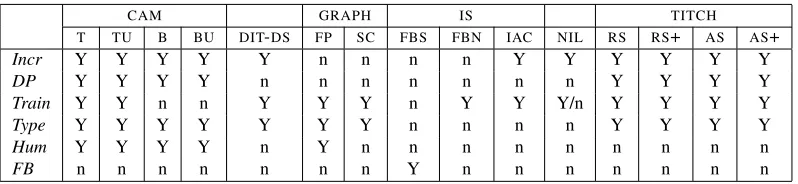
The evaluations reported below included 15 of the 22 submitted ASGRE systems. Table 1 is an
overview of these systems in terms of five of the classic algorithmic properties described in Section 1, and one property that has emerged in more recent
ASGREalgorithms:Trainability, or automatic adapt-ability of systems from data. This classification of systems is based on the reports submitted by their developers to the ASGREChallenge. Properties are indicated in the first column (abbreviations are ex-plained in the table caption).
The version of the IS-FBS system that was origi-nally submitted to ASGRE contained a bug and did not actually output minimal attribute sets (but added an arbitrary attribute to each set). Unlike theASGRE
Challenge task-performance evaluation, the analysis presented in this paper uses the corrected version of this system.
3 Evaluation methods
Evaluation methods can be characterised as either intrinsicorextrinsic. While intrinsic methods eval-uate the outputs of algorithms in their own right,
ei-ther relative to a corpus or based on absolute evalu-ation metrics, extrinsic methods assess the effect of an algorithm on something external to it, such as its effect on human performance on some external task.
3.1 Intrinsic measures
In the evaluation results reported below, we use two of the intrinsic methods used in the ASGRE Chal-lenge. The first of these is Minimality, defined as the proportion of descriptions produced by a system that are maximally brief, as per the original defini-tion in Dale (1989). The second is the Dice coeffi-cient, used to compare the description produced by a system (DS) to the human-produced description (DH) on the same input domain. Dice is estimated as follows:
2× |DS∩DH| |DS|+|DH|
(1)
For this paper, we also computed MASI, a ver-sion of the Jaccard similarity coefficient proposed by Passonneau (2006) which multiplies the simi-larity value by a monotonicity coefficient, biasing the measure towards those cases where DS and
DH have an empty set difference. Intuitively, this means that those system-produced descriptions are preferred which do not include attributes that are omitted by a human. Thus, two of our intrinsic mea-sures assessHumanlikeness(Dice andMASI), while Minimalityreflects the extent to which an algorithm conforms to brevity, one of the principles that has emerged from theASGREliterature.
3.2 Extrinsic measures
partici-CAM GRAPH IS TITCH T TU B BU DIT-DS FP SC FBS FBN IAC NIL RS RS+ AS AS+
Incr Y Y Y Y Y n n n n Y Y Y Y Y Y
DP Y Y Y Y n n n n n n n Y Y Y Y
Train Y Y n n Y Y Y n Y Y Y/n Y Y Y Y
Type Y Y Y Y Y Y Y n n n n Y Y Y Y
Hum Y Y Y Y n Y n n n n n n n n n
[image:4.612.108.507.70.162.2]FB n n n n n n n Y n n n n n n n
Table 1: Overview of properties of systems submitted to theASGRE Challenge. All systems produce outputs with
unique reference. The meaning of the abbreviations is as follows (for definitions see Section 1):Incr = Incrementality;
DP = Discriminatory Power; Train = Trainability; Type = Hardwired Type Selection; Hum = Human Preference Modelling;FB = Full Brevity
.
pants were shown visual representations of the do-mains that were used as inputs in the test data, coupled with a system-generated description on the same screen. Their task was to identify the intended referent in the domain by means of a mouse click. The rationale behind the experiment was to assess the degree to which an algorithm achieved its stated purpose of generating a description that facilitates identification of the intended referent.
Since system outputs were sets of attributes (see Figure 1(b)), they were first mapped to NL strings using a deterministic, template-based method which always maps each attribute to word(s) in the same way and in the same position regardless of context2. The present analysis is based on results from a new evaluation experiment which replicated the original methodology with a slight difference. While participants in the ASGRE experiment were shown visual domains and descriptions at the same time, this experiment sought to distinguish reading and identification time. Thus, for each system out-put, participants first saw the description, using the mouse to call up the visual domain once they had read it. This yields three dependent measures: (a) reading time (RT); (b) identification time (IT); (c)
er-ror rate (ER), defined as the proportion of trials per system for which participants identified the wrong referent.
One of the possible complications with the RT
measure is that, while it depends on the semantics of a description (the attributes that an algorithm se-lects), the syntactic complexity of the description will also impact the time it takes to read it. In our
2The template-based string-mapping algorithm was created
by Irene Langkilde-Geary at the University of Brighton.
setup, the adoption of a deterministic, one-to-one mapping between an attribute and its linguistic rep-resentation controls for this to some extent. Since every attribute in any semantic representation will invariably map to the same surface form, there is no variation between systems in terms of how a partic-ular attribute is realised.
Design: As in the original experiment, we used a Repeated Latin Squares design in which each com-bination of peer system and test set item is allocated one trial. Because there were 148 items in the test set, but 15 peer systems, 2 test set items were ran-domly selected and duplicated to give a test set size of 150, and 10 Latin Squares. The 150 test set items were divided into two sets of 75; 15 of the 30 partici-pants did the first 75 items (the first 5 Latin Squares), while the other 15 did the rest. This resulted in 2250 trials (each corresponding to a combination of test set item and system) in all. For the purposes of this paper, the duplicate items were treated as fillers, that is, every item was included only once in the analysis.
Participants and procedure: The experiment was carried out by 30 participants recruited from among the faculty and administrative staff of the University of Brighton. Participants carried out the experiment under supervision in a quiet room on a laptop. Stimulus presentation was carried out us-ing DMDX, a Win-32 software package for psy-cholinguistic experiments involving time measure-ments (Forster and Forster, 2003). Participants initi-ated each trial, which consisted of an initial warning bell and a fixation point flashed on the screen for
Identi-fication was carried out by clicking on the image that a participant thought was the target referent of the description they had read. RT was measured from the point at which the description was presented, to the point at which a participant called up the next screen via mouse click. ITwas measured from the point at which pictures (the visual domain) were pre-sented on the screen to the point where a participant identified a referent by clicking on it. In addition to the time taken to identify a referent, the program recorded the location of a participant’s mouse click, in order to assess whether the object identified was in fact the correct one. Trials timed out after 15 sec-onds; this only occurred in 2 trials overall (out of 2250).
4 Results and discussion
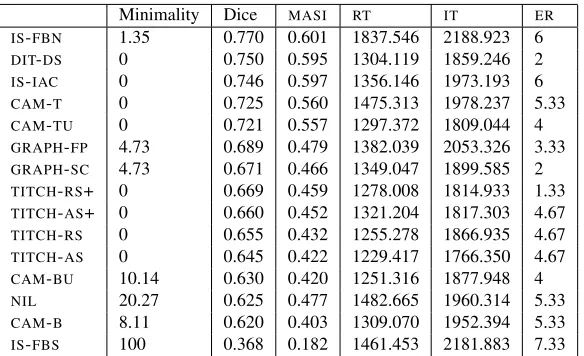
Table 2 displays aggregate (mean or percentage) scores for each of the intrinsic and extrinsic mea-sures. As an initial test for differences between the 15 systems separate univariate ANOVAs were conducted using SYSTEM as the independent
vari-able (15 levels), testing its effect on the extrinsic task-performance measures (RT and IT). For er-ror rate (ER), we used a Kruskall-Wallis ranks test
to compare identification accuracy rates across sys-tems3. The main effect ofSYSTEM was significant on RT (F(14,2219) = 2.58, p < .01), and IT
(F(14,2219) = 1.90,p < .05). No significant main effect was found onER(χ2 = 13.88,p > .4).4
Systems also differed significantly on Dice (F(14,2219) = 18.66,p < .001) andMASIscores (F(14,2219) = 15.94,p < .001).
In the remainder of this section, we first consider the differences between systems based on the algo-rithmic properties listed in Table 1 (and described in Section 1). For this part of the analysis, we con-sider intrinsic and extrinsic evaluation measures sep-arately (Section 4.1 and 4.2). Subsequently, we ex-plicitly compare the intrinsic and extrinsic methods (Section 4.3).
3The large number of zero values in
ERproportions, and a high dependency of variance on the mean, meant that a non-parametric test was more appropriate.
4
We left out the duplicated items in this analysis.
4.1 Differences between system types
As Table 1 indicates, there are some similarities between the new systems submitted for the AS
-GRE tasks, and the classic approaches discussed in Section 1. Eleven of the systems are incremen-tal, although only a minority (5 systems) explic-itly hardwire human preferences. Furthermore, 8 systems (all variations on two basic systems, CAM
andTITCH) compute the discriminatory value of the properties selected. Just one system adopts the Full Brevity approach of Dale (1989), while the major-ity (11 systems) adopt the Dale and Reiter conven-tion of always adding TYPE. Perhaps the greatest
point of divergence between the ASGRE Challenge systems and the classic algorithms discussed in Sec-tion 1 is the predominance of data-driven approaches (12 systems are trainable), a characteristic that mir-rors trends elsewhere inHLT.
It is worth asking how the particular algorithmic properties impact on performance, as measured with the evaluation methods used. Table 3 displays means computed with all the extrinsic and intrinsic mea-sures, for all system properties except full brevity and discriminatory power. Since the latter are re-lated to Minimality, which was a separate evaluation measure in this study, they are treated separately be-low (Section 4.2). Note that the aggregate scores in Table 3 are based on unequal-sized samples, since this is a post-hoc analysis which the evaluation stud-ies described above did not directly target.
Table 3 indicates that systems that were directly trained on data display higher agreement (Dice and
MASI) scores with the human data. This is
rela-tively unsurprising; what is less straightforwardly predictable is that trainable systems have better task-performance scores (ITandRT). Systems which
al-ways include TYPE and those which are incremen-tal apparently score better overall. Somewhat sur-prisingly, incorporating human attribute preferences results in smaller improvements than incremental-ity and TYPE inclusion. This is likely due to the fact that the attributes preferred by humans are not straightforwardly determinable in the people subdo-main (van der Sluis et al., 2007). In contrast, those in the furniture domain, which include COLOUR,
psy-Minimality Dice MASI RT IT ER IS-FBN 1.35 0.770 0.601 1837.546 2188.923 6
DIT-DS 0 0.750 0.595 1304.119 1859.246 2
IS-IAC 0 0.746 0.597 1356.146 1973.193 6
CAM-T 0 0.725 0.560 1475.313 1978.237 5.33
CAM-TU 0 0.721 0.557 1297.372 1809.044 4
GRAPH-FP 4.73 0.689 0.479 1382.039 2053.326 3.33
GRAPH-SC 4.73 0.671 0.466 1349.047 1899.585 2
TITCH-RS+ 0 0.669 0.459 1278.008 1814.933 1.33
TITCH-AS+ 0 0.660 0.452 1321.204 1817.303 4.67
TITCH-RS 0 0.655 0.432 1255.278 1866.935 4.67
TITCH-AS 0 0.645 0.422 1229.417 1766.350 4.67
CAM-BU 10.14 0.630 0.420 1251.316 1877.948 4
NIL 20.27 0.625 0.477 1482.665 1960.314 5.33
CAM-B 8.11 0.620 0.403 1309.070 1952.394 5.33
[image:6.612.162.454.70.248.2]IS-FBS 100 0.368 0.182 1461.453 2181.883 7.33
Table 2: Results for systems and evaluation measures (in order of Dice).
trainable includes type incremental human preferences
no yes no yes no yes no yes
Dice 0.561 0.700 0.627 0.676 0.625 0.677 0.656 0.677
MASI 0.370 0.511 0.464 0.477 0.432 0.488 0.468 0.484 RT 1376.13 1371.41 1534.45 1313.83 1507.52 1323.63 1387.49 1343.02 IT 1993.13 1911.55 2076.08 1881.39 2080.93 1879.63 1932.87 1934.19
[image:6.612.81.291.398.467.2]ER 5.2% 4.2% 6.3% 3.8% 4.7% 4.4% 4.5% 4.5%
Table 3: Means on intrinsic and extrinsic measures, by system type.
Dice MASI IT RT
Trainable 171.67∗ 145.63∗ .002 4.36 Incremental 47.90∗ 45.61∗ 7.43 1.64 Includes type 18.42∗ 29.38∗ 6.89 11.27 Human pref. 3.27 5.12 2.11 .83 Incr.×Train. 40.82∗ 30.99∗ .001 7.08
Table 4: Multivariate tests examining impact of system
type on evaluation measures. Cells indicate F−values
with 4 numerator and 2201 error degrees of freedom. ∗:
p≤.05after Bonferroni correction.
cholinguistic results (Pechmann, 1989; Arts, 2004). As a further test of these differences, a multivari-ateANOVAwas conducted, comparing scores on the intrinsic and extrinsic measures, as a function of the presence or absence of the 4 algorithmic properties being considered here. The results are shown in Table 4 which displays figures for all main effects and for the one interaction that was significant (in-crementality×trainability, bottom row). Since this is a multiple-test post-hoc analysis on unequal-sized samples, all significance values are based on a Bon-ferroni correction5The table does not includeER, as
5
The Bonferroni correction adjusts for the increased
like-no main effect ofSYSTEMwas found on this mea-sure.
The results show that trainability, followed by in-crementality and inclusion ofTYPEhad the strongest impact on system quality, as far as this is measured by Dice andMASI.
The incrementality × trainability interaction is mostly due to the huge effect that trainability has on how non-incremental systems perform. In the case of incremental systems, trainability gives rise to marginally better performance: the mean Dice score for non-trainable incremental systems was .625, as compared to .696 for trainable incremental systems. Similar patterns are observable with MASI (.433 vs .439). However, the most significant feature of the interaction is the large benefit that training on data confers on non-incremental systems. Un-trained non-incremental systems obtained a mean Dice score of .368 (MASI = .182), while the mean Dice score on trained non-incremental systems was .710, with a mean MASI score of .515. Another,
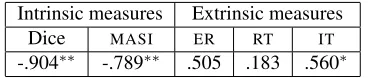
Intrinsic measures Extrinsic measures
Dice MASI ER RT IT
[image:7.612.94.278.71.110.2]-.904∗∗ -.789∗∗ .505 .183 .560∗
Table 5: Correlations between Minimality and other
eval-uation measures. Legend:∗∗:p≤.01,∗:p≤.05
more tentative, conclusion that could be made by looking at these figures is that trainable systems per-form better if they are non-incremental; however, the difference (Dice of .710 vs .696) seems rather marginal and would require further testing. What is also striking in this table is the absence of any significant impact of these properties on the task-performance measures of reading and identification time, despite initial impressions based on means (Ta-ble 3).
In summary, at least one of the principles that has been widely adopted in ASGRE – incrementality – seems to be validated by the evaluation results for these new algorithms. However, results show that improvement on an automatically computed human-likeness metric such asMASIor Dice does not neces-sarily imply an improvement on a task-performance measure. This is a theme to which we return in Sec-tion 4.3.
4.2 The role of minimality
Apart from incrementality, the other dominant prin-ciple that has emerged from nearly three decades of
ASGRE research is brevity. While psycholinguistic
research has shown (Pechmann, 1989; Belke and Meyer, 2002; Arts, 2004) that the strict interpre-tation of the Gricean Quantity Maxim, adopted for example by Dale (1989), is not observed by speak-ers, brevity has remained a central concern in recent approaches (Gardent, 2002). Only one algorithm adopted a full-brevity approach in theASGRE Chal-lenge; however, several algorithms emphasised dis-criminatory power, and some of these, as a compar-ison between Tables 1 and 2 shows, tended to have higher Minimality scores overall.
Since Minimality was part of the overall design of the evaluation, it is possible to see the extent to which it covaries significantly with other perfor-mance measures. The relevant correlations are dis-played in Table 5. There are highly significant neg-ative correlations between Minimality and the two
intrinsic humanlikeness measures (Dice andMASI).
The significant positive correlation with IT implies that participants in our evaluation experiment tended to take longer to identify referents in the case of sys-tems which produce more minimal descriptions.
The negative correlation with the humanlikeness measures corroborates previous findings that peo-ple do not observe a strict interpretation of the Gricean Quantity Maxim (Pechmann, 1989; Belke and Meyer, 2002; Arts, 2004). On the other hand, the direction of the correlation withITis somewhat more surprising. One possible explanation is that minimal descriptions often do not include a TYPE
attribute, since this seldom has any discriminatory power in theTUNACorpus domains.
The role of Minimality remains a topic of some debate in the psycholinguistic literature. A recent study (Engelhardt et al., 2006) showed that identifi-cation of objects in a visual domain could be delayed if a description of the target referent was overspeci-fied, suggesting a beneficial effect from Minimality. However, Engelhardt et al. also found, in a separate study, that overspecified descriptions tended to be rated as no worse than brief, or minimal ones. In-deed, one of the points that emerges from this study is that intrinsic and extrinsic assessments can yield contrasting results. It is to this issue that we now turn.
4.3 Intrinsic vs. extrinsic methods
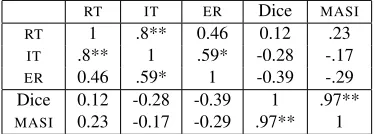
Since humanlikeness (intrinsic) and task perfor-mance (extrinsic) are different perspectives on the outputs of an ASGRE algorithm, it is worth ask-ing to what extent they agree. This is an impor-tant question for comparative HLTevaluation more generally, which has become dominated by corpus-based humanlikeness metrics. To obtain an indi-cation of agreement, we computed correlations be-tween the two humanlikeness measures and the task-performance measures; these are displayed in Table 6.
The two time measures (RT andIT) are strongly correlated, implying that when subjects took longer to read descriptions, they also took longer to iden-tify a referent. This may seem surprising in view of the positive correlation between Minimality and
RT IT ER Dice MASI
RT 1 .8** 0.46 0.12 .23
IT .8** 1 .59* -0.28 -.17
ER 0.46 .59* 1 -0.39 -.29 Dice 0.12 -0.28 -0.39 1 .97**
[image:8.612.92.280.72.139.2]MASI 0.23 -0.17 -0.29 .97** 1
Table 6: Pairwise correlations between humanlikeness
and task-performance measures (∗:p≤.05;∗∗:p≤.01)
shown not to correlate withRT(shorter descriptions do not imply longer or shorterRT). What this result
indicates is that rather than the number of attributes in a description, as measured by Minimality, it is the content that influences identification latency. Part of the effect may be due to the lack ofTYPEin minimal descriptions noted earlier.
Table 6 also shows that error rate is significantly correlated withIT(but not withRT), i.e. where sub-jects took longer to identify referents, the identifi-cation was more likely to be wrong. This points to a common underlying cause for slower reading and identification, possibly arising from the use of at-tributes (such asSIZE) which impose a greater cog-nitive load on the reader.
The very strong correlation (0.97) between Dice andMASI is to be expected, given the similarity in the way they are defined.
Another unambiguous result emerges: none of the similarity-based metrics covary significantly with any of the task-performance measures. An extended analysis involving a larger range of intrinsic met-rics confirmed this lack of significant covariation for string-based similarity metrics as well as set-similarity metrics across two task-performance ex-periments (Belz and Gatt, 2008). This indicates that at least for some areas of HLT, task-performance
evaluation is vital: without the external reality check provided by extrinsic evaluations, intrinsic evalua-tions may end up being too self-contained and dis-connected from notions of usefulness to provide a meaningful assessment of systems’ quality.
5 Conclusion
Comparative evaluation can be of great benefit, es-pecially in an area as mature and diverse as GRE. A shared-task evaluation like the ASGREChallenge can help identify the strengths and weaknesses of al-ternative approaches and techniques, as measured by
different evaluation criteria. Perhaps even more im-portantly, such a challenge helps evaluate the evalu-ation methods themselves and reveals which (com-binations of) evaluation methods are appropriate for a given evaluation purpose.
As far as the first issue is concerned, this paper has shown that trainability, incrementality and not aiming for minimality are the algorithmic proper-ties most helpful in achieving high humanlikeness scores. This result is in line with psycholinguistic research on attribute selection in reference by hu-mans. Less clear-cut is the relationship between these properties and task-performance measures that assess how efficiently a referent can be identified based on a description.
The second part of the analysis presented here showed that intrinsic and extrinsic perspectives on the quality of system outputs quality can yield un-correlated sets of results, making it difficult to pre-dict quality as measured by one based on quality as measured by the other. Furthermore, while in-tuitively it might be expected that higher human-likeness entailed better task performance, our results suggest that this is not necessarily the case.
Our main conclusions for ASGRE evaluation are that (a) while humanlikeness evaluation may provide a measure of one aspect of systems but we need to be cautious in relying on humanlikeness as a criterion of overall quality (standard in evaluation ofMTand summarisation); and (b) that we must not leave the
NLG tradition of task-performance evaluations be-hind as we move towards more comparative forms of evaluation.
Acknowledgements
References
D. Appelt and A. Kronfeld. 1987. A
computa-tional model of referring. InProc. 10th International
Joint Conference on Artificial Intelligence (IJCAI-87), pages 640–647.
D. Appelt. 1985. Planning English referring expressions.
Artificial Intelligence, 26(1):1–33.
A. Arts. 2004. Overspecification in Instructive Texts.
Ph.D. thesis, University of Tilburg.
E. Belke and A. Meyer. 2002. Tracking the time course of multidimensional stimulus discrimination: Analy-sis of viewing patterns and processing times during
same-different decisions. European Journal of
Cog-nitive Psychology, 14(2):237–266.
A. Belz and A. Gatt. 2007. The Attribute Selection for GRE Challenge: Overview and evaluation results. In
Proc. 2nd UCNLG Workshop: Language Generation and Machine Translation (UCNLG+MT), pages 75– 83.
A. Belz and A. Gatt. 2008. Intrinsic vs. extrinsic evalu-ation measures for referring expression generevalu-ation. In
Proc. 46th Annual Meeting of the Association for Com-putational Linguistics (ACL-08). To appear.
R. Dale and N. Haddock. 1991. Generating
refer-ring expressions containing relations. In Proc. 5th
Conference of the European Chapter of the Associa-tion for ComputaAssocia-tional Linguistics (EACL-91)., pages 161–166.
R. Dale and E. Reiter. 1995. Computational interpreta-tion of the Gricean maxims in the generainterpreta-tion of
refer-ring expressions. Cognitive Science, 19(8):233–263.
R. Dale and M. White, editors. 2007. Shared tasks and
comparative evaluation in Natural Language Genera-tion: Workshop Report.
Robert Dale. 1989. Cooking up referring expressions. In Proc. 27th Annual Meeting of the Association for Computational Linguistics (ACL-89)., pages 68–75. P. E. Engelhardt, K.G.D Bailey, and F. Ferreira. 2006.
Do speakers and listeners observe the Gricean Maxim
of Quantity? Journal of Memory and Language,
54:554–573.
K. I. Forster and J. C. Forster. 2003. DMDX: A
win-dows display program with millisecond accuracy.
Be-havior Research Methods, Instruments, & Computers, 35(1):116–124.
C. Gardent. 2002. Generating minimal definite
descrip-tions. In Proc. 40th Annual Meeting of the
Associa-tion for ComputaAssocia-tional Linguistics (ACL-02)., pages 96–103.
A. Gatt and K. van Deemter. 2007. Incremental genera-tion of plural descripgenera-tions: Similarity and partigenera-tioning. In Proc. 2007 Joint Conference on Empirical Meth-ods in Natural Language Processing and Computa-tional Natural Language Learning
(EMNLP/CONLL-07), pages 102–111.
A. Gatt, I. van der Sluis, and K. van Deemter. 2007. Evaluating algorithms for the generation of referring
expressions using a balanced corpus. In Proc. 11th
European Workshop on Natural Language Generation (ENLG-07)., pages 49–56.
H. P. Grice. 1975. Logic and conversation. In P. Cole
and J. L. Morgan, editors, Syntax and Semantics:
Speech Acts., volume III. Academic Press.
S. Gupta and A. J. Stent. 2005. Automatic
evalua-tion of referring expression generaevalua-tion using corpora. In Proc. 1st Workshop on Using Corpora in NLG (UCNLG-05)., pages 1–6.
H. Horacek. 2004. On referring to sets of objects
natu-rally. InProc. 3rd International Conference on
Natu-ral Language Generation (INLG-04)., pages 70–79. A. Karasimos and A. Isard. 2004. Multilingual
evalua-tion of a natural language generaevalua-tion system. InProc.
4th International Conference on Language Resources and Evaluation (LREC-04).
J. D. Kelleher and G-J Kruijff. 2006. Incremental gen-eration of spatial referring expressions in situated
di-alog. In Proc. joint 21st International Conference
on Computational Linguistics and 44th Annual Meet-ing of the Association for Computational LMeet-inguistics (ACL/COLING-06)., pages 1041–1048.
R. Passonneau. 2006. Measuring agreement on
set-valued items (MASI) for semantic and pragmatic
anno-tation. InProc. 5th International Conference on
Lan-guage Resources and Evaluation (LREC-06)., pages 831–836.
Thomas Pechmann. 1989. Incremental speech
pro-duction and referential overspecification. Linguistics,
27:89–110.
E. Reiter, R. Robertson, and L. Osman. 2003. Lessons from a failure: Generating tailored smoking cessation
letters. Artificial Intelligence, 144:41–58.
E. Reiter. 1990. The computational complexity of
avoid-ing conversational implicatures. InProc. 28th Annual
Meeting of the Association for Computational Linguis-tics (ACL-90)., pages 97–104.
K. van Deemter. 2002. Generating referring
expres-sions: Boolean extensions of the incremental
algo-rithm. Computational Linguistics, 28(1):37–52.
K. van Deemter. 2006. Generating referring expressions
that involve gradable properties. Computational
Lin-guistics, 32(2):195–222.
I. van der Sluis, A. Gatt, and K. van Deemter. 2007. Evaluating algorithms for the generation of referring
expressions: Going beyond toy domains. InProc.
In-ternational Conference on Recent Advances in Natural Language Processing (RANLP-07).