Combining Word Sense and
Usage for Modeling Frame
Semantics
Diego De Cao
1
Danilo Croce
1
Marco Pennacchiotti
2
Roberto Basili
1
1University of Rome Tor Vergata (Italy)
2University of the Saarland (Germany)
email:
[email protected]
Abstract
Models of lexical semantics are core paradigms in most NLP applica-tions, such as dialogue, information extraction and document understand-ing. Unfortunately, the coverage of currently available resources (e.g. FrameNet) is still unsatisfactory. This paper presents a largely applicable approach for extending frame semantic resources, combining word sense information derived from WordNet and corpus-based distributional infor-mation. We report a large scale evaluation over the English FrameNet, and results on extending FrameNet to the Italian language, as the basis of the development of a full FrameNet for Italian.
1
Introduction and Related Work
Models of lexical meaning are explicit or implicit basic components of any text pro-cessing system devoted to information extraction, question answering or dialogue. Several paradigms proposed for a variety of notions, such as word sense (Miller et al., 1990) or frame semantics (Baker et al., 1998), have given rise to large scale resources, respectively WordNet and FrameNet. Recent studies (e.g. Shen and Lapata (2007)) show that the use of FrameNet can potentially improve the performance of Question Answering systems. Yet, Shen and Lapata (2007) also point out that the low cov-erage of the current version of FrameNet significantly limits the expected boost in performance. Other studies have shown similar evidences for Recognizing Textual Entailment (RTE) (Clark et al., 2007; Burchardt et al., 2008): most examples of the RTE challenges corpora can be solved at the predicate-argument structure level, but FrameNet coverage is still a major problem.
Approaches to (semi-)automatically acquire frame information are then today a priority to solve these problems. Despite this, not many efforts have been paid so far in this direction. Burchardt et al. (2005) presented Detour, a system for predicting frame assignment of potential lexical units not covered by FrameNet, by using the paradigmatic information enclosed in WordNet. Although the authors do not fully solve the problem related to the fuzzy relationships between senses and frames, they propose an empirical association measure for ranking frame candidates according to sense information as stored in WordNet. To our knowledge, this is the only work trying to bridge frame membership to referential properties of lexical senses. Pitel (2006) presents a preliminary study on the applicability of semantic spaces and space geometrical transformations (namely, Latent Semantic Analysis) to expand FrameNet, but the investigation is too limited in scope to draw relevant conclusions. Finally, Padó et al. (2008) propose a method to automatically label unknown semantic roles of event nominalizations in FrameNet, but their method needs a large amount of annotated verbal data.
Another important limitation of FrameNet is the limited support to multilingual-ity, which is becoming a critical issue in real NLP applications. In recent years, some efforts have focused on the manual adaptation of the English FrameNet to other languages (e.g., German (Burchardt et al., 2006) and Spanish (Subirats and Petruck, 2003)). Unlike PropBank, FrameNet is in fact suitable to cross-lingual induction, as frames are mostly defined at the conceptual level, thus allowing cross-lingual interpre-tation. Yet, all these efforts consist in manually defining frame linguistic knowledge (e.g. lexical units) in the specific language, and in annotating a large corpus, thus requiring a large human effort. While attempts to automate the annotation process are quite promising (Pado and Lapata, 2007), they require the availability of a par-allel corpus, and leave open the issue of inducing the resource as a whole in a new language.
In particular, in this paper we focus on the application of such methods to study the semantics of the core elements of FrameNet, i.e. thelexical units(hereafter LUs). Lexical units are predicates (nouns, verbs, adjectives, etc.) that linguistically express the situation described by a frame. Lexical units of the same frame share semantic arguments. For example the frameKILLINGhas lexical units such as:assassin, blood-bath, fatal, massacre, kill, suicide. These predicates share semantic arguments such asKILLER,INSTRUMENTandVICTIM. Our goal is to combine corpus distributional
evidence with WordNet information to supply three tasks: the induction of new LUs not already in FrameNet (unknown LUs); the reduction of LUs polysemy by mapping
them to WordNet synsets; the translation of English LUs into Italian.
The paper is organized as follows. In Section 2 we describe our FrameNet paradig-maticanddistributional model, and we discuss how these two models can be com-bined in a single framework. In Section 3 we analyze the applicability of these models to the three proposed experimental tasks, and discuss the results. Finally, in Section 4 we draw final conclusions and outline future work.
2
Paradigmatic and distributional models of frame semantics
In this section we describe our paradigmatic, distributional and combined models for representing FrameNet. The general goal of each of these three methods is to offer a computational model of FrameNet. In such a model, frames and LUs should have a specific computational representation (e.g. vectors), and allow the computation ofsimilarityeither among different LUs or between a frame and a LU. Such model thus offers explicit means to use FrameNet in a NLP task or to expand FrameNet, e.g. by assigning unknown LUs to its most similar frame, or by mapping a LU to its proper WordNet synset(s). A key notion for these tasks is the definition of a principled and reliable semantic similarity measuresimto be applied to frames and LUs.
2.1 Paradigmatic model
The basic intuition behind our paradigmatic model is that knowledge about predicates of a frame, through a (possibly limited) set of LUs, allows to detect the set of the suitable WordNet senses able to evoke the same frame. These senses are topologically related to (one or more) sub-hierarchies capturing the lexical semantics implicit in the frame. We propose a weakly-supervised approach to discover these structures. The main idea is that frames correspond to specific sub-graphs of the WordNet hyponymy hierarchy, so that these latter can be used to predict frames valid for other LUs, not yet coded in FrameNet. Figure 1 reports the WordNet sub-hierarchy covering the frame PEOPLE_BY_AGE: here, the frame’s nominal LUs{adult, adolescent, baby, boy, infant, kid, geezer, teenager, youngster, youth}are all represented with the senses correctly referring to the frame. The correct senses (e.g. sense 1 ofyouthout of its 6 potential senses) are selected as they share most specific generalizations with the other LUs. This graph can be intended as an “explanation” of the lexical semantic
properties characterizing the frame: future predictions about new LUs can be done on the basis of the graph as a paradigmatic model for PEOPLE_BY_AGE. We call such a
graph theWordNet modelof the frame. As WordNet organizes nouns, verbs and other
Formally, given the setFof the LUs of a frame, a WordNet model is built around the subsetSF of WordNet synsets able to generalize the largest number of words in
[image:4.595.153.444.204.381.2]F1.
Figure 1: The WordNet model for the framePeople_by_Ageas evoked by the set of its nouns. Sense numbers #nrefer to WordNet 2.0
The WordNet modelW NF(Γ,W)of a frameF, is a graph
(3) W NF(Γ,W) =<W,SF,LF,h,simW N,m>
where: W ⊂F are the subset of all LUs inF having the same part-of-speechΓ∈ {verb,noun,ad jective},SFis the subset of synsets in WN needed to generalize words
w∈W;LF⊂SFare the lexical senses ofw∈W subsumed bySF;h⊆SF×SFis the
projection of the hyponymy relation of WN inSF;m⊆W×2LF is the lexical relation
between wordsw∈W and synsets inLF;simW N:SF→ℜis a weighting function that
expresses the relevance of each senseσ∈SF for the frame, as it is represented by its
words inF.
The model exemplified in Figure 1 is
W NPeople_by_Age(noun, {adult, ..., youth}), whereLF={adult#1, adolescent#1, baby#1,
boy#1, boy#2, boy#3, ..., youth#1}and the setSFcorresponds to the sub-hierarchies
dom-inated by the synsets#6026, #9622621, #9285271and#9015843.
The overall goal of computing the WordNet model is to determine the similarity function simW N :SF →ℜ, expressing the relevance of a synset σ∈SF as a good
representative of a frameF. This is what is hereafter referred to as the paradigmatic
similarity model between words senses and frames.
Paradigmatic Similarity measures
Given the WordNet hierarchy separation on part-of-speaches, the similarity function
simW Nis independently defined for verbs, nouns and adjectives.
1In the following, we will use the same notation for a frameFand for the set of its known lexical units,
Fornounswe adoptconceptual density(cd) (Agirre and Rigau, 1996; Basili et al., 2004), a semantic similarity measure defined for word sense disambiguation tasks. Thecd score for a senseσ∈SF is the density of the WordNet sub-hierarchy rooted
atσin representing the set of nouns inF. The intuition behind this model is that the larger is the number of all and only LUs in F that are generalized by σ, the better it captures the lexical semantics intended by the frame. Coarse generalizations (i.e. synsets higher in the hierarchy) are penalized, as they give rise to bushy hierarchies, covering too many words not in the targetF. The greedy algorithm proposed in Basili
et al. (2004) selects the subset of synsets able to “cover” (i.e. generalize) all the input words and characterized by the highestcd values. The set of such synsets and their
corresponding sub-hierarchies forms a graph derived from a set of LUsF. The result
is the WordNet modelW NF forF, i.e. the minimal subset of WordNet that explains
all (the possible) LUs inF with the maximally similar senses.
Figure 1 shows that correct senses (e.g. the sense 1 ofyouthout of the 6 potential
senses) are generally detected and preserved in the model. Irrelevant senses that do not share any common hypernym with other words in F are neglected. Conceptual density scores can be used to rank individual senses as in the case ofboy.
Given a frameF, the above model can be naturally used to compute the similarity between a nounn∈/FandF. This is particularly useful in LU induction task, as de-scribed in Section 3.1. To do so, the similaritysimW N(F,n)betweennandFis derived
by computing thecdscores over the setF∪ {n}. ThesimW N(F,n)is the maximalcd
of any synset σn∈SF that is also hypernym of a lexical sense ofn. In the
exam-ple, the nounboywould receive a score of 0.117 through the hypernym{child,kid}, according to its third sense in WordNet 2.0 (“{son,boy}”).
As conceptual density can be only applied to nouns, whenverbs vare
consid-ered, we exploit the synonymy and co-hyponymy relations. The following similarity
simW N(F,v)is computed:
(4) simW N(F,v) =
1 iff∃K⊂Fsuch that|K|>τAND
∀w∈K wis a co-hyponym ofv ε otherwise
Foradjectives, the similarity simW N(F,a), is computed on the basis of the
syn-onymy relation, as follows:
(5) simW N(F,a) =
1 iff∃w∈Fsuch that
wis a synonym oftw ε otherwise
The overall modelW NF is used to predict if a frameF is a correct situation for a
given unknown LUul∈/F(a noun, a verb or an adjective), wheneversimW N(F,ul)>ε.
This can be used as a frame predictor for aulcurrently not foreseen in the Berkley database but possibly very frequent in a specific corpus, as described in Section 3.1.
2.2 Distributional model
the similarity between a LU and a frame, by evaluating the distance of their vectors in the space.
Semantic spaces have been widely applied in several NLP tasks, ranging from in-formation retrieval to paraphrase rules extraction (Lin and Pantel, 2001). The intuition is that the meaning of a word can be described by the set of textual contexts in which it appears (Distributional Hypothesis(Harris, 1964)), and that words with similar
vec-tors are semantically related. This distributional approach has been often claimed to support thelanguage in useview on meaning. Word space models (Schütze, 1993) have been shown to emphasize different aspects of lexical semantics: associative (i.e. topical) information between words, as well as paradigmatic information (i.e. in ab-sentia) or syntagmatic information (i.e.in presentia).
In our setting, the goal is to leverage semantic spaces to capture the notion offrame
— i.e. the property of“being characteristic of a frame”. To do so, we model a lexical unit las a vector~l, whose dimensions represent the set of contexts of the semantic space. In our space, contexts are words appearing in an-window of the lexical unit: such a space models a generic notion ofsemantic relatedness— i.e. two LUs close in the space are likely to be either in paradigmatic or syntagmatic relation (Pado, 2007; Sahlgren, 2006). The overall semantic space is then represented by a matrixM, whose rows describe LUs and whose columns describe contexts.
We reduce in dimensionality the matrix M by applying Singular Value Decom-position (SVD) (Landauer and Dumais, 1997), a decomDecom-position process that creates an approximation of the original matrix, aiming to capture semantic dependencies between source vectors, i.e. contexts. The original space is replaced by a lower di-mensional space Mk, calledk-space in which each dimension is a derived concept.
The matrixMis transformed in the product of three new matrices:U,S, andV such thatM=U SVT. TruncatingM to its first kdimensions means neglecting the least meaningful dimensions according to the original distribution. Mkcaptures the same
statistical information in a newk-dimensional space, where each dimension is a linear combination of some original features. These newly derived features may be thought of as artificial concepts, each one representing an emerging meaning component as a linear combination of many different words (or contexts).
The SVD reduction has two main advantages. First, the overall computational cost of the model is reduced, as similarities are computed on a space with much fewer dimensions. Secondly, it allows to capture second-order relations among LUs, thus improving the quality of the similarity measure.
Once the vectors~l for all FrameNet LUs are available in the reduced space, it is also possible to derive a vectorial representation~F of a whole frameF. Intuitively,
~
F should be computed as the geometric centroid of the vectors of its lexical units. Unfortunately, such a simple approach is prone to errors due to the semantic nature of frames. Indeed, even if the LUs of a given frame describe the same particular situation, they can typically do that in different type of contexts. For example, the LUsassassinateandholocaustevoke the KILLINGframe, but are likely to appear in
{suicide,euthanasia}).
We then adopt a clustering approach to model frames: each frame is represented by the set of clustersCFof its lexical units. ClustersCFare composed by lexical units
close in the space and can have different size. They are computed by using an adaptive (unsupervised) algorithm, based onk-means (Heyer et al., 1999; Basili et al., 2007), applied to all known LUs ofF. Each clusterc∈CF is represented in the space by a
vector~c, computed as the geometric centroid of all its lexical units.
In this framework, it is then possible to compute the similarity between an unknown LUuland a frameF, as the the cosine distance between the vector~uland the closest
centroidc∈~CF:
(6) simLSF(F,ul) =argmaxc∈CFsimcos(~ul, ~CF)
Given this measure, it is finally possible to assign an unknownulto one or more of the most similar frames.
2.3 Combining paradigmatic and distributional models
In order to be effective in a NLP task, a model of lexical meaning should typically ac-count for both the paradigmatic and distributional similarity. The following definition thus hold:
(7) µ(F,w) =Ψ(D(w,F),P(w,F))
where µ(F,w) is the association between a word w and a frame F, Ψ is a com-position operator applied to the corpus-driven distributional measure D(F,w) and to the paradigmatic similarity P(F,w). Notice that in this worksimLSF(F,w) and
simW N(F,w)are used as models ofD(F,w)andP(F,W), respectively. Different
com-binationsΨare here possible, from simple algebraic operations (e.g. linear combina-tions) to more complex algorithmics. We will explore this latter issue in section 3.1 where the evaluation of a combined model for LU induction is reported.
3
Experiments
In this section we experiment our proposed models on three different tasks: induc-tion of new LUs (Secinduc-tion 3.1), mapping LUs to WordNet synsets (Secinduc-tion 3.2), and automatic acquisition of LUs in Italian (Section 3.3). In all the experiments we use FrameNet 1.3, consisting of 795 frames and about 10,196 LUs (7,522 unique LUs), as source information and as a gold standard. As regards WordNet, we adopt version 2.0, with all mappings from 1.6 applied through the Italian component of MultiWordNet (Pianta et al., 2008)2
For computing vectors in the distributional model, we use the TREC-2002 Vol.2 corpus, consisting of about 110 million words for English. The contexts for the de-scription of LUs are obtained as±5 windows around each individual LU occurrence: each word occurring in this windows is retained as a potential context3. A resulting
set of about 30,000 contexts (i.e. individual words) has been obtained. The vector~l
2http://www.lsi.upc.es/~nlp/tools/download-map.php
3For all occurrences of feature words, the POS tag has been neglected in order to verify the applicability
representing an individual LU is derived by computing pointwise mutual information between the LU and each context. The SVD reduction has been run over the result-ing 7.522×30,000 matrix, with a dimension cut ofk=50, other values resulting in non-statistically different outcomes.
Experiments for Italian are run against the italian component of the Europarliament corpus (Koehn, 2002), made of about 1 million sentences for about 36 millions tokens, for which about 87,000 contexts are used for the targeted LUs. Also for Italian a dimension cut ofk=50 has been applied.
3.1 Lexical Unit induction
The goal of this experiment is to tackle the FrameNet low coverage problem, by check-ing if our models are good in expandcheck-ing FrameNet with new LUs. Formally, we de-fineLU inductionas the task of assigning a generic unknown lexical unitul not yet present in the FrameNet database to the correct frame(s). As the number of frames is very large, the task is intuitively hard to solve. A further complexity regards mul-tiple assignments. Lexical units are sometimes ambiguous and can then be mapped to more than one frame (for example the wordteacould map both to FOODand SO -CIAL_EVENT). Also, even unambiguous words can be assigned to more than one
frame — e.g.childmaps to both KINSHIPand PEOPLE_BY_AGE.
In the experiment, we simulate the induction task by executing a leave-one-out procedure over the set of existing FrameNet LUs, as follows. First, we remove a LU from all its original frames. Then, we ask our model to reassign it to the most similar frame(s), according to its similarity measure. We repeat this procedure for all lexical units and compute the accuracy in the assignment.
We experiment all three models: distributional, paradigmatic and the combined one. In particular, the combined model is applied as follows. First, for each frame
F we create its cluster setCF in the LSA space. Then, at each iteration of the
leave-one-out a different LU ul is removed from FrameNet, and the following steps are performed:
• We recompute the clusters for all framesFul which containul, by neglecting
ul.4
• We compute the similaritysimLF S(F,ul) betweenul and all frames. During
the computation we empirically impose a threshold: if a clusterc∈C has a
similaritycos(c,ul)<0.1 (i.e. poorly similar toul), it is neglected. Finally, all suggested frames are ranked according tosimLFS(F,ul).
• For each frameFwe also compute the similaritysimW N(F,ul)according to the
paradigmatic model, by neglectingulin the computation of the WordNet model of each frame.
• We combine the distributional and paradigmatic similarities following the gen-eral Equation 7, by applying the following specific equation:
(8) sim(F,ul) =simLF S(F,ul)·simW N(F,ul)
4Note thatallappearances oful in the database are neglected (irrespectively from its POS tag, e.g.
Table 1: The Gold Standard for the test over English and Italian
English Number of frames: 220
Number of LUs: 5042
Most likely frames:Self_Motion(p=0.015),Clothing(p=0.014)
Italian Number of frames: 10
Number of LUs: 112
Frames:Buildings,Clothing,Killing,Kinship,Make_noise
Medical_conditions,Natural_Features,Possession,Self_Motion,Text
Note, that in practicesim(F,ul)acts as a re-ranking function of the previously obtained clustersCF
• We execute LU induction, by mappingulto the most similarkframes according tosim(F,ul).
Evaluation
We evaluate the model by computing the accuracy over the FrameNet gold standard.
Accuracyis defined as the fraction of LUs that are correctly re-assigned to the original frame during the leave-one-out. Accuracy is computed at different levelsk: a LU is correctly assigned if its gold standard frame appears among the best-kframes ranked by the model. We experimented both on English (using FrameNet version 1.3), and on Italian. Since an Italian FrameNet is not available, we manually created a gold stan-dard of 11 frames. Overall statistics on the data are reported in Table 1: the number of frames and LUs analysed is slightly reduced wrt FrameNet as we ignored the predicate words absent from the targeted corpus (e.g. mooin MAKE_NOISE) and multiwords
expressions as it was not possible to locate them unambiguously in the corpus (e.g.
shell outin COMMERCE_PAY). Also, in order to get reliable distributional statistics,
we filter out LUs occurring less than 50 times in the corpus, and frames with less than 10 LUs.
For all the experiments, the parameterτin the Equation 4 of the paradigmatic model has been set to 2. As a baseline, we adopt a model predicting as best-kframes the most likely ones in FrameNet — i.e. those containing the highest number of LUs.
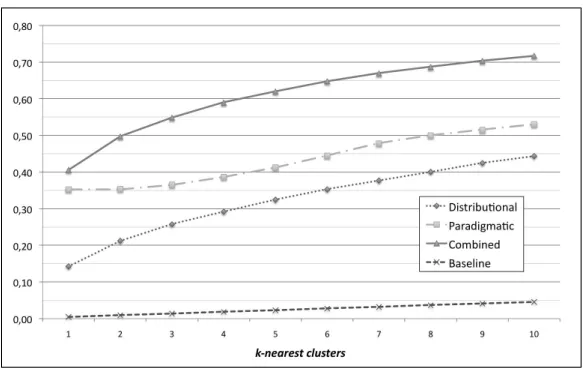
Results for English are reported in Figure 2.
As shown, all methods improve significantly the baseline whereas accuracy values naturally improve along increasing values fork. The performance of the paradigmatic model are significantly high even for very small k. The best model is given by the combination of distributional and paradigmatic similarity, producing significant im-provements wrt the paradigmatic model alone.
Figure 2: Accuracy of the leave-one-out over the English FrameNet 1.3
model for the test has been obtained using as source the LUs in the English FrameNet. As the computation of thesimW N(F,w)depends only on the hyponymy hierarchy, for
each Italian nounnthe conceptual density computation over the set{n} ∪Fis applied,
whereF is given by the LUs in English. The interlingual index is here used to map
everynto its lexical senses (i.e. synsets) in the English WN. Then, the computation
of the greedy algorithm is applied exactly as in the monolingual process. The same approach has been used for verbs (Equation 4) and adjectives (Equation 5).
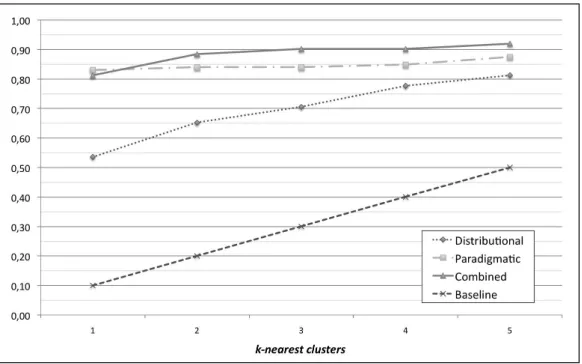
Although the limited scale of the experiment (only 11 frames are targeted), the ev-idence are similar as for the test over English: the combined model is always superior to the individual ones. High levels of accuracy are achieved, although the “most likely frame” baseline is much higher than for the English test. Similar trends are also ob-served for the paradigmatic model, reaching a plateau for smaller values ofk. Overall
results indicate that reliable predictions can be obtained for unknown LUs also when a whole Italian FrameNet is not yet available. Our method can then be used to support lexicographers in the task of building a new FrameNet, in the specific stage of adding LUs to frames.
Results suggest that the WordNet models derived from the English LUs are valid predictors also for Italian words, as confirmed by the experiments in the next sections.
3.2 Assessing WordNet models of Frames
The goal of the experiment is to validate the notion of WordNet model of a frame as derived through the method discussed in Section 2.1. Formally, given the set of all possible WordNet sensesSl of a given LUl, we aim at mapping each senses∈Sl to
the correct frame f ∈Fl, whereFlis the set of frames in whichlappears. If a frame
cannot be found for a given sense, the sense is simply neglected.
For example, the LUburnhas 15 senses in WordNet and it belongs to 3 frames:
Figure 3: Accuracy of the leave-one-out tests over 11 frames in Italian
reports some of the possible correct mapping between senses and frames. Other senses, such as “destroy by fire” cannot be mapped to any existing frame.
By creating such an automatic mapping we achieve three goals. First, we disam-biguate FrameNet lexical units. Second, we enrich WordNet synsets with new infor-mation — i.e. a computational description of the situations they refer to, as repre-sented in FrameNet. Third, we derive a language independent model of frames based on WordNet synsets.
The mapping targeted by the experiment is carried out according to the discussion in Section 2.1. The WordNet model of a frame F for nouns is the outcome of the greedy cd computation over the set F of all frame’s LUs: given a LU, a sense is accepted if it is a member of the setLFin the model. For verbs and adjectives all
co-hyponyms and synonyms used in Equations 4 and 5 are included inLF. The procedure
for developing a WordNet model is completely automatic, this avoiding the costs of manual annotation.5
Note that our approach is easily portable to languages different from English. In-deed, the WordNet hierarchy is the backbone of sense repositories in other languages (as for example in MultiWordNet (Pianta et al., 2008)). The English modelsW NFcan
be then interpreted in a different language, by applying the interlingual indexes to all synsets LF inW NF. The corresponding sets of synonyms are natural candidates as
LUs in the target language.
Evaluation
In this experiment, in order to account for data sparseness we reduce the dataset in two ways. First, we neglect low frequency lexical units: LUs occurring less than 50 times in the corpus are not considered. Second, we exclude frames that have less than
5In this experiment we focus on verbs and nouns, since they are core predicates expressing the targeted
Table 2: Mapping between WordNet senses and frames for verbburn, as induced by
the paradigmatic method
Synset Evoked FRAME Co-Hyponyms WordNet Definition
1775952 EMOTION_HEAT chafe, fume, smolder Feel strong emotion, especially anger or passion; “She was burning with anger”; “He was burning to try out his new skies”
189569 EXPERIENCE_BODILY_HARM break, bruise, hurt, injure
Burn with heat, fire, or radiation; “The iron burnt a hole in my dress” 2059143 PERCEPTION_BODY itch, sting Cause a sharp or stinging pain or
dis-comfort; “The sun burned his face”
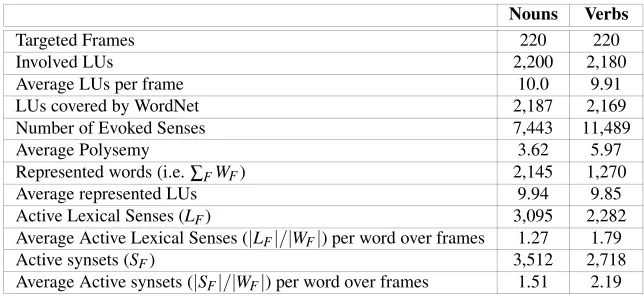
10 LUs. This leaves us with 220 frames, involving 2,200 nominal LUs and 2,180 verbal LUs. Table 3 reports overall statistics. Over the 2,200 nouns and 2,180 verbs examined, the vast majority is covered by WordNet (fourth row). For these words, a large set of lexical senses exist in WordNet giving an average polysemy between 3 and 6 senses per word (sixth row). Our paradigmatic method is able to significantly reduce the average polysemy: only 1.79 senses per verb survive among the initial 5.29, while only 1.29 among the 3.62 are retained for nouns. Moreover, the number of senses used to entirely represent a frame in a paradigmatic model (i.e.SF) is about 3,512 and
2,718 respectively for nouns and verbs, as averaged across all frames. An example of the mapping produced by our method is reported in Table 2.
The above statistics suggest that a consistent reduction in average polysemy can be obtained when the context of a frame is used to model semantic similarity among LUs in WordNet.
Table 3: Statistics on nominal and verbal senses in the paradigmatic model of the English FrameNet
Nouns Verbs
Targeted Frames 220 220
Involved LUs 2,200 2,180
Average LUs per frame 10.0 9.91
LUs covered by WordNet 2,187 2,169
Number of Evoked Senses 7,443 11,489
Average Polysemy 3.62 5.97
Represented words (i.e.∑FWF) 2,145 1,270
Average represented LUs 9.94 9.85
Active Lexical Senses (LF) 3,095 2,282
Average Active Lexical Senses (|LF|/|WF|) per word over frames 1.27 1.79
Active synsets (SF) 3,512 2,718
Average Active synsets (|SF|/|WF|) per word over frames 1.51 2.19
[image:12.595.136.458.506.654.2]analysed all 786 senses of 306 LUs in 4 frames (i.e. KILLING, PEOPLE_BY_AGE,
STATEMENTand CLOTHING). The Cohen’s kappa, computed over two frames (i.e. KILLINGand PEOPLE_BY_AGEfor 192 senses of 77 words) results in a 0.90 inter-annotator agreement: this indicates that senses and frames are highly correlated and their mapping is consistent and motivated, as Table 2 suggests.
The system is considered to accept a senseσfor a given frameFiff the conceptual density score characterizing such a sense is positive, i.e. theσ∈LF. Our method
obtained a Precision of 0.803 and a Recall of 0.79 (F-measure=0.796). Among the 786 senses tested, 85 false positives and 92 false negatives have been found: 346 senses have been correctly accepted and 263 true negatives have been rejected by the sytem. It must be also noticed that the conceptual density scores obtained are well correlated with correct senses. If senses of a word with significantly lowercdscores than others
are removed from the setLF of a frame, a significant improvement in precision can
be obtained. For example,tiein CLOTHINGhas 9 senses, of which 3 are proposed by
the system, corresponding to 1 true positives, 2 false positives and 6 true negatives. It is interesting to note that the true positive sense (i.e. {necktie, tie}as “a neckwear consisting of a long narrow piece of material worn ...”) has acdscore of 0.492, while
0.018 is the score of all the three false positives (i.e. sense #5{link,linkup tie, tie-in}
as “a fastener that serves to join or link”; sense #8{tie, railroad tie, crosstie, sleeper}
as “one of the cross braces that support the rails on a railway track”; sense #9{tie}as “a cord with which something is tied”). A careful selection policy can be thus easily devised to deal with such skewed preference distributions and achieve higher values of precision by neglecting lower preferences.
These results show that the proposed frame WordNet model is not only effective in reducing the average lexical polysemy (as shown in Table 3), but it is also a rather accurate method to capture the lexical semantics implied by frames. The achieved level of accuracy justifies the adoption of the model defined in (3) for the development of FrameNets in languages other than English.
3.3 Development of an Italian FrameNet
In this section we explore the use of our English paradigmatic model to automatically support the building process of a FrameNet in a different language, namely Italian. In particular, we leverage the modelW NF for the English language to induce new LUs
forFin the new language. To do so, we proceed as follows.
For each frameF in FrameNet we first generate the WordNet model for English
W NF using all the LUs available in the database, as discussed in Section 2.1. Then,
we use an interlingual index (e.g. MultiWordNet) to obtain words in the new language corresponding to lexical sensesLF in the modelW NF. Each of thesetranslated LU
l is a cross-lingual synonym of at least a sense inSF and is a candidate LUs for the
frame in the new language, since it satisfiessimW N(F,l)>ε.
Evaluation
Table 4: Number of generated Lexical Units
Number of LUs
Nouns 6611
Verbs 8332
Adjectives 129
Total 15072
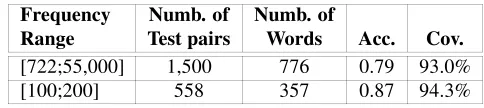
To evaluate the quality of the translated LUs we performed two different tests. In the first test, we collected the 776 most frequent words in the Europarliament corpus, including many generic nouns and verbs, such asprodurre(to_produce/make),fare
(to_make/fabricate),avere(to_have). Then we manually validated all the 1,500 sys-tem decisions regarding these words. A decision is accepted if the frame suggested for the word is correct for at least one of its senses. Accuracyis computed as the per-centage of the correct system decisions over the number of validated cases. For some words no frame was predicted, as they were not in Wordnet or as no Wordnet model was able to correctly generalize them. The percentage of words receiving at least one correct prediction, i.e. assigned to at least one frame accepted by the annotators, is here calledCoverage, and reported with the accuracy scores in the second line of
[image:14.595.175.417.485.539.2]Ta-ble 5. The above test was repeated also for more specific words, with a number of occurrences in the corpus ranging from 100 to 200. Results are reported in the third line of Table 5. These outcomes are surprisingly good especially considering that the computation of the individualsimW N(F,l)scores is fully automatic.
Table 5: Manual validation of the italian LUs generated through WordNet
Frequency Numb. of Numb. of
Range Test pairs Words Acc. Cov.
[722;55,000] 1,500 776 0.79 93.0% [100;200] 558 357 0.87 94.3%
In a second test, the results generated by our method were compared against the words of the oracle manually developed for the experiment in Section 3.1. In this case, the predictions of the method about frames and words are compared with the oracle. As no filter has been here applied with respect to the corpus, all the 527
<LU,Frame>pairs in the manually created oracle have been used6, although only
437 pairs were represented through the MultiWordNet resources. The system was not able to decide for 71 words, and produced wrong guesses for 49 words: 317 correct guesses are thus produced. The results is a Precision of 0.87 and a Recall of 0.72. The recall value, lower than the coverage observed in the previous test, is also by a significant generative effect: the methoddiscoversa number of new entries not accounted for in the oracle.
6Notice that no LU was multiply assigned to different frames in the oracle, so that the number of
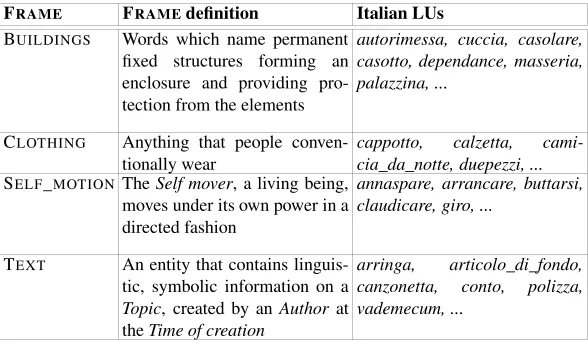
Table 6: Excerpt of the Italian LUs in four different frames
FRAME FRAMEdefinition Italian LUs
BUILDINGS Words which name permanent fixed structures forming an enclosure and providing pro-tection from the elements
autorimessa, cuccia, casolare, casotto, dependance, masseria, palazzina, ...
CLOTHING Anything that people conven-tionally wear
cappotto, calzetta, cami-cia_da_notte, duepezzi, ...
SELF_MOTION TheSelf mover, a living being, moves under its own power in a directed fashion
annaspare, arrancare, buttarsi, claudicare, giro, ...
TEXT An entity that contains linguis-tic, symbolic information on a
Topic, created by anAuthorat theTime of creation
arringa, articolo_di_fondo, canzonetta, conto, polizza, vademecum, ...
Typical new LUs introduced in the oracle are words not accounted for in the En-glish Framenet, as reported in Table 6. The table shows that most of the new guesses of the system are indeed highly plausible. They represent widely used dialectal forms (e.g.masseriain the frame BUILDING), jargon (e.g.duepezziin CLOTHING),
techni-cal terms (e.g.polizzain TEXT) and specific nouns (e.g.autorimessain BUILDINGS).
Although it is certainly questionable if words likearticolo_di_fondo(i.e.main article
in a newspaper) are worth to be considering as LUs for the frame TEXT, it is clear that if the application domain requires frame-like information, the presented model (even only the paradigmatic association here discussed) provides an effective tool for fast and robust prototyping. Notice that the low Recall (only 0.60 of the oracle words are correctly addressed), can be compensated by combining paradigmatic and distribu-tional similarity (Equation 8), as experiments reported in Figure 3 suggest. We leave this last point as a future work.
4
Conclusions
Italian, we automatically generated a very large and accurate set of 15,000 LUs. The overall framework has encouraged us to develop a robust toolbox for the large scale acquisition of FrameNet-like lexicons in different domains and languages. The tool will be made publicly available for research studies in this area. Future work is on going on the adoption of richer models for Framenet, able to take into account more evidence than LUs, such as frame elements and syntagmatic information. Moreover, the use of the derived space as a model for the recognition of frames in free-texts is expected to speed-up the development of a large collection of annotated sentences for the Italian language.
References
Agirre, E. and G. Rigau (1996). Word sense disambiguation using conceptual density. InProceedings of COLING-96, Copenhagen, Denmark.
Baker, C. F., C. J. Fillmore, and J. B. Lowe (1998). The Berkeley FrameNet project. InProceedings of COLING-ACL, Montreal, Canada.
Basili, R., M. Cammisa, and F. Zanzotto (2004). A semantic similarity measure for unsupervised semantic disambiguation. InProceedings of LREC-04, Lisbon, Por-tugal.
Basili, R., D. D. Cao, P. Marocco, and M. Pennacchiotti (2007). Learning selectional preferences for entailment or paraphrasing rules. InProceedings of RANLP 07.
Burchardt, A., K. Erk, and A. Frank (2005). A wordnet detour to framenet. In Pro-ceedings of the GLDV 2005 GermaNet II Workshop, Bonn, Germany.
Burchardt, A., K. Erk, A. Frank, A. Kowalski, S. Pado, and M. Pinkal (2006). The salsa corpus: a german corpus resource for lexical semantics. InProceedings of the 5th International Conference on Language Resources and Evaluation, Genova,
Italy.
Burchardt, A., M. Pennacchiotti, S. Thater, and M. Pinkal (2008). Assessing the impact of frame semantics on textual entailment. Journal of Natural Language Engineering (to appear).
Clark, P., P. Harrison, J. Thompson, W. Murray, J. Hobbs, and C. Fellbaum (2007, June). On the Role of Lexical and World Knowledge in RTE3. InProceedings of the ACL-PASCAL Workshop on Textual Entailment and Paraphrasing, Prague, pp.
54–59. Association for Computational Linguistics.
Harris, Z. (1964). Distributional structure. In J. J. Katz and J. A. Fodor (Eds.),The Philosophy of Linguistics, New York. Oxford University Press.
Heyer, L., S. Kruglyak, and S. Yooseph (1999). Exploring expression data: Identifi-cation and analysis of coexpressed genes. Genome Research 9, 1106–1115.
Landauer, T. and S. Dumais (1997). A solution to plato’s problem: The latent se-mantic analysis theory of acquisition, induction and representation of knowledge.
Psychological Review 104, 211–240.
Lin, D. and P. Pantel (2001). DIRT-discovery of inference rules from text. In Proceed-ings of the ACM Conference on Knowledge Discovery and Data Mining (KDD-01), San Francisco, CA.
Miller, G., R. Beckwith, C. Fellbaum, D. Gross, and K. Miller. (1990). An on-line lexical database.International Journal of Lexicography 13(4), 235–312.
Pado, S. (2007). Cross-Lingual Annotation Projection Models for Role-Semantic In-formation, Volume 21 ofSaarbrücken Dissertations in Computational Linguistics and Language Technology. Saarland University.
Pado, S. and M. Lapata (2007). Dependency-based construction of semantic space models. Computational Linguistics 33(2), 161–199.
Padó, S., M. Pennacchiotti, and C. Sporleder (2008). Semantic role assignment for event nominalisations by leveraging verbal data. InProceedings of COLING 2008, Manchester, UK.
Pianta, E., L. Bentivogli, and C. Girardi (2008). MultiWordNet: Developing an aligned multilingual database. In Proceedings of the 1st International Global WordNet Conference, Marrakech, Morocco, pp. 293–302.
Pitel, G. (2006). Using bilingual lsa for framenet annotation of french text from generic resources. InWorkshop on Multilingual Semantic Annotation: Theory and Applications, SaarbrÃijcken, Germany.
Sahlgren, M. (2006). The Word-Space Model. Ph. D. thesis, Department of
Linguis-tics, Stockholm University.
Schütze, H. (1993). Word space. In S. Hanson, J. Cowan, and C. Giles (Eds.), Ad-vances in Neural Information Processing Systems 5. Morgan Kaufmann Publishers.
Shen, D. and M. Lapata (2007). Using semantic roles to improve question answer-ing. InProceedings of the Conference on Empirical Methods in Natural Language Processing and on Computational Natural Language Learning, Prague, pp. 12–21.
Subirats, C. and M. Petruck (2003). Surprise! Spanish FrameNet! InProceedings of the Workshop on Frame Semantics at the XVII. International Congress of Linguists,
Prague.