GrAF: A Graph-based Format for Linguistic Annotations
Nancy Ide
Department of Computer Science Vassar College
Poughkeepsie, New York USA [email protected]
Keith Suderman
Department of Computer Science Vassar College
Poughkeepsie, New York USA [email protected]
Abstract
In this paper we describe the Graph Anno-tation Format (GrAF) and show how it is used represent not only independent lin-guistic annotations, but also sets of merged annotations as a single graph. To demon-strate this, we have automatically trans-duced several different annotations of the
Wall Street Journal corpus into GrAF and show how the annotations can then be merged, analyzed, and visualized using standard graph algorithms and tools. We also discuss how, as a standard graph rep-resentation, it allows for the application of well-established graph traversal and analysis algorithms to produce information about interactions and commonalities among merged annotations. GrAF is an extension of the Linguistic Annotation Framework (LAF) (Ide and Romary, 2004, 2006) developed within ISO TC37 SC4 and as such, implements state-of-the-art best practice guidelines for representing linguistic annotations.
1 Introduction
Although linguistic annotation of corpora has a long history, over the past several years the need for corpora annotated for a wide variety of phe-nomena has come to be recognized as critical for the future development of language processing ap-plications. Considerable attention has been devoted to the development of means to represent annota-tions so that phenomena at different levels can be merged and/or analyzed in combination. A
particu-lar focus has been on the development of standards and best practices for representing annotations that can facilitate “annotation interoperability”, that is, the use and re-use of annotations produced in dif-ferent formats and by difdif-ferent groups and to en-able easy adaptation to the input requirements of existing annotation tools.
In this paper we describe the Graph Annotation Format (GrAF) and show how it is used represent not only independent linguistic annotations, but also sets of merged annotations as a single graph. We also discuss how, as a standard graph represen-tation, it allows for the application of well-established graph traversal and analysis algorithms to produce information about interactions and commonalities among merged annotations. GrAF is is an extension of the Linguistic Annotation Framework (LAF) (Ide and Romary, 2004, 2006) developed within ISO TC37 SC41 and as such, im-plements state-of-the-art best practice guidelines for representing linguistic annotations.
This paper has several aims: (1) to show the generality of the graph model for representing lin-guistic annotations; (2) to demonstrate how the graph-based model enables merging and analysis of multi-layered annotations; and (3) to propose as the underlying model for linguistic annotations, due to its generality and the ease with which it is mapped to other formats. To accomplish this, we have automatically transduced several different annotations of the Wall Street Journal corpus into GrAF and show how the annotations can then be merged, analyzed, and visualized using standard graph algorithms and tools. Discussion of the
1
transduction process brings to light several prob-lems and concerns with current annotation formats and leads to some recommendations for the design of annotation schemes.
2 Overview
Graph theory provides a well-understood model for representing objects that can be viewed as a con-nected set of more elementary sub-objects, to-gether with a wealth of graph-analytic algorithms for information extraction and analysis. As a result, graphs and graph-analytic algorithms are playing an increasingly important role in language data analysis, including finding related web pages (Kleinberg, 1999; Dean and Henzinger, 1999; Brin, 1998; Grangier and Bengio, 2005), patterns of web access (McEneaney, 2001; Zaki, 2002), and the extraction of semantic information from text (Widdows and Dorow, 2002; Krizhanovsky, 2005; Nastase and Szpakowicz, 2006). Recently, there has been work that treats linguistic annotations as graphs (Cui et al., 2005; Bunescu and Mooney, 2006; Nguyen et al., 2007; Gabrilovich and Mark-ovitch, 2007) in order to identify, for example, measures of semantic similarity based on common subgraphs.
As the need to merge and study linguistic anno-tations for multiple phenomena becomes increas-ingly important for language analysis, it is essential to identify a general model that can capture the relevant information and enable efficient and effec-tive analysis. Graphs have long been used to de-scribe linguistic annotations, most familiarly in the form of trees (a graph in which each node has a single parent) for syntactic annotation. Annotation Graphs (Bird and Liberman, 2001) have been widely used to represent layers of annotation, each associated with primary data, although the concept was not extended to allow for annotations linked to other annotations and thus to consider multiple annotations as a single graph. More recently, the Penn Discourse TreeBank released its annotations of the Penn TreeBank as a graph, accompanied by an API that provides a set of standard graph-handling functions for query and access2. The
graph model therefore seems to be gaining ground as a natural and flexible model for linguistic anno-tations which, as we demonstrate below, can
2
http://www.seas.upenn.edu/~nikhild/PDTBAPI/
sent all annotation varieties, even those that were not originally designed with the graph model as a basis.
2.1 LAF
[image:2.612.327.513.266.388.2]LAF provides a general framework for represent-ing annotations that has been described elsewhere in detail (Ide and Romary, 2004, 2006). Its devel-opment has built on common practice and conver-gence of approach in linguistic annotation over the past 15-20 years. The core of the framework is specification of an abstract model for annotations instantiated by a pivot format, into and out of which annotations are mapped for the purposes of exchange.
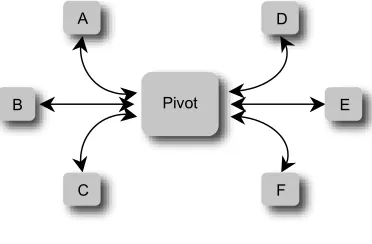
Figure 1: Use of the LAF pivot format
Figure 1 shows the overall idea for six different user annotation formats (labeled A – F), which re-quires two mappings for each scheme—one into and one out of the pivot format, provided by the scheme designer. The maximum number of map-pings among schemes is therefore 2n, vs. n2-n
mu-tual mappings without the pivot.
To map to the pivot, an annotation scheme must be (or be rendered via the mapping) isomorphic to the abstract model, which consists of (1) a referen-tial structure for associating stand-off annotations with primary data, instantiated as a directed graph; and (2) a feature structure representation for anno-tation content. An annoanno-tation thus forms a directed graph referencing n-dimensional regions of pri-mary data as well as other annotations, in which nodes are labeled with feature structures providing the annotation content. Formally, LAF consists of:
• A data model for annotations based on directed
graphs defined as follows: A graph of annota-tions G is a set of vertices V(G) and a set of edges E(G). Vertices and edges may be labeled
Pivot A
B
C F
with one or more features. A feature consists of a quadruple (G’, VE, K, V) where, G’ is a graph,
VE is a vertex or edge in G’, K is the name of the feature and V is the feature value.
• A base segmentation of primary data that
de-fines edges between virtual nodes located be-tween each “character” in the primary data.3
The resulting graph G is treated as an edge graph G’ whose nodes are the edges of G, and which serve as the leaf (“sink”) nodes. These nodes provide the base for an annotation or several layers of annotation. Multiple segmen-tations can be defined over the primary data, and multiple annotations may refer to the same segmentation.
• Serializations of the data model, one of which is
designated as the pivot.
• Methods for manipulating the data model.
Note that LAF does not provide specifications for annotation content categories (i.e., the labels describing the associated linguistic phenomena), for which standardization is a much trickier matter. The LAF architecture includes a Data Category Registry (DCR) containing pre-defined data ele-ments and schemas that may be used directly in annotations, together with means to specify new categories and modify existing ones (see Ide and Romary, 2004).
2.2 GrAF
GrAF is an XML serialization of the generic graph structure of linguistic annotations described by LAF. A GrAF document represents the referential structure of an annotation with two XML elements:
<node> and <edge>. Both <node> and <edge>
elements may be labeled with associated annota-tion informaannota-tion. Typically, annotaannota-tions describing a given object are associated with <node> ele-ments. Although some annotations, such as de-pendency analyses, are traditionally depicted with labeled edges, GrAF converts these to nodes in order to analyze both the annotated objects and the relations of a graph uniformly. Associating annota-tions with nodes also simplifies the association of an annotation (node) with multiple objects.
3 A character is defined to be a contiguous byte sequence of a
specified length .For text, the default is UTF-16.
According to the LAF specification, an annota-tion is itself a graph representing a feature structure. In GrAF, feature structures are encoded in XML according to the specifications of ISO TC37 SC4 document 1884. The feature structure graph
associ-ated with a given node is the corresponding
<node> element’s content. Note that the ISO specifications implement the full power of feature structures and define inheritance, unification, and subsumption mechanisms over the structures, thus enabling the representation of linguistic informa-tion at any level of complexity. The specificainforma-tions also provide a concise format for representing sim-ple feature-value pairs that suffices to represent many annotations, and which, because it is suffi-cient to represent the vast majority of annotation information, we use in our examples.
<edge> elements may also be labeled (i.e.,
as-sociated with a feature structure), but this informa-tion is typically not an annotainforma-tion per se, but rather information concerning the meaning, or role, of the link itself. For example, in PropBank, when there is more than one target of an annotation (i.e., a node containing an annotation has two or more outgoing edges), the targets may be either co-referents or a “split argument” whose constituents are not contiguous, in which case the edges collect an ordered list of constituents. In other case, the outgoing edges may point to a set of alternatives. To differentiate the role of edges in such cases, the edge may be annotated. Unlabeled edges default to pointing to an unordered list of constituents.
A base segmentation contains only <sink>
elements (i.e., nodes with no outgoing edges), which are a sub-class of <node> elements. As noted above, the segmentation is an edge graph created from edges (spans) defined over primary data. The from and to attributes on <sink>
ele-ments in the base segmentation identify the start and end points of these edges in the primary data.
Each annotation document declares and associ-ates the elements in its content with a unique namespace. Figure 2 shows several XML frag-ments in GrAF format.
4
Figure 2: GrAF annotations in XML
3 Transduction
To test the utility of GrAF for representing annotations of different types produced by different groups, we transduced the Penn TreeBank (PTB), PropBank (PB), NomBank (NB), Penn Discourse TreeBank (PDTB), and TimeBank (TB) annotations of the Wall Street Journal (WSJ)
corpus to conform to the specifications of LAF and GrAF. These annotations are represented in several different formats, including both stand-off and embedded formats. The details of the transduction process, although relatively mundane, show that the process is not always trivial. Furthermore, they reveal several seemingly harmless practices that can cause difficulties for transduction to any other format and, therefore, use by others. Consideration of these details is therefore informative for the development of best practice annotation guidelines. The Penn TreeBank annotations of the WSJ are embedded in the data itself, by bracketing compo-nents of syntactic trees. Leaf nodes of the tree are comprised of POS-word pairs; thus, the PTB in-cludes annotations for both morpho-syntax and syntax. To coerce the annotations into LAF/GrAF, it was necessary to
• extract the text in order to create a primary
data document;
• provide a primary segmentation reflecting
the tokenization implicit in the PTB;
• separate the morpho-syntactic annotation
from the syntactic annotation and render
each as a stand-off document in GrAF for-mat, with links to the primary segmentation. NB, PB, and PDTB do not annotate primary data, but rather annotate the PTB syntax trees by providing stand-off documents with references to PTB Tree nodes. The format of the NB and PB stand-off annotations is nearly identical; consider for example the following PB annotation:
wsj/00/wsj_0003.mrg 18 18 gold include.01 p---a 14:1,16:1-ARG2 18:0-rel 19:1-ARG1
In GrAF, this becomes
Each line in the PB and NB stand-off files pro-vides a single annotation and therefore interpreted as an annotation node with a unique id. Each anno-tation is associated with a node with an edge to the annotated entity. The PB/NB comma notation (e.g.,
14:1,16:1) denotes reference to more than one
node in the PTB tree; in GrAF, a dummy node is created to group them so that if, for example, a NB annotation refers to the same node set, in a merged representation a graph minimization algorithm can collapse the dummy nodes while retaining the an-notations from each of PB and NB as separate nodes.
Some interpretation was required for the trans-duction, for example, we assume that the sense number and morpho-syntactic descriptor are asso-ciated with the element annotated as “rel” (vs. the “gold” status that is associated with the entire proposition), an association that is automatically discernible from the structure. Also, because the POS/word pairs in the PTB leaf nodes have been split into separate nodes, we assume the PB/NB annotations should refer to the POS annotation rather than the string in the primary data, but either option is possible.
Given the similarities of the underlying data models for the PDTB and LAF, creating GrAF-compliant structures from the PDTB data is
rela-role: ARG1
role: ARG2
cat: NP role: rel
sns: 01 msd: p---a
cat: NP
cat: VBG cat: PP
id: pb0003.18 status: gold
Base segmentation:
<seg:sink seg:id="42" seg:start="24" seg:end="35"/>
Annotation over the base segmentation:
<msd:node msd:id=”16”>
<msd:f name=”cat” value=”NN”/> </msd:node>
<msd:edge from="msd:16" to="seg:42"/>
Annotation over another annotation:
<ptb:node ptb:id="23">
<ptb:f name="type" value="NP"/> <ptb:f name="role" value="-SBJ"/> </ptb:node>
tively trivial. This task is simplified even further because the PDTB API allows PDTB files to be loaded in a few simple steps, and allows the pro-grammer to set and query features of the node as well as iterate over the children of the node. So, given a node P that represents the root node of a PDTB tree, an equivalent graph G in GrAF format can be created by traversing the PDTB tree and creating matching nodes and edges in the graph G.
Like the PTB, TimeBank annotation is embed-ded in the primary data by surrounding annotated elements with XML tags. TB also includes sets of “link” tags at the end of each document, specifying relations among annotated elements. The same steps for rendering the PTB into GrAF could be followed for TB; however, this would result in a separate (and possibly different) primary data document. Therefore, it is necessary to first align the text extracted from TB with the primary data derived from PTB, after which the TB XML anno-tations are rendered in GrAF format and associated with the corresponding nodes in the base segmen-tation.
Note that in the current GrAF representation, TB’s tlink, slink, and alink annotations are applied to edges, since they designate relations among nodes. However, further consideration of the na-ture and use of the information associated with these links may dictate that associating it with a node is more appropriate and/or useful.
Variations in tokenization exist among the dif-ferent annotations, most commonly for splitting contractions or compounds (“cannot” split into “can” and “not”, “New York-based” split into “New York”, “-“, and “based”, etc.). This can be handled by adding edges to the base segmentation (not necessarily in the same segmentation docu-ment) that cover the relevant sub-spans, and point-ing to the new edge nodes as necessary. Annota-tions may now reference the original span, the en-tire annotation, or any sub-part of the annotation, by pointing to the appropriate node. Alternative segmentations of the same span can be joined by a “dummy” parent node so that when different anno-tations of the same data are later merged, nodes labeling a sub-graph covering the same span can be combined. For example, in Figure 3, if the PTB segmentation (in gray) is the base segmentation, an alternative segmentation of the same span (in black) is created and associated to the PTB seg-mentation via a dummy node. When annotations
[image:5.612.319.531.155.318.2]using each of the different segmentations are merged into a single graph, features associated with any node covering the same sub-tree (in bold) are applied to the dummy node (as a result of graph minimization), thus preserving the commonality in the merged graph.
Figure 3: Alternative segmentations
4 Merging Annotations
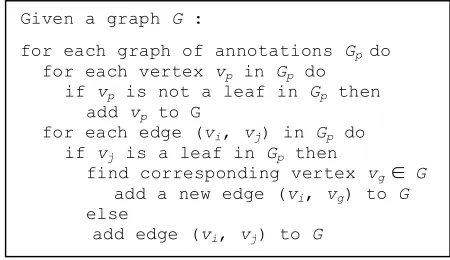
Once they are in in GrAF format, merging annota-tions of the same primary data, or annotaannota-tions ref-erencing annotations of the same primary data, in-volves simply combining the graphs for each anno-tation, starting with graph G describing the base segmentationandusing the algorithm in Figure 4. Once merged, graph minimization, for which effi-cient algorithms exist (see, e.g., Cardon and Cro-chemore, 1982; Habib et al., 1999), can be applied to collapse identically-labeled nodes with edges to common subgraphs and eliminate dummy nodes such as the one in Figure 3.
Figure 4: Graph-merging algorithm
cat: NP
cat: PUNC type: hyphen
cat: VBG
N e w Y o r k - b a s e d
cat: JJ cat: NNP
cat: ADJP
role: alt role: alt
Given a graph G :
for each graph of annotations Gp do
for each vertex vp in Gp do
if vp is not a leaf in Gp then
add vp to G
for each edge (vi, vj) in Gp do
if vj is a leaf in Gp then
find corresponding vertex vg ∈ G
add a new edge (vi, vg) to G
else
[image:5.612.317.542.539.669.2]5 Using the Graphs
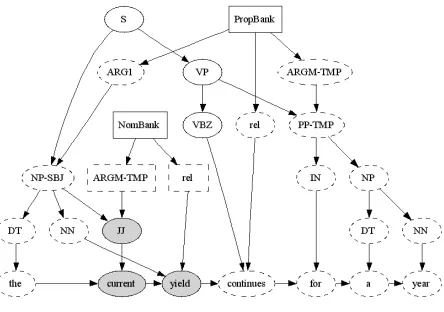
[image:6.612.76.298.256.412.2]Because the GrAF format is isomorphic to input to many graph-analytic tools, existing software can be exploited; for example, we have generated graph diagrams directly from a merged graph in-cluding PTB, NB, and PB annotations using GraphViz5, which takes as its input a simple text file representation of a graph. Generating the input files to GraphViz involves simply iterating over the nodes and edges in the graph and printing out a suitable string representation. Figure 5 shows a segment of the GraphViz output generated from the PTB/NB/PB merged annotations (modified slightly for readability).
Figure 5: Fragment of GraphViz output
Graph-traversal and graph-coloring algorithms can be used to identify and generate statistics concern-ing commonly annotated components in the merged graph. For example, we modified the merging algorithm to "color" the annotated nodes as the graphs are constructed to reflect the source of the annotation (e.g., PTB, NB, PB, etc.) and the annotation content itself. Colors are propagated via outgoing edges down to the base segmentation, so that each node in the graph can be identified by the source and type of annotation applied. The colored graph can then be used to identify common sub-graphs. So, for example, a graph traversal can identify higher-level nodes in PTB that cover the same spans as TB annotations, which in the merged graph are connected to sink nodes (tokens) only, thus effectively “collapsing” the two annota-tions.
5
www.graphviz.org
Traversal of the colored graph can also be used to generate statistics reflecting the interactions among annotations. As a simple example, we gen-erated a list of all nodes annotated as ARG0 by both PB and NB6, the “related” element (a verb for
PB, a nominalization for NB), the PTB annotation, and the set of sink nodes covered by the node, which reveals clusters of verb/nominalization pairs and can be used, for example, to augment semantic lexicons. Similar information generated via graph traversal can obviously provide a wealth of statis-tics that can in turn be used to study interactions among linguistic phenomena. Other graph-analytic algorithms—including common sub-graph analy-sis, shortest paths, minimum spanning trees, con-nectedness, identification of articulation vertices, topological sort, graph partitioning, etc.—may prove to be useful for mining information from a graph of annotations at multiple linguistic levels, possibly revealing relationships and interactions that were previously difficult to observe. We have, for example, generated frequent subgraphs of the PB and NB annotations using the IBM Frequent Subgraph Miner7 (Inokuchi et al., 2005). We are currently exploring several additional applications of graph algorithms to annotation analysis.
The graph format also enables manipulations that may be desirable in order to add information, modify the graph to reflect additional analysis, cor-rect errors, etc. For example, it may be desirable to delete or move constituents such as punctuation and parenthetical phrases under certain circum-stances, conjoin sub-graphs whose sink nodes are joined by a conjunction such as “and”, or correct PP attachments based on information in the tree.
6 Discussion
GrAF provides a serialization of annotations that follows the specifications of LAF and is therefore a candidate to serve as the LAF pivot format. The advantages of a pivot format, and, in general, the use of the graph model for linguistic annotations, are numerous. First, transduction of the various formats into GrAF, as described in section 4, de-manded substantial programming effort; similar effort would be required to transduce to any other
6
The gray nodes in Figure 5 are those that have been “col-ored” by both PB and NB.
7
format, graph-based or not. The role of the LAF pivot format is to reduce this effort across the com-munity by an order of magnitude, as shown in Figure 1. Whether or not GrAF is the pivot, the adoption of the graph model, at least for the pur-poses of exchange, would result in a similar reduc-tion of effort, since graph representareduc-tions are in general trivially mappable.
In addition to enabling the generation of input to a wide range of graph-handling software, the graph model for annotations is isomorphic to representa-tion formats used by emerging annotarepresenta-tion frame-works, in particular, UIMA’s Common Analysis System8. It is also compatible with tools such as
the PDTBAPI, which is easily generalized to han-dle graphs as well as trees. In addition, the graph model underlies Semantic Web formats such as RDF and OWL, so that any annotation graph is trivially transducable to their serializations (which include not only XML but several others as well), and which, as noted above, has spawned a flurry of research using graph algorithms to extract and ana-lyze semantic information from the web.
A final advantage of the graph model is that it provides a sound basis for devising linguistic anno-tation schemes. For example, the PB and NB for-mat, although ultimately mappable to a graph rep-resentation, was not developed with the graph model as a basis. The format is ambiguous as to the relations among the parts of the annotation, in particular, the relation between the information at the beginning of the line providing the status (“gold”), sense number, and morpho-syntactic de-scription, and the rest of the annotation. Human interpretation can determine that the status (proba-bly) applies to the whole annotation, and the sense number and msd apply to the PTB lexical item be-ing annotated, as reflected in the graph-based rep-resentation given in section 3. This somewhat in-nocuous example demonstrates an all-too-pervasive feature of many annotation schemes: reliance on human interpretation to determine structural relations that are implicit in the content
of the annotation. Blind automatic transduction of the format to any other format is therefore impos-sible, and the interpretation, although more or less clear in this example, is prone to human error. If the designers of the PB/NB format had begun with a graph-based model—i.e., had been forced to
8
http://www.alphaworks.ibm.com/tech/uima
“draw the circles and lines”—this ambiguity would likely have been avoided.
7 Conclusion
We have argued that a graph model for linguistic annotations provides the generality and flexibility required for representing linguistic annotations of different types, and provides powerful and well-established means to analyze these annotations in ways that have been previously unexploited. We introduce GrAF, an XML serialization of the graph model, and demonstrate how it can be used to rep-resent annotations originally made available in widely varying formats. GrAF is designed to be used in conjunction with the Linguistic Annotation Framework, which defines an overall architecture for representing layers of linguistic annotation. We show how LAF stand-off annotations in GrAF format can be easily merged and analyzed, and discuss the application of graph-analytic algo-rithms and tools.
Linguistic annotation has a long history, and over the past 15-20 years we have seen increasing attention to the need for standardization as well as continuing development and convergence of best practices to enable annotation interoperability. Dramatic changes in technology, an in particular the development of the World Wide Web, have impacted both the ways in which we represent lin-guistic annotations and the urgency of the need to develop sophisticated language processing applica-tions that rely on them. LAF and GrAF are not based on brand new ideas, but rather reflect and make explicit what appears to be evolving as common best practice methodology.
References
A. Cardon and Maxime Crochemore, 1982. Partitioning a graph in O(|A| log2 |V| ).Theoretical Computer Sci-ence, 19(1):85–98.
Akihiro Inokuchi, Takashi Washio, and Hiroshi Mo-toda, 2005. A General Framework for Mining Fre-quent Subgraphs from Labeled Graphs. Fundamenta Informaticae, 66:1-2, 53-82.
Andrew A. Krizhanovsky, 2005. Synonym search in
Wikipedia: Synarcher.
Dat P.T Nguyen, Yutaka Matsuo, and Mitsuru Ishizuka, 2007. Exploiting Syntactic and Semantic Information
for Relation Extraction from Wikipedia. IJCAI
Workshop on Text-Mining & Link-Analysis (TextLink 2007).
Dominic Widdows and Beate Dorow, 2002. A graph model for unsupervised lexical acquisition. Proceed-ings of the 19th International Conference on Compu-tational Linguistics, 1093-1099.
Evgeniy Gabrilovich and Shaul Markovitch, 2007. Computing Semantic Relatedness Using Wikipedia-based Explicit Semantic Analysis. Proceedings of the 20th International Joint Conference on Artificial In-telligence, Hyderabad, India.
Hang Cui, Renxu Sun, Keya Li, Min-Yen Kan and Tat-Seng Chua, 2005. Question answering passage re-trieval using dependency relations. SIGIR '05: Pro-ceedings of the 28th Annual International ACM SIGIR Conference on Research and Development in Information Retrieval, 400-407.
Jeffrey Dean, Monika R. Henzinger, 1999. Finding re-lated pages in the World Wide Web. Computer Net-works, 31(11-16):1467–1479.
John E. McEneaney, 2001. Graphic and numerical methods to assess navigation in hypertext. Interna-tional Journal of Human-Computer Studies, 55, 761-786.
Jon M. Kleinberg, 1999. Authoritative sources in a hy-per-linked environment. Journal of the ACM
46(5):604-632.
Michel Habib, Christophe Paul, Laurent Viennot, 1999. Partition refinement techniques: An interesting algo-rithmic tool kit. International Journal of Foundations of Computer Science, 10(2):147–170.
Mohammed J. Zaki, 2002. Efficiently mining trees in a forest. Proceedings of SIGKDD’02.
Nancy Ide and Laurent Romary, 2004. A Registry of Standard Data Categories for Linguistic Annotation.
Proceedings of the Fourth Language Resources and Evaluation Conference (LREC), Lisbon, 135-39. Nancy Ide and Laurent Romary, 2004. International
Standard for a Linguistic Annotation Framework.
Journal of Natural Language Engineering, 10:3-4,
211-225.
Nancy Ide and Laurent Romary, 2006. Representing Linguistic Corpora and Their Annotations. Proceed-ings of the Fifth Language Resources and Evaluation Conference (LREC), Genoa, Italy.
Razvan C. Bunescu and Raymond J. Mooney, 2007. Extracting relations from text: From word sequences to dependency paths. In Anne Kao and Steve Poteet (eds.), Text Mining and Natural Language Process-ing, Springer, 29-44.
Sergey Brin, 1998. Extracting patterns and relations from the world wide web. Proceedings of the 1998 International Workshop on the Web and Databases, 172-183.
Sisay Fissaha Adafre and Maar ten de Rijke, 2005. Dis-covering missing links in Wikipedia. Workshop on Link Discovery: Issues, Approaches and Applica-tions.
Stephen Bird and Mark Liberman, 2001. A formal framework for linguistic annotation. Speech Commu-nication, 33:1-2, 23-60.