Study on Compressive Strength of M20 Grade of
Concrete with Partial Replacement of Cement by
Flyash, Fine Aggregate by Waste Glass Powder
and Coarse Aggregate by E-Plastic Waste
D Suresh1, Dr. K Narasimhulu2, K Nagaraju3
Assistant Professor, Dept. of Civil Engineering, Kuppam Engineering College, Kuppam, Chittoor,
Andhra Pradesh, India1
Professor& HOD, Dept. of Civil Engineering, Kuppam Engineering College, Kuppam, Chittoor,
Andhra Pradesh, India2
Assistant Professor, Dept. of Civil Engineering, Kuppam Engineering College, Kuppam, Chittoor,
Andhra Pradesh, India3
ABSTRACT: All over the globe, because of rapid growth of electronics people are accustomed in using electronic products which are becoming obsolete or having short span of utility. Due to this large E- plastic waste is generated day by day causing, waste disposal problem. New technologies have to be developed in utilization of waste materials or disposal to eliminate or to reduce environmental and ecological problems. Concrete is the most widely used construction material. The constituents of concrete are coarse aggregate, fine aggregate, cement & water. Due to population explosion and their comfort living conditions leads to enormous construction activity resulting in massive use of concrete. Due to this natural resources coarse aggregate, fine aggregate, cement are depleting rapidly. Hence alternate construction materials or partial replacement of above natural resources in concrete is to be developed. So researchers are trying to use waste materials like fly ash, glass powder, E- plastic waste, coconut shell etc., in concrete by partially replacing the ingredients of conventional concrete.
Based on above, laboratory experimentation was carried out to analyze the compressive strength performance of M20 concrete made by partially replacing aggregates with waste materials like Cement by Fly ash, Fine Aggregate by Waste Glass Powder and Coarse Aggregate by E-Plastic Waste”. In this work, waste glass is crushed to 1.18 mm for replacement of fine aggregate (FA). E-plastic waste is cut into a size of 20mm for replacement of coarse aggregate (CA) and cement is replaced with 10% of fly ash. Compressive strength of concrete with various proportions of E-plastic waste in coarse aggregate is compared with ordinary Portland cement (OPC). Uses of such waste materials will not only cut down the cost of construction, but will also contribute in safe disposal of waste materials. Apart from the environmental benefits the addition of such wastes, also improves certain properties of resultant concrete.
KEYWORDS: Compressive strength, M20 Concrete, E-plastic,
Sub Area: Structural Engineering / Environmental Engineering
1. INTRODUCTION
GENERAL
Concrete is widely used in all constructions like architectural structures, foundations, pavements, bridges/over passes, motorways/roads, runways, parking structures, dams, and pools/reservoirs. Its usage in construction has been increased rapidly from time to time. Concrete owes its unique position as the structural material to the fact, that it is economical, highly resistant to fire, wind, water and earthquakes. In the recent times, its use in construction has been increased considerably due to the rapid development of cities and towns. The demand is likely to increase in the future to match the rapid industrialization, growing population, housing, transportation and other factors.
Scientists, Engineers and Technologists are continuously on the look-out for the materials that can act as substitute for convention materials and which can be used along with the concrete, so that the structure can be built economically. Environmental campaign group Greenpeace(in Ghana) [4] took soil and water samples from the scrap market and found high concentrations of leads, phthalates or plastic softeners and dioxins that are known to promote cancer. "Chemicals like lead are very dangerous especially for children. They affect the brain when it is developing and therefore cause a lower IQ when they grow up," Greenpeace's Kim Schoppink says, "Other chemicals found cause cancer or disrupt hormone system."
Greenpeace is calling for an end to what it calls "poisoning the poor". It wants electronics manufacturers to stop using hazardous materials and to take responsibility for the whole lifecycle of their products. But unless waste management policies are enforced, in our disposable age of frequent computer upgrades, this poisonous supply will not be drying up soon.
Rapid technology change, low initial costs have resulted in a fast growing surplus of electronic waste around the globe. Several tonnes of E waste need to be disposed every year. E plastic waste is one of the fastest growing waste streams in the world. In developed countries, previously, it was about 1% of total solid waste generation and currently it grows to 2%. In developing countries, it ranges 0.01% to 1% of the total municipal solid waste generation. Therefore the scientific and industrial community must commit towards more sustainable practices. Test results have shown that the maximum compressive strength is obtained at 12% replacement of E-plastic waste. The compressive strength was measured for 7 and 28 days.
The glass has been used as an engineering material since ancient times. Much of the glass produced in the World is discarded, stockpiled or land filled. The waste glass [8] is one of the issues of environmental problem. Hence, the usage of glass has increased considerably, which has in essence, contributed to the increase of waste disposal. Fly-Ash is finely divided residue resulting from the combustion of the ground or pulverised bituminous coal. It is largely available in the country.
II. LITERATURE REVIEW
The potential of using waste glass and E-plastic [3] waste in civil engineering and building construction works has also been investigated by various researchers. The Ghana E-Waste Country Assessment [4] was developed in the framework of the project entitled "Building local capacity to address the flow of e-wastes and electrical and electronic products destined for reuse in selected African countries and augment the sustainable management of resources through the recovery of materials in e-wastes".
A group of research scholars[8] has highlighted the usage of glass in powdered form as a partial replacement of cement in concrete. Results found were promising as strength tests showed the glass concrete mixtures to have moderate to high strengths which shows that a concrete derived from recycled glass could be effectively applied to a multitude of services including structural applications. The compressive strength values are calculated for 7, 28 days.
II. MATERIALS USED
1. Cement:
Cement is a binder, a substance that sets and hardens independently, and can bind other materials together. In this work, the grade of cement used is JSW OPC 53 Grade.
2. Fly ash:
Fly ash is defined in Cement and Concrete Terminology (ACI Committee 116) as “the finely divided residue resulting from the combustion of ground or powdered coal, this is transported from the firebox through the boiler by flue gases.” Fly ash is a by-product of coal-fired Electric generating plants.
Although fly ash offers environmental advantages, it also improves the performance and quality of concrete. Fly ash affects the plastic properties of concrete by improving workability, reducing water demand, reducing segregation and bleeding, and lowering heat of hydration. Fly ash increases strength, reduces permeability, reduces corrosion of reinforcing steel, increases sulphate resistance, and reduces alkali-aggregate reaction. Fly ash reaches its maximum strength more slowly than concrete made with only Portland cement. The techniques for working with this type of concrete are standard for the industry and will not impact the budget of a job.
3. Fine aggregate:
Aggregate properties greatly influence the behaviour of concrete, since they occupy about 80% of the total volume of concrete. Sand (>0.07 mm) is used as a fine aggregate in mortar and concrete. It is a granular form of silica. Sand used for mix design is known as standard sand (IS: 650). The standard sand should be obtained from Ennore, Tamil nadu. It should be quartz, light grey or whitish variety and should (100%) retained on 90-micron IS sieve with the following distribution.
The aggregate used in this investigation are 2.36 mm[6].
4. Waste glass powder:
The glass [8] is a mixture of a number of metallic silicates, one of which is usually that of an alkali metal. It is an amorphous, transparent or translucent. It may also be considered as a solidified super cooled solution of various metallic silicates having infinite viscosity.
Much of the glass produced in the world is discarded, stockpiled or land filled. The waste glass is one of the issues of environmental problem. Hence, the usage of glass has increased considerably, which has in essence, contributed to the increase of waste disposal. Waste glass mainly includes of quarry windows in steel frame, glass bottles etc, but we considered glass bottles which are broken and crushed into a fine powder.
5. Coarse aggregate:
6. E- Plastic waste:
"Electronic waste" may be defined as waste discarded from electronic goods like computers, office electronic equipment, entertainment device electronics, mobile phones, television sets and refrigerators.
An estimated 50 million tons of E-waste are produced each year. The USA discards 30 million computers each year and 100 million phones are disposed of in Europe each year. The Environmental Protection Agency estimates that only 15-20% of e-waste is recycled, the rest of these electronics go directly into landfills and incinerators. Electrical waste contains hazardous but also valuable and scarce materials. Up to 60 elements can be found in complex electronics. In the United States, an estimated 70% of heavy metals in landfills come from discarded electronics.
In this investigation, we collected E-waste from different electronic items surround by us and we broken into small pieces nearly 20 mm size. We considered the plastic printed boards only.
III. METHODOLOGY
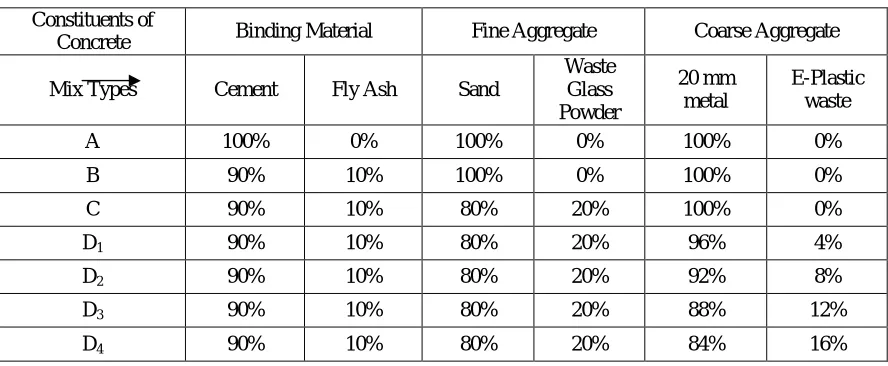
The quantities of cement, fly ash, fine aggregate, coarse aggregate and water for each batch were measured by a weighing balance of an accuracy 1gm. Casting of concrete cubes done for various mixes used in this investigation as shown in table below.
Table -1 Mix Proportions
Constituents of
Concrete Binding Material Fine Aggregate Coarse Aggregate
Mix Types Cement Fly Ash Sand
Waste Glass Powder
20 mm metal
E-Plastic waste
A 100% 0% 100% 0% 100% 0%
B 90% 10% 100% 0% 100% 0%
C 90% 10% 80% 20% 100% 0%
D1 90% 10% 80% 20% 96% 4%
D2 90% 10% 80% 20% 92% 8%
D3 90% 10% 80% 20% 88% 12%
D4 90% 10% 80% 20% 84% 16%
For mix A, there is no addition of any replacements and it is purely conventional concrete and from mix B, the constant percentage of 10% for fly ash is replaced in cement for all mixes. To check the strength for replacing fly ash in cement, B mix is prepared. From D1 to D4, the E- plastic waste is replaced in various percentages shown in table as 4%, 8%,
IV. RESULTS AND DISCUSSIONS
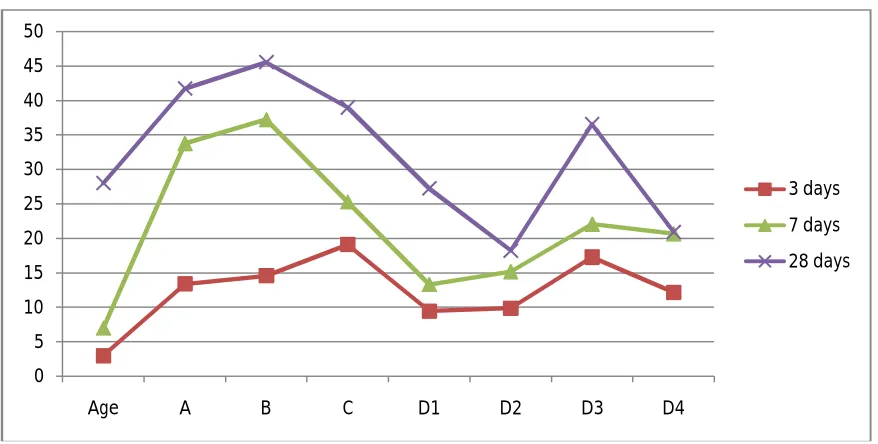
Compressive strength test results are obtained for various mixes as shown in table below.
Table - 2 Compressive strength of mixes
Age
( Days) A B C D1 D2 D3 D4
3 13.38 14.56 19.08 9.46 9.86 17.25 12.17
7 33.76 37.22 25.30 13.32 15.17 22.06 20.67
28 41.75 45.56 38.99 27.25 18.22 36.55 20.93
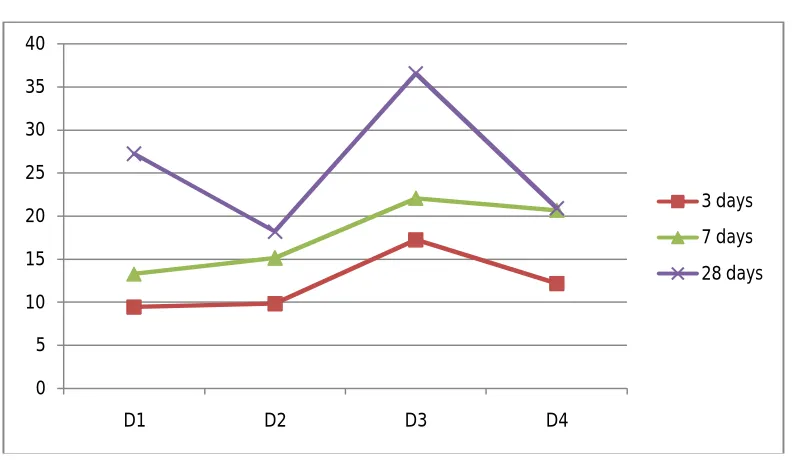
The strength results for D1, D2, D3, D4 mixes are lower than ordinary mix A. But the strength for partial replacement of
E-waste added in those mixes are increased up to 12 % and it is declined gradually. Based on the compressive strength results, the optimum E-waste can be added to manufacturing concrete is nearly 12%.
Fig 1. Graph showing compressive strength for A, B, C, D1, D2, D3 & D4 0
5 10 15 20 25 30 35 40 45 50
Age A B C D1 D2 D3 D4
3 days
7 days
Fig 2. Graph showing compressive strength for D1, D2, D3 & D4
V. CONCLUSION
1. In this investigation, We observed that the increase of E-Plastic waste from 4% to 12% the 3, 7 and 28 days compressive strength increases and then decreases at 16% was found that the Optimal of 12% partial replacement of E-waste in coarse aggregate gives the better results.
2. By using Waste Glass Powder as a partial replacement in fine aggregate [8] gives a better compressive strength results.
3. Here, Fly ash is considered 10% constantly for all mixes. If we increase the percentage of fly ash will may change the results. So that further investigational research is needed to use in concrete.
4. It will be have scope for improving concrete technology as a solid waste management in India.
VI. FUTURE SCOPE OF WORK
1. Effect of gradation of waste glass powder on compressive strength of concrete can be investigated. 2. Effect of admixtures with E-Plastic waste on compressive strength of concrete can be investigated.
REFERENCES
1. Asian journal of civil engineering (Building and Housing) vol-12, no.6 (2011), page-773 to 787. 2. Concrete technology (theory and practice) by M.S.Shetty,S.Chand Publications-1982. 3. EWM India -2013 brochure.
4. "Ghana e-Waste Country Assessment". Ghana e-Waste Country Assessment. SBC e-Waste Africa Project. Retrieved 29 August 2011. 5. IS 456-2000 by using mix design
6. KrishnamRaju: “Design of concrete mix”4 Edition C.B.S, Publishers and Distributors.
7. Lakshmi.R & Nagan.S, “Studies on Concrete containing E plastic waste”- International Journal of Environmental Sciences Volume 1, No: 3 ,2010
8. Ahamed Shayan, Aimin Xu, “Value added utilization of waste glass in concrete”, Cement and Concrete Research vol 34 (2004) pp 8189.
0 5 10 15 20 25 30 35 40
D1 D2 D3 D4
3 days
7 days