Copyright2000 by the Genetics Society of America
The Impact of Lagging Strand Replication Mutations on the Stability of CAG
Repeat Tracts in Yeast
Malia J. Ireland, Shanda S. Reinke and Dennis M. Livingston
Department of Biochemistry, Molecular Biology and Biophysics, University of Minnesota, Minneapolis, Minnesota 55455 Manuscript received December 16, 1999
Accepted for publication April 26, 2000
ABSTRACT
We have examined the stability of long tracts of CAG repeats in yeast mutants defective in enzymes suspected to be involved in lagging strand replication. Alleles of DNA ligase (cdc9-1 and cdc9-2) destabilize CAG tracts in the stable tract orientation, i.e., when CAG serves as the lagging strand template. In this orientation nearly two-thirds of the events recorded in the cdc9-1 mutant were tract expansions. While neither DNA ligase allele significantly increases the frequency of tract-length changes in the unstable orientation, the cdc9-1 mutant produced a significant number of expansions in tracts of this orientation. A mutation in primase (pri2-1) destabilizes tracts in both the stable and the unstable orientations. Mutations in a DNA helicase/deoxyribonuclease (dna2-1) or in two RNase H activities (rnh1⌬and rnh35⌬) do not have a significant effect on CAG repeat tract stability. We interpret our results in terms of the steps of replication that are likely to lead to expansion and to contraction of CAG repeat tracts.
T
HE instability of repetitive CAG tracts was first rec- a yeast chromosome have focused on using the many mutations in the replication and repair genes to under-ognized in the pedigrees of families with particularhereditary neurological disorders (PaulsonandFisch- stand the molecular events leading to CAG repeat tract expansion and contraction (Schweitzerand Living-beck1996). The disease genes in these families contain
long tracts of CAG repeats encoding polyglutamine se- ston 1997, 1998, 1999; Maurer et al. 1998). Already known is the effect of a mutation in the yeast flap endo-quences in the respective proteins. Upon passage from
parent to child, the length of the repeat tract often nuclease gene (rth1⌬/rad27⌬) that destabilizes CAG tracts and increases the frequency of tract expansions changes. Particularly intriguing are the observations
that many of the tract-length changes are biased toward (Freudenreich et al. 1998; Schweitzer and Living-ston1998;Spiroet al. 1999). The flap endonuclease is expansion of the CAG tract. The increase in tract length
gives rise to the phenomenon of anticipation—the ear- an enzyme that appears to be needed to remove primers from Okazaki fragments during lagging strand replica-lier onset and more severe presentation of the
patholog-ical conditions—often observed in human pedigrees. tion. Consequently, we have examined mutations in In addition to the studies carried out in humans and other genes involved in lagging strand replication to on human cells, many studies on CAG repeat tract stabil- understand how they contribute to CAG repeat tract ity have been performed in mice, yeast, and Escherichia stability. We have shown that mutations in DNA poly-coli (Wells and Warren 1998). None of these three merase␣, DNA polymerase␦, and PCNA (proliferating model organisms completely recapitulates the expansion- cell nuclear antigen) all destabilize CAG repeat tracts biased instability observed in human pedigrees. CAG re- (SchweitzerandLivingston1999). In these mutants, peat tracts in mice are relatively stable in comparison to as well as in wild-type yeast cells, the predominant their instability during human gametogenesis. In both the changes in tract length that occur are contractions. In prokaryote E. coli and the simple eukaryote Saccharomyces this work, we have examined additional mutations in cerevisiae, CAG repeat tracts are very unstable, but most of lagging strand replication: DNA ligase, DNA helicase, the tract-length changes are large contractions. Neverthe- primase, and RNase H (Bambaraet al. 1997;Wagaand less, much has been learned about the causes of repeat Stillman1998). While some of the mutations destabi-tract instability from these organisms. In particular an lize CAG repeat tracts, one DNA ligase allele yields an appreciation for the role of replication in repeat tract increase in the ratio of tract expansions to tract contrac-stability has come from work in E. coli and yeast. tions, comparable to the ratio observed in the flap
endo-Our studies using a CAG repeat tract embedded in nuclease mutant.
MATERIALS AND METHODS
Corresponding author: Dennis M. Livingston, Department of
Bio-chemistry, Molecular Biology and Biophysics, 6-155 Jackson Hall, 321
Yeast strains: The parental strains used in this study are Church St. SE, Minneapolis, MN 55455-0347.
E-mail: [email protected] SSL204a and ␣ (MATa or MAT␣ his3 leu2 ura3 ade2 trp1;
1658 M. J. Ireland, S. S. Reinke and D. M. Livingston
individual cells were grown on YPD agar at 30⬚, a temperature semipermissive for growth of the temperature-sensitive strains (cdc9, dna2, and pri2). These parental colonies were dispersed in water and individual cells were plated to YPD agar. After growth for 3 days at 25⬚, whole colonies were collected and DNA was extracted. The DNA from these sibling colonies was used as a template for PCR, and radiolabeled PCR products were displayed on a sequencing gel (Figures 2 and 3). Sibling colonies that no longer possess the repeat tract length of the parent colony have undergone a change in tract length during the 20 generations of growth undergone by the parental col-ony. For most mutants, we analyzed six sets of 32 sibling colo-Figure1.—Stable and unstable orientations of CAG repeat nies. Because the sets of colonies are independent, we use a tracts embedded in a yeast chromosome. This figure is a repre- randomization test to compare the results from sets of mutant sentation of the chromosomal placement of CAG repeat tracts cells to sets of wild-type cells (SchweitzerandLivingston that were made by embedding repeat tracts in the coding 1999). When all six of the mutant values are higher than the region of ADE2. ADE2 clones were used to disrupt the ARO2 six sets of wild-type values, the probability that the mutant locus on chromosome VII (Maureret al., 1996). The tracts and wild-type values are the same is 0.001. For tracts of the C are oriented so that CAG or CTG are on the top strand of orientation, this probability could be achieved with a sixfold ADE2 in tracts C and D, respectively. Replication proceeds increase in frequency, i.e., if each mutant set had two changes. from the ARS in the ADE2 clone (StotzandLinder1990), For tracts of the D orientation, this probability could be making tract C with CAG as the lagging strand template the achieved with a 1.5-fold increase in frequency, i.e., if each stable orientation and tract D with CTG as the lagging strand mutant set had eight changes. Another statistical calculation template the unstable orientation. of exact probability, the Fisher’s Exact Test (http://www. matforsk.no/ola/fisher.htm), was used to compare the num-ber of sibling sets that contained tract expansions between mutant and wild-type strains.
DornfeldandLivingston1991). Replication mutations and CAG repeat tracts have been placed in this background. CAG repeat tracts were previously inserted into the 3⬘end of the
yeast ADE2 gene, and the ADE2 construct was used to disrupt RESULTS the ARO2 locus on chromosome VII (Figure 1,Maureret al.
1996). To place the DNA ligase alleles in our strain back- Studying CAG repeat tracts in yeast: To study CAG ground with the CAG repeat tracts, we outcrossed strains 244 repeat tract instability in yeast cells, we embedded repeat (cdc9-1) and 280 (cdc9-2) (Hartwellet al. 1973) to SSL204.
tracts in the yeast ADE2 gene and used this construction We then backcrossed spores three times to SSL204 to recover
to disrupt the ARO2 gene on chromosome VII (Figure strains that contained the appropriate markers and the repeat
tract. The presence of the cdc9 alleles was scored by tempera- 1). Repeat tracts were cloned with either CAG (tract C) ture-sensitive growth. In the case of cdc9-1, sequencing of a por- or CTG (tract D) in the ADE2 coding strand. In yeast tion of the gene ensured that it contained the amino acid sub- and in E. coli, tract orientation with respect to the lead-stitutions and adjacent polymorphisms of the original cdc9-1
ing and lagging strands of replication influences tract isolate (UnternahrerandHinnen1992). The mutation(s)
stability (Kanget al. 1995;Maureret al. 1996; Freuden-in cdc9-2 has not been identified but sequencFreuden-ing of isolates
reichet al. 1997). Tracts are more unstable when CTG revealed the polymorphisms present in the original
back-ground (strain A364A,Hartwellet al. 1973). Two or more serves as the lagging strand template than when CAG independent spores containing the cdc9 alleles were used for serves as the lagging strand template. Because replica-each mutant. A similar procedure was used for the DNA heli- tion initiates at an ARS sequence (replication origin) case/nuclease mutation (dna2-1), provided in strain
3X154-that lies upstream of ADE2 (Figure 1), this configuration 9A by Martin Budd and Judith Campbell (California Institute
makes tract D more unstable than tract C. In wild-type of Technology; Budd et al. 1995). The dna2-1 mutational
change has been found to be a P504S substitution (Formosa yeast cells most changes in tract length are tract contrac-andNittis1999), and this was confirmed in our strain back- tions.
ground. The primase mutation (pri2-1) was obtained from CAG repeat tract instability is increased in some lag-James Haber (Brandeis University) and substituted into
ging strand replication mutants:We placed CAG repeat SSL204 by two-step transplacement (Scherer and Davis
tracts into yeast strains harboring mutations in genes 1979). DNA from candidates was sequenced to ensure the
identity of the G152Q mutation (Francesconiet al. 1991). A encoding enzymes that are thought to play a role in URA3 disruption of RNase HI (rnh1⌬) was obtained from lagging strand replication (Bambaraet al. 1997;Waga Anita Hopper (Pennsylvania State University Medical Center) and Stillman 1998). DNA ligase I is responsible for and used for single-step disruption of that gene in SSL204
joining nascent Okazaki fragments. The temperature-(Rothstein 1983). To disrupt RNase HII (rnh35⌬) we
de-sensitive DNA ligase I alleles cdc9-1 and cdc9-2 were from signed PCR primers that produced a product containing 45
bases of RNH35 on either end and the complete sequence of the original cdc collection of Leland Hartwell (Hart-URA3. The PCR product was used for single-step disruption well et al. 1973). cdc mutations confer temperature (Manivasakamet al. 1995). lethality and cell-cycle-specific arrest. The identification
Yeast culturing and repeat tract-length determination:
Meth-of CDC9 as the gene encoding DNA ligase was made by ods used to culture yeast and to determine CAG repeat tract
Johnston and Nasmyth (1978). DNA primase com-length are given in greater detail in a previous publication
Figure2.—Analysis of tract-length changes in mutant cells. Portions of two gels, labeled A and B, are shown. Each is half of a 32-sibling colony analysis.32P-labeled PCR products copied
Figure3.—Analysis of tract-length changes in mutant cells. from template DNA purified from sibling colonies have been The analyses, as described in the legend for Figure 2, have run in a sequencing gel. (A) Lanes a–p are from tract C in a been performed for tract D from the rnh1⌬ (A, lanes a–p) rnh1⌬ mutant. (B) Lanes a–p are from tract C in a cdc9-1 and the cdc9-1 (B, lanes a–p) mutants. In this case the instability mutant. These represent one mutant that does not yield sig- is similar for the two mutants, but a significant number of nificantly greater levels of tract instability than wild-type levels tract expansions have been found in the cdc9-1 mutant. For and one mutant that does, respectively. “P” is the PCR product tract D the parental size band of 71 repeat units is the same of the parental colony, and the parental size repeat tract, 78 in both mutants and can be seen in lane P of B. (A) Lanes l, CAG repeats, was the same for both the rnh1⌬ and cdc9-1 o, and p do not contain the parental band but instead have mutants. Size standards of32P-labeled HpaII fragments of KS⫹
smaller bands indicative of tract contractions. (B) Lanes a, b, e, are run in the lanes marked “S”. The largest products are and m do not contain the parental size band. The replacement those from the repeat tract. Stutter bands differing by a repeat band in lane a is an expansion and the bands in lanes e and unit often descend from the band of the largest product. The m are contractions. Repeated PCR on the template for lane very dark band across the bottom is the PCR product from b revealed the parental band. The parental band in lane h is the mutant copy of ADE2 on chromosome XV. It serves as a present, but faint. In A and B a few lanes contain a prominent positive PCR control. As repeat tracts become longer, they parental band along with smaller bands reinforcing some of become more difficult to polymerize through during the PCR. the stutter bands. In accord with our experimental regimen, This is why the bands from the smallest repeat tracts and none of these lanes represent a change (Schweitzer and the control template are of greatest intensity. For the rnh1⌬ Livingston1999).
mutant (A) the parental band is present in all 16 sibling colonies (a–p) and no changes are recorded. In the case of the cdc9-1 mutant (B) the parental band is missing in lanes
two primase subunits. It leads to arrest of DNA synthesis b, g, i, j, m, n, and o. In lanes i and o, a larger band indicative
of tract expansions replaces the parental band, and in lane j, at the elevated temperature of 37⬚(Francesconiet al. a smaller band representing a tract contraction replaces the 1991). The dna2-1 mutation is also a temperature-sensi-parental band. The PCR was repeated using the template DNA tive mutation that lies outside the helicase domain of a for lanes b, g, m, and n and each was found to contain the
protein that has both helicase and nuclease activities parental size product. Thus, three changes, two tract
expan-(Buddet al. 1995;Baeet al. 1998;FormosaandNittis sions and one tract contraction, were recorded for this set of
16 sibling colonies. 1999). The conditional lethality of this mutation can be suppressed by high-level expression of the flap endonu-clease (Rth1p/Rad27p) with which the helicase inter-acts (Budd andCampbell1997). On the basis of this and synthesizes the primers needed for discontinuous
1660 M. J. Ireland, S. S. Reinke and D. M. Livingston
the flap endonuclease. The RNase H mutations, rnh1⌬ of expansions to contractions between the cdc9-1 and pri2-1 mutants by a chi-square test shows that the ratios and rnh35⌬, eliminate RNase H activities (Itayaet al.
1991; Frank et al. 1998). Neither deletion mutation are significantly different (P⫽ 0.03). (The chi-square test could be applied because no two events from any appears to have a phenotype, and a double mutant has
been reported to be viable (Franket al. 1999). Whether set of sibling colonies were of the same length, signifying the likely independence of all events.) Because the ratio either enzyme plays a role in the removal of RNA
prim-ers from nascent Okazaki fragments is unknown. of expansions to contractions has not been determined for tracts of the stable orientation in wild-type cells To perturb the mutant cells without killing them, we
grew all strains at the semipermissive temperature of (Miretet al. 1998), we are unable to apply a statistical comparison with the wild type.
30⬚. We compiled the frequencies of tract-length changes
that occurred in these mutants (Figures 2 and 3) and While we could not compare the ratio of expansions to contractions for cdc9-1 with the wild-type ratio for compared them to frequencies recorded in wild-type
cells (Table 1). Using a randomization test to calculate tract C, we were able to make a calculation for tract D. In this case the results in Table 1 show that no expan-significance (Schweitzerand Livingston 1999), we
judge that the two DNA ligase mutations (cdc9-1 and sions were recorded among 32 tract-length changes in samples from wild-type cells. In the DNA ligase mutant cdc9-2) and the DNA primase mutation (pri2-1)
signifi-cantly increase the instability of tract C at the semip- cdc9-1, eight expansions and 40 contractions were re-corded from a similar number of sibling colonies. Using ermissive temperature of 30⬚(P⬍0.008). The increase
in the frequencies of tract-length changes for the three the Fisher’s Exact Test, we judged the significance by comparing the number of sets of wild-type sibling colo-mutants are 12-fold, 16-fold, and 10-fold for the cdc9-1,
cdc9-2, and pri2-1 mutants, respectively. These values are nies that contained an example of a tract expansion (zero sets/six sets) to the number of sets of cdc9-1 sibling within the range of values we have previously recorded
for destabilization of C tracts by mutations in the replica- colonies that had at least one example of a tract expan-sion (five sets/six sets). The difference is significant tive DNA polymerases (Schweitzer and Livingston
1999). Of the mutations tested in this study, only the (P⫽0.008). Again, we note that the ratio of tract expan-sions to contractions is comparable to previous results pri2-1 mutation destabilizes tract D to a significant extent
(P⫽0.001). This represents only a 2-fold difference in for tract D of comparable lengths in the rth1⌬/rad27⌬ mutant (Maureret al. 1998;Schweitzerand Living-the frequency of events above Living-the wild-type value. The
fold difference is in keeping with the higher baseline ston1998).
Of the other mutants that we examined, the mutant value for the instability of D tracts in wild-type cells
(SchweitzerandLivingston1999). The dna2-1 muta- that yielded the next highest ratio of expansions to contractions was the cdc9-2 mutant. In this mutant nearly tion appears to destabilize tract C but the result is not
significant by the test we use. Repeat tracts are no more 50% of the events occurring in tract C were expansions andⵑ10% of the events occurring in tract D were expan-unstable in either of the two RNase H mutants (rnh1⌬
or rnh35⌬) than they are in wild-type cells. sions. These results are not significantly different from the wild-type results by the Fisher’s Exact Test.
Tract expansions in mutant strains:We also examined
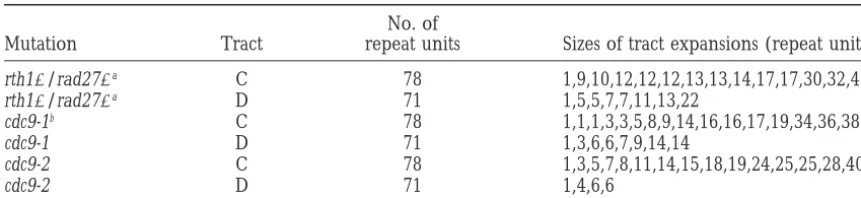
the frequency with which tracts expand or contract in We also measured the sizes of the tract expansions in the cdc9-1 mutant (Table 2). For tract C the average the mutants (Table 1). While the majority of tract-length
changes in wild-type and in many replication-defective expansion length is 14⫾13 repeat units, and for tract D the average expansion length is 7.5 ⫾ 4.7 repeat yeast cells are tract contractions, a large number of tract
expansions occur in the DNA ligase mutant cdc9-1 (Figures units. We previously measured the mean sizes of tract expansions in a rth1⌬/rad27⌬ mutant using tracts of 2 and 3). In this mutant nearly two-thirds of the events
occurring in the tract of the relatively stable orientation the same lengths to be 17 and 8.9 repeat units for the stable and unstable orientations, respectively (Table 1; (tract C) are expansions (Table 1). This ratio of
expan-sions to contractions in the DNA ligase mutant is slightly SchweitzerandLivingston1998). Thus, in both the cdc9-1 and rth1⌬/rad27⌬mutants, expansions are longer higher than what we previously recorded for the rth1⌬/
rad27⌬mutant, which is deficient for the flap endonu- in the stable orientation than in the unstable orienta-tion.
clease that prepares Okazaki fragments for ligation
(Ta-ble 1; Schweitzer and Livingston 1998). Further- Genetic interactions:The similarity in phenotype with respect to CAG tract expansions between the DNA ligase more, other replication mutants that destabilize CAG
repeat tracts yield expansion frequencies that are⬍40% (cdc9-1) and flap endonuclease (rth1⌬/rad27⌬) muta-tions led us to explore their genetic interaction. We of the combined total of expansions and contractions.
For example, in a previous study (SchweitzerandLiv- recovered spores from a cross of the two strains that contained both mutations. Unlike either of the parental ingston 1999), we found that a DNA polymerase ␦
mutant (pol3-14) destabilizes tract C and yields ⵑ20% strains, the double mutant is incapable of forming colo-nies at 30⬚and grows poorly at 25⬚. Examination of a expansions. In the current study we found that the
1661
CAG
Tract
Stability
in
Lagging
Strand
Mutants
Changes in CAG repeat tract length in replication mutants
No. of changes
No. of among siblings Total no. of Mean size of Mean size of
repeat from six changes/no. No. of No. of expansions⫾SD contractions⫾SD
Strain Genotype Tract units parental colonies of siblings expansions contractions (repeat units) (repeat units)
CAG101 Wild typea C 78 0,0,0,0,1,1 2/192 1 1 8 38
CAG119 Wild typea D 71 3,5,5,6,6,7 32/189 0 32 — 37⫾17
CAG126 rth1⌬/rad27⌬a C 78 13,20 33/61 14 19 17⫾10 40⫾15
CAG128 rth1⌬/rad27⌬a D 71 20,24 44/62 8 36 8.9⫾6.5 26⫾15
CAG213 cdc9-1b C 78 1,4,4,5,5,6 25/187 16 9 14⫾13 38⫾19
CAG214 cdc9-1 D 71 5,6,7,9,9,12 48/190 8 40 7.5⫾4.7 31⫾15
CAG229 cdc9-1 C 78 11,14 25/63 9 16 14⫾11 25⫾13
rth1⌬/rad27⌬
CAG215 cdc9-2b C 78 2,3,6,6,7,9 33/190 15 18 16⫾11 23⫾17
CAG216 cdc9-2 D 71 3,4,6,7,8,11 39/192 4 35 4.2⫾2.4 31⫾17
CAG221 pri2-1b C 78 2,2,2,3,4,6 19/191 6 13 14⫾14 32⫾15
CAG222 pri2-1b D 71 9,10,10,12,12,15 68/188 5 63 7.4⫾5.4 38⫾16
CAG217 dna2-1 C 78 0,0,1,1,2,4 8/191 2 6 9.5⫾3.5 32⫾11
CAG218 dna2-1 D 71 5,7,8,8,9,13 50/192 0 50 — 33⫾19
CAG219 rnh1⌬ C 78 0,0,0,0,0,1 1/188 0 1 — 27
CAG220 rnh1⌬ D 71 4,5,6,8,8,14 45/191 2 43 7.0⫾5.7 39⫾12
CAG226 rnh35⌬ C 78 0,0,0,0,1,1 2/192 0 2 — 11⫾7
CAG227 rnh35⌬ D 71 2,3,6,6,7,9 33/192 0 33 — 39⫾17
CAG230 rnh1⌬/rnh35⌬ C 68 0,0,1,2,2,3 8/184 1 7 9 23⫾16
aThe data for five of the six wild-type parental colonies and the rth1⌬/rad27⌬data were reported in previous studies (SchweitzerandLivingston1998, 1999).
1662 M. J. Ireland, S. S. Reinke and D. M. Livingston
TABLE 2
Sizes of CAG tract expansions in DNA ligase and flap endonuclease mutants
No. of
Mutation Tract repeat units Sizes of tract expansions (repeat units)
rth1⌬/rad27⌬a C 78 1,9,10,12,12,12,13,13,14,17,17,30,32,40
rth1⌬/rad27⌬a D 71 1,5,5,7,7,11,13,22
cdc9-1b C 78 1,1,1,3,3,5,8,9,14,16,16,17,19,34,36,38
cdc9-1 D 71 1,3,6,6,7,9,14,14
cdc9-2 C 78 1,3,5,7,8,11,14,15,18,19,24,25,25,28,40
cdc9-2 D 71 1,4,6,6
aValues fromSchweitzerandLivingston(1998).
bDuplicate values derive from different sets of sibling colonies.
DISCUSSION rth1⌬/rad27⌬mutant (Table 1;Schweitzer and
Liv-ingston 1998). The apparent decrease in the ratio of We have compared the stability of long CAG tracts expansions to contractions in the double mutant, in in yeast replication mutants harboring possible defects comparison to the single mutants, could reflect a distur- in lagging strand replication. The comparison shows bance of processive replication leading to tract contrac- that the primase mutation pri2-1 significantly
destabi-tions (seediscussion). lizes tracts when either CAG or CTG serves as the lagging
We were unable to recover a cdc9-1 dna2-1 double strand template, while the two DNA ligase I mutations, mutant. In this case we included a wild-type copy of cdc9-1 and cdc9-2, significantly destabilize tracts only DNA2 on a URA3-CEN plasmid in the sporulation of when CAG serves as the lagging strand template. Muta-the cross. Suspected double mutants could not survive tions in a DNA helicase gene (dna2-1) or in two RNase on agar containing fluoroorotic acid. We did not at- H genes (rnh1⌬and rnh35⌬) do not destabilize repeat tempt to construct the dna2-1 rth1⌬/rad27⌬double mu- tracts in either orientation.
tant because it has been shown to be inviable (Budd Using conditional lethal mutations, such as the pri-andCampbell1997). mase and DNA ligase I mutations, requires a statement We also attempted to create a cdc9-1 rad52⌬ double concerning the comparability of results. Because we mutant, but were unsuccessful. In this case we failed to grew the cells at a semipermissive temperature where recover a spore from 40 tetrads that was both tempera- cells remain viable, the degree to which the altered ture sensitive (cdc9-1) and Leu⫹(rad52-⌬HSLEU2). Our enzymes are impaired may vary among the different failure is in accord with previous studies that had shown mutants. This means that the magnitude of the effect that many other alleles of cdc9 (including cdc9-2) are of different mutations on CAG repeat stability cannot incompatible with the rad52-1 mutation (Montelone be used to state that one enzymatic event is more critical
et al. 1981). than another. In particular, the DNA2-encoded
heli-We were successful in creating haploid strains that case/nuclease may play a vital role in replication, but are rnh1⌬rth1⌬/rad27⌬and rnh35⌬rth1⌬/rad27⌬. An the severity of the dna2-1 mutation may not render the examination of repeat tract changes in the two double enzyme sufficiently impaired to destabilize CAG repeat mutants (two sets of 32 sibling colonies with tract C) tracts.
1989). Thus, mutations that affect priming of Okazaki rad27⌬) of the flap endonuclease. The similarity sug-gests that the difference is not proscribed by the flap fragments appear to increase CAG repeat tract
instabil-ity. In the case of both the pri2-1 mutation, presented endonuclease.
Some differences between the DNA ligase allele and in the current study, and the pol1-1 mutation, presented
in our previous study (Schweitzer and Livingston the flap endonuclease mutation are also apparent from our studies. In particular, the rth1⌬/rad27⌬ mutation 1999), destabilization of C tracts leads to some tract
expansions, and both mutants give rise to a few expan- has a much stronger phenotype than the DNA ligase allele. In the rth1⌬/rad27⌬ mutant nearly half of the sions among events of the D orientation. While the
frequency of tract expansions in these mutants is not sibling colonies from a cell with tract C had undergone a tract-length change and nearly two-thirds of the sibling as great as that observed in the flap endonuclease and
DNA ligase mutants, the results suggest that alteration colonies from a cell with tract D had undergone a change (Table 1;SchweitzerandLivingston1998). of Okazaki fragment priming might be an additional
step in replication that can give rise to CAG repeat This is contrasted to the milder phenotype of the cdc9-1 mutant where⬍15% of C tracts andⵑ25% of D tracts expansions.
The temperature-sensitive dna2-1 mutation did not had undergone changes (Table 1). One consequence of the greater instability in the rth1⌬/rad27⌬ mutant lead to significant destabilization of CAG tracts. DNA2
encodes a protein with both helicase and nuclease activi- is that the frequency of tract contractions significantly increases along with the frequency of tract expansions ties (Buddet al. 1995;Bae et al. 1998). While the role
of this enzyme is not fully established, its physical associa- in this mutant. Another consequence is that the double mutant of cdc9-1 and rth1⌬/rad27⌬reflects the pheno-tion with the flap endonuclease suggests that one of its
important activities is to unwind primers to provide a type of the rth1⌬/rad27⌬mutant more than it does that of the cdc9-1 mutant. That the cdc9-1 allele should not substrate for the flap endonuclease (Buddand
Camp-bell1997). We note that the dna2-1 helicase mutation have as severe a phenotype as the rth1⌬/rad27⌬ muta-tion is likely a direct consequence of the nature of the must not impair the action of the flap endonuclease
significantly, or else we might have observed a pheno- two genes and the types of mutations. The DNA ligase allele cdc9-1 is a conditional allele, and the mutant was type approaching the severe phenotype of a rth1⌬/
rad27⌬mutant. Possibly, our failure to record a signifi- challenged at a semipermissive temperature unlikely to completely ablate the enzyme activity. In contrast, the cant effect of the dna2-1 mutation results from a
redun-dant helicase or nuclease activity that has yet to be identi- rth1⌬/rad27⌬mutation results in the loss of activity, and this null mutant has numerous phenotypes indicative fied.
Finally, we comment on the DNA ligase mutations of problems in DNA replication and repair (Prakash et al. 1993;Reaganet al. 1995;Tishkoffet al. 1997). cdc9-1 and cdc9-2. One allele, cdc9-1, leads to the
destabi-lization of tract C and a preponderance of tract expan- We can speculate upon the pathway by which a failure to ligate Okazaki fragments together leads to tract sions. In the case of tract D, we did not record greater
instability in this mutant but did find a significant num- expansions. One possibility is that the cdc9-1 mutant DNA ligase impairs the flap endonuclease. At present ber of expansion events. The allele cdc9-2 was similar
in its destabilization of C tracts but did not lead to a no evidence exists that the two enzymes, the CDC9-encoded DNA ligase and the flap endonuclease, bind significant increase in the number of expansions in D
tracts. We presume that the variation between the two to each other, but both are known to interact with PCNA in a similar region (Levin et al. 1997; Jonsson et al. alleles results from allelic differences drawn out by our
employment of a semipermissive growth temperature. 1998). Possibly, alteration of this indirect interaction could be strong enough to impair the flap endonucle-The phenotypes of the cdc9-1 allele and the rth1⌬/
rad27⌬ mutation exhibit a number of similarities but ase, leading to tract expansions. We favor a more direct explanation based on the diminished capacities of the also some differences. The primary similarity is that both
increase the incidence of tract expansions. In addition, DNA ligase and the flap endonuclease. In the cdc9-1 mutant the ligase is only partially active because of its the mean sizes of the expansions in the two mutants
are close in value and show that C tracts yield longer mutational alteration, and the activity of the flap endo-nuclease is susceptible to inhibition by a flap containing expansions than D tracts. The longer length of C
expan-sions than D expanexpan-sions has been hypothesized to result CAG repeats (Gordeninet al. 1997;Kunkelet al. 1997; Spiroet al. 1999). We envision that an initial failure to from the greater propensity of flaps containing CTG
repeats (Okazaki fragments from C tracts) to form hair- ligate results in the recreation of a flap of DNA at the 5⬘end of the penultimate Okazaki fragment (Figure 4). pin structures than flaps containing CAG repeats
(Oka-zaki fragments from D tracts; Miret et al. 1998; This flap might be created either by the action of a DNA helicase such as Dna2p or by strand displacement Schweitzer and Livingston 1998). The interesting
result from this study is that longer expansions in the synthesis (MasamuneandRichardson1971) through the action of DNA polymerase ␦. The flap then folds tracts of the stable orientation occur in both mutants,
endonu-1664 M. J. Ireland, S. S. Reinke and D. M. Livingston
Figure 5.—Contraction and expansion of CAG repeat tracts. The model depicts an opening replication fork where the repeat tracts are represented by the heavier line. Contrac-tions likely occur by collapse of the lagging strand template into a hairpin structure followed by polymerization that skips over the hairpin. When a subsequent round of replication occurs, copying of the newly synthesized strand leads to a shortened repeat tract. Most contractions occur distal to the opening fork in the region of the template that would be expected to remain single stranded for a longer time than template sequences closer to the opening fork (Maureret al. 1998). In contrast, most expansions occur at the end of the tract closer to the opening fork (Maureret al. 1998; Rolfs-meierand Lahue2000). Flaps of DNA containing CAG re-peats that fold back into hairpins resist excision by the flap endonuclease (Spiroet al. 1999). If polymerization occurs to complement the template during the formation of the flap, then incorporation of the flap into the duplex creates a loop of extra DNA. The loop on the newly made strand is then fixed as an expansion in the next round of replication.
capable of hairpin formation (Maureret al. 1996, 1998; SchweitzerandLivingston1999). This scenario ex-plains why mutations, such as a DNA polymerase␦ muta-tion and some PCNA mutamuta-tions, lead to an increase in Figure4.—A potential mechanism for tract expansions in
the DNA ligase mutant cdc9-1. This diagram shows that if the frequency of tract contractions (Schweitzerand ligation fails after the removal of the flap of nucleotides con- Livingston1999). In contrast, tract expansions proba-taining the Okazaki fragment primer, a second round of flap bly occur by a pathway that involves excess synthesis of formation ensues. When the flap contains a CAG repeat tract,
DNA along the newly synthesized lagging strand. This the tract can fold back into a hairpin and assimilate into the
conclusion is based on the result that CAG tract expan-newly made strand. Belated ligation followed by a subsequent
round of replication produces a tract expansion. sions can be increased by mutations in the RTH1/ RAD27 (Freudenreich et al. 1998; Schweitzer and Livingston1998;Spiroet al. 1999) and CDC9 genes. clease (Spiroet al. 1999). Assimilation of the loop into Mutations in both genes have the potential to lead to a the growing chain and belated ligation would lead to flap of nucleotides at the 5⬘end of an Okazaki fragment.
tract expansion. When the flap contains CAG repeats, it can fold into a
determined by the direction of replication in E. coli. Nat. Genet. phenotypic similarities between the DNA ligase and flap
10:213–218.
endonuclease mutations to be the genetic demonstra- Kunkel, T. A., M. A. ResnickandD. A. Gordenin,1997 Mutator specificity and disease: looking over the FENce. Cell 88: 155–158. tion that perturbations in the final steps of Okazaki
Levin, D. S., W. Bai, N. Yao, M. O’DonnellandA. E. Tomkinson,
fragment maturation are the most likely steps in
replica-1997 An interaction between DNA ligase I and proliferating tion that cause CAG repeat tract expansions. cell nuclear antigen: implications for Okazaki fragment synthesis
and joining. Proc. Natl. Acad. Sci. USA 94: 12863–12868. We appreciate Jill Schweitzer’s help and insight. We also thank
Lucchini, G., C. Mazza, E. ScacheriandP. Plevani,1988 Genetic those who sent us strains and plasmids: Martin Budd, Judith Campbell,
mapping of the Saccharomyces cerevisiae DNA polymerase I gene James Haber, and Anita Hopper. and characterization of a pol1 temperature-sensitive mutant
al-tered in DNA primase-polymerase complex stability. Mol. Gen. Genet. 212: 459–465.
Manivasakam, P., S. C. Weber, J. McElverandR. H. Schiestl,1995 Micro-homology mediated PCR targeting in Saccharomyces cerevis-LITERATURE CITED
iae. Nucleic Acids Res. 23: 2799–2800.
Bae, S.-H., E. Choi, K.-H. Lee, J. S. Park, S.-H. Leeet al., 1998 Dna2 Masamune, Y.,andC. C. Richardson,1971 Strand displacement of Saccharomyces cerevisiae possess a single-stranded DNA-specific during deoxyribonucleic acid synthesis at single strand breaks. endonuclease activity that is able to act on double-stranded DNA J. Biol. Chem. 246: 2692–2701.
in the presence of ATP. J. Biol. Chem. 273: 26880–26890. Maurer, D. J., B. L. O’CallaghanandD. M. Livingston,1996 Ori-entation dependence of trinucleotide CAG repeat instability in
Bambara, R. A., R. S. MuranteandL. A. Henricksen,1997
En-yeast. Mol. Cell. Biol. 16: 6617–6622. zymes and reactions at the eukaryotic replication fork. J. Biol.
Maurer, D. J., B. L. O’Callaghan and D. M. Livingston,
Chem. 272: 4647–4650.
1998 Mapping the polarity of changes that occur in interrupted
Budd, M. E.,andJ. L. Campbell,1997 A yeast replicative helicase,
CAG repeat tracts in yeast. Mol. Cell. Biol. 18: 4597–4604. DNA2 helicase, interacts with yeast FEN-1 nuclease in carrying
Miret, J. J., L. P. BrandaoandR. S. Lahue,1998 Orientation-out its essential function. Mol. Cell. Biol. 17: 2136–2142.
dependent and sequence-specific expansions of CTG/CAG
tri-Budd, M. E., K. D. Wittrup, J. E. BaileyandJ. L. Campbell,1989
nucleotide repeats in Saccharomyces cerevisiae. Proc. Natl. Acad. DNA Polymerase I is required for premeiotic DNA replication
Sci. USA 95: 12438–12443. and sporulation but not for X-Ray repair in Saccharomyces cerevisiae.
Montelone, B. A., S. PrakashandL. Prakash,1981 Spontaneous Mol. Cell. Biol. 9: 365–376.
mitotic recombination in mms8-1, an allele of the CDC9 gene of
Budd, M. E., W. C. ChoeandJ. L. Campbell,1995 DNA2 encodes
Saccharomyces cerevisiae. J. Bacteriol. 147: 517–525.
a DNA helicase essential for replication of eukaryotic
chromo-Paulson, H. L.,andK. H. Fischbeck,1996 Trinucleotide repeats somes. J. Biol. Chem. 270: 26766–26769.
in neurogenetic disorders. Annu. Rev. Neurosci. 19: 79–107.
Dornfeld, K. J.,andD. M. Livingston,1991 Effects of controlled
Prakash, S., P. SungandL. Prakash,1993 DNA repair genes and
RAD52 expression on repair and recombination in Saccharomyces
proteins of Saccharomyces cerevisiae. Annu. Rev. Genet. 27: 33–70.
cerevisiae. Mol. Cell. Biol. 11: 2013–2017.
Reagan, M. S., C. Pittenger, W. SiedeandE. C. Friedberg,1995
Formosa, T.,andT. Nittis,1999 Dna2 mutants reveal interactions
Characterization of a mutant strain of Saccharomyces cerevisiae with with DNA polymerase alpha and Ctf4, a Pol alpha accessory factor,
a deletion of the RAD27 gene, a structural homolog of the RAD2 and show that full Dna2 helicase activity is not essential for growth.
nucleotide excision repair gene. J. Bacteriol. 177: 364–371. Genetics 151: 1459–1470.
Rolfsmeier, M. L.,and R. S. Lahue,2000 Stabilizing effects of
Francesconi, S., M. P. Longhese, A. Piseri, C. Santocanale, G.
interruptions on trinucleotide repeat expansions in Saccharomyces
Lucchiniet al., 1991 Mutations in conserved yeast DNA primase
cerevisiae. Mol. Cell. Biol. 20: 173–180.
domains impair DNA replication in vivo. Proc. Natl. Acad. Sci.
Rothstein, R. J.,1983 One-step gene disruption in yeast. Methods USA 88: 3877–3881.
Enzymol. 101: 202–211.
Frank, P., C. Braunshofer-ReiterandU. Wintersberger, 1998
Scherer, S.,andR. W. Davis,1979 Replacement of chromosome Yeast RNase H(35) is the counterpart of the mammalian RNase
segments with altered DNA sequences constructed in vitro. Proc. HI, and is evolutionarily related to prokaryotic RNase HII. FEBS
Natl. Acad. Sci. USA 76: 4951–4955. Lett. 421: 23–26.
Schweitzer, J. K.,andD. M. Livingston,1997 Destabilization of
Frank, P., C. Braunshofer-Reiter, A. Karwan, R. GrimmandU.
CAG trinucleotide repeat tracts by mismatch repair mutations in
Wintersberger, 1999 Purification of Saccharomyces cerevisiae
yeast. Hum. Mol. Genet. 6: 349–355. RNase H(70) and identification of the corresponding gene. FEBS
Schweitzer, J. K.,andD. M. Livingston,1998 Expansions of CAG Lett. 450: 251–256. repeat tracts are frequent in a yeast mutant defective in Okazaki
Freudenreich, C. H., J. B. StavenhagenandV. A. Zakian,1997
fragment maturation. Hum. Mol. Genet. 7: 69–74.
Stability of a CTG/CAG trinucleotide repeat in yeast is dependent Schweitzer, J. K.,andD. M. Livingston,1999 The effect of DNA on its orientation in the genome. Mol. Cell. Biol. 17: 2090–2098. replication mutations on CAG tract instability in yeast. Genetics
Freudenreich, C. H., S. M. Kantrow and V. A. Zakian, 1998 152:953–963.
Expansion and length-dependent fragility of CTG repeats in yeast. Spiro, C., R. Pelletier, M. L. Rolfsmeier, M. J. Dixon, R. S. Lahue Science 279: 853–856. et al., 1999 Inhibition of FEN-1 processing by DNA secondary
Gordenin, D. A., T. A. KunkelandM. A. Resnick,1997 Repeat structure at trinucleotide repeats. Mol. Cell 4: 1079–1085. expansion: All in a flap? Nat. Genet. 16: 116–118. Stotz, A.,andP. Linder,1990 The ADE2 gene from Saccharomyces
Hartwell, L. H., R. K. Mortimer, J. CulottiandM. Culotti,1973 cerevisiae: sequence and new vectors. Gene 95: 91–98.
Genetic control of the cell division cycle in yeast. V. Genetic Tishkoff, D. X., N. Filosi, G. M. GaidaandR. D. Kolodner,1997 analysis of cdc mutants. Genetics 74: 267–286. A novel mutation avoidance mechanism dependent on S. cerevisiae
Itaya, M., D. McKelvin, S. K. ChatterjieandR. J. Crouch,1991 RAD27 is distinct from DNA mismatch repair. Cell 88: 253–263. Selective cloning of genes encoding RNase H from Salmonella Unternahrer, S.,andA. Hinnen,1992 Temperature sensitivity of
typhimurium, Saccharomyces cerevisiae and Escherichia coli rnh mutant. the cdc9-1 allele of Saccharomyces cerevisiae DNA ligase is dependent
Mol. Gen. Genet. 227: 438–445. on specific combinations of amino acids in the primary structure
Johnston, L. H.,andK. A. Nasmyth,1978 Saccharomyces cerevisiae of the expressed protein. Mol. Gen. Genet. 232: 332–334.
mutant cdc9 defective in DNA ligase. Nature 274: 891–893. Waga, S.,andB. Stillman,1998 The DNA replication fork in
eukar-Jonsson, Z. O., R. HindgesandU. Hubscher,1998 Regulation of yotic cells. Annu. Rev. Biochem. 67: 721–751.
DNA replication and repair proteins through interaction with the Wells, R. D.,andS. T. Warren,1998 Genetic Instabilities and Heredi-front side of proliferating cell antigen. EMBO J. 17: 2412–2425. tary Neurological Diseases. Academic Press, San Diego.
Kang, S., A. Jaworski, K. OhshimaandR. D. Wells,1995