Copyright2000 by the Genetics Society of America
Extensive Amino Acid Polymorphism at the
Pgm
Locus Is Consistent With
Adaptive Protein Evolution in
Drosophila melanogaster
Brian C. Verrelli and Walter F. Eanes
Department of Ecology and Evolution, State University of New York, Stony Brook, New York 11794-5245
Manuscript received April 18, 2000 Accepted for publication July 31, 2000
ABSTRACT
PGM plays a central role in the glycolytic pathway at the branch point leading to glycogen metabolism and is highly polymorphic in allozyme studies of many species. We have characterized the nucleotide diversity across thePgmgene inDrosophila melanogasterandD. simulansto investigate the role that protein polymorphism plays at this crucial metabolic branch point shared with several other enzymes. Although
D. melanogasterandD. simulansshare common allozyme mobility alleles, we find these allozymes are the result of many different amino acid changes at the nucleotide level. In addition, specific allozyme classes within species contain several amino acid changes, which may explain the absence of latitudinal clines for PGM allozyme alleles, the lack of association of PGM allozymes with the cosmopolitanIn(3L)P inver-sion, and the failure to detect differences between PGM allozymes in functional studies. We find a significant excess of amino acid polymorphisms withinD. melanogasterwhen compared to the complete absence of fixed replacements withD. simulans.There is also strong linkage disequilibrium across the 2354 bp of the
Pgmlocus, which may be explained by a specific amino acid haplotype that is high in frequency yet contains an excess of singleton polymorphisms. LikeG6pd,Pgmshows strong evidence for a branch point enzyme that exhibits adaptive protein evolution.
U
NDERSTANDING how selection at higher pheno- amino acid changes in the lineage leading toD. simulans (Eaneset al.1993, 1996). To understand this problem typic levels impacts molecular variation at thesin-in a larger context, a systematic study of the enzymes gle gene level is an important question in evolutionary
of the pathway is important (Eanes1999). This lab has and physiological genetics. A working view from a
physi-focused on the need to characterize molecular variation ological perspective would propose that selection on
in these genes and in this report addresses the nature life history variation results in selection to modulate
of molecular variation found at the Pgm locus in D. energy budgets and this targets the partitioning of
meta-melanogasterandD. simulans. bolic fluxes into growth and reproduction. Central to
Phosphoglucomutase (PGM; EC 2.7.5.1) plays a major this reductionist view is how the differential fluxes at
role in the synthesis and breakdown of glycogen, which metabolic crossroads, such as those involving the
glyco-is important to energy storage in muscle tglyco-issue, and lytic pathway and its numerous junctions, respond to
catalyzes the interconversion of glucose-1-phosphate selection. Historically, allozyme studies revealed much
and glucose-6-phosphate (RayandRoscelli1964; Hir-about polymorphism in these genes, and the
observa-ose et al.1970). PGM shares glucose-6-phosphate with tion that some enzymes are variable, while others are
several other enzymes at a branch point at the head of not, has potential adaptive explanations (Gillespie
the metabolic pathway leading into glycogen metabo-1991;Mitton1998). A fundamentally important
ques-lism, the pentose shunt, and the main glycolytic corri-tion is whether intrinsic features of these enzymes, such
dor. PGM has been routinely studied in many organisms as their structure-function constraints or relative roles
because of its high level of allozyme polymorphism in partitioning fluxes among competing pathways, lead
(DawsonandJaegar1970), and there are three com-to the gene-specific patterns of intra- and interspecific
mon allozymes inD. melanogaster(Hjorth1970;Trippa variation. Studies ofG6pd, which shares a common
sub-et al. 1970). TheMedium mobility allele is widespread, strate with both phosphoglucomutase and hexokinase
but seven additional allozyme alleles and other underly-at the head of the glycolytic punderly-athway underly-at the branch
ing amino acid variants have been revealed by electro-leading to the pentose shunt, make a compelling case
phoretic and thermostability criteria (Trippaet al.1976, for both selection acting on the enzyme polymorphism
1977, 1978). A study of geographic variation of the allo-in Drosophila melanogaster and episodic selection on
zyme alleles found no evidence of clines (Oakeshott
et al.1981), which differs from other allozyme polymor-phisms in D. melanogaster, where latitudinal clines are Corresponding author:Brian C. Verrelli, Department of Ecology and
common and taken as supporting evidence for the
ac-Evolution, State University of New York, Stony Brook, NY 11794-5245.
E-mail: [email protected] tion of natural selection (SinghandRhomberg1987;
transcripts of unwanted sizes. The recovered 300-bpPgm frag-this protein polymorphism. In addition, several lab
se-ment was labeled with biotin-14-dATP using PCR, denatured lection experiments also suggest balancing selection
in-at 95⬚ for 5 min, and hybridized to the size-selected single-fluences PGM allozyme allele frequencies, although
stranded cDNA pool at 45⬚ for 8 hr. This DNA-duplex was other studies show inconsistent patterns (Carfagnaet then isolated with streptavidin-coated magnetic beads (Dynal, al.1980;Oakeshottet al.1985, 1988). A biochemical Inc., Great Neck, NY) at room temperature for 20 min. After several washes to remove unspecific fragments bound to the study of the allozyme alleles inD. melanogasterreported
beads, the DNA was eluted from the magnetic beads in 2.5 no difference in kinetic properties (Fucciet al.1979).
mmEDTA at 85⬚, and this template DNA was used directly Nonetheless, if a specific allozyme mobility class results
for PCR. A specific Pgm positive primer was paired with a from several different amino acid differences (as sug- negative cDNA primer to obtain the remaining sequence to gested by the thermostability studies), this will poten- the 3⬘end. However, due to the reverse transcriptase enzyme prematurely falling off during transcription, a heterogeneous tially confound both studies of geographic variation and
fragment pool was amplified when a positive vector-specific functional studies where variation is defined only by
primer was paired with a negativePgmspecific primer. This allozyme mobility. Finally, the Pgm locus (located on
PCR fragment pool was cloned and 100 clones were subse-the third chromosome at 72D7) also lies just inside quently used for PCR templates. The largest cloned insert the proximal breakpoint (73E3) of the cosmopolitan from this screen was sequenced and found to be short of the In(3L)P inversion. This inversion exhibits clines with 5⬘ end. A new negativePgmspecific primer was synthesized from this sequence and combined with the positive cDNA latitude in natural populations on several continents
vector-specific primer to amplify another pool ofPgm tran-(Mettleret al.1977;Knibbet al.1981), and, in
princi-scripts from the template DNA recovered from the magnetic ple, selection favoring the inversion could actually main- beads. This “transcript walk” of amplification, cloning, se-tain variation at thePgmlocus (WesleyandEanes1994; quencing, and primer synthesis was performed several times Hasson and Eanes 1996). Despite this tight physical until the 5⬘end of the coding region was finally discovered. A new positivePgm specific primer was then synthesized at linkage, no significant linkage disequilibrium has been
the 5⬘ end to amplify the entire gene from genomic DNA. found between PGM allozyme alleles and the inversion
Introns were determined when full genomic sequence was in natural populations (Langleyet al.1974, 1977).
compared to our previously recoveredPgmcDNA sequence. Given our interest in examining patterns of variation Origin of wild lines: D. melanogaster isofemale lines were in metabolic genes, we were interested in addressing collected from a Davis Peach Farm, Mt. Sinai, New York, popu-lation in 1995 (DPF95) and made homozygous for the third several questions in this study. We first recover and
chromosome using theTM3/TM6balancer. Lines were geno-characterize the primary sequence forPgmfromD.
mela-typed for allozyme mobility (Hjorth1970), and based on the
nogasterand from this investigate overall sequence
varia-frequency of the three common allozyme mobilities (Medium, tion and the molecular nature of the allozyme variation. Fast, andSlow) in this population, a constructed random sam-We address whetherPgmis similar toEst-6in exhibiting ple (CRS, Hudson et al. 1994) of 22 lines was sequenced. abundant amino acid variation (as predicted from ther- Therefore, parameter estimates (i.e.,and) calculated from this sample reflect the frequencies of PGM allozyme alleles mostability studies), as well as possessing high levels of
in this population. Isofemale lines collected in 1990 from two interspecific divergence. BecauseD. melanogasterandD.
populations in Zimbabwe [Havare, Z(H) and Sengwa Wildlife
simulans share the same allozyme mobility alleles for Preserve, Z(S)] were kindly provided by C.-I. Wu’s laboratory. PGM, we will also examine the possibility of a common Thirteen of these lines were made homozygous for the third mutational origin and long-term persistence of these chromosome and were sequenced for Pgm to compare the level of variation in Zimbabwe with the North American popu-allozymes in both species. Finally, we were interested
lation sample. Using primers specific for theIn(3L)P arrange-in determarrange-inarrange-ing whether there is evidence for adaptive
ment (WesleyandEanes1994), extracted third chromosome protein evolution at the Pgm locus like that seen for
lines were screened for the inversion andPgmwas sequenced other metabolic enzymes such as G6pd (Eanes et al. from these: Davis Peach Farm, Mt. Sinai, New York (3 lines; 1993) andAdh (McDonaldandKreitman1991). DPF95), Maryland (1 line; MD90), Spartanburg, South Caro-lina (1 line; SC96), and Homestead, Florida (5 lines; HFL97).
D. simulansisofemale lines were collected from a Davis Peach Farm population in 1996 (DPF96), and a survey for the three MATERIALS AND METHODS
PGM allozyme allele frequencies was performed. We se-quenced a CRS of 13 lines, which reflects the frequencies of
Isolation ofPgmlocus:A third instar larvae cDNA library
the alloyzme alleles in this population. Lines genotyped as a made from D. melanogaster was kindly provided by Peter
thePgmlocus after two generations of mating with aMedium acid changes that are not detectable in allozyme screens.
mobility allele stock. Conversely, lines genotyped with aMe- TheD. simulanssequences predict that theMediumallele diumallozyme mobility were made homozygous at the Pgm
is the ancestral state. The average numbers of silent locus after two generations of mating with aFastmobility allele
differences within the Medium, Slow, and Fast allele stock. Flies were then cut in half, and the abdomen was used
to check allozyme genotype while the thorax served as tissue classes are 1.76, 4.00, and 0.00. On average,Mediumand for DNA extraction. Nine D. yakubaisofemale lines from a Fastalleles differ by 2.35 silent sites, Mediumand Slow 1999 West African sample (T. F. C. Mackay’s laboratory) were alleles differ by 2.74 silent sites, andFastandSlowalleles sequenced and used to partition fixations into theD.
melano-differ by 2.67 silent sites. gasterandD. simulanslineages. Finally, a PGM null allele (line
Sequence variation for the Davis Peach Farm CRS, PgmnGB1) found in a natural population sample from Great
Britain (Langleyet al.1981;Burkhartet al.1984) was ob- the Zimbabwe sample, and theIn(3L)Psample are all tained from the Bloomington Stock Center (B4039) and se- summarized in Table 1. The 13 sequences from Zim-quenced. babwe add an additional five silent, four replacement,
PCR amplification and sequencing:Fragments were
ampli-and two intron polymorphisms to the North American fied in 10-l volumes in an Idaho Technologies (Idaho Falls,
sample in Figure 1. A single Slow allozyme allele was ID) Air-Thermo-Cycler by PCR from single-fly CTAB genomic
preps (Winnepenninckx et al.1993). PCR products are ex- sequenced in this sample (Z26H) and shares the same cised from 2% agarose gels for 50-l reamplifications using change at nucleotide site 25 as that found in the North internal primers. DNA fragments were purified from PCR American sample (DPF95 94.1). The level of silent poly-reactions [Bio-Rad (Hercules, CA) Prep-A-Gene kit] and
dou-morphism in the Zimbabwe sample is actually lower ble-stranded DNA templates were manually sequenced using
than that of the North American sample. This is not a the Sequenase kit (United States Biochemical Co., Cleveland)
and [35S]dATP (Amersham, Buckinghamshire, England). Re- typical observation seen in comparisons made between
actions were run on acrylamide gels with an electrolyte gradi- these two geographic regions (Begun and Aquadro ent and electrophoresed for 3–7 hr. All sequences are stored 1993;Eaneset al.1996). The Zimbabwe sample segre-under GenBank accession nos. AF290313–AF290370.
gates several of the North American replacements in addition to a few unique singletons. The CRS of 22 lines was screened for the In(3L)P inversion and two lines, RESULTS
DPF95 13.0 and DPF95 48.2, both bear the inversion.
Levels of intraspecific polymorphism: The isolation Eight additional lines containing the inversion are also
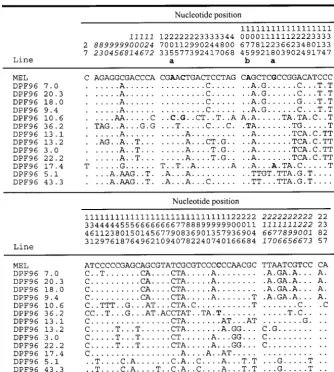
Figure 1.—List of 55 poly-morphic sites identified across 2354 bp of Pgmin 44 lines of
D. melanogaster. Characters a
andbdesignate nucleotide po-sitions responsible forSlowand
Fast allozyme polymorphisms, respectively. Nucleotide poly-morphisms shown in boldface type are amino acid polymor-phisms. Italics refer to poly-morphisms in introns I, II, and III, respectively. SIM refers to
D. simulans line DPF96 3.0. Line labels followed by an as-terisk have the In(3L)P inver-sion.
and may explain the reported loss of PGM activity for DPF96 17.4 has a change at nucleotide site 1128 (D175N) that results in the second Slow allele. Line this allele.
The summary statistics for the 13 D. simulansalleles DPF96 36.2 has a second replacement polymorphism at nucleotide site 1954 (T450I) in addition to the change are presented in Tables 1 and 2. The CRS of 2Slow, 1
Fast, and 10Medium alleles are presented in Figure 2. responsible for itsFastmobility at nucleotide site 1075 (K157M). AdditionalFast alleles were sequenced (our When compared toD. melanogaster, Table 1 shows almost
a sixfold increase in the level of silent site polymorphism unpublished data), and all show the same polymor-phism at nucleotide site 1075. In contrast toD. melano-for D. simulans with 64 silent site polymorphisms in
the sample. The level of replacement polymorphism is gaster, the second intron is highly variable in length withinD. simulansand is omitted from the data in Figure lower, which is typical for these two species (Moriyama
and Powell 1996). Five replacement and 22 intron 2. An apparent 2-bp insertion in the third intron inD. melanogasterand the highly variable second intron inD. polymorphisms are also shown in Figure 2. All 5 of
the replacement polymorphisms result in rare allozyme simulansaccount for the only differences in gene length for the two species.
alleles, none of which are shared withD. melanogaster.
The two sampledSlowallozyme alleles are the result of Figure 3 shows the neighbor-joining analysis (Saitou andNei1987) of all 44 sequences ofD. melanogasterand two different replacements at the nucleotide level. Line
DPF96 10.6 has a second replacement polymorphism 13 sequences ofD. simulans. It is based only on silent and intron polymorphisms within and between both at nucleotide site 217 (A49G) in addition to the change
varia-TABLE 1 retic mobilities, both species possessSlowmobility alleles that are more closely related toMediumandFastalleles
Summary parameter estimates forD. melanogaster
than they are to otherSlow alleles. The difference in
andD. simulans
levels of silent polymorphism within each species is re-flected in the deeper branches inD. simulanscompared
Sample n s a s a
toD. melanogaster. D. melanogaster
Linkage disequilibrium: There is pervasive linkage
CRS 22 0.0087 0.0026 0.0052 0.0015
disequilibrium across the entire 2354-bp region of the Zimbabwe 13 0.0063 0.0020 0.0051 0.0013
Pgmgene inD. melanogaster.This is notable from Figure
In(3L)P 10 0.0043 0.0011 0.0052 0.0012
D. simulans 13 0.0506 0.0013 0.0483 0.0007 4 in the high associations of polymorphisms for the
22 sequences of the Davis Peach Farm CRS. Using 21 CRS refers to the constructed random sample (see text)
polymorphic sites (21 singletons are omitted), 99 out of 22D. melanogastersequences from the Davis Peach Farm
population. All estimates are based on 408 silent site equiva- of 210 pairwise correlations are statistically significant lents. s and s and a and a are measures of nucleotide by a chi-square test (P⬍0.05). Figure 4 also shows that
diversity for silent and replacement sites, respectively. nucleotide sites more than 2 kb apart show some of the strongest disequilibria (33 of the 210 pairwise correla-tions are significant at the 0.1% level with a Bonferroni tion independent of the amino acid polymorphisms.
correction). Because two of the sequences in our Davis Although recombination can obscure the true
genealog-Peach Farm CRS (DPF95 48.2 and DPF95 13.0) are ical relationship among allele copies, this analysis is
associated with theIn(3L)Pinversion, this could inflate used simply as an exploratory method to structure the
estimates of linkage disequilibrium for the entire data variation at this locus. However, the analysis using all
set. However, because there is no apparent association polymorphic sites (including amino acid
polymor-between the inversion andPgmvariation, and because phisms) results in the same clustering of alleles
indicat-no divergence exists between arrangements, linkage dis-ing strong disequilibrium across the gene. As previously
equilibrium estimates did not change even when these pointed out in Figure 1, Figure 3 demonstrates that
two alleles were removed from the analysis. there is no evidence of geographic structuring when
Tests of the polymorphism frequency spectrum:
Taj-the Davis Peach Farm and Zimbabwe populations are
ima(1989) andFuandLi(1993) tests were applied to compared in a genealogical framework. In addition, the
the data for both species. We tested the Davis Peach In(3L)Psequences do not form one single cluster, but
Farm CRS of 22 sequences of D. melanogaster, the 13 three small clusters, representing gene conversion
Zimbabwe sequences, the 10 In(3L)P sequences, and events that have led to some divergence between alleles
the 13D. simulans sequences, each independently, to on inverted chromosomes and convergence with alleles
see if either the silent or replacement polymorphism on the standard arrangements. TwoIn(3L)Psequences
frequency distributions differed from that expected for branch in a cluster that is ancestral to all other
se-a neutrse-al distribution of vse-arise-ation. All test results se-are quences, including all other standard alleles, an
observa-presented in Table 3. Only the analysis ofD. simulans tion not uncommon for this inversion (Hasson and
replacement polymorphism by the Fu and Li test is Eanes 1996). All allozyme alleles are also labeled in
Figure 3. Although severalPgmalleles share electropho- significant.
TABLE 2
Intra- and interspecific comparisons forD. melanogasterandD. simulans
for the 1680-bp coding region ofPgm
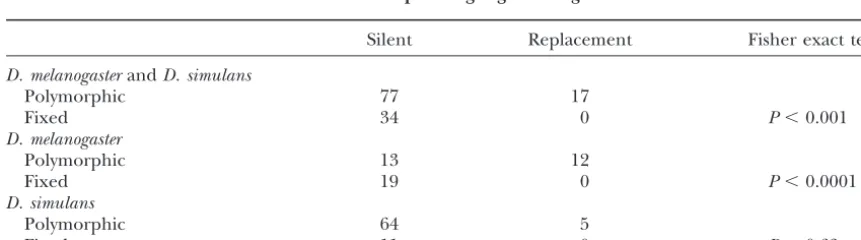
Silent Replacement Fisher exact test
D. melanogasterandD. simulans
Polymorphic 77 17
Fixed 34 0 P⬍0.001
D. melanogaster
Polymorphic 13 12
Fixed 19 0 P⬍0.0001
D. simulans
Polymorphic 64 5
Fixed 11 0 P⫽0.63
Figure 2.—List of 92 polymorphic sites identified across 1852 bp ofPgmin 13 lines ofD. simulans.Charactersaand
bdesignate nucleotide positions respon-sible forSlowandFastallozyme polymor-phisms, respectively. Nucleotide poly-morphisms shown in boldface type are amino acid polymorphisms. Italics refer to polymorphisms in introns I and III, respectively (intron II omitted). MEL re-fers toD. melanogasterline DPF95 2.0.
Interspecific comparisons: Table 2 shows the sum- Fisher’s exact test, the D. melanogaster comparison is
mary of polymorphism and divergence for the total cod- highly significant (P⬍0.0001), whereas theD. simulans ing region of 1680 bp inD. melanogasterandD. simulans. contrast is not. Compared to the level of divergence at Pooled polymorphisms for the two species result in 77 silent and replacement sites along the D. melanogaster silent and 17 replacement polymorphisms. Comparing lineage (19/0), there appears to be a significant devia-the Davis Peach Farm CRS of 22 sequences ofD. melano- tion in the ratio of silent to replacement polymorphism gaster with the 13 sequences of D. simulans, the total (13/12). The level of silent site polymorphism at Pgm numbers of fixed silent and replacement sites between ( ⫽ 0.0087) is typical of other D. melanogaster loci the two species are 34 and 0, respectively. Because intra- (Moriyamaand Powell1996). Assuming that the si-specific polymorphism and intersi-specific divergence are lent site variation is neutral, the difference in the ratios correlated, a statistical test of independence can deter- of polymorphism to divergence at replacement and si-mine if these values deviate from that expected under lent sites could indicate unusually high amino acid poly-neutrality (McDonaldandKreitman1991). The 2⫻ morphism or unusually low amino acid divergence. Be-2 contingency Fisher’s exact test of the pooled polymor- cause interspecific comparisons often show no replace-phism (77/17)vs.the divergence at silent and replace- ment site divergence for these species (Moriyamaand ment sites (34/0) is highly significant (P⬍0.001). Using Powell1996), this suggests that the observation of high D. yakuba as an outgroup, the number of fixed differ- replacement polymorphism at thePgmlocus inD. mela-ences along theD. melanogaster-simulanslineage can be nogasteris unusual.
partitioned into either species’ lineage, as shown in Table 2. There is no significant difference in the num-ber of silent fixations in either lineage. However, when
DISCUSSION the number of silent and replacement polymorphisms
Excess of amino acid polymorphism:The principal
in each species is contrasted with the number of fixed
Figure 3.—Neighbor-join-ing tree based on silent substi-tutions among and between the 44D. melanogaster and 13
D. simulans Pgmsequences.S1,S2, andS3 designate Slow alloyzme alleles due to three unique mu-tations at the nucleotide level inD. melanogaster. S4andS5 des-ignateSlowallozyme alleles due to two unique mutations at the nucleotide level inD. simulans. F1 and F2 designate Fast allo-zyme alleles due to two unique mutations at the nucleotide level inD. melanogaster andD. simulans, respectively. Asterisks designate sequences with the
In(3L)P inversion. Scale indi-cates one difference.
acid polymorphisms segregating in both species. The Because the contrast of silent and replacement polymor-phism (64/5) to silent and replacement divergence significance of this observation is supported by the
Mc-Donald-Kreitman test using the pooled data for both (11/0) in theD. simulanslineage is not statistically sig-nificant, the result from the pooled data from both species. The overall level of silent divergence (8%) is
typical of these two species (Moriyama and Powell species (P⬍0.001) appears largely due to the significant excess of replacement polymorphism in theD. melano-1996) and therefore cannot explain the significant
devi-ation in the McDonald-Kreitman test. By usingD. yakuba gasterlineage (P ⬍0.0001).
The relative difference between levels of polymor-as an outgroup, fixations along theD.
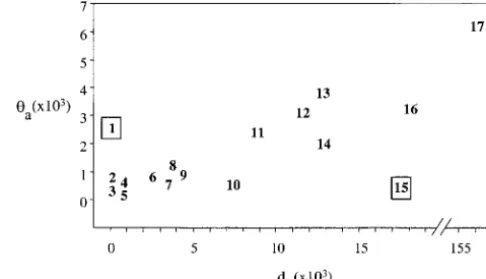
melanogaster-sim-ulanslineage can be partitioned into each species’ lin- phism and divergence at the Pgm locus is atypical of other genes inD. melanogaster.Figure 5 plots the rela-eage and compared to levels of silent and replacement
polymorphism. Although the ratio of silent to replace- tionship of replacement polymorphism (characterized as a) to divergence at replacement sites (da) for 17
ment polymorphisms is near parity within theD.
Figure 4.—(a) Shaded boxes indicate the strength of linkage disequilibrium across the 2354-bp gene of
Pgmand designate the 99 of possible 210 associations be-tween the 21 polymorphic sites (not including single-tons) in both introns and exons that are significant by a chi-square test. The gene diagram above the correla-tion matrix displays the structure of the four exons (black boxes) and three in-trons for Pgm. The (B) in both plots refers to the 33 correlations that are sig-nificant at the 0.1% level with a Bonferroni correc-tion. (b) Relationship be-tween the measure of link-age disequilibrium R2 and
the distance between the 21 compared polymorphic sites.
for references for original data).Watterson’sa(1975) because polymorphism is simply an intermediate stage
in divergence between species. When the McDonald-was calculated using the effective number of
replace-ment sites, and divergence was calculated as the total Kreitman test is performed on each of the 17 genes for D. melanogaster, only 2 reject the neutral expectation. number of fixed differences between species (compared
with D. simulans) divided by the effective number of These outliers,PgmandG6pd, both show highly signifi-cant departures, but in opposite directions. In addition, replacement sites. Overall there is a strong positive
cor-relation (r2 ⫽ 0.587; P ⬍ 0.001), and loci that show the exclusion of these two outliers from the plot in Figure 5 results in an even stronger correlation (r2 ⫽ high levels of amino acid polymorphism also display
high levels of amino acid divergence. An extreme ex- 0.750;P⬍0.0001).G6pdpossesses two protein polymor-phisms, but displays a very high number of fixed replace-ample isEst-6, where a high level of amino acid
polymor-phism is paralleled by extensive amino acid divergence ments (Eanes et al. 1993). This pattern is consistent with adaptive protein evolution where amino acid re-(Cooke andOakeshott1989; Karotam et al.1995).
TABLE 3
Neutrality tests forD. melanogasterandD. simulansintraspecific polymorphism
Tajima’sD Fu and Li’sD
Sample n Silent Rep Silent Rep
D. melanogaster
CRS 22 ⫺1.45 ⫺1.47 ⫺1.57 ⫺1.32 Zimbabwe 13 ⫺0.69 ⫺1.39 ⫺1.12 ⫺1.41
In(3L)P 10 0.80 0.32 0.60 0.38
D. simulans 13 ⫺0.13 ⫺1.59 0.16 ⫺2.74**
CRS refers to the constructed random sample of 22 D.
Figure 5.—Relationship between amino acid
polymor-melanogastersequences from the Davis Peach Farm population.
phism (a) and amino acid divergence (da) for 17D.
melanogas-Tajima’sDand Fu and Li’sDare shown for tests of the silent
terloci. Plotted loci are the following: (1)Pgm, this study; (2) and replacement polymorphism frequency spectrums for all
Sod,Hudsonet al.(1994); (3)Tpi,Hassonet al.(1998); (4) four samples. **P⬍0.01.
Pgi,John H. McDonald, personal communication; (5) per, KlimanandHey(1993a); (6)boss,AyalaandHartl(1993); (7)Adh,McDonaldandKreitman(1991); (8)Gld,Hamblin unseen as polymorphisms. A significant and
dispropor-andAquadro(1997); (9)runt,Labateet al.(1999); (10)Pgd, tionate number of these fixed differences have accumu- Begun and Aquadro (1994); (11) Amy-p and (12) Amy-d, lated in theD. simulanslineage, and this is consistent Inomata et al. (1995); (13) Est6, Cooke and Oakeshott (1989);Karotamet al.(1995); (14)ase,Hiltonet al.(1995); with a larger effective population size and increased
(15) G6pd, Eanes et al. (1993); (16) Mst26Aa and (17) efficacy at fixing adaptive protein polymorphism (Eanes
Mst26Ab,Aguade´et al.(1992). Boxed loci,Pgm(1) andG6pd et al. 1996). By showing no amino acid fixations, yet (15), show significant deviations from neutrality by McDonald-a significMcDonald-ant excess of McDonald-amino McDonald-acid polymorphism, the Kreitman tests (bothP⬍0.001).
pattern forPgmis unique amongD. melanogasterloci. Excessive intraspecific amino acid variation has been
reported in several studies involving mtDNA (Ballard a positive correlation is still expected between levels of polymorphism and divergence. The relationship will be andKreitman 1994;Nachman et al. 1996;Rand and
Kann1996) and three explanations have been proposed complex in contrasts between silent and replacement sites, because silent and replacement substitutions will for this excess: (1) Replacement mutations are typically
slightly deleterious and as a consequence contribute have different frequency distributions under selection (Akashi1999). Therefore, the classical neutral model disproportionately to polymorphism and divergence
(Kimura 1983;Ohta1992). (2) There has been a re- may be more applicable to silent site variation, while replacement variation may follow a nearly neutral model cent period of relaxed constraint that would affect
im-mediate within-species amino acid variation, but not where most variation is slightly deleterious. The devia-tions generated by this mixed model cannot explain long-term substitution rates (Kennedy and Nachman
1998). (3) Positive selection maintains amino acid poly- apparent deficiencies of amino acid polymorphisms (or excess fixations) as seen forG6pdandAdh(McDonald morphism by fluctuating over time and space, and these
fluctuations either retard or do not impact fixation andKreitman1991;Eaneset al.1993). However, excess replacement polymorphisms, as seen in mtDNA genes probabilities (Gillespie1991, 1994).
There is increasing evidence that the classical neutral (BallardandKreitman1994;Randet al.1994; Niel-sen andWeinreich 1999) and Pgm(this study), may model (Kimura1983) is inadequate to explain certain
patterns in DNA evolution (Kreitman 1996; Ohta be consistent with a nearly neutral interpretation. In the case of mtDNA, this cannot be further addressed 1996). A more realistic relaxed model assumes a
spec-trum of selection where many segregating mutations due to the lack of suitable comparisons (independent genes with the same Ne), but for Pgm, contrasts with
possess selection coefficients near the reciprocal of the
effective population size. As population size decreases, other nuclear genes are informative. If a nearly neutral model serves as a global explanation for amino acid selection becomes increasingly less effective at
count-ering drift and at the limit behaves as in the classical variation and Pgm is typical, then one must reconcile why 10 of the genes with lower amino acid polymor-neutral model. This slightly deleterious or nearly
neu-tral model is difficult to test explicitly because it involves phism than Pgmin Figure 5 all possess higher levels of amino acid divergence. On the other hand, the 5 genes an unknown spectrum of selection coefficients for
classes with unknown mutation rates. It can be shown with comparable levels of amino acid polymorphism to Pgm show very high levels of amino acid divergence. that as selection intensity or population size changes,
fixation rates are more responsive than polymorphism The bottom line is thatPgmappears to possess too much amino acid polymorphism.
ferred codons is informative for demographic infer-atPgmsegregate as singletons on rare haplotypes. This
odd DNA haplotype structure inD. simulansis possibly ences, it cannot explain the excess of amino acid polymorphism.
explained by historical population structure and
subse-quent admixture (BallardandKreitman1994;Has- A recent decrease in population size should also be reflected in other genes since all are demographically sonet al.1998;HamblinandVeuille1999). The
differ-ence in levels of polymorphism betweenD. simulansand influenced in the same fashion. However, there is no trend toward an excess of singletons for otherD. melano-D. melanogasterhas been explained by a reduced
effec-tive population size inD. melanogasterresulting in higher gaster genes (Akashi 1995; Moriyama and Powell 1996). Thus, a period of relaxed functional constraint levels of replacement polymorphism (if the majority of
this class are slightly deleterious mutations), but lower for PGM would have to demonstrate that this period has been fairly recent, given the absence of amino acid levels of synonymous site variation, as seen here. This
is further supported by the observation of increased fixation at this locus. Given the recent colonization of North America by D. melanogaster (David and Capy levels of amino acid fixation in many genes in the D.
melanogaster lineage (Akashi 1995, 1996; Eanes et al. 1988), the pattern of variation atPgmmay be an artifact of a founding population that has undergone a bottle-1996). Increased levels of amino acid fixation would be
indicative of a long-term reduction in population size, neck. The Zimbabwe population represents an addi-tional population for comparison to patterns of varia-but one must then explain forPgmthe absence of amino
acid fixation in the face of the abundance of amino tion in the North American sample. Compared to cosmopolitan populations, estimates of nucleotide vari-acid polymorphism.
Other features of the polymorphism at thePgmlocus ation for other genes from Zimbabwe tend to show elevated levels of silent polymorphism, which is consis-are inconsistent with a recent decrease in population
size and a release of deleterious mutation into the pool tent with a much larger historical ancestral population size in Africa (Begun andAquadro1993;Eaneset al. of amino acid polymorphisms. Recent contractions in
population size with subsequent expansion result in the 1996). Both Figure 1 and Figure 3 show that these two populations share the same genealogy at this locus. distortion of the frequency spectrum tending toward
mutations at low frequencies, and in the case of mtDNA There is neither evidence for geographic clustering due to fixed differences nor an absence of shared polymor-variation there are typically excesses of replacement
polymorphism in the singleton class (Nachman et al. phism between population samples. If the analysis of polymorphism atPgmis indicative of a decrease in popu-1994, 1996;RandandKann1996;Hasegawaet al.1998;
NielsenandWeinreich1999), consistent with a slightly lation size for recently colonized areas, then we might expect lowered levels of variation in our North Ameri-deleterious model. However, many of the Pgm amino
acid replacements in the D. melanogaster lineage are can sample. However, silent site variation is comparable in the two samples forPgm, and the Zimbabwe popula-found at substantial frequencies (only 6 of the 12 are
singletons), and both the Tajima test and the Fu and tion exhibits the same high level of amino acid polymor-phism (Table 1). Although both samples harbor some Li test find no significant skew in either the frequency
distribution of amino acid variation or silent site varia- private alleles for both silent and replacement polymor-phism, the level of nucleotide diversity between samples tion. Because metabolic enzymes exhibit some of the
highest codon bias for D. melanogaster genes (Kliman is almost identical to the level of variation within sam-ples. While this is generally unusual for comparisons andHey1993b), we were also interested in examining
silent site fixations between D. melanogasterandD. sim- between Zimbabwe and non-Zimbabwe populations (BegunandAquadro1993), these patterns of variation ulans for any significant lineage-specific divergence
(Akashi1995; Eaneset al. 1996). A significant excess are typical of a fewD. melanogasterloci (Acp26Aa,Tsaur
et al. 1998;cecropin,Clark andWang 1997). This dis-of fixed unpreferred codons would predict historically
relaxed functional constraint at thePgmlocus. We find crepancy suggests selection had historically determined variation at several, but not all, loci in ancestral African no significant difference in silent site fixation between
lineages, nor is there evidence for the fixation of pre- populations beforeD. melanogastercolonized cosmopoli-tan regions (Begun et al. 1999). Finally, there is no ferred or unpreferred codons atPgmin either lineage
North American or the Zimbabwe sample, as would selection, but fail to reach fixation as they are replaced by a continuous traffic of amino acid polymorphism. be expected if amino acid polymorphism had recently
accumulated at this locus or if there had been a recent This incomplete fixation process generates overlapping hitchhiking events, where silent variation linked to bottleneck of silent site variation.
A selection model that manages to maintain amino adaptive amino acid polymorphism is reduced.Wayne
et al.(1996) explain an excess of amino acid polymor-acid polymorphisms withinD. melanogasterwhile
limit-ing amino acid fixation is required to explain the pat- phism at theref(2)Plocus inD. melanogasteras an adap-tive response for resistance to the rapidly evolving sigma tern of replacement mutation at thePgmlocus.
Balanc-ing selection predicts the persistence of lineages in the virus. However, the level of overall amino acid fixation for this locus is also relatively high. The fact that amino population longer than expected under genetic drift,
and associated lineages should have elevated levels of acid fixation is rare for Pgm suggests that periods of environmental fluctuation are very short relative to the between-lineage variation because of hitchhiking near
the selected polymorphisms (Kaplanet al.1988;Kreit- strength of positive selection acting on amino acid poly-morphism.
manandHudson1991). AtPgm, there is no evidence
of an excess of silent variation associated with the amino These episodes may be difficult to detect in DNA sequences because, while hitchhiking under fluctuating acid polymorphisms. The textbook case for balancing
selection has become the study ofAdhinD. melanogaster selection may decrease heterozygosity, the resulting fre-quency distributions may not deviate from neutrality (Kreitman1983;KreitmanandHudson1991), where
a peak of excess silent polymorphism is found around (Gillespie 1994, 1997; Braverman et al. 1995). Al-though the Tajima and the Fu and Li tests were not theF/Spolymorphism. This pattern of variation is novel
and may be the exception rather than the rule forD. significant for the overall gene analysis, the trend of negative D values suggests an excess of rare alleles at melanogasterloci, even where there is good ancillary
evi-dence for natural selection (Kreitman and Akashi Pgm.While these statistical tests lack the power to detect the effect of purifying selection on linked neutral varia-1995;McDonald1998). In addition, evidence suggests
that this excess of silent site variation arose prior to the tion (Golding 1997; Neuhauser and Krone 1997; Przeworskiet al.1999), they can detect distortions in Fastallele, and the peak of polymorphism around the
F/Spolymorphism is purely coincidental (Begunet al. genealogical structure resulting from recent and recur-rent selective sweeps (Bravermanet al.1995). We were 1999). The difficulty of using silent polymorphism in
detecting a pattern of balancing selection for Pgm is interested in whether there possibly is an underlying structure to the sequence variation that can explain the further complicated by the many amino acid
polymor-phisms. Because it is also unnecessary to invoke selection apparent excess of rare alleles (Depaulis et al. 1999). A subset of Pgm alleles with significantly fewer silent to explain all amino acid variation at the Pgm locus
(some variation may have no adaptive value), it can be polymorphisms than expected under neutrality would be indicative of a mutation recently favored by direc-difficult to separate neutral background noise from the
selected signal. There are also other reasons why an tional selection. Because amino acid mutations have functional implications, we were especially interested in excess of silent site polymorphism may not always
ac-company a balanced polymorphism. If the local recom- accessing the potential of specific amino acid polymor-phisms to distort the genealogical structure in our sam-bination rate is sufficiently high or the selected site is
relatively recent, the signature of balancing selection ple. From the polymorphism data in Figure 1 and the genealogy structure implied in Figure 3, there are two will not be reflected in the genealogical structure of
linked neutral variation (Hudsonet al.1994;Navarro lineages ofPgmsequences in the North American CRS that are defined by the amino acid polymorphism at et al.2000). Balancing selection may also be difficult to
detect if much adaptive polymorphism is short lived. In nucleotide site 2055 (V484L). While our sample con-tains many amino acid polymorphisms, we were specifi-this case, the accumulation of neutral variation will be
negligible and an excess of silent polymorphism will not cally interested in the site 2055 polymorphism because it is the only amino acid polymorphism that is intermedi-be observed. Instead, adaptive polymorphisms that are
short lived and relatively recent may cause linked neu- ate in frequency and also lies at the base of the gene tree. For this analysis, lineage A is defined by a G at tral variation to be skewed toward an excess of rare
alleles (Gillespie1994, 1997). nucleotide site 2055 and lineage B is defined by a T. Both the Tajima test and the Fu and Li test were used Models with fluctuating selection might best explain
the excess of amino acid polymorphisms seen at the to test the frequency distributions of both silent and replacement polymorphisms independently for these Pgmlocus inD. melanogaster.The long-term turnover of
amino acid polymorphisms may be the result of selec- two lineages to detect deviations from that expected under a strictly neutral model (Table 4). Neither test tion operating in response to fluctuating and ephemeral
environments. Because adaptive episodes or environ- found any deviations from neutrality for lineage B, while both tests found the frequency distributions of both ments may be short lived, amino acid polymorphisms
de-Lineage A and B refer to the two alleles designated by the amino acid polymorphism at nucleotide site 2055 (seediscussion). Tajima’sDand Fu and Li’sDare shown for tests of the silent and replacement polymorphism frequency distributions for all four samples. *P⬍0.05, **P⬍0.01.
viated from neutrality for lineage A. Not only is less fixations between the standard and the In(3L)P ar-rangements in the immediate vicinity of the breakpoints variation associated with lineage A, but also low
fre-quency variants are found in significant excess for this (Wesleyand Eanes 1994;Hasson and Eanes 1996). Gene conversion is the likely mechanism for genetic lineage. It is unclear whether selection is acting upon
the amino acid polymorphism at this defining site, or exchange near inversion breakpoints, and it can explain the exchange of at least two small tracts ofPgmsequence a site within or linked with this haplotype. However, it
is clear that this specificPgmamino acid haplotype may between standard and inverted arrangements, and the three In(3L)P sequence clusters that are distributed have recently increased in frequency. A fundamental
feature of the coalescence process is that allele age, among the standard arrangements in Figures 1 and 3. Apparent gene conversion has been reported forrp49 frequency, and intra-allele variability are correlated
(Slatkin and Rannala 1997; Wiuf and Donnelly on standard and inverted arrangements inD. subobscura (RozasandAguade´1994;Rozaset al.1999). This evi-1999). It should be emphasized that the pattern of
varia-tion associated with this Pgm amino acid haplotype is dence of exchange, combined with the fact that the same PGM allozyme allele arises from different amino not the case of a new mutation, since the A lineage
bears the ancestral state at nucleotide site 2055. An acid changes, explains the lack of association between PGM allozyme variation and this inversion in earlier analysis of this variation along a latitudinal cline shows
this haplotype markedly increasing in temperate cli- studies (Langleyet al.1974, 1977).
Although gene conversion has contributed to ex-mates (B. C. Verrelliand W. F. Eanes,unpublished
data). This pattern of variation is consistent with a model change between arrangements, it is possible to infer the ancestral Pgm sequence initially captured by the of fluctuating selection where a certain amino acid
hap-lotype may increase in frequency and accumulate little inversion event. TwoPgmsequences found on inverted chromosomes DPF95 48.2 and HFL97 93 appear ances-variation over a short period of time, but is limited from
reaching fixation. tral to all standard sequences in the genealogy in Figure
3. This is in accord with Hasson and Eanes (1996),
Association with theIn(3L)Pinversion:Inversion
poly-morphisms are a pervasive feature of Drosophila ge- who showed that alleles on the In(3L)Pchromosomes coalesce earlier in time than all alleles on the standard nomes and their role in structuring genic variation by
suppressing recombination is an enduring question. In chromosomes. This basal relationship may be expected if this inversion is under balancing selection (Mettler this regard thePgmlocus occupies a potentially
interest-ing chromosomal position. We had initially mapped the et al. 1977; Knibbet al. 1981). Pgmalleles on In(3L)P chromosomes do not show elevated levels of polymor-cytological position of Pgmby in situ hybridization to
third chromosome bands 72D1–5, which are immedi- phism nor are there any fixed differences between ar-rangements; however, gene conversion at thePgmlocus ately inside the proximal breakpoint (73E3) of the
In(3L)P inversion. With the completion of the entire will erode any effect of balancing selection. Although there is evidence of exchange between arrangements, Drosophila genome sequence, the exact location ofPgm
is determined to beⵑ180 kb inside the proximal inver- Pgmalleles on inverted chromosomes that cluster ances-tral to all other alleles may represent the allele first sion breakpoint. Despite this close proximity and the
apparent old age of theIn(3L)Pinversion (Wesleyand captured by the inversion.
The pattern of linkage disequilibrium: The linkage
Eanes 1994), there are no fixed differences between
Pgm alleles on different arrangements, and there are disequilibrium analysis of the entire 2354-bp region of Pgmshows that many sites are strongly correlated. This also shared polymorphisms indicating genetic
ex-change. Recombination is expected to be rare near in- chromosomal region is predicted to have moderate rates of recombination (seeHudsonandKaplan1995). version breakpoints because of difficulty in homologous
ance in the number of pairwise differences, we obtain Katzand Harrison (1997) found that although two distantly related cricket species in the genus Gryllus a locus-specific value ofC ⫽11.20. Dividing this value
by our locus-specific estimate of, the effective number shared six allozyme mobility alleles for phosphoglucose isomerase, there were also no shared amino acid poly-of recombination events per mutation event (c/) is
estimated to be 1.37. The estimates for a fewD. melano- morphisms between the two species. Both studies em-phasize how tenuous studies of enzyme variation and gasterloci,Mlc1(13.4;Leichtet al.1995) andTpi(8.89;
Hassonet al.1998), result in larger values, whileG6pd function can be when based solely on electrophoretic studies, especially in highly polymorphic allozyme loci. (1.7;Eaneset al.1996), Adh(1.6;Hudson1987), and
Sod(0.80;Hudsonet al.1994) are comparable toPgm. AlthoughD. yakubadoes not share the same allozyme mobility alleles with D. melanogaster andD. simulans, it There is also direct evidence of recombination in our
sample from inspection of Figures 1 and 3, and using exhibits the same high level of allozyme variability. Three allozyme mobility alleles, two of which are high the criteria ofHudsonandKaplan(1985) at least five
recombination events are detected in the Davis Peach in frequency, were found in a screen of only 30 isofemale lines from the West African population sample. Our Farm CRS. The absence of amino acid fixation, yet a
normal level of silent site divergence at Pgm, implies sample ofD. yakuba Pgmsequences segregates four re-placement polymorphisms (which are all responsible that despite ubiquitous linkage disequilibrium across
thePgmlocus, recombination has been sufficient that for electrophoretic differences), and likeD. melanogaster andD. simulans, different amino acid replacements re-amino acid polymorphism has been historically
uncou-pled from silent site polymorphism. sult in the same allozyme mobility alleles (our unpub-lished data). A preliminary analysis of this sample also It is likely that much of this disequilibrium has a
recent mutational origin; an immediate association shows a normal level of silent site divergence between the D. melanogaster-simulans lineage and the D. yakuba arises between a new mutation and sites on the allele
that the new mutation first appears. As new mutations lineage atPgm, yet a low number of amino acid fixations.
Adaptive protein evolution in the glycolytic pathway:
persist as low frequency variants, only after sufficient
time will these initial associations between sites be re- D. melanogasterhas been an important model for study-ing selection on enzyme polymorphisms datstudy-ing back to duced by recombination. Our sample shows evidence
of recombination, but these involve intermediate fre- the earliest of allozyme studies. While there is evidence for selection on some metabolic enzymes, it is of funda-quency mutations. Much of the disequilibrium appears
due to a single amino acid haplotype (as defined by a mental importance to understand why specific enzy-matic points in the pathway possess protein polymor-G at nucleotide site 2055) at high frequency with a
significant excess of low frequency variants. Although phisms and rapid evolution, while others do not. Because of their position and intrinsic ability to allocate the entire sample shows a trend toward rare mutations
and association between sites, the strong disequilibrium substrate into competing minor pathways (LaPorteet al. 1984; Keightley and Kacser 1987; Keightley associated with this amino acid haplotype is likely the
result of recent directional selection. 1989), molecular variation in branch point enzymes may be subject to adaptive evolution. The location of PGM
Within-species allozyme heterogeneity: This study
clearly shows that the PGM allozyme mobility classes can at a branch point at the head of the metabolic pathway and its high allozyme polymorphism implicated adap-be heterogeneous mixtures of amino acid replacements,
where amino acid replacements often converge on the tive protein evolution. LikeG6pd(another branch point enzyme competing for the same substrate),Pgmshows same electrophoretic mobility. This within-allozyme
het-erogeneity had been predicted from thermostability significant patterns of adaptive replacement polymor-phism, but unlikeAdh(Kreitman1983;Kreitmanand studies on PGM (Trippa et al. 1976, 1978) and may
explain the failure to detect functional differences in Hudson 1991) and possibly G6pd(McDonald1998), Pgmdoes not exhibit the patterns of silent site variation kinetic studies (Fucciet al.1979;Carfagnaet al.1980),
the absence of linkage disequilibrium between allozyme expected of long-term balancing selection. It is possible that selection maintains diversifying variation in the mobility classes and theIn(3L)Pinversion (Langleyet
al.1974, 1977), and the reported absence of latitudinal competing storage of glycogen or that amino acid poly-morphisms atPgmarise from structure-function trade-clines for PGM allozyme alleles (Oakeshottet al.1981).
The observation of three allozyme mobility alleles offs between enzyme activity and stability (see Eanes 1999). The absence of any geographic variation for PGM shared between D. melanogaster and D. simulans
war-ranted study. TheMediumallozyme allele inD. simulans allozymes was an unusual observation for a metabolic enzyme inD. melanogaster(Oakeshottet al.1981); how-is identical in amino acid sequence to one of the D.
melanogaster Mediumallozyme alleles, so both species still ever, we find that amino acid haplotypes at thePgmlocus inD. melanogastershow strong and significant clines with share a common ancestral amino acid sequence from
which numerous alleles emerge. However, the other latitude (B. C. VerrelliandW. F. Eanes,unpublished data). This adds compelling evidence for the selective Mediumalleles and derivedFastandSlowmobility classes
al., 1996 Historical selection, amino acid polymorphism and lineage-specific divergence at theG6pdlocus inDrosophila melano-gasterandD. simulans.Genetics144:1027–1041.
LITERATURE CITED Fu, Y. X.,andW. H. Li,1993 Statistical tests of neutrality of
muta-tions. Genetics133:693–709.
Aguade´, M., N. MiyashitaandC. H. Langley,1992 Polymorphism
Fucci, L., L. Gaudio, R. Rao, A. SpanoandM. Carfagna,1979 and divergence in theMst26Amale accessory gland gene region
Properties of the two electrophoretic variants of phosphogluco-in Drosophila. Genetics132:755–770.
mutase inDrosophila melanogaster.Biochem. Genet.17:825–836.
Akashi, H.,1995 Inferring weak selection from patterns of
polymor-Gillespie, J. H.,1991 The Causes of Molecular Evolution.Oxford Uni-phism and divergence at “silent” sites in Drosophila DNA.
Genet-versity Press, New York. ics139:1067–1076.
Gillespie, J. H.,1994 Substitution processes in molecular evolution.
Akashi, H.,1996 Molecular evolution betweenDrosophila
melanogas-III. Deleterious alleles. Genetics138:943–952.
ter andD. simulans: reduced codon bias, faster rates of amino
Gillespie, J. H.,1997 Junk ain’t what junk does: neutral alleles in acid substitution, and larger proteins inD. melanogaster.Genetics
a selected context. Gene205:291–299.
144:1297–1307.
Golding, G. B.,1997 The effect of purifying selection on
genealo-Akashi, H., 1999 Inferring the fitness effects of DNA mutations
gies, pp. 271–285 inProgress in Population Genetics and Human
from polymorphism and divergence data: statistical power to
Evolution, edited byP. DonnellyandS. Tavare.Springer Verlag, detect directional selection under stationarity and free
recombi-New York.
nation. Genetics151:221–238. Hamblin, M. T.,andC. F. Aquadro,1997 Contrasting patterns of
Anderson, P. R.,andJ. G. Oakeshott,1984 Parallel geographical
nucleotide sequence variation at the glucose dehydrogenase patterns of allozyme variation in two sibling Drosophila species. (Gld) locus in different populations of Drosophila melanogaster. Nature308:729–731.
Genetics145:1053–1062.
Argos, P., M. G. Rossmann, U. M. Grau, H. Zuber, G. Franket al., Hamblin, M. T.,andM. Veuille,1999 Population structure among 1979 Thermal stability and protein structure. Biochemistry18: African and derived populations ofDrosophila simulans: evidence
5698–5703. for ancient subdivision and recent admixture. Genetics153:305–
Ayala, F. J.,andD. L. Hartl,1993 Molecular drift of the bride- 317.
of-sevenless (boss) gene in Drosophila. Mol. Biol. Evol.10:1030– Hasegawa, M., Y. CaoandZ. Yang,1998 Preponderance of slightly 1040. deleterious polymorphism in mitochondrial DNA:
nonsynony-Ballard, J. W. O.,andM. Kreitman,1994 Unraveling selection in mous/synonymous rate ratio is much higher within species than the mitochondrial genome of Drosophila. Genetics138:757–772. between species. Mol. Biol. Evol.15:1499–1505.
Begun, D. J.,andC. F. Aquadro,1993 African and North American Hasson, E.,andW. F. Eanes,1996 Contrasting histories of three populations ofDrosophila melanogasterare very different at the gene regions associated withIn(3L)PayneofDrosophila melanogas-DNA level. Nature365:548–550. ter.Genetics144:1565–1575.
Begun, D. J.,andC. F. Aquadro,1994 Evolutionary inferences from Hasson, E., I.-N. Wang, L.-W. Zeng, M. KreitmanandW. F. Eanes, DNA variation at the 6-phosphogluconate dehydrogenase locus 1998 Nucleotide variation in the triosephosphate isomerase in natural populations of Drosophila: selection and geographic (Tpi) locus ofDrosophila melanogasterandDrosophila simulans.Mol. differentiation. Genetics136:155–171. Biol. Evol.15:756–769.
Begun, D. J., A. J. Betancourt, C. H. LangleyandW. Stephan, Hilton, H., R. M. KlimanandJ. Hey,1995 Using hitchhiking genes
1999 Is the Fast/Slow allozyme variation at theAdhlocus of to study adaptation and divergence during speciation within the
Drosophila melanogasteran ancient balanced polymorphism? Mol. Drosophila melanogasterspecies complex. Evolution48:1900–1913. Biol. Evol.16:1816–1819. Hirose, M., E. Sugimoto, R. SasakiandH. Chiba,1970
Crystalliza-Braverman, J. M., R. R. Hudson, N. L. Kaplan, C. H. Langleyand tion and reaction mechanism of yeast phosphoglucomutase. J.
W. Stephan,1995 The hitchhiking effect on the site frequency Biochem.68:449–457.
spectrum of DNA polymorphisms. Genetics140:783–796. Hjorth, J. P.,1970 A phosphoglucomutase locus inDrosophila
mela-Burkhart, B. D., E. Montgomery, C. H. LangleyandR. A. Voelker, nogaster.Hereditas64:146–148.
1984 Characterization of allozyme null and low activity alleles Hudson, R. R.,1987 Estimating the recombination parameter of a from two natural populations ofDrosophila melanogaster.Genetics finite population model without selection. Genet. Res.50:245–
107:295–306. 250.
Carfagna, M., L. Fucci, L. Gaudio, G. PontecorvoandR. Rubino, Hudson, R. R.,andN. L. Kaplan,1985 Statistical properties of the 1980 Adaptive value of PGM polymorphism in laboratory popu- number of recombination events in the history of a sample of lations ofDrosophila melanogaster.Genet. Res.36:265–276. DNA sequences. Genetics111:147–164.
Chakrabartty, A., J. A. SchellmanandR. L. Baldwin,1991 Large Hudson, R. R., andN. L. Kaplan, 1995 Deleterious background differences in the helix propensities of alanine and glycine. Na- selection with recombination. Genetics141:1605–1617. ture351:586–588. Hudson, R. R., K. Bailey, D. Skarecky, J. KwiatowskiandF. J. Clark, A. G.,andL. Wang,1997 Molecular population genetics of Ayala,1994 Evidence for positive selection in the superoxide Drosophila immune system genes. Genetics147:713–724. dismutase (Sod) region ofDrosophila melanogaster.Genetics136:
Cooke, P. H., andJ. G. Oakeshott,1989 Amino acid polymor- 1329–1340.
phisms for esterase-6 inDrosophila melanogaster.Proc. Natl. Acad. Hyytia, P., P. Capy, J. R. DavidandR. S. Singh,1985 Enzymatic Sci. USA86:1426–1430. and quantitative variation in European and African populations
Dai, J.-B., Y. Liu, W. J. Ray, Jr.andM. Konno,1992 The crystal ofDrosophila simulans.Heredity54:209–217.
structure of muscle phosphoglucomutase refined at 2.7-angstrom Inomata, N., H. Shibara, E. OkuyamaandT. Yamazaki,1995 Evo-resolution. J. Biol. Chem.267:6322–6337. lutionary relationships and sequence variation of␣-amylase
vari-David, J. R.,andP. Capy,1988 Genetic variation ofDrosophila melano- ants encoded by duplicated genes in theAmylocus ofDrosophila melanogaster.Genetics141:237–244.
Kaplan, N. L., T. DardenandR. R. Hudson,1988 The coalescent 1996 Nonneutral mitochondrial DNA variation in humans and chimpanzees. Genetics142:953–963.
process in models with selection. Genetics120:819–829.
Karotam, J., A. C. DelvesandJ. G. Oakeshott,1995 Conservation Navarro, A., A. BarbadillaandA. Ruiz,2000 Effect of inversion polymorphism on the neutral nucleotide variability of linked and change in structural and 5⬘flanking sequences of esterase
6 in sibling Drosophila species. Genetica88:11–28. chromosomal regions in Drosophila. Genetics155:685–698.
Neuhauser, C.,andS. K. Krone,1997 The genealogy of samples
Katz, L. A.,andR. G. Harrison,1997 Balancing selection on
elec-trophoretic variation of phosphoglucose isomerase in two species in models with selection. Genetics145:519–534.
Nielsen, R.,andD. M. Weinreich,1999 The age of nonsynonymous of field cricket:Gryllus veletisandG. pennsylvanicus.Genetics147:
609–621. and synonymous mutations in animal mtDNA and implications for the mildly deleterious theory. Genetics153:497–506.
Keightley, P. D.,1989 Models of quantitative variation of flux in
metabolic pathways. Genetics121:869–876. Oakeshott, J. G., G. K. Chambers, J. B. GibsonandD. A. Willcocks,
1981 Latitudinal relationships of esterase-6 and
phosphogluco-Keightley, P. D.,andH. Kacser,1987 Dominance, pleiotropy, and
metabolic structure. Genetics117:319–329. mutase gene frequencies inDrosophila melanogaster.Heredity47:
385–396.
Kennedy, P.,and M. W. Nachman, 1998 Deleterious mutations
at the mitochondrial ND3 gene in South American marsh rats Oakeshott, J. G., S. R. Wilson andP. Parnell, 1985 Selective effects of temperature on some enzyme polymorphisms in labora-(Holochilus). Genetics150:359–368.
Kimura, M.,1983 The Neutral Theory of Molecular Evolution.Cam- tory populations ofDrosophila melanogaster.Heredity55:69–82.
Oakeshott, J. G., S. R. WilsonandW. R. Knibb,1988 Selection bridge University Press, New York.
Kliman, R. M.,andJ. Hey,1993a DNA sequence variation at the affecting enzyme polymorphisms in enclosed Drosophila popula-tions maintained in a natural environment. Proc. Natl. Acad. Sci. period locus within and among species of theDrosophila
melanogas-tercomplex. Genetics133:375–387. USA85:293–297.
Ohta, T.,1992 The nearly neutral theory of molecular evolution.
Kliman, R. M.,andJ. Hey,1993b Reduced natural selection
associ-ated with low recombination inDrosophila melanogaster.Mol. Biol. Annu. Rev. Ecol. Syst.23:263–286.
Ohta, T.,1996 The current significance and standing of neutral Evol.10:1239–1258.
Knibb, W. R., J. G. OakeshottandJ. B. Gibson,1981 Chromosome and nearly neutral theories. Bioessays18:673–677.
Przeworski, M., B. CharlesworthandJ. D. Wall,1999 Genealo-inversion polymorphisms inDrosophila melanogaster.I. Latitudinal
clines and associations between inversions in Australasian popula- gies and weak purifying selection. Mol. Biol. Evol.16:246–252.
Rand, D. M.,andL. M. Kann,1996 Excess amino acid polymorphism tions. Genetics98:833–847.
Kreitman, M.,1983 Nucleotide polymorphism at the alcohol dehy- in mitochondrial DNA: contrasts among genes from Drosophila, mice, and humans. Mol. Biol. Evol.13:735–748.
drogenase locus ofDrosophila melanogaster.Nature304:412–417.
Kreitman, M.,1996 The neutral theory is dead. Long live the neutral Rand, D. M., M. Dorfsman and L. M. Kann, 1994 Neutral and nonneutral evolution of Drosophila mitochondrial DNA. Genet-theory. Bioessays18:678–683.
Kreitman, M.,andH. Akashi,1995 Molecular evidence for natural ics138:741–756.
Ray, W. J., Jr., andG. A. Roscelli,1964 A kinetic study of the selection. Annu. Rev. Ecol. Syst.26:403–422.
Kreitman, M.,andR. R. Hudson,1991 Inferring the evolutionary phosphoglucomutase pathway. J. Biol. Chem.239:1228–1236.
Rozas, J., andM. Aguade´,1994 Gene conversion is involved in histories of theAdhandAdh-duploci inDrosophila melanogaster
from patterns of polymorphism and divergence. Genetics 127: the transfer of genetic information between naturally occurring inversions of Drosophila. Proc. Natl. Acad. Sci. USA91:11517– 565–582.
Krimbas, C. B.,andJ. R. Powell,1993 Introduction, pp. 1–52 in 11521.
Rozas, J.,andR. Rozas,1999 DnaSP version 3: an integrated
pro-Inversion Polymorphism in Drosophila, edited byC. B. Krimbasand
J. R. Powell.CRC Press, Boca Raton, FL. gram for molecular population genetics and molecular evolution analysis. Bioinformatics15:174–175.
Labate, J. A., C. H. BiermannandW. F. Eanes,1999 Nucleotide
variation at theruntlocus inDrosophila melanogasterandDrosophila Rozas, J., C. Segarra, G. RiboandM. Aguade´,1999 Molecular population genetics of therp49gene region in different
chromo-simulans.Mol. Biol. Evol.16:724–731.
Langley, C. H., Y. N. TobariandK.-I. Kojima,1974 Linkage dis- somal inversions ofDrosophila subobscura.Genetics151:189–202.
Saitou, N.,andM. Nei,1987 The neighbor-joining method: a new equilibrium in natural populations ofDrosophila melanogaster.
Ge-netics78:921–936. method for reconstructing phylogenetic trees. Mol. Biol. Evol.
4:406–425.
Langley, C. H., K. ItoandR. A. Voelker,1977 Linkage
disequilib-rium in natural populations ofDrosophila melanogaster: seasonal Singh, R. S.,andL. R. Rhomberg,1987 A comprehensive study of genic variation in natural populations ofDrosophila melanogaster.
variation. Genetics86:447–454.
Langley, C. H., R. A. Voelker, A. J. Leigh-Brown, S. Ohnishi, B. II. Estimates of heterozygosity and patterns of geographic differ-entiation. Genetics117:255–271.
Dickson et al., 1981 Null allele frequencies at allozyme loci in
natural populations ofDrosophila melanogaster.Genetics99:151–156. Slatkin, M.,andB. Rannala,1997 Estimating the age of alleles by use of intraallelic variability. Am. J. Hum. Genet.60:447–458.
LaPorte, D. C., K. Walshand D. E. Koshland, Jr., 1984 The
branch point effect. J. Biol. Chem.259:14068–14075. Tajima, F.,1989 Statistical method for testing the neutral mutation hypothesis by DNA polymorphism. Genetics123:585–595.
Leicht, B. G., S. V. Muse, M. HanczycandA. G. Clark,1995
Con-straints on intron evolution in the gene encoding the myosin Trippa, G., C. SantolamazzaandR. Scozarri,1970 Phosphoglu-comutase (PGM) locus in Drosophila melanogaster: linkage and alkali light chain in Drosophila. Genetics139:299–308.
Liu, Y., W. J. Ray, Jr.andS. Baranidharan,1997 Structure of rabbit population data. Biochem. Genet.4:665–667.
Trippa, G., A. LoverreandA. Catamo,1976 Thermostability stud-muscle phosphoglucomutase refined at 2.4-angstrom resolution.
Acta Cryst. D53:392–405. ies for investigating non-electrophoretic polymorphic alleles in
Drosophila melanogaster.Nature260:42–44.
McDonald, J. H.,1998 Improved tests for heterogeneity across a
region of DNA sequences in the ratio of polymorphism to diver- Trippa, G., G. A. Danieli, R. CostaandR. Scozarri,1977 A new allele at the PGM locus inDrosophila melanogaster.Dros. Inf. Serv. gence. Mol. Biol. Evol.15:377–384.
McDonald, J. H.,andM. Kreitman,1991 Adaptive protein evolu- 52:74.
Trippa, G., A. Catamo, A. LombardozziandR. Cicchetti,1978 tion at theAdhlocus in Drosophila. Nature351:652–654.
Mettler, L. E., R. A. VoelkerandT. Mukai,1977 Inversion clines A simple approach for discovering common nonelectrophoretic enzyme variability: a heat denaturation study inDrosophila
melano-in populations ofDrosophila melanogaster.Genetics87:169–176.
Mitton, J. B.,1998 Selection in Natural Populations.Oxford University gaster.Biochem. Genet.16:299–305.
Tsaur, S. C., C. T. TingandC.-I. Wu,1998 Positive selection driving Press, New York.
Moriyama, E. N.,andJ. R. Powell,1996 Intraspecific nuclear DNA the evolution of a gene of male reproduction,Acp26Aa, of Dro-sophila: II. Divergence versus polymorphism. Mol. Biol. Evol.15:
variation in Drosophila. Mol. Biol. Evol.13:261–277.
Nachman, M. W., S. N. BoyerandC. F. Aquadro,1994 Non-neutral 1040–1046.
Watterson, G. A.,1975 On the number of segregating sites in evolution at the mitochondrial NADH dehydrogenase subunit 3
gene in mice. Proc. Natl. Acad. Sci. USA91:6364–6368. genetic models without recombination. Theor. Popul. Biol.7:
256–276.