Study of Control Cloud Data Access Privilege
and Anonymity Based on Fully Anonymous
Attribute Revocation
Dr. K. Praveen Kumar1, K. Sree Ranganayaki2
Associate Professor, Department of Computing, School of Electrical Engineering & Computing, Adama Science
&Technology University, Adama, Ethiopia1
M. Tech Student, Chaitanya Institute of Technology and Science, Warangal, India2
ABSTRACT: Cloud computing is a progressive computing paradigm, which permits bendy, on-demand, and low-cost utilization of computing assets, however the records is outsourced to a few cloud servers, and diverse privateness worries emerge from it. In this paper, we tried to present a privilege control scheme Anonymity Control to address and the user identification privateness in current access control. Anonymity Control decentralizes the important authority to restrict the identity leakage and for that reason achieves partial anonymity. It additionally generates the file get right of access to control to the privilege control, by way of which privileges of all operations on the cloud data can be controlled in a right manner. We present the Anonymity Control-F, which prevents the identification and obtain the anonymity.
KEYWORDS: Anonymity, multi-authority, attribute-basedencryption.
I. INTRODUCTION
Cloud Computing set up pervasive, convenient, on demand network get right of access to a shared pool of configurable computing resources (e.g., networks, servers, storage, programs, and services) that may be straight away provision and released with vital efforts for management or service provider interplay. Its major goal is to supply quick, relaxed, handy data storage and internet computing service, with all computing sources envision as offerings and delivered over the Internet. A quantity of computing concepts and technology are mixed in Cloud Computing to satisfy the computing needs of users, it offers common commercial enterprise programs on line over internet browsers, whilst their data and software’s are stored on the servers. This is an approach that is used to maximize the scope or step up competencies robustly without making an investment in new infrastructure, sustenance new personnel or licensing new software. It affords quality storage for data and rapid computing to clients over the internet. Data safety is one of the components of the cloud which prohibit users from the usage of cloud offerings. There is distress between the data owner’s mainly in huge agencies that their data probable misuse by the cloud company without their data. Data safety of the users can be ensured by the use of the idea of digital personal networks, firewalls, and by using enforcing different safety rules inside its very own circumferences.
A secure server plus provides a blanketed basis for web hosting our Web packages, and Web server configuration performs a crucial function for our Web software's protection. Badly configured server can result in unauthorized get right of access to. A forgotten percentage can provide a handy lower back door, at the same time as an omitted port may be an attacker's front door. Neglected user money owed can allow an attacker to slip by our defences unnoticed. Understanding threats to our Web server and being capable of discover appropriate countermeasures allows us to count on many attacks and thwart the ever growing numbers of attackers. This system affords bidirectional encryption of communications between a client and server, which protects in opposition to eavesdropping and tampering with and/or forging the contents of the communication. In exercise, this affords an affordable guarantee that one is communicating with precisely. The internet site that one meant to speak with, in addition to making sure that the contents of communications between the person and location cannot be examine or forged by any third party auditing.
II. RELATED WORK
There are numerous works carried in the area of data protection at cloud. Many models, schemes and strategies are proposed for data security. M. Sugumaran et al [10] illustrates multiple techniques that resolves the security of the data and proposes architecture to guard the statistics in cloud. In proposed structure the encrypted data is stored in cloud the use of cryptography approach i.e. Located on block cipher.
Cindhamani.J et al [3] proposed a stronger frame works for data security in cloud which follows the safety polices such as integrity, confidentiality and availability. Parameters they used are 128 bit encryption, RSA set of rules and Trusted PartyAuditor (TPA). Before storing the data into the cloud, the facts owner assigns the privileges that who will get access to the data. After assigning the privileges they encrypt the data and stores into the cloud.
Dharmendra [4] proposed the unified data encryption architecture which ensures the data security and privateness with affordable overall performance overhead of computing machine. It is based totally on multilevel identification encryption method with two degree/issue identification verification system.
Dr. L.Arockiam et al [5] achieves the data confidentiality in cloudstorage with exclusive strategies i.e. Encryption and obfuscation. Encryption encrypts the alpha-numeric and alpha facts while obfuscation encrypts the numeric statistics. Both are accomplished on user side. First, the user has to encrypt the data usingany approach then he stores the data into cloud garage. TaehoJung et al [14] use two schemes to govern the data privateness and the identification privateness. One is the Anony Control scheme i.e.Semianonymous privilege control scheme which not best addresses the data privacy but also the user identification privacy inextant access control schemes. It decentralizes the important authority to restraint the identity leakage and accordingly achieves semianonymity. Another is the AnonyControl-F scheme that controls the identity leakage and achieves the whole anonymity.
Eman M.Mohamed et al [6] Exhibits the data protection model that is based totally at the evaluation of cloud architecture and applied software to intensify enterprise in statistics security model for cloud computing. Hu Shuijing [7] defined the giant essentials in cloud computing, consisting of protection key era, regulation and preferred etc and discussed way in which they may be addressed. In this Proposed model data is covered in opposition to all threats i.e.Internal and external, thread all through, transits in addition to when information at rest.
III.ANONYCONTROL AND ANONYCONTROL-F
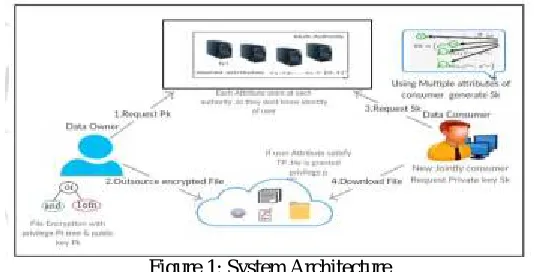
the authorities, and they do not know which attributes are controlled by which authorities. When the Data Consumers request their private keys from the authorities, authorities jointly create corresponding private key and send it to them. All Data Consumers are able to download any of the encrypted data files, but only those whose private keys satisfy the
privilege tree Tp can execute the operation associated with privilege p. The server is delegated to execute an operation p
if and only if the user’s credentials are verified through the privilege tree Tp. To formally define the security of our
Anony Control, we first give the following definitions.
Figure 1: System Architecture
Setup→ PK, MKk : This algorithm takes nothing as input except implicit inputs such as security parameters.
Attributes authorities execute this algorithm to jointly compute asystem-wide public parameter PK as well as an
authority wide public parameter yk , and to individually compute amaster key MKk .
KeyGenerate (PK, MKk, Au) → SKu: This algorithm enablesa user to interact with every attribute authority, and
obtains aprivate key SKu corresponding to the input attribute set Au.
Encrypt(PK, M, {Tp}p∈{0,...,r−1}) → (CT,VR): This algorithm takes as input the public key PK, a message M, anda
set of privilege trees {Tp}p∈{0,...,r−1}, where r is determined by the encrypter. It will encrypt the message Mand
returns a ciphertext CT and verification set VR so that auser can execute specific operation on the ciphertext if andonly if his attributes satisfy the corresponding privilege treeTp. As we defined, T0 stands for the privilege to read the file. Decrypt (PK, SKu , CT) → M or verification parameter: This algorithm will be used at file controlling (e.g. reading,
modification, deletion). It takes as input the public key PK, aciphertext CT, and a private key SKu, which has a set of
attributes Au and corresponds to its holder’s GIDu. If the setAu satisfies any tree in the set {Tp}p∈{0,..., r−1}, the
algorithm returns a message M or a verification parameter. If the verification parameter is successfully verified by Cloud Servers, who use VR to verify it, the operation request will be processed.
As we studied various schemes of ABE like IBE, KP-ABE, CP-ABE also one access control system i.e AnonyControl but the common problem with this techniques that no author work on user revocation strategy with these techniques, because whenever we want to implement these techniques in real scenario then there will be a need of user revocation, sohere we proposed user revocation strategy which can work with AnonyControl system. In Revocational
AnonyControl system after key generation phase, multi authority system build revocation tree Rt by using attributes of
user. There vocation tree corresponds to time t and the identifier of revoked user is uid which is associated with one
IV.SUGGESTED WORK
Propose anonymity Control to allow cloud servers to control users’ access privileges without knowing theiridentity information.
1. The proposed schemes are able to protect user’s privacy against each single authority. Partial information isdisclosed in anonymity Control and no information is disclosed in anonymity Control-F.
2. The proposed schemes are tolerant against authority compromise, and compromising of up to (N −2) authoritiesdoes not bring the whole system down.
3. Provided detailed analysis on security and performance to show feasibility of the scheme anonymityControl and anonymity Control-F.
4. First implement the real toolkit of a multi-authority based encryption scheme anonymity Control and anonymityControl-F.
In this setting, each authority knows only a part of anyuser’s attributes, which are not enough to figure out theuser’s identity. However, the scheme proposed by Chaseconsidered the basic threshold-based KP-ABE, which lacks generality in the encryption policy expression. Many attribute based encryption schemes having multiple authorities have been proposed afterwards, but they either also employ a threshold-based ABE or have a semi-honestcentral authority, or cannot tolerate arbitrarily many users’collusion attack.
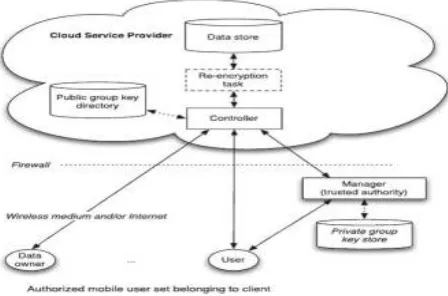
Figure 2: Suggested block diagram
Algorithm 1
1-Out-of-2 Oblivious Transfer
1: Bob randomly picks a secret s and publishes to Alice.
2: Alice creates an encryption/decryption key pair :{ , r}
3: Alice chooses i and calculates = , = , and sends to Bob.
4: Bob calculates = and encrypts using and using and sends two cipher texts ( ),
( ) to Alice.
5: Alice can user to decrypt the desired cipher text ( ), but she cannot decrypt the other one. Meanwhile,Bob
does not know which cipher text is decrypted.
2: For each i ∈ {1, . . . , n}, Bob and Alice are engaged ina 1-out-of-2 OT where Bob’s first message is and
thesecond message is . Alice picks to receive if she wants and otherwise.
3: After Alice receives n components, she has = ⊕· · ·⊕ ⊕ for the i she wants and for k _= i , she
canrecover the byI. = ⊕ ⊕ · · ·⊕s1
V. CONCLUSION
In this paper, the survey of various encryption schemes likeIBE, ABE, KP-ABE, CP-ABE, Anonycontrol and AnonyControl-F is noted with their advantage anddisadvantage. The unique variation of this scheme are compared and mentioned with the present scheme according to the upward thrust in the safety issues in cloud computing. Using multiple government inside the cloud computing machine, our suggested schemes attain no longer simplest quality-grained privilege manage however also identity anonymity while engaging in privilege manage based totally on users’
identity data. More importantly, our device can tolerate upto N − 2 authority compromise, that is enormously most
advantageous mainly in Internet-based cloud computing environment. We also carried out specific security and overall recital evaluation which suggests that Anony- Control both relaxed and efficient for cloud garage system.
REFERENCES
[1] Control Cloud Data Access Privilege and Anonymitywith Fully Anonymous Attribute-Based Encryption190 IEEE transactions on informationforensics and security, vol. 10, no. 1,January 2015
[2] A Privilege Based Attribute Encryption System ForSecure and Reliable Data Sharing. International Journalof Innovative Research in Computer andCommunication Engineering (An ISO 3297: 2007Certified Organization) Vol. 2, Issue 5, May 2014
[3] J. Bethencourt, A. Sahai, and B. Waters, “Ciphertextpolicy attribute based encryption,” in Proc. IEEE SP,May 2007, pp. 321–334.
[4] A. Shamir, “Identity-based cryptosystems and signatureschemes,” in Advances in Cryptology. Berlin, Germany:Springer-Verlag, 1985, pp. 47– 53.
[5] A. Sahai and B. Waters, “Fuzzy identity-basedencryption,” in Advances in Cryptology. Berlin,Germany: Springer-Verlag, 2005, pp. 457–473. [6] V. Goyal, O. Pandey, A. Sahai, and B. Waters,“Attribute-based encryption for fine-grained accesscontrol of encrypted data,” in Proc. 13th
[7] Identity-Based Encryption with Outsourced Revocationin Cloud Computing IEEE transactions oncomputers, vol. 64, no. 2, February 2015 [8] Improving Privacy and Security in DecentralizedCiphertext-Policy Attribute-Based Encryption JinguangHan, Member, IEEE, Willy Susilo, Senior Member,IEEE, Yi Mu, Senior Member, IEEE.
[9] Jianying Zhou, and Man Ho Allen Au, Member, IEEEK. Yang, X. Jia, K. Ren, and B. Zhang, “DAC-MACS:Effective data access control for multi-authority cloudstorage systems,” in Proc. IEEE INFOCOM, Apr. 2013,pp. 2895–2903.
[10] S. Yu, C. Wang, K. Ren, and W. Lou, “Attribute baseddata sharing with attribute revocation,” in Proc. 5thACM Symp. Inf. Comput. Commun.
Security(ASIACCS’10), 2010, pp. 261–270
BIOGRAPHY
Dr.K.Praveen Kumar received the PhD in Computer Science & Engineering in 2015, M.Tech in Software Engineering from Kakatiya Institute of Technology & Science Warangal, Telangana, India in 2010 and B.Tech in Information Technology from Kakatiya Institute of Technology & Science Warangal, Telangana, India 2007. Presently working as Assistant Professor in Computer Science Department at Adama Science and Technology University, Adama, Ethiopia.