Copyright to IJIRSET www.ijirset.com 14010
Flexural Behavior of Trough Shaped
Ferrocement Panels
P.Saranya Banu1, S.Dharmar2 , Dr.S.Nagan3
1
PG Scholar, Department of Civil Engineering, P.S.R Engineering College, Sivakasi, India
2
Assistant Professor, Department of Civil Engineering, P.S.R Engineering College, Sivakasi, India
3
Associate Professor, Department of Civil Engineering, Thiagarajar College of Engineering, Madurai, India
ABSTRACT: Ferrocement is a highly versatile construction material and possess high performance characteristic, especially in cracking, strength, ductility, and impact resistance as its reinforcement is uniformly distributed in the longitudinal and transverse directions and closely spaced through the thickness of the section.. There is an ample scope for mass production and standardization together with the economy in construction. Ferrocement is suitable for low-cost roofing, pre-cast units and man-hole covers. It is also used for the construction of domes, water tanks, boats, silos and folded plates. An experimental investigation on flexural behavior of trough shaped ferrocement panels reinforced with skeletal steel and GI hexagonal wire mesh with varying number of wire mesh layers is presented. The slab panels are tested under flexural loading by applying line loads at 1/3rd points. From the studies, it is observed that the load carrying capacity, deformation of ultimate load and energy dissipation capacity are high in case of increasing number of wire mesh layers. Further it is observed that a reduction in crack width and increase in no of cracks indicates the delay in crack growth.
_______________________________________________________________________________
KEY WORDS
:
Ferrocement, Flexural Behaviour, Trough Panel, Wire mesh.I. INTRODUCTION
Ferrocement is a type of thin wall reinforced concrete commonly constructed of hydraulic cement mortar reinforced with closely spaced layers of continuous and relatively small size wire mesh which may be made of metallic or other suitable materials. Since ferrocement possess certain unique properties, such as high tensile strength-to-weight ratio, superior cracking behavior, lightweight, moldability to any shape and certain advantages such as utilization of only locally available materials and semi-skilled labor/workmanship, it has been considered to an attractive material and a material of good promise and potential by the construction industry, especially in developing countries. It has wide range of applications such as in the manufacture of boats, barges, prefabricated housing units, biogas structures, silos, tanks, and recently in the repair and strengthening of structures.
Ferrocement is suitable for low-cost roofing, pre-cast units and man-hole covers. It is used for the construction of domes, vaults, grid surfaces and folded plates. It can be used for making water tanks, boats, and silos. Ferrocement is the best alternative to concrete and steel. Generally, ferrocement shells range from 10 mm to 60 mm in thickness and the reinforcement consists of layers of steel mesh usually with steel reinforcing bars sandwiched midway between. The resulting shell or panel of mesh is impregnated with an extraordinarily rich (high ratio of cement to sand) Portland cement mortar.
Copyright to IJIRSET www.ijirset.com 14011 2.1.2 Sand
Fine aggregate used is the Trichy river sand passing through sieve in 4.75mm with Specific gravity of 2.62, and having a fineness modulus of 2.80 (IS 383-1971 Zone II).
2.1.3 Water
Potable Water was used for mixing and as well as for curing.
2.1.4 Super Plasticizer
Super plasticizer-CONPLAST SP430 from FOSROC was added to improve the workability of fresh mortar.
2.1.5 Skeletal Steel
The skeletal rod used in the present work is 6mm dia mild steel @ 100mm c/c both in the transverse and the longitudinal direction. The ultimate tensile strength of mild steel is 472 N/mm2.
2.1.6 Wire Mesh
G.I.wire mesh with hexagonal opening of size 12mm and a wire thickness of 1.29 mm (20gauge) was used.
2.2 Geometry of Trough Ferrocement Panel
The geometry of ferrocement panel is trough shape with dimensions of 1000 mm x 350 mm x 30 mm. The reference number and designation of the panels are given in the table. The panels are constructed using the conventional ferrocement materials, which is composed of cement mortar and hexagonal wire mesh.
Copyright to IJIRSET www.ijirset.com 14012 Fig. (2) Trough Ferrocement Panel with Single layer mesh (FP-TH 01)
Fig. (3) Trough Ferrocement Panel with Double layer mesh (FP-TH 02)
2.2.1 Casting of control specimens
Cement mortar cubes of size 70.7 mm × 70.7 mm× 70.7 mm were cast to test the characteristic strength of the mortar mix.
Fig. (4) Casting of control specimens
2.2.2 Casting of Trough Shape Panels
Copyright to IJIRSET www.ijirset.com 14013 Fig.(6) Fabrication of Mould
Fig.(7) Skeletal Steel
Copyright to IJIRSET www.ijirset.com 14014 Fig. (9) Curing of panels
2.2.3 Testing of Trough Panels
The required geometry of the trough panel was made using steel mould fabricated to match the shape and size. Each sample was cast after fixing the required wire mesh and meshes in its proper position in the mould. For the panels with single wire mesh, the mesh was placed at mid depth of the panel and the mortar mix was prepared using sand-cement ratio and water-cement ratio by weight of 1:1 and 0.3, respectively. After 24 hours from casting, the samples are removed from the mould and the cured in water for 28 days. The slabs were tested under loading frame. The load was applied by means of a load cell 50T. The specimens were tested by simulating simply supported conditions. The load was applied as two symmetrically arranged concentrated line loads. Loading was applied using a Hydraulic Jack and LVDT was fixed at central bottom to measure the deflection. The slabs were painted using whitecem to help in tracing the cracks. The test setup of the tested trough panel is shown in fig(5).The load is applied in small increments and simultaneously the deflection at the center of the panel was recorded during the loading process up to failure. The deflection at the mid span is measured by LVDT. Cracking was carefully checked throughout the loading process and the corresponding cracking load is also noted.
Fig.(10) Test Setup
III.RESULTS AND DISCUSSION
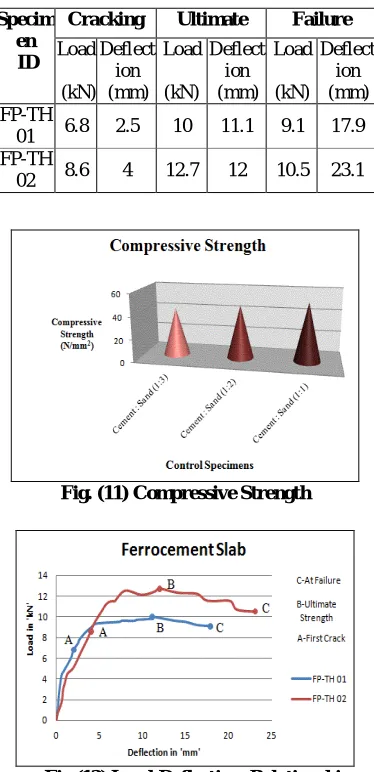
Copyright to IJIRSET www.ijirset.com 14015 Table 2: Experimental Results
Fig. (11) Compressive Strength
Fig.(12) Load-Deflection Relationship
Specim
en ID
Cracking Ultimate Failure
Load (kN) Deflect ion (mm) Load (kN) Deflect ion (mm) Load (kN) Deflect ion (mm) FP-TH
01 6.8 2.5 10 11.1 9.1 17.9 FP-TH
Copyright to IJIRSET www.ijirset.com 14016 3.1 Cracking Behavior
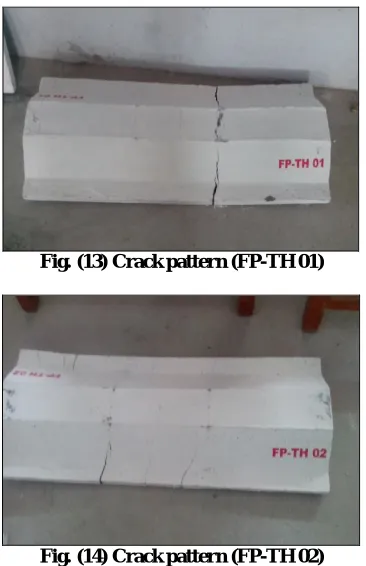
The failure of the slab specimen’s results from the yielding of wire mesh reinforcement is followed by the crushing of mortar. Initially fine flexural cracks appeared at the bottom of the specimen. With further increase in the load, regularly spaced vertical cracks were observed
and they extended from the bottom of the specimen towards top (Fig.13) & (Fig.14).The load was increased up to ultimate stage.
Fig. (13) Crack pattern (FP-TH 01)
Fig. (14) Crack pattern (FP-TH 02)
IV. CONCLUSIONS
The following conclusions were drawn from the experimental study carried out on Trough shaped ferrocement panels.
The cracking load was not significantly affected by the number of the wire mesh layer particularly for the Trough panel.
The experimental result shows the superiority of the trough to the flat panel and folded panels in terms of ultimate strength and initiation of cracking.
From the experimental result, the flexural strength of the trough shaped panel with single layer wire mesh is 81% more than flat panel and 50% lower than folded panel. And the deflection is 61.18% less than flat panel and 44.68% more than folded panel,
And trough shape panel with double layer wire mesh is 77.95 % more than flat panel and 53.81% lower than folded panel. And the deflection is reduced by 56.36% and 6.17% respectively when compared of flat panel and folded panel.
Copyright to IJIRSET www.ijirset.com 14017
5. R.Vicent prabakar, S.Dharmar., “Experimental Investigation On Flexural Behavior of Fold Shape Ferrocement Panels”, 2nd National Conference Recent Advancement in Civil Engineering (RACE’14) 21,March 2014.
6. Jain, A.K., "Ferrocement Folded Plate Roofing Industrial Sheds", India Concrete Journal,Vol. 55, No. 6, June 1981.
7. Desayi, P., Viswanatha, C.S. and Hubli, G.K., "Ferrocement Precast Elements for Roofing of Low-Cost Housing", Journal of Ferrocement, Vol. 13, No. 1, January 1983.