Meiotic Mutants That Cause a Polar Decrease in Recombination on the
X
Chromosome in
Caenorhabditis elegans
Sherry1 A. Broverman’ and Philip
M.
Meneely
Fred Hutchinson Cancer Research Center, Seattle, Washington 98104 Manuscript received June 7 , 1993
Accepted for publication September 10, 1993
ABSTRACT
Recessive mutations in three autosomal genes, him-], him-5 and him-8, cause high levels of X chromosome nondisjunction in hermaphrodites of Caenorhabditis elegans, with no comparable effect on autosomal disjunction. Each of the mutants has reduced levels of X chromosome recombination, correlating with the increase in nondisjunction. However, normal or elevated levels of recombination occur at the end of the X chromosome hypothesized to contain the pairing region (the left end), with recombination levels decreasing in regions approaching the right end. Thus, both the number and the distribution of X chromosome exchange events are altered in these mutants. As a result, the genetic map of the X chromosome in the him mutants exhibits a clustering of genes due to reduced recombination, a feature characteristic of the genetic map of the autosomes in non-mutant animals. We hypothesize that these him genes are needed for some processive event that initiates near the left end of the X chromosome.
M
EIOSIS reduces the chromosome number of gametes prior to the onset of the next genera- tion. Despite the importance of meiosis and its near universality among eukaryotes, the mechanics of this reductional division remain poorly understood. T h e central process of reductional division involves each chromosome finding its homolog, pairing and then disjoining. If chromosomes fail to pair, they frequently do not disjoin correctly and chromosome loss can occur. In organisms that undergo genetic exchange, at least one exchange event per chromosome is often necessary for proper pairing and disjunction (re- viewed in HAWLEY 1988). Mutations that decrease or abolish recombination lead to high levels of homolog nondisjunction (reviewed in BAKER et al. 1976), often a lethal event. It has been postulated (SMITHIES and POWERS 1986; CARPENTER 1987) and recently shown for one strain of yeast that initiation of recombination is one of the earliest events in the meiotic cycle (PAD- MORE, CAO and KLECKNER 1991).Caenorhabditis elegans consists of two sexes: X X self- fertile hermaphrodites and X 0 males. Hermaphrod- ites are basically females that transiently make sperm, which they store and use for self-fertilization if males are absent. Hermaphrodites usually produce X X her- maphrodite self-progeny, but in 0.2% of all meioses spontaneous nondisjunction of the X chromosome generates X 0 male progeny. Since X 0 males are via- ble aneuploids, it is simple to isolate meiotic mutations that elevate nondisjunction or loss by screening for an
’
Current address: Department of Biochemistry and Cell Biology, State University of New York at Stony Brook, Stony Brook, New York 11794. Genetics 1 3 6 1 19-127 uanuary, 1994)Initial work (HODGKIN, HORVITZ and BRENNER 1979) on the X chromosome-specific him genes dem- onstrated that these mutations dramatically reduce recombination on the X chromosome but not in most of the six large autosomal regions tested. [ h i m 3 is the one exception, causing a decrease in recombination in one autosomal interval.] T h e amount of reduction in recombination roughly correlates with the degree of chromosome loss. For example, the mutation him-
Z(e879) yields 20% X 0 progeny with a decrease in recombination over a large X-linked interval of 3276, while him-8(e1489), produces 40% X 0 males and re- duces recombination in the same interval by 92% (HODGKIN, HORVITZ and BRENNER 1979). All three him strains also generate diplo-X gametes that upon self-fertilization produce morphologically distinct tri- plo-X hermaphrodites. When the two X chromosomes that do not disjoin are examined they are usually found to be nonrecombinant. These triplo-X progeny are less frequent than X 0 progeny, suggesting that nondisjoined chromosomes are often lost.
T o determine how these mutations lead to nondis- junction and specific loss of the X , we isolated new alleles of him-8 and undertook a more detailed analysis of recombination over the majority of the X chromo- some in the three X-specific mutants. Strikingly, o u r results suggest that these three genes are involved in determining not only the frequency of exchange events, but also their spatial distribution along the X chromosome. T h e data suggest a biphasic mechanism for chromosome pairing.
MATERIALS AND METHODS
Strains and maintenance of C. elegans: Nematodes (var. Bristol, wild-type designated N2) were cultivated on Esche- richia coli strain OP50 (SULSTON and HODGKIN 1988). All crosses and growth were at 20" except for mutant screens, which were performed at 25 O f Genes and alleles used were:
Linkage group (LG) I: him-l(e879), dpy-5(e61), unc-l3(e51);
LG 11: unc-4(e120); dpy-lO(e128);
LG 111: unc-36(e251);
LG IV: dpy-2O(e1282ts), him-6(e1423);him-8(e1489), him-8 (mn253), mec-3(n578),unc-24(e138), unc-43(e408), dpy-
13(e184) mDj7/nTl[let?(m435)(ZV;V)];
LG V: unc-42(e270), sgt-3(sc63), him-5(el49O); dpy-1 l(e224)
LC X: unc-l(e538), unc-l(e719), dpy-3(e27), unc-2(e55), lon- 2(e678), unc-l8(e81), dpy- 6(e14), unc-3(e151), lin-l5(n309).
Screen for new alleles that fail to complement him-
8fe2489): A population of N2 animals containing males was mutagenized with ethyl methanesulfonate (EMS) at room temperature as described by SULSTON and HODGKIN (1 988), except that a lower concentration of EMS (30 mM) was used. Eight to ten L4 mutagenized males were mated to two unc- 24(e138) him-8(e1489) dpy-2O(e1282ts) hermaphrodites. All crosses and subsequent generations were maintained at 25" until temperature sensitivity was assayed. F1 non-Dpy non-
Unc hermaphrodites were picked to individual plates as L3
or L4 larvae and allowed to self-fertilize. FZ progeny were
screened for the presence of males. Several individuals were
picked from each candidate plate and retested. New muta- tions were outcrossed several times, usually while mapping to a chromosome, to remove any secondary mutations.
Linkage analysis: Linkage to each chromosome was tested independently using standard techniques. Males were
chosen from each him-8 candidate mutation and mated to hermaphrodites mutant for a morphological marker, e.g., unc-13 (I). non-Unc F1 progeny were transferred to new plates as larvae and allowed to self. Twenty-five Unc F P progeny were transferred to new plates and the Fs progeny were screened for the presence of males. If unlinked, then approximately six FZs (1 /4 of the total) are expected to be Him. For new allele ec51 the number of Fz Hims for each linkage group was: LG I, 6; LG 11, 5; LG 111, 4; LG IV, 0 ; LG V, 7.
Analysis of recombination on the X chromosome in him-2, him-5 and him-8: Recombination was initially exam- ined in a non-Him strain to establish a wild-type standard. N2 males were mated to hermaphrodites carrying two X- linked markers, e.g., unc-2 dpy-3. non-Unc non-Dpy F1 prog-
eny were transferred to individual plates as larvae and transferred to new plates daily once egg laying commenced. T h e number of recombinant and nonrecombinant F2 prog- eny were determined.
T o test recombination in a him background triple mutant strains were constructed consisting of either him-1, him-5 or
him-8 and the same two X-linked markers used to construct the map in wild type. Each strain was then mated to un- marked him males to generate him homozygotes that were heterozygous for both X-linked markers. Since him strains normally produce some triplo-X progeny that are morpho- logically Dpy (HODGKIN, HORVITZ and BRENNER 1979), the Unc non-Dpy recombinant F2 progeny were always scored whenever an X-linked dpy marker was used. Fls were cul- tured until no longer fertile to ensure scoring of the entire F2 brood, and to avoid age effects on recombination (ROSE and BAILLIE 1979). unc-l(e719) was used in strains contain- ing him-5 and him-8, while unc-l(e538) was used for him-1, since we found that him-l(e879) unc-l(e719) is not a viable strain. Deviations from the wild-type map distance in a him stain were expressed as a percentage of that found in N2.
Creation and analysis of double mutant strains: him- l(e879);him-8(el489) was created by mating dpy-5(e6l);him- 8(e1489) males with him-l(e879);unc-24(e138) hermaphrod- ites. F, non-Unc hermaphrodites were transferred to new plates and allowed to self-fertilize. FZ non-Unc non-Dpy hermaphrodites were transferred to individual plates and the Fs screened for the absence of Unc and Dpy progeny. Those individuals producing only wild-type hermaphrodites and males were designated as being him-1;him-8. This was confirmed by mating him-1;him-8 males to both him- 8(e1489)unc-24(e138) and him-l;(e879)unc-24(e138), select- ing non-Unc Fls and checking for males in the FZ generation. him-5(e149O);him-8(mn253) and him-5(e149O);him-8(el489) were created using the above strategy and the marked strains him-5(e149O);mec-3(n578) o r him-5(e149O);unc- 24(e138), and him-8(rnn253);sqt-3(~~63), or him-8(el489);sqt- 3(sc63). him-5;him-8 strains were confirmed by mating to
him-5(el49O);unc-24(el38) or him-8(mn253) unc-24(e138) her- maphrodites, selecting non-Unc Fls and checking for males in the FP generation.
Male counts were done by picking larvae from the Him double mutants and transferring them to new plates daily so that entire broods could be scored.
Chromosome Meiosis in eleguns
procedure developed by HODGKIN, HORVITZ and BRENNER (1979). Specifically, the strains unc-4(e120) II; dpy-1 l(e224)
V; him-6(e1423) N and dpy-lO(e128) II; unc-42(e270) V; him-
6(e1423) N were used to generate disomic and nullo-somic
oocytes that were fertilized by wild-type male sperm. By screening for Unc non-Dpy and Dpy non-Unc progeny the frequency of loss of chromosomes 11 and V during him+ spermatogenesis could be assesed. In more than 30,000 individuals examined no such progeny were discovered. Similar experiments, though with fewer numbers, were also conducted for chromosomes I , 111 and N and again no sign was seen of spontaneous autosomal nondisjunction in a him+ strain. The reciprocal experiments were also done using him-6(el423) males and unc-4(e120) II; dpy-1 l(e224) V or dpy-
lO(e128) IZ; unc-42(e270) V hermaphrodites to look for spon-
taneous autosomal nondisjunction during him+ oogenesis. Again, greater than 20,000 progeny were examined and no progeny indicative of autosomal loss were recovered.
RESULTS
Isolation and analysis of him-8 alleles: When this analysis began only two alleles of him-8 existed, e1489 (HODGKIN, HORVITZ and BRENNER 1979) and mn253 (HERMAN and KARI 1989), both of which were healthy and gave high frequencies of males. [A third allele of
him-8, him-8(g203) (HODGKIN et al. 1988) has been lost
(R. CASSADA, personal communication).] We wanted to examine more alleles in order to determine if the high level of non-disjunction was the only phenotype that could be obtained by mutation in him-8. We conducted a screen for mutations that failed to com- plement him-8(e1489). N2 males were mutagenized with EMS and mated to dpy-20 him-8 unc-24 herma- phrodites at 25 O
.
non-Dpy non-Unc F1 hermaphroditeprogeny were picked to individual plates at 25 O prior
to reaching the adult molt in order to avoid generating males from mating. From 1728 genomes screened we recovered two mutations that failed to complement
him-8(e1489), neither of which was temperature sen-
sitive. ec51 fails to complement both him-8 (e1489)
and him-8 (mn253), produces 44% self-progeny males
when homozygous, and maps to chromosome N . From 25 ec51
+/+
unc-24 animals, none of the Unc progeny was Him, suggesting that ec51 maps close tounc-24. We thus concluded that ec51 was a new allele
of him-8.
T h e second noncomplementing mutation was homozygous lethal and failed to complement unc-43 as well as him-8. We concluded that this mutation was a deficiency and named it ecDf4. ecDf4 complements both unc-24 and dpy-20, however, delineating the maximum size of the deficiency as less than two map units.
Excluding ecDf4, there now exist seven independ- ently isolated alleles of him-8 (this work; HODGKIN, HORVITZ and BRENNER 1979; HERMAN and KARI 1989). During the course of this work several new alleles of him-8 were given to us by colleagues (A. VILLENEUVE and C. MELLO, personal communica-
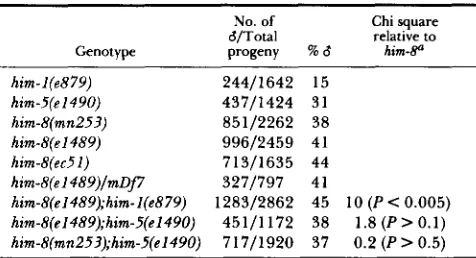
TABLE 1
Percentage male progeny from different him strains
$/Total
Genotype progeny % d h i m - b No. of Chi square
relative to
him-l(e879) 24411642 15
him-5(e1490) 43711424 31
him-8(mn253) 85112262 38
him-B(e1489) 99612459 41
him-8(ec51) 71311635 44
him-8(el489)/mDj7 3271797 41
him-s(el489);him-l(e879) 128312862 45 10 ( P < 0.005) him-8(e1489);him-5(e1490) 45111172 38 1.8 ( P > 0.1)
hirn-8(mn253);him-5(el490) 71711920 37 0.2 ( P > 0.5)
Chi square analysis was used to determine if the phenotype of the double mutant differed significantly from the phenotype of him- 8 alone. A confidence level of P < 0.05 was considered significant.
tions). All yield similar percentages of self-progeny males, suggesting that the Him phenotype is not likely to be due to novel changes in gene function. If the 40% Him phenotype represents the absence of active gene product, rather than simply a reduction, then the phenotype should not change when the mutant allele is placed in trans to a deficiency for the locus. This was done for the canonical allele, e1489, using the deficiency mDj7 and the number of self-progeny males generated was determined. No significant change in percent males produced occurred (Table 1). Similar results were seen with him-8(e1489)/ecDf4 (data not shown). Unlike the sterility associated with
him-5 mutations (P. MENEELY, unpublished data), and
the lethality (HOWELL et a l . 1987) and semi-domi- nance of him-I mutations (HODGKIN, HORVITZ, and BRENNER 1979), him-8(e1489) is recessive and has no other phenotypes. Thus it is likely that the X chro- mosome nondisjunction phenotype of e1489 and ec51 represents the null mutant phenotype of the him-8 gene.
Further data distinguishing the roles of these genes in meiosis comes from HARTMAN and HERMAN ( 1 982), who demonstrated that him-1 is sensitive to UV and ionizing radiation, while him-5 and him-8 are not. him-
1 mutations can also be suppressed by a mutation in the UV radiation-sensitive gene rad-4, while him-5
and him-8 mutations can not (HARTMAN and HERMAN
1982). HODGKIN, HORVITZ and BRENNER (1979) re- ported that the effects of mutation in him-I(e879) and
him-5(e1490) are additive. We find that a him-
I(e879);him-8(e1489) double mutant strain produces
45% males, a slight but statistically significant increase in production of nullo X gametes above what him-8 alone produces (Table 1). In contrast, the him-
5(e1490);him-s(e1489) strain gave 38% males and him-
5(e1490);him-8(mn253) gave 37% males, not signifi-
cantly different from either him-8 allele alone (Table
1). Thus, him-l(e879) is additive with both him-
A. M.
TABLE 2
Frequency of recombination on the X chromosome in him+
Interval recombinants Map Frequency of unitsa
unc-1 dfy-? 3.4 5313 120
dpy-? unc-2 3111619 3.8 unc-2 lon-2 4711587 6.0 lon-2 unc-18 7912858 5.6
unc-18 dpy-6 1111448 1.6
dpy-6 unc-9 14212903 9.8 unc-9 unc-3 8312652 6.2
unc-? lin-15 5.4 7312659
Since only one recombinant class was scored, only half of all recombination events were counted. Thus the number of recom- binant progeny was doubled before being divided by the total number of progeny and then multiplied by 100 to be expressed as map units.
him-1, him-5 and him-8 cause a reduction and redistribution of recombination frequencies along the
X
chromosome: HODGKIN, HORVITZ and BRENNER(1979) examined recombination in him-1, him-5 and
him-8 for two large intervals on the X chromosome
and concluded that all three him mutants had de- creased recombination on the X . In fact, the allele
him-8(mn25?) was originally isolated in a screen for
mutations that reduce recombination on the X chro- mosome (HERMAN and KARI 1989). Only him-5 has been seen to affect recombination dramatically in any one of six autosomal regions tested (HODCKIN, HORV- ITZ and BRENNER 1979). In order to determine if these reductions in X chromosome recombination re- flect local phenomena specific to one site or a more global effect on X chromosome recombination, we measured exchange rates in small intervals from unc-
1 to lin-15. These totaled a distance of 41.8 map units
(m.u.), representing 84% of the genetically defined X chromosome. This was initially done in him+ herma- phrodites in order to develop an internal map for comparison (Table
2;
Figure 1). We also examined recombination in several overlapping intervals and found results comparable to those presented (data not shown).As previously reported by HODGKIN, HORVITZ and BRENNER (1 979) we also saw a decrease in X chromo- some recombination when examining hermaphrodite progeny of him-8(e1489). By summing the amount of recombination in small intervals we find that the ge- netic map in him-8 consists of only 12.2 m.u. from
unc-1 to lin-15, a threefold reduction in exchange
from the wild type (Figure 1). However, the pattern of reduction is neither uniform nor random, but highly skewed from one end of the chromosome to the other. In a region near the right end of the chromosome (unc-? lin-15), only 2% of the wild-type level of crossing over occurred (Figure 2). Strikingly, reduction in the frequency of crossing over becomes less severe in intervals approaching the opposite end
unc-1 dpy-3 unc-2 Ion-2 unc-I8 dpy-6 unc-9 unc-3 [in-15
3 m.u.
FIGURE 1 .-Genetic map of the X chromosome in him and him+
strains. Genetic maps were constructed by summing the map dis- tances of each interval measured in each strain. Numbers of progeny counted for each interval are given in the figure legends of the corresponding graphs for each mutant. him alleles used were: him- 8(e1489), him-5(e1490) and him-l(e879).
140 I 6 O C
.
w
-
.
20 -
-
0
unc-1 dpy-3 unc-2 Ion.2 unc-18 dpy-6 unc-9 ~11C-3 [in-15
I I
I I J JI I I I
X
chromosome interval 5m.u.FIGURE 2.-Recombination on the X chromosome in him-
8(e1489); hermaphrodite progeny scored. In this and in Figures 3
and 4, the genes are placed along the x axis as determined by the recombination distance between them in non-Him strains. Horizon- tal lines indicate the amount of recombination in that interval as a percentage of the recombination in wild type. Thus, 100% (the dotted line) is the amount of recombination in each interval in non- mutant strains. The number of individuals scored (no. of one recombinant class/no. total progeny) for each interval is: unc-1 dpy-
? (3911647); dpy-? unc-2 (2412295); unc-2 Ion-2 (1811620); lon-2
unc-l8(3/1416);unc-18dpy-6(4/1602);dpy-6unc-9(13/1374);unc-
9 unc-3 (31369); unc-3 lin-15 (112039).
of the chromosome, and the frequency in the most leftward interval examined, unc-1 dpy-3, was actually elevated above wild type. These data suggest that him- 8 mutants confer a polarity in the ability of the X chromosome to undergo recombination, and that the
unc-1 dpy-3 region is capable of undergoing normal
or elevated rates of crossing over in the absence of
him-8 gene product.
We performed the same type of analysis with him-
5(e1490). The reduction in exchange was not as severe
X Chromosome Meiosis in C. eleguns
2W
E: 120
2
100E 80
8
z
0
.*
.l+.3
P
60
5
40
20
0
unl
I ( J JI I I I
dpy-3 unc-2 lon-2 unc-18 dpy-6 arrc-9 unc-3 lin-15 X chromosome interval 5m.u.
FIGURE 3.-Recombination on the X chromosome in him-
5(e1490); hermaphrodite progeny scored. The graph is explained
in more detail in the legend to Figure 1. The number of individuals scored (no. of one recombinant class/no. total progeny) for each interval is: unc-1 dpy-3 (42/1224); dpy-3 unc-2 (4/623); unc-2 lon-2 (1 3/1193); lon-2 unc-18 (3/579); unc-18 dpy-6 (3/759); dpy-6 unc-9 (14/774); unc-9 unc-3 (9/598); unc-3 lin-I5 (4/558).
20 m.u. in length, a twofold overall reduction (Figure 1). T h e distribution of crossovers, however, was qual- itatively similar to that seen with him-8(e1489), with a large increase in exchange in the unc-1 to dpy-3 inter- val and a reduction over the remainder of the regions tested (Figure 3).
A similar analysis of exchange in him-l(e879) pro- duced a pattern strikingly similar to that seen in him-
8 and him-5. There is a twofold decrease in overall
recombination in the region of the X chromosome examined (Figure l ) , but the distribution of exchange in different regions is again highly skewed. T h e most dramatic difference between him-1 and either him-5
or h i m 4 is the presence of nearly normal levels of
exchange between dpy-3 and unc-2 (Figure 4). This suggests that a greater physical length of the chro- mosome is proficient for wild-type levels of exchange
in him-1 mutants than in the other two him mutants.
This might account for the greater stability of the X chromosome in him-1, as assayed by the smaller num- ber of males generated by non-disjunction or loss.
In the analyses above, the data were collected from hermaphrodite self-progeny, which receive an X chro- mosome from both hermaphrodite germlines. It is not possible to directly assay nondisjunction during her- maphrodite spermatogenesis. However, HODCKIN, HORVITZ and BRENNER (1979) measured X chromo- some nondisjunction rates during spermatogenesis in sexually transformed him-8;tra-1 XX males. They found 1 1 % nullo-X sperm produced, as compared to the 38% nullo-X ova formed in him-8 hermaphrodites,
140
-
I II ' I I JI I I I
unc-1 dpy-3 unc-2 1011-2 unc-18 dpy-G ~rrrc-9 nnc-3 1in-15 X chromosome interval 5m.u.
FIGURE 4.-Recombination on theXchromosome in him-I(e879);
hermaphrodite progeny scored. The graph is explained in more detail in the legend to Figure 1 . The number of individuals scored (no. of one recombinant class/no. total progeny) for each interval is: unc-1 dpy-3 (38/1371); dpy-3 unc-2 (31/1745); unc-2 lon-2 (31/ 1649); lon-2 unc-I8 (11/1609); dpy-6 unc-3 (24/1743);unc-3 lin-15 (8/2235).
and suggested that disjunction during spermatogene- sis may be less affected than during oogenesis. The origin of the single X present in male progeny of hermaphrodites will therefore reflect the frequencies of nondisjunction or loss in each germline: higher levels of loss during oogenesis means that the majority of the X chromosomes found in X 0 male progeny come from spermatogenesis. When the X chromo- somes in male him-8 progeny were examined, the frequency of recombination was reduced to a summed map distance of 18.6 m.u., and the distribution of the remaining crossovers was similar to that seen when hermaphrodite progeny were examined (data not shown). Thus recombination is reduced to similar degrees in both germlines, but this may lead to higher levels of loss during oogenesis.
A recombinational analysis of the X chromosome inherited by him-5 male progeny was also performed. Again, the reduction and pattern of exchange on the X chromosome in him-5 males was very similar to that
in him-5 hermaphrodites (data not shown). Analysis
by HODGKIN, HORVITZ and BRENNER ( 1 979) had in- dicated that both germlines of a hermaphrodite are also likely to be affected in him-5. Thus in him-5 hermaphrodites both oogenesis and spermatogenesis are similarly affected for disjunction and exchange.
X chromosome, as well as an alteration in distribution. Since this region of the chromosome is proficient for at least wild-type levels of recombination in the ab- sence of the wild-type him gene products, it suggests that the products of him-1, him-5 and him-8 may not normally function in this region, but may perhaps be necessary for extension of the ability to undergo re- combination to the remainder of the X chromosome (discussed below).
The severe reduction in total map distance seen in the him mutants suggests frequent recovery of nonrecombinant chromosomes: T o generate the ex- treme compression of the genetic map observed in the him mutants, particularly in him-8, one of two things must be occurring. Either nonrecombinant chromo- somes must be recovered the majority of the time, or significant increases in recombination must be occur- ring in regions not examined at the ends of X chro- mosome. Unfortunately, at this time it is not possible to distinguish between these two possibilities as few useful genetic markers map to the ends of the X chromosome. Efficient recovery of nonrecombinant chromosomes may suggest the presence of a secondary disjunction system, such as the distributive disjunction system first reported by GRELL (1 976) that routinely segregates the nonrecombinant fourth chromosome in Drosophila. Evidence from other studies (discussed below) suggest that a similar system may also function in C. elegans.
DISCUSSION
Many mutations that alter exchange during meiosis have been isolated and examined in a variety of or- ganisms [for reviews see BAKER et al. (1 976) and HAWLEY 1988). We find that mutations in the genes
him-1, him-5 and him-8 in C. elegans reduce recombi-
nation on the X chromosome in a way that is neither uniform nor random, but polar with respect to the chromosome. In all three him mutants, recombination occurs at normal or elevated levels in the region of the X chromosome thought to be involved in pairing, but at reduced levels elsewhere on the X chromosome. Some meiotic mutants in Drosophila alter the proba- bility of exchange along a chromosomal arm (BAKER and CARPENTER 1972; reviewed in BAKER et al. 1976). Such mutants were called “precondition mutants” by SANDLER et al. (1 968) and were hypothesized to estab- lish the ability of chromosomal regions to undergo exchange.
T h e patterns of recombination seen in him-I, him-5
and him-8 mutants suggest that in C. elegans the X
chromosome can be divided into two general domains. One region, defined by the region unc-1 to dpy-3 [hereafter called the “unc-1 region”], can undergo at least normal levels of exchange in the absence of normal levels of him wild-type gene products. T h e
remainder of the X chromosome, however, requires all of these gene products for correct level and spatial distribution of crossover events. In him-1 and him-8 mutants recombination decreases progressively in in- tervals farther away from the unc-1 region. This skewed pattern of recombination might help to reveal the mechanism of chromosome pairing and exchange for the X chromosome in C. elegans. T h e data suggest an inability to propagate some process out of the unc- 1 region into the remainder of the chromosome.
T h e unc-1 region of the chromosome has elevated levels of crossing over in the him mutant backgrounds we tested, and may contain a pairing site (HERMAN, KARI and HARTMAN 1982; HERMAN and KARI 1989) or homolog recognition region (ROSE and MCKIM
1992). These studies demonstrated that it is necessary to have the unc-1 region in cis for correct disjunction and correct exchange anywhere along the X chromo- some, and that when a third unlinked copy of this region is present X chromosome disjunction is dis- rupted. For example, a small duplication of the region in a hermaphrodite competes with the two normal X chromosomes for a pairing partner, recombines at near wild-type rates, and excludes one normal homo- log from the pair, causing X chromosome loss (HER- MAN and KARI 1989). Duplications of other regions of the X chromosome do not recombine at high levels with the chromosome and do not cause nondisjunc- tion, prompting HERMAN and KARI (1989) to suggest that the unc-1 region contains one or more sites nec- essary for X chromosome pairing. It should be em- phasized that while the region around unc-1 resides near one end of the chromosome as defined by the genetic map, the physical end of the chromosome has not been located. Indeed several genes map to the left
of unc-1, suggesting that the physical end may not be
immediate.
Chromosome Meiosis in eleguns 125
strong double strand break (DSB) site. GOLDWAY et al. (1993) suggest that DSB sites might serve as pairing sites for homologs during meiosis. Studies in Drosoph- ila suggest that a chromosome might contain multiple pairing sites along its length (HAWLEY 1980). Whether these sites are functionally homologous to those de- fined in yeast and implicated in worms is as yet un- known.
T h e work of HERMAN and ROSE indicates that re- combination along the majority of the X chromosome depends upon a small region near unc-1. Our work suggests that when him-1, him-5 or him-8 are mutant, this region can still pair and recombine, while the remainder of the chromosome is affected. Taken to- gether, the data lead us to suggest that these him gene products are not necessary for the process that initi- ates in the unc-1 region, but are essential for proces- sivity or extension of this process into the majority of the X chromosome. Several testable predictions for X-specific him function can be constructed based on this hypothesis.
Models for X-specific him function
him mutations might affect synaptonemal com-
plex extension or function: In many organisms for- mation of a synaptonemal complex (SC) correlates with meiotic recombination (reviewed in VON WETT- STEIN, RASMUSSEN and HOLM 1984), and many meiotic mutants cause both recombination and the SC to be aberrant (SMITH and KING 1968; ALANI, PAD- MORE and KLECKNER 1990; ENGEBRECHT, HIRSCH and ROEDER 1990). ENGEBRECHT, HIRSCH and ROEDER (1990) have postulated that only those exchange events that occur in the context of a synaptonemal complex lead to efficient disjunction. In
C.
eleguns the synaptonemal complex may initiate in a region local- ized near the left end of the X chromosome independ- ent of the him genes described here, but the products of these genes may be necessary for extension into the remainder of the X chromosome. If a functional SC very rarely extended into the right end of the chro- mosome, then few exchange events involving the right end would be recovered, giving the impression that recombination occurred only at low levels in that region. This model suggests that him-8 is involved in formation or extension of the SC, and that the SC, for the X chromosome at least, should be aberrant or absent in the mutant.GOLDSTEIN (1982) investigated the SCs in him-8 mutants by serial sectioning the gonad and forming three-dimensional reconstructions of four nuclei. In
C. eleguns the X chromosome is not cytologically dis- tinct and so a numerical test must be applied. He found six apparently normal SCs, even though him-8 has dramatic effects on recombination. It is possible that GOLDSTEIN examined the SC during a phase of pachytene when the defect was not apparent. It is also
possible that him-1, him-5 and him-8 are not structural components of the SC, but might instead regulate its function.
X-specific him genes might
be
involved in chro- matin structure: Many organisms globally control re- combination during meiosis to coordinate exchange throughout the genome (HAWLEY 1988; CARPENTER 1988). This is evident by the nonrandom distribution of exchange over chromosomes, and the non-uniform relationship between map units and kilobases in dif- ferent regions of the genome (SZAUTER 1984; LE- FEVRE 197 1 ; SYMINGTON and PETES 1988; MORTIMER and SCHILD 1985) InC.
elegans chromosome wide control of recombination is evident by an exclusion of exchange from the central region of each autosome, but not the X chromosome, leading to a tight genetic cluster of 3-5 m.u. that encompasses the majority of the genes identified (BRENNER 1974; GREENWALD etul. 1987; STARR et ul. 1989; EDGLEY and RIDDLE
An alternative possibility for the role of him-1, him- 5 and him-8 gene products is that they are involved in generating domains of chromatin that are differen- tially receptive to recombination. This model is anal- ogous to the way some transcription factors alter transcriptional rates by modulating chromatin struc- ture (WINSTON and CARLSON 1992). Unlike the auto- somes the X chromosome in C. elegans is distinguished
by the absence of a genetically defined cluster. T h e coordination of recombination events to generate the more uniform genetic map characteristic of the X chromosome might be due to the gene products of the X-specific him genes, him-1, him-5 and him-8. In- deed, when him-1, him-5 or him-8 is mutant, the X chromosome assumes the tight cluster of genes typical of an autosome, the cluster occurring at the end
opposite the hypothesized initiation site near the unc- 1 region (Figure 1). On the autosomes, however, the cluster is more centrally located, perhaps because processive events affecting recombination initiate at both ends of an autosome instead of only one, as on the X chromosome. This may also explain the obser- vation that an autosome can undergo double cross- overs while the X chromosome in a hermaphrodite apparently undergoes only single events (HODGKIN, HORVITZ and BRENNER 1979). The presence of a cluster distinguishes the X-specific him mutants from Drosophila mutants that alter the distribution of ex- change by creating a more uniform map such as is seen after irradiation (BAKER and CARPENTER 1972). Thus the Drosophila mutants seem to relax the con- straints on exchange, while him-1, him-5 and h i m d alter them, or reveal underlying constraints.
T h e asymmetry of effect in the absence of him function suggests a polar localization of him gene product. Elucidating the specific process affected will
require molecular analysis of the genes and localiza- tion of the gene products.
Evidence for distributive disjunction in C. elegans: Our analysis of recombination on the X chromosome
in C . elegans suggests many nonrecombinant chromo-
somes are faithfully transmitted. This may occur in both germlines of a hermaphrodite and perhaps more frequently during spermatogenesis. We speculate that meiosis in C . elegans might employ a mechanism for disjoining nonrecombinant X chromosomes, such as a distributive disjunction system (GRELL 1976). None of the X-specific him mutants affects transmission of the X during male spermatogenesis, suggesting that the X chromosome in males uses some other mecha- nism for disjunction (HODGKIN, HORVITZ and BREN- NER 1979). HERMAN and KARI (1989) showed that
him-8 functions during male spermatogenesis by ex-
amining recombination between duplications and the X chromosome. him-8 again appears to decrease and redistribute recombination between the X chromo- some and a homologous duplication, but as during hermaphrodite spermatogenesis, this does not lead to increased nondisjunction or loss of nonrecombinants. Finally, HERMAN, MADL and KARI (1979) and ROSE, BAILLIE and CURRAN (1 984) showed that in males free autosomal duplications tend to segregate from the single X chromosome, demonstrating that homology is not necessary for pairing as is typical of the distrib- utive disjunction system in Drosophila (reviewed by GRELL 1976).
Evolutionary implications of X chromosome spe- cific meiotic functions: T h e meiotic control of the X chromosome in C . degans appears to be at least par- tially independent of the autosomes, as evidenced by greater frequency of loss of the X chromosome in wild-type strains (see MATERIALS AND METHODS), the existence of X chromosome-specific meiotic muta- tions, the lack of a genetic cluster, and the presence of complete interference over most of its length in hermaphrodites. C . elegans is a facultative herma- phrodite, and when male sperm are present they are preferentially used, yielding 50% male outcross prog- eny. However, in the absence of male sperm oocytes are self-fertilized and generate almost 100% herma- phrodite progeny. Thus even in the best conditions males are not maintained at high levels in a wild-type population. Outcrossing generates new allelic combi- nations and distributes alleles more rapidly through a population than self-crossing. Thus, X chromosome- specific meiotic processes that are less efficient than autosomal processes might have evolved in herma- phroditic species due to the benefit accrued from specifically generating male progeny via X-specific loss during self-fertilization. X chromosome-specific com- ponents of a meiotic system might be absent or have assumed different functions ( i e . , no longer be X chro-
mosome specific) in related nematode species that are dioecious and have a more typical 1 : 1 sex ratio. With the molecular probes being generated in our labora- tory, this hypothesis should now be testable.
The authors thank GERRY SMITH, SUSAN PARKHURST, JIM
THOMAS, BETH CAPOWSKI, SANDRA PENNINGTON, SCOTT ROBERT-
SON, GREG WRAY, two reviewers and BOB HERMAN for their critical and timely reading of the manuscript. S.A.B. was supported by a postdoctoral fellowship (GM14007) from the National Institutes of Health. This work was also supported by funding from the National Science Foundation (DMB 9105708) and the National Institutes of Health (HD24324) to P.M.M.
LITERATURE CITED
ALANI, P., R. PADMORE and N. KLECKNER, 1990 Analysis of wild- type and r a d 5 0 mutants of yeast suggests an intimate relation- ship between meiotic chromosome synapsis and recombination. Cell 61: 419-436.
BAKER, B. S., and A. T. C. CARPENTER, 1972 Genetic analysis of sex chromosomal meiotic mutants in Drosophila melanogaster.
Genetics 71: 255-286.
BAKER, B. S., A. T. C. CARPENTER, M. S. BPOSITO, R. E. ESPOSITO and L. SANDLER, 1976 The genetic control of meiosis. Annu. Rev. Gen. 1 0 53-134.
BRENNER, S., 1974 The genetics of Caenorhabditis elegans. Ge- netics 77: 71-94.
CARPENTER, A. T . C., 1987 Gene conversion, recombination nod- ules, and the initiation of meiotic synapsis. Bioessays 6 232- 236.
CARPENTER, A. T. C., 1988 Thoughts on recombination nodules, meiotic recombination, and chiasmata, pp. 529-547 in Genetic Recombination, edited by R. KUCHERLAPATI and G. SMITH. American Society for Microbiology, Washington, D.C. EDCLEY, M. L., and D. L. RIDDLE, 1990 Caenorhabditis elegans,
pp. 3.1 11-3.133, in Genetic Maps, Vol. 5, edited by S. J.
O’BRIEN. Cold Spring Harbor Laboratory, Cold Spring Har- bor, N.Y.
ENGEBRECHT, J., J. HIRSCH and G. S. ROEDER, 1990 Meiotic gene conversion and crossing over: their relationship to each other and to chromosome synapsis and segregation. Cell 62: 927- 937.
GOLDSTEIN, P., 1982 The synaptonemal complexes of Caenorhab- ditis elegans: pachytene karyotype analysis of male and herma- phrodite wild-type and him mutants. Chromosoma 86: 577- 593.
GOLDWAY, M., A. SHERMAN, D. ZENVIRTH, T. ARBEL and G. SIMCHEN, 1993 A short chromosomal region with major roles in yeast chromosome 111 meiotic disjunction, recombination and double strand breaks. Genetics 133: 159-169.
GREENWALD, I., A. COULSON, J. SULSTON and J. PRIESS, 1987 Correlation of the physical and genetic maps in the lin- I 2 region of Caenorhabditis elegans. Nucleic Acids Res. 15:
2295-2307.
GRELL, R., 1976 Distributive pairing, pp. 435-486 in The Genetics and Biology of Drosophila, edited by M . A. ASHBURNER and E. NOVITSKI. Academic Press, New York.
HARTMAN, P. S., and R. K. HERMAN, 1982 Radiation-sensitive mutants of Caenorhabditis elegans. Genetics 102: 159-1 78. HAWLEY, R. S., 1980 Chromosomal sites necessary for normal
levels of meiotic recombination in Drosophila melanogaster. I. Evidence for and mapping of sites. Genetics 9 4 625-646. HAWLEY, R. S., 1988 Exchange and chromosomal segregation in
HERMAN, R. K., and C. K. KARI, 1989 Recombination between small X chromosome duplications and the X chromosome in
Caenorhabditis elegans. Genetics 121: 723-737.
HERMAN, R. K., C. K. KARI and P. S. HARTMAN, 1982 Dominant X-chromosome nondisjunction mutants of Caenorhabditis ele- gans. Genetics 102: 379-400.
HERMAN, R. K., J. E. MADL and C. K. KARI, 1979 Duplications in
Caenorhabditis elegans. Genetics 92: 41 9-435.
HODGKIN, J., 1983 X chromosome dosage and gene expression in
Caenorhabditis elegans: two unusual dumpy genes. Mol. Gen. Genet. 194: 452-458.
HODGKIN, J., H. R. HORVITZ and S. BRENNER, 1979 Nondisjunction mutants of the nematode Caenorhabditis ele- gans. Genetics 91: 67-94.
HODGKIN, J., M. EDGLEY, D. L. RIDDLE and D. G. ALBERTSON, 1988 Genetics, pp. 491-584 in The Nematode C. elegans, ed- ited by W. B. WOOD. Cold Spring Harbor Laboratory, Cold Spring Harbor, NY.
HOWELL, A. M., S. G. GILMOUR, R. A. MANCEBO and A. M. ROSE, 1987 Genetic analysis of a large autosomal region in Caenor- habditis elegans. by the use of a free duplication. Genet. Res.
KEMPHUES, K. J., M. KUSCH and N. WOLF, 1988 Maternal effect mutations on linkage group I1 of Caenorhabditis elegans. Ge- netics 120: 977-986.
LEFEVRE, G., JR, 1971 Salivary chromosome bands and the fre- quency of crossing over in Drosophila melanogaster. Genetics
MCKIM, K. S., K. PETERS and A. M. ROSE, 1993 Two types of sites required for meiotic chromosome pairing in Caenorhabditis elegans. Genetics 134 749-768.
MORTIMER, R., and D. SCHILD, 1985 Genetic map of Saccharomy- ces cereuisiae, edition 9. Microbiol. Rev. 4 9
PADMORE, R., L. CAO and N. KLECKNER, 1991 Temporal com- parison of recombination and synaptonemal complex forma- tion during meiosis in S. cereuisiae. Cell 66: 1239-1256. PLENEFISCH, J. D., L. DELONG and B. J. MEYER, 1989 Genes that
implement the hermaphrodite mode of dosage compensation in Caenorhabditis elegans. Genetics 121: 57-76.
4 9 207-213.
67: 497-513.
ROSE, A. M., and D. L. BAILLIE, 1979 The effect of temperature and parental age on recombination and non-disjunction in
Caenorhabditis elegans. Genetics 92: 409-418.
ROSE, A. M., D. L. BAILLIE and J. CURRAN, 1984 Meiotic pairing of two free duplications of linkage group I in Caenorhabditis elegans. Mol. Gen. Genet. 195 52-56.
ROSE, A. M., and K. S. MCKIM, 1992 Meiotic recombination in
Caenorhabditis elegans, pp. 1 13-1 24 in Mechanisms of Euhtaryotic DNA Recombination, edited by M. E. GOTTESMAN and H. J.
VOGEL. Academic Press, San Diego, Calif.
SANDLER, L., D. L. LINDSLEY, B. NIC~LETTI and G. TRIPPA, 1968 Mutants affecting meiosis in natural populations of Dro- sophila melanogaster. Genetics 6 0 525-558.
SMITH, P. A., and R. C. KING, 1968 Genetic control of synapto- nemal complexes in Drosophila melanogaster. Genetics 6 0 335- 351.
SMITHIES, O . , and P. A. POWERS, 1986 Gene conversions and their relation to homologous chromosome pairing. Phil. Trans. R. SOC. Lond. 312B 291-302.
STARR, T., A. M. HOWELL, J. MCDOWELL, K. PETERS and A. M.
ROSE, 1989 Isolation and mapping of DNA probes within the linkage group I gene cluster of Caenorhabditis elegans. Genome
SULSTON, J., and J. HODCKIN, 1988 Methods, pp. 587-606 in The Nematode Caenorhabditis elegans, edited by W. B. WOOD. Cold Spring Harbor Laboratory, Cold Spring Harbor, N.Y. SYMINGTON, L. S., and T. D. PETES, 1988 Expansions and con-
tractions of the genetic map relative to the physical map of yeast chromosome 111. Mol. Cell. Biol. 8: 595-604.
SZAUTER, P., 1984 An analysis of regional constraints on exchange in Drosophila melanogaster using recombination-defective meiotic mutants. Genetics 106 45-7 1.
VON WETTSTEIN, D., S. W. RASMUSSEN and P. B. HOLM, 1984 The synaptonemal complex in genetic segregation. Annu. Rev. Gen.
WINSTON, F., and M. CARLSON, 1992 Yeast SNF/SWI transcrip tional activators and the SPT/SIN chromatin connection. Trends Genet. 8: 387-391.
32: 365-372.
1%: 331-413.