Coevolution of the Major Histocompatibility Complex and the t-Complex in
the Mouse.
11.
Modification
of
Response to Sharing
of
Histocompatibility
Antigens
Marcy
K.
Uyenoyama
Department of Zoology, Duke University, Durham, North Carolina 27706 Manuscript received June 6, 1988
Accepted for publication September 23, 1988
ABSTRACT
Selective pressures imposed by high complementarity associations between the major histocompat- ibility complex (MHC) and the t-complex on a locus that modifies the expression of prezygotic and postzygotic incompatibility are investigated through the analysis of a quantitative model. Sharing of MHC antigens between mates or between mother and offspring elicits weak inhibition of conception or gestation. In the presence of high complementarity associations between the MHC and the t-
complex, weak incompatibility depresses the mean fitness of the population. Nevertheless, natural selection favors the enhancement of the expression of incompatibility if the number of antigens associated with the +-haplotype exceeds the number associated with the t-haplotype by a sufficient margin. Under absolute linkage between the modifier locus and the t-complex, the number associated with the +-haplotype need only be greater than the number associated with the t-haplotype. In the absence of linkage, a twofold difference is sufficient
-
to ensure the initial increase of modifier alleles that intensify the expression of incompatibility.G
ROUPS defined with respect to complementa- tion among t-complex haplotypes in the mouse show a strong congruence with groups defined with respect to antigens of the major histocompatibilitycomplex (MHC), a phenomenon which suggests that
noncomplementing t-haplotypes have a common ori-
gin (HAMMERBERG and KLEIN 1975; LEVINSON and
MCDEVITT 1976). In fact, direct sequence compari- sons within the t-complex region indicate that all known t-haplotypes share a single ancestor (SILVER et
al. 1987). T h e restriction fragment patterns of MHC regions derived from different t-haplotypes exhibit great similarity; in contrast, the MHC regions derived from different +-haplotypes (wild-type) are as distinct from one another as they are from those derived from t-haplotypes (SHIN et al. 1982; SILVER 1982). Interspe- cific comparisons of MHC regions associated with t- haplotypes indicate that the restriction of t-haplotypes
to particular MHC antigens antedated the divergence
between Mus musculus and Mus domesticus over one
million years ago (NIZETIC, FIGUEROA, and KLEIN
1984; FIGUEROA et al. 1985). Natural populations in any single locality generally harbor only one t-specific MHC antigen and several common +-specific antigens
(NADEAU et al. 1981; STURM, FIGUEROA and KLEIN
1982).
I analyzed a quantitative model designed to explore the effect of prezygotic and postzygotic incompatibil- ity on the generation and maintenance of associations between the MHC and the t-complex (UYENOYAMA
1989). Incompatibility is represented in the model by
Genetics 121: 153-161 (January, 1989)
a weak inhibition of conception or gestation of off-
spring derived from sperm bearing MHC antigens in
common with the mother. Recombination suppression
in +/t individuals [see SILVER (1 985) for a review of the genetic structure of t-haplotypes] permits the ex- istence of high complementarity equilibria, which are characterized by the occurrence of certain antigens with only the t-haplotype and the occurrence of the complementary set of antigens with only the +-hap- lotype. In conjunction with rare recombination events, the expression of incompatibility can modify the relative numbers of antigens associated with each t-complex haplotype by actively promoting or exclud- ing recombinant haplotypes. My analysis indicates that the high complementarity configuration that is stable over evolutionary time under the expression of incom- patibility involves a single antigen associated with the t-haplotype and no more than three to five antigens associated with the +-haplotype in any one population. T h e purpose of the present study is to investigate the effects of high complementarity associations be-
tween the MHC and the t-complex on the evolution
response and loci that influence offspring viability or fertility. Heterozygosity at antigen loci reflects general genomic heterozygosity and, in the presence of such associations, can serve as a prospective indicator of the expression of deleterious recessive alleles at cor- related loci. By virtue of its close association with the t-complex, the MHC represents a prime candidate for an indicator locus of this kind. T h e analysis to be described addresses whether the highly specific asso- ciations observed between the MHC and the t-com- plex can generate selective pressures that direct the evolution of the expression of incompatibility.
A preliminary investigation of this issue indicates that intensification of the expression of incompatibil- ity by a separate modifier locus evolves if the magni- tude of the association between the antigen locus and the locus influencing viability exceeds a threshold that depends upon the level of inbreeding, the frequency of deleterious alleles at the viability locus, and the
number of antigens maintained in the population
(UYENOYAMA 1988d). Although the construction of this model was inspired by the associations observed between the MHC and the t-complex, it did not in- corporate segregation distortion, an essential feature that maintains genetic variation within the t-complex. T o address the evolution of incompatibility systems, I develop a quantitative model of a modifier of incom- patibility that evolves in response to high-complemen- tarity associations between the MHC and the t-com- plex. Segregation distortion at the t-complex affects transmission at both the MHC and the modifier locus, with which it may show linkage. Incompatibility ap- pears in the model as a weak inhibition of conception or gestation of zygotes that share more than one antigen with the mother. As in the preceding study in this series (UYENOYAMA 1989), incompatibility is dis- tinguished from viability selection by complete repro-
ductive compensation through the replacement of
zygotes terminated by incompatibility. My conclusions regarding the adaptive significance of incompatibility are based on an analysis of the fate of a rare modifier allele that causes a small change in the level of expres- sion of incompatibility.
MODEL CONSTRUCTION
Characterization of the resident population: “Res- ident” refers to the population prior to the introduc- tion of variation at the locus that modifies the expres- sion of incompatibility. In this population, two haplo- types, the wild-type (+) and the recessive lethal (t),
segregate at the t-complex. Segregation distortion fa- voring the t-haplotype occurs in males, with a propor- tion
k (k
>
1/2) of the viable sperm produced by + / tmales bearing the t-allele. Lethal expression of the t-
allele occurs in both sexes.
An arbitrary number of antigens segregate at a
locus residing on the chromosome that bears the t- complex. A rearrangement of gene order on t-haplo- types completely suppresses recombination between the antigen locus and the t-complex in + / t individuals of both sexes. T h e absence of recombination permits the existence of high complementarity equilibria, which are characterized by the complete association of the +-haplotype with a subset of the antigens (class A) and the t-haplotype with the complementary set of antigens (class B). T h e number of antigens that belong to class A is a, and the number that belong to class B is b (a, b 2 1). Specification of the joint frequencies of antigen and t-complex genotypes at the high-comple- mentarity equilibria is given in UYENOYAMA (1989).
Maternal expression of incompatibility reduces the rate at which sperm that share antigens with the mother generate offspring that complete gestation. Prior to the introduction at the new modifier allele, sperm that share antigens with the mother produce offspring at the rate gl (1 2 gl 2 0) relative to com- patible sperm. As in the preceding study (UYENOYAMA
1989), offspring eliminated by incompatibility
through the prevention of conception or through termination are assumed to be replaced; consequently, incompatibility causes no reduction in brood size.
Introduction of a new modifier allele: A distinct locus modifies the intensity with which incompatibility is expressed. Initially the modifier locus is mono- morphic, with genotype B I / B I determining the gesta- tion rate gl. The analysis to be described begins with the introduction in low frequency of a new modifier allele B2 that alters the gestation rate of incompatible
sperm. Females bearing genotypes B1/Bz and B2/B2
express incompatibility at the rates gz and g3. T h e intensification of the expression of incompatibility by allele B2 is represented by setting g2 and gs less than gl, denoting a reduction in the gestation rate of incom- patible sperm.
The introduction of the new modifier allele B2
generates four haplotype classes, distinguished by the identities of the alleles held at the t-complex and the modifier locus: +B1 (haplotype l), +B2 (haplotype 2),
tB1 (haplotype 3), and tB2 (haplotype 4). Up to terms of the first order in the frequency of
Bz,
two common genotypes and three rare genotypes arise upon the introduction of Bz. T h e frequencies of the two com- mon genotypes are denoted U I I (+Bl/+B2) and v13 ( + B l / t B I ) , in which u and v (v = 1-
u ) denote the frequencies of the genotypes at the t-complex(+/+
and + / t ) , and the subscripts the constituent haplo- types. Expressions for u and v are obtained from (1 0 ) ,Modification of Incompatibility 155
tB1). As is the case with the common genotype, these variables represent sums over all possible antigen gen- otypes. Two subgroups within the genotype repre- sented by u12 must be distinguished: u12(Hom) denotes the frequency of +Ill/+& individuals that are homo- zygous at the antigen locus, and u12(Het)
+
B1/+B2 individuals that are heterozygous at the antigen locus. Because the set of t-specific and +-specific antigens are disjoint, all + / t individuals are heterozygous at the antigen locus. The remaining possible genotypes, all of which involve two rare haplotypes (for example, +B2/tB2), occur in frequencies considered negligible in the first-order analysis presented in the next sec- tion.Within sperm, the four haplotypes occur with fre- quencies x1 (+B1), x2 (+B2), x3 (@I), and x4 (tB2), which sum to unity. Ignoring terms of the order of the frequencies of the rare haplotypes, the common hap- lotypes (+B1 and tB1) occur with frequencies
X ] = 1
-
ku ( la)x3 = 1
-
X]. Ob)The extent to which segregation distortion within the t-complex affects the transmission ratio at the modifier locus depends on the rate of recombination ( T , 1 / 2 2 r 2 0) between the t-complex and the modifier locus.
The frequencies of haplotypes carrying B2 are given
by
x2 = [u12(Hom)
+
u12(Het)]/2+
(1-
k)[Wl4+
(1-
r)v23]x4 = k[(l
-
r)vI4+
~ 2 3 1 .Symmetries in the frequencies among
within class A and within ciass B permit rgduction of the linearized recursions describing changes in the rare genotypes to four variables: uln(Hom), ule(Het),
u14, and v23. The object of the analysis presented in
the next section is to determine the conditions under which the rare modifier allele B2 invades the resident population. The additional assumptions of weak in- compatibility in the resident population ( g l near 1)
and weak selection at the modifier locus (g2 near g l ) are incorporated by considering terms of the order
(1 - g d 2 , ( g l
-
g2)*, (1-
g l ) ( g l-
g2), or smaller to be negligible.RESULTS
Absolute linkage: In the absence of recombination
( r = 0 ) , the recursion for depends only on itself
(see APPENDIX z ) , providing a sufficient condition for the initial increase of the modifier allele B2:
(g1
-
g2)(a-
b) > 0. (3)Condition (3) indicates that modifiers that intensify
the expression of incompatibility ( g l
>
g2) increase when rare if the number of antigens associated with the +-haplotype exceeds the number associated with the t-haplotype (a>
b). This result reflects the effec- tiveness of + / t mothers with genotype BJBI relative to those with genotype B1/B2 to inhibit fertilization by the t-haplotype. Incompatibility expressed by + / tmothers inhibits fertilization of one out of a +-haplo- types and one out of b t-haplotypes; consequently, the haplotype with which fewer antigens are associated suffers greater exclusion. For a greater than b , the case that applies to the house mouse, enhanced ma- ternal discrimination against t-bearing sperm increases offspring production.
Rates of recombination large relative to the inten- sity of selection: To explore the effects of incomplete linkage, I assume that the rate of recombination be- tween the modifier locus and the antigen locus is large relative to the difference between the levels of incom- patibility expressed by the common (BI/BI) and rare (B1/B2) genotypes. This assumption entails that quan- tities of the form ( g l
-
g $ / r are of the same order as (gl-
g2). For recombination rates satisfying this re- quirement, the condition for the initial increase of modifier allele B2 is independent of the actual value of r:(g1
-
g 2 ) k W+ 1)
-
b[2ku(2-
l/a)+
2k+
I ] )>
0, ( 4 ) in which u denotes the frequency of+/+
individuals in the resident population.Intensification of expression of incompatibility ( g l
>
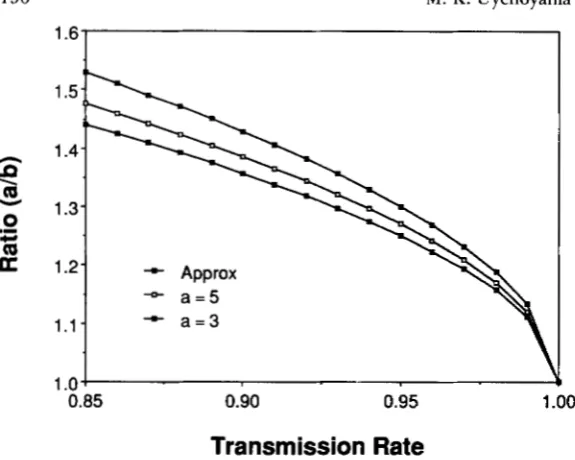
g2) is favored if the number of antigens association with the t-haplotype ( b ) is sufficiently small relative to the number of antigens associated with the +-haplo- type (a). For large values of a, for which the term involving l / a is small, the initial increase condition depends primarily on the ratio of the numbers of classA and class B antigens (alb). The approximate thresh- old ratio (RA), obtained by ignoring the l/a term in
(4), is
RA = 1
+
4ku/(2k+
1). ( 5 )Figure 1 compares the approximate ratio (RA) to the actual ratios determined by setting a equal to 3 and
to 5 . The approximation, which assumes arbitrarily
1
+ Approx
+ a = 5
+ a = 3
0.85 0.90 0.95
Transmission Rate
A PARTITIONING O F T H E C O M P O N E N T S OF
SELECTION
By construction, the novel allele at the modifier locus itself imparts no advantage or disadvantage in fertility or viability; the selective forces that promote its invasion or exclusion derive from associations be- tween the modifier and the t-complex. In order to elucidate the nature and effects of such associations that arise under incomplete linkage, I develop an alternative representation of the results based on an
extension of the covariance method of LI (1967, 1976
Chapter
2)
and PRICE (1970, 1972). In addition to establishing a basis for comparison of structural fea-tures of related models (UYENOYAMA 1988a, b, c, d),
this approach provides an equivalent expression for initial increase condition
(4)
in terms of two-locus measures of association.Measures of association
Three measures of association between two loci
emerge from the analysis. Identity disequilibrium
(COCKERHAM and WEIR 1968) denotes the difference
between the probability of two-locus identity and the product of the probabilities of one-locus identity at each locus separately. I express the analogue of this measure of association in terms of genotypic frequen- cies as the difference between the frequency of double heterozygotes and the product of the frequencies of heterozygotes at each locus:
4* = u14
+
2123-
u(u12+
u14+
u 2 3 ) (6)= u(vl4
+
v23)-
vu12(compare (15) in COCKERHAM and WEIR 1968; and
WEIR and COCKERHAM 1969). Variables 2)14 and 7.~23 represent the two linkage configurations for double heterozygotes, u the frequency of heterozygotes at the t-complex, and (1412
+
V I 4+
u23) the frequency of1
.oo
FIGURE 1 .-Comparison of the approximate thresh- old ratio of antigens associated with the +-haplotype (a) and the t-haplotype (b) to the actual threshold ratios for 3 and 5 class A antigens. The approximate ratio corre- sponds to arbitrarily large numbers of class A antigens. Modifier alleles that enhance the expression of incom- patibility invade the population if the antigen ratio ex- ceeds the threshold.
heterozygotes at the modifier locus. Near the fixation of B1 (the initial state of the population), positive q* indicates that the ratio of the frequencies of +/t to
+/
+
among B1/B2 individuals is greater than that amongB1/B1 individuals:
(from (6)), which implies that the new allele B2 is associated with the t-haplotype.
T h e difference between the frequencies of the two linkage configurations of double heterozygotes esti- mates D,, a measure of within -individual disequili- brium:
(COCKERHAM and WEIR 1977). Under random union
of gametes and Mendelian segregation, within-indi- vidual disequilibrium among newly formed zygotes is identical to gametic phase disequilibrium; however, in the model under study, segregation distortion, un- equal gametic frequencies transmitted by the sexes, and the expression of incompatibility preclude this reduction. Positive D,,, represents an excess of the tB2
haplotype over the +E2 haplotype among double het-
erozygotes, which implies that the new allele is asso- ciated with the t-haplotype among double heterozy- gotes.
For convenience, I introduce a third measure of association, gametic phase disequilibrium among sperm (Os), which is completely determined by
v*
andD,:
= h { ~ *
+
Dw(l - 2r)[u+
2 4 1-
k ) ] ) / 2 . (9) Positive D, indicates that the new allele B2 is associatedComponents of selection
Covariance between fitness and additive geno- typic value: Through its association with the t-com- plex, the modifier locus influences the number of viable offspring produced. Let MR denote a random
variable that represents the size of broods censused subsequent to viability selection. T h e value of this
random variable depends on the genotype of the
mother at the modifier locus and any associations between the modifier locus and the t-complex. While the level of expression of incompatibility does not, by assumption, affect brood size at the end of gestation, it influences the number of offspring that survive to reproductive age by reducing the rate of formation of t / t offspring. T o mothers of genotype
Bl/Bl,Bl/B*,
and B2/B2 associate additive genotypic values 2al, (a1+
a?), and 2a2. T h e average effect of substitution (a1-
a2) expresses the extent to which variation in off-spring production (MR) can be attributed to variation in genotype at the modifier locus (see APPENDIX 1).
One measure of fitness of a given genotype at the modifier locus is the relative rate of increase of indi- viduals carrying that genotype. For example, the rate of increase of genotype B1/B2 is
w12 = Wf i2/fi2, (10) in which f i 2 = (u12
+
' V I 4+
vz3) represents the frequency of B I / B ~ in the present generation, f i 2 the frequency in the next generation, and W(W = T ) the normalizer that ensures that the genotypic frequencies in the next generation sum to unity. Fitnesses W11 and W22, asso- ciated with genotypes B 1 / B 1 and B2/B2, are defined ina similar way using51 and f 2 2 .
T h e covariance between fitness and additive geno- typic value with respect to offspring production re- solves into covariances between the maternal charac- ter of offspring production ( M R ) and the additive
genotypic value of offspring:
Cov(A W)
= E(MRRa)
-
E(Ma)E(MR) (1 l a )= COV(MRR,)
+
E(MR)[E(R,)-
E(M,)], (1 1 b )in which E denotes expectation, Cov covariance, R,
the additive genotypic value of viable offspring, and
M , the additive genotypic value of the mother (UYEN- OYAMA 1988a, b, c, d). T h e average number of off- spring produced is equal to the mean fitness (E(MR) =
Parent-offspring relatedness is defined in studies of kin selection and sex ratio modification as a modified
regression coefficient (UYENOYAMA 1984):
T).
bl"n = COV(MRR,)/COV(MRM,)
= Cov(M&)/Var(M,), (1 2)
in which the last equality follows from the independ- ence of the additive and nonadditive components of variation. Parent-offspring relatedness is a measure of similarity between the genotypic distributions of par- ents and their offspring (see APPENDIX 1).
T h e second summand in (1 l b ) represents the dif- ference between the average genotypic values among
offspring and among parents. UYENOYAMA (1988a, b,
c, d) described this component as a measure of gametic selection:
GS = E(MR)[E(&)
-
E(M,)]. (13)This component expresses the effect of incompatibil- ity on the transmission of the modifier alleles through sperm; it derives from associations between the mod- ifier and antigen loci, which depend in turn on the rates of recombination and segregation distortion.
Positive covariance between fitness and additive genotypic value with respect to offspring production indicates that natural selection favors the modifier allele that enhances offspring production. T h e con- dition for initial increase obtained from the stability analysis (4) is equivalent to
(a1
-
' Y Z ) [ ~ " + R+
GS/Var(M,)]<
0 (14)(compare (24) in UYENOYAMA 1988d). Condition (14)
indicates that the new modifier allele increases when rare if it enhances offspring production ((a1
-
a2)<
0) and natural selection favors offspring production (Cov(AW)
>
0), or if both conditions are reversed.Effect of associations on the components of selec- tion: T h e assumptions of weak incompatibility (gl
near 1) and weak selection (g2 near gl) permit much simplification in the expressions for the selection com- ponents near the fixation of B 1 (see APPENDIX 1). T h e average effect of substitution reduces to
(a1
-
@2)(u12+
'1114+
'1123)= Q[V*
+
(gl-
gz)vx1(1-
a/b)/a]/2, (15) in which x1 and x3 are obtained from (1). Equation 15 reflects a linearization with respect to the frequency of genotypes bearing the new modifier allele B2, in-corporating the same level of approximation used in the first-order stability analysis.
Parent-offspring relatedness reduces to
b"-t~ = 1/2
-
Ux3[Dsv+
-
2 ~ ) ~ 3 / 2 ] /[2(1 X I ) ( ~ I
-
~ z ) ( ~ I z v14 Vm)], (16)in which u and v are obtained from (1 0). Equation 16 indicates that associations between the modifier locus and the t-complex cause parent-offspring relatedness to depart from 1/2, the value expected under neu- trality. This effect arises even in the absence of linkage
These associations generate gametic selection as
well:
[ W Q
-
W W I
= (a1-
az)[D,v+
Dw(l-
2r)(l-
2k)]/(l+
~ 3 ) . (17) Equation 17 indicates that gametic selection can affect transmission through sperm of alleles at the modifier locus even if the modifier locus and the t-complex reside on different chromosomes.In the absence of linkage ( r = 1/2), substitution of these expressions into (14) indicates that the new modifier allele increases when rare if
9 * X s / 2
+
(a1-
az)(u12+
v14+
v 2 3 )<
0, (18a)or, equivalently,
V * X ~
+
DwT<
0. (1 8b)Evaluation of the measures of association: Evalu- ation of the expressions for 9* (6), D, (8), and D, (9) requires knowledge of the genotypic distribution within the population. T h e criterion for initial in- crease suggested by the covariance partitioning (1 4) is equivalent to the result obtained from the local stabil- ity analysis (4), provided that the selection components isolated by the covariance partitioning are evaluated
at the appropriate genotypic vector (UYENOYAMA
Evaluation of (8) at this genotypic distribution pro- 1988b; See APPENDIX 2).
duces
0, = (gl
-
~ Z ) ~ X I X S ( 1-
a/b)/(4rar). (1 9)Equation 19 indicates that the average effect of sub- stitution can also be expressed in terms of the meas- ures of disequilibrium:
(a1
-
~ ~ ) ( u I z+
v14+
v23) = X S V * / ~+
Dw2rT. (20)For greater numbers of antigens in class A than class B (a
>
b ) , new modifier alleles that increase the expres- sion of incompatibility (gl>
g2) occur more often with +-haplotypes than t-haplotypes among double heter- ozygotes (Ow<
0 ; from (1 9)). As discussed in RESULTS, incompatibility is more effective in inhibiting the fer- tilization of + / t mothers by t-haplotypes than +-hap- lotypes. Consequently, the modifier allele that causes greater incompatibility develops an association with the +-haplotype. Evaluation of (6) with respect to the same genotypic distribution produces9" = (g1
-
gz)x1xs[u(2-
1/a)+
v ( l-
a/b)/2]/(aT)+
DWu(l-
2r). (21) Under the assumptions of free recombination ( r = 1/2) and greater numbers of antigens belonging to class A than class B (a>
b), a positive average effect of substitution of the resident allele ((a1-
ag)>
0)implies positive 7" (see (15)). Consequently, (18a) in- dicates that a necessary condition for initial increase
of the new modifier allele is that it enhance offspring production (a1
-
a 2 )<
0). Condition (18b) indicatesthat negative q * , representing the association of a new modifier causing greater expression of incompatibility with the +-haplotype in the population as a whole as well as among double heterozygotes (0, from (1 9)), is sufficient to ensure the invasion of the introduced modifier allele.
DISCUSSION
Prospects for the evolution of incompatibility
Conditions favoring enhanced expression of in- compatibility: Incompatibility of the kind considered in the analysis is nonspecific, distinguishing among sperm only to the extent that they bear antigens that are identical to or different from antigens recognized by the mother. In contrast, the association between the MHC and the t-complex shows a high level of specificity, with a small set of antigens restricted to the t-haplotype. Whether this highly specific associa- tion can form the basis for the operation of a nonspe- cific eugenic mechanism depends upon the relative numbers of antigens associated with the wild-type and the deleterious haplotypes within the t-complex.
Wild-type mother (+/+) generate fully viable off- spring, although a fraction may carry the t-haplotype.
Mothers of genotype +/t risk producing inviable off-
spring if offspring derived from sperm bearing the t-
haplotype complete gestation. T h e model analyzed in
preceding sections assumes that a MHC antigens are
associated exclusively with the +-haplotype and b with
the t-haplotype. Heterozygous mothers (+/t) mount
an incompatibility reaction against one of the antigens associated with the +-haplotype and one with the t-
haplotype. Incompatibility is more effective in exclud- ing the t-haplotype if it is associated with fewer anti- gens than the number associated with the +-haplotype
( b
<
a).In the absence of recombination between the mod- ifier of incompatibility and the t-complex ( r =
o),
this condition (a> b)
ensures that modifier alleles that enhance the expression of incompatibility are favored (see (3)). Invasion of the population by such alleles occurs through the increase of double heterozygotes that carry the introduced modifier allele and the t-haplotype in repulsion phase (tBl/+Bz).
Modification of Incompatibility 159
ensure the invasion of a rare modifier allele that intensifies the expression of incompatibility.
Components of selection: In the present study, the restatement of the condition for initial increase in terms of the components of selection (14) reveals that
the evolution of incompatibility depends upon two
factors: the effect of the modifier on offspring pro- duction (al
-
a2) and the transmission of the modifier allele (relatedness and gametic selection). Unlike an earlier study (UYENOYAMA 1988d), disequilibria be-tween the modifier locus and the t-complex cause
differential exclusion of sperm bearing the two mod- ifier alleles. Consequently, gametic selection arises, which reflects differences between the frequencies of the new modifier allele before and after transmission; further, parent-offspring relatedness with respect to the modifier locus departs from its neutral value of 1/2. If the analogue of identity disequilibrium
(v*)
is positive, indicating that the new modifier allele is associated with the t-haplotype among two-locus gen- otypes within the population as a whole, then in the absence of linkage ( r = 1/2) gametic selection (1 6)disfavors the modifier allele that intensifies the expres- sion of incompatibility, but parent-offspring related- ness (15) exceeds 1/2. Negative
v * ,
indicating an association between the new modifier allele and the +-haplotype, generates gametic selection favoring in- creased expression of incompatibility but depresses parent-offspring relatedness in the absence of linkage.Comparison to natural populations: Surveys of natural populations indicate that this condition is sat- isfied and, in general, exceeded by a considerable margin. In any particular locality, t-haplotypes gen- erally occur with only one antigenic haplotype
(STURM, FIGUEROA and KLEIN 1982). NADEAU et al.
(1981) detected between one and four common anti- gens (not including the antigens known to be associ- ated with the t-haplotype) within thirteen populations from western Europe and Egypt. T h e high frequen- cies (up to 60%) of blanks, which failed to react with the available sera, and the small sample sizes (median
= 13 mice) suggest that more antigens did in fact occur with the +-haplotype in each population. T h e analysis described in preceding sections indicates that the conditions prevalent in natural populations favor the intensification of the expression of incompatibility
by modifier loci situated virtually anywhere in the genome.
Incompatibility generates associations between the modifier locus and the t-complex even in the
absence of linkage
Differential exclusion of t-complex haplotypes:
T h e conditions favoring the enhancement of the expression of incompatibility are independent of the recombination rate, provided that the rate is large relative to the change in the level of incompatibility
caused by the introduced novel allele. This finding does not imply that the selective pressures imposed on the modifier locus are independent of its associa- tions with the MHC and the t-complex. For greater numbers of antigens associated with the +-haplotype than the t-haplotype (a
>
b), increased expression of incompatibility in +/t mothers promotes the produc- tion of offspring derived from sperm bearing the+-
haplotype. Differential exclusion of sperm on the basis of the associated MHC antigens places the resident and introduced modifier alleles in different distribu- tions of t-complex genotypes, and generates associa- tions between the modifier locus and the t-complex with each round of offspring production.Absence of linkage: Under free recombination be- tween the modifier locus and the t-complex ( r = 1/2), a necessary condition for the initial increase of the more active modifier is that enhanced incompatibility increase offspring production ((a1
-
a2) C 0; see (15) and (18a)). Further, the invasion of the new allele requires its transmission through those offspring. Negative genotypic linkage disequilibrium (Ow), which occurs for a>
b and g l>
g2 (see (1 9)), implies that themodifier allele that generates greater incompatibility becomes associated with the +-haplotype in double heterozygotes. If the analog of identity disequilibrium
(v*,
see (6)) is also negative, which implies that the more active modifier is associated with the +-haplo- type in the general population as well, then condition (18b) ensures the invasion of modifier alleles that intensify the expression of incompatibility. Increased expression of incompatibility may evolve even if the more active modifier allele is associated with the t-haplotype in the population as a whole
(v*
positive), provided that this association is sufficiently weak rel- ative to the negative association among double heter-ozygotes (Ow).
T h e association of the more active modifier allele with the t-haplotype promotes transmission through
+/+
mothers, which express no inhibition against t-haplotypes, but exposes the modifier allele to elimi- nation in t/t offspring. Although the expression of incompatibility in +/t mothers reduces the transmis- sion of t-haplotypes through sperm to a greater extent than +-haplotypes, transmission of the t-haplotype through eggs is unimpaired. In spite of the advantage of segregation distortion favoring the t-haplotype and the modifier allele with which it is associated in sperm, the disadvantage of recessive lethality discourages the initial increase of new modifier alleles that are associ- ated with the t-haplotype.
Proximate and ultimate effects of incompatibility on offspring viability
Dependence of the mean fitness on incompatibil- ity: In the absence of associations between the MHC
proceeds entirely independently of the other complex
(compare LEACH, MAYO and MORRIS 1986). In con-
trast, high complementarity associations between the MHC and the t-complex present a supergene to the forces of evolution, which are generated through the expression of incompatibility in conjunction with via-
bility selection. High complementarity associations
cause the depression of the mean fitness of the popu- lation under the expression of weak incompatibility
relative to the absence of incompatibility (UYENOY-
AMA 1989). T h e depression of mean fitness reflects an increase in the frequency of the t-haplotype main- tained under the expression of incompatibility. In- compatibility favors the t-haplotype through two ef- fects:
+/+
mothers express inhibition against sperm bearing either of the two +-haplotype antigens they bear, but not against antigens associated with the t-haplotype; further, +/t mothers shelter the recessive lethal by reducing the formation of t/t offspring.
Modification of the expression of incompatibility:
Were the increase of the mean fitness of the popula- tion the primary evolutionary pressure to which mod- ifiers of incompatibility respond, the finding that weak incompatibility depresses mean fitness would imply that the enhancement of incompatibility is uniformly disfavored. T h e analysis described in preceding sec- tions demonstrates that it is the proximal effects of incompatibility on the production of viable offspring and on the transmission of the new modifier allele, rather than its ultimate effect on mean fitness, that directs the evolution of incompatibility. In the absence of linkage between the modifier locus and the t-com- plex, a necessary condition for the enhancement of incompatibility is that it cause the production of greater numbers of viable offspring. T h e modifier locus, which by construction does not directly influ- ence viability or fertility, affects offspring production only through its association with the t-complex. In- creased expression of incompatibility in turn trans- forms the selective regime that governs evolution within the t-complex, resulting ultimately in the depression of mean fitness through its effects on the transmission of the t-haplotype and on the sheltering of its lethal expression.
I thank M. W. FELDMAN and the Morrison Institute for Popula- tion and Resource Studies for support and office space during my visit to the Department of Biological Sciences at Stanford Univer- sity; and B. S. WEIR and the reviewers for their suggestions and references to relevant literature. This study was supported by U.S.
Public Health Service grants GM-37841 (M.K.U.) and GM-28016 (M. W. FELDMAN).
L I T E R A T U R E CITED
COCKERHAM, C. C., and B. S. WEIR, 1968 Sib mating with two
COCKERHAM, C. C., and B. S. WEIR, 1977 Digenic descent meas- linked loci. Genetics 60: 629-640.
ures for finite populations. Genet. Res. 30: 121-147.
FIGUEROA, F., M. GOLUBIC, D. NIZETIC and J. KLEIN,
1985 Evolution of mouse major histocompatibility complex genes borne by t chromosomes. Proc. Natl. Acad. Sci. USA 82:
HAMMERBERG, C., and J. KLEIN, 1975 Linkage disequilibrium
between H-2 and t complexes in chromosome 17 of the mouse. Nature 258: 296-299.
LEACH, C. R., 0. MAYO and M. M. MORRIS, 1986 Linkage dise- quilibrium and gametophytic self-incompatibility. T h e o r . Appl. Genet. 73: 102-112.
LEVINSON, J. R., and H. 0. MCDEVITT, 1976 Murine t factors: An association between alleles at t and H-2. J. Exp. Med. 144: 834-939.
LI, C. C., 1967 Fundamental theorem of natural selection. Nature
LI, C. C., 1976 First Course in Population Genetics. Boxwood Press, Pacific Grove, Calif.
NADEAU, J. H., E. K. WAKELAND, D. GOTZE and J. KLEIN,
198 1 T h e population genetics of the H-2 polymorphism in European and North African populations of the house mouse (Mus musculus L.). Genet. Res. 37: 17-3 1.
NIZETIC, D., F. FIGUEROA and J. KLEIN, 1984 Evolutionary rela- tionships between the t and H-2 haplotypes in the house mouse. Immunogenetics 1 9 31 1-320.
PRICE, G. R., 1970 Selection and covariance. Nature 227: 520- 521.
PRICE, G. R., 1972 Fisher’s “fundamental theorem” made clear. Ann. Hum. Genet. 36: 126-140.
SHIN, H . 3 , J. STAVNEZER, D. BENNETT and K. ARTZT,
1982 Genetic structure and origin of t haplotypes of mice, analyzed with H-2 cDNA probes. Cell 29: 969-976.
SILVER, L. M., 1982 Genomic analysis of the H-2 complex region associated with mouse t haplotypes. Cell 2 9 961-968. SILVER, L. M., 1985 Mouse t haplotypes. Annu. Rev. Genet. 19:
179-208.
SILVER, L. M., M. HAMMER, H. Fox, J. CARRELS, M. BUCAN, B.
HERRMANN, A,”. FRISCHAUF, H. LEHRACH, H. WINKING, F.
FICUEROA and J. KLEIN, 1987 Molecular evidence for the rapid propagation of mouse t haplotypes from a single, recent, ancestral chromosome. Mol. Biol. Evol. 4: 473-482.
STURM, S., F. FIGUEROA and J. KLEIN, 1982 The relationship
between t and H-2 complexes in wild mice. 1. T h e H-2 haplo- types of 20 t-bearing strains. Genet. Res. 40: 73-88.
UYENOYAMA, M. K . , 1984 Inbreeding and the evolution of altru- ism under kin selection: effects o n relatedness and group struc- ture. Evolution 38: 778-795.
UYENOYAMA, M. K., 1988a On the evolution of genetic incom- patibility systems: incompatibility as a mechanism for the reg- ulation of outcrossing distance. pp. 212-232. In: The Evolution
of Sex: An Examination of Current Ideas, Edited by R. E. MICHOD and B. R. LEVIN. Sinauer, Sunderland, Mass.
UYENOYAMA, M. K., 1988b On the evolution of genetic incom- patibility systems. 11. Initial increase of strong gametophytic self-incompatibility under partial selfing and half-sib mating. Am. Nat. 131: 700-722.
UYENOYAMA, M. K., 1988c On the evolution of genetic incom- patibility systems. 111. Introduction of weak gametophytic self- incompatibility under partial inbreeding. Theor. Popul. Biol. 3 4 47-9 1.
UYENOYAMA, M. K., 1988d On the evolution of genetic incom- patibility systems. IV. Modification of response to an existing antigen polymorphism under partial selfing. Theor. Popul. Biol. 34: in press.
UYENOYAMA, M. K., 1989 Coevolution of the major histocompat- ibility complex and the t-complex in the mouse. 1. Generation and maintenance of high complementarity associations. Ge- netics 121: 139-151.
WEIR, B. S., and C. C. COCKERHAM, 1969 Pedigree mating with 2819-2823.
average additive genotypic value among their offspring is
t w o linked loci. Genetics 61: 923-940.
Communicating editor: B. S. WEIR
APPENDIX I
Partitioning of variation
Average effect of substitution: The average effect of substitution is obtained by minimizing the dominance vari- ance. Let fl , J z , andf22 denote the frequencies of genotypes
B I B I , B I B 2 , and B2Bp; c1, cp, and c3 the trait values associated
with these genotypes; and c the average trait value. The dominance variance represents the mean squared deviation between the additive genotypic value associated with each genotype and its trait value centered relative to the mean:
fil[(CI
-
c) - 2aI]2 + f i z [ ( c z-
c)-
(CYI+
o~z)]' +f22[(c3-
C)-
2a2I2, (A1 . I )in which 2 a l , ( a I
+
a ~ ) , and 2a2 denote the additive geno- typic values of the three genotypes. Minimization of (Al. 1) with respect to the ai produces(a1
-
as) = [2f2(cs-
C) + f i z ( c z-
~)]/(4fif~ - f i z ) , (A1.2) in whichfi = f i l +fi4/2 andf2 = 1-5.
Expressions for (YIand a2 can be obtained from (A 1.2) using
fi.1
+
f 2 a 2 = 0. (A1.3)Components of selection: In the case under study, the trait value corresponds to the number of viable offspring produced (the random variable MR), with c = T . The relative number of viable offspring produced by
+/+
individuals carrying either the common or the rare genotype at the modifier locus is 1, reflecting the complete recessivity of the t-haplotype. Up to first-order terms in the frequencies of the rare genotypes, the relative number of viable offspring produced by + / t mothers among residents (BI/BI) is V(gl)/ Ns(gl), in whichand Ns(gl) represents the average rate at which sperm received by these mothers generate offspring that complete gestation [see (1 1) in UYENOYAMA (1989)l. Among hetero- zygotes at the modifier locus (B1/B2), the relative number of viable offspring produced is V( gz)/N3( gz), in which V(g2) and Ns(g2) are defined in a similar way to V(gl) and Ns(gl), but with g2 substituted for gl. These values, together with (Al.2), determine the average effect of substitution (1 5).
Parent-offspring relatedness: Relatedness between par- ents and their offspring (1 2) depends on products involving maternal trait values of the form (ci
-
c) and the average additive genotypic value within broods. For example, resi- dent+/+
mothers ( + B I / + B l ) that are homozygous at the antigen locus have maternal trait value (1-
r ) and the2a1
+
((YI+
an){~n[l+
(gl-
l)/a]+
x4J/Nl(gl), (A1.5)in which N(gl) represents the average rate at which offspring derived from sperm received by these mothers complete gestation (UYENOYAMA 1989). For resident
+/+
mothers that are heterozygous at the antigen locus, the maternal trait value is (1-
2') and the average offspring additive genotypic value is given by (Al.5) with NZ(gl) replacing Nl(gl). The corresponding quantities for resident + / t moth- ers ( + B l / t B l ) are V(gl)/N3(gl) for the maternal trait value and the average offspring additive genotypic value is2a1
+
(a1+
az)Ixz[l+
(g1 - l)/a]+
+
(gl-
l)/b]/2)/V(g1). (A1.6) Analogous quantities corresponding to the other genotypes are used in the calculation of COV(MRR,).Gametic selection: The difference between the average additive genotypic value among offspring and the additive genotypic value of the mother is averaged across broods to obtain [E(&)
-
E(M,)]. For example, the additive genotypic value of resident mothers is 2 a l and the average additive genotypic value among their offspring is of the form (A 1.5) for+/+
mothers and (Al.6) for + / t mothers.APPENDIX 2
Evaluation of the covariance criterion
The elements of the genotypic distribution at which the covariance criterion is evaluated are obtained from the linearized stability matrix, and does not require knowledge of the dominant eigenvalue (UYENOYAMA 1988b). For ex- ample, the linearized recursion for the variable vI4 is given by
TU 14 = VI^( 1
-
T )+
Vp3T].
[1/2 +k[Wom)/Nl(gl) +~Wet)/N~(gl)I (A3.1) +XlI[l +(g2- l)/aI/N,(gz)-
[ I + (g1- 1)/aI/Ns(g1)Jl,in which u(Hom) and u(Het) denote the frequencies of anti- gen homozygotes and antigen heterozygotes in the resident population; and the Ni( gl) the average rates at which sperm generate offspring that complete gestation (see (7) in UYEN- OYAMA 1989). An expression for the mean fitness ( r ) is
given by
T = 1/2
+
k[u(Hom)/Nl(gl)+
u(Het)/N~(g~)] (A3.2) Replacement of v i 4 by V I 4 in (A3.1), using (A3.2), producesTT(VI4