THE
FREQUENCIES OF SEED AND SEEDLING ABNORMALITIES I N MAIZE1G. F. SPRAGUE AND J. F. SCHULER2
Received August 28, 1961
T
HE fact that cross-fertilizing species carry relatively large numbers of del- eterious recessives in a heterozygous condition has been demonstrated by various investigators and for several species. The results obtained have been used to make inferences or to provide a critical interpretation relative to popu- lation structure and size, types of gene action, mutation rates, selective advan- tage, and other attributes which contribute to the description of a population in genetic terms. Relatively little information is available, however, for the subse- quent behavior of populations that have been experimentally purged of deleteri- ous recessives. The purpose of the present paper is to provide information about one such case in maize.Information on the frequency of deleterious recessives is most extensive for Drosophila species. Less information is available for many other species of ani- mals and plants. We shall be concerned here with only the pertinent informa- tion available for maize.
JENKINS (1924) reported a range of 0.0 to 35.5 percent for chlorophyll-defec- tive types in first selfed-generation progenies derived from 16 open pollinated varieties. In samples representing six varieties,
HAYES
and BREWBAKER (1924) reported frequencies of chlorophyll-deficient types ranging from 10.0 to 39.4 percent.WENTZ and GOODSELL (1929) sampled 19 varieties which had been included in the Iowa State yield test for 1924 and 1925. The observed range for percent- age of chlorophyll deficiencies was 3.6 to 42.8. In three varieties, WOODWORTH
(1929) observed the percentage of self-pollinated ears segregating for chlorophyll deficiencies to range from 10.0 to 28.9. I n a later summary WOODWORTH and MUMM (1931) reported 17.7 percent of self-pollinated ears of the variety Reid segregated for chlorophyll deficiencies and 3.9 percent for defective seeds. This report is of particular interest since a reconstituted Reid was produced by com- positing remnant seed of all selfed ears whose progeny were free from detectable segregations. This reconstituted variety was propagated under open-pollination
1 Contribution from the Iowa Agricultural and Home Economics Experiment Station and
the Crops Research Division, Agricultural Research Service, U S . Department of Agriculture, cooperating. Journal Paper 5-4162 of the Iowa Agricultural and Home Economics Experiment Station, Project 1140.
*
Research Agronomist, U.S. Department of Agriculture, formerly also Research Professor,Iowa State University, Ames, Iowa; formerly Graduate Assistant, Iowa State University, and Assistant Professor, Department of Genetics, North Carolina State College, Raleigh, North Carolina.
1714 G . S PR A GUE A N D J. S C H U L E R
conditions for a three-year period. At the end of this period the reconstituted variety was sampled and the observed frequencies of chlorophyll deficiencies and defective seeds were found to be 28.6 and 12.2 percent, respectively. These figures represent nearly a twofold increase in chlorophyll deficient types and a threefold increase in defective seeds. No tests for allelism were made in either sample; therefore no estimates of gene frequency were obtained, and increase in frequency of seed and seedling segregations would not have been predicted. The present study was initiated to determine the generality of these results.
MATERIALS A N D M E T H ODS
A strain of the variety Reid, maintained by open pollination at the Iowa Agri- cultural Experiment Station, was used as source material for this study. In a special planting made in 1948 all plants which silked and tasseled at the same time were self-pollinated. Ears from a few plants were lost because of loss of or damage to the shoot bag or because of disease. The 801 self-pollinated ears avail- able for study were assumed to constitute a random sample of the variety.
Each of the self-pollinated ears was shelled individually and a 50 kernel sample grown i n a sandbench and examined for seedling segregations. Field plantings were made for all progenies classified as segregating. S2 seed was ob- tained to confirm the tentative classification and to provide adequate material for subsequent tests for allelism.
Tests for allelism were made by direct intercrossing of the viable recessive types and classification of the resulting F, progeny. Progenies carrying lethals were grown in paired rows involving all possible combinations among similar phenotypes. Within each pair of rows as many intercrosses were made as stand and similarity of time of flowering would permit. With a monogenic character, 4/9 of such matings should exhibit segregation if plants of the two stocks were
A A and Aa in expected frequency and carried members of the same allelic series.
If positive indication of allelism was obtained, no further plantings were grown. If no segregation was observed, plantings were repeated until at least ten crossed progenies were available for classification.
After the initial classification for segregation was completed a reconstituted variety was prepared representing equal quantities of seed from the approxi- mately 550 S, ears for which no segregations could be detected. Planting was made in a n isolated plot and open pollination was permitted. Approximately 400 ears. chosen at random, were used to perpetuate the LLreconstituted” variety. The ears were shelled in bulk and passed repeatedly through a sampler to ensure thorough mixing, and an aliquot was taken for planting a l-acre or larger block the follow- ing season. This process was repeated during each of the four years during which the reconstituted variety was grown.
MUTATION LOAD 1715
EXPERIMENTAL RESULTS
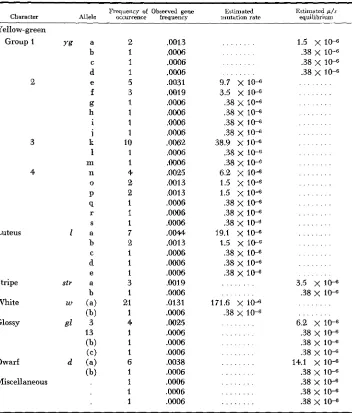
In the sample from the original variety Reid, the percentages of self-pollinated ears segregating for seedling abnormalities was 18.9 (SCHULER 1952). This figure is in good agreement with percentages reported by other investigators. A list of the different phenotypic groups and their estimated gene frequencies is pre- sented in Table 1. Estimated mutation rates are also presented for the nonviable mutant types.
TABLE 1
Estimated gene frequencies and mutation rates fo r the various mutant alleles isolated from the original Reid
Character Allele
Yellow-green Group 1
2 Luteus Stripe White Glossy Dwarf Miscellaneous
Frequency of Observed gene occurrence frequency
2 ,0013
1 .0006
1 .OW6
1 .0006
5 .0031
3 .0019
1 .0006
1 .OW6
1 .0006
1 ,0006
10 .0062
1 .0006
1 .0006
4 .0025
2 .0013
2 .0013
1 .0006
1 .OW6
1 .OW6
7 .OOM
2 .0013
1 .0006
1 .OW6
1 .0006
3 .0019
1 .0006
21 .0131
1 .WO6
4 .W25
1 .0006
1 .0006
1 ,0006
6 .0038
1 .0006
1 .0006
1 .0006
1 .WO6
Estimated mutation rate
9.7 x 10⁻⁶ 3.5 x 10⁻⁶
.38 x .38
x
10-6 .38 x 10-6 .38 x 38.9 X.38 x 10-6 .38
x
10-66.2 x IO4 1.5 x 10⁻⁶ 1.5 x
.38
x
10-6 .38 x 10-6 .38 x I F 6 19.1x
10-61.5
x
10-6 .38 x 1 P .38 x .38 x 1 0 - 6171.6
x
10-6 .38 x 10-6. . . . . . . . . . . .
Estimated 11/s
equilibrium
1.5 x 10⁻⁶ .38 x 10-6 .38 x 10-6 .38 x 10-6
, . . . . .
. . .
. . .
. . . . . .
3.5 x 10⁻⁶ .38
x
10-6. . . 6.2 x 10⁻⁶
.38 x 10-6 .38 x .38 x
1716 G . SPRAGUE A N D J. S C H U L E R
Two items require some explanation. Twenty-one ears of the 801-ear sample segregated for the virescent phenotype. Through accident this material was lost and no tests for allelism are available. Forty ears exhibited segregation for a yellow-green phenotype. Tests for allelism would have required 780 pairs of progeny rows. This number was greater than could be handled with facilities available. The material therefore was divided into four groups.
In a n attempt to minimize the total number of crosses required Group 1 in- cluded all phenotypes which offered promise of viability. Allocations to the re- maining three groups were at random. Intergroup crosses of established alleles were not completed. Thus gene frequencies for this phenotype may be slightly underestimated. Among the remaining phenotypes the estimated gene frequen- cies ranged from 0.0006 to .0131.
The estimates of mutation rates for all lethals are based on the assumption that the variety was at equilibrium; i.e. A g = 0. Consequently Q' = and the mutation rate p is equal to Q z since for all lethals s = 1. The mutation rates calculated in this indirect manner and under the assumption of equilibrium ranged from 0.38 X 1 0-6 to 171.6 X 1 O-6.
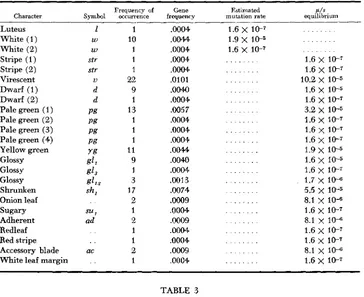
In the sample derived from the reconstituted strain the frequency of seed and seedling abnormalities among 1,137 selfed progenies was 8.5 percent. This is approximately half the frequency obtained from the original variety sample. Estimates of gene frequency and mutation rates are presented in Table 2.
The estimated gene frequencies ranged from ,0004 to .0101. This range was somewhat less than that observed for the Reid sample. Only ten different mutant phenotypes were observed in the Reid sample while 20 different phenotypes were recorded for the reconstituted Reid. Only six of these were common to the two samples. These except the luteus phenotype exhibit rather similar patterns of gene frequency as is illustrated in Table 3.
Tests for genetic identity among loci for the two samples were not attempted with all phenotypes. Within the glossy group, where the appropriate testcrosses were made, the similarity in frequency estimates does not extend to a complete duplication of loci involved. In the Reid sample g l , was found four times, gl,, once and two additional unnumbered glossies once each. In the reconstituted Reid sample gl, was found once, gl,, three times and gl, was found nine times. This last glossy was not represented in the original sample.
S
DISCUSSION
One point of particular interest in this study and the earlier summary report of WOODWORTH and MUMM (1 931 ) is the rapidity with which the reconstituted populations accumulated their mutation load. Several factors could conceivably be involved and these will be considered in the following section.
M U T A T I O N LOAD 1717
TABLE 2
Estimated gene frequencies, mutation rates, and equilibrium values for seed
and seedling types isolated from the reconstituted Reid
Character
Luteus White ( 1 ) White (2) Stripe (1) Stripe (2) Virescent Dwarf (1 )
Dwarf (2) Pale green ( 1 ) Pale green (2)
Pale green (3)
Pale green (4)
Yellow green Glossy Glossy Glossy Shrunken Onion leaf Sugary Adherent Redleaf Red stripe Accessory blade White leaf margin
SUI ad
ac . .
Frequency of Gene Estimated occurrence frequency mutation rate
1 .WO4 1.6
x
1 0 - 710 . O M 1.9 x 1 0 - 5
1 .0004 1.6 X IO-" 1 .0004 . . .
1 .0004 . . .
22 .0101 . . .
9 . O M . . . , . . . .
1 .OW4 . . . . . .
13 .0057 . . .
1 ,0004 . . . 1 .0004 . . .
1 .WO4 . . .
11 ,0044 . . . , . .
9 .0040 . . . 1 .0004 . . .
3 .0013 . . .
1 7 "4 . . .
2 .WO9 . . . 1 ,0004 . . . 2 .WO9 . . . . . 1 .0004 . . . 1 .0004 . . . 2 ,0009 . . . . . 1 .0004 . . .
I L / S
equilibrium
1.6
x
1 0 - 7 1.6x
1 0 - 710.2 x 10⁻⁵ 1.6 x 10⁻⁵ 1.6
x
1 0 - 7 3.2 x 10⁻⁵ 1.6 x 10-71.6 x 1 0 - 7
1.9
x
10-5 1.6x
10-5 1.6 x 1 0 - 75.5
x
10-51.6 x 10-7
1.6
x
1 0 - 7 1.6 x 1 0 - 71.6
x
10-7 1.6x
1 0 - 71.7 x 10⁻⁶
8.1 X le6
8.1 x IO4
8.1
x
l e 6TABLE 3
Gene frequency ranges for six phenotypes common to the Reid and the reconstituted Reid samplings
Phenotype Stripe Luteus Yellow-green White Glossy Dwarf ~~~~~~~~
Observed frequency ranges vvlthin
Reid Reconstituted Reid
,0006 .0006 .OW6 .0006 .0006 .0006
.0019 .0004 . . . .
.0044 .OW4 . . . .
.0062 .oO44 . . . .
.0131 .oO04 .0044
.0025 .0004 .OW
.0038 .OW4 .OW,
1718 G . SPRAGUE A N D J. SCHULER
Aberrant segregations were of infrequent occurrence in either sample. The one exception to this generality was the class “germless” seeds. Because the limited progeny tests conducted were somewhat erratic, this class of segregants was ignored in
both
samples.Exact records were not kept of the number of parental ears involved in each random mating generation. However, as a close approximation we can assume 550 ears for the composite forming the “reconstituted” variety, 400 ears to prop- agate the strain i n 1950, 1951, and 1952, and 1137 ears representing the sam- pling in 1953. A total of approximately 6000 gametes was involved assuming two parental gametes per ear.
It is felt that the data obtained were influenced little, if any, by inaccurate classification, by failure to detect segregations, or by excessively small popula- tions during the propagation phases. Consequently any genetic explanation for the observed results must involve one or more of the following: (1 ) a mutation rate materially greater than (2) a much larger number of loci than com- monly assumed, or (3) a strong selective advantage for the heterozygote.
Generally speaking, the frequency of a n allele giving rise to a deleterious or a normal phenotype is some function of its mutation rate and adaptive value and the breeding system involved. A stable equilibrium is eventually reached for lethals and for sublethals; this equilibrium value is simply the mutation rate p. T h e equilibrium values for the two populations are given in Tables 1 and 2. The assumption of equilibrium is undoubtedly more realistic for the Reid variety than for the “reconstituted” Reid, which involved only four generations of free interbreeding. One may calculate the number of generations required to attain the observed frequencies in the “reconstituted” variety using the relationship n p = log e - where n equals the number of generations to reach equilibrium, p equals mutation rate, and po and pn are the initial and final frequencies re- spectively. If we consider the allele, white ( l ) , which was found ten times (Table 2 ) , a very large number of generations are indicated as being required to reach this frequency. Either a high initial mutation rate or other undetermined forces must have been operative to achieve the observed frequency in four gen- erations. A comparable situation was observed for other of the mutant pheno- types.
Tests for allelism of the glossy phenotypes were made within and between the two Reid samples as well as with known genetic stocks. Only two types, glossy 3 and 13, occurred in both samples but with differing frequency. Glossy 3 was present i n greatest frequency in the Reid sample. If the difference was of a magnitude to be significant it would suggest that the reconstituted strain had failed to reach equilibrium. However the much greater frequency of glossy 13 in the reconstituted sample does not support such a n argument. There remains a possibility that differences in mutation rate as well as in equilibrium may be involved. Either or both of these changes could conceivably have a n effect on selective advantage.
If a selective disadvantage involving one or both of the homozygotes were
P O
MUTATION LOAD 1719
involved, inbreeding would increase the effectiveness of the selection. Assuming random mating and a minimum population size of 400 ears saved in each gen- eration the expected rate of inbreeding would be approximately one percent per year. I n the initial generation involving a composite of SI seed, however, as- sortive mating based on similarity in time of blooming may have led to some- what greater inbreeding values. In any event it would appear that the inbreeding effects would be important only if accompanied by a selective disadvantage.
It is apparent from Tables 1 and 2 that the estimated mutation rates for the lethal phenotypes and the u/s equilibrium values for the viable types are of es- sentially the same order of magnitude. Such similarity suggests that if the heter- ozygote enjoys a selective advantage, such advantage could be rather similar for the two classes. It is assumed that in the reconstituted variety each of the loci in question was represented by the A A genotype until a mutation occurred. Follow- ing such a mutation, the frequency of the gene a in the next generation becomes
'(l - where S and
s represent the selective disadvantages of the A A and 1 - Sp' - sq'
aa individuals, respectively. If the aa individuals are selectively eliminated as would be true for a lethal, the preceding formula becomes
'
.
Any se- lective disadvantage of the A A type must result largely from a reduction in number of progeny rather than a differential viability. If a selective disadvantage of 0.5 is assumed and it is further assumed that the initial mutation occurred in one of the gametes produced by the 550 parental plants, then the a allele would increase about eightfold during the four generations involved in this study. If a mild selective disadvantage of 0.1 is assumed for the A A genotype, then the fre- quency of a would increase about 35 percent in the same period. Thus, while a strong selective disadvantage for A A could result in a rapid increase in the fre- quency of a, the fact that no such disadvantage has been demonstrated ( SCHULER 1954; MANGELSDORF 1928; GARBER and ROWLEY 1927) renders this possible explanation for the observed results somewhat unattractive.Experiments are currently underway to obtain additional information on the magnitude of any selective disadvantage. The longtime inbred line B14 is being used as the parental stock and induced mutations sought by use of UV and vari- ous chemical mutagens.
1 - Sp'
SUMMARY
1720 G. S P R A G U E A N D J. S C H U L E R
heterozygote could account for the observed results. The data available do not permit a critical distinction between these two alternatives.
L I T E R A T U R E CITED
HAYES, H. K., and H. E. BREWBAKER, 1924
JENKINS, M. T., 1924
GARBER, R. J., and H. K. ROWLEY, 1927
MANGELSDORF, P. C., 1928
SCHULER, J. F., 1952
Frequency of mutations for chlorophyll-deficient
Heritable characters of maize. XX-Iojap-striping, a chlorophyll defect.
A defective endosperm in the heterozygous condition
The effects of a lethal on the heterozygote in maize. J. Heredity 19:
Gene frequency of seed and seedling characters in corn. Iowa State College M.S. Thesis (unpublished).
Natural mutations in inbred lines of maize and their heterotic effect. I. Comparison of parent, mutant and their F, hybrid in a highly inbred background. Genetics 39: 908-922. Recessive defects and yield in corn. J. Agr. Research
38: 505-510.
Comparative frequency of defective seeds and chlorophyll abnor- malities in different varieties of corn following self-fertilization. J. Am. Soc. Agron. 21 :
1007-1014.
Reports of progress in corn improvement under seedlings in maize. J. Heredity 15: 497-502.
J. Heredity 15: 467-472.
as related to yield in maize. J. Am. Soc. Agron. 19: 797-803.
123-1 3 1.
1954
WENTZ, J. B., and S. F. GOODSELL, 1929
WOODWORTH, C. M., 1929