Copyright1998 by the Genetics Society of America
Two Pleiotropic Classes of daf-2 Mutation Affect Larval Arrest, Adult Behavior,
Reproduction and Longevity in Caenorhabditis elegans
David Gems,*
,1Amy J. Sutton,* Mark L. Sundermeyer,* Patrice S. Albert,* Kevin V. King,*
Mark L. Edgley,* Pamela L. Larsen*
,†and Donald L. Riddle*
*Molecular Biology Program and Division of Biological Sciences, University of Missouri, Columbia, Missouri 65211 and†Division of Neurogerontology and Molecular Biology Program, University of Southern California, Los Angeles, California 90089
Manuscript received April 23, 1997 Accepted for publication June 11, 1998
ABSTRACT
The nematode Caenorhabditis elegans responds to overcrowding and scarcity of food by arresting develop-ment as a dauer larva, a nonfeeding, long-lived, stress-resistant, alternative third-larval stage. Previous work has shown that mutations in the genes daf-2 (encoding a member of the insulin receptor family) and
age-1 (encoding a PI 3-kinase) result in constitutive formation of dauer larvae (Daf-c), increased adult
longevity (Age), and increased intrinsic thermotolerance (Itt). Some daf-2 mutants have additional develop-mental, behavioral, and reproductive defects. We have characterized in detail 15 temperature-sensitive and 1 nonconditional daf-2 allele to investigate the extent of daf-2 mutant defects and to examine whether specific mutant traits correlate with each other. The greatest longevity seen in daf-2 mutant adults was approximately three times that of wild type. The temperature-sensitive daf-2 mutants fell into two overlap-ping classes, including eight class 1 mutants, which are Daf-c, Age, and Itt, and exhibit low levels of L1 arrest at 25.58. Seven class 2 mutants also exhibit the class 1 defects as well as some or all of the following: reduced adult motility, abnormal adult body and gonad morphology, high levels of embryonic and L1 arrest, production of progeny late in life, and reduced brood size. The strengths of the Daf-c, Age, and Itt phenotypes largely correlated with each other but not with the strength of class 2-specific defects. This suggests that the DAF-2 receptor is bifunctional. Examination of the null phenotype revealed a maternally rescued egg, L1 lethal component, and a nonconditional Daf-c component. With respect to the Daf-c phenotype, the dauer-defective (Daf-d) mutation daf-12(m20) was epistatic to daf-2 class 1 alleles but not the severe class 2 alleles tested. All daf-2 mutant defects were suppressed by the daf-d mutation daf-16(m26). Our findings suggest a new model for daf-2, age-1, daf-12, and daf-16 interactions.
T
HUS far, C. elegans is the only metazoan organism ment through four larval stages (L1–L4) to the adult,in which a number of single gene mutations causing but high pheromone levels and higher temperatures
large increases in life span have been identified. These promote dauer formation and inhibit exit from the
genes include daf-2 (Kenyon et al. 1993) and age-1 dauer state. Under the latter conditions, L1 larvae molt
(Friedman and Johnson1988), formerly also known to a predauer (d) L2d stage, which lasts longer than
as daf-23 (Maloneet al. 1996;Morriset al. 1996;Tissen- the L2 (Goldenand Riddle 1984a). L2ds retain the
baum and Ruvkun 1998). These mutations result in developmental potential to molt to the L3 should
condi-mean life spans of up to 250 and 300% of wild type, tions improve, but if they do not, they molt into the
respectively (Larsenet al. 1995). Both genes also con- dauer stage, shrink radially, and become resistant to
trol dauer larva formation (Riddle1988;Gottlieband detergent treatment and other environmental insults.
Ruvkun 1994). Dauer larvae are long lived relative to the adult, with
Dauer larvae are nonfeeding, developmentally ar- maximum life spans of around 70 days (Klass and
rested, alternative third-stage larvae, which form in re- Hirsh1976) and 30 days (JohnsonandWood1982),
sponse to crowding and reduced food supply (Cassada respectively, in liquid culture. Dauer larvae are
consid-andRussell1975;GoldenandRiddle1984a). A con- ered nonaging because the length of time spent in the
stitutively released dauer-inducing pheromone serves as dauer stage has no effect on postdauer life span (Klass
a measure of population density. A low pheromone:food andHirsh1976). The basis for the enhanced longevity
ratio and low temperature promote continuous develop- of dauer larvae is unknown. However, evidence suggests
that a reduction in metabolic activity occurs, consistent
with long-term survival in the absence of food (
O’Rior-Corresponding author: Donald L. Riddle, Molecular Biology Program, dan and Burnell 1989; Wadsworth and Riddle
311 Tucker Hall, University of Missouri, Columbia, MO 65211.
1989), and although capable of rapid movement, dauer
E-mail: [email protected]
larvae are largely inactive. Dauer longevity may also be
1Present address: The Galton Laboratory, Department of Biology,
University College London NW1 2HE, UK. enhanced by increased resistance to stress. Dauer larvae
show enhanced resistance to thermal injury (Anderson both dauer larva formation and life span. Our results reveal the existence of two overlapping classes of daf-2 1978) and to oxidative damage-inducing chemicals
(Larsen1993). They also show increased activities of allele, differing both in their mutant phenotypes and in their interactions with daf-12. Class 1 mutants display
superoxide dismutase (Anderson1982;Larsen1993)
and catalase (VanfleterenandDe Vreese1995) rela- Daf-c, Age, and increased intrinsic thermotolerance
(Itt) phenotypes. Class 2 mutants are more pleiotropic, tive to adults.
Over 30 genes controlling dauer larva formation have exhibiting the class 1 defects, in addition to other
devel-opmental and behavioral defects, and resembling severe been identified. Mutations in these daf genes result in
either the inability to form dauer larvae in response to age-1 mutants with respect to their larval arrest
pheno-type and interactions with daf-12 (Gottlieband
Ruv-crowding and starvation (dauer-defective, or Daf-d), or
the constitutive formation of dauer larvae in the pres- kun 1994;Larsen et al. 1995). Defects resulting from
both mutant classes are suppressed by daf-d mutations ence of abundant food (dauer-constitutive, or Daf-c).
Studies of the phenotypes resulting from combinations in daf-16, whereas mutations in daf-12 suppress the class
1 Daf-c and Age phenotype but not the class 2 mutants of daf-c and daf-d mutations have allowed the daf genes
to be ordered into complex, branched pathways (re- we tested. Our findings clarify the relationship between
daf-2, age-1, daf-12, and daf-16 in the genetic pathway
viewed byRiddleandAlbert1997). Mutations in one
branch of the pathway (age-1, daf-2, daf-16, and daf-18) controlling dauer formation and life span.
affect both dauer larva formation and adult life span (Kenyonet al. 1993; Larsenet al. 1995; Dormanet al.
MATERIALS AND METHODS 1995). All daf-2 and most age-1 mutants are Daf-c and
may be involved in transduction of environmental infor- Culture methods and strains:Animals were maintained
mo-noxenically in 60-mm Petri dishes containing 10 ml NG agar mation via the nervous system or by some other route.
seeded with Escherichia coli OP50 as the food source (Brenner The age-1 gene encodes a putative phosphatidylinositol
1974). The daf-2 mutations used in this study were e979, e1365,
3-OH kinase catalytic subunit (Morris et al. 1996). PI
e1368, e1369, e1370, e1371, e1391, m41, m65, m120, m212, m577,
3-kinases typically transmit signals from cell-surface re- m579, m596, m631, m632, sa193, and sa223. Other mutations
ceptor tyrosine kinases into the cell (Kapeller and used were LG I, daf-16(m26); LG III, dpy-1(e1), mec-12(e1605),
unc-32(e189), unc-93(e1500); LG V, dpy-11(e224); and LG X, Cantley 1994). The daf-2 gene encodes a receptor
daf-12(m20). The daf-2(sa193) and daf-2(sa223) strains were tyrosine kinase similar to the vertebrate and Drosophila
provided byJ. H. Thomas.InVowelsandThomas(1992),
insulin receptors (Kimuraet al. 1997).
daf-2(e979) was referred to as daf-2(e1286) (J. H. Thomas,
Adult expression of functions normally expressed in personal communication).
the dauer stage may account for the increased longevity All alleles were backcrossed to the Caenorhabditis Genetics
Center wild-type (N2) male stock at least three times to remove
(Age) of daf-2 (Kenyonet al. 1993) and age-1 adults.
possible second-site mutations. Because most strains had pre-The Age phenotype requires daf-16 activity because a
viously been backcrossed once or twice, it was necessary to
daf-d mutation in this gene suppresses the enhanced
perform one or two further backcrosses. The twice
back-longevity resulting from mutations in daf-2 (Kenyonet
crossed sa223 strain was backcrossed two more times only after
al. 1993) or age-1 (Larsen et al. 1995; Dormanet al. its detailed characterization, but tests on dauer larva formation and life span indicated that the four-times backcrossed strain 1995). The daf-16 gene encodes a Fork head-related
was indistinguishable from the strain originally received.
transcription factor (Ogg et al. 1997; Lin et al. 1997).
Construction of daf-2; daf-12 double mutants:In the case of The establishment of a causal link between
misexpres-ts daf-2 alleles, daf-2; daf-12 double mutanmisexpres-ts were constructed as
sion of a particular dauer trait in the adult and extension previously described (Larsenet al. 1995). The daf-2(m65) III
of adult life span would be illuminating with respect to mutation results in nonconditional dauer larva formation.
Consequently, the construction of the double mutant carrying the nature of the biological determinants of life span.
daf-12(m20) X used qC1 [dpy-19(e1259ts) glp-1(q339)] III to Previous comparisons between the canonical allele,
balance m65. 2(m65)/qC1 males were mated with
daf-daf-2(e1370), and other daf-2 alleles have revealed
con-12(m20) hermaphrodites at 208, and the F1males were
back-siderable variation in the daf-2 mutant phenotype. For crossed with balanced daf-2 hermaphrodites. F
1
hermaphro-example, the phenotypes of daf-2(e1370) and daf-2(m41) dites were selfed individually at 158 to identify cross progeny
of genotype m65/qC1; m20/1 based on the segregation of differ with respect to temperature dependence of the
dauer larvae (m65), sterile adults defective in germline prolifer-Age phenotype, effects on fecundity, and interactions
ation (Glp) (qC1), and longer animals (some m20
homozy-with mutations in the daf-d gene daf-12 (Larsen et al.
gotes are longer than wild type). Also observed among the
1995). The daf-2(e979) mutation results in embryonic segregants were dark-bodied animals that exhibited a novel
and L1 arrest (VowelsandThomas1992). developmental arrest phenotype (see results). A long
seg-regant was used to establish the daf-2(m65)/qC1; daf-12(m20) To better understand daf-2 function, we have
con-strain. ducted a detailed phenotypic study of 16 mutant alleles.
Construction of daf-2(m65) unc-32(e189)/qC1 strain:
dpy-We have focused, in particular, upon the range of effects
1(e1) unc-32(e189)/11 males were crossed with daf-2(m65)/
on life span, how the severity of other mutant traits qC1 hermaphrodites, and F1hermaphrodites were selfed. Two
correlates with the degree of life span extension, and of 12 F1s segregated dauer larvae and Dpy Unc (dumpy, short
F2s were selfed, seven of which segregated Unc dauer larvae Life span determination:L4 larvae grown at 158were placed
at 158 and 22.58, typically at a density of 15–30 animals per and Dpy Uncs (i.e., were1daf-2 unc-32/dpy-11unc-32). Unc
non-Dpy F3hermaphrodites were crossed with N2 males, prog- plate. These were transferred daily to fresh plates during the
egg-laying period and subsequently at approximately weekly eny males were crossed with daf-2(m65)/qC1, hermaphrodite
progeny were selfed, and a daf-2 unc-32/qC1 strain was identi- intervals. Death was scored as the absence of any movement and failure to move at all after several light pokes with a fied as one segregating Unc dauer and Dpy Glp progeny at
208. platinum wire. The zero time point was the time of L4 transfer.
Samples compromised by bacterial contaminants were ex-Construction of heteroallelic strains: To test the possible
dominance of daf-2(e979), a daf-2(e979)/daf-2(m577) strain was cluded. Life span was assayed at 22.58rather than the usual constructed as follows. e979/1males were crossed with m577 nonpermissive temperature of 25.58, at which a high level of hermaphrodites at 22.58, at which temperature m577 homozy- mortality is seen throughout adult life in some daf-2 mutants gotes do not form dauer larvae. Dauer progeny were picked due to internal hatching of eggs and other unknown causes and allowed to recover at 158. Approximately half proved to that may not be related to senescence. It was expected that be male, confirming that such dauer progeny resulted from at 22.58, population survival curves would be more rectangular crossing. For progeny testing at 25.58, dauer larvae that recov- and show less variation between trials, facilitating comparisons ered to adult hermaphrodites were allowed to lay eggs for between strains.
24 hr, then removed. Progeny were scored after 72 hr of Intrinsic thermotolerance assays:Young adult hermaphro-development (measured from the middle of the 24-hr egg- dites grown at 158were transferred to prewarmed (358)
60-laying period). mm NG agar plates (not spread with bacteria) and maintained
Animals heteroallelic for different combinations of ts daf-2 at that temperature. The number of worms dead and alive alleles and nonconditional daf-2 alleles were constructed to was recorded at 2-hr intervals until all were dead. Any worms examine the 258phenotype of nonconditional segregants in that died as the result of crawling up the wall of the plate the absence (or severe reduction) of maternal rescue. To were excluded from the analysis.
construct daf-2(m65) unc-32(e189)/daf-2(m577) 1, daf-2(m65) Intrinsic thermotolerance of selected daf-2(class 2); daf-12
unc-32/qC1 males were crossed with daf-2(m577) hermaphro- double mutants was determined in the same manner. How-dites at 22.58. Since m577 does not result in dauer formation ever, to test the effect of daf-12 on certain class 1 alleles, the at 22.58, dauer progeny were necessarily daf-2(m65) unc-32/ procedure was modified to increase the thermotolerance of
daf-2(m577)1. They were induced to resume development by the daf-2 adults. Synchronous populations were raised to adult
transfer to 158. at 208, then transferred to fresh plates at 258for 2 days before
The phenotypes of daf-2(m65)/daf-2(e979), mDf12/daf- testing, as described above. To compensate for the slower
2(e979), and mDf12/mDf11 at 25.58were determined by scor- development of the class 1 m41 mutant and the class 2 e1391 ing brooded cross plates 2, 3 and, if necessary, 4 days after mutant, populations of strains containing these alleles were the parental animals were transferred to fresh plates. daf- started 1 day earlier.
2(m65)qC1 or mDf12/qC1 males were mated to either daf- Adult behavior and morphology: During the course of life 2(e979) or mDf11/qC1 hermaphrodites at 25.58. The number span assays, behavior and appearance of adult animals were of self-progeny was minimized by mating 10 adult males with examined at 1- to 3-day intervals through a dissecting micro-two L4 hermaphrodites on plates with a 1-cm-diameter spot scope. At higher temperature several alleles resulted in some
of bacteria. shrinkage of the adult body, clearly discernible at325
magni-Dauer formation, predauer arrest, and brood size assays: fication, and gonadal abnormalities, which were easily visible The effects of daf-2 mutations on brood size, dauer formation, at350 magnification as clear regions against the otherwise and early larval arrest were examined at 158, 208, 22.58, and dark body characteristic of daf-2 adults. The onset of an obvi-258. Gravid adults (10–20) grown at 158were allowed to lay ous reduction in motility and the appearance of coiling behav-eggs for 1 hr, then removed. The resulting synchronous
popu-ior was generally rapid (occurring over a 1- to 2-day period), lation was raised at 158 until the late L4 stage. Ten animals
such that motility was readily classified as normal or reduced. were placed singly on plates and shifted to the assay
tempera-Reproducibility of scoring was confirmed by consistency in ture. These P0animals were transferred to new plates every
classification in blind trails on successive days and by indepen-24 hr until the end of the reproductive period. Each brood
dent classification by two observers. plate was examined daily to follow development to a terminal
Pharyngeal pumping rate:Worms were raised at 158, then phenotype. Any adults or L4 larvae were counted and
re-transferred singly at the L4 stage to fresh plates at 22.58. The moved. The number of dauer progeny was scored 72 hr after
mean pumping rate did not include nonpumping animals. the midpoint of egg laying at 25.58, 80 hr at 22.58, 96 hr at
Pumping was scored over a 15-sec interval or at 30-sec or 208, and 120 hr at 158. Samples compromised by fungal or
1-min intervals where pumping rate was reduced. In graphs bacterial contaminants were excluded. In the case of
daf-of pumping rate as a function daf-of percentage daf-of maximum life
2(sa223), maternally rescued adults were picked from among
span, the latter was calculated by dividing the ages at which progeny of daf-2(sa223)/qC1 hermaphrodites. Although these
pumping rate was measured by maximum life spans (shown
sa223 progeny often arrested development as L3s, L4s, or
in Table 3). adults (exhibiting darkness of body, reduced motility, and
Male mating efficiency:Six daf-2 alleles were tested for their reduced gonad development), a number of adult sa223
homo-effects on male fertility at 208and 25.58. These alleles (e1370, zygotes developed gonads, and these were picked for
brood-e1371, e1391, m41, m120, and m577) were selected as a
repre-size analysis.
sentative sample of the range of severity and variation in mu-In studies of larval development of daf-2; daf-12 strains,
tant phenotypes. Male stocks were established with males ob-groups of gravid hermaphrodites raised at 158 were allowed
tained by heat shock (SulstonandHodgkin1988) or from
to lay eggs overnight (5–6 animals, 22.58) or for 4 hr (10–15
males occurring spontaneously in hermaphrodite populations animals, 25.58), then removed. At 22.58, the appearance of
maintained at 158. A standard quantitative mating test was larvae was checked 60 hr after the midpoint of egg laying and
employed (Hodgkin1983), in which six late L4 daf-2 males
scored after 80 hr. At 25.58, the appearance of larvae was
(raised at 158) and six late L4 dpy-11(e224) hermaphrodites checked after 50 hr. Progeny were intermittently observed
were placed together on a 60-mm plate spread with bacteria and scored between 50 and 100 hr after the midpoint of egg
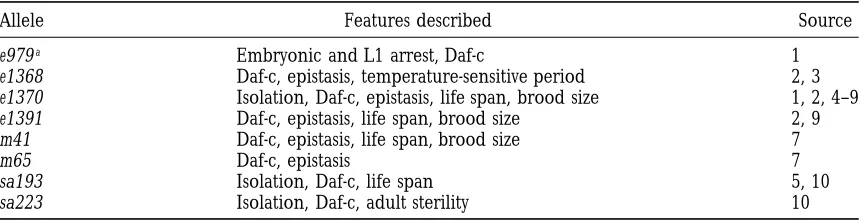
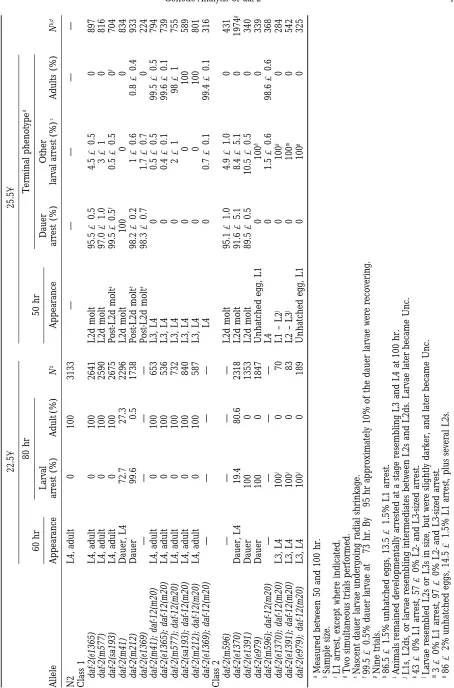
TABLE 1
Prior phenotypic analysis of daf-2 alleles
Allele Features described Source
e979a Embryonic and L1 arrest, Daf-c 1
e1368 Daf-c, epistasis, temperature-sensitive period 2, 3
e1370 Isolation, Daf-c, epistasis, life span, brood size 1, 2, 4–9
e1391 Daf-c, epistasis, life span, brood size 2, 9
m41 Daf-c, epistasis, life span, brood size 7
m65 Daf-c, epistasis 7
sa193 Isolation, Daf-c, life span 5, 10
sa223 Isolation, Daf-c, adult sterility 10
References: 1, Vowelsand Thomas (1992); 2,Riddle et al. (1981); 3, Swanson and Riddle (1981); 4, Riddle(1977); 5,Kenyonet al. (1993); 6,GottliebandRuvkun(1994); 7,Larsenet al. (1995); 8,Dorman et al. (1995); 9,TissenbaumandRuvkun(1998); and 10,MaloneandThomas(1994), which describes the
Daf-c phenotype of a further seven daf-2 alleles.
adaf-2(e979) (reference strain CB 1286) is referred to as daf-2(e1286) in reference 1.
removed. Total cross-progeny (non-Dpy F1) were counted. ing a portion of the kinase domain. Another primer pair
(AGCAGCACCAGCAACAGGAGTAAC and TTTCAAACCCC Tests of mating efficiency at 25.58were performed in a manner
similar to those at 208except that early (rather than late) L4 CAACTCATACCTC) from the lin-31 region of chromosome
II (cosmid K10G6) was used as an internal positive control to
males were used, such that the entire period of
spermatogene-sis occurred at the higher temperature. confirm that amplifiable DNA from the deficiency homozy-gotes was present in the reaction. This primer pair amplified Isolation and characterization of daf-2 deficiencies: Two
g-radiation-induced deficiencies were isolated in a noncom- a 523-bp product.
To identify and isolate deficiency homozygotes (dead eggs), plementation screen. Mixed-stage N2 populations containing
many males were exposed to 1500 R. Irradiated young adult newly starved plates of mDf/qC1 bearing large numbers of unhatched eggs were washed free of gravid adults and most males were immediately crossed to dpy-1(e1) daf-2(e1370)
unc-32(e189) hermaphrodites at 208then shifted to 258after 24 larvae by two gentle rinses with sterile M9 buffer, leaving most eggs still adhering to the agar surface. Washed plates were hr. Three days later the F1progeny were screened by visual
inspection and SDS selection for the presence of wild-type or incubated at 208for 24 hr and washed again to remove larvae that hatched after the initial rinse. Deficiency homozygotes Dpy dauer larvae. Four of seven wild-type larvae that failed to
recover spontaneously at 258 recovered to the L4 stage after were identified as eggs that appeared abnormal in shape and remained unhatched after a further 24–48 hr of incubation 2 days at 158, and these four were crossed individually with
daf-2(m65) unc-32(e189)/qC1[dpy-19(e1259) glp-1(q339)] males at 208. These were picked individually or in groups of up to 15 using a pulled-out 20-ml pipette filled with chitinase solution at 208. All four crosses were shifted to 258 after egg laying
began (approximately 24 hr). Two of the crosses gave progeny. (Williamset al. 1992).
PCR reactions (25 ml final volume) were performed ac-From each, wild-type nondauer L4 hermaphrodites of
puta-tive genotype mDf[daf-2]/qC1 or dpy-1 daf-2 unc-32/qC1 were cording toWilliamset al. (1992), except that Taq polymerase
(Fisher Scientific) was used at 0.5 unit per reaction, and “mas-placed individually on plates. Those issuing Dpy Unc progeny
were discarded. The remainder for both isolates gave only ter mix” was added to each reaction in 18.5-ml volumes to allow for separate addition of daf-2 and lin-31 control primers. wild-type and qC1 progeny, indicating that the new mutations
were lethal when homozygous. The two putative deficiencies Test reactions on N2 DNA using a mix of control and daf-2 primers resulted in production of both predicted products, were named mDf11 and mDf12. Complementation testing
showed that neither deficiency deleted unc-93; tests against whereas parallel reactions with putative Df DNA gave only the control product. For each strain and primer pair, assays
mec-12 were inconclusive. Thus, the putative deficiency
end-points lie between dpy-1 and unc-93. Progeny counts confirmed were performed in duplicate on purified N2 DNA, deionized water blanks, and worm extracts (Df/qC1 heterozygotes) and that both strains gave approximately 25% embryonic lethal
in quadruplicate on eggs (Df homozygotes). All reactions were progeny. The mDf12/qC1 animals, but not mDf11/qC1, grow
brought to 958 rapidly and held for 3 min, cycled 30 or 50 slowly relative to qC1 homozygotes.
times (958/30 sec, 588/30 sec, 728/60 sec), then held for 7 min Both deficiencies were shown by PCR analysis to lack daf-2
at 728. Amplification products were resolved on 1–2% agarose sequences encoding portions of the extracellular domain and
minigels. the tyrosine kinase domain. The sequence of the daf-2 cDNA
was obtained from GenBank (accession no. AF012437) and compared to the C. elegans sequence database to identify geno-mic YAC clones corresponding to daf-2 (Kimuraet al. 1997).
RESULTS Two pairs of oligonucleotide primers were designed for PCR,
one pair each from genomic sequence encoding the extra- Selection of alleles for study: Most previous studies cellular and intracellular domains of the protein. Primers of daf-2 used the canonical allele, e1370. We selected CTCTCGAACAAAACAGTGCCTATC and AATGAGGGCCA 15 additional alleles to cover a wide range of severity of ACTAAAGAAGACC amplified a 659-bp wild-type fragment
the Daf-c phenotype. Fourteen alleles, including e1370, encoding a portion of the extracellular domain, whereas
prim-were selected from the 40 currently in the Riddle lab ers TTCGGACCGTGTGCTATTAAGATT and CTCGGACCT
noncon-TABLE 2
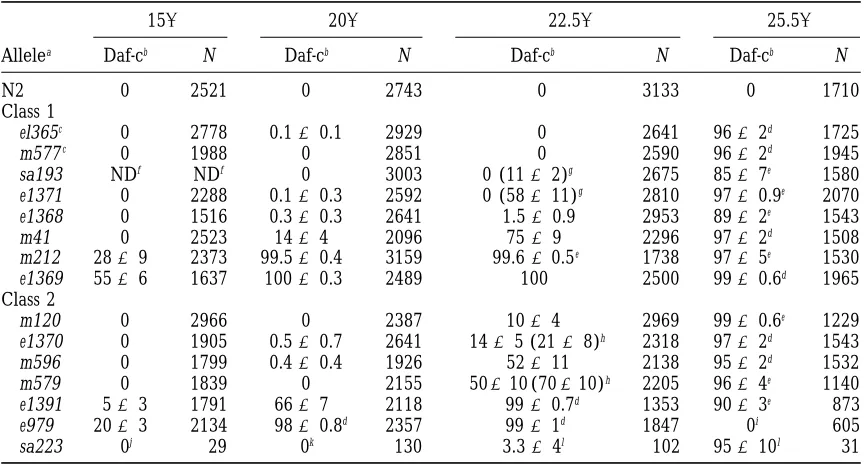
Percentage larval arrest by daf-2 mutants
158 208 22.58 25.58
Allelea Daf-cb N Daf-cb N Daf-cb N Daf-cb N
N2 0 2521 0 2743 0 3133 0 1710
Class 1
el365c 0 2778 0.160.1 2929 0 2641 9662d 1725
m577c 0 1988 0 2851 0 2590 9662d 1945
sa193 NDf NDf 0 3003 0 (1162)g 2675 8567e 1580
e1371 0 2288 0.160.3 2592 0 (58611)g 2810 9760.9e 2070
e1368 0 1516 0.360.3 2641 1.560.9 2953 8962e 1543
m41 0 2523 1464 2096 7569 2296 9762d 1508
m212 2869 2373 99.560.4 3159 99.660.5e 1738 9765e 1530
e1369 5566 1637 10060.3 2489 100 2500 9960.6d 1965
Class 2
m120 0 2966 0 2387 1064 2969 9960.6e 1229
e1370 0 1905 0.560.7 2641 1465 (2168)h 2318 9762d 1543
m596 0 1799 0.460.4 1926 52611 2138 9562d 1532
m579 0 1839 0 2155 50610 (70610)h 2205 9664e 1140
e1391 563 1791 6667 2118 9960.7d 1353 9063e 873
e979 2063 2134 9860.8d 2357 9961d 1847 0i 605
sa223 0j 29 0k 130 3.364l 102 95610l 31
aRanked in approximate order of increasing severity with respect to L2d and dauer arrest, within each class. bValues6standard error, calculated from the percentage dauer larva formation among progeny (complete broods) of 10 individual animals.
cRanking of e1365 above m577 based upon suppression of e1365 Age phenotype by daf-12(m20). See Table 3.
dAll animals not arrested at the dauer stage arrested as unhatched eggs, L1s, or early L2s.
eAll animals not arrested at the dauer stage arrested as unhatched eggs, L1s or early L2s, or developed into adults.
fNot determined.
gTransient dauer larvae; scored at 48 hr. hArrest at L2d or dauer stage.
i24% embryonic arrest, 76% L1 arrest.
j48% embryonic arrest, 14% L1 or L2 arrest, 38% L2d arrest. k92% L2d arrest, 1% L1 arrest, 7% embryonic arrest.
lAll animals that did not arrest at the dauer stage arrested development as L2ds.
ditional). Two other alleles, sa193 and sa223, were pro- focusing on weaker alleles we have been able to examine
the role of daf-2 in later larval development and in the
vided byJ. H. Thomas.All are recessive. Some
pheno-typic characterization had previously been reported for biology of the adult.
Examination of the phenotypes of 16 daf-2 mutants 8 of the 16 alleles (including 2, m65 and sa223, that
are recessive lethal and are maintained in heterozy- revealed two types of daf-2 allele, class 1 and class 2.
The following sections on the phenotypic analysis begin gous stocks) as listed in Table 1. The remaining 8 are
previously undescribed, temperature-sensitive (ts) Daf-c with descriptions of the major traits common to the
class 1 and class 2 alleles: Daf-c, Age, and Itt. Next, L1 mutants and were isolated from mutant screens over
the last 25 years in the MRC Laboratory of Molecular arrest is described, which results from all daf-2 alleles
but at a greatly elevated frequency in two class 2 alleles. Biology, Cambridge, United Kingdom (1973–1975) or
subsequently in the Riddle laboratory. All alleles were Then follow descriptions of the diverse class 2-specific
traits, with an overview and more refined classification backcrossed to N2 at least three times to avoid possible
phenotypic variation due to differences in genetic back- of the 16 alleles.
Constitutive dauer larva formation:The percentage
ground.
Characterization of alleles:We focused on the pheno- of the mutant population that constitutively entered the
dauer stage in abundant food was measured at 158, 208,
typic effects of hypomorphic daf-2 alleles, although
anal-ysis of daf-2(e979), nonconditional daf-2 alleles, and daf-2 22.58, and 25.58for all ts alleles (Table 2). These alleles
largely formed a continuous series in severity, from the deficiencies suggested that the null [daf-2(0)]
pheno-type has an embryonic and L1 arrest component as well weakest, e1365 and m577, to the strongest, e1369.
class 1, some class 1 alleles exhibited a stronger Daf-c phenotype than most class 2 alleles. Differences in the
severity of most alleles were revealed at 22.58; the
major-ity formed no dauer larvae at 158but formed all dauer
larvae at 25.58.
At 22.58 most alleles resulted in the rapid
develop-ment of larvae either into L3 or dauer larvae (either transient or persistent). The sa193 and e1371 alleles were ranked in severity on the basis of the percentage of dauer larvae that recovered spontaneously within 80 hr after eggs were laid (Table 2). However, in two in-stances (e1370 and m579) all larvae arrested initially at the predauer L2d stage, followed by slow development either into dauer larvae or into stages apparently inter-mediate between the L2d and L3 or L4 stages. These dauer-like animals resembled L2ds in their darkness of body yet resembled L3s or L4s in size and gonadal development (Figure 1B).
Two exceptional alleles were e979, which at 25.58
ar-rested as embryos, L1s, or rarely at a stage resembling
L2d larvae (as previously reported by Vowels and
Thomas1992), and sa223, which formed dauer larvae
at 25.58but at lower temperatures largely arrested
devel-opment as L2ds (MaloneandThomas1994). At 25.58,
three of the daf-2 mutants (e1368, e1371, and sa193) formed dauer larvae that displayed sporadic pharyngeal movement resembling the pumping of feeding animals. Normal dauer larvae do not feed, the buccal cavity is closed, and pharyngeal pumping is not observed.
To examine maintenance of the dauer stage, dauer
larvae from all ts Daf-c strains were maintained at 25.58
for 8 days after hatching and examined daily for the presence of adults. A high proportion of e1371 and sa193 dauer larvae resumed development. Occasional adults were seen among e1368 and m212 dauer larva
populations (all population sizes.200). Thus, in the
cases of e1368, e1371, and sa193, pharyngeal movement in dauer larvae corresponded with some degree of recov-ery from developmental arrest.
To determine whether nondauer development was affected by daf-2 mutations, we tested the effect of 14 daf-2 alleles on the subsequent development of animals
raised at 158and transferred to 25.58as early L3s. Only
in the case of e1371 did all the animals grow to gravid adults within 24 hr. In most other cases, the majority of animals developed into gravid adult hermaphrodites,
with a minority (5–20%) of pregravid adults. In three Figure1.—Morphology of daf-2 mutant larvae and adults.
(A) daf-2(e1370) L3, raised in abundant food at 158; (B) e1370 cases, e979, e1370, and e1391, abnormal development
dauer-like L3, raised at 22.58; (C) 5-day-old e1370 hermaphro-occurred; 24 hr after upshift, most animals were
abnor-dite maintained at 158; (D) daf-2(sa193) hermaphrodite trans-mally dark and thin, with underdeveloped gonads, and
ferred to 25.58at the L4 stage and incubated for 3 days; (E)
in many cases a protruding vulva. After 48 hr, some e1370 hermaphrodite transferred to 25.58at the L4 stage and
gonadal development was observed in most of the e979 incubated for 3 days; (F) e1370 dauer larva raised at 25.58.
(A–F) Scale bar, 0.2 mm. and e1391 adults and in all of the e1370 adults.
Hermaphrodite life span:The effect of 15 daf-2 alleles
on adult hermaphrodite life span was measured at 158
and 22.58 (Figure 2, Table 3). All mutations increase
in-cases. At either temperature, this longevity ceiling repre-sents a 2.5-fold increase in median life span and a 3-fold increase in maximum life span relative to wild type.
In some class 2 alleles, the extension of maximum
life span at 22.58greatly exceeded that of median life
span (Figure 2B). This suggests either that these muta-tions have a deleterious effect on adults, resulting in some premature deaths, or conceivably that they cause individuals in the population to age at different rates.
Intrinsic thermotolerance: Mutations in daf-2 and
age-1 also result in increased tolerance to thermal stress, and it has been suggested that increased Itt, as measured
by time of survival at 358, is a necessary condition for
the Age phenotype (Lithgowet al. 1995). Because
mu-tant daf-2 alleles result in a range of Age phenotypes at
158, the Itt phenotype of populations of young adults
raised to the age of onset of egg laying at 158was tested
(Figure 3, Table 4). Increased Itt was observed in all alleles tested except m41 and m577. Seven of the most
severely Age alleles at 158 (e979, e1369, e1370, e1391,
m212, m579, and m596) showed similarly high values for Itt, suggesting that, as in the case of life span, the limit of adult thermotolerance that can result from loss
of daf-2(1) function has been reached in these cases.
The severely Age allele sa223 was also strongly Itt (data not shown). This suggests that loss of daf-2 function in
mutants that can grow to the adult at 158may result in,
at most, approximately a 75% increase in median
sur-vival at 358(Table 4).
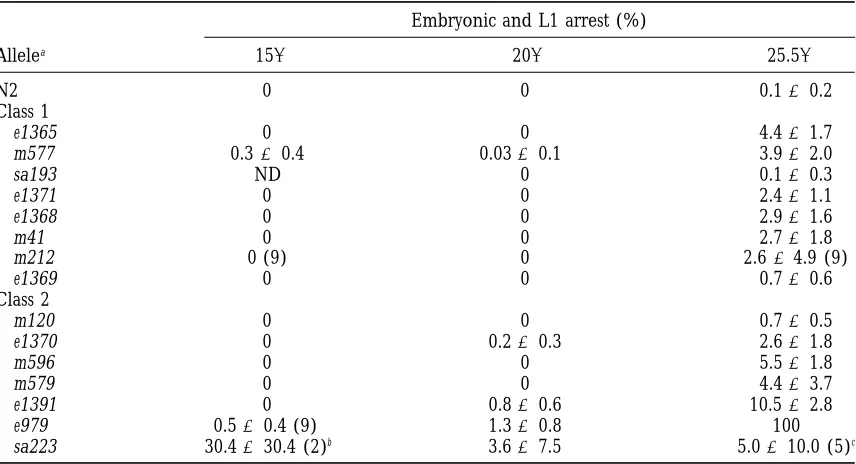
Embryonic and L1 arrest: daf-2(e979) exhibits almost
100% embryonic or L1 arrest at 258. This phenotype
was examined in all 15 ts alleles at 158, 208, and 25.58
Figure2.—Effect of daf-2 mutations on median and
maxi-(Table 5). Some embryonic and L1 arrest (mostly the mum hermaphrodite life span. Median and maximum life
span are expressed as a percentage of that of the wild-type latter), higher than that observed in N2 controls, was control. Bars represent standard error. (A) Life span at 158; observed in all daf-2 alleles tested at 25.58(except sa193) (B) life span at 22.58. Alleles are in order of increasing severity but in most cases not at 158or 208(Table 5). The fre-of the L2d and dauer arrest phenotype within each class.
quency of such arrest was generally low or undetectable
at the temperatures tested (mean,,6%). However, at
25.58the e1391 and e979 mutations resulted in 10.56
creasing longevity at 158, but the relative extensions of
median and maximum life span were similar in most 2.8 and 100% embryonic and L1 arrest, respectively.
A high level of sa223 embryonic arrest (14/29 total cases (Figure 2A, Table 3). The greatest increases in
maximum life span were approximately 300% of the N2 progeny) was seen at 158.
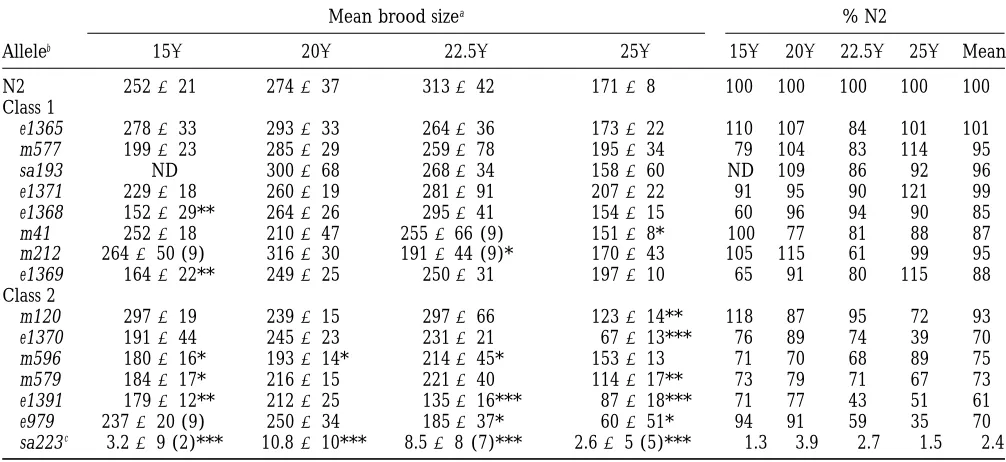
Brood size: Fecundity of daf-2 mutant
hermaphro-control. At 158, increases in life span were only marginal
for e1365, m41, and m577. dites was assayed at 158, 208, 22.58, and 25.58(Table 6).
In self-fertilizing Caenorhabditis elegans hermaphrodites,
At 22.58all 15 mutants had clearly extended life spans
(Figure 2B, Table 3). Most weaker alleles showed greater maximum brood size normally reflects the fixed
num-ber of sperm produced before the switch from
spermato-extensions in life span relative to N2 at 22.58than at
158. However, the five alleles with the largest increases genesis to oogenesis. When averaged over all
tempera-tures tested, class 1 mutants have broods ranging from
in median and maximum life span at 158, e979, e1369,
e1391, m212, and sa223, at 22.58generally showed simi- 85 to 100% that of N2, and class 2 mutants (except sa223) have broods ranging from 60 to 93% of N2. Two lar or reduced extension of median life span and similar
extensions in maximum life span (Figure 2, Table 3). class 1 alleles (e1368 and e1369) were cold sensitive,
showing 35–40% reductions in brood size only at 158.
The greatest percentage increases in life span at 22.58
did not exceed those seen at 158, suggesting that the These were the only class 1 alleles where significant
brood size reductions (P , 0.01) were seen, whereas
limit of adult life span extension that may result from
TABLE 3
Adult life span
158 22.58
Allelea Median Maximum Nb Median Maximum Nc
1 24.061.6 31.063.0 304 (5) 16.3 61.3 22.262.4 306 (6)
daf-12(m20) 16.760.6 24.864.1 80 (4) 10.6 61.4 16.061.2 80 (4) Class 1
daf-2(e1365) 28.262.9 36.562.5 224 (2) 29.2 63.0 39.768.3 257 (3)
daf-2(m577) 25.861.1 34.064.3 269 (4) 25.9 63.8 40.366.6 246 (4)
daf-2(sa193) 33.561.2 40.561.5 41 (2) 26.0 62.0 35.061.0 39 (2)
daf-2(e1371) 31.862.8 45.562.2 273 (4) 21.6 60.5 36.365.6 247 (4)
daf-2(e1368) 33.263.2 47.565.3 263 (4) 29.5 64.2 43.368.6 223 (4)
daf-2(m41) 27.061.3 35.061.4 71 (3) 29.4 61.2 35.060.0 60 (2)
daf-2(m212) 48.461.4 64.060.0 40 (2) 34.0 63.0 47.564.5 38 (2)
daf-2(e1369) 52.862.8 74.561.5 213 (2) 38.2 62.4 54.863.1 232 (4)
daf-2(e1365); daf-12(m20) 18.261.5 29.763.8 64 (3) 15.2 62.3 24.064.7 77 (4)
daf-2(m577); daf-12(m20) 21.663.2 32.761.9 61 (3) 18.5 67.5 33.861.1 89 (4)
daf-2(sa193); daf-12(m20) 26.762.4 42.069.0 41 (2) 18.4 62.6 29.563.0 91 (4)
daf-2(m41); daf-12(m20) 24.663.9 32.866.0 89 (4) 17.9 64.8 41.364.7 88 (4)
daf-2(m212); daf-12(m20) 25.365.6 51.167.0 78 (4) 34.0 67.0 52.563.6 80 (4) Class 2
daf-2(m120) 32.361.8 50.063.0 252 (2) 31.6 64.4 57.867.2 257 (4)
daf-2(e1370) 33.860.2 42.061.4 66 (3) 20.4 62.4 45.060.0 39 (2)
daf-2(m596) 36.865.3 56.564.5 208 (2) 35.4 63.8 54.364.6 257 (3)
daf-2(m579) 44.361.3 63.561.5 239 (2) 40.0 63.2 64.3615.0 266 (3)
daf-2(e1391) 63.465.0 91.3610.9 259 (3) 29.2 69.7 68.0610.0 142 (3)
daf-2(e979) 50.362.8 69.063.0 105 (4) 28.3 61.7 56612.0 57 (2)
daf-2(sa223) 58.762.7 92.062.0 36 (2) 41.0 62.0 53.063.0 37 (2)
daf-2(e1370); daf-12(m20) 30.462.0 41.762.1 65 (3) 21.6 64.6 62.561.7 88 (4)
daf-2(e1391); daf-12(m20) 58.768.0 81.369.6 69 (3) 71.8 62.2 94.067.0 94 (4)
daf-2(e979); daf-12(m20) 45.664.8 91.5613.5 37 (2) 43.3 68.7 72.062.9 86 (4)
adaf-2 alleles ordered in increasing severity of L2d and dauer arrest phenotype, within each class. bSample size; number of trials in parentheses.
brood size, which were generally more severe at higher size did not exceed 4% of wild type at any of the four
temperatures (Table 6). temperatures tested (Table 6). At all temperatures,
The largest reductions in brood size resulted from some sa223 adults were sterile, even though adults in
sa223. In this case, brood sizes of maternally rescued which some gonad development was evident were
se-animals were measured because progeny of sa223 homo- lected (seematerials and methods).
zygotes do not develop to adulthood. Mean sa223 brood Late progeny:Production of progeny by N2
hermaph-rodites at 25.58 ceases after 3–5 days, but e1370
her-maphrodites continue to produce occasional progeny
for at least 50 days (Larsenet al. 1995). All 15 ts daf-2
alleles were examined for late progeny production at
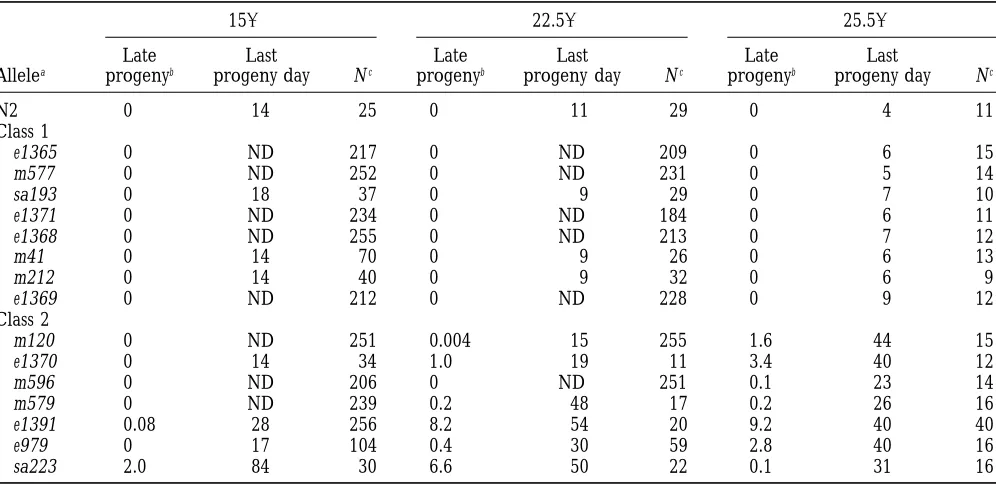
158, 22.58, and 25.58(Table 7). Of these, only the 7 class
2 alleles resulted in this trait.
Because late progeny generally appeared after the transfer of hermaphrodites to fresh plates, and often produced in bursts by a single individual, it is possible that a cue present in fresh bacterial lawns might stimu-late stimu-late reproduction in these mutants. At least some late progeny were released by their mothers as L1 larvae rather than as eggs. Late eggs were never observed.
Late progeny could result from a delay in production of oocytes or from renewal of spermatogenesis later in Figure3.—Intrinsic thermotolerance assays. A
representa-life, after depletion of the sperm produced during the tive sample of 358survival curves for daf-2 adult hermaphrodite
TABLE 4
Intrinsic thermotolerance of daf-2 hermaphrodites
Median Maximum
Straina survival (hr) % N2b survival (hr) % N2 Nc
N2 7.160.5 — 8.6 60.9 — 514 (7)
Class 1
e1365 8.660.3 12366 11.061.0 130612 299 (4)
m577 8.060.8 10469 10.062.0 110610 151 (2)
sa193 8.1 117 10 125 69 (1)
e1371 9.360.4 13466 13.061.7 155629 275 (2)
e1368 10.061.1 144618 13.061.7 154622 305 (4)
m41 7.960.2 10969 10.560.9 118610 256 (5)
m212 11.660.7 166612 15.061.0 188613 166 (2)
e1369 12.461.0 178617 15.061.0 188613 136 (2)
Class 2
m120 10.3 166 12 150 57 (1)
e1370 12.260.7 172615 16.460.8 197621 363 (5)
m596 11.260.9 163612 14.5615.0 172628 153 (2)
m579 12.160.1 17861 14.061.0 156611 117 (2)
e1391 11.860.8 16869 15.061.0 188613 163 (2)
e979 12.360.1 17563 16.060.0 20060 163 (2)
sa223 ND ND ND ND ND
ND, not determined.
aAlleles ranked in order of increasing severity of L2d and dauer arrest phenotype, within each class. bTo calculate these values, mutant median survival at 358 was expressed as a percentage of the wild-type control in each respective trial, and then the mean and standard error were calculated from the set of percentages. For this reason, these values cannot be derived directly from the values in the preceding columns.
cTotal number of animals; in parentheses, number of trials.
TABLE 5
Embryonic and L1 arrest in daf-2 mutants
Embryonic and L1 arrest (%)
Allelea 158 208 25.58
N2 0 0 0.160.2
Class 1
e1365 0 0 4.461.7
m577 0.360.4 0.0360.1 3.962.0
sa193 ND 0 0.160.3
e1371 0 0 2.461.1
e1368 0 0 2.961.6
m41 0 0 2.761.8
m212 0 (9) 0 2.664.9 (9)
e1369 0 0 0.760.6
Class 2
m120 0 0 0.760.5
e1370 0 0.260.3 2.661.8
m596 0 0 5.561.8
m579 0 0 4.463.7
e1391 0 0.860.6 10.562.8
e979 0.560.4 (9) 1.360.8 100
sa223 30.4630.4 (2)b 3.667.5 5.0610.0 (5)c
Table shows mean and standard error of percentage embryonic or L1 arrest in broods of a set of individual hermaphrodites raised entirely at 158, or shifted to 208or 25.58at the L4 stage. Unless otherwise noted by the number in parentheses, 10 hermaphrodites were tested for each allele. See Table 2 for total progeny scored. ND, not determined.
aRanked in order of increasing severity of the L2d and dauer arrest phenotype, within each class. bof 10 animals tested, only 2 bore progeny.
TABLE 6
Brood sizes of daf-2 mutants
Mean brood sizea % N2
Alleleb 158 208 22.58 258 158 208 22.58 258 Mean
N2 252621 274637 313642 17168 100 100 100 100 100
Class 1
e1365 278633 293633 264636 173622 110 107 84 101 101
m577 199623 285629 259678 195634 79 104 83 114 95
sa193 ND 300668 268634 158660 ND 109 86 92 96
e1371 229618 260619 281691 207622 91 95 90 121 99
e1368 152629** 264626 295641 154615 60 96 94 90 85
m41 252618 210647 255666 (9) 15168* 100 77 81 88 87
m212 264650 (9) 316630 191644 (9)* 170643 105 115 61 99 95
e1369 164622** 249625 250631 197610 65 91 80 115 88
Class 2
m120 297619 239615 297666 123614** 118 87 95 72 93
e1370 191644 245623 231621 67613*** 76 89 74 39 70
m596 180616* 193614* 214645* 153613 71 70 68 89 75
m579 184617* 216615 221640 114617** 73 79 71 67 73
e1391 179612** 212625 135616*** 87618*** 71 77 43 51 61
e979 237620 (9) 250634 185637* 60651* 94 91 59 35 70
sa223c 3.269 (2)*** 10.8610*** 8.568 (7)*** 2.665 (5)*** 1.3 3.9 2.7 1.5 2.4
ND, not determined.
* 0.01,P,0.05; ** 0.005.P,0.01; *** P,0.005 (Student’s t test).
aBrood sizes6standard error of 10 hermaphrodites per allele, unless otherwise stated (in parentheses); sample sizes as in Table 2.
bRanked in order of increasing severity of the L2d and dauer arrest phenotype, within each class.
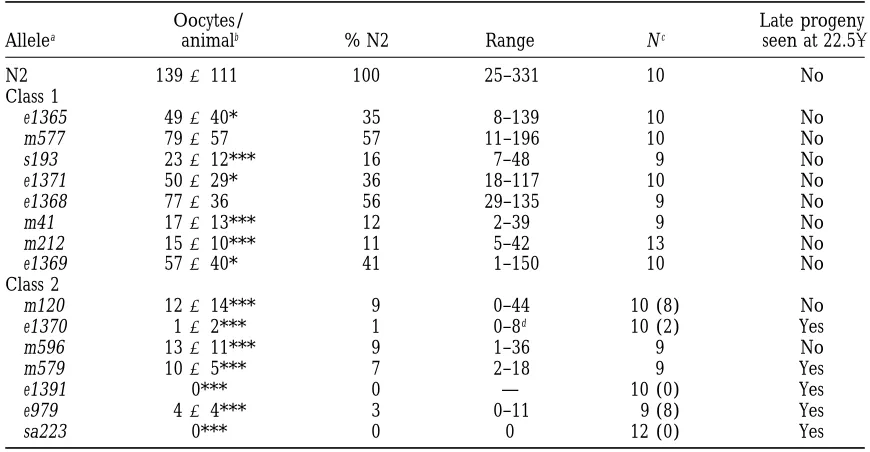
cMaternally rescued hermaphrodites used. At 158, 208, 22.58, and 25.58, 2/10, 10/12, 7/12, and 5/12 hermaphrodites, respec-tively, produced progeny.
unfertilized oocytes at the end of the egg-laying period, larvae in the absence of maternal rescue. The ratio of
nondauer-to-dauer larva progeny was approximately 3:1,
an indicator of sperm depletion (Ward and Carrel
1979), was monitored at 22.58(Table 8). All daf-2 mutant except for m41 heterozygotes, which segregated only
1268% dauer larvae, indicating that the Daf-c
pheno-alleles resulted in a reduction in the number of oocytes
laid relative to the N2 control, although this reduction type was maternally rescued in approximately half of
the m41 homozygous progeny (Table 9; data not shown was not significant in many class 1 alleles. The seven
class 2 mutants, which exhibited late progeny produc- for ts alleles where no maternal rescue was seen).
Re-peating the m41 test at 25.58,1m411/ dpy-11unc-32
tion, also laid the fewest oocytes. Hence, stored sperm
may be present in hermaphrodites of the late progeny- parents issued 8% dauer larvae, 66% wild-type L4-adult
and 25% DpyUnc progeny (N 5 185). The e979
em-producing strains at the end of the normal egg-laying
period, and late progeny may result from fertilization bryonic and L1 arrest phenotype was found to be fully
maternally rescued such that e979 homozygotes ar-of oocytes that are not produced until late in life. That
daf-2(e1370) hermaphrodites are defective in oocyte pro- rested development at the dauer stage or, occasionally, the L2d stage (Table 9).
duction is also suggested by the abnormal appearance
of the gonad. Microscopic examination with Nomarski The m65 mutation results in nonconditional dauer
larva formation, and sa223 results in formation of L2ds, optics of adult daf-2(e1370) hermaphrodites 19 hr after
shifting from 158to 25.58revealed that, instead of the dauer larvae, and sterile or near-sterile adults. Both
these alleles are maintained in trans to the balancer usual 8–10 oocytes stacked in the proximal arm and
loop of each gonad arm, only 2–4 oocytes were present chromosome qC1[dpy-19(e1259) glp-1(q339)]III. No
ma-ternal rescue of m65 was detected at 25.58when assayed
(J. McCarter,personal communication).
Maternal rescue of larval arrest:To test for maternal by scoring the progeny of m65/qC1 hermaphrodites
(Ta-ble 9). Homozygous sa223 progeny of sa223/qC1 either rescue of the Daf-c trait, hermaphrodites from the 15
ts daf-2 strains were crossed with N2 males at 25.58, and arrested permanently at a stage resembling late L2d or
developed to adulthood via dauer-like third and fourth
F1 heterozygotes were selfed at the same temperature.
Their progeny were scored after 48 hr. Because at 25.58 stages. These adults were sometimes thin and dark
bod-ied, and when gonads were present, they often appeared all, or almost all, homozygous daf-2 mutants form dauer
TABLE 7
Late progeny production by daf-2 hermaphrodites
158 22.58 25.58
Late Last Late Last Late Last
Allelea progenyb progeny day Nc progenyb progeny day Nc progenyb progeny day Nc
N2 0 14 25 0 11 29 0 4 11
Class 1
e1365 0 ND 217 0 ND 209 0 6 15
m577 0 ND 252 0 ND 231 0 5 14
sa193 0 18 37 0 9 29 0 7 10
e1371 0 ND 234 0 ND 184 0 6 11
e1368 0 ND 255 0 ND 213 0 7 12
m41 0 14 70 0 , 9 26 0 6 13
m212 0 14 40 0 , 9 32 0 6 9
e1369 0 ND 212 0 ND 228 0 9 12
Class 2
m120 0 ND 251 0.004 15 255 1.6 44 15
e1370 0 14 34 1.0 19 11 3.4 40 12
m596 0 ND 206 0 ND 251 0.1 23 14
m579 0 ND 239 0.2 48 17 0.2 26 16
e1391 0.08 28 256 8.2 54 20 9.2 40 40
e979 0 17 104 0.4 30 59 2.8 40 16
sa223 2.0 84 30 6.6 50 22 0.1 31 16
ND, not determined.
aRanked in order of increasing severity of the L2d and dauer arrest phenotype, within each class.
bProgeny produced per animal after 17 days of age at 158, after 11 days of age at 22.58, after 10 days of age at 25.58. cNumber of animals in trial on day 18 (158), day 12 (22.58), and day 11 (25.58).
Comparison of progeny of homozygous sa223 and swollen with retained eggs. Over subsequent days,
over-all body darkening and shrinkage in diameter were heterozygous sa223/qC1 hermaphrodites (Tables 2 and
9, respectively) revealed maternal rescue of the L2d- seen. The gonad and intestine, viewed in the
stereomi-croscope at 350 magnification, appeared to become
like arrest but no rescue of the Daf-c phenotype. Animals
homozygous for the sa223 allele formed dauer larvae squeezed by the contracting body, the intestine
becom-ing reduced to a narrow, longitudinal strip. In such
at 25.58but very few at 22.58, whether they were progeny
of sa223 homozygotes (Table 2) or of sa223/qC1 (Table animals, the gonad had an abnormal, clear appearance
(Figure 1E). These animals also displayed an uncoordi-9). These results suggest that, whereas the Daf-c
pheno-type is not normally maternally rescued (with the excep- nated phenotype, comprising reduced movement,
coil-ing behavior, and frequent adoption of a kinked posture tion of m41), the L2d arrest phenotype resulting from
certain alleles may be. similar to that seen in dauer larvae (Figures 1E and F).
Appearance and behavior of the 15 ts daf-2 mutants
Death from internal hatching (matricide): Animals
that died as the consequence of internal hatching of was monitored during the first 2 weeks of adulthood
at 158, 22.58, and 25.58. Morphological and behavioral
eggs were excluded from measurements of life span. In
most daf-2 mutants, matricide, resulting in a “bag of abnormalities similar to those seen in e1370 mutants
resulted from 11 of the 15 alleles in a
temperature-worms” phenotype (Trentet al. 1983), was observed at
a low frequency (,20%), occurring more readily at sensitive manner (Table 10), whereas sa223 exhibited
these defects at all temperatures. At 22.58, only 8 of the
22.58 than 158 (data not shown). At 22.58, a higher
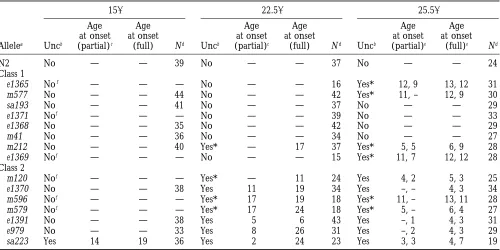
frequency of matricide (over 30%) resulted from four 15 alleles resulted in reduced motility. Timing and rate
of onset of this Unc trait showed considerable variation class 2 alleles: e979, e1370, e1391, and sa223.
Adult morphology and behavior:Certain daf-2 alleles among alleles (Table 10). Interestingly, in several alleles
adult motility appeared normal for an extended period (e.g., e1370) resulted in progressive changes in adult
hermaphrodite appearance and behavior during the before becoming reduced.
The e1370 allele was tested for reversibility of the
3 days after shifting L4s from 158to 22.58or 25.58. Such
changes were generally not seen at 158(Figure 1C), and morphological and behavioral abnormalities.
Twenty-six late L4 larvae that were shifted to 25.58 for 3 days
some alleles (e.g., sa193) did not produce such changes
at any temperature (Figure 1D). One day after transfer, became fully Unc. They were then shifted back to 158.
TABLE 8
Production of unfertilized oocytes by daf-2 hermaphrodites at 22.58
Oocytes/ Late progeny
Allelea animalb % N2 Range Nc seen at 22.58
N2 1396111 100 25–331 10 No
Class 1
e1365 49640* 35 8–139 10 No
m577 79657 57 11–196 10 No
s193 23612*** 16 7–48 9 No
e1371 50629* 36 18–117 10 No
e1368 77636 56 29–135 9 No
m41 17613*** 12 2–39 9 No
m212 15610*** 11 5–42 13 No
e1369 57640* 41 1–150 10 No
Class 2
m120 12614*** 9 0–44 10 (8) No
e1370 162*** 1 0–8d 10 (2) Yes
m596 13611*** 9 1–36 9 No
m579 1065*** 7 2–18 9 Yes
e1391 0*** 0 — 10 (0) Yes
e979 464*** 3 0–11 9 (8) Yes
sa223 0*** 0 0 12 (0) Yes
* Indicates 0.01,P,0.05; *** indicates P,0.005 (Student’s t test).
aRanked in order of increasing severity of the L2d and dauer arrest phenotype, within each class. bOocytes laid at the end of the normal reproductive phase,6SE.
cNumber of P
0’s examined; number laying oocytes, if different from N, in parentheses. dTwo animals laid one and eight oocytes, respectively.
TABLE 9
Maternal rescue of developmental arrest
Parent Temperature % L4 % Dauer larvaea Otherb Nc
m41/1 25.58 8769 1268 (48) 0.662 302 (8)
e979/1 25.58 7564 2564 (100)d 0 457 (8)
m65/1 25.58 7563 2363 (92) 1.860.5 1361 (6)
1/qC1 25.58 9762 0 3.160.2 876 (4)
sa223/qC1 25.58 7361 2661 (100) 1.360.6 1561 (7)
sa223/qC1 22.58 8062 560.8 (20) 1564e,f 816 (2)
sa223/qC1 208 85 0 16e,g 476 (1)
sa223/qC1 158 7663 0 2463e,h 493 (2)
m65/qC1 25.58 6962 2262 (88) 961 753 (4)
m41 25.58 0 9762 362 1508
e979 25.58 0 0 100 605
sa223 25.58 0 95610 5610 31
sa223 22.58 0 3.364 9764i 102
sa223 208 0 0 100 130
sa223 158 0 0 100 29
aEstimated percentage of the homozygous daf-2 segregants displaying this phenotype shown in parentheses. bPrimarily unhatched eggs, L1s, or clear, unhealthy-looking L2s.
cTotal number of progeny scored. Number of trials given in parentheses. dIncludes a small proportion of late L2ds.
eProbably underestimated due to scoring homozygous sa223 adults with extensive gonad development as
wild type.
f0.460.2% dead eggs; 260.6% L2d; 1264% dauer-like L3 and L4 forms, and adults without discernible gonad develpment; 160.7% adults with some degree of gonad development (underestimated). Scored 80 hr after egg laying.
g0.6% dead eggs; 12% dauer-like L3 and L4 forms, and adults without discernible gonad development; 3% adults with some degree of gonad develpment (underestimated). Scored 96 hr after egg laying.
turned, and.200 progeny were produced. Twelve con- of maximum life span (Figure 4B). The decline in
trol hermaphrodites of the same age left at 25.58 pro- pumping rate with percentage maximum life span was
duced only two progeny and no unfertilized oocytes. similar in N2 and e1371 animals; that is, the decline in
The 24 survivors of the shift were returned to 25.58, pumping rate scaled with life span. This indicates that
and by day 8 all animals were once again Unc and e1371 has little effect on the rate of pharyngeal pumping
morphologically abnormal. Twenty survivors were again relative to biological or developmental (as opposed to
downshifted to 158. These animals again recovered wild- chronological) age and also that, in e1371 mutants,
pha-type motility and appearance by day 10, at which time ryngeal pumping rate provides a biomarker for
develop-they were shifted up to 25.58 for the third time. By mental age. Conversely, in the case of e1391, pumping
day 12, all 15 survivors were Unc and morphologically is a poor indicator of developmental age. This is also
abnormal. These were shifted to 158, and by day 13, true of e1370 (data not shown).
most animals had again recovered wild-type appearance Animals in which no pumping was observed in a 1-min
and behavior. Thus, the behavioral and morphological interval were excluded from pumping rate
measure-abnormalities displayed by e1370 hermaphrodites at ments. In the case of class 2 alleles (e1370, e1391, and
higher temperatures are reversible at least three succes- m596), the majority of animals exhibited greatly
re-sive times in the same animals. To our knowledge, this duced pumping during the first 40% of the life span,
is the only case of a reversible ts adult Unc phenotype but in class 1 (e1371, m41, and sa193) mutants, as in
in C. elegans. wild-type populations, the majority of animals exhibited
Male fertility:The effect of six mutant daf-2 alleles on greatly reduced pumping only in the second half of the
male mating efficiency was measured using a standard life span (data not shown).
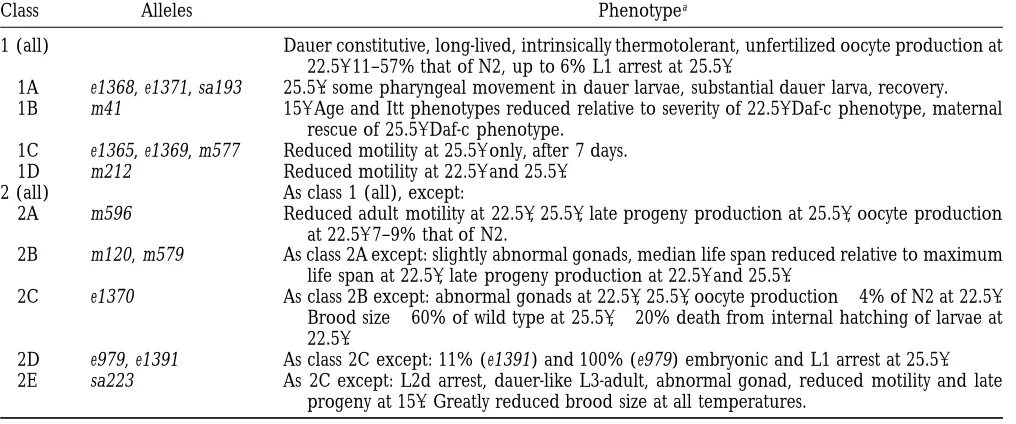
quantitative mating test (Hodgkin1983). Males were Classification of daf-2 alleles: On the basis of the
raised at 158and tested at 208and 25.58. At 208mating above phenotypic descriptions, daf-2 alleles fell broadly
efficiency and fertility were reduced to 31–45% of wild- into two types (Table 12). Class 1 alleles resulted in
type controls, except for e1391, where it was reduced constitutive dauer larva formation (Table 2), increased
to 10% of wild-type controls (Table 11). At 25.58, the longevity (Table 3), increased intrinsic thermotolerance
class 1 (e1371, m41, and m577) males were as fertile as (Table 4), a low level of embryonic and L1 arrest (mean,
N2 males or even more so, whereas the class 2 males less than 6%) at 25.58(Table 5), and a reduction in the
(e1370, e1391, and m120) males produced no progeny number of unfertilized oocytes laid (Table 8). Class 2
at all. The latter three alleles also resulted in greatly mutants exhibited all of the above traits plus some or
reduced male motility, suggesting that, as in the case all of the following: a higher level of embryonic or L1
of many uncoordinated mutant males (Hodgkin1983),
arrest (mean, greater than 6%) at 25.58(Table 5),
for-their failure to sire offspring is the result of for-their inability mation of dauer-like L3 and dauer-like L4 larvae (Figure
to copulate. 1B), reduced adult motility (Table 10), shrinkage of the
Pharyngeal pumping rate:Kenyonet al. (1993)
com-adult body and gonad abnormalities at 22.58and 25.58
pared the rate of pharyngeal pumping, an indicator of (Table 10), reduced brood size (Table 6), increased
the rate of ingestion of food, in wild-type and daf- frequency of internal hatching at 25.58and production
2(e1370) adult hermaphrodites at 208. They found that of late progeny (Table 7), greatly reduced (less than
although the rate of pumping declines with time at a 10% that of wild type) number of oocytes laid (Table
similar rate in both strains, it is greatly reduced through- 8), and a reduction in the extension of median life span
out the extended phase of the e1370 life span. Our as compared to that of maximum life span (Table 3).
examination of pharyngeal pumping in three class 1 The class 1 alleles (except m41) can be ranked into
and three class 2 mutants indicated that class 2 but
an allelic series defined by the severity of Daf-c and Age, not class 1 mutations depress the rate of pharyngeal
where the latter is expressed as maximum life span at pumping.
158(Tables 2 and 3). This allelic series is as follows, in
We examined the effect of daf-2 alleles e1371 (class 1)
order of increasing severity: and e1391 (class 2) on the rate of pharyngeal pumping
at 22.58 from early adulthood onward. e1391 mutants N2,e1365 5m577,sa193, e1371
exhibited a rapid decline in the rate of pumping with 5e1368,m212, e1369.
advancing age (Figure 4A), whereas the rate of
pump-This allelic series also approximately describes the rank-ing slowed down more gradually with advancrank-ing age in
ing in severity of Itt. The class 1 allele m41 is among e1371 animals.
the weakest alleles with respect to Age and Itt when From day 6 onward, the rate of pumping was greater
grown at 158(Tables 3 and 4), whereas with respect to
in e1371 animals than in wild type. Does this signify
its Daf-c phenotype at higher temperatures it is more that e1371 results in higher rates of pumping in older
severe than e1368 (Table 2). animals or that e1371 animals are biologically younger
The class 1 alleles can be subdivided into four sub-at lsub-ater chronological ages? To clarify this issue,
TABLE 10
Reduced movement in adult daf-2 hermaphrodites
158 22.58 25.58
Age Age Age Age Age Age
at onset at onset at onset at onset at onset at onset
Allelea Uncb (partial)c (full) Nd Uncb (partial)c (full) Nd Uncb (partial)e (full)e Nd
N2 No — — 39 No — — 37 No — — 24
Class 1
e1365 Nof — — — No — — 16 Yes* 12, 9 13, 12 31
m577 No — — 44 No — — 42 Yes* 11, – 12, 9 30
sa193 No — — 41 No — — 37 No — — 29
e1371 Nof — — — No — — 39 No — — 33
e1368 No — — 35 No — — 42 No — — 29
m41 No — — 36 No — — 34 No — — 27
m212 No — — 40 Yes* — 17 37 Yes* 5, 5 6, 9 28
e1369 Nof — — — No — — 15 Yes* 11, 7 12, 12 28
Class 2
m120 Nof — — — Yes* — 11 24 Yes 4, 2 5, 3 25
e1370 No — — 38 Yes 11 19 34 Yes –, – 4, 3 34
m596 Nof — — — Yes* 17 19 18 Yes* 11, – 13, 11 28
m579 Nof — — — Yes* 17 24 18 Yes* 5, – 6, 4 27
e1391 No — — 38 Yes 5 6 43 Yes –, 1 4, 3 31
e979 No — — 33 Yes 8 26 31 Yes –, 2 4, 3 29
sa223 Yes 14 19 36 Yes 2 24 23 Yes 3, 3 4, 7 19
aRanked in order of increasing severity of the L2d and dauer arrest phenotype, within each class. bAnimals that were Unc also developed severe gonad abnomalities, except where marked *.
cDays of adulthood. Late L4 stage is day 0. Some or full reduction of motility in some animals, or some reduction of motility in all animals.
dNumber of animals examined. eResults of two consecutive trials. fObservations made during subculture.
e1371, and sa193) do not exhibit any reduced motility stage and may eventually recover into adults at 25.58. The single class 1B allele, m41, resembles a class 1A at any of the temperatures tested (Table 10) and differ
from other class 1 mutants in that dauer larvae display allele, except that no pharyngeal movement or dauer
larva recovery occurs at 25.58. m41 is also unique in
slight pharyngeal movement at 25.5872 hr after the egg
TABLE 11
Mating efficiency of mutant daf-2 malesa
208 25.58
Cross Mating Cross Mating
Alleleb progeny/male % N2 efficencyc progeny/male % N2 efficiencyc
N2 658 100 4 45 100 4
Class 1
m577 291 44 4 85 188 4
e1371 295 45 4 70 154 4
m41 230 35 4 50 110 4
Class 2
m120 203 31 4 0 0 0
e1370 238 36 4 0 0 0
e1391 62 10 2 0 0 0
aSix males tested per allele. Males raised at 158and shifted to 208 at late L4 stage, or to 25.58at early L4 stage.
bRanked in order of increasing severity of Daf-c phenotype, within each class.