To Study the Effect of Activated Charcoal,
Ascorbic Acid and Light Duration on InVitro
Micropropagation of
Aloe vera
L
Priyanka Das
1, Alok Kumar Srivastav
2Master of Technology, Department of Biotechnology, Bengal College of Engineering & Technology, Durgapur,
West Bengal, India 1
Master of Technology, Department of Biotechnology, Bengal College of Engineering & Technology, Durgapur,
West Bengal, India 2
ABSTRACT: The research was conducted to determine the effect of ascorbic acid (50 mgl-1, 100 mgl-1, 200 mgl-1) and activated charcoal (0.5 gl-1, 1 gl-1, 2 gl-1) independently with different light duration (darkness for 4 weeks, and
16 hours light for 4 weeks followed by 2 weeks in 16 hours light) on shoot regeneration. Explants of Aloe vera were
planted on MS basal media supplemented with 1.6 mgl-1 IAA, 4.0 mgl-1 BAP and cultured for 4 weeks. After 4 weeks, degree of explant browning was evaluated. Explants were then cut vertically into two pieces and planted on shoot regeneration media. After 4 weeks more number of shoot developed on shoot regeneration medium, i.e. MS medium supplemented with 1.6 mg/l IAA + 4.0 mg/l BAP + 100 mg/l ascorbic acid + 0.5g/l activated charcoal. Browning of ex- plants was minimized in this medium and elongation of micro-shoots and the growth of the plantlets were also better. Further elongation and rooting of micro-shoots were obtained when sub-cultured on to MS basal medium containing 0.5g/l activated charcoal and 100% of the survival of rooted plantlets was observed after acclimatization. Therefore, the
above protocol could be effectively used in rapid mi- cropropagation of elite plants of Aloe vera.
KEYWORDS: Aloe vera, Explant browning, Micropropagation, Growth hormones, Light duration, Culture media,
Phenolic compounds.
I. INTRODUCTION
Aloe vera (Liliaceae), is a succulent plant indigenous to Northern Africa and Mediterranean countries and has become
naturalized almost in all parts of India (Klein et al. 1988). The plant has stiff gray-green lance-shaped leaves containing
clear gel in a central mucilaginous pulp. Aloe vera has been used for several thousands of years in folk medicine in
many cultures from ancient Egypt, Greece, and Rome to China and India (Kemper and Chiou 1999). Some of the most
important pharmacological activities of Aloe vera are antiseptic (Capasso et al. 1998), anti- tumor (Winter et al. 1981),
anti- inflammatory (Yagi et al. 1998), wound and burn healing effect (Heggers et al. 1993), anti diabetic (Rajasekaran
et al. 2006) and as an adjunct to current AIDS therapy (Mc Daniel et al. 1990).
Aloe vera propagates vegetatively in its natural state. However, propagation rate is very slow because a single plant can
produce only three to four lateral shoots in a year. Moreover, the production of Aloe leaves is insufficient to meet the
industry demand in India (Aggarwal and Barna 2004) and the production of cosmetics, foods and pharmaceuticals
containing A. vera has experienced a slow increase due to limited availability of raw material with high quality
(Campestrin et al. 2006). Therefore, there is a need to develop suitable, an alternative method for traditional
propagation of A. vera.
In vitro techniques using micropropagation and tissue culture offer a great possibility to overcome this problem.
Micropropagation using stem and lateral shoot pieces of Aloe vera has already been proved successful (Natali et al.
1990; Roy and Sarkar 1991; Mayer and Staden 1991; Aggarwal and Barna 2004). However, source of explants, their sterilization procedure, media composition, culture conditions, phenolic browning of explants and media discoloration
Problem often encountered in mass micropropagation of Aloe vera is the explant browning. Explant browning caused
by oxidation of phenolic compounds resulting from injuries during the isolation of explant[1]. It leads to the death of
explant and failure of shoot regeneration[2]. This is due to quinones produced by oxidation of phenolic compounds[1] are
toxic[3] and it diffuses into culture media causing tissue necrosis and death of explant[4]. The concentration and
combination of auxin and cytokininin in culture media is a key factor which determines successful shoot regeneration[1].
Besides growth hormone, other compounds such as ascorbic acid and activated carbon can be added to culture media. Both compounds are able to reduce the oxidation of phenolic compounds that can prevent death due to explant
browning and increase shoot regeneration[6]. Ascorbic acid is an antioxidant that are able to prevent or inhibit oxidation
process[7]. Besides its role as an antioxidant, ascorbic acid is involved in cell division and elongation[8]. Phenolic
browning of explant, media composition and culture conditions greatly affect shoot regeneration[5]. Activated charcoal
is an essential component of plant tissue culture media. It is a strong adsorbent that can absorb toxic substances[10].
Effect of light duration on regeneration shoots is also evaluated. According to[11] light plays an important role in the
regeneration shoots. The main objective of this research was to investigate the effect of ascorbic acid and activated
charcoal in culture media independently and light duration on shoot regeneration on Aloe vera in vitro culture. Thus,
present study aimed to develop a rapid and high frequency shoot regeneration protocol for elite plants of Aloe vera
suitable for mass propagation by improving culture media while controlling phenolic browning of explants.
II. MATERIALSANDMETHOD
2.1 Source of Explant: Shoots with young leaves was collected from the elite plants. The extra leaves were removed
and the explants were prepared by removing roots and brown colored tissues and extending leaf portions to give an average size of 3-4cm.
2.2 Sterilization Procedure: The explants were washed thoroughly with running tap water for about 10 minutes till
all soil and other foreign materials washed off. Sets of twenty explants were then washed with tap water containing a few drops of Tween 20 and rinsed in 70% ethanol for 30 seconds followed by initial soaking in sodium hypochlorite approximately for 10 minutes and then in freshly prepared mercuric chloride solution (0.1 %) for 10 minutes. Finally they were washed 3-4 times with sterile distilled water before culturing.
2.3 Initiation Media: Surface sterilized explants were planted on Murashige and Skoog (1962) basal media
supplemented with growth regulator hormone BAP 4 mgl-1 and IAA 1.6 mgl-1. Ascorbic acid and activated charcoal were added into media independently. The concentration of ascorbic acid was 50 mgl-1(A-1), 100 mgl-1 (A-2), 200 mgl-1 (A-3) and activated charcoal 0.5 gl-1 (K-1), 1 gl-1 (K-2), 2 gl-1 (K-3). pH media was 5.7-6.1. 50ml of nutrient medium was dispensed into 300ml glass jars that were capped with polycarbonate caps.
2.4 Culture Condition: Explants were incubated at –
1) Darkness for 4 weeks (D)
2) Light 16 hours for 4 weeks (L)
3) Darkness for 2 weeks followed by light 16 hours for 2 weeks (DL).
All culture conditions were at room temperature 27± 2ο C under cool white fluorescent tubes (20-30 E.m-2s-2), using
Phillips lamps of 20 watt which were placed in 20 cm above bottles. Total sample of each treat ment was twenty.
Figure 1: Degree of Explant Browning
(A) Level 1 = No Browning; (B) Level 2 = A Bit Browning;
(C) Level 3 = Much Browning; (D) Level 4 = Browning at whole Explant Surface
III.RESULTANDDISCUSSION
3.1 Effect of Ascorbic Acid and Light Duration on Regeneration of Shoot :
Explants on ascorbic acid free media (A-0) produced a higher number of shoots than those on media with addition of ascorbic acid in concentration of 50 mgl-1 (A-1), 100 mgl-1 (A-2) and 200 mgl-1 (A-3) (Figure 2). Ascorbic acid is known to decay rapidly in plant tissue culture media. Ascorbic acid is oxidized by reactions catalysed by Cu
(II) and Fe (III), both of which are component of Murashige and Skoog media[12]. Light and pH accelerated the
decay[12]. In darkness, ascorbic acid might be preserve. Ascorbic acid was most stable at pH 4.5[12]. In this research,
media culture used at pH 5.9 - 6.1. Since ascorbic acid in an ephemeral component of culture media, it is quite possible that none exist when explant is planted.
The result showed explants of Aloe vera produced higher number of shoots at dark condition for 4 weeks (D) than
at 16 hours light for 4 weeks (L). Even at dark for 2 weeks followed by light 16 hours for 2 weeks (DL) number of shoots produced higher than at 16 hours light for 4 weeks (L). Dark conditions enhanced higher number of shoots
than light conditions suggesting that Aloe vera in vitro culture is a photomorphogenically process. Although light
may be essential for plant development, darkness is also beneficial for plant morphogenesis.
Figure 2: Effect of Ascorbic Acid and Light Duration on Number of Shoots
According to[9], addition of ascorbic acid to the surface of culture media not only prevented the development of lethal
browning but also greatly increased the number of shoot produced. The result showed increasing of ascorbic acid concentration in media did not increase the number of shoot produced (Figure 2). The effectiveness of ascorbic acid to induce regeneration shoots suggests that adding ascorbic acid onto the surface of the media should be tried.
0 2 4 6 8 10 12
A-0 A-1 A-2 A-3
N
o
.O
f
Sh
o
o
ts
Media
D
DL
L
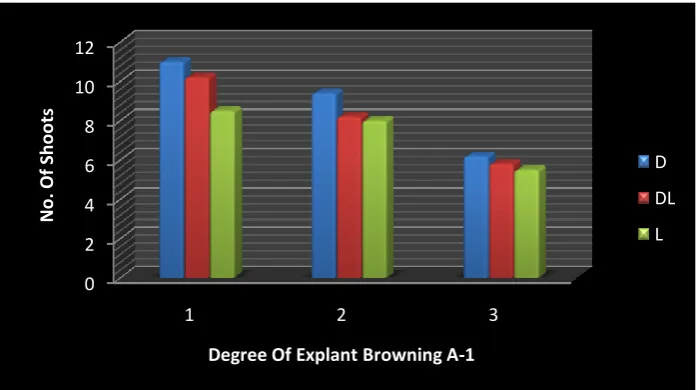
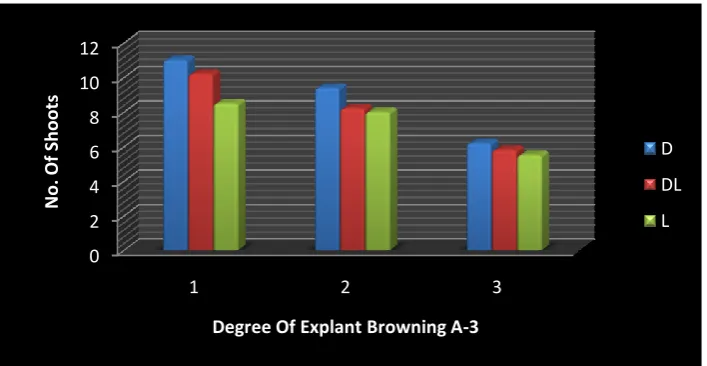
explant became necrotic and die. Number of shoots produced depends on degree of explant browning. The higher degree of explant browning, the lesser number of shoots produced.
At all degree of explant browning, increasing of ascorbic acid concentration could not induced more shoots. In ascorbic acid free media, more shoots produced at all degree of explant browning, especially in darkness for 4 weeks (D). It showed that darkness condition is beneficial for phenolics contents of explant incorporated with the use of an unstable ascorbic acid.
Figure 3.1: Effect of Light Duration and Degree of Explant Browning on Number of Shoots Produced on Media without Ascorbic Acid
Figure 3.2: Effect of Light Duration and Degree of Explant Browning on Number of Shoots Produced on Media with 50mg/l Ascorbic Acid
0 2 4 6 8 10 12
1 2 3
N
o
. Of
Sh
o
o
ts
Degree of Explant Browning A-0
D
DL
L
0 2 4 6 8 10 12
1 2 3
N
o
. Of
Sh
o
o
ts
Degree Of Explant Browning A-1
D
DL
Figure 3.3: Effect of Light Duration and Degree of Explant Browning on Number of Shoots Produced on Media with 100mg/l Ascorbic Acid
Figure 3.4: Effect of Light Duration and Degree of Explant Browning on Number of Shoots Produced on Media with 200mg/l Ascorbic Acid
3.3 Effect of Activated Charcoal and Light Duration on Regeneration of Shoot :
The result showed that explants on activated charcoal-free media (K-0) produced a higher number of shoots than those on media with addition of activated charcoal in concentration of 0.5 gl-1 (K-1), 1 gl-1 (K-2) and 2 gl-1 (K-3)
(Figure 4). Activated charcoal is a strong adsorbent[10]. It adsorbs not only toxic substances, but also nutrients in
media. Use of activated charcoal as an adsorbent was not an appropriate option. The development of a activated charcoal - free media is an alternative.
Figure 4 showed that explant on media with addition of activated charcoal in concentration of 2 gl-1 (K-3) produced more shoots than activated charcoal in concentration 0.5 gl-1 and 1 gl-1. Activated charcoal stimulate
growth and differentiation during culture regeneration[5]. However its addition to regeneration media may have
adverse effects on growth and development as activated charcoal is able to adsorb high concentration of growth
regulators[13]. The non-selective adsorption of growth regulators may result in inhibitory effects of growth in
vitro[14]. It will reduce their effectiveness in tissue culture.
0 2 4 6 8 10 12
1 2 3
N
o
. Of
Sh
o
o
ts
Degree Of Explant Browning A-2
D
DL
L
0 2 4 6 8 10 12
1 2 3
N
o
. Of
Sh
o
o
ts
Degree Of Explant Browning A-3
D
DL
Figure 4: Effect of Activated Charcoal and Light Duration on Number of Shoots
3.4 Effect of Light Duration and Degree of Explant Browning on Number of Shoots Produced by Explant on
Addition of Activated Charcoal Media :
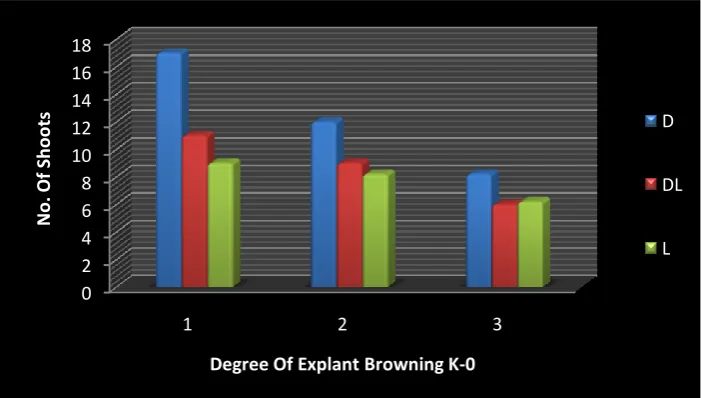
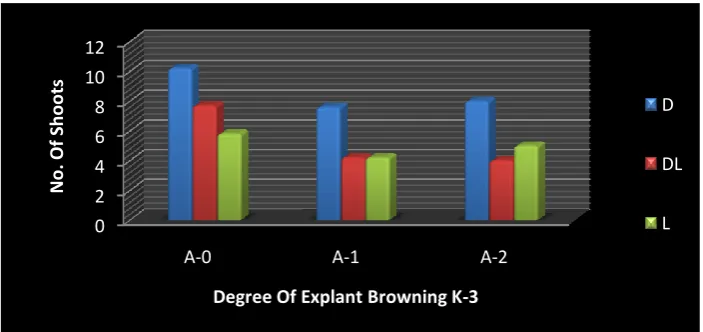
Explants with degree of browning level 1, 2 and 3 on media with addition of activated charcoal produced shoots. Even on free activated charcoal media. No shoots produced by explant with degree of browning level 4 (Figure 5).
The explant became necrotic and die. Number of shoots produced depends on degree of explant browning. The higher degree of explant browning, the lesser number of shoots produced.
In producing number of shoot, there is a big difference between explant on activated charcoal free media and media with addition of activated charcoal. In all degree of explant browning, increasing of activated charcoal concentration could not induced more shoots. Combination of BAP and IAA was crucial for shoot regeneration. It showed that degree of explant browning incorporated with adsorption properties of activated charcoal result in variations in plant growth regulator levels in media.
Figure 5.1: Effect of Light Duration and Degree of Explants Browning on Number of Shoots Produced by Explants in Activated Charcoal Free Medium
0 2 4 6 8
A-0 A-1 A-2 A-3
N
o
. Of
Sh
o
o
ts
Media
D
DL
L
0 2 4 6 8 10 12 14 16 18
1 2 3
N
o
. Of
Sh
o
o
ts
Degree Of Explant Browning K-0
D
DL
Figure 5.2: Effect of Light Duration and Degree of Explants Browning on Number of Shoots Produced by Explants on Addition of 0.5 g/L of Activated Charcoal
Figure 5.3: Effect of Light Duration and Degree of Explants Browning on Number of Shoots Produced by Explants on Addition of 1g/L of Activated Charcoal
Figure 5.4: Effect of Light Duration and Degree of Explant Browning on Number of Shoots Produced by Explant on Addition of 2g/l of Activated Charcoal
0 5 10 15 20
1 2 3
N
o
. Of
Sh
o
o
ts
Degree Of Explant Browning K-1
D
DL
L
0 2 4 6 8 10 12
A-0 A-1 A-2
N
o
. Of
Sh
o
o
ts
Degree Of Explant Browning K-2
D
DL
L
0 2 4 6 8 10 12
A-0 A-1 A-2
N
o
. Of
Sh
o
o
ts
Degree Of Explant Browning K-3
D
DL
regeneration shoot than light condition. The optimal collaboration of a dark incubation period together with growth regulator hormone increased regeneration shoot. Although light may be essential for plant development, darkness is also beneficial for plant morphogenesis, mainly at its initial stage of development in vitro. Degree of explant browning greatly affects shoot regeneration. The higher degree of explant browning the lesser number of shoots produced.
ACKNOWLEDGEMENT
I express my heartfelt thanks and sincere gratitude to my guide Dr. Anita Paul, Head of The Department of Biotechnology, Bengal College of Engineering & Technology, Durgapur, West Bengal, for her immense support, guidance and direction through valuable suggestions along with the enthusiastic encouragement providing me through out the entire period of this work.
Last but not the least I would like to thank my parents for their constant support and encouragement in bringing this work to the present form.
REFERENCES
[1] J. J. North, P.A. Ndakidemi & C.P. Laubscher. 2010. The potential of developing an in vitro method for propagating Strelitziaceae. African
Journal of Biotechnology 9(45): 7583--7588.
[2] R. L. M. Pierik. 1987. In vitro culture of higher plant. Martinus Nijhoff Publishers, Dordrecht: v + 344 pp.
[3] M. Ziv & A.H. Halevy.1983. Control of oxidative browning and in vitro propagation of Strelitziareginae.
[4] H. Laukkanen, H. Haggman, S. Kontunen-Scoppia & A. Hohtola. 1999. Tissue browning of in vitro culture of Scot pine: Role of peroxidase
and polyphenol oxidase. Physiological Plantarum 106: 337--343.
[5] N. M. C. Nayanakantha, B.R. Singh & A. Kumar. 2010. Improved culture medium for micropropagation of
[6] R. Abdelwahd, N. Hakam, M. Labhilili & S.M. Udupa. 2008. Use of an adsorbent and antioxidants to reduce the effects of leached phenolics
in in vitro plantlet regeneration of faba bean. African Journal of Biotechnology 7(8): 997--1002.
[7] N. Babbar, H.S. Oberoi, D.S. Uppal & R.T. Patil. 2010. Total phenolic content and antioxidant capacity of extracts obtained from six
important fruit residues. Food Research International 44: 391--396.
[8] N. Smirnoff. 1996. The function and metabolism of ascorbic acid in plants. Annals of Botany 78: 661--669.
[9] W. H. Ko, C.C. Su, C.L. Chen & C.P. Chao. 2009. Control of lethal browning of tissue culture planlets of Cavendish banana cv. Formosana
with ascorbic acid. Plant Cell Tissue Organ Culture 96: 137--141.
[10] Bin Zhou, Xinfang Wei, Rongting Wang & Jingming Jia. 2010. Quantification of the enzymatic browning and secondary metabolites in the
callus culture system of Nigella glandulifera Freynet Sint. Asian Journal of traditional medicines 5(3):109--116.
[11] A. M. Makara, P.R. Rubaihayo & M.J.S. Magambo. 2010. Carry-over effect of Thidiazuron on banana in vitro proliferation at different culture
cycles and light incubation conditions. African Journal of Biotechnology 9(21): 3079--3085.
[12] H. W. Elmore, B. Samples, S. Sharma & M. Harrison. 1990. Influence of cultural and physiochemical factors on ascorbate stability in plant
tissue culture media. Plant Cell, Tissue and Organ Culture 20: 131--135.
[13] S. C. Fernando, E.S. Santha & D.J.A. Hewarathna. 2010. Activated coconut shell charcoal as a component of tissue culture media of Cocos
nucifera L. Journal National Science Foundation Sri Lanka 38(3): 181--185.