Identification of a Regulatory Transposon That Controls the
Mutator
Transposable Element System in Maize
Paul Chomet,*” Damon Lisch,* Kristine J. Hardeman: Vicki L. Chandler? and Michael Freeling*
*Deflartment of Plant Biology, University of Calqornia, Berkeley, Calqornia 94720,
and tInstitute of Molecular Biology, University of Oregon, Eugene, Oregon 97403
Manuscript received April 16, 199 1
Accepted for publication May 22, 1991
ABSTRACT
The Mutator system of maize consists of more than eight different classes of transposable elements
each of which can be found in multiple copies. All M u elements share the -220-bp terminal inverted repeats, whereas each distinct element class is defined by its unique internal sequences. The regulation of instability of this system has been difficult to elucidate due to its multigenic inheritance. Here we present genetic experiments which demonstrate that there is a single locus, M u R I , which can regulate the transposition of Mu1 elements. We describe the cloning of members of a novel class of Mu elements, MuR, and demonstrate that a member of the class is the regulator of Mutator activity,
M u R I . This conclusion is based on several criteria: MuRl activity and a MuR-homologous restriction
fragment cosegregate; when MuRl undergoes a duplicative transposition, an additional MuR restric- tion fragment is observed, and MuRl activity and the cosegregating MuR fragment are simultaneously lost within clonal somatic sectors. In addition, the MuR element hybridizes to transcripts in plants with Mutator activity. Our genetic experiments demonstrate that the - MuRl transposon is necessary to specify Mutator activity in our lines.
C
ERTAIN lines of maize, called “Mutator lines,” generate a high frequency of mutations (ROB-ERTSON 1978). Mutations arising in Mutator lines often exhibit somatically unstable phenotypes charac- teristic of transposable element-induced alleles. The molecular characterization of Mutator induced muta- tions at A d h l , B r l , A1 and other loci, has established that transposable elements, called Mu transposons, are likely to cause the high rate of mutation (STROMMER et al. 1982; TAYLOR, CHANDLER and WALBOT 1986; O’REILLY et al. 1985).
Nine different classes of
Mu
transposons have been distinguished on the basis of the sequence heteroge- neity within the element (BARKER et al. 1984; TAYLOR and WALBOT 1987; OISHI and FREELING 1987; TAL-BERT and CHANDLER 1988; TALBERT, PATTERSON and CHANDLER 1989; SCHNABLE, PETERSON and SAEDLER 1989; VARAGONA, FLEENOR and WESSLER 1987; QIN
and ELLINGBOE 1990; V. CHANDLER, unpublished). All classes of
Mu
elements have in common the -220- base pair (bp) terminal inverted repeats, but different classes have distinct unrelated internal sequences. Members within the same class share a strong se- quence homology throughout the internal regions ofthe elements. Furthermore, the described classes can exist in multiple, heterogeneous copies and all ele- ments shown to be capable of transposition generate
Connecticut 06340. ’ Present address: Dekalb Plant Genetics, Eastern Point Rd., Groton,
Genetics 149: 261-270 (September, 1991)
a 9-bp genomic duplication upon insertion (BARKER et al. 1984; CHEN et al. 1987; SCHNABLE, PETERSON and SAEDLER 1989). At least six different elements representing four classes ( M u l , M u l .
7,
Mul-del, Mu3,Mu7
and Mu8) are capable of transposition (STROM-MER et al. 1982; TAYLOR and WALBOT 1987; OISHI and FREELING 1987; HARDEMAN and CHANDLER
1989). The other four classes (Mu4, Mu5, Mu6 and M u A ) have been identified by their DNA homology to the common -220-bp inverted terminal repeats (TALBERT, PATTERSON and CHANDLER 1989; QIN and ELLINGBOE 1990; V. L. CHANDLER, unpublished). At least a few sequences characteristic of each class of element are found in most non-Mutator standard inbred lines of maize (CHANDLER, RIVIN and WALBOT
1986; TALBERT, PATTERSON and CHANDLER 1989; V. L. CHANDLER unpublished data). To date there is no evidence that any of these characterized
Mu
elements encode a transposase (LILLIS, SPIELMANN and SIMPSON 1985; ALLEMAN and FREELING 1986; see TALBERT, PATTERSON and CHANDLER 1989 for discussion), al- though, recently a MuA element has been shown to be homologous to a transcript associated with Mutator activity (QIN and ELLINCBOE 1990).the ends of M u transposons become methylated (CHANDLER and WALBOT 1986; BENNETZEN 1987; BENNETZEN, BROWN and SPRINGER 1988). Third, ex- trachromosomal M u circles associated with Mutator activity are not detectable (SUNDARESAN and FREEL- ING 1987). Finally, a reporter allele that is normally suppressed by Mutator activity and expresses a mutant phenotype, expresses the wild-type phenotype in M u - inactive lines (MARTIENSSEN et al. 1990). In some, but not all cases, the loss of Mutator activity can be re- versed by crossing to Mutator-active plants (ROBERT- SON et al. 1985; BENNETZEN 1987; WALBOT 1986).
ROBERTSON and STINARD (1989) reported an un- usual Mutator stock where the control of M u 1 excision segregated 1 : 1 in a testcross, suggesting the presence of a single regulator locus. Using a similar line con- structed independently in this laboratory we have identified a M u transposon with regulatory activity and designated it Mu-Regulator1 ( M u R I ) . We have demonstrated that this gene is itself a transposon and is necessary to confer activity on different classes of M u elements (this report; P. CHOMET, D. LISCH and M. FREELING, unpublished data).
We have identified and cloned two members of a new class of M u elements that have not been described before. These elements have the M u terminal inverted repeats, and hybridize with the M u 5 element's ex- tended terminal repeats. However, their internal se- quences do not hybridize with those of M u l , M u l . 7 , M u 3 , M u 4 , M u 5 , M u 6 , M u 7 or M u 8 . In this paper we demonstrate that a member of this new class of M u elements is the M u R l transposon, a regulator for the multiclass Mutator system. In addition, we show that the M u R elements are homologous to two transcripts present in plants carrying M u R I .
MATERIALS AND METHODS
Maize lines: The al-mum2 allele was originally isolated by D. S. ROBERTSON and the line containing al-mum2 in this study was originally obtained from S. DELLAPORTA. T h e a l - dt sh2 tester line was obtained from B. MCCLINTOCK. The
al-dt allele has a stable, colorless phenotype in the absence of Dt. All lines used in this report lacked the Dt element and
for this reason we simply refer to the a-dt allele as a l .
insertion in the shl gene.
Nucleic acid samples: Maize DNA from leaves was puri- fied according to CONE (1989). RNA was isolated from leaves and immature ears by the guanidinium thiocyanate method and the sodium dodecyl sulfate (SDS) method (Au- SUBEL et al. 1987). Plasmids containing M u l , M u l . 7 , M u 4
and M u 5 probes were previously described (TALBERT, PAT- TERSON and CHANDLER 1989). A plasmid containing the
M u 3 element was obtained from K. OISHI and a plasmid containing M u 8 was obtained from S. WESSLER. Internal fragments of the Mu6 and Mu7 elements were from D. TURKS. T h e actin probe was obtained from R. MEACHER (MEACHER et al. 1983). A KfnI fragment from the 5' end of the A 1 gene was obtained from J. BROWN (O'REILLY et al. 1985).
Cloning: An -8.5-kb sequence from the shl-A83 allele was cloned by ligating size-fractionated BclI-digested maize DNA into the BamHI site of the XBv2 vector (obtained from N. MURRAY, University of Edinburgh). After in vitro pack- aging (HOHN 1979), the phage were plated and screened (BENTON and DAVIS 1977) using a S h l clone, p17.6, ob- tained from C. HANNAH. An 8-kb PstI fragment containing the entire M u insertion, shl sequences, and -1.8 kb of the X vector was subcloned into a pTZl8 vector (United States Biochemical). The site of insertion of the element in the shl
allele was determined by sequencing the two SstI fragments (subcloned into a pTZ 18 vector) which contained homology to both the Mu-termini and S h l . Both strands were se- quenced by the dideoxy chain termination method (SANGER, NICKLEN and COULSEN 1977) using the 17-mer universal primer (Pharmacia). An internal EcoRI-BamHI fragment of the element at shl-A83 was designated Mu*.
A BclI clone containing most of the M u R l element was
obtained by size-fractionating BclI digested DNA from a plant carrying M u R l . This DNA was ligated into the BamHI
site of XEMBLS (purchased from Stratagene Inc.). The phage were in vitro packaged, plated and screened using the Mu* probe. A clone carrying the MuRl-diagnostic 1.4- kb internal XbaI fragment was restriction mapped further.
Southern and Northern blot hybridizations: Maize DNA was digested for 4 hr with a fourfold excess of restriction enzymes (conditions according to suppliers), electrophoret- ically separated through agarose gels, blotted to Duralon
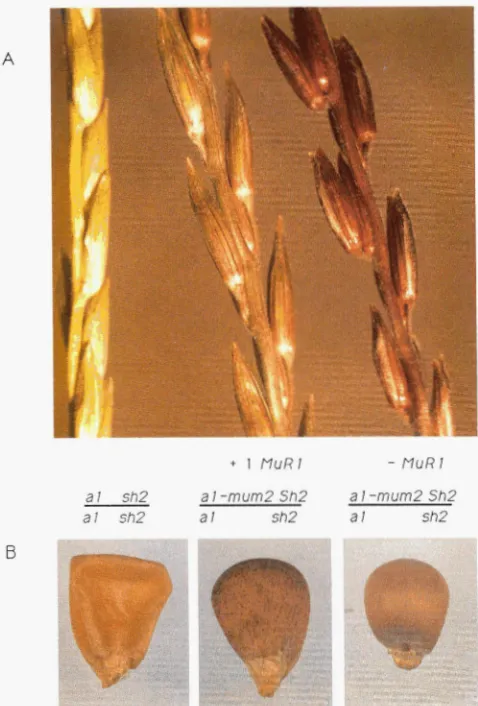
FIGURE 1.-Tassel branch (A) and seed phe- notypes (B) of the al-mum2 allele in the presence and absence of M u R l . Plants carrying M u R l show small red clonal sectors of tissue on a green back- ground. Plants lacking M u R l express red antho- cyanin color (the intensity of red is dependent on genetic background). The suppression of the a l -
mum2 allele is not readily apparent in the aleurone layer of the kernels. The genotypes of the plants and seeds shown are listed between each structure, respectively.
tured salmon sperm DNA, and 10% sarcosine and hybrid- ized in the same solution with the denatured probe for 6- 12 hr. The filters were washed in 0.2 X SSPE, 0.1 % SDS at 65" for 1.5 hr with three wash changes and exposed to Kodak X-Omat film with a Du Pont Cronex Lightning-Plus intensifying screen at -80" for varying lengths of time.
RESULTS
Mutator activity is controlled by the
MuRl
trans- posable element: T o detect Mutator regulatory activ-ity we used al-mum2, an allele of the anthocyanin- conditioning gene A I . This mutant allele contains a MuZ insertion in the 5' promoter region of the AI gene (O'REILLY et al. 1985). In the absence of Mutator activity this allele produces a pale colored (nonspotted) seed, whereas in the presence of Mutator activity, the allele produces a spotted phenotype (Figure 1B). T o independently follow the segregation of the chromo-
some containing the reporter allele it was linked to Shrunken2 (Sh2) which produces plump kernels. The recessive allele, sh2, was linked to a stable recessive a1 allele in the non-Mutator tester stock (see MATERIALS AND METHODS for a further description of this allele).
AI and Sh2 are closely linked with only 0.2% recom- bination.
Testcrosses (as shown in MATERIALS AND METHODS)
generated ears segregating 50% spotted, plump ker- nels and 50% nonspotted, plump kernels, thereby defining a locus ( M u R I ) which regulated somatic Mu- tator activity. Most ears from crosses of this type segregated for MuRI over a five generation period. Table 1 gives data for two consecutive generations of such crosses. These results suggested the presence of a single locus which was unlinked to al-mum2, and was responsible for somatic excision of M u l .
994-7 994-8 994-9 994-9 994-1 0
994-1 0 1277-2 1277-2 1277-1 1
1277-14 1277-14 1277-17 1277-20
M F
F M
F M F
M F F M
F M
39 45 24 17 51 67 55 61 65 70 59 54 94 61 61 50 74 74 87 65 107 85 110 113
98 103
0.429 1.195 2. I69 0.310 0.185 0.221 7.026' 1.090 0.000 3.184 3.000 0.040 0.124 MuRl carrying parent was used as either a male (M) or female
'
Fars with a significantly different x' value at the 0.05 level for (F) in the cross as outlined in MATERIALS AND METHODS. the segregation of one MuRl element.of A1 expression mediated by the Mu1 element inser- tion in al-mum2. In plants lacking M u R l activity (as assayed by nonspotted seed) we observed a strong red pigmentation in a variety of tissues whereas plants carrying M u R l expressed a mutable pattern of red somatic sectors over a green background (Figure 1 A).
A new M u transposon sequence identifies the M u R l locus: Most transposon systems are character- ized by a regulatory element that encodes a transpos- ase. In general, the regulatory elements are larger than their defective derivatives. At the time this study was initiated, the characterized M u elements ranged in size from 1 to
2
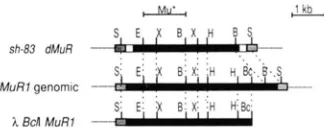
kilobases (kb). Thus, we were interested in characterizing several larger M u inser- tions (4-5 kb) at the Shrunkenl ( S h l ) locus that were potential candidates for regulatory elements based on their size. A description of the stocks and mutant isolation is outlined in MATERIALS AND METHODS.Southern blot analyses were used to map the inser- tions relative to Shl restrictions sites. We cloned one insertion ( s h l - A 8 3 ) and a restriction map of this ele- ment is shown in Figure
2.
This insertion hybridized to the Mu1 terminal repeat probe indicating that this new insertion is a member of the Mutator family. Furthermore, two fragments near the ends of the insertion had homology to the 138-bp extended in- verted repeats of Mu5 (TALBERT, PATTERSON and CHANDLER 1989). T h e insertion failed to hybridizeelement were directly compared on the same agarose gel. The genomic restriction map of MuRl was generated from southern blots o f complete digests of genomic DNA. Dashed lines between the maps indicate the shared restriction sites and their positions. The nine bp target site duplication o f Shl sequence caused by the dMuR element is: AGAGAAACC, which includes the Sh1 transcrip- tion start site (WERR et al. 1985). The restriction enzyme sites are abbreviated as follows: B, BamHl; Bc, Bcll; E, EcoRl; H, Hindlll; S, Sstl; X , Xbal.
with the complete internal probes for the M u l , M u l . 7 , Mu3, Mu4 and M u 8 classes of elements. It also failed to hybridize to small internal probes of Mu6 and Mu7. However, as our Mu6 and Mu7 specific probes do not represent the entire internal sequences of these ele- ments we can not completely eliminate the possibility of limited sequence homology between the new ele- ment and Mu6 or M u 7 .
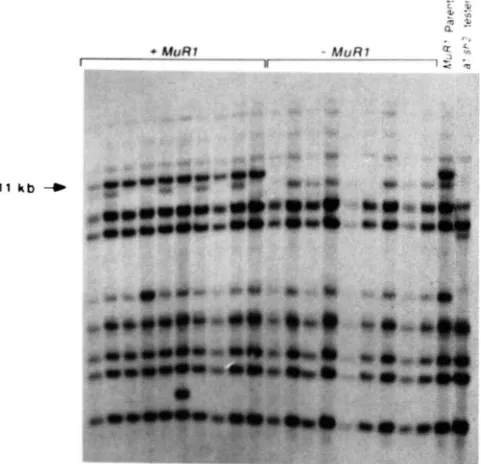
&segregation of the M u R l locus with a DNA fragment homologous to the new Mu transposon: To determine whether the new M u transposon might
11 k b
+
4 4
4
FIGURE 3.--Southern blot analysis of DNA from plants segregat- ing for MuRI activity. D N A from plants containing (+MuRI) and lacking (-MuRI) was digested with HindIII, electrophoretically separated on a 0.8% agarose gel, blotted and hybridized to the Mu* probe. An 1 1-kb fragment (marked by an arrow) is present only in samples from MuRI-containing plants.
homologous fragment cosegregated with M u R I . Duplicative transposition of
MuRZ
was associated with duplication of aM u *
hybridizing fragment: Typically, most crosses of plants segregating for a single M u R l locus gave rise to mutable kernels which showed similar frequencies of spotting. However, in some testcrosses, including those in which plant 994-1 was the Mutator male parent, an excess of spotted, plump kernels was observed (Tables 1 and 2) and approximately half of the spotted kernels were more frequently sectored. Previous observations indicated that increased copies of M u R l in the endosperm pro- duced an increase in the density of the al-mum2 mediated spotting pattern in these lines (P. CHOMET, D. LISCH and M. FREELING, unpublished). We rea- soned that the increased spotting in the progeny of
plant 994-1 was due to an increase in MuRI copy number. Fertilization by the gametes containing two MuRI copies would be initially detected by a frequent spotting pattern in the endosperm. The unusually high proportion of spotted, plump kernels might have resulted from a premeiotic duplicative transposition
of MuRI during tassel development of plant 994-1, as this was observed in only the male transmitted ga- metes of the plant (Table l).
To test this hypothesis, plants were grown from these heavily spotted kernels and testcrossed with a1 sh2 plants. Ears resulting from these crosses (1 176A family) often segregated 3 spotted:l nonspotted, plump kernels consistent with the presence of a second nonlinked regulator gene. Sibling plants grown from
TABLE 2
MuRl segregation showing copy number changes
No. Sh2 kernels MuRI
Plant No. parent" Mutable Pale MuRl*
No.
994- 1 F 85 75 1
994-1' M 68 34 2
1 176A-1 F 5 98
1 176A-2 F 93 36 2
1 176A-2' M 8 9 13 3
1 176A-3 F 97 20 3
1 176A-4 F 69 20 2
1176B-1 F 64 63 1
1176B-2 F 56 56 1
d
-
1 1 7 6 E 3 F 70 62 1
1 176B-4 F 30 40 1
8A-1 F 37 23 1
8A-1 M 35 65
8A-2 F 71 8 3
8A-3 F 94 24 2
8A-3 M 73 29 2
8A-6 F 43 2 0 2
8A-6 M 6 6 19 2
8A-7 M 75 30 2
8B- 1 F 55 42 1
8B- 1 M 57 55 1
8B-4 M 40 76
d
-
d
8B-6 F 38 41 1
8B-6 M 48 43 1
8B-7 F 49 44 1
-
8 B-7 M 56 43 1
a MuRI carrying parent was used as either a male (M) or female
(F) in the cross as outlined in MATERIALS AND METHODS.
'
Minimum number of independently segregating MuRl to ob- tain a nonsignificant x* value at the 0.05 level.' Plant 994-1 M was the MuRl parent for family 1 176. Family 1 176 individuals marked A arose from heavily spotted kernels, and individuals marked with a B arose from medium spotted kernels.
The observed ratio is significantly different at the 0.05 signifi- cance level from the expected ratios for all possible numbers of
independently segregating MuRI.
' Plant 1176A-2M was the MuRl parent for family 8. Family 8 individuals marked A arose from heavily spotted kernels and indi- viduals marked with a B arose from medium spotted kernels.
kernels displaying medium spot densities all continued to segregate 1 spotted:l nonspotted plump kernels (Table
2,
1 176B family). From the data presented in Table 1, we can also infer that a germinal duplicative transposition event to an unlinked site occurred in approximately 20% of the plants which originally carried one MuRI element.4-4.5 kb
4.5 kb
1
FIGURE 4.-Identification of a unique Mu* hybridizing fragmentafter duplicative transposition of M u R I . DNA from plants with either two MuRI copies (plants 8A-3 and 8A-6), one M u R l copy (plants 8B-1, 8B-6 and 8B-7). or zero M u R l copies (a1 sh2 tester line) was digested with HindIII. electrophoretically separated on a 0.8% agarose gel, blotted and hybridized to the Mu* probe. See Table 2 for genetic analyses of these plants. The open arrow points
a t the new 4.5-kb fragment found in both DNA samples from plants carrying two M u R l copies and in plants 8B-1 and 8B-6 which has one M u R l element. The closed arrow indicates the original 1 1-kb band.
tester (known to genetically lack Mutator activity). In all the testcross progeny deduced to carry two MuRI genes by genetic analysis, a unique 4.5-kb fragment was detected (Figure 4; hollow arrow) in addition to the original 11 kb fragment and the other Mu*- homologous fragments. This new 4.5-kb fragment was not present in the 994 family (data not shown). In progeny plants segregating for only one element, either the original 1 1-kb or the new 4.5-kb band was present, but not both (Figure 4).
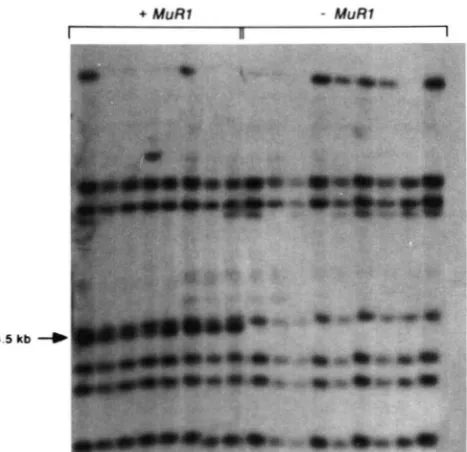
If the new 4.5-kb fragment was derived from a duplication of the original MuRI locus, it too should confer M u R l genetic activity. Progeny analysis of 40 individuals from a plant carrying only the 4.5-kb Mu*- homologous fragment (plant 8B-6) showed that this fragment cosegregated with MuRI activity as was pre- viously shown for the 1 1-kb fragment. A subset of this segregating population is shown in Figure 5. There- fore, either the original (1 1-kb HindIII) or the newly transposed (4.5-kb HindIII) MuRI gene was sufficient to confer somatic excision activity to M u l . Taken together these results demonstrate that the Mu* probe is homologous to a regulatory element, M u R I , which is itself a transposable element. Furthermore, one MuRI transposon, independent of its chromo- somal location, is necessary to encode Mutator activ-
ity. We will refer to the transposable element w e
FIGURE .5.-.l'he novel 4..5-kI> M u * hybr-idizing fragment co- segregates with MuRl activity. DNA from MuRl-segreg;lting prog- eny of a plant carrying the new 4.5-kb fragment (8B-6) was digested with Hindlll, electrophoretically separated on a 1.0% agarose gel, blotted and hybridized to the Mu* probe. The arrow points at the segregating 4.5-kb fragment.
cloned from shl-A83 as a derivative of M u R ( d M u R ) . We cloned a BcZI fragment containing most of a M u R l element from a line which segregated for a single element. Restriction analysis comparing MuRI in the BclI clone, the d M u R element at Shl and a proposed genomic restriction map of MuRI is shown in Figure 2. Genomic mapping data indicated that in our segregating lines the MuRI element had unique internal restriction fragments that were not shared by other M u R homologous sequences, such as a 1.4-kb XbaI and a 1.9-kb EcoRI-Hind111 fragment (see Figure
2).
As shown by the restriction map, the M u R l clone contains all such restriction sites so far examined. Interestingly, restriction analysis of the d M u R ele- ment, cloned from an unrelated Mutator line, dem- onstrated that it is very similar to MuR1 except for a putative deletion of approximately 0.9 kb near one end of the element. This region encompasses the BcZI and one of the HindIII sites found in M u R I . T h e 1.4- kb XbaI and a 1.9-kb EcoRI-Hind111 internal frag- ments are unique only in our M u R l segregating lines and are not likely unique in other unrelated Mutator lines since the sh-83dMuR element contains these re- striction fragments.Control of the Mutator System 267
-
!.l kb") Yyr
. ..
B
7 kb
Hind I I I
Mu'
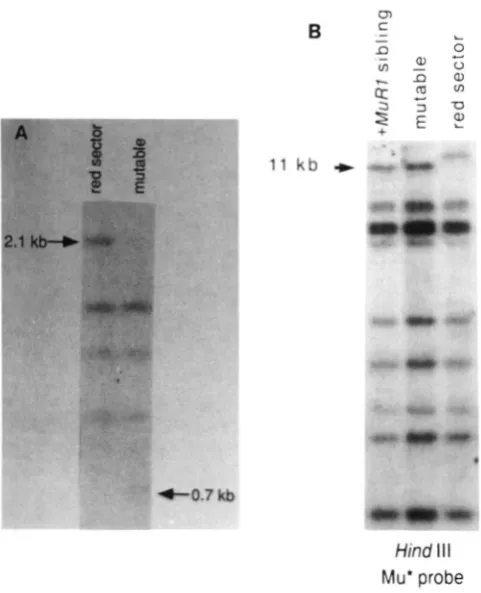
probeFIGURE 6.-Loss of MuRI activity in a somatic sector correlates with the loss of the 1 I-kb MuRI fragment. DNA was prepared from
a red sector of sheath tissue (red sector) and an adjoining region of tissue which still showed MuRl activity (mutable). With the red sector, efforts were made to remove the nonpigmented tissue before isolating DNA. Panel A shows a Southern blot hybridized to the A I probe of the DNA samples digested with HinfI, a methylation sensitive enzyme. The 2.1-kb fragment represents the entire Mu1 element methylated at the Hinfl sites and flanked by A I sequence. T h e 0.7-kb fragment represents complete digestion at the Hinfl site in the Mu1 terminal inverted repeat. The other A I hybridizing fragments are from regions outside of the Mu1 insertion in a1- mum2 and from the other allele and are found in both samples. Panel B is a Southern analysis of a different but comparable sector. The DNA was digested with HindIII, electrophoretically separated on a 0.8% gel, and hybridized to the Mu* probe. The 1 I-kb MuRI fragment (marked by the arrow) is present in the sample from the mutable tissue but is absent in the DNA from the red sector. An additional, larger MuR-homologous fragment is detected in the red sector.
plants carrying the al-mum2 allele but lacking MuRI (Figure 1) and (2) HinfI digestion of the DNA from tissue of many independent sectors revealed the M u 1 element inserted at al-mum2 was methylated in its inverted terminal repeats (Figure 6A). CHANDLER and WALBOT (1 986) and BENNETZEN (1 987) have shown that modification of methylation sensitive sites in M u 1 ends correlates with the lack of Mutator activity. Given that M u R l activity was lacking in these sectors, we investigated what happened to the M u R l fragment in these sectors.
DNA from pale red sectors and adjoining mutable tissue was analyzed by Southern blotting. One exam- ple is shown in Figure 6B. T h e sector was obtained
from a plant that contained the 11-kb HindIII frag- ment. This red sector, which lacked MuRI activity, also lacked the 11-kb fragment. Similar results were obtained from plants which carried the 4.5-kb M u R l fragment. T h e adjoining leaf tissue which continued to show MuR1 activity contained the appropriate HindIII fragment, serving as a control. All the other MuR-homologous fragments appeared in all samples independent of the activity of MuRI with the excep tion of a new M u R hybridizing fragment which ap- peared in the DNA from the red sector. T h e appear- ance of a new fragment has been observed in some, but not all, of the other red sectors examined (data not shown). I t is unclear if this fragment represents an alteration of the original M u R l fragment or is an alteration or duplication of another M u R sequence. Similar results, showing loss of the MuRI-containing fragment, were obtained using several other restric- tion enzymes suggesting the 1 l-kb fragment was lost and not absent due to incomplete digestion of the DNA. Furthermore, Southern analysis of DNA from six independent sectors indicated that the unique,
internal EcoRI-Hind111 fragment of M u R l was lacking in all six red sector samples (data not shown). T h e consistent lack of the M u R l fragment in mutator-loss sectors provides independent conformation that
M u R l is necessary for mutator activity.
Transcripts homologous to
Mu*
are associated withMuRl:
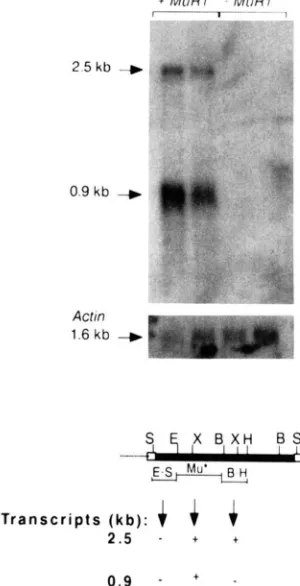
T o determine whether there were tran- scripts homologous to M u R that correlated with both MuRI and Mutator activity in general, we performed Northern blot hybridizations. Figure7
shows the re- sults of hybridization of the Mu* probe to a blot carrying poly(A)+ RNA from four siblings, two con- taining ( + M u R I ) and two lacking M u R I ( - M u R I ) from a population segregating 1 : 1 for M u R I . T w o transcripts, migrating at approximately 2.5 and 0.9 kb were homologous to the Mu* probe, and were present in segregants carrying MuRI only. These tran- scripts may represent a MuRI encoded transcript in- volved in M u R l activity, or represent transcripts from defective M u R elements that are regulated by Mutator activity. We have examined other Mutator-active, Mu- tator-inactive and non-Mutator stocks from diverse backgrounds and found the 2.5-kb transcript and the smaller 0.9-kb transcript in all Mutator-active stocks examined to date (data not shown), supporting the hypothesis that both poly(A)+ RNA species are in- volved in Mutator activity.T r a n s c r i p t s ( k b ) :
4 4
4
2 . 5 ~ + t0.9
-
'
.FIGURE 7.-ldentification of Mu*-homologous transcripts asso- ciated with Mutator activity. A sample of 1 pg of poly(A)+ R N A
from immature ears of MuRI containing (+MuRI lanes) and MuRI
lacking (-MuRI lanes) plants was separated on a 1 % formaldehyde agarose gel and hybridized to the Mu* probe. The 2.5-kb and 0.9- kb RNA species are indicated by arrows. The Mu* probe was washed off the membrane (according to the manufacturer) and the blot was hybridized with the maize Actin probe (lower panel) to
show each lane contained approximately equal amounts of intact RNA. Distinct restriction fragments of dMuR were used as probes
to additional Northern blots and the results are summarized in the diagram below the blot. A
"+"
indicates that the particular restric- tion fragment probe detected the indicated transcript. A "-" indi- cates no signal was detected.hybridization signal on Northern blots was detected with the Mu E-S probe. Therefore, it is likely that the 0.9-kb transcriptional unit is contained within the limits of the Mu* sequence and that the 2.5-kb tran- scriptional unit extends to the right side of that se- quence.
DISCUSSION
A member of a previously unidentified class of M u elements was cloned from a Mu-induced shrunken1 allele. We have shown that this 4.0 kb element molec- ularly identifies the genetically characterized MuRI element, which regulates the activity of M u elements. There are multiple fragments homologous to MuRI in all maize plants examined, even plants lacking MuRI or Mutator activity. T h e 4.0-kb element cloned from shl-A83 appears to be incomplete, as a restriction analysis comparison between this dMuR and M u R l
tionships.
Mutator-active stocks contain MuR-homologous transcripts that are absent in non-Mutator and Muta- tor-inactive stocks. Presence of these transcripts cor- relates with MuRI activity. These transcripts do not hybridize with the M u termini, and are therefore unlikely to result from the simple readthrough from a gene into an endogenous dMuR element. Thus, our working hypothesis is that one or both of these tran- scripts encodes a product involved in Mutator activity. Isolation and characterization of these transcripts should reveal clues as to their role in Mutator activity.
Unlike other two-element systems in maize, each of which usually segregate for a single regulatory ele- ment, ROBERTSON'S Mutator system does so only very rarely. Upon outcrossing, most progeny from a Mu- tator plant receive Mutator activity. T o explain the unusual segregation, ROBERTSON (1978) and BEN-
NETZEN (1984) suggested that multiple copies of a
regulatory element would have to exist and such c o p ies would have to undergo premeiotic amplification to be passed on to most progeny. Although Mu1 transposons behave according to these expectations (ALLEMAN and FREELINC 1986), Mu1 does not regu- late the Mu system (LILLIS, SPIELMANN and SIMPSON 1985; P. Chomet, unpublished). Our data show that M u R l does undergo premeiotic duplicative transpo- sition events which result in the increase in MuRI copy number. Although the frequency of duplication we observed may not completely explain the unusual segregation patterns of Mutator activity, it is possible that multiple MuRI elements act synergistically to increase their rate of duplication. This possibility is currently being tested.
Control the System
is likely that these data are not explained simply by meiotic segregation of regulatory elements. We do know that M u R l can functionally replace Mutator activity when Mutator activity was lost via outcrossing (P. CHOMET, D. LISCH and M. FREELING, unpublished data). Furthermore, we show here that inactivity in our lines is primarily due to the lack of the M u R l element, although we do note exceptional plants which give rise to non-mendelian loss of Mutator activity (see Table 2). Therefore, it is possible that genetic loci, such as M u R l , are responsible for the segregation of Mutator activity but the unusual be- haviors may be caused by stable or metastable second- ary modifications (such as DNA methylation) to these regulating loci rendering them functionless.
The simultaneous occurrence of the loss of Mutator activity, the methylation of M u l , and the loss of the M u R l restriction fragment in somatic sectors, suggests that the loss of M u R l is associated with the gain of Mu1 methylation. Furthermore, loss o f M u R l through mendelian segregation is also associated with Mu1 methylation (P. CHOMET, D. LISCH and M. FREELING, unpublished data). One possibility for such results is that Mu1 methylation is the consequence of the loss of M u R l in these instances. It would follow then that Mu1 methylation is the “ground state” in the absence of M u R l activity. By this reasoning, the presence of M u R l product(s) should block Mu1 methylation. A DNA footprint in the Mul-end sequence associated with Mutator activity has been detected (Z. ZHAO and V. SUNDARESAN, personal communication). We sug- gest that M u R l product(s) bind to these protected nucleotides.
The mechanism underlying M u R l loss in somatic sectors is unclear. It is possible that the element was altered or rearranged during the transposition proc- ess. The appearance of a new fragment in some of these sectors would be consistent with such an as- sertion. The new fragment may represent a re- arrangement derivative at the M u R l location or at a new genomic position. In either case, it is likely these new fragments appearing in the red sectors are not complete M u R l elements since analysis of independ- ent sectors indicated that a unique, internal restriction fragment, associated with M u R l , was lacking in the red sectors (data not shown). More detailed analyses to further elucidate these alterations are underway.
Genetic studies on the Cy controlling element sys- tem demonstrated that Cy is a transposable element capable of regulating Mu1 and Mu7 (SCHNABLE and PETERSON 1988; SCHNABLE, PETERSON and SAEDLER
1989). Cy can segregate as a single mendelian element and has been observed to increase its copy number (SCHNABLE and PETERSON 1988). Presumably, this means that Cy is a regulatory element of the Mutator system, functionally analogous to M u R I . Molecular
analyses will demonstrate if the sequence of M u R l is homologous to that of Cy.
Recently, a ninth class of Mutator elements has been described. One member of the family, designated MuA, was cloned and shown to be homologous to a 3.5-kb transcript associated with Mutator activity (QIN and ELLINGBOE 1990). Although no evidence indi- cates that MuA is the autonomous element, it is pos- sible that MuA and M u R l are members of the same class of M u elements, as they have similar but not identical restriction maps. The reason for the discrep- ancy in size between the reported 3.5-kb transcript and the 2.5-kb transcript we observe is not clear. Different electrophoresis conditions and RNA mark- ers might have led to different size estimations. Alter- natively, the two elements may be hybridizing to dif- ferent transcripts. A direct comparison between the two elements will clarify the differences.
The recent insertion of the dMuR element into Shl caused a 9-bp host site direct duplication. All other recently transposed Mutator elements also produced a 9-bp duplication (BARKER et al. 1984; CHEN et al. 1987; SCHNABLE, PETERSON and SAEDLER 1989). Such host site duplications are a common feature of trans- posable elements and the extent of the duplication is specific for each family of interacting elements. Since all elements within a family are under the control of a common transposase, the host-site duplication length is likely a reflection of the shared transposase-me- diated insertion mechanism. This suggests the trans- position of MuR elements, along with the other Mu- tator elements, is controlled by a similar mechanism, likely regulated by M u R l .
Although M u transposons are excellent insertional mutagens in maize, it has been difficult to clone some Mu-induced mutations due to the complexity of the system. The identification of a regulatory element will greatly facilitate the use of the Mutator system as a transposon tag in maize. Furthermore, a demonstra- tion of M u transposition in transgenic systems would prove to be a valuable tool for insertional mutagenesis and cloning in other plants as well. Sequences homol- ogous to MuRI have been detected in other monocots (D. LISCH, unpublished data). An efficient transposon- tagging system for major crops other than maize would be particularly valuable.
We thank Doctor A. BARKAN for her initial observations using the Mu* probe. We thank S. BELCHER, A . CHYTRY, R. LACHMAN-
BENNETZEN, J. L., 1987 Covalent DNA modification and the regulation ofMutator element transposition in maize. Mol. Gen. Genet. 208: 45-5 1.
BENNETZEN, J. L., W. E. BROWN and P. S. SPRINGER, 1988 The state of DNA modification within and flanking maize transpos- able elements, pp. 237-250 in Plant Transposable Elements, edited by 0. NELSON. Plenum Press, New York.
BENTON, W. D., and R. W. DAVIS 1977 Screening Xgt recombi- nant clones by hybridization to single plaques in situ. Science
BURR, B., and F. A. BURR, 1981 Controlling-element events at
CHANDLER, V., C. RIVIN and V. WALBOT, 1986 Stable non-mu- tator stocks of maize have sequences homologous to the Mu1 transposable element. Genetics 1 1 4 1007-21.
CHANDLER, V. L., and V. WALBOT, 1986 DNA modifications of a maize transposable element correlates with loss of activity. Proc. Natl. Acad. Sci. USA 83: 1767-1771.
CHEN, C. H., K. K. OISHI, B. KLOECKENER-GRUISSEM and M.
FREELING, 1987 Organ-Specific Expression of maize Adhl is altered after a Mu transposon insertion. Genetics 1 1 6 469- 477.
CONE, K., 1989 Yet another rapid plant DNA prep. Maize Genet. Coop. Newsl. 63: 68.
DORING, H. P., M. FREELING, S. HAKE, M. A. JOHNS, R. KUNZE, A.
MERCKELBACH, F. SALAMINI and P. STARLINGER, 1984 A Ds-
mutation of the Adhl gene in Zea mays L. Mol. Gen. Genet.
FEDOROFF, N., S. WESSLER and M. SHURE, 1983 Isolation of the transposable maize controlling elements Ac and Ds. Cell 3 5
HARDEMAN, K. J., and V. L. CHANDLER, 1989 Characterization of b z l mutants isolated from mutator stocks with high and low numbers of Mu1 elements. Dev. Genet. 1 0 460-472.
HOHN, B., 1979 In vitro packaging of lambda and cosmid DNA. Methods Enzymol. 68: 299-309.
LILLIS, M., A. SPIELMANN and R. B. SIMPSON, 1985 Transfer of a Robertson’s mutator element to tomato and tobacco cells, pp. 213-224 in Plane Genetics, edited by M. FREELING. Alan R. Liss, New York.
MARTIENSSEN, R., A. BARKAN, W. C. TAYLOR and M. FREELING,
1990 Somatically heritable switches in the DNA modification
of Mu transposable elements monitored with a suppressible mutant in maize. Genes Dev. 4 331-343.
MEAGHER, R. B., R. C. HIGHTOWER, D. M. SHAH and T. MOZER, 1983 Plant actin is encoded by diverse multi-gene families, pp. 17 1-1 87 in Advances in Gene Technology: Molecular Genetics of Plants and Animals, edited by K. DOWNEY, R. VOELLMEY, F. AHMAD and J. SHULTZ. Academic Press, New York.
OISHI, K., and M. FREELING, 1987 A new Mu element from a Robertson’s Mutator line, pp. 289-291 in Plant Transposable Elements, edited by 0. NELSON. Plenum Press, New York. 1 9 6 180-182.
the Shrunken locus in maize. Genetics 98: 143-156.
193: 199-204.
235-242.
Mutator-induced aleurone mutants of maize. Dev. Genet. 1 0 482-506.
ROBERTSON, D. S., P. S. STINARD, J. G. WHEELER and D. W. MORRIS, 1985 Genetic and molecular studies on germinal and somatic instability in Mutator-induced aleurone mutants of maize, pp. 3 17-33 1 in Plant Genetics, edited by M. FREELING. Alan R. Liss, New York.
SACHS, M. M., W. J. PEACOCK, E. S. DENNIS and W. L. GERLACH, 1983 Maize Ac-Ds controlling elements-a molecular view- point. Maydica 28: 289-301.
SANGER, F., S. NICKLEN and A. R. COULSEN, 1977 DNA sequenc- ing with chain terminating inhibitors. Proc. Natl. Acad. Sci. USA 7 4 5463-5467.
SCHNABLE, P. S., and P. A. PETERSON, 1988 The Mutator-related Cy transposable element of Zea mays L. behaves as a near- Mendelian factor. Genetics 1 2 0 587-596.
SCHNABLE, P. S., P. A. PETERSON and H. SAEDLER, 1989 The bz-rcy allele of the Cy transposable element system of Zea mays contains a Mu-like element insertion. Mol. Gen. Genet. 217:
STROMMER, J. N., S. HAKE, J. L. BENNETZEN, W. C. TAYLOR and M. FREELING, 1982 Regulatory mutants of the maize Adhl gene caused by DNA insertions. Nature 3 0 0 542-544. SUNDARESAN, V., and M. FREELING, 1987 An extrachromosomal
form of the Mu transposon in maize. Proc. Natl. Acad. Sci.
TALBERT, L. E., and V. L. CHANDLER, 1988 Characterization of a highly conserved sequence related to Mutator transposable elements in maize. Mol. Biol. Evol. 5: 519-529.
TALBERT, L. E., G. I. PATTERSON and V. CHANDLER, 1989 Mu transposable elements are structurally diverse and distributed throughout the genus Zea. J. Mol. Evol. 2 9 28-39.
TAYLOR, L. P., V. L. CHANDLER and V. WALBOT, 1986 Insertion of 1.4 kb Mu elements into the bronze1 gene of Zea mays L. Maydica 31: 31-45.
TAYLOR, L. P., and V. WALBOT, 1987 Isolation and characteriza- tion of a 1.7-kb transposable element from a mutator line of
maize. Genetics 117: 297-307.
VARAGONA, M., D. FLEENOR and S. R. WESSLER, 1987 Unique Ds and Mu elements inserted in exons of the Waxy gene, pp. 38 1 in Plant Transposable Elements, edited by 0. NELSON. Plenum Press, New York.
WALBOT, V., 1986 Inheritance of Mutator activity in Zea mays as assayed by somatic instability of the bz2-mu1 allele. Genetics
WALBOT, V., and C. WARREN, 1988 Regulation of Mu element copy number in maize lines with an active or inactive Mutator transposable element system. Mol. Gen. Genet. 211: 27-34.
WERR, W., W. B. FROMMER, C. MAAS and P. STARLINGER,
‘1 985 Structure of the sucrose synthase gene on chromosome 9 ofZea mays L. EMBO J. 4: 1373-1380.
459-463.
USA 8 4 4924-4928.
114: 1293-1312.