Copyright to IJIRSET www.ijirset.com 9034
Space Vector Pulse Density Modulation
Scheme For Multilevel Inverter With 18-sided
Polygonal Voltage Space Vector
Anilett Benny
1, Dr.T. Ruban Deva Prakash
2PG Student, Sree Narayana Gurukulam College of Engineering, Kadayiruppu, Kerala, India1 Professor, Sree Narayana Gurukulam College of Engineering, Kadayiruppu, Kerala, India2
Abstract: Space Vector Based Pulse Density Modulated scheme for multilevel inverter is proposed in this paper. A two level and three level inverters with three different DC input voltages are used to produce 18 stepped output sinusoidal voltage. First order sigma delta modulator is used to obtain Pulse Density Modulation. The vector space is divided into 18 segments for spatial quantization. Sixty degree co-ordinate system is used to avoid fractional arithmetic. The proposed scheme uses only switching vectors which lie on the vertices of 18 sided polygon. The scheme uses only sector identification for selecting the switching vectors without using lookup table and timer. The proposed scheme with 18 sided polygonal multilevel inverter results in elimination of 5th, 7th, 11th and 13th order harmonics when compared to two level inverter schemes. Simulation results of the proposed scheme are compared with that of two level inverter schemes. From the results, the total harmonic distortion (THD) of the output voltage of SVPDM based 2-level inverter is 31.13% and the 18-sided multilevel inverter with SVPDM is 10.11%. From the results, the validity of the SVPDM based 18-sided multilevel inverter has been confirmed. Zero voltage switching can be incorporated in future for achieving high efficiency.
Keywords: Space vector pulse density modulation, multi-level inverter, two level inverter, harmonics, sigma delta modulator.
I. INTRODUCTION
Pulse density modulation (PDM) control method is applied in order to reduce the switching loss of the inverter side. In this method the density and the plus/minus of the constant width pulse is controlled, and then these pulse signals are used as switching pulses [5]. In general, delta-sigma conversion is used for analog-digital conversion. These PDM signals are used to turn on/off the inverter arm in PDM inverters. Delta-sigma conversion generates the inverse voltage pulses in order to cancel the quantization error. In order to resolve this problem, the PDM based SVM is proposed [6]. In PDM based SVM, the phase error between the voltage and current does not occur rapidly, because the SVM controller can select the switching pattern and hence the phase change on the voltage becomes smaller. Space vector based pulse density modulation (SVPDM) is proposed for two-level inverters. The total harmonic distortion in 2-level inverter is large.
Multilevel inverters have become more superior to conventional two level voltage inverters [1][2]. Different topologies of multilevel inverters are explained in literature [3], [7], [10]. SVPWM is commonly used [8] for generating switching pulses where the switching losses are more. Hence we propose SVPDM for multilevel inverter. Pulse density modulation scheme consists of a first order delta sigma modulator and a space vector quantizer [4]. 12-sided polygonal voltage space vector concept for PWM is proposed in [9]. In this paper, the principle of vector quantization is applied for 18 sided polygonal voltage space vector.
Copyright to IJIRSET www.ijirset.com 9035
structure gives an increased modulation range with the absence of 5th, 7th, 11th and 13th harmonics from the output voltage [7]. So this scheme can be considered as available alternative for low and medium voltage high power drive applications.
II. SPACE VECTOR PULSE DENSITY MODULATION SCHEME
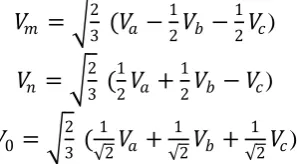
Fig. 1 represents proposed space vector pulse density scheme for multilevel inverter with 18 sided polygonal voltage space vector. The instantaneous values of three phase voltages are converted into reference voltage space vector Vref. The instantaneous values are resolved into sixty degree (m-n) coordinate system (Fig. 2). The m-axis is placed along A phase. The transformation equations are given below:
𝑉
𝑚=
23
(𝑉
𝑎−
1
2
𝑉
𝑏−
1
2
𝑉
𝑐)
𝑉
𝑛=
23
(
1
2
𝑉
𝑎+
1
2
𝑉
𝑏− 𝑉
𝑐)
𝑉
0=
23
(
1
2
𝑉
𝑎+
1
2
𝑉
𝑏+
1
2
𝑉
𝑐)
Each forward path consists of a first order sigma delta modulator consisting of a difference node, discrete time integrator, a quantizer and a digital to analog converter. The space vector quantizer consists of two parts, m-n to three phase voltage converter and a space vector quantizer.
The difference between reference space vector Vref and analog estimate of quantizer output vector Sa is integrated to obtain error vector Ve in delta sigma modulator. The error vector is quantized to obtain switching sectors S. The m-n frame components are converted back to three phase voltages.
Copyright to IJIRSET www.ijirset.com 9036 Fig. 2 abc to mn transformation
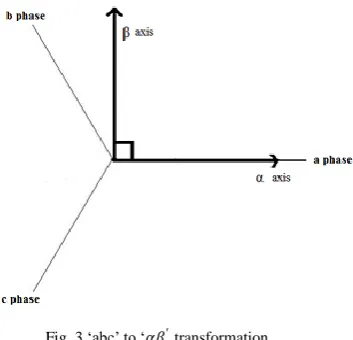
In space vector quantizer the three phase components are again converted to 𝛼𝛽 frame components (Fig.3) to produce the reference voltage vector and angle of sector selection using the transformation equations given below:
𝑉
𝛼=
23
(𝑉
𝑎−
1
2
𝑉
𝑏−
1
2
𝑉
𝑐)
𝑉
𝛽=
23
(
3
2
𝑉
𝑏−
3
2
𝑉
𝑐)
𝑉
𝑟𝑒𝑓= 𝑉
𝛼2+ 𝑉
𝛽2𝜃 = 𝑡𝑎𝑛
−1𝑉
𝛽𝑉
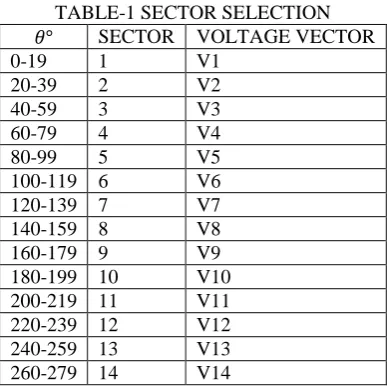
𝛼The sector in which the voltage space vector is located is determined (as per table-1) for finding out the multilevel inverter switching states.
TABLE-1 SECTOR SELECTION
𝜃° SECTOR VOLTAGE VECTOR 0-19 1 V1
Copyright to IJIRSET www.ijirset.com 9037
280-299 15 V15 300-319 16 V16 320-339 17 V17 340-359 18 V18
The output voltage is fed back and converted to m-n frame components. The m and n components are added to delta sigma loop as shown in the figure.
Fig. 3 „abc‟ to „𝛼𝛽′ transformation
III. MULTILEVEL INVERTER WITH 18 SIDED POLYGONAL VOLTAGE SPACE VECTOR
Multilevel inverter to generate 18-sided polygonal voltage space vectors is shown in Fig.4. It consists of a 2-level inverter on one side and a 3-level inverter on the other side of load. The 3-level inverter is made by cascading two conventional 2-level inverters. Asymmetrical DC link voltages are used for the inverters.
For the proposed inverter we can achieve 6 different voltage levels in each winding. Therefore a total of 63 =216
switching states can be generated. Out of these switching states, vectors which lie on the vertices of 18 sided polygon are selected to generate 18-sided voltage space vector. Each pole A, B or C in INV1 can be independently connected either to 0.742Vdc or to the zero voltage. The poles A1, B1 or C1 of INV2 can be connected to any of three levels 0,
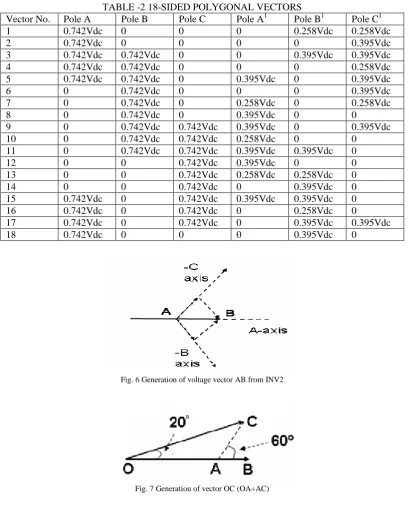
0.258Vdc or 0.395Vdc independently. This can be used to generate 18 polygonal voltage space vectors. The top and
Copyright to IJIRSET www.ijirset.com 9038 Fig. 4 Power circuit of inverter with 18 sided polygonal voltage space vector
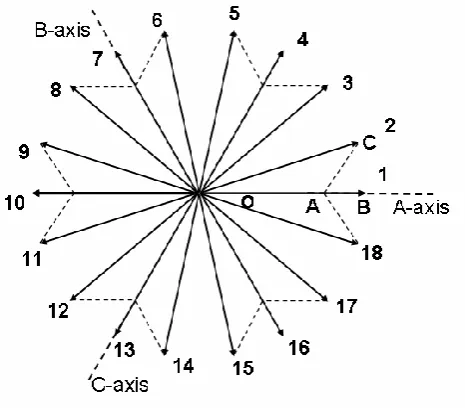
The 18 voltage space vectors are shown in Fig.5. The angle between two adjacent voltage vectors is 20°. Resultant sum of vector OA and AB gives vector 1. In first segment INV1produces vector OA by connecting the pole A to 0.742Vdc.
Vector AB has a magnitude of 0.258Vdc and is generated as shown in the Fig. 6. Pole voltages A1, B1, and C1 of INV2
are subtracted from the pole voltages A, B, C of INV1. When B1 is connected to 0.258Vdc it is along the negative B-axis
and when C1 is connected to 0.258Vdc it is along the negative C-axis. Their resultant is AB with magnitude 0.258Vdc
along A-axis. The vectors AB and OA gives vector 1 of magnitude Vdc.
Fig. 5 18-polygonal voltage vectors
In the second sector, pole A of INV1 is connected to 0.742Vdc, poles B and C at zero level. Hence vector OA is
produced. Pole voltages A1 and B1 are at zero voltage levels and C1 at 0.395Vdc. Vector sum of the above vectors yields
vector 2 in Fig. 7.
Vector-3 is generated as follows. In INV1 pole voltages A and B are maintained at 0.742Vdc, while C is at 0Vdc. Hence
Copyright to IJIRSET www.ijirset.com 9039
while B1 and C1 are at levels 0.395Vdc. This produces a vector with magnitude of 0.395Vdc along the positive A axis.
Together the vector sum produces vector 3 in Fig.5.
TABLE -2 18-SIDED POLYGONAL VECTORS
Vector No. Pole A Pole B Pole C Pole A1 Pole B1 Pole C1 1 0.742Vdc 0 0 0 0.258Vdc 0.258Vdc 2 0.742Vdc 0 0 0 0 0.395Vdc 3 0.742Vdc 0.742Vdc 0 0 0.395Vdc 0.395Vdc 4 0.742Vdc 0.742Vdc 0 0 0 0.258Vdc 5 0.742Vdc 0.742Vdc 0 0.395Vdc 0 0.395Vdc 6 0 0.742Vdc 0 0 0 0.395Vdc 7 0 0.742Vdc 0 0.258Vdc 0 0.258Vdc 8 0 0.742Vdc 0 0.395Vdc 0 0
9 0 0.742Vdc 0.742Vdc 0.395Vdc 0 0.395Vdc 10 0 0.742Vdc 0.742Vdc 0.258Vdc 0 0
11 0 0.742Vdc 0.742Vdc 0.395Vdc 0.395Vdc 0 12 0 0 0.742Vdc 0.395Vdc 0 0 13 0 0 0.742Vdc 0.258Vdc 0.258Vdc 0 14 0 0 0.742Vdc 0 0.395Vdc 0 15 0.742Vdc 0 0.742Vdc 0.395Vdc 0.395Vdc 0 16 0.742Vdc 0 0.742Vdc 0 0.258Vdc 0
17 0.742Vdc 0 0.742Vdc 0 0.395Vdc 0.395Vdc 18 0.742Vdc 0 0 0 0.395Vdc 0
Fig. 6 Generation of voltage vector AB from INV2
Copyright to IJIRSET www.ijirset.com 9040
IV. SECTOR IDENTIFICATION
The angle calculation in space vector quantizer is used to identify the sector. Depending upon the value of angle calculated in 𝛼𝛽 frame, one of the 18 sectors is selected and switching vector corresponding to that specific sector is applied to multilevel inverter.
TABLE-3 VOLTAGE LEVELS FOR 18 VECTORS VECTOR A B C A1 B1 C1 1 1 0 0 0 1 1 2 1 0 0 0 0 2 3 1 1 0 0 2 2 4 1 1 0 0 0 1 5 1 1 0 2 0 2 6 0 1 0 0 0 2 7 0 1 0 1 0 1 8 0 1 0 2 0 0 9 0 1 1 2 0 2 10 0 1 1 1 0 0 11 0 1 1 2 2 0 12 0 0 1 2 0 0 13 0 0 1 1 1 0 14 0 0 1 0 2 0 15 1 0 1 2 2 0 16 1 0 1 0 1 0 17 1 0 1 0 2 2 18 1 0 0 0 2 0
Voltage level in A, B, C: 0=0 & 1=0.742Vdc; Voltage level in A1, B1, C1: 0=0, 1=0.258Vdc & 2=0.395Vdc
TABLE-4
GATE PULSES FOR INVERTER SWITCHES
SECTOR AND VOLTAGE
VECTOR→ 1 2 3 4 5 6 7 8 9 10 11 12 13 14 15 16 17 18
SWITCH ↓
1 0 0 0 0 1 0 0 1 1 0 1 1 0 0 1 0 0 0
2 0 0 0 0 0 0 1 0 0 1 0 0 1 0 0 0 0 0
3 0 0 0 0 1 0 1 1 1 1 1 1 1 0 1 0 0 0
4 1 1 1 1 0 1 0 0 0 0 0 0 0 1 0 1 1 1
5 0 0 1 0 0 0 0 0 0 0 1 0 0 1 1 0 1 1
6 1 0 0 0 0 0 0 0 0 0 0 0 1 0 0 1 0 0
7 1 0 1 0 0 0 0 0 0 0 1 0 1 1 1 1 1 1
8 0 1 0 1 1 1 1 1 1 1 0 1 0 0 0 0 0 0
9 0 1 1 0 1 1 0 0 1 0 0 0 0 0 0 0 1 0
10 1 0 0 1 0 0 1 0 0 0 0 0 0 0 0 0 0 0
11 1 1 1 1 1 1 1 0 1 0 0 0 0 0 0 0 1 0
Copyright to IJIRSET www.ijirset.com 9041
13 1 1 1 1 1 0 0 0 0 0 0 0 0 0 1 1 1 1
14 0 0 0 0 0 1 1 1 1 1 1 1 1 1 0 0 0 0
15 0 0 1 1 1 1 1 1 1 1 1 0 0 0 0 0 0 0
16 1 1 0 0 0 0 0 0 0 0 0 1 1 1 1 1 1 1
17 0 0 0 0 0 0 0 0 1 1 1 1 1 1 1 1 1 0
18 1 1 1 1 1 1 1 1 0 0 0 0 0 0 0 0 0 1
Gate pulses for each inverter switches are generated individually by calculating the voltage levels for each vector from table-3. Hence sector identification is performed. The switching pulses for inverter switches are shown in table-4.
V. SIMULATION RESULTS
The simulink model of the proposed SVPDM scheme for 18-sided multilevel inverter is shown in Fig.8. The inverter sub system is also shown in the figure. The simulink model of SVPDM for two-level inverter is shown in Fig.9.
Copyright to IJIRSET www.ijirset.com 9042 (b)
Fig. 8 Simulink model (a) Main model (b)18-sided multilevel inverter subsystem
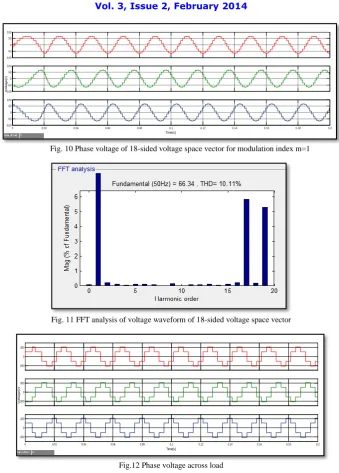
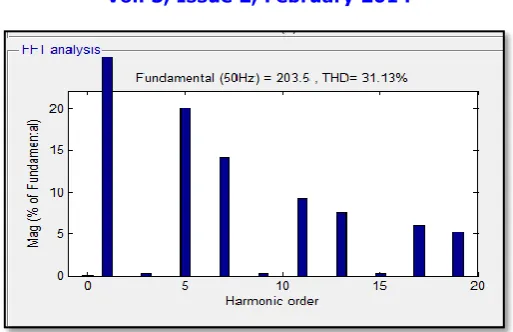
The phase voltage of 18-sided voltage space vector and its FFT analysis are shown in Fig. 10 and Fig. 11. The total harmonic distortion is found to be 10.11%. The phase voltage of two-level inverter with hexagonal quantizer and its FFT analysis are shown in Fig. 12 and Fig. 13. The total harmonic distortion is found to be 31.13%
From simulation results it is found that the phase voltage for multilevel inverter with 18 sided voltage space vector produces 18 stepped output waveform. For a two level inverter with hexagonal quantizer, the phase voltage is 6-stepped waveform. When harmonic analysis is performed, the proposed scheme with multilevel inverter is found to eliminate 5th, 7th, 11th and 13th order harmonics. The Total Harmonic Distortion (THD) factor for the proposed scheme is very less when compared with the two-level inverter with hexagonal quantizer.
Copyright to IJIRSET www.ijirset.com 9043 Fig. 10 Phase voltage of 18-sided voltage space vector for modulation index m=1
Fig. 11 FFT analysis of voltage waveform of 18-sided voltage space vector
Fig.12 Phase voltage across load
-100 -50 0 50 100 -100 -50 0 50 100
0 0.02 0.04 0.06 0.08 0.1 0.12 0.14 0.16 0.18 0.2
-100 -50 0 50 100 Time(s) V o lta g e (v ) -200 0 200 -200 0 200
0 0.02 0.04 0.06 0.08 0.1 0.12 0.14 0.16 0.18 0.2
Copyright to IJIRSET www.ijirset.com 9044 Fig. 13 FFT analysis of voltage waveform
V. CONCLUSION
An 18-sided multilevel inverter control scheme using space vector pulse density modulation is proposed. Sigma delta modulation and vector quantization principles are used in this scheme. The vector space is divided into 18 segments for spatial quantization. Sixty degree co-ordinate system is used to avoid fractional arithmetic. The proposed scheme uses only switching vectors which lie on the vertices of 18 sided polygon. The scheme uses only sector identification for selecting the switching vectors without using lookup table and timer.
Simulation studies are performed for SVPDM based 2-level and multilevel inverter with 18-sided voltage space vectors. Pulse density modulation scheme for multilevel inverter with 18 sided voltage space vector yields low switching losses and very less harmonic content as compared to pulse width modulation techniques in multilevel inverters. The proposed scheme can be implemented for multilevel inverter with 12 sided voltage space vectors. Zero voltage switching can be incorporated in future for achieving high efficiency. This scheme is simple and timing calculations for voltage vectors are eliminated.
REFERENCES
[1] J-S. Lai and F. Z Peng, “Multi-level converters-a new breed of power converters”, IEE Transaction on Industry Applications, Vol. 32, No.3, , pp: 509-517, May-June 1996.
[2] K. Corzine, and Y. Familiant, “A new cascad ed multilevel H Bridge drive”, IEEE Transactions on power electronics. Vol.17, NO.1, pp. 125-131, January 2002.
[3] Sanjay Lakshminarayanan, R.S. Kanchan, P.N. Tekwani and K Gopakumar:, “Multilevel inverter with 12-sided polygonal space vector locations for induction motor drive,” IEE Proc.-Electr. Power Appln. Vol. 153, No.3, pp. 411-419, May 2006.
[4] Biji Jacob and M.R. Baiju, “Spread Spectrum Scheme for Three-Level Inverters based on Space Vector Sigma-Delta Modulation,” IEEE International Symposium on Industrial Electronics, ISIE 2010, pp.1491-1496, July 2010.
[5] Biji Jacob and M.R. Baiju, “Spread spectrum modulation scheme for two-level inverter using vector quantised space vector-based pulse density modulation” , IET Electric Power Applications, 2011
[6] Nieznanski J, “Analytical Establishment of the Minimum Distortion Pulse Density Modulation,” Electrical Engineering 80, pp 251-258, 1997 [7] Sanjay Lakshminarayanan, Gopal Mondal , K.Gopakumar, “Multilevel Inverter with 18-sided Polygonal Voltage Space Vector for an Open-end
Winding Induction Motor Drive” ,The International Conference on “Computer as a Tool”, 2007.
[8] Sanmin Wei, Bin Wu, Fahai Li and Congwei Liu, “A General Space Vector PWM Control Algorithm for Multilevel Inverters,” Proc. Applied Power Electronics Conference and Exposition, pp.562-568, 2003
[9] Nagath Abdul Azeez, Anubrata Dey, K.Mathew, Jaison Mathew, K.Gopakumar, “A Medium –Voltage Inverter-Fed Induction Motor Drive Using Multilevel 12 Sided Polygonal Vectors With Nearly Constant Switching Frequency Current Hysteresis Controller”, IEEE Transactions on Industrial Electronics, Vol. 61, No.4, 2014.