Copyright1999 by the Genetics Society of America
Mutational Analysis of Yeast TFIIB: A Functional Relationship Between Ssu72
and Sub1/Tsp1 Defined by Allele-Specific Interactions With TFIIB
Wei-Hua Wu,*
,†Ine´s Pinto,*
,1Bo-Shiun Chen
†and Michael Hampsey*
,†*Department of Biochemistry and Molecular Biology, Louisiana State University Medical Center, Shreveport, Louisiana 71130 and†Department of Biochemistry, Division of Nucleic Acids Enzymology, UMDNJ–Robert Wood Johnson Medical School, Piscataway, New Jersey 08854
Manuscript received February 23, 1999 Accepted for publication June 17, 1999
ABSTRACT
TFIIB is an essential component of the RNA polymerase II core transcriptional machinery. Previous studies have defined TFIIB domains required for interaction with other transcription factors and for basal transcription in vitro. In the study reported here we investigated the TFIIB structural requirements for transcription initiation in vivo. A library of sua7 mutations encoding altered forms of yeast TFIIB was generated by error-prone polymerase chain reaction and screened for conditional growth defects. Twenty-two single amino acid replacements in TFIIB were defined and characterized. These replacements are distributed throughout the protein and occur primarily at phylogenetically conserved positions. Most replacements have little or no effect on the steady-state protein levels, implying that each affects TFIIB function rather than synthesis or stability. In contrast to the initial sua7 mutants, all replacements, with one exception, have no effect on start site selection, indicating that specific TFIIB structural defects affect transcriptional accuracy. This collection of sua7 alleles, including the initial sua7 alleles, was used to investigate the allele specificity of interactions between ssu72 and sub1, both of which were initially identified as either suppressors (SUB1 2m) or enhancers (sub1D, ssu72-1) of sua7 mutations. We show that the interactions of ssu72-1 and sub1Dwith sua7 are allele specific; that the allele specificities of ssu72 and sub1 overlap; and that each of the sua7 alleles that interacts with ssu72 and sub1 affects the accuracy of transcription start site selection. These results demonstrate functional interactions among TFIIB, Ssu72, and Sub1 and suggest that these interactions play a role in the mechanism of start site selection by RNA polymerase II.
T
RANSCRIPTION initiation by RNA polymerase II subsets of GTFs in both yeast and mammalian systems (RNAPII) requires general transcription factors (reviewed in Koleske and Young 1995; Greenblatt(GTFs) that include the TATA-binding protein (TBP), 1997).
TFIIB, TFIIF, TFIIE, and TFIIH (reviewed inOrphan- The structure of TFIIB includes a zinc-binding motif
ides et al. 1996; Roeder 1996; Hampsey 1998). Al- near the N terminus and two imperfect repeats in the though the full complement of GTFs is generally re- C-terminal two-thirds of the protein (Ha et al. 1991;
quired for accurate initiation, a minimal transcription Pintoet al. 1992). The zinc motif and the repeats are
system consisting of RNAPII, TBP, TFIIB, and TFIIF is organized into structurally distinct domains defined as sufficient for basal initiation from certain promoters a compact, protease-resistant C-terminal core (cIIB) and under specific conditions (Parvin and Sharp 1993; a protease-susceptible N-terminal region (nIIB; Bar-Tyreeet al. 1993;GoodrichandTjian1994). In vitro, beris et al. 1993; Maliket al. 1993). cIIB is necessary
the GTFs assemble in a defined order on a DNA tem- and sufficient for interaction with the TBP-promoter plate to generate a functional transcription preinitiation complex, whereas nIIB interacts with RNAPII/TFIIF complex (Buratowskiet al. 1989; reviewed in Zawel (Barberiset al. 1993;BuratowskiandZhou1993;Ha
and Reinberg 1995). These order-of-addition experi- et al. 1993; Hisatake et al. 1993; Malik et al. 1993;
ments provided the first insight into factor-factor inter- Yamashita et al. 1993; Bangur et al. 1997). The nIIB
actions within the preinitiation complex, but do not region also includes a phylogenetically conserved do-necessarily reflect assembly of the preinitiation complex main, located immediately distal to the zinc-binding
in vivo. This was suggested by the discovery of activation- domain, that affects the accuracy of initiation (Pinto
proficient RNAPII holoenzyme complexes that include et al. 1994).
The three-dimensional structure of cIIB has been solved by NMR and X-ray crystallography (Bagbyet al. Corresponding author: Michael Hampsey, Department of Biochemis- 1995; Nikolov et al. 1995). The crystal structure was
try, UMDNJ–Robert Wood Johnson Medical School, 675 Hoes Lane,
determined for a cIIB-TBP-TATA ternary complex,
de-Piscataway, NJ 08854 E-mail: [email protected]
fining specific contacts between TFIIB, TBP, and the
1Present address: Department of Genetics, Harvard Medical School,
200 Longwood Ave., Boston, MA 02115. DNA template (Nikolov et al. 1995). Consistent with
footprinting (Lee and Hahn 1995) and crosslinking shift at ADH1 was dramatically enhanced in the double mutant, an effect that is dependent upon both alleles. (Lagrangeet al. 1996) experiments, TFIIB binds
under-neath and to one side of the DNA-TBP complex, con- Another enhancer of sua7 mutations, also encoding amino acid replacements at E62 and R78, has also been tacting DNA both upstream and downstream of the
TATA sequence. The TFIIB-DNA interaction appears identified. In this case, the SUB1 gene was initially identi-fied as a high-copy suppressor of E62G and R78H re-to be sequence specific, suggesting that this interaction
affects promoter strength (Lagrangeet al. 1998). placements; deletion of the SUB1 gene was subsequently shown to be lethal in combination with E62G and R78H The solution structure of unbound cIIB and the crystal
structure of the cIIB-TBP-DNA complex revealed that (Knauset al. 1996). SSU72 is an essential gene encoding
a novel protein of unknown function that is conserved the two imperfect repeats are arranged as two domains,
each consisting of fivea-helices. Although the solution among eukaryotic organisms (Sun and Hampsey
1996a). The Sub1 protein is identical to yeast Tsp1, and crystal structures of cTFIIB are comparable, there
are several notable differences, including a more com- identified biochemically on the basis of its ability to stimulate basal transcription (Henry et al. 1996), and
pact structure for the unbound form of cIIB and a
different orientation of the two repeat domains relative is homologous to the human transcriptional coactivator PC4 (GeandRoeder1994;Kretzschmaret al. 1994).
to each other. Also, the A2 helix in the second repeat
consists of only 5 residues in the unbound form, com- In an effort to identify amino acid residues within TFIIB that are critical for specific functions in vivo, we pared to 12 residues in the complexed form, and a short
helix (designated F2) located at the end of the second have generated and characterized a collection of ran-dom sua7 mutants that encode single amino acid re-repeat is unique to the complexed form (Hayashi et
al. 1998). No three-dimensional structure is available placements within TFIIB. These mutants were charac-terized with respect to protein stability, effects on start for full-length TFIIB, although an NMR structure for the
N-terminal region of TFIIB from the archaebacterium site selection, and genetic interactions with Ssu72 and Sub1. Our results demonstrate that only specific TFIIB
Pyrococcus furiosus revealed that the metal-binding
do-main forms a zinc ribbon (Zhuet al. 1996). replacements alter the accuracy of start site selection. Furthermore, sub1Dand ssu72-1 are allele specific with This structural information implies that TFIIB is
pli-able. Indeed, VP16 induces a conformational change respect to sua7 interactions and the specificity of these two sets of interactions overlaps. These results function-in TFIIB (Robertsand Green1994), and binding of
either nIIB or the activation domain of VP16 causes ally link Ssu72 and Sub1 and implicate both proteins in the mechanism of start site selection.
free cIIB to adopt a conformation similar to that of cIIB in the DNA-bound form (Hayashi et al. 1998). This
conformational change is likely to be physiologically
MATERIALS AND METHODS
significant since the Pho4 transcriptional activator in-duces a similar change in yeast TFIIB, and a TFIIB
Strains, media, and nomenclature:The Saccharomyces
cerevis-derivative that blocks the Pho4-TFIIB interaction fails iae strains used in this study are listed in Table 1. Unless to express the PHO5 gene in an activator-specific man- otherwise indicated, all media were prepared according to standard recipes (Sherman 1991). 5-FOA medium contains
ner (WuandHampsey1999).
5-fluoroorotic acid and was used as a positive selection against
Yeast TFIIB is encoded by the SUA7 gene, which was
the URA31gene (Boekeet al. 1984). The heat- (Tsm2) and
first identified on the basis of the ability of sua7 muta- cold-sensitive (Csm2) phenotypes denote impaired growth
tions to alter the accuracy of transcription initiation relative to the isogenic SUA71strain YMH130 at 378and 168,
(Pintoet al. 1992). The sua7-1 and sua7-3 alleles encode respectively. These phenotypes were initially identified on rich (YPD) medium, but were subsequently scored on synthetic
com-glutamate-62→lysine (E62K) and arginine-78→cysteine
plete (SC) medium, which diminished the inherent cold
sensi-(R78C) replacements, respectively, and cause dramatic
tivity associated with the trp1 marker on YPD medium.
downstream shifts in start site selection at the CYC1 and
Yeast and E. coli transformations: Yeast transformations
ADH1 genes (Pintoet al. 1994). Recessive suppressors were done by the lithium acetate procedure (Gietz et al.
of the sua7-1 mutation identified the genes encoding 1992). Plasmid DNA was recovered from yeast as described previously (Hoffman and Winston 1987) and introduced
the largest subunit of TFIIF (ssu71/TFG1; Sun and
into Escherichia coli by electroporation (Doweret al. 1988). E. Hampsey1995) and the Rpb9 (ssu73/RPB9) subunit of
coli strain XL1-Blue (recA1, endA1, gyrA96, thi-1, supE44, hsdR17
RNAPII (Sun et al. 1996). These mutations not only
(r2k m2k) relA1 lac, [F9proAB laclQlacZDM15 Tn10 (tet9)]) was
suppressed the sua7-1 cold-sensitive growth defect, but used as the host strain for all plasmids.
also partially or completely restored the normal initia- Error-prone PCR mutagenesis ofSUA7:Error-prone PCR (EP-PCR) was performed according to the procedures
de-tion pattern.
scribed previously (Muhlradet al. 1992). The reaction
mix-An enhancer of the sua7-1 mutation has also been
ture contained the following components: (i) 10 ng pM299
identified. The SSU72 gene was identified on the basis (SUA7) template DNA; (ii) 103
PCR buffer II (Perkin-Elmer,
of the synthetic heat-sensitive phenotype of an sua7-1 Norwalk, CT); (iii) 0.2 mmof one “biased” dNTP; (iv) 1 mm
ssu72-1 double mutant (Sun and Hampsey 1996b). of the three other dNTPs; (v) 3 mmMgCl2and 0.2 mmMnCl2;
(vi) 2.5 units of AmpliTaq DNA polymerase (Perkin-Elmer);
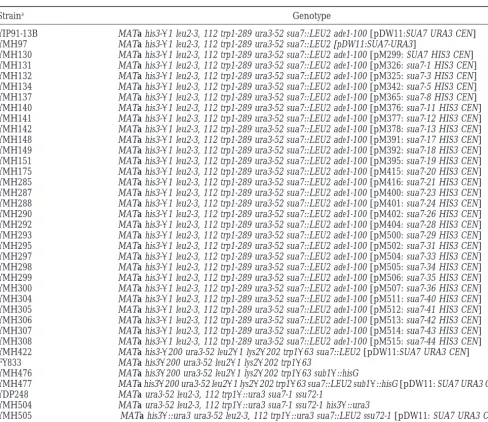
TABLE 1
Yeast strains used in this study
Straina Genotype
YIP91-13B MATa his3-D1 leu2-3, 112 trp1-289 ura3-52 sua7::LEU2 ade1-100 [pDW11:SUA7 URA3 CEN] YMH97 MATa his3-D1 leu2-3, 112 trp1-289 ura3-52 sua7::LEU2 [pDW11:SUA7-URA3]
YMH130 MATa his3-D1 leu2-3, 112 trp1-289 ura3-52 sua7::LEU2 ade1-100 [pM299: SUA7 HIS3 CEN] YMH131 MATa his3-D1 leu2-3, 112 trp1-289 ura3-52 sua7::LEU2 ade1-100 [pM326: sua7-1 HIS3 CEN] YMH132 MATa his3-D1 leu2-3, 112 trp1-289 ura3-52 sua7::LEU2 ade1-100 [pM325: sua7-3 HIS3 CEN] YMH134 MATa his3-D1 leu2-3, 112 trp1-289 ura3-52 sua7::LEU2 ade1-100 [pM342: sua7-5 HIS3 CEN] YMH137 MATa his3-D1 leu2-3, 112 trp1-289 ura3-52 sua7::LEU2 ade1-100 [pM365: sua7-8 HIS3 CEN] YMH140 MATa his3-D1 leu2-3, 112 trp1-289 ura3-52 sua7::LEU2 ade1-100 [pM376: sua7-11 HIS3 CEN] YMH141 MATa his3-D1 leu2-3, 112 trp1-289 ura3-52 sua7::LEU2 ade1-100 [pM377: sua7-12 HIS3 CEN] YMH142 MATa his3-D1 leu2-3, 112 trp1-289 ura3-52 sua7::LEU2 ade1-100 [pM378: sua7-13 HIS3 CEN] YMH148 MATa his3-D1 leu2-3, 112 trp1-289 ura3-52 sua7::LEU2 ade1-100 [pM391: sua7-17 HIS3 CEN] YMH149 MATa his3-D1 leu2-3, 112 trp1-289 ura3-52 sua7::LEU2 ade1-100 [pM392: sua7-18 HIS3 CEN] YMH151 MATa his3-D1 leu2-3, 112 trp1-289 ura3-52 sua7::LEU2 ade1-100 [pM395: sua7-19 HIS3 CEN] YMH175 MATa his3-D1 leu2-3, 112 trp1-289 ura3-52 sua7::LEU2 ade1-100 [pM415: sua7-20 HIS3 CEN] YMH285 MATa his3-D1 leu2-3, 112 trp1-289 ura3-52 sua7::LEU2 ade1-100 [pM416: sua7-21 HIS3 CEN] YMH287 MATa his3-D1 leu2-3, 112 trp1-289 ura3-52 sua7::LEU2 ade1-100 [pM400: sua7-23 HIS3 CEN] YMH288 MATa his3-D1 leu2-3, 112 trp1-289 ura3-52 sua7::LEU2 ade1-100 [pM401: sua7-24 HIS3 CEN] YMH290 MATa his3-D1 leu2-3, 112 trp1-289 ura3-52 sua7::LEU2 ade1-100 [pM402: sua7-26 HIS3 CEN] YMH292 MATa his3-D1 leu2-3, 112 trp1-289 ura3-52 sua7::LEU2 ade1-100 [pM404: sua7-28 HIS3 CEN] YMH293 MATa his3-D1 leu2-3, 112 trp1-289 ura3-52 sua7::LEU2 ade1-100 [pM500: sua7-29 HIS3 CEN] YMH295 MATa his3-D1 leu2-3, 112 trp1-289 ura3-52 sua7::LEU2 ade1-100 [pM502: sua7-31 HIS3 CEN] YMH297 MATa his3-D1 leu2-3, 112 trp1-289 ura3-52 sua7::LEU2 ade1-100 [pM504: sua7-33 HIS3 CEN] YMH298 MATa his3-D1 leu2-3, 112 trp1-289 ura3-52 sua7::LEU2 ade1-100 [pM505: sua7-34 HIS3 CEN] YMH299 MATa his3-D1 leu2-3, 112 trp1-289 ura3-52 sua7::LEU2 ade1-100 [pM506: sua7-35 HIS3 CEN] YMH300 MATa his3-D1 leu2-3, 112 trp1-289 ura3-52 sua7::LEU2 ade1-100 [pM507: sua7-36 HIS3 CEN] YMH304 MATa his3-D1 leu2-3, 112 trp1-289 ura3-52 sua7::LEU2 ade1-100 [pM511: sua7-40 HIS3 CEN] YMH305 MATa his3-D1 leu2-3, 112 trp1-289 ura3-52 sua7::LEU2 ade1-100 [pM512: sua7-41 HIS3 CEN] YMH306 MATa his3-D1 leu2-3, 112 trp1-289 ura3-52 sua7::LEU2 ade1-100 [pM513: sua7-42 HIS3 CEN] YMH307 MATa his3-D1 leu2-3, 112 trp1-289 ura3-52 sua7::LEU2 ade1-100 [pM514: sua7-43 HIS3 CEN] YMH308 MATa his3-D1 leu2-3, 112 trp1-289 ura3-52 sua7::LEU2 ade1-100 [pM515: sua7-44 HIS3 CEN] YMH422 MATa his3-D200 ura3-52 leu2D1 lys2D202 trp1D63 sua7::LEU2 [pDW11:SUA7 URA3 CEN] FY833 MATa his3D200 ura3-52 leu2D1 lys2D202 trp1D63
YMH476 MATa his3D200 ura3-52 leu2D1 lys2D202 trp1D63 sub1D::hisG
YMH477 MATa his3D200 ura3-52 leu2D1 lys2D202 trp1D63 sua7::LEU2 sub1D::hisG [pDW11: SUA7 URA3 CEN] YDP248 MATa ura3-52 leu2-3, 112 trp1D::ura3 sua7-1 ssu72-1
YMH504 MATa ura3-52 leu2-3, 112 trp1D::ura3 sua7-1 ssu72-1 his3D::ura3
YMH505 MATa his3D::ura3 ura3-52 leu2-3, 112 trp1D::ura3 sua7::LEU2 ssu72-1 [pDW11: SUA7 URA3 CEN]
aYIP91-13B and YMH130 were described previously (Pintoet al. 1994). FY833 was from F. Winston (Winstonet al. 1995).
Strains YMH131-YMH308 are isogenic to YMH130 and were derived by plasmid shuffle. The sua7 plasmid shuffle derivatives of YMH477 (sub1D) and YMH505 (ssu72-1) are not listed, but are available upon request.
(vii) 1mmof primers oIP-81 [59-TTTCTAGACGCTGGTGTG (Muhlradet al. 1992). Master plates representingz4000 His1 transformants were made. The SUA7 wild-type gene, carried on GACGATC (SUA7 coding strand, position254 to234, plus
XbaI overhang)] and oIP-82 [59-CGAATTCCCGTGCTTCTT a URA3 vector, was then counterselected on 5-FOA medium, allowing for phenotypes associated with plasmid-borne sua7 GTTCCTA (SUA7 template strand, position 1086 to 1062, plus
EcoRI overhang)]. The volume of the reaction mixture was alleles to be scored in the absence of wild-type SUA7. The sua7 allele in pM362 carries a nonsense mutation at codon 100 ml. Amplification conditions were 33 cycles of 948 for
1 min, 458for 2 min, and 728for 3 min. Four reactions, each 62 (Trp→stop), which eliminates any SUA7 wild-type back-ground. Accordingly, the YMH series of strains are isogenic biased against one dNTP, were pooled following amplification.
Plasmid shuffle:The pooled EP-PCR reaction mixes were derivatives of strain YIP91-13B, differing from each other only
by the sua7 allele carried on derivatives of the HIS3 plasmid combined with pM362 (HIS3 sua7 CEN) that had been gapped
within sua7 by digestion with BspEI and BamHI. This mixture pM362.
A second plasmid shuffle system was constructed in isogenic was introduced into strain YIP91-13B, selecting for
trans-formants on2His medium. Strain YIP91-13B contains a dis- SUB1 wild-type (FY833) and sub1D(YMH476) strains. YMH476 was constructed by transforming the PvuII–EcoRI fragment ruption of the chromosomal SUA7 locus (sua7::LEU2); cell
viability is maintained by plasmid pDW11 (SUA7 URA3 CEN; encompassing the sub1D::hisG-URA3-hisG cassette into FY833, selecting for Ura1transformants, and subsequently selecting
Pintoet al. 1992). The gapped plasmid includes sequences
identical to both ends of the amplified DNA, allowing for for FOArcolonies to recover the ura3 marker. YMH476 was
somal SUA7 gene was subsequently disrupted (sua7::LEU2) as sensitive (Csm ) or heat sensitive (Tsm ), respectively. described previously (Pintoet al. 1992). The resulting strain, To confirm that phenotypes were conferred by plasmid-YMH477, was used as the host to shuffle sua7 alleles into the
borne sua7 alleles, plasmid DNA was extracted from
sub1Dbackground, as described above for YIP91-13B.
each strain and reintroduced into strain YIP91-13B, and
A third plasmid shuffle system was set up using strain
YDP248 (ssu72-1 sua7-1). The HIS3 gene of YDP248 was dis- FOA-resistant colonies were rescored at 168 and 378.
rupted (his3D::URA3) and the ura3 marker was recovered by Strains were then crossed with strain YMH97 (SUA71) selection for spontaneous FOA resistance, yielding strain and the resulting diploid strains were scored at 168and YMH504. YDP504 was transformed with plasmid pM299 (SUA7
378to assess dominance/recessiveness of each sua7
al-HIS3 CEN) and the chromosomal sua7-1 allele was
subse-lele. Most sua7 mutations were recessive, although five
quently disrupted (sua7::LEU2; Pinto et al. 1992). The
re-sulting strain, YMH505, was used as the host to shuffle sua7 exhibited semidominance with respect to growth defects
alleles into the ssu72-1 background, as described above. at either 168or 378. Results are summarized in Table 2.
DNA sequence analysis:Plasmid DNA was recovered from Characterization ofsua7mutants:Plasmid DNAs from
each of the YMH strains and introduced into E. coli strain
33 Csm2and/or Tsm2mutants were recovered and the
XL1-Blue by electroporation. Single-stranded DNA was
iso-DNA sequence of the entire SUA7 open reading frame
lated using the VCS M13 helper bacteriophage (Stratagene,
La Jolla, CA) in the presence of kanamycin. The sua7 coding was determined for each mutant. One or more base
region was sequenced in its entirety for each allele by the pair substitutions within the SUA7 coding region were dideoxy-terminator method using three SUA7 template strand identified for all 33 sua7 alleles. Twenty-two of the 33 primers (oIP-82, 1086→1062; oIP-133, 676→698; and
oIP-alleles encode single amino acid replacements at 21
125, 314→298; ATG start codon is designated11).
different positions. The remaining 11 alleles encode
Western blot analysis:Yeast strains were grown in YPD
me-dium to A6005 1.0. Cells were harvested, washed, and total two or more replacements. Only the mutants encoding
protein was extracted into electrophoresis sample buffer. single residue replacements are described here. These Western blotting was performed according to standard proce- replacements are summarized in Table 2, which also dures using 10% polyacrylamide gels. The primary antibody
includes the E62K, E62R, and R78C single mutants and
was rabbit anti-TFIIB (Pintoet al. 1994); rabbit anti-Leu4 was
E62K-R78C and E62R-R78E double replacements,
used as a loading control. Antigen-antibody complexes were
detected by chemiluminescence using goat anti-rabbit IgG which were defined previously (Pintoet al. 1994).
conjugated to horseradish peroxidase. The TFIIB signal was The collection of single amino acid replacements in quantified using the public domain NIH Image program TFIIB are distributed throughout the length of the pro-(http://rsb.info.nih.gov/nih-image/) and normalized to the
tein (Figure 1). Comparison with the phylogenetic
se-Leu4 signal. Accordingly, the TFIIB/se-Leu4 ratio was defined
ries of TFIIB sequences revealed that most replacements
as 1.0 for the wild type in each panel.
Determination of transcription start sites:Primer extension occur at conserved positions; only the N19D, P25L,
was performed as described previously, using total RNA and C149Y, and H158R replacements occur at variable posi-the ADH1-specific primer oIP-87 (Pintoet al. 1992). Primer tions (NaandHampsey1993). Replacements were iden-extension products were resolved in a 6% polyacrylamide DNA
tified in each of the structurally defined domains of
sequencing gel and visualized by autoradiography. The
molec-TFIIB, including the zinc ribbon, both repeats of the
ular size markers correspond to SUA7 DNA sequenced with
primer oIP-133 (Pintoet al. 1992). core domain, and the phylogenetically conserved region
GST pull-down experiments:A total of 3mg of glutathione between the zinc ribbon and the core. However,
replace-S-transferase (GST), GST-TFIIB, GST-E62K, or GST-R78C was ments within the zinc ribbon and in the first two helices incubated with 20 ml bed volume of glutathione-Sepharose
of the second repeat of the core domain (A2 and B2)
beads in 300ml of Buffer T (10 mmtris-acetate, pH 7.9; 100
were underrepresented. This distribution underscores
mmNaCl; 10% glycerol; 1 mmEDTA; 1 mmDTT) containing
0.01% NP40 at 48for 1 hr. Input Ssu72 protein was generated the functional importance of the entire TFIIB sequence
by in vitro transcription/translation using the TNT kit (Pro- and suggests that the zinc ribbon and part of the core mega, Madison, WI). A total of 5 ml of input protein was domain are especially intolerant of amino acid replace-incubated with GST and its derivatives at 48for 4 hr. Beads were
ments.
collected by centrifugation, washed three times with Buffer T
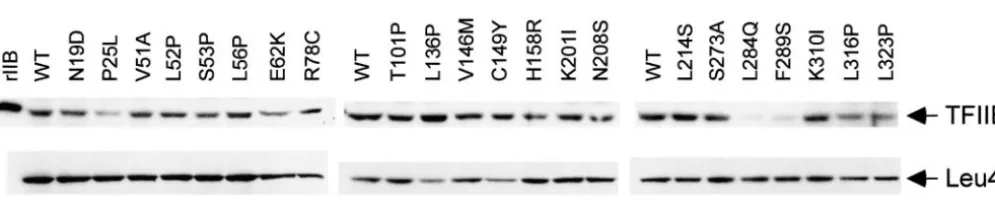
Western blot analysis was used to determine the
ef-containing 300 mmNaCl and 0.05% NP40, and boiled in 15
ml loading buffer. Proteins were resolved by SDS-PAGE and fects of each amino acid replacement on the
steady-visualized by autoradiography. state level of TFIIB (Figure 2). Many replacements did
not adversely affect TFIIB levels and some even ap-peared to enhance TFIIB stability, although in no case
RESULTS
was the increase greater than twofold. Other replace-ments reproducibly diminished TFIIB levels. Among the
Isolation ofsua7mutants:A library of sua7 mutants
was generated by EP-PCR as described in thematerials six amino acid replacements near the C terminus, only K3101 had no appreciable effect on stability and L284Q
and methods.Following plasmid shuffle, FOA-resistant
colonies were spotted onto three sets of rich (YPD) and F289S diminished steady-state levels by at least five-fold. The only other replacements to cause a significant medium and incubated at normal (308), reduced (168),
and elevated (378) temperatures. Strains that failed to decrease in TFIIB levels were P25L, which lies within the zinc ribbon, and H158R, a component of the B1 grow, or grew very poorly at either 168 or 378 relative
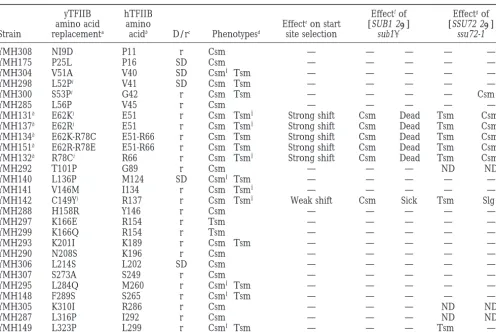
TABLE 2
Summary of TFIIB amino acid replacements, their phenotypes, and interactions with Sub1 and Ssu72
yTFIIB hTFIIB Effectfof Effectgof
amino acid amino Effecteon start [SUB1 2m] [SSU72 2m]
Strain replacementa acidb D/rc Phenotypesd site selection sub1D ssu72-1
YMH308 NI9D P11 r Csm2 — — — — —
YMH175 P25L P16 SD Csm2 — — — — —
YMH304 V51A V40 SD Csm6Tsm2 — — — — —
YMH298 L52Pi V41 SD Csm2Tsm2 — — — — —
YMH300 S53Pi G42 r Csm2Tsm2 — — — — Csm22
YMH285 L56P V45 r Csm2 — — — — —
YMH131h E62Ki E51 r Csm2Tsm6 Strong shift Csm1 Dead Tsm1 Csm0
YMH137h E62Ri E51 r Csm2Tsm6 Strong shift Csm1 Dead Tsm1 Csm0
YMH134h E62K-R78C E51-R66 r Csm2Tsm2 Strong shift Csm1 Dead Tsm1 Csm0
YMH151h E62R-R78E E51-R66 r Csm2Tsm2 Strong shift Csm1 Dead Tsm1 Csm0
YMH132h R78Ci R66 r Csm2Tsm6 Strong shift Csm1 Dead Tsm1 Csm0
YMH292 T101P G89 r Csm2 — — — ND ND
YMH140 L136P M124 SD Csm6Tsm2 — — — — —
YMH141 V146M I134 r Csm2Tsm6 — — — — —
YMH142 C149Yi R137 r Csm2Tsm6 Weak shift Csm1 Sick Tsm1 Slg2
YMH288 H158R Y146 r Csm2 — — — — —
YMH297 K166E R154 r Tsm2 — — — — —
YMH299 K166Q R154 r Tsm2 — — — — —
YMH293 K201I K189 r Csm2Tsm2 — — — — —
YMH290 N208S K196 r Csm2 — — — — —
YMH306 L214S L202 SD Csm2 — — — — —
YMH307 S273A S249 r Csm2 — — — — —
YMH295 L284Q M260 r Csm6Tsm2 — — — — —
YMH148 F289S S265 r Csm6Tsm2 — — — — —
YMH305 K310I R286 r Csm2 — — — ND ND
YMH287 L316P I292 r Csm2 — — — ND ND
YMH149 L323P L299 r Csm6Tsm2 — — — Tsm1 —
aThe yeast TFIIB (yTFIIB) numbering system and single-letter amino acid designations are used. bDenotes corresponding amino acids in human TFIIB (hTFIIB).
cDominance/recessiveness of the indicated sua7 alleles was assessed by crossing each strain with YMH97 and the resulting
diploid was scored for growth at 168and/or 378. SD, semidominant; r, recessive.
dCsm2and Tsm2denote dramatically impaired growth on YPD medium at 168and 378, respectively, relative to the isogenic
SUA7 strain (YMH130) under the same conditions. Csm6and Tsm6denote impaired growth, although to a lesser extent than Csm2and Tsm2.
eEffects on start site selection were determined at the ADH1 gene. “Strong shift” denotes diminished initiation at position
237 and enhanced initiation at sites downstream of227. “Weak shift” denotes a subtle, but reproducible, shift resulting in enhanced initiation at230. These data are summarized from Figure 4.
fCsm1denotes suppression of the Csm2phenotype on YPD medium at 168. “Dead” denotes failure of the plasmid shuffle
strain (sua7::LEU2) carrying plasmid-borne SUA7 URA3 and sua7 HIS3 to grow on FOA medium, indicating that the sua7 allele encoding the indicated amino acid replacement is lethal in combination with sub1D.
gCsm0denotes almost no growth at 168and is depicted in Figure 5. The growth phenotype of the S53P ssu72-1 strain is more
pronounced than the Csm2phenotype of the S53P SSU72 strain and is therefore designated Csm22. ND, potential interactions between SSU72 2mor ssu72-1 and the sua7 alleles encoding T101P, L284Q, and L316P were not determined.
hStrains YMH131, YMH132, YMH134, YMH137, and YMH151 were defined previously (Pintoet al. 1994).
iAmino acid replacements at these positions were also identified in a screen for heat- or cold-sensitive sua7 mutants by Guarente
and co-workers (Knauset al. 1996) or by site-directed mutagenesis (Shawet al. 1996;Banguret al. 1997,Pardeeet al. 1998). The L52P replacement has been identified in two independent studies (Knauset al. 1996; Pardeeet al. 1998); L52P is lethal in the strain background described by Ponticelli and co-workers. A C149R replacement is phenotypically Tsm2(Knauset al. 1996); C149R was also described by Ma and co-workers as one of four TFIIB amino acid replacements encoded by the YR1m4 mutant (Shawet al. 1996).
replacements described here appear to affect TFIIB Effects of TFIIB derivatives on start site selectionin vivo: All of the TFIIB derivatives described here were function, although specific replacements in defined
re-gions of the protein appear to affect stability, implying assayed for potential effects on start site selection at the
ADH1 gene by primer extension (Figure 3 and data not
that the growth defects associated with these mutants
Figure 1.—Schematic summary of TFIIB amino acid re-placements. The single amino acid replacements generated by EP-PCR are denoted by small ball-and-stick figures at their approximate positions within TFIIB and are summarized in Table 2. Large ball-and-stick figures denote positions of amino acid replacement that affect the accuracy of start site selection, which, with the exception of the C149Y replacement within the first repeat of the core domain, arose in the sua genetic selection for genes that affect start site selection (Pintoet al. 1994). Zn denotes the zinc ribbon domain; the narrow cross-hatch denotes the phylogenetically conserved domain
imme-diately downstream of the zinc ribbon; the two arrows denote Figure 3.—Effects of TFIIB amino acid replacements on the two imperfect repeats of the core domain; and the black the accuracy of transcription initiation at the ADH1 gene. Start rectangle near the C terminus denotes the small helical struc- sites were mapped by primer extension analysis. The TFIIB ture that is specific to the bound form of TFIIB (Hayashiet amino acid replacements are denoted by the single letter code al. 1998). The N-terminal domain interacts directly with at the top of each lane. The downstream shift caused by the RNAPII and TFIIF and the core domain interacts with TBP E62K and R78C replacements was reported previously (Pinto and the DNA template (Haet al. 1993). et al. 1994). The initiation pattern associated with the C149Y replacement is different from the initiation pattern associated with E62K and R78C, but similar to the effect of a quadruple
because specific amino acid replacements in TFIIB replacement that includes a C149R replacement (Shawet al. 1996). All other replacements had little or no effect on start
(sua7) and the Rpb1 (sua8) subunit of RNAPII were
site selection.
shown previously to affect the accuracy of initiation at
ADH1, yet initiation at several other genes was
unaf-fected (Berroteranet al. 1994;Pintoet al. 1994).
Tran-start sites at ADH1 was also observed in a sua7 mutant scription at ADH1 normally initiates with equal
fre-that encodes four single amino acid replacements, in-quency at positions 237 and227 relative to the ATG
cluding C149R (Shawet al. 1996). These results
demon-start codon (lane 1, WT). Hallmarks of demon-start site effects
strate that the first repeat of core TFIIB is also involved at ADH1 are diminished initiation at position237
rela-in the accuracy of rela-initiation, yet most TFIIB replace-tive to227 and enhanced initiation at sites downstream
ments do not alter initiation. Thus, specific TFIIB de-of 227 (Pinto et al. 1992, 1994; Sun and Hampsey
fects, rather than general structural abnormalities, ac-1996b). Consistent with previous results, E62K and
count for altered start site selection. R78C shifted initiation downstream of normal.
How-Allele specificity ofsua7 interactions withsub1: The
ever, with the exception of the C149Y replacement,
yeast SUB1 gene was identified as a high-copy suppressor none of the other replacements significantly affected
of R78H and E62G replacements in TFIIB (Knauset al.
start site selection at ADH1. The C149Y replacement
1996). The extensive collection of sua7 mutants de-diminished initiation at 237 relative to 227 and
en-hanced initiation at230 (Figure 3). A similar effect on scribed here presented an opportunity to further
investi-Figure2.—Western blot analysis of TFIIB derivatives. Crude cell extracts were prepared and analyzed as described inmaterials
and methods.Leu4 was used as a loading control. rIIB denotes recombinant TFIIB. The TFIIB amino acid replacements are
Figure 4.—Allele specificity of sua7 sub1D interactions.
Strain YMH477 (sua7::LEU2 sub1D[SUA7 CEN URA3]) and the Figure 5.—Allele specificity of sua7 ssu72-1 interactions. isogenic strain YMH422 (sua7::LEU2 SUB1) were transformed Strain YMH505 (sua7::LEU2 ssu72-1 [SUA7 CEN URA3]) was with sua7 HIS3 CEN plasmid DNA encoding either wild-type transformed with sua7 HIS3 CEN plasmids encoding either TFIIB or the indicated amino acid replacements. His1trans- wild-type TFIIB or the indicated amino acid replacements. formants were selected, subcloned, and replica printed onto His1 transformants were selected and subsequently replica
5-FOA medium to counterselect the wild-type SUA7 plasmid. printed onto 5-FOA medium to counterselect the SUA71
plas-No 5-FOA-resistant colonies arose for sub1Din combination mid. Cells were then spotted onto YPD medium and grown with sua7 alleles encoding amino acid replacements at posi- at either 168(6 days) or 308 (2 days). The ssu72-1 mutation tions E62 or R78, yet these same alleles resulted in 5-FOA- enhanced the Csm2phenotypes associated with the sua7
al-resistance in the SUB11background. Thus, E62 and R78 re- leles encoding either single or double amino acid replace-placements are lethal in combination with sub1D, whereas all ments at positions E62 and R78 and, to a lesser extent, the other TFIIB replacements are viable. Although not lethal, S53P and C149Y replacements. These enhanced Csm2 pheno-sua7-13 (C149Y) exhibited impaired growth in combination types can be rescued by plasmid-borne, wild-type SSU72, con-with sub1D. Data are summarized for all sua7 alleles in Table 2. firming that the synthetic phenotypes are a consequence of the specific sua7 mutations in combination with ssu72-1. These data are summarized in Table 2.
gate the interaction between TFIIB and Sub1. Accord-ingly, we scored for potential suppression of sua7 Csm2
phenotypes by high-copy SUB1 expression and synthetic (YZS19), two genes were identified that interacted with
sua7-1: ssu73-1/rpb9 suppressed the sua7-1 Csm2 pheno-enhancement of sua7 phenotypes in combination with
a sub1D deletion. Similar to its effects on E62G and type, whereas ssu72-1 enhanced the sua7-1 defect, re-sulting in a Tsm2phenotype (SunandHampsey1996a). R78H, high-copy SUB1 suppressed the phenotypes
asso-ciated with E62K, E62R, and R78C single replacements Furthermore, the sua7-1 ssu72-1 double mutation dra-matically shifted start site selection at ADH1 downstream and the E62K-R78C and E62R-R78E double
replace-ments (Table 2). Interestingly, the Csm2growth defect of normal (Sun andHampsey 1996a). In an effort to further define the relationship between TFIIB and of the C149Y replacement within helix B1 was also
sup-pressed by high-copy SUB1. Thus, suppression by high- Ssu72, we used our collection of sua7 alleles to deter-mine if ssu72-1 is allele specific with respect to enhance-copy SUB1 correlates with sua7 alleles that affect start
site selection (summarized in Table 2). ment of sua7 mutations. As described above for sub1D, this was done by plasmid shuffle in an ssu72-1 back-Disruption of the nonessential SUB1 gene (sub1D)
caused synthetic lethality in combination with E62G and ground, using the sua7 alleles described in Table 2. Although many of the sua7 alleles impaired growth at R78H (Knauset al. 1996). Similarly, we found that sub1D
was lethal in combination with all E62 and R78 replace- 168(Table 2), ssu72-1 dramatically enhanced this pheno-type in an allele-specific manner. Accordingly, ssu72-1 ments, including E62K-R78C and E62R-R78E double
replacements (Figure 4; summarized in Table 2). The essentially eliminated growth in sua7 strains encoding the E62K, E62R, and R78C single residue replacements
sub1Ddeletion also enhanced the growth defect of the
C149Y replacement, resulting in a slow growth pheno- and the E62K-R78C and E62R-R78E double replace-ments (Figure 5; summarized in Table 2). The only type comparable to that described previously for a
C149R sub1Dmutant (Knauset al. 1996), although this other sua7 alleles affected by ssu72-1 encode S53P and C149Y, also resulting in enhanced Csm2growth defects, effect was much less pronounced than the lethal effect
of sub1D in combination with E62 and R78 replace- albeit to a lesser extent than the alleles encoding E62 and R78 replacements. Furthermore, high-copy expres-ments. Thus, high-copy SUB1 and sub1Dexert opposite
effects on the growth phenotypes associated with all sion of SSU721from a 2mplasmid suppressed the weak Tsm2phenotypes of sua7 mutants encoding E62, R78, TFIIB mutations that alter start site selection, yet have
no discernable effect on TFIIB replacements that do and C149 replacements, yet, with the exception of L323P, did not affect the Tsm2 phenotype of other not affect the accuracy of initiation.
Allele specificity ofsua7interactions withssu72-1:The sua7 mutants at 378(Table 2). Although ssu72-1 did not
enhance the Csm2phenotype of L323P, it did confer a
ssu72-1 allele was identified in a genetic screen for
sup-pressors of the Csm2 phenotype associated with sua7-1 synthetic slow-growth phenotype at 308(Table 2). Thus,
ssu72-1 and high-copy SSU72 display allele specificity
the second repeat of the core domain appear to be hypomutable or mutations in these regions do not con-fer conditional growth defects. Two of the replacements reported here were also found in other studies. L52P and S53P were also generated by EP-PCR and identified as Csm2 mutants (Knaus et al. 1996), although L52P
has also been reported to be an inviable replacement (Pardeeet al. 1998).
The role of TFIIB in start site selection: The SUA7
Figure 6.—Direct interaction between TFIIB and Ssu72.
gene was initially identified in a genetic selection for
Equal amounts of GST alone or GST fused to full-length TFIIB or its E62K or R78C derivatives were incubated with35S-labeled
mutants that shifted transcription start site selection
Ssu72 protein (input). Following centrifugation of immobi- downstream of normal (Pintoet al. 1992). Three mu-lized GST, samples were washed with buffer containing 300 tants encoding either E62K or R78C replacements were mmNaCl, 0.05% NP-40, denatured in sample buffer,
fraction-defined (Pintoet al. 1994). On the basis of the effects
ated by SDS-PAGE, and analyzed by autoradiography.
of single- and double-residue replacements, it was sug-gested that E62 and R78 form a salt bridge and that this interaction is important for accurate initiation in a with respect to enhancement and suppression of sua7
promoter-specific manner. Other defects in this region, defects and this specificity correlates (with the exceptions
including replacements at W63, R64, and F66, also affect of S53P and L323P) with TFIIB derivatives that affect the
start site selection (Bangur et al. 1997; Pardee et al.
accuracy of initiation. Moreover, this specificity overlaps
1998). Among the new replacements described here, the allele specificity of the sua7 sub1Dinteractions.
only C149Y affects initiation, causing a modest
down-TFIIB interacts directly with Ssu72:The allele
speci-stream shift at the ADH1 promoter (Figure 3). All other ficity of the sua7 ssu72 interaction indicates a specific
replacements described in Table 2 had no discernable functional relationship, possibly involving direct
con-effect on the accuracy of initiation. The limited number tact, between TFIIB and Ssu72. We determined whether
of amino acid replacements that affect start site selection Ssu72 directly interacts with TFIIB by GST pull-down
implies that specific defects, rather than general struc-assays. Input protein for these assays was generated by
tural abnormalities, account for altered initiation.
in vitro transcription and translation of Ssu72. Equal
The TFIIB E62K and R78C replacements markedly amounts of GST protein and its TFIIB derivatives were
diminish the affinity of TFIIB for RNAPII as defined used in these assays, as determined by Coomassie stained
by surface plasmon resonance (Bushnellet al. 1996),
SDS/PAGE-resolved protein samples (data not shown).
suggesting that altered start sites might be a conse-Results are shown in Figure 6. Incubation of GST-TFIIB
quence of diminished TFIIB-RNAPII affinity. However, with35S-labeled Ssu72 resulted in recovery of the Ssu72
an R64E replacement affects start site selection, but does protein (lane 3) that was substantially greater than with
not affect TFIIB-RNAPII affinity (Bangur et al. 1997;
the GST control (lane 2). Neither the E62K nor R78C
Pardeeet al. 1998). Instead, R64E enhances
DNA-TBP-replacement significantly weakened the Ssu72-TFIIB
in-TFIIB ternary complex formation, although this was teraction (lanes 4 and 5). Thus, Ssu72 directly binds
reported not to be a general effect of replacements that TFIIB in vitro, a result consistent with the allele
specific-alter start site selection (Banguret al. 1997;Pardeeet
ity of sua7 ssu72-1 interactions in vivo. However, the
al. 1998). Therefore, it appears that neither diminished
enhanced Csm2 phenotypes associated with the E62K
TFIIB-RNAPII affinity nor enhanced ternary complex and R78C replacements do not appear to be a
conse-stability directly affects start site selection. The observed quence of weakened Ssu72-TFIIB interactions.
start site effects might be a consequence of altered inter-action between the active site of RNAPII and the DNA
DISCUSSION template at the initiator region. Accordingly, specific
This article defines a collection of 22 single amino TFIIB alterations would affect the active site of RNAPII acid replacements in yeast TFIIB. Each of these sua7 such that it no longer efficiently recognizes certain start mutants was generated by EP-PCR and selected solely on site sequences. In such cases RNAPII would scan down-the basis of heat- and/or cold-sensitive growth defects. stream of normal, seeking preferable start sites. This Accordingly, these mutants were isolated without regard scenario is consistent with evidence that RNAPII in S. for effects on any specific function associated with cerevisiae is capable of scanning promoter DNA (
Giar-TFIIB, including DNA-TBP-TFIIB ternary complex for- dina and Lis 1993). Furthermore, downstream start mation, TFIIB-RNAPII interaction, effects on either the sites are not new initiation sites, but correspond to en-rate or accuracy of transcription initiation, or interac- hanced initiation at normally weak initiation sites tion with gene-specific activator proteins. The amino (Pintoet al. 1992, 1994;Berroteranet al. 1994). Thus,
sites whose use is precluded or diminished by upstream sey 1996b). Accordingly, Ssu72 and Sub1 appear to interact in a similar fashion with TFIIB, but do not sites in a normal strain. A feature of this model is that
altered start site selection occurs only at promoters necessarily influence the same event in transcription. In support of this idea, high-copy SUB1 expression sup-where the normal start sites are relatively weak initiator
elements and predicts that the normal pattern of initia- presses the Csm2growth defects of E62 and R78 mutants but does not restore the normal transcription start site tion might be restored by cis-acting initiator mutations
that create preferred start sites. pattern (W.-H. Wu andM. Hampsey, unpublished re-sults). Furthermore, high-copy SUB1 does not suppress
Interaction of TFIIB with Sub1 and Ssu72:Our results
demonstrate that ssu72-1 and sub1Dinteract with sua7 the growth defects of sua8/rpb1 mutations (B-S.Chen
and M. Hampsey, unpublished results), even though in an allele-specific manner and that the specificity of
these interactions is completely overlapping (summa- sua8 alleles cause the same defect in start site selection
as the sua7-1 allele (Berroteranet al. 1994).
rized in Table 2). Furthermore, sua7-1 does not enhance
the growth defect of the temperature-sensitive ssu72-2 Perspectives: The collection of TFIIB mutants de-scribed here is a valuable resource for extensive charac-mutant (encodes R129A; D. L.Pappasand M.Hampsey,
unpublished results), suggesting that the interaction of terization of the role of TFIIB in transcription by RNAPII. These TFIIB derivatives can be used to
corre-sua7-1 with ssu72 is also allele specific. These results
argue that TFIIB interacts directly with Ssu72 and Sub1. late defects in the accuracy or rate of transcription in
vivo with specific biochemical defects in vitro. For
exam-Indeed, Sub1 was shown previously to bind TFIIB
(Knaus et al. 1996) and data presented here demon- ple, the TFIIB S53P mutant is defective for activation of the PHO5 and ADH2 genes in vivo and defective for strate direct binding of Ssu72 to TFIIB.
Although no specific function has been assigned to interaction with the Pho4 and Adr1 activators in vitro, thereby implicating TFIIB as the physiological target of Ssu72, Sub1 is identical to Tsp1, identified as a factor
that stimulates basal transcription in vitro, and interacts specific activators in yeast (Wu and Hampsey 1999). These mutants are also a valuable collection of primary with both TFIIB and the activation domain of
Gal4-VP16 (Henryet al. 1996). Furthermore, the N terminus mutants that can be exploited for genetic suppression analysis. Since all of the mutants described here display of Sub1 is structurally similar to human PC4, a
transcrip-tional coactivator that appears to bridge the interaction at least one conditional growth defect, revertants can be readily selected. The value of this type of analysis between gene-specific activators and the general
tran-scriptional machinery (GeandRoeder1994;Kretzsch- has already been demonstrated for the sua7-1 mutant (SunandHampsey1995, 1996b;Sunet al. 1996).
Addi-mar et al. 1994). The role of PC4 in transcription is
complex, repressing transcription under certain condi- tional factors are likely to turn up as either suppressors or enhancers of other TFIIB defects and might define tions, while stimulating transcription under others
(Maliket al. 1998;Wertenet al. 1998). PC4 binds single- either novel components of the RNAPII transcriptional machinery or novel activities associated with known stranded DNA, an activity that is dispensable for its
acti-vation function, but is required for repression in the factors.
We thank David S. McNabb and Leonard Guarente for SUB1
plas-absence of TFIIH (Wertenet al. 1998). A dynamic role
mids; David S. McNabb, Danny Reinberg, and Zu-Wen Sun for valuable
for PC4 has been proposed, involving conversion of an
discussions; and Gunter B. Kohlhaw for Leu4 antiserum. This work
inactive promoter complex to an initiation-competent was supported by grants from the American Cancer Society (NP-842) structure (Maliket al. 1998). Although less well charac- and the National Institutes of Health (GM-39494).
terized, the function of Sub1 is also complex,
stimulat-ing basal transcription in vitro, but facilitatstimulat-ing transcrip- LITERATURE CITED
Bagby, S., S. J. Kim, E. Maldonado, K. I. Tong, D. Reinberget
tional activation in vivo. Like PC4, Sub1 is
phos-al., 1995 Solution structure of the C-terminal core domain of
phorylated and this modification controls its activity
human TFIIB: similarity to cyclin A and interaction with
TATA-(Henryet al. 1996). binding protein. Cell 82: 857–867.
Bangur, C. S., T. S. PardeeandA. S. Ponticelli,1997 Mutational
Despite the overlapping allele specificities of ssu72-1
analysis of the D1/E1 core helices and the conserved N-terminal
and sub1Dwith respect to sua7 interactions, the Ssu72
region of yeast transcription factor IIB (TFIIB): identification of
and Sub1 proteins are not functionally redundant. an N-terminal mutant that stabilizes TATA-binding
protein-TFIIB-DNA complexes. Mol. Cell. Biol. 17: 6784–6793.
There is no structural relationship between these two
Barberis, A., C. W. Muller, S. C. HarrisonandM. Ptashne, 1993
proteins and disruption of SUB1 confers only minimal
Delineation of two functional regions of transcription factor
growth defects (Knaus et al. 1996), whereas SSU72 is TFIIB. Proc. Natl. Acad. Sci. USA 90: 5628–5632.
Berroteran, R. W., D. E. WareandM. Hampsey, 1994 The sua8
essential for cell viability (Sun andHampsey 1996b).
suppressors of Saccharomyces cerevisiae encode replacements of
Guarente and co-workers proposed that Sub1 is a
clear-conserved residues within the largest subunit of RNA polymerase
ance factor that stimulates release of TFIIB from the II and affect transcription start site selection similarly to sua7
(TFIIB) mutations. Mol. Cell. Biol. 14: 226–237.
promoter by disrupting the interaction between TFIIB
Boeke, J. D., F. LacrouteandG. R. Fink, 1984 A positive selection
and TBP (Knauset al. 1996). On the other hand, Ssu72
for mutants lacking orotidine-59-phosphate decarboxylase activity
was suggested to be an assembly factor that promotes in yeast: 5-fluoro-orotic acid resistance. Mol. Gen. Genet. 197:
345–346.
Hamp-localized mutagenesis of yeast genes. Yeast 8: 79–82. scription factor TFIIB. Proc. Natl. Acad. Sci. USA 90: 5633–5637.
Na, J. G., andM. Hampsey, 1993 The Kluyveromyces gene encoding
Buratowski, S., S. Han, L. Guarenteand P. A. Sharp, 1989 Five
the general transcription factor IIB: structural analysis and expres-intermediate complexes in transcription initiation by RNA
poly-sion in Saccharomyces cerevisiae. Nucleic Acids Res. 21: 3413– merase II. Cell 56: 549–561.
3417.
Bushnell, D. A., C. BamdadandR. D. Kornberg, 1996 A minimal
Nikolov, D. B., H. Chen, E. D. Halay, A. A. Usheva, K. Hisatake
set of RNA polymerase II transcription protein interactions. J.
et al., 1995 Crystal structure of a TFIIB-TBP-TATA-element ter-Biol. Chem. 271: 20170–20174.
nary complex. Nature 377: 119–128.
Dower, W. J., J. F. MillerandC. W. Ragsdale, 1988 High efficiency
Orphanides, G., T. LaGrangeandD. Reinberg, 1996 The general transformation of E. coli by high voltage electroporation.
Nu-initiation factors of RNA polymerase II. Genes Dev. 10: 2657– cleic Acids Res. 16: 6127–6145.
2683.
Ge, H., andR. G. Roeder, 1994 Purification, cloning, and
character-Pardee, T. S., C. S. Bangur and A. S. Ponticeii, 1998 The ization of a human coactivator, PC4, that mediates transcriptional
N-terminal region of yeast TFIIB contains two adjacent functional activation of class II genes. Cell 78: 513–523.
domains involved in stable RNA polymerase II binding and
tran-Giardina, C., andJ. T. Lis, 1993 DNA melting on yeast RNA
poly-scription start site selection. J. Biol. Chem. 273: 17859–17864. merase II promoters. Science 261: 759–762.
Parvin, J. D., andP. A. Sharp, 1993 DNA topology and a minimal
Gietz, D., A. St. John, R. A. WoodsandR. H. Schiestl, 1992
Im-set of basal factors for transcription by RNA polymerase II. Cell proved method for high efficiency transformation of intact yeast
73:533–540. cells. Nucleic Acids Res. 20: 1425.
Pinto, I., D. E. WareandM. Hampsey, 1992 The yeast SUA7 gene
Goodrich, J. A., andR. Tjian, 1994 Transcription factors IIE and
encodes a homolog of human transcription factor TFIIB and is IIH and ATP hydrolysis direct promoter clearance by RNA
poly-required for normal start site selection in vivo. Cell 68: 977–988. merase II. Cell 77: 145–156.
Pinto, I., W.-H. Wu, J. G. NaandM. Hampsey, 1994
Characteriza-Greenblatt, J., 1997 RNA polymerase II holoenzyme and
transcrip-tion of sua7 mutatranscrip-tions defines a domain of TFIIB involved in tional regulation. Curr. Opin. Cell Biol. 9: 310–319.
transcription start site selection in yeast. J. Biol. Chem. 269:
Ha, I., W. S. LaneandD. Reinberg, 1991 Cloning of a human gene
30569–30573. encoding the general transcription initiation factor IIB. Nature
Roberts, S. G. E., andM. R. Green, 1994 Activator-induced
confor-352:689–695.
mational change in general transcription factor TFIIB. Nature
Ha, I., S. Roberts, E. Maldonado, X. Sun, L. U. Kimet al., 1993
371:717–720. Multiple functional domains of human transcription factor IIB:
Roeder, R. G., 1996 The role of general initiation factors in tran-distinct interactions with two general transcription factors and
scription by RNA polymerase II. Trends Biochem. Sci. 21: 327– RNA polymerase II. Genes Dev. 7: 1021–1032.
335.
Hampsey, M., 1998 Molecular genetics of the RNA polymerase II
Shaw, S. P., J. Wingfield, M. J. DorseyandJ. Ma, 1996 Identifying general transcriptional machinery. Microbiol. Mol. Biol. Rev. 62:
a species-specific region of yeast TFIIB in vivo. Mol. Cell. Biol. 465–503.
16:3651–3657.
Hayashi, F., R. Ishima, D. Liu, K. I. Tong, S. Kimet al., 1998 Human
Sherman, F., 1991 Getting started with yeast. Methods Enzymol. general transcription factor TFIIB: conformational variability and
194:3–21. interaction with VP16 activation domain. Biochemistry 37: 7941–
Sun, Z. W., and M. Hampsey, 1995 Identification of the gene 7951.
(SSU71/TFG1) encoding the largest subunit of transcription
fac-Henry, N. L., D. A. BushnellandR. D. Kornberg, 1996 A yeast
tor TFIIF as a suppressor of a TFIIB mutation in Saccharomyces transcriptional stimulatory protein similar to human PC4. J. Biol.
cerevisiae. Proc. Natl. Acad. Sci. USA 92: 3127–3131. Chem. 271: 21842–21847.
Sun, Z. W., andM. Hampsey, 1996a Synthetic enhancement of a
Hisatake, K., R. G. RoederandM. Horikoshi, 1993 Functional
TFIIB defect by a mutation in SSU72, an essential yeast gene dissection of TFIIB domains required for TFIIB-TFIID-promoter
encoding a novel protein that affects transcription start site selec-complex formation and basal transcription activity. Nature 363:
tion in vivo. Mol. Cell. Biol. 16: 1557–1566. 744–747.
Sun, Z.-W., andM. Hampsey, 1996b Synthetic enhancement of a
Hoffman, C., andF. Winston, 1987 A ten-minute DNA preparation
TFIIB defect by a mutation in SSU72, an essential gene encoding from yeast efficiently releases autonomous plasmids for
transfor-a novel protein thtransfor-at transfor-affects trtransfor-anscription sttransfor-art site selection in mation of Escherichia coli. Gene 57: 267–272.
vivo. Mol. Cell. Biol. 16: 1557–1566.
Knaus, R., R. Pollockand L. Guarente, 1996 Yeast SUB1 is a Sun, Z. W., A. TessmerandM. Hampsey, 1996 Functional interac-suppressor of TFIIB mutations and has homology to the human tion between TFIIB and the Rpb9 (Ssu73) subunit of RNA poly-co-activator PC4. EMBO J. 15: 1933–1940. merase II in Saccharomyces cerevisiae. Nucleic Acids Res. 24:
Koleske, A. J., and R. A. Young, 1995 The RNA polymerase II 2560–2566.
holoenzyme and its implications for gene regulation. Trends Tyree, C. M., C. P. George, L. M. Lira-DeVito, S. L. Wampler, Biochem. Sci. 20: 113–116. M. E. Dahmuset al., 1993 Identification of a minimal set of
Kretzschmar, M., K. Kaiser, F. LottspeichandM. Meisterernst, proteins that is sufficient for accurate initiation of transcription 1994 A novel mediator of class II gene transcription with homol- by RNA polymerase II. Genes Dev. 7: 1254–1265.
ogy to viral immediate-early transcriptional regulators. Cell 78: Werten, S., G. Stelzer, A. Goppelt, F. M. Langen, P. Groset al., 525–534. 1998 Interaction of PC4 with melted DNA inhibits transcription.
Lagrange, T., T. K. Kim, G. Orphanides, Y. W. Ebright, R. H. EMBO J. 17: 5103–5111.
Ebrightet al., 1996 High-resolution mapping of nucleoprotein Winston, F., C. DollardandS. L. Ricuperohovasse, 1995 Con-complexes by site-specific protein-DNA photocrosslinking: orga- struction of a set of convenient Saccharomyces cerevisiae strains nization of the human TBP-TFIIA- TFIIB-DNA quaternary com- that are isogenic to S288C. Yeast 11: 53–55.
plex. Proc. Natl. Acad. Sci. USA 93: 10620–10625. Wu, W. H., andM. Hampsey, 1999 An activation-specific role for
Lagrange, T., A. N. Kapanidis, H. Tang, D. ReinbergandR. H. TFIIB in vivo. Proc. Natl. Acad. Sci. USA 96: 2764–2769. Ebright, 1998 New core promoter element in RNA polymerase Yamashita, S., K. Hisatake, T. Kokubo, K. Doi, R. G. Roederet al., II-dependent transcription: sequence-specific DNA binding by 1993 Transcription factor TFIIB sites important for interaction transcription factor IIB. Genes Dev. 12: 34–44. with promoter-bound TFIID. Science 261: 463–466.
Lee, S., andS. Hahn, 1995 Model for binding of transcription factor Zawel, L., andD. Reinberg, 1995 Common themes in assembly TFIIB to the TBP-DNA complex. Nature 376: 609–612. and function of eukaryotic transcription complexes. Annu. Rev.
Malik, S., D. K. LeeandR. G. Roeder, 1993 Potential RNA polymer- Biochem. 64: 533–561.
ase II-induced interactions of transcription factor TFIIB. Mol. Zhu, W. L., Q. D. Zeng, C. M. Colangelo, L. M. Lewis, M. F. Summers Cell. Biol. 13: 6253–6259. et al., 1996 The N-terminal domain of TFIIB from Pyrococcus
Malik, S., M. GuermahandR. G. Roeder, 1998 A dynamic model furiosus forms a zinc ribbon. Nature Struct. Biol. 3: 122–124. for PC4 coactivator function in RNA polymerase II transcription.