THE BREAKUP OF INITIAL LINKAGE BLOCKS UNDER SELECTED MATING SYSTEMS
W. D. HANSON
Crops Research Diuision, Agricultural Research Seruice, U S . Department of Agriculture, Beltsuille, Maryland
Received February 16, 1959
HE extent to which linkage blocks are broken and to which recombination
T
occurs is of critical interest to the plant breeder since the success of his breed- ing program depends upon obtaining desirable genetic recombinations. The con- ventional procedure for the improvement of a self-pollinated species involves a program of continued crossing and pure lining. If the genetic diversity can bcmaintained in the breeding material, effective breakup of linkage blocks and re- combination of genetic types will be achieved over an extended period of time. Unfortunately, genetic diversity is not always maintained in the advanced breed- ing stock. Information on the extent to which linkage blocks can be broken if a gene pool were held in a heterozygous state for a selected number of generations and then pure lined would be extremely helpful in evaluating breeding pro- cedures. The objective of this paper is to derive the average lengths of linkage blocks per chromosome which are intact after selected breeding procedures and to interpret the information available from a segment analysis. Mating systems involving random mating within a population synthesized from a limited num- ber of parents and pure lining from such a random mating population will be considered in detail in this paper.
Derivation of uueruge segment length per chromosome
Segment lengths will be considered with reference to the true genetic map scale. The true genetic map distance for a segment length is the expected number of breaks or points of genetic recombination for the segment (FISHER 1948). A genetic map length for a chromosome will be taken as s. The length of any seg- ment will be defined as c, 0
<
c<
s. The transformation t = c/s places all measurements on a proportionate scale. Thus, a chromosome length is 1.0 and858 W. D. H A N S O N
chromosome segment which represents ai1 intact linkage unit from a progenitor chromosome is the map length between two consecutive loci of effective re- combinations, or recombinations involving loci heterozygous for two progenitor chromosome types.
If one were to develop the expected segment lengths for a mating system by considering the mechanics of a meiotic division, the problem would be extremely complex. The problem is appreciably simplified if the products of the meiotic divisions, or the gametic arrays, are considered. HANSON ( 1959a) has developed the distribution of segment lengths in the gametes of an F, individual and (1959b) has extended the concept to include the distribution of segment lengths in the gametes of a population intermated for n generations. In the latter publication the assumption was made that the probability of a recombination involving a locus homozygous for a progenitor chromosome type was small and could be ignored. Theoretical ramifications for the distribution of segment lengths were given in detail. The approach involved the description for the discrete distribu- tion of chromosomes having a total of x breaks or points of genetic recombination after n meiotic divisions. Given the probability (P,,) that a chromosome will have a total of x breaks, the average proportionate segment length per chromo-
1.
With the assumption of inde- some can be computed, E[t,l = Z: PnJ,[-pendence (no interference).
I n this paper the assumption will be made that the occurrence of any two breaks is independent in a probability sense. The limitations imposed by this assumption are not as critical as might be expected. The assumption of independence did not appreciably affect the estimate of average segment length per chromosome in the gametes from an F, individual (HANSON 1959a). Since only a limited number of recombinations will have occurred within a chromosome in any one meiotic division and breaks will occur independently between generations, the assump- tion of independence will not be critical when the distribution of the total number of breaks after rz meiotic divisions is considered.
The distribution for the total number of breaks or points of genetic recombina- tion occurring within any chromosome of the gametic array of the population is identical for any mating system, and P,, is defined in (i)
.
However, some of the recombinations will involve loci homozygous for a progenitor chromosome type and will not represent a reduction i n the initial linkage block. The probability that a break will involve a locus heterozygous for progenitor chromosome types will depend upon the mating system. The solution requires a description for the distribution of x',the number of effective breaks per chromosome. If P,,, repre- sents the probability of obtaining a chromosome with x' effective breaks after rz meiotic divisions, thenm 1
x+l
2 = 0
P,,
= e n s ( n s ) " / x ! . (i)m 1
E[t,] = B P & [ L
I.
x'+ 1
x'=o (ii)
LINKAGE BLOCKS BREAKUP 859
(A)
If
the total proportionate length of heterozygous segments for a homolo- gous chromosome pair is t, then Px8, the probability of obtaining x' efjective breaksper chromosome in the gametic array, is e-(ts)(ts)x' /x' !. Let t be the total pro- portionate length of a chromosome pair which is heterozygous for progenitor chromosome types. Since t is the proportion of the genetic map length for a chro- mosome pair which is heterozygous, the probability that a break will involve a locus within a heterozygous segment and thus represent a n effective break is t. Consider the chromosomes of the gametic array from such a n individual which contains exactly z breaks. The distribution of effective breaks (z') would be
2:
I:
(Y)
( 1 -t) (3-x') ( t ) C ' .,'=0 P
However, the probability of obtaining
z
breaks is P, = e-8sx/x!. Collecting on anyx',
one obtainsm
P,,
= e - 8 [ Z ,(",) (I-t)"-"' ( t ) " ' (s),/z!]a=, x
= e - t s ( t s ) 3 ' / z ' ! . (iii)
(B) For a mating population the probability that a break will involve a heter- ozygous segment is the probability that any one locus will be heterozygous for two progenitor types. The detailed ramifications for this proposition are involved for the general case. The proposition can be shown to hold for the simpler cases where an intermating population is restricted to two, three, or four progenitor chromosome types and, of course, when the number of progenitor chromosome types is large. For illustrative purposes consider the gametic array of a random mating population arising from the cross between two homozygous parents or from an F, population. The individuals of the population can be grouped, based on the type of gametes from which they arose. Consider as a group all individuals which resulted from the union of two gametes containing U and U effective breaks, respectively, with a probability P,, of occurring. Since only two progenitor block types need be considered, (u+v+l ) segments are involved per chromosome pair, and the average total heterozygous length per chromosome pair for the group is ai = E [ t ] = 1/2, which holds whether (ut-U) is odd or even. If (u+v) is even, ( u + v ) / 2 or (u+v+2)/2 heterozygous segments are formed regardless of the order of breaks for the pair of homologous chromosomes except for the trivial case. The twca types occur in equal frequencies. Similarly, (u+v+l ) / 2 heterozygous segments are always formed if ( u f u ) is cdd. Thus, for the random mating popu- lation with two basic progenitor chromosome types or for an F, population the average total heterozygous segment length per chromosome pair is 1/2. For three progenitor chromosome types, the pattern of development is identical to that illustrated; however, it is more complex since a sequence of three block types must be considered. The average total heterozygous segment length per chromo- some for the population can be shown to be 2/3. For a random mating population from p parents, ai =
-
follows by induction. The probability that a break860 W. D. H A N S O N
will involve a heterozygous segment, and thus produce an effective break. is the average total proportionate heterozygous length per chromosome f o r a generation of mating. The average total proportionate heterozygous length per chromosome is identical to the probability that any one locus will be heterozygous for a mating generation.
(C) After n meiotic diuisiom, the distribution of eflectiue breaks per chromo- some (x') for the nth meiotic diuision can be approximated b y considering a,,
the Probability that a break involued a heterozygous segment, and the approxi- mate distribution approaches the exact distribution for x' as n becomes large. Consider the individuals of the nth generation of breeding. Any individual of the population will be characterized by having a total length of heterozygous seg- ments of t where E [ t ] = a,, and the central moments of t are ,U?. From (B) a , also represents the Probability that any one locus will be heterozygous in the nth generation of breeding. An individual with a heterozygous length of t will gen- erate a distribution of effective breaks as defined in (iii) . Expanding e for each t
and considering expectations. one can obtain the following generalization:
The correction series, {
*
,U,{ f ( a , s ) }}, is complex and does not warrant a detailedexamination here except that the series represents a convergent sequence of con- vergent sequences and is thus a convergent sequence. { f ( a , s ) } represents conver- gent sequences involving (a,s) and ,U, is small for any r since 0
<
t<
1.0. For arandom mating population from p parents, the total heterozygous segment length for a chromosome pair of any individual in the nth generation would rapidly approach a, = ____
'-'
as n becomes large, and the rth moments of t about a, will approach zero. It follows from the correction in (iv) or from logic that as n be- comes large the distribution of x' approachesThe limitiig distribution for x' in a population which has been selfed can be more easily ident4fied from the distribution of total
x'
which will be considered next. Although iv) represents an approximate distribution of x', the relation is the limiting d's++bution of x' as n becomes large.(D) The? distribution of total effectiue breaks (x') following a selected breed- ing procedure can be obtained b y considering a length of chromosome (s') equiualmt to a linkage system which would generate the distribution of eflectiue breaks in one meiotic diuision. The distribution for the total number of recombi- nations per chromosome which has occurred in n meiotic divisions has been defined ;r! (;) Consider t as the total proportionate length of heterozygous seg- ments pr. chromosome pair for any individual of the n generations and I / n as the prob-b'lity that any individual was a member of the ith generation. Let
a E r t l . a -cpresents the probability in the nth generation that a break occurring in ane of 1' 0 n generations will be an effective break. Following the algebraic
P J , = e a L S ( a l s ) " ' / x ' !
+
{ -C p 7 { f ( a , s ) } }.
(iv)P
LINKAGE BLOCKS BREAKUP 861 manipulations as outlined i n (A) and the ramifications discussed in ( C ) , one obtains the limiting distribution
for the distribution of total effective breaks per chromosome after n meiotic divisions. The probability that a break generated in the ith generation is an effective break has been defined in ( C ) as ai. Since a n effective break can arise by any one of n mutually exclusive ways, the probability that any break produced in n meiotic divisions will involve a heterozygous segment is
Pnx, = ( n a S ) X ’ /x’!, (vi)
1 ”
a = - Z ai.
Substituting for a in (vi), one obtains
P,,, = e-(s2ai) (sZai)”‘ /z’!. (vii)
Thus, equivalent chromosome length can be considered,
s’= s .Z a i . (viii)
i = 1
n
t = 1
That is, the contribution of any meiotic division in a breeding plan to the equiva- lent chromosome length is sai, where ai can be taken as the probability that a
locus is heterozygous for progenitor types within a specific division. The expected x’ as determined from (vii) is s’. Thus, the distribution of the total effective breaks generated in n meiotic divisions can be determined by considering the distribution of breaks generated in one meiotic division with a n equivalent chromosome length of s’.
The limiting distribution of
x’
for a selfed population can be readily verified as (vi). As n becomes large, a+
2 / n+
0, and all central moments would ap- proach zero. Also, it should be pointed out that E [ t ] for any division is ai; hence, the approximation in formula (iv) involves only the final distribution. On the other hand, if the approximation had involved each division, errors would have been compounded, and (vii) would have had limited value.The average proportionate segment length per chromosome of the progenitor linkage blocks intact in the nth generation gametes of individuals in a breeding system is defined in (ii)
.
Substituting forP,,,,
one obtainswhere s’, the equivalent chromosome length, is defined i n (viii) and c is the seg- ment length expressed in terms of the true genetic map scale. The average num- ber of segments per chromosome is
E [ c ] = s E [ t n ] = s[1-eS’]/s’, (ix)
m
E [ x ’ + l ] =
I:
F n x , ( ~ ’ + l ) (~’+l)0 = 0
Breakup of linkage blocks in a random mating population with a restricted number of progenitor chromosome types
862 W. D. H A N S O N
this paper p
>
2 will be considered. Since p is small, the first generation of mating will be obtained by intermating the p parents in all possible combinations. Thus, all members of the first generation will be F, individuals, and the first division will contribute s to the equivalent chromosome length rather thanthe parents were randomly intermated. For n meiotic divisions in the random mating population,
s(p-1) , i f
P
since the probability ( a , ) in any generation ( n > l ) of obtaining an effective break is (p-I ) / p . The average segment length per chromosome can be calculated from (ix) for selected values of n, p , and s. As n becomes large the average seg- ment length per chromosome approaches p/ [ n ( p - 1 )
+
11.
It is interesting that s’ has an intuitive interpretation. If the effective breaks per chromosome are totaled over n meiotic divisions, the expected number of effective breaks per chromosome would be equivalent to a chromosome map length of (s
+
s(p-l)/p+
s ( p - l ) / p+
.
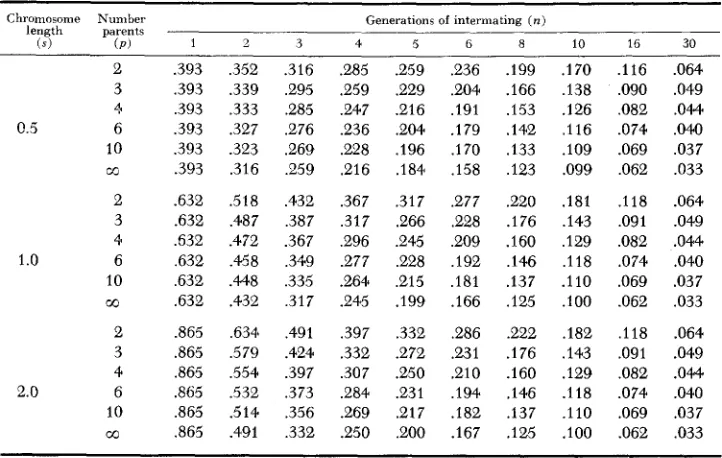
. .).For convenience the average segment length per chromosome after n meiotic divisions, or in the nth generation gametes from a population intermated as out- lined, is given in Table 1 for selected numbers of parents ( p ) , generation ( n ) and chromosome lengths ( s )
.
The lengths are expressed in the units of the genetic map scale. The chromosome lengths selected represent the range of chromosome lengths which might be found in an organism, based on available linkage measure- ments in corn (RHOADES 1955). Each parent used to synthesize the population contributes a progenitor homologue to the intermating population. With two parents ( p = 2 ) , segment lengths represent lengths of alternate linkage blocks from the two parents. With three parents, the segment lengths represent alternate linkage blocks involving units from three progenitor chromosomes.LINKAGE BLOCKS BREAKUP 863 TABLE 1
Expected segment length per chromosome (centimorguns/lOO) for selected chromosome map lengths ( s ) in the n t h generation gametes of a random muting population where the
first generation of intermating was obtained b y intermating p homozygous parents in all possible combinations followed b y random intermating
Chromosome Number length parents
(SI (P)
Generations of intermating ( n )
1
2 3
4.
0.5 6
10
ffi
2 3
4
1.0 6
10
CQ
2 3 4
2.0 6
10 CO .393 ,393 ,393 ,393 ,393 .393 .632 .632 .632 ,632 ,632 .632 .865 .865 ,865 ,865 .865 .a65 ,352 .339 ,333 .327 .323 .31G .518 .487 .472 .458 .448 .432 ,6344 ,579 ,554 .532 .514 .491 3 .316 ,295 ,285 ,276 ,269 ,259 ,432 ,387 .367 ,349 ,335 ,317 ,491 .424 .397 .373 ,356 ,332 4 .e85 .259 .247 .236 .228 .216 .367 ,317 ,296 .277 .264 .e45 ,397 ,332 ,307 ,284 269 .250 5 .259 ,229 .e16 .204 ,196 .184 ,317 .266 .e45 ,228 ,215 .I99 ,332 .272 .250 .e31 ,217 ,200
6 8
,236 .199 ,204 .I66 ,191 ,153 .179 .142 ,170 ,133 ,158 .I23
.e77 ,220 .228 .I76 ,209 ,160 ,192 ,146 ,181 .137 .I66 .I25
.286 .222 231 .176 .el0 .160 ,194 .146 .I82 .137 .167 .I25
10 16 30
.I70 .I38 .I26 ,116 .IO9 .099 .181 ,143 ,129 ,118 .I10 .loo .182 ,143 .I29 .I18 .I10 .IO0 .i16 ,090 ,082 .074 .069 ,062 ,118 ,091 ,082 .074 .069 .062 .118 ,091 ,082 .074 .069 .062 .064 .049 .OM ,040 ,037 ,033 .064 .049 .044 .040 .037 ,033 .064 .049 .OM ,040 .037 ,033
The cumulative distribution for proportionate segment length per chromosome can be stated directly from the information presented by HANSON (1959b) and is
F(t,) = l _ g s t , [ n l l ~ - 1 ) + 1 l / D 0
<
t,<
1.0. Breakup of linkage blocks with random mating and selfingThe equivalent chromosome length as defined in (viii) for a selfed population is 2"- 1
s' = s
+
s/2+
s/4+
- - - = s [--- 9 - 1I,
I
where n is the filial generation. As n becomes large, s'
+
2s. The average segment length per chromosome of progenitor linkage blocks intact at fixation can be sum- marized as follows, for selected chromosome lengths and segment lengths ex- pressed on the proportionate scale and on the genetic map scale:Length of chromosome (s)
Scale 0.3 0.5 1
.o
2.0Proportionate ... .
__
...- .752 .632 .432 .245Genetic ____..._____...._.___.._ ,226 ,316 .432 .491
864 W. D. H A N S O N
occur in the (n+u) generations occur within a region which is heterozygous in the nth generation of inbreeding. Effective breaks would occur at random along the chromosome in the meiotic division of the F, generation and could be con- sidered approximately at random in the meiotic division of the F, generation. However, in subsequent generations, additional effective breaks would tend to occur in clusters within the chromosome map. For a chromosome of length 0.5, 79 percent of the chromosome is transmitted intact on the average in the meiotic division of an F, individual (Table 1 , n = l ) . The additional reduction in Flock length to 63 percent through selfing represents additional breakup produced in part by localized recombination.
Coiisider a population synthesized by intermating p homozygous parents in all possible combinations. The ( n = l ) generation would be a population of F, indi- viduals. Randomly intermate the population for q generations, and then self witli- in the population until fixation. The (n=q+l ) generation would represent the final generation of randomly intermated individuals. and (n=q+2) generation would represent the first generation of selfing within the population. The equiva- lent chromosome length at complete homozygosity (n= cc ) would be
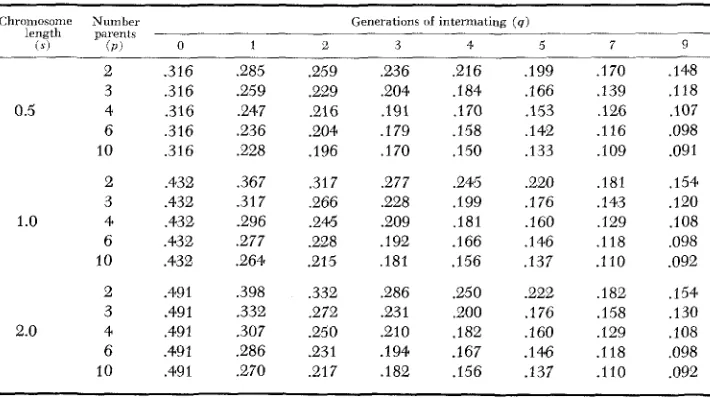
The average segment lengths per chromosome (centimorgans) of progenitor chromosome blocks intact in the selfing population at fixation are given in Table 2 for selected generations of random intermating (9)
,
number of progenitor parents( p ) and chromosome lengths (s) .
s’ = s l l f q ( p - l ) / p + 2 ( p - 1 ) / p l = S I P + ( p - l ) ( q + 2 ) l / p .
TABLE 2
Expected segment iength per chromosome (centimorgans/100) for selected chromosome map lengths ( s ) for a population synthesized b y intercrossing p homozygous parents in all
possible combinations, intermating for q generations and selfing to complete homozygosity
- C h r o m o ~ o m e Num bel Generations [if intermating (4)
length palent?
( 5 ) ( P I 0 1 L. 3 4 5 7 9
2 .3 16 ,285 ,259 ,236 ,216 ,199 .I 70 ,148
3 .3 16 .e59 .229 ,204 ,184 .I 66 .I39 .I 18
0.5 4 .316 .247 ,216 ,191 ,170 ,153 126 ,107
6 .3 16 .236 .204 ,179 .I58 ,142 .I 3 6 .098
10 ,316 ,228 ,196 .I70 .I50 ,133 .IO9 .091
2 ,432 ,367 ,317 ,277 ,245 ,220 ,181 .I54
3 .432 .3 1 7 266 ,228 .I 99 ,176 ,143 .I20
1.0 4 ,432 .e96 .246 .e09 .I81 .I60 ,129 ,108
6 ,432 .277 .228 .I92 .I66 ,146 .I 18 ,098
10 .432 .e64 .e15 181 .I56 ,137 .110 .092
2 .491 ,398 ,332 ,286 .250 ,222 ,182 ,154
3 .491 .332 ,272 .231 ,200 .I 76 .I58 ,130
2.0 4 ,491 .307 .e50 .el0 .I82 ,160 .I29 ,108
6 ,491 .286 .e31 .194 .I67 .I46 .I 18 .098
LINKAGE BLOCKS BREAKUP 865
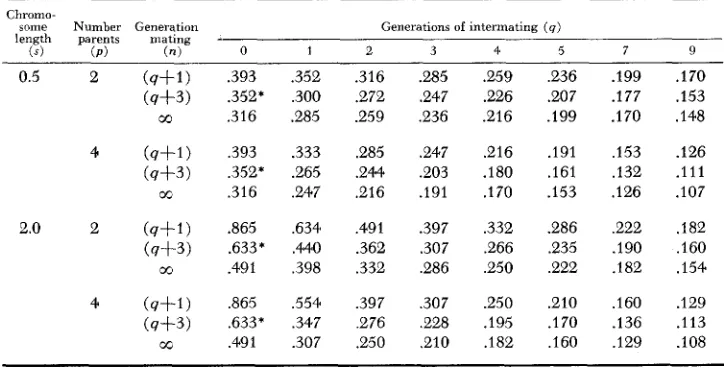
The information in Table 1 can be used to help interpret the information avail- able in Table 2. The average block length in the gametes from the (n=q+l) generation represents the block lengths prior to the selfing generations. The additional reduction in block lengths following a selfing program is obtained by comparing the (n=q+l) generations in Table 1 with the corresponding q generation in Table 2. The information from the two tables has been summarized for a few extreme cases in Table 3 . The (n=q+l) generation represents the average block lengths in the gametes from the final generation of intermating while (n= 00 ) represents the final average block length at fixation. Since effective
breaks in the ( n + u ) generations of selfing can occur only in segments heterozy- gous in the nth generation of selfing, the average block lengths in the gametes of the F, generation (n=q+3) have been included for comparative purposes. The comparable generation with no random intercrossing would be n=2. Some ques- tion should be raised as to the comparability of the respective F, levels, specifically when p is small. The bias introduced by selecting the F, level favors specifically the (p=2) case and would indicate a more favorable reduction in block length than that which actually occurred. However, the summary should serve for general comparative purposes.
Random intermating for four generations within a population synthesized from four parents is equivalent to about five generations of random mating with two parents with respect to the reduction of block length. Furthermore, with four
TABLE 3
Expected segment length per chromosome (centimorgans/100) for selected chromosome map lengths ( s ) in the nth generation gametes of a population synthesized b y intercrossing
p homozygous parents in all possible combinations ( n = l ) , intermating for q generations ( n = q + l ) and selfing to complete homozygosity
Chroma-
mme Number Generation Generations of intermating (4)
length parents mating
-
(s) (PI (-1 0 1 2 3 4 5 7 9
.393 .352* ,316 ,393 .352* ,316 .865 .633* .491 ,865 .633* ,491 .352 ,300 .285 .333 .e65 ,247 ,6344 .MO ,398 ,554 ,347 .307 .316 .272 .259 .285 .244 .216 ,491 .362 ,332 .397 .e76 .e50 .285 .247 ,236 .247 .203 .191 .397 .307 ,286 ,307 .228 .&IO
.e59 ,236 .226 .e07 .216 .199
.216 .I91 .180 A61 .I70 .153
.332 .286 ,266 ,235 ,250 .222
.250 .el0 .195 .I70 .I82 ,160
.199 .I77 .I70 ,153 .132 .le6 .222 .I90 .I82 ,160 .I36 .I29 .170 .I53 .I48 .126 .I11 .IO7 .I82 ,160 ,154 .I29 .I13 .lo8
866 W. D. H A N S O N
parents segments represent alternate linkage blocks with one of four types rather than two alternating progenitor segment types with two parents.
Since we are interested primarily in the equivalent breakup of linkage blocks under different breeding procedures, the segment lengths at the F, level ( n = q f 3 ) become a logical reference point for comparative purposes. It is extremely difficult to breakup linkage blocks for short chromosomes ( 0 . 5 ) . Approximately, 30 per- cent (1-.352/.5) reduction in the original linkage block is achieved by selfing ( p = 4 ) . The inclusion of one generation of intermating effects a 47 percent aver- age reduction while the inclusion of four generations of intermating effects a 64 percent average reduction in the original linkage blocks. The corresponding block lengths with one and four generations of intermating included in the breeding system are about 3/4 and 1/2, respectively, of the average block lengths with no intermating. For the long chromosome (s=2.0 and p=4) the inclusion of one generation of intermating in the breeding system reduces the average length of segment by about 1 / 2 while four generations of intermating correspondingly reduce the average block length to 1/3, as compared to the average block length with no intermating.
DISCUSSION
T h e derivation of the average segment length per chromosome in the gametic array of a population subjected to a selected breeding system has been presented. The development was based primarily on theoretical considerations; however, a n y theoretical development requires experimental ramifications for support and justification. Unfortunately, experimental data from which the average segment length per chromosome can be estimated is not available and would be extremely difficult to obtain. The model must be critically examined in terms of the restric- tions required for the development.
LINKAGE BLOCKS BREAKUP 867 The concept of genetic map scale has arisen from the theory of genetic recombi- nation involving simply inherited characters. It is entirely possible that the distri- bution of breaks is not uniform with respect to the physical length of the chromo- some. The distribution would be uniform with respect to the genetic map scale. The assumption is made that the genes controlling quantitative characters are distributed in some manner within the genetic map scale. The failure to identify s, the length of a chromosome for a species, is not a restriction for the theoretical development but does represent a limitation in application. Information on the genetic map lengths for most species of economic importance is extremely limited. The measured map lengths in corn range from 0.28 for linkage group seven to 1.61 for linkage group one with an average of 0.91
(RHOADES
1955). These lengths would, of course, represent minimum lengths. The chromosome lengths of 0.5, 1 .O and 2.0 have been selected in this paper to represent the extreme ranges and the average for chromosome map lengths which might characterize a species.The degree of homology between a pair of homologues will affect the length of the genetic map for a chromosome. Thus, a chromosome map length may be 1.0 for normal homologies; however, the reduction in homology between two homolo- gous chromosomes, such as i n an interspecies cross, would be equivalent to a reduc- tion in chromosome map length to less than 1 .O. With complete lack of homologous pairing, the chromosome map length would be zero. Thus, when a plant breeder is working with distant crosses, he may essentially be working with a material which is equivalent to a species with exceptionally short chromosome maps. When selection in a wide species cross involves a specific character, a backcrossing program would be followed; however, with the equivalence of a short chromosome map length the rate of breakup of the linkage block would be exceptionally slow
(HANSON 1 9 5 9 ~ ) . Thus, a genetic map length for a chromosome is essentially a conceptial measure. Information available from a segment analysis will serve primarily as a point of reference.
868 W. D. H A N S O N SUMMARY
The derivation of the average segment length per chromosome in the gametic array of a population under any breeding system has been presented. Segment lengths were taken with reference to the progenitor chromosome types f o r the population. Detailed considerations were given to a randomly intermated popula- tion synthesized from a limited number of initial parents and to a selfed p o p - lation in which cycles of intermating have been included. The theoretical develop- ment has been presented in detail, and the ramifications for the restrictions imposed for the development were discussed.
The expected lengths of progenitor chromosome types intact in a chromosome after n meiotic divisions were detailed for the randomly intermating population and for the selfed population which included intermating cycles. The lengths were used to interpret the merits of selected breeding procedures.
If intermating in a self-pollinated species is at all possible, at least one or more, and preferably four, intermating cycles should precede the selfing generations to insure a degree of breakup of the linkage groups and to increase the genetic re- combinations within the linkage group. At least four initial parents should be included in the intermating population. The inclusion of four or more parents in the population would increase the genetic potentials of the population and would effect a greater reduction in lengths of intact progenitor linkage blocks as com- pared to a population synthesized from two parents.
LITERATURE CITED
FISHER, R. A., 1948 Biometrics 4: 1-13.
HANSON, W. D., 1959a
A quantitative theory of genetic recombination and chiasma formation.
The theoretical distribution of lengths of parental gene blocks in the
Theoretical distribution of the initial linkage block lengths intact in the gametes of a
Early generation analysis of lengths of heterozygous chromosome segments around a
The cytogenetics of maize. Chapter IV. Corn and Corn Improvement.
gametes of an F, individual. Genetics 44: 197-209.
population intermated f o r n generations. Genetics 44: 839-846.
locus held heterozygous with backcrossing or selfing. Genetics 44 : 833-837.
Academic Press. Inc. New York. 1959b
1959c