®
Operators Manual
In a world of compromise, some don’t.
USC
Universal Self-loading
Carbine
Operators Manual
CAUTION: Read the safety rules before handling theUSC Carbine!
®
© Heckler & Koch, Inc., 11/99 (revised June 2001) All rights reserved
HK, Inc., 21480 Pacific Blvd. Sterling, Virginia 20166-8903
TABLE OF CONTENTS
TABLE OF CONTENTS
Troubleshooting Guide ...33
Carrying Sling ...35
Sights ...36
Exploded Diagram and Parts List...38
Specifications ...40
Firearms Service Record ...41
Safety Rules on the Use of the HK USC ...6
General ...8
Assembly Groups ...10
Description of Assembly Groups ...11
Assembly Group 1 Upper Receiver with barrel...11
Assembly Group 2 Bolt Group ...12
Assembly Group 3 Lower Receiver with trigger mechanism ...13
Assembly Group 4 Buttstock with pistol grip...15
Assembly Group 5 Magazine ...15
Accessories ...16
Carrying Sling...16
Cleaning Kit ...16
Mounting Rails for Aiming Devices according to MIL-STD-1913 ...16
Handling and Operation ...17
Filling the Magazine ...17
Emptying the Magazine ...17
Insertion and Removal of the Magazine ...17
Loading the USC ...18
Forward Assist ...19
Storage of the USC ...20
Disassembly ...21
Safety Check ...21
Disassembly into Assembly Groups ...23
Disassembly and Assembly of the Bolt Group...23
Disassembly and Assembly of the Magazine ...24
Reassembly of the USC ...25
Function Check ...26
Cleaning & Maintenance ...27
Normal Cleaning ...28
Major Cleaning ...30
Operator Inspection ...30
USC SAFETY RULES
USC SAFETY RULES
• Before handling and cleaning the carbine check to ensure that: - The bolt is locked to the rear
- The carbine is unloaded (cartridge chamber empty) - The barrel is free of obstructions
- The magazine is empty.
• Keep your finger off the trigger when loading, unloading or otherwise handling the carbine. Always place the trigger finger outside of the trigger guard.
• Never use force when handling, disassembling, cleaning and assembling the carbine.
• Disassemble the carbine only as far as described in this manual.
• A handstop is provided with each USC to keep the nonfiring hand or fingers away from the barrel of the carbine. This handstop should be used at all times and can be mounted on the USC with or without the mounting rails attached.
• Always wear eye protection when using the carbine. • Always wear hearing protection when using the carbine.
• Take into account the fact that bystanders are also endangered. Ensure bystanders are also wearing ear and eye protection. • Only use ammunition designed to SAAMI specifications that is
factory-loaded, undamaged, and of the correct caliber. The use of low powered cartridges (including wadcutter and semi-wadcutters bullets) could lead to functional stoppages
(including bullets stuck in the barrel) and is not recommended. • Always mind that the muzzle area is free of obstacles during
firing.
• Store the USC and ammunition in separate places. • Discharging firearms in poorly ventilated areas, cleaning
firearms, or handling ammunition may result in exposure to lead, a substance known to be associated with birth defects, reproductive harm, and other serious injury. Have adequate ventilation at all times. Wash hands thoroughly after exposure. • Heckler & Koch does not assume liability for events due to
disregarding this manual, improper handling, negligence, improper treatment, unauthorized exchange of parts, or manipulations of the carbine.
• Remember, firearms safety begins with you. Read this operators manual and be familiar with the safe handling of this firearm before using it. Store all firearms in a safe and secure location. Keep firearms away from children. Always be a safe shooter. Keep this manual with the carbine.
Safety Rules on the use of the HK USC carbine.
Clear the firearm! Before handling the carbine, “clear it!” Do so by: • Make sure fingers are outside of the trigger guard and the
weapon is pointed in a safe direction at all times! • ON SAFE – Rotate the safety/selector lever to the “Safe”
position. (With the safety/selector lever set at the white box with a white bullet symbol inside.)
• REMOVE MAGAZINE – Depress the magazine release lever and remove the magazine from the magazine well.
• COCKING LEVER – Rotate the ejection port towards the ground and pull the cocking lever rearward one or more times to insure the chamber is empty. Watch for a live round or empty case to be ejected. Rotate the cocking lever upward slightly and lock it into the indent in the cocking lever housing to lock the bolt open.
• INSPECT CHAMBER – Inspect chamber for the presence of a live round or empty case.
Visually – View chamber through open ejection port. Physically – Insert index finger through magazine well or ejection port and feel for the presence of a round or cartridge case in the chamber.
Remove any live rounds or empty cases from the chamber or from within the firearm or magazine before handling the USC further.
The HK USC carbine is now considered “Clear”.
WARNINGS
• Carefully read this operators manual before handling the carbine.
• Only use the carbine after you have fully reviewed and understand these instructions.
• Observe all notes on handling and operation. Failure to do so may result in injury or death of the operator or bystanders. • Do not use any firearm if you have recently ingested alcohol or
drugs.
• When passing the carbine between persons, the weapon must be clear and the bolt should be open.
• Always treat the carbine as if it were loaded and ready to fire. • Never point the carbine at anyone during handling.
• Always point the carbine in a safe direction.
GENERAL
USC CARBINE
Fig. 2 USC (right side view)
Fig. 3 USC oblique (rear, left side view) General
The USC Carbine is a semi-automatic small arm designed and constructed according to the latest methods of advanced technology. The upper receiver, magazine, lower receiver, and buttstock are made of high strength polymer. The USC is a simple blowback operated weapon with a fixed barrel capable of semi-automatic fire.
The USC offers maximum safety and accuracy as it fires from the closed bolt position. The USC is easily disassembled into its main assembly groups for cleaning and care without the use of tools.
Accessories
The following accessories are available:
• mounting rails for aiming devices • handstop
• multi-purpose carrying sling • tactical lights
NOTE: Photographs throughout this manual show the USC carbine with the accessory Picatinny rail mounted on the top of the upper receiver.
Other accessories may also be available, please contact HK for more information.
DESCRIPTION OF ASSEMBLY GROUPS
USC CARBINE
Assembly Group 1 Upper receiver with barrel
The upper receiver is produced using fiber-reinforced plastics and houses other subassemblies. The inside of the upper receiver contains metal guideways for the bolt group as well as attachment points for the lower receiver with magazine well and the buttstock.
The barrel is inserted into and pinned to the upper receiver. The cocking lever of the carbine is located above the barrel. It also serves to
manually lock the bolt in its open position. The right side of the upper receiver contains the ejection port.
The bottom part of the upper receiver includes the support bolts for the lower receiver and a handstop with dual mounting points for the carrying sling.
The sights are fastened to the top of the upper receiver. They consist of a flip-up type rear sight with diopter (peep) and u-notch apertures as well as of the front sight post with front sight hood. A Picatinny rail is mounted on the top of the receiver. Six additional hard points are molded into the receiver on the left, right, and on the bottom sides. These hard points allow for the easy installation of additional rails.
Fig. 5 Upper Receiver with barrel and attachment components
1 Upper receiver 5 Flip-up rear sight
2 Barrel 6 Accessory Picatinny rail
3 Front sight 7 Handstop
4 Cocking lever 8 Hardpoints Assembly Groups
1 Upper receiver with barrel, folding buttstock and attachment components
2 Bolt Group with recoil spring assembly, complete
3 Lower receiver with trigger mechanism, backplate and magazine well
4 Buttstock with pistol grip
5 Magazine
For accessories see pages 15-16
DESCRIPTION OF ASSEMBLY GROUPS
Assembly Group 3 Lower receiver with trigger mechanism
The lower receiver houses the trigger mechanism with ambidextrous safety/selector levers, the magazine well, magazine release lever and bolt catch. The forward portion of the lower receiver is hooked to the upper receiver. The rear portion is fastened to the upper receiver using guide rails in the pistol grip of the buttstock.
The safety/selector levers are fitted on both sides of the pistol grip. The forward portion of the lower receiver has lugs for attachment to the upper receiver. Behind these lugs is the magazine well with the
magazine release lever.
Above the magazine release lever is the bolt catch. It serves to hold the bolt rearward when the last round is fired and to release the bolt from the open position after an empty magazine has been replaced with a loaded magazine.The rear side of the lower receiver includes the integrated backplate with buffer and support for the recoil spring assembly.
Fig. 10 Lower receiver with trigger mechanism and magazine well
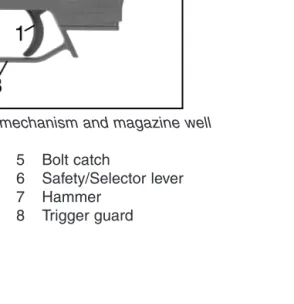
1 Trigger 5 Bolt catch
2 Magazine release lever 6 Safety/Selector lever
3 Magazine well 7 Hammer
4 Attachment lugs 8 Trigger guard
USC CARBINE
Assembly Group 2 Bolt Group
The bolt group, together with the recoil spring assembly, is contained inside the upper receiver. The reciprocal movement of the bolt group provides for feeding and ignition of the cartridge, for extraction and ejection of the spent case as well as for cocking of the hammer. The right side of the bolt has a thumb recess for manual closing of the bolt (forward assist).
The recoil spring assembly pushes the bolt forward into the firing position. The cone-shaped support for the recoil spring assembly is housed in the backplate of the lower receiver. The longitudinally movable guide ring supports itself within the bolt.
The bolt group (Fig. 8 and 9) consists of:
1 bolt 5 firing pin retaining pin
2 firing pin spring 6 recoil spring assembly, complete 3 firing pin assembly 6a guide ring
4 extractor 6b support
Fig. 8 Bolt Group, assembled
USC CARBINE
DESCRIPTION OF ASSEMBLY GROUPS
Assembly Group 4 Buttstock with pistol grip
The buttstock is attached to the receiver by the means of two hex head screws which can be installed or removed by using the HK tool.
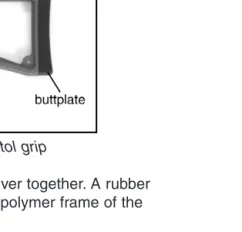
Fig. 11 Buttstock with pistol grip
The buttstock holds the upper and lower receiver together. A rubber cheek rest and buttplate are molded onto the polymer frame of the buttstock.
Assembly Group 5 Magazine
The magazine housing is constructed from plastic. The magazine consists of: magazine housing, magazine floor plate, follower, follower spring and locking plate.
Fig. 12 Magazine, complete Fig. 13 Magazine, disassembled
1 Magazine housing 4 Follower spring
2 Magazine floor plate 5 Locking plate 3 Follower
safe semi-automatic fire
The safety/selector lever of the USC trigger mechanism has two positions :
Position = Safe
HANDLING & OPERATION
USC CARBINE ACCESSORIES
Filling the Magazine
• Grasp magazine.
• Slide individual cartridges under the magazine lips one by one (Fig. 20). • Repeat this process until the required number of cartridges has been
inserted or the magazine is full (maximum 10 rounds).
Fig. 17 Filling the magazine
NOTE: Loading more than the prescribed number of rounds will prevent the magazine from being inserted in the weapon with the bolt forward.
Emptying the Magazine
• Grasp magazine.
• With your thumb, push cartridges forward out of the magazine into the palm of the other hand OR
• Grasp magazine and hold it with the points of the bullets pointing towards the bottom.
• Use a piece of wood to slide the cartridges out of the magazine.
Insertion and removal of magazine
• Put the USC safety/selector on (Safe).
• Insert magazine into the magazine well (Fig. 18). The magazine catch has to engage audibly in the process. Tug on the magazine to ensure it is fully engaged.
• For removal of the magazine, push magazine catch forward (Fig 19) and remove magazine downward.
Carrying sling
The carrying sling (Fig.14) enables the shooter to carry the USC carbine securely in a wide variety of positions.
Fig. 14 Sling
Cleaning Kit The cleaning kit includes:
1 Transport case 5 Oil bottle 2 Cleaning patches 6 Bore brush 3 Cleaning brush 7 Patch holder 4 Cleaning rod with folding handle
Fig. 15 Cleaning Kit
Mounting rails (MIL-STD-1913) for aiming devices
LOADING THE USC
USC CARBINE
Starting Situation 2: There is an empty magazine in the carbine. The bolt is held back by the bolt catch.
• Put the USC safety/selector on (Safe).
• Push magazine catch forward and remove empty magazine. • Insert the filled magazine into the magazine well until the magazine
catch engages audibly. Tug to check.
• Depress upper end of bolt catch (Fig. 21), thus releasing the bolt and allowing it to snap forward chambering a round.
WARNING: The USC is now fully loaded and with the safety on.
FIg. 21 Depress bolt catch to release the bolt
With heavy external fouling of the USC, (sand, sludge) or to load the firearm quietly, the thumb recess on the bolt may be used as a forward assist (Fig 25A). To do so use the thumb recess, push bolt forwards until it is in the forward most position.
Starting Situation 1: No magazine is present in the carbine. The bolt is forward.
• Put the USC safety/selector on (Safe).
• Insert the loaded magazine into the magazine well until the magazine catch engages audibly. Tug downward to ensure it is properly seated. • The USC is partially loaded and with the safety on.
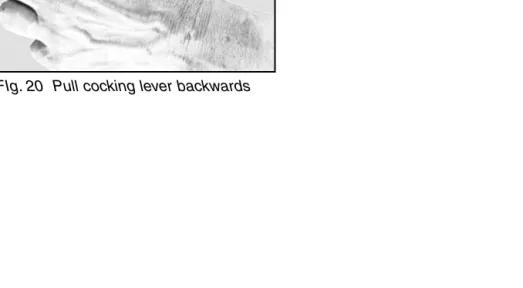
• Pull cocking lever backwards as far as it will go and let bolt snap back to its forward position chambering a round. In the process do not ride the cocking lever forward.
WARNING: The USC is now fully loaded and with the safety on.
or
• Pull cocking lever backwards as far as it will go, (Fig. 20 ) and swivel it upwards (engage it in the indent) into the open position.
• Insert the loaded magazine into the magazine well until the magazine catch engages audibly. Tug to check.
• With the open palm of the non-firing hand "slap" the cocking lever downward and forward to chamber a round. During this process do not ride the cocking lever forwards.
WARNING: The USC is now fully loaded and with the safety on.
DISASSEMBLY
USC STORAGE
NOTE: The USC is easily disassembled and reassembled with the HK Tool. Do not use force in any of the disassembly procedures. Disassembly beyond the procedures outlined in this manual is not recommended and may void the HK Warranty. Disassembly beyond the operators level described here may be carried out by qualified maintenance personnel only. Contact HK for more information.
Clear the carbine! Before handling the firearm, “clear it!” Do so by: 1 • Make sure fingers are outside of the trigger guard and the
weapon is pointed in a safe direction at all times! 2 • ON SAFE – Rotate the safety/selector lever to the “Safe”
position. (With the safety/selector lever set at the white box with a white bullet symbol inside.)
3 • REMOVE MAGAZINE – Depress the magazine release lever and remove the magazine from the magazine well.
4 • COCKING LEVER – Rotate the ejection port towards the ground and pull the cocking lever rearward one or more times to insure the chamber is empty. Watch for a live round or empty case to be ejected. Rotate the cocking lever upward slightly and lock it into the indent in the cocking lever housing to lock the bolt open.
5 • INSPECT CHAMBER – Inspect chamber for the presence of a live round or empty case.
Visually – View chamber through open ejection port. Physically – Insert index finger through magazine well or ejection port and feel for the presence of a round or cartridge case in the chamber.
Remove any live rounds or empty cases from the chamber or from within the firearm or magazine before handling the USC further.
The HK USC is now considered “Clear.” Once clear, let the bolt move forwards.
1. Store the carbine clean and lubricated.
2. Store the carbine without a round in the chamber.
3. Store the carbine with the cocking lever forward and the hammer down (at rest).
4. After no more than twelve (12) months unload all loaded magazines and replace the ammunition with fresh ammunition.
5. Clean and lubricate the carbine and magazines every twelve (12) months while in storage.
DISASSEMBLY INTO ASSEMBLY GROUPS
USC CARBINE
Disassembly of the Bolt
1 • Push and hold firing pin forward.
2 • Pull out firing pin assembly retaining pin to the left (Fig. 28). 3 • Remove firing pin assembly and firing pin spring to the rear. To
do this, push the locking catch to the right (Fig. 29). With your thumb prevent the firing pin assembly with firing pin spring from springing out.
Fig. 28 Fig. 29
Pull out firing pin retaining pin Push locking catch to the right
WARNING: Never disassemble the firing pin. It is possible to assemble the firing pin assembly incorrectly and in doing so, disabling the USC firing pin safety. Contact HK for more information.
Assembly of the Bolt
1 • Place firing pin spring onto firing pin.
2 • Insert firing pin spring and firing pin assembly into the bolt from the rear and push them forwards (Fig. 30).
3 • Using any pointed object push the rear end of the firing pin forwards (Fig. 31).
4 • Insert firing pin retaining pin from the left to retain firing pin assembly in the bolt.
Fig. 30 Fig. 31
Insert firing pin spring Push firing pin forwards and firing pin assembly
locking catch
Stripping into assembly groups
1 • Detach carrying sling
2 • Use the 5 mm Allen wrench of the HK tool and remove the hex headed Allen screws located on the left and right sides of at the rear end of the receiver
3 • Pull the buttstock straight backwards out of the guiding rails of the lower the receiver.
4 • Swivel the lower receiver downwards at an angle of
approximately 45° and detach it from the support bolts of the upper receiver (figures 23 & 24).
Fig. 23 Detaching lower receiver Fig. 24 (Detail) lower receiver
5 • Pull back the cocking lever and remove the recoil spring assembly and the bolt to the rear (figure 25).
ASSEMBLY
USC CARBINE
Reassembly of the USC
1 • With the cocking lever forward, insert the bolt and recoil spring assembly to the receiver from the rear.
2 • From below, engage lower receiver (hammer between cocked and released positions) into the support bolts on the upper receiver and swivel it upwards (Fig. 32).
Fig. 32
3 • Hold the upper and lower receiver firmly together. Slide buttstock guiding rails horizontally into the appropriate slots of the lower receiver (Fig. 33).
Fig. 33
Pushing buttstock into upper and lower receiver
4 • Fasten the buttstock to the upper receiver by means of the two Allen screws with the HK tool (do not use excessive force to tighten the screws down).
5 • Put the USC safety/selector on (Safe). 6 • Insert empty magazine.
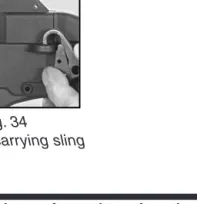
7 • Carry out a function check as described on page 26. 8 • Attach carrying sling (Fig. 34)
Disassembly of the Magazine
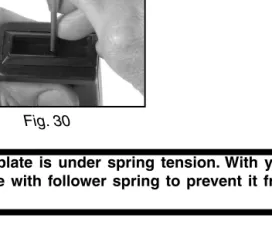
1 • Depress locking plate through magazine floor plate and slide magazine floor plate to the rear (fig. 30).
2 • Detach magazine floor plate to the rear.
3 • Remove follower spring with locking plate and follower.
Fig. 30
CAUTION: Magazine floor plate is under spring tension. With your thumb secure locking plate with follower spring to prevent it from springing out.
Assembly of Magazine
1 • Insert follower and follower spring with locking plate into the magazine housing from below.
2 • Fully depress follower spring and locking plate (Fig. 31) and slide magazine floor plate onto magazine housing from the rear. 3 • Push magazine floor plate forwards as far as it will go.
4 • Check that the floorplate is fully seated and secured in place by the tab of the locking plate.
CLEANING & MAINTENANCE
USC CARBINE
Operator Cleaning
• The functional performance of any mechanical device varies greatly on the quality and frequency of the maintenance performed on that item. Firearms are no exception. The operator spends most of the time with the weapon and therefore has the best opportunity to perform the necessary upkeep required to insure top performance at all times. • Metal components of new USC are coated in a thick, oily preservative
that should be removed prior to the weapon being used or fired. This preservative oil, applied by HK personnel prior to the shipment of the weapons from the manufacturing facility in Germany, guarantees that the weapons and accessories will remain corrosion-free during storage and transport. However, this preservative fluid is not
considered a lubricant and therefore should be removed and replaced with a high-quality weapons lubricant whenever possible. This
preservative fluid attracts debris and dirt and possesses little or no lubrication qualities.
• Cleaning the USC, especially with its polymer construction, need not take hours and a great deal of effort. With the right equipment a very fouled USC should be able to be thoroughly cleaned in less than 10 minutes. A solvent tank where the parts can be immersed in and scrubbed will save a great deal of time and effort as will compressed air to blow off the fouling and solvent or to spread the lubricant. There are companies, such as Safety-Kleen, that sell or rent such solvent tanks and will exchange the solvent on a regular basis at a
reasonable price.
NOTE: If using ultra sonic cleaning machines, do not immense the painted portion of the USC, specifically the color pictogram firing mode markings on the lower receiver. Ultra sonic cleaning or strong solvents will remove the markings!
• If such a set up is not available to you, a complete weapons cleaning kit specially designed for the HK USC will reduce your cleaning time and make the job easier.
• Any quality weapons solvent or oil can be used to clean the USC. Basically, if it’s safe to put your bare hands into it won’t hurt the surfaces of the weapon.Break-Free (CLP), Ballistol, Militecor any of the other brand-name cleaners or lubricants specifically designed for use with weapons will work well on the USC.
• At HK we recommend two types of operator cleaning. Normal cleaning and Major cleaning.
Fig. 34 Attaching carrying sling
NOTE: A Function Check should be performed anytime the carbine is reassembled. This quick check indicates whether or not the carbine has been properly assembled and/or assembled with all components. A properly executed Function Check can also reveal many of the more obvious malfunctions that could occur between the interactive components of the carbine. ALWAYS clear the carbine before performing the Function Check! ENSURE the carbine is clear!
1 • Clear the carbine!
2 • Place the cocking lever and bolt group in the forward position. 3 • With the carbine on “Safe”, pull the trigger. Hammer should not fall. 4 • Place the weapon on “Semi-automatic”. Pull the trigger and hold
the trigger back. Hammer should fall.
5 • Still holding the trigger back, recock the carbine. Release the trigger. Listen for the “click” of the trigger and sear resetting. Pull the trigger. Hammer should fall.
CLEANING
USC CARBINE
• Chamber – Apply a liberal amount of solvent to the appropriate bore brush. Insert the brush through the back of the receiver into the chamber.DO NOTpush the brush past the chamber! Work the brush back and forth in the chamber at least three times. Remove the brush and let the solvent go to work on the fouling for a few minutes while you work on other components.
• Chamber face– This area is easily tackled using the special Chamber Face brush available in the HK Field Cleaning Kit for the USC carbine. Attach this brush to the cleaning rod and lock the handle so that the rod and brush can be turned together. Apply a liberal amount of solvent to the bristles of the brush. Insert the brush through the back of the receiver until it makes contact with the area surrounding the opening to the chamber and bore. With slight inward pressure, rotate the brush in a clockwise direction to break up the carbon fouling built-up on the face of the chamber. Continue this procedure until you are satisfied with your efforts.
• Upper Receiver– Apply a few drops of solvent to a toothbrush and scrub the area around the chamber face and along the length of the receiver rails to break-up the carbon fouling. Remove all of the fouling, carbon, and visible debris from the entire upper receiver using a solvent tank and compressed air or swabs, patches, rags, etc. Run al least three clean patches of the appropriate size all the way through the bore in the direction of bullet travel to remove the loose fouling and solvent.
• Muzzle – Use a nylon bristle toothbrush and a small amount of solvent to remove any fouling from the muzzle.
Bolt group Scrub all parts of the bolt group with a toothbrush and solvent where carbon is visible, especially around the face of the bolt and the extractor.Do not attempt to remove the extractor for cleaning! There is no functional need to remove the extractor for normal
cleaning. Remove the loose fouling from all parts using a rag, swabs or compressed air.
Magazine Don’t forget the magazines! They are very important and very often overlooked during cleaning. Many stoppages occur as a result of improperly maintained magazines. Apply a few drops of solvent to a toothbrush and scrub the top of the magazine to remove any visible carbon fouling or loose debris. Pay special attention to the front edge of the housing, feed lips, and the follower. Remove the solvent and loose
Normal cleaning
Performed after each firing or every twelve (12) months.
Major cleaning
Often referred to as “detailed cleaning”. Performed on a USC after 1,000 rounds or when the weapon is exposed to or excessively laden with sand, dust, water or other visible contaminants or foreign matter. • The cleaning intervals listed here are recommendations only! • Your intervals between cleaning will vary greatly depending on many
factors to include the type of ammunition used, the environment in which the weapon is used, and the thoroughness of your cleaning, etc.
Normal cleaning
1.CLEAR THE CARBINE!
2. Disassemble the weapon into the major assembly groups.
Multi-purpose carrying slingThe nylon webbing and plastic components of the multi-purpose carrying sling can be cleaned using warm water and a soft bristled brush. Allow the sling material to dry completely before storage or use. Avoid getting the metal sling components wet.
Buttstock Simply remove any foreign debris from the exterior polymer and rubber surface of the buttstock using a toothbrush, rag, swabs or compressed air when available.
Lower receiver Remove any foreign debris from the plastic pistol grip using a tooth-brush, rag, swabs or compressed air. Scrub the top of the hammer, ejector and the area around the front of the ejector with a small amount of solvent or oil to break up the carbon fouling. Remove the loose fouling and debris by rinsing the components in the a solvent tank or by using rags, swabs, or compressed air.
Forearm / foregrip Remove any foreign debris from the forearm or optional foregrip using a toothbrush, rag or compressed air.
Upper receiver with barrel Start with the bore and chamber.
LUBRICATION
USC CARBINE
Lubrication
Any type of high-quality, medium-weight lubricant (oil) specifically designed for use on firearms such as Break-Free (C.L.P.) Ballistol,or Militec will work well on the HK USC carbine.DO NOTuse
lubricants/cleaners that boast of their ability to penetrate metal (i.e. WD-40, Tri-Flow,etc.) as these substances may deaden primers.
Where and how much?
No Lube – (surface is dry and not slippery to the touch)
• Sling material • Plastic components
Light Lube – (finger run across surface yields little or no lube)
• Bore and chamber
• All metal parts (except sound suppressor) • Muzzle
• Magazine spring
• Axles of all operating controls (cocking lever, bolt catch, safety/selector lever, magazine catch, etc.) • Rear sight assembly
• All metal accessories
Medium Lube – (finger run across surface yields some lube but lube does not run down surface when held in a vertical position)
• Bolt group with recoil spring and guide rod
Heavy Lube – (Lube runs down surface when held in a vertical position) No heavy lube is required on the HK USC!
• Reapply lubrication to the bolt of the USC periodically during firing as it burns off from the heat.
• Apply lubricant using a shaving brush, swabs, patches, or rag. A spray bottle also works well using compressed air to circulate the lubricant into all parts and to remove the excess.
Major Cleaning
As mentioned earlier, Major cleaning should be performed after 1,000 rounds are fired through a USC. Major cleaning is also performed when the weapon has been immersed in water or is laden with large amounts of visible foreign matter or fouling.
During major cleaning, all firearm components except the painted surfaces (firing modes symbols) and the carrying sling, should be rinsed with or immersed in solvent and scrubbed thoroughly with a brush. This includes the magazine and it’s parts. The components can then be dried using a rag or swabs, though compressed air is preferable for Major cleaning.
If any assembly groups require a more thorough cleaning, an “ultra-sonic” cleaning machine can be used containing any solvent that it is safe to place your bare hands in, as a general rule.
However, avoid placing painted surfaces such as the firing mode markings on the lower receiver into an ultra-sonic cleaner, as this may remove the colored markings. Further disassembly of any assembly group(s) beyond the level described above mustbe performed by, or at a minimum supervised by, an HK factory-trained armorer.
Operator inspection
During or after cleaning the operator should inspect the firearm and it’s components for any irregularities that may causes problems during it’s operation. If any potential deficiencies are noted, they should be corrected immediately and/or brought to the attention of the unit armorer. In general, the operator should keep a watchful eye out for the following discrepancies both in the weapon as a whole and in each assembly group.
• Improper function • Missing parts
• Cosmetic flaws (cracks, dents, burrs, rust, etc.) • Improper assembly
• Loss of spring tension (where applicable) • Unusual looseness (where applicable) • Cracked welds
• Excessive wear
TROUBLESHOOTING GUIDE
USC CARBINE
1. Put the USC safety/selector on (Safe). 2. Remove the magazine.
3. Pull rearward on the cocking lever and lock the bolt open. 4. Ensure that barrel, cartridge chamber and receiver are free of
obstructions.
5. Next, determine and eliminate the cause of the stoppage. The items indicated in the following tables do not cover all stoppages
theoretically possible. A given stoppage may also have been caused by other reasons than the ones indicated.
Stoppage Cause Remedy
Cartridge not ignited Ammunition fault Replace round (Dud round)
Firing pin damaged Take USC to or broken maintenance shop
Hammer spring Take USC to damaged or broken maintenance shop
Bolt did not stay open on Cartridge case stuck in Unload. Retract bolt to the last shot chamber because it is eject spent case. Clean
deformed or the chamber if fouled. If required take is dirty USC to maintenance shop
Cartridge case not Chamber is dirty Clean cartridge chamber extracted or ejected
Extractor broken Take USC to maintenance shop
Ejector damaged Take USC to maintenance shop
Insufficient bolt recoil Unload. Retract cocking lever to eject spent case. Check for smooth movement of bolt and Ammunition
The USC carbine was designed to use ammunition made to NATO or SAAMI specifications. Like an automobile engine, you cannot expect top performance by using poor quality fuel. The same applies to firearms. There are a number of general considerations that should be made when choosing the type of ammunition you plan to use in the USC.
DO USE
• Ammunition of the appropriate caliber and of recent manufacture • Clean burning ammunition
• Non-corrosive ammunition
• Jacketed Hollow Point (JHP), “Silver-Tip”, ball, truncated cone, “Hydra Shok”, +P, etc.
DO NOT USE
• Reloads or remanufactured ammunition. Beware of military surplus, foreign or outdated ammunition.
• Non-jacketed or exposed lead ammunition • Corrosive ammunition (primer and/or propellant)
• Empty cases as “dummy“ (inert) rounds, as damage may result to the weapon, especially the synthetic magazines employed in the USC. Use complete dummy rounds available for training purposes. • Any ammunition that exceeds NATO or S.A.A.M.I. pressure limits
WARNING: Only use ammunition designed to SAAMI specifications that is factory-loaded, undamaged, and of the correct caliber. The use of low powered cartridges (including wadcutter and semi-wadcutters bullets) could lead to functional stoppages (including bullets stuck in the barrel) and is not recommended.
Stoppages
In the event of stoppages on the USC, the carbine is to be considered loaded until the actual cause of the stoppage has been determined. During the elimination of stoppages, safety precautions are to be taken into account.
In the event of stoppages on the USC, for example the cartridge fired from the USC is not ignited, the bolt assembly does not close
CARRYING SLING
USC CARBINE
Carrying sling
The carrying sling enables the USC to be carried in several ways. The carrying sling is attached to the mounting points on the receiver, handstop, or buttstock via the carbine hooks.
Length Adjustment
1 • Close coupler
2 • Rest the carrying sling between thumb and index finger and let the USC hang down in a horizontal position. Adjust the length in such a way that there is a space of approximately 10 cm (4 inches) between your forearm and the USC.
For adjustment
1 • Slide the forward buckle and coupler with the sewn-up end as far as possible up to the front carbine.
2 • Somewhat loosen the belt loop in the rear buckle.
3 • To shorten the carrying sling, pull the upper loop forwards 4 • To lengthen the carrying sling, pull the upper loop to the rear. 5 • Tighten loop in the buckle
6 • Tighten carrying sling
Routing the Carrying sling
In order to carry the USC laterally against the body or in front of the body (ready position), or on the back, the carrying sling must be properly routed. To do so:
1 • Pull the two halves of the carrying sling apart and upwards. 2 • Place the upper part of the carrying sling onto your shoulder
over your head.
Stoppage Cause Remedy
No cartridge fed by bolt. Magazine not properly Insert magazine properly inserted
Magazine loose Check magazine catch and tab on magazine. If required take USC to maintenance shop.
Follower spring lame Replace magazine or follower spring and take to maintenance shop.
Magazine lips damaged Replace magazine or magazine housing and take the damaged one to maintenance shop
Bolt not fully closed. Cartridge chamber dirty Clean cartridge chamber Cartridge not fully fed
Cartridge damaged Replace cartridge
Recoil spring lame Take USC to maintenance shop
Improperly cocked Allow cocking lever to snap forward. On releasing cocking lever do not ride it forward.
Bolt does not stay open Magazine spring lame Replace magazine and
after last shot take damaged one to the
maintenance shop
Bolt catch damaged Take USC to maintenance shop
Magazine stuck in Magazine damaged Replace magazine housing
magazine well and take damaged one to
to the maintenance shop
SIGHT ALIGNMENT
USC CARBINE
Correct point of aim Even circle of light
Fig. 42 Sight pictures
Point of aim Rear sight Aperture Circle of light Front sight holder Front sight post
Impact as with incorrectly centered front sight = right
Impact as with full sight = high
Impact as with fine sight = low
Impact as with incorrectly centered front sight = left
Sight Adjustment
If the point of impact has to be corrected, this will be done by adjustment of the rear sight using the Allen wrench provided with the weapon. The USC is zeroed at the factory to hit the point of aim at 25 meters (27.3 yards).
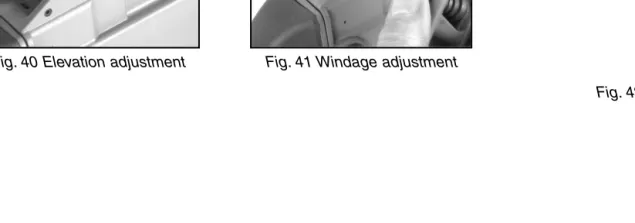
Elevation adjustment
• To lower the weapon’s point of impact, turn the elevation adjustment screw clockwise.
• To raise the weapon’s point of impact, turn the elevation adjustment screw counterclockwise.
NOTE: 1 revolution of the elevation adjustment screw changes the point of impact by 4.5 centimeters (1.77 inches) at a range of 25 meters (27.3 yards).
Windage adjustment
• To move the weapon’s point of impact to the left, turn the windage adjustment screw counterclockwise.
• To move the weapon’s point of impact to the right, turn the windage adjustment screw clockwise.
NOTE: 1 click of the windage adjustment screw changes the point of impact by 1.15 centimeters (.45 inches) at a range of 25 meters (27.3 yards).
EXPLODED DIAGRAM & PARTS LIST
USC CARBINE
Item Description Part No. Item Description Part No.
36 Locking lever spring 214616 37 Locking lever 219095
38 Bolt 214615
39 Locking lever housing 214613 40 Elbow spring right 217946 41 Elbow spring left 205201
42 Hammer 217936
43 Hammer spring, left 217533 44 Hammer spring, right 217585
45 Notched disk 217614
46 Compression spring 205418
47 Index plate 205419
48 Axle, locking lever 219521 49 Safety lever, left 217945 50 Safety lever, right 205437 51 Magazine release 219530 52 Magazine release spring 217536 53 Magazine release axle 219549
57 Allen screw, buttstock (2) 217903 * Magazine complete .45 (58 - 62) 219486 58 Magazine housing, .45 ACP 219522 59 Follower .45 ACP 219523 60 Magazine spring .45 ACP 219524 61 Locking plate .45 ACP 219525
62 Floor plate 219526
* Picatinny rail, short, complete with screws 219662 63 Picatinny rail, short 219660 64 Cylindrical screw (2x) 219413 * Picatinny rail, long, complete (66 - 67) 219663 65 Picatinny rail, long 219661 66 Cylindrical screw (2x) 219413
* HK tool 988496
67 Carrying sling, USC complete 214085 * Adaptor for UTL* 219693 * not pictured
* Upper receiver with barrel, complete (I - 21) 1 Upper receiver, incomplete 219492
2 Front sight 217506
3 Roll pin, front sight, 4 x 144 mm 928747 * Rear sight, complete (4 - 10) 217513
4 Sight support 217504
5 Flat spring 217515
6 Rear sight 217516
7 Windage adjustment screw 217517 8 Rear sight spring 217518 9 Sight support spring 217503 10 Elevation adjustment screw 217505 11 Roll pin, sight support, 4 x 30 mm 987695 12 Cocking lever 217519 13 Cocking lever spring 217508 14 Cocking lever support 217507 15 Roll pin, cocking lever support, 4 x 16 mm 986546 16 Barrel .45 ACP 219497
19 Hand stop, incomplete 219342 20 Insert plate, handstop 219343 21 Cylindrical screw, handstop 5 x 16 mm 219414 * Buttstock, complete (24- 25) 219496
22 Buttstock 217528
23 Buffer 217544
* Bolt, complete .45 ACP (24 - 29) 219495 24 Bolt, incomplete, .45 ACP 219499 25 Extractor .45 ACP 217573 26 Firing pin assembly, complete 217555 27 Firing pin spring 217523 28 Firing pin retaining pin 217587 29 Recoil spring assembly, complete 217548 * Lower receiver, complete (30-56) 219487 30 Lower receiver, incomplete 219491
31 Trigger 205420
32 Trigger spring 217918
33 Axle (3x) 217532
Fig. 43 USC .45 ACP
FIREARM SERVICE RECORD
Firearm Type ________________ Serial Number ________________
Number of Cumulative Total Maintenance & Date Rounds Fired of Rounds Fired Users Name Remarks ______________________________________________________________________________
______________________________________________________________________________
______________________________________________________________________________
______________________________________________________________________________
______________________________________________________________________________
______________________________________________________________________________
______________________________________________________________________________
______________________________________________________________________________
______________________________________________________________________________
______________________________________________________________________________
______________________________________________________________________________
______________________________________________________________________________
______________________________________________________________________________
______________________________________________________________________________
______________________________________________________________________________
______________________________________________________________________________
______________________________________________________________________________
______________________________________________________________________________
______________________________________________________________________________
______________________________________________________________________________
______________________________________________________________________________
______________________________________________________________________________
USC CARBINE
Specifications
Caliber . . . .45 ACP Operating principle . . . .Simple blow back, firing from a closed bolt position
Dimensions
Overall length . . . 900 mm (35.43 in) Overall width . . . 55 mm (2.17 in) Overall height with magazine . . . 243 mm (9.75 in) Barrel length . . . 406 mm (16 in) Twist length . . . 406 mm (16 in) Sight radius . . . 327 mm (12.87 in)
Weights
USC without magazine . . . approximately 2.715 kg (6 lb.) Magazine, empty (10 rounds) . . . 0.098 kg (.216 lb.) Carrying sling . . . 0.10 kg (.22 lb.)
Other Data
Heckler & Koch, Inc. 21480 Pacific Blvd.
Sterling,Virginia 20166-8903
In a world of compromise, some don’t.
Heckler & Koch GmbH D-78722 Oberndorf/Neckar Postfach 1329
HK USA 6/01 #701474