INSTRUCTION
MANUAL
FOR
RUGER
®
SIDE-BY-SIDE SHOTGUNS
12 GAUGE
For Product Service on This Model Please Call:
(603) 865-2442 (See p. 27)
STURM, RUGER & Company, Inc.
Southport, Connecticut 06890 U.S.A.
THIS INSTRUCTION MANUAL SHOULD ALWAYS ACCOMPANY THIS FIREARM AND BE TRANSFERRED WITH IT UPON CHANGE OF OWNERSHIP, OR WHEN THE FIREARM IS LOANED OR
PRESENTED TO ANOTHER PERSON.
READ THE INSTRUCTIONS AND
WARNINGS IN THIS MANUAL CAREFULLY
BEFORE USING THIS FIREARM
Gold Label
WARNING
!
“Children are attracted to and
can operate firearms that can
cause severe injuries or death.
Prevent child access by always
keeping guns locked away and
unloaded when not in use. If you
keep a loaded firearm where a
child obtains and improperly uses
it, you can be fined or sent to
prison.”
ADVERTENCIA
!
State-By-State Warnings
Certain states require by law that their own specified warning
notices in larger-than-normal type be conspicuously included by
the manufacturer, distributor, or retail dealer with firearms sold
in that state. Sturm, Ruger sells its products in compliance with
applicable laws and regulations. Because our products may be
sold in these states, we include the following:
California:
“A los niños los atraen las armas
de fuego y las pueden hacer
funcionar. Ellos pueden causarses
lesions graves y la muerte. Evite
que los niños tengan accesso a las
armas de fuego guardándolas
siempre con llave y descargadas
cuando no las esté utilizando. Si
usted tiene un arma de fuego
cargada en un lugar en que un
niño tiene acceso a ella y la usa
indebidamente, le pueden dar una
multa o enviarlo a la carcel.”
Connecticut:
“UNLAWFUL STORAGE OF A LOADED FIREARM MAY
RESULT IN IMPRISONMENT OR FINE.”
Florida:
“IT IS UNLAWFUL, AND PUNISHABLE BY
IMPRISONMENT AND FINE, FOR ANY ADULT TO
STORE OR LEAVE A FIREARM IN ANY PLACE WITHIN
THE REACH OR EASY ACCESS OF A MINOR UNDER 18
YEARS OF AGE OR TO KNOWINGLY SELL OR
OTHERWISE TRANSFER OWNERSHIP OR POSSESSION
OF A FIREARM TO A MINOR OR A PERSON OF
Maine:
“ENDANGERING THE WELFARE OF A CHILD IS A
CRIME. IF YOU LEAVE A FIREARM AND AMMUNITION
WITHIN EASY ACCESS OF A CHILD, YOU MAY BE
SUBJECT TO FINE, IMPRISONMENT OR BOTH. KEEP
FIREARMS AND AMMUNITION SEPARATE. KEEP
FIREARMS AND AMMUNITION LOCKED UP. USE
TRIGGER LOCKS.”
Maryland:
“WARNING: Children can operate firearms which may cause
death or serious injury. It is a crime to store or leave a loaded
firearm in any location where an individual knew or should
have known that an unsupervised minor would gain access to
the firearm. Store your firearm responsibly!”
Massachusetts:
“WARNING FROM THE MASSACHUSETTS ATTORNEY
GENERAL: This handgun is not equipped with a device that
fully blocks use by unauthorized users. More than 200,000
firearms like this one are stolen from their owners every year
in the United States. In addition, there are more than a
thousand suicides each year by younger children and
teenagers who get access to firearms. Hundreds more die from
accidental discharge. It is likely that many more children
sustain serious wounds, or inflict such wounds accidentally on
others. In order to limit the chance of such misuse, it is
imperative that you keep this weapon locked in a secure place
and take other steps necessary to limit the possibility of theft
or accident. Failure to take reasonable preventive steps may
result in innocent lives being lost, and in some circumstances
may result in your liability for these deaths.”
“IT IS UNLAWFUL TO STORE OR KEEP A FIREARM,
RIFLE, SHOTGUN OR MACHINE GUN IN ANY PLACE
UNLESS THAT WEAPON IS EQUIPPED WITH A
New Jersey:
“IT IS A CRIMINAL OFFENSE TO LEAVE A LOADED
FIREARM WITHIN EASY ACCESS OF A MINOR.”
New York City:
“THE USE OF A LOCKING DEVICE OR SAFETY LOCK IS
ONLY ONE ASPECT OF RESPONSIBLE WEAPONS
STORAGE. ALL WEAPONS SHOULD BE STORED
UNLOADED AND LOCKED IN A LOCATION THAT IS
BOTH SEPARATE FROM THEIR AMMUNITION AND
INACCESSIBLE TO CHILDREN AND ANY OTHER
UNAUTHORIZED PERSONS.”
North Carolina:
“IT IS UNLAWFUL TO STORE OR LEAVE A FIREARM
THAT CAN BE DISCHARGED IN A MANNER THAT A
REASONABLE PERSON SHOULD KNOW IS ACCESSIBLE
TO A MINOR.”
Texas:
“IT IS UNLAWFUL TO STORE, TRANSPORT, OR
ABANDON AN UNSECURED FIREARM IN A PLACE
WHERE CHILDREN ARE LIKELY TO BE AND CAN
OBTAIN ACCESS TO THE FIREARM.”
Wisconsin:
“IF YOU LEAVE A LOADED FIREARM WITHIN THE
REACH OR EASY ACCESS OF A CHILD YOU MAY BE
FINED OR IMPRISONED OR BOTH IF THE CHILD
IMPROPERLY DISCHARGES, POSSESSES, OR EXHIBITS
THE FIREARM.”
* * * * * * * * * * * * * * * * * * * * * *
• Always keep your firearm pointed in a safe direction, including when you are installing or removing your locking device.
• Always verify that your firearm is completely unloaded
before installing your locking device.
• Do not install locking devices in the trigger guard; always keep your fingers, clamp and locking device outside the trigger guard during device installation and removal.
• Store firearms, ammunition and keys separately and securely, away from children and careless adults; do not store your firearm with the keys in the locking device. • Do not attempt to work the action of your firearm with
the locking device in place; this may damage your firearm.
• While locking devices are an important aid to security measures, they are not a substitute for safe firearm handling and proper storage. Remember that any mechanical device can be bypassed with enough time, knowledge, determination and equipment.
LOCKING DEVICES MUST BE USED
SAFELY AND RESPONSIBLY
LOCKING DEVICE
INSTALLATION INSTRUCTIONS
!
WARNING – USE OF LOCKING DEVICES
Use the Correct Lock:
While the basic locking device is substantially
similar for all Ruger
®firearms, due to the different shapes of the many
Ruger
®firearms, different firearms utilize different locking devices. The
locking device for your
SIDE-BY-SIDE SHOTGUN
includes a 2 1/2”
lock and a clamp (black metal bracket to which the lock is applied.)
To Install the Factory-Supplied Locking Device:
1.
Keep the muzzle pointed in a safe direction and your fingers outside the
trigger guard at all times!
2.
Be sure the firearm is completely unloaded and contains no cartridges or
cartridge cases!
4. Apply the clamp to the stock-receiver assembly as show in Figure 1.
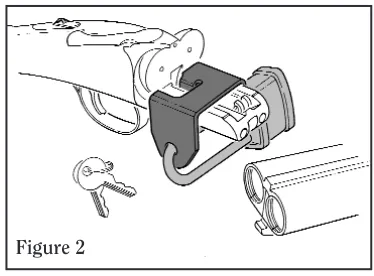
5. Apply the lock to the clamp by inserting the shackle of the lock into the
holes in the clamp as shown in Figure 2.
6. Close the lock by pressing the shackle into the body of the lock (the part
that receives the key) as tightly together as possible. The lock has
bumpers and the shackle is coated with a non-marring material that will
not harm the metal finish of your firearm; be careful not to dent or
scratch the wooden stock.
7. Once the lock is securely closed, turn the key to its locked position and
remove it. Pull firmly on the shackle and lock to test connection and be
sure it is locked.
Do not leave or store your firearm with the key in the
lock!
Store your locked unloaded firearm and the key in secure, separate
locations, away from ammunition, children, or unauthorized adults.
Correct Installation of Lock through Clamp
For Ruger Side By Side Shotgun Only
Correct Installation of Clamp
Figure 1
FIREARMS SAFETY-YOUR RESPONSIBILITY
SAFETY MUST BE THE FIRST AND CONSTANT
CONSIDERATION OF EVERY PERSON WHO
HANDLES FIREARMS AND AMMUNITION.
This Instruction Manual is designed to assist you in learning how to use
and care for your
RUGER
®SIDE-BY-SIDE SHOTGUN
properly.
Please contact us if you have any questions about it.
Only when you are certain you fully understand the Manual and can
properly carry out its instructions should you practice loading, etc. with
live ammunition. If you have any doubts about your ability to handle or
use a particular type of gun safely, then you should seek supervised
instruction. Such personalized instruction is often available from gun
dealers, gun clubs or police departments. If none of these sources can
help you, write to the National Rifle Association, 11250 Waples Mill Rd.,
Fairfax, VA 22030-7400. They will assist you.
The person possessing a gun has a full-time job. You cannot guess; you
cannot forget. You must know how to use your firearm safely.
Do not use
any firearm without having a complete understanding of its particular
characteristics and safe use.
Remember: There is no such thing as a
foolproof gun.
TABLE OF CONTENTS
Page
State by State Warnings . . . .3
Locking Device Installation Instructions . . . .6
Mechanical Characteristics . . . .9
Nomenclature . . . .11
Operation of Safety . . . .12
Safety/Barrel Selector Positions . . . 13
Ammunition . . . 14
Steel Shot . . . 14
Assembling the Shotgun . . . 16
Installation of Screw-In Choke Inserts . . . 18
Operation of the Shotgun . . . 19
To Load and Fire . . . 20
To Unload . . . .21
Disassembly Procedure . . . 23
Care and Cleaning . . . .24
Storage . . . .25
Maintenance of Stainless Steel Components . . . .26
Service and Parts Policy . . . 27
Parts Drawing . . . 33
The Basic Rules of Safe Firearms Handling
. . . .
34
Warranty Information . . . 40
“RUGER®
WARNINGS OF GREAT IMPORTANCE ARE
FOUND ON THE FOLLOWING PAGES:
Locking Devices 6 Unloading 21
Alterations 9 Handling 22
Safety Selector 14 Disassembly 23
Ammunition 15 Lubrication 24
Lead Exposure 15 Storage 25
Screw-In Chokes 19 Parts Purchasers 28
Firing 21
OTHER CAUTIONS AND WARNINGS APPEAR
THROUGHOUT THE MANUAL.
!
!
FIREARMS ARE DANGEROUS WEAPONS–
READ THE INSTRUCTIONS AND WARNINGS
IN THIS MANUAL THOROUGHLY AND
CAREFULLY BEFORE USING.
GENERAL INFORMATION
AND MECHANICAL CHARACTERISTICS
The RUGER®GOLD LABEL SIDE-BY-SIDE SHOTGUNis a two-shot,
double barreled, lightweight shotgun. It comes with “screw-in” choke tubes of various degrees of choke, a single selective trigger, and selective ejectors.
THE SAFETY MECHANISMS
The trigger mechanism includes a hammer interrupterwhich directly blocks the
hammers if either or both are cocked and the safety is engaged. With the safety off, the hammer interrupter can be lifted clear of the hammers only by a deliberate pull of the trigger. A complete release of the trigger is necessary to set the gun for firing the second shot. The automatic safety mounted on top of the receiver also serves as the barrel selector that determines which of the two barrels is to be fired first. The conical pointed firing pins are strongly proportioned and will not be damaged by dry-firing.
The sliding safety thumbpiece, in addition to its fore and aft motion, pivots to
swing from side to side and thus incorporates the function of barrel selectorin
association with the single trigger mechanism. In its rear, or “safe” position, the
WARNING–ALTERATIONS
This product was designed to function properly in its original condition. Alterations can make it unsafe. Do not alter any part or add or substitute parts or accessories not made by Sturm, Ruger & Co. Inc.
safety mechanism locks the hammer interrupter – a unique characteristic of this gun. In this position, it is impossible for the hammers to reach the firing pins. The hammer interrupter, in turn, locks the trigger against being pulled. The sequence of firing is set with the safety in its rearmost “safe” position. If the thumbpiece is swung to its left side position and pushed forward, an “R” is visible and the selector allows the right barrel to be fired first. If the thumbpiece is swung to the right side and pushed forward, an “L” is visible and the selector allows the left barrel to be fired first.
Under recoil, an inertia weight swings to the rear and pulls the sear selector out of engagement with the sears. The sear selector is inoperative until the inertia weight returns to its forward position, so the gun is thus made safe from “doubling” (firing both barrels with a single pull of the trigger). This mechanism has the desirable feature of permitting the second barrel to be discharged even if the first pull of the trigger results in a misfire. The second shot can be fired whether the gun has recoiled or not.
The hammersare of the rebounding type. After firing, they move back from the
firing pins enough to clear then and are held in this position by the mainspring. The rebound position of the hammers means that their cocking motion is not started until after the barrels are partially opened, and this contributes materially to the easy opening of the gun. The hammers cannot fall completely forward to reach the firing pins unless the locking bolt, which lies directly ahead of them, is in its forward position when the barrels are locked shut in the frame.
THE BARREL ASSEMBLY
The lightweight barrelsare silver brazed to the monobloc at the chamber portion of
the barrel. The rib is securely soldered to the barrels and machine-cut cross serrations in the top surface of the rib provide a matte, glare-free sighting plane. The front sight is a standard gold bead.
A massive square lugat the bottom rear of the monobloc locks into the thick
bottom wall of the receiver to provide extra security for the barrel-to-frame lock-up.
Projecting from the rear end of the monobloc is a heavy, integral heat-treated lug which is engaged by the locking bolt as it slides forward when the gun is closed. The locking bolt is, in effect, a wedge, due to the angle of the locking face. The face has more than adequate area and is hardened and precision-ground.
The automatic ejectorsassemble to the monobloc simply, with a retaining screw.
The ejector strikersare “selective” in that only fired shells are ejected when the
barrels are fully opened. (See “Unloading Warning”, p. 21)
THE WOOD
The stock and forearm are made from high grade American walnut, fully seasoned, with deep-cut checkering of 22 lines to the inch. A straight grip and synthetic buttplate are standard on all models. All wood surfaces are sealed with a satin weather-resistant finish.
Provision is made in the stock for the through-boltsystem of attachment which is
The
SAFETY
, in addition to its fore and aft
motion, pivots to swing from side to side when on “safe” (S) and incorporates the function of barrel selector
. If the selector is
swung to its left side position the right barrel fires first. If the selector is to the right, the left barrel fires first. In its rearmost “safe” position, the safety locks the hammer interrupter
. In this position it is impossible for
the hammer to reach the firing pin and the trigger cannot be pulled. The
BUTTST
OCK
is held
on the gun by a long through-bolt, which is accessible only after the butt plate on the end of the buttstock is removed.
The
T
O
P
LEVER
and its pivot directly
engage the locking bolt on both opening and closing motions.
The
MONOBLOC
joins the barrels at the
rear and supports the 3” chambers.
The solid
RIB
is securely fastened to the
barrels for quick target alignment.
NOMENCLA
TURE
The single-selective
TRIGGER
fires the selected barrel when pulled with the safety in the forward “Fire” position.
The steel
TRIGGER GUARD
protects the
trigger from inadvertent blows. Fingers should always be kept outside the trigger guard except when actually firing.
The
FOREND LA
TCH PLUNGER
allows the forend to be swung away from the gun when depressed, as for disassembly
.
The stainless steel
RECEIVER
is
of shallow profile and comfortable “round action” styling.
The
FOREND
, like the buttstock,
is of finely checkered high-grade walnut.
SPECIAL FEATURES
The RUGER® 12 GAUGE SIDE-BY-SIDE shotguns are offered with
stainless steel receivers. The trigger and forend iron are made of stainless steel with an attractive brushed finish. The trigger guard, top lever, and safety thumbpiece, as well as barrels, are of heat-treated chrome-molybdenum steel, polished overall and blued.
The top lever and its pivot directly engage the locking bolt both on opening and closing motions. The lever and the locking bolt are driven to the closed position by the top lever spring which, through its strut, retains the top lever in the gun. The Ruger shotgun has been engineered to minimize the force required for cocking.
OPERATION OF SAFETY
The RUGER® SIDE-BY-SIDE SHOTGUNhas a safety selector combined
with a barrel selector for convenient use. The safety selector is located at the top rear of the receiver.
The safety selector can be moved from the “Fire” position to its “Safe” position whether or not the mechanism is cocked. Fully opening the shotgun cocks the mechanism. The action can be opened with the safety “on.”
Whenever the action is opened, the safety automatically moves rearward to its “on,” or “Safe” position (the letter ‘S’ visible forward of the safety thumbpiece on the top surface of the receiver). If the safety thumbpiece is moved forward to cover the letter ‘S’, the safety is in its “off” or “Fire” position and remains in that position until moved back to the “Safe” position manually, or until the action is
opened again. Keep the safety “on” unless actually firing!
BARREL SELECTION
The letters “L” and “R” appear to the right and left of the safety thumbpiece, and
indicate which barrel is to fire first. NOTE:The safety must be “on” (letter ‘S’
visible, safety moved to rearmost position) before the barrel selector feature can be used. You cannot change the barrel firing sequence while the safety is “off.” If the thumbpiece is then moved to the left so that the letter “R” appears, the right barrel will fire first when the safety is pushed forward and the trigger is pulled. If the thumbpiece is moved to the right when the safety is on so that the letter “L” appears, the left barrel will fire first when the safety is pushed forward and the trigger is pulled. See page 13.
Practice (with an unloaded shotgun) moving the safety/barrel selector to the three positions until you know the position of the safety selector for the three modes – Safe (S), Fire left barrel first (L), and Fire right barrel first (R).
WARNING: When manipulating the safety selector, DO NOT HAVE ANY FINGER
INSIDE THE TRIGGER GUARD! Whenever the safety selector is in the “Fire” position and the trigger is pulled, the shotgun will fire.
The safety selector should always be in the “Safe” (S) position except when the gun user is actually firing. The safety selector should unfailingly be moved to the “Safe” (S) position when the gun user ceases firing, even for a moment.
SAFETY/BARREL SELECTOR POSITIONS
The safety selector should be moved to the “Safe” (S) position and kept there unless the gun is to be fired immediately.
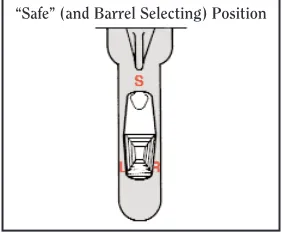
“Safe” (and Barrel Selecting) Position
“Fire” — Right Barrel First
Figure 6. Safety selector in forward “Fire Right Barrel (R) First” position. Pulling the trigger will fire the right barrel – a second pull will then fire the left barrel. It is not necessary to select between shots. The safety selector should be in this position only when the gun user is actually firing.
“Fire” — Left Barrel First Figure 4. Safety selector in “Safe” (S) full rearward position. The safety selector must be in this position to select position ‘L’ or ‘R’ described below. In this position, the trigger cannot be pulled to fire the gun. Either ‘L’ or ‘R’ may be partially visible, but the shotgun is only on “Safe” when the ‘S’ is fully exposed. If the ‘S’ is not visible, the shotgun is ready to fire!
Figure 5. Safety selector is forward “Fire Left Barrel (L) First” position. Pulling the trigger will fire the left barrel – a second pull of the trigger will then fire the right barrel. It is not necessary to select between shots. The safety selector should be moved to this position only when the gun user is actually firing.
Keep the safety on unless actually firing.
Always move the safety fully to its intended position and check it. The safety has three positions – “SAFE” (S), “FIRE (L) LEFT Barrel-FIRST” and “FIRE (R) RIGHT Barrel - Barrel-FIRST”. Never depend on a safety mechanism or any other mechanical device to justify careless handling or permitting the shotgun to point in an unsafe direction. The only “safe” gun is one in which the action is open and the chambers are empty.
KNOW HOW TO USE THE SAFETY
!
WARNING – SAFETY SELECTOR
This safety selector is held in each of its three positions by a plunger that is under spring tension. Therefore, the gun user should frequently check the position of the safety selector to be certain it has not been inadvertently moved. If the safety selector seems to move too easily, or if the safety selector does not seem firmly positioned in any of its three positions, the shotgun should be discontinued from use and returned to our Newport, New Hampshire Product Service Department for repair.
AMMUNITION
The Ruger 12 gauge Gold Label Side-by-Side Shotguns have 3” chambers and may be used with all standard commercially manufactured 2 3/4” and 3” shot shells. This gun has been tested with special proof test ammunition which conforms to U.S. industry practice. It is intended for use only with standard ammunition of the proper gauge and loading. Use of incorrect ammunition can destroy any gun and result in serious injury to the shooter or bystanders. (See “Ammunition Warning,” p. 15)
STEEL SHOT
All steel shot loads loaded to current U.S. industry specifications can be used in currently manufactured Ruger shotguns equipped with screw-in chokes, including the Ruger Gold Label Side-By-Side shotgun. Some older Ruger “Red Label” Over and Under shotguns were manufactured with conventional fixed chokes. In conventionally choked full choke barrels without screw-in choke tubes, the use of large size (F, T, BB and larger) steel shot can result in a very slight ring near the muzzle. It must be emphasized that this ring should have no adverse effect on pattern or shot velocity. As we have no control over the manufacture of ammunition which may be introduced in the future, we cannot be responsible for damage caused by steel shot loads.
“SAFE” “FIRE” RIGHT BBL.
FIRST
“FIRE” LEFT BBL.
Since steel shot generally patterns tighter than conventional lead shot loads, it would be wise to avoid the use of steel shot altogether in conventionally choked “full choke” barrels. Modified choke barrels generally deliver “full choke” patterns when used with steel shot.
We do not recommend anyof our shotguns for use with reloads, steel shot or
otherwise.
!
WARNING – AMMUNITION
AMMUNITION (CARTRIDGES) NOTICE
WE SPECIFICALLY DISCLAIM RESPONSIBILITY FOR ANY DAMAGE
OR INJURY WHATSOEVER OCCURING IN CONNECTION WITH, OR
AS A RESULT OF, THE USE IN ANY RUGER FIREARMS OF FAULTY, OR
NON-STANDARD, OR “REMANUFACTURED” OR HAND-LOADED
(RELOADED) AMMUNITION, OR OF CARTRIDGES OTHER THAN
THOSE FOR WHICH THE FIREARM WAS ORIGINALLY CHAMBERED.
Discharging firearms in poorly ventilated areas, cleaning firearms, or handling ammunition may result in exposure to lead and other substances known to the state of California to cause birth defects,
reproductive harm, and other serious physical injury. Have adequate ventilation at all times. Wash hands thoroughly after exposure.
SHOOTING OR CLEANING GUNS
MAY EXPOSE YOU TO LEAD
!
WARNING – LEAD EXPOSURE
Death, serious injury, and damage can result from the use of wrong ammunition, bore obstructions, powder overloads, or incorrect cartridge components. Always wear shooting glasses and hearing protectors.
3. To attach the barrel assembly to the receiver, hold the stock by the pistol grip in one hand as shown in Figure 8. Make sure the top lever is opened to the right in order to accept the barrel assembly. Hold the barrel assembly in the other hand, make sure both ejectors are fully extended from the chambers, and engage the hinge pin in the receiver with the corresponding
recesses at the front end of the monobloc. Be sure the small lug (indicated by the arrow in “A” in Figure 8.) on the outer surfaces of the ejectors engage the
corresponding slot inside the front end of the receiver BEFORE CLOSING
THE GUN! The foregoing caution must be followed otherwise the receiver will be damaged by the ejectors as the gun is closed.
ASSEMBLING THE SHOTGUN
The Ruger Gold Label Side-By-Side Shotgun is shipped partially disassembled. To assemble, proceed as follows:
1. After unwrapping the barrel/forearm assembly and receiver/stock assembly, wipe excess rust preventative oil from the monobloc and inside surfaces of the receiver. Swab the bores with a clean cloth patch on a cleaning rod to remove any excess oil.
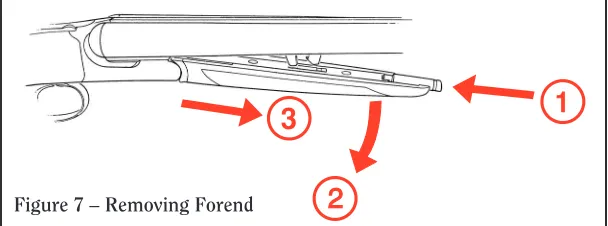
2. To Correctly Remove Forend (See Figure 7):
a. Unlatch forend by pressing in the forend latch plunger at tip of forend. b. Carefully pull down on tip of forearm until slight resistance is felt
-APPLICATION OF EXCESSIVE FORCE AT THIS POINT CAN RESULT IN BREAKAGE.
c. While holding forearm tip away from barrels, carefully pull forearm toward the muzzle and remove forearm from barrels.
Do not attempt to attach barrel assembly to receiver with the forend attached!
3
Figure 7 – Removing Forend
3
Figure 8 – Attaching Barrels
3
4. Swing the muzzle end of the barrels upward, pivoting the rear end of the monobloc
downward to seat in the receiver as shown in Figure 9. The barrel assembly is seated and locked into the receiver when the top lever snaps to its centered position.
Figure 9 – Closing Action
Figure 10 – Attaching Forend
5. Place the rear end of the forend iron against the receiver as shown in Figure 10, and swing the front end of the forearm upward until the forend latch lever aligns with the forend latch hook on the underside of the lower barrel. Depress the forend latch and carefully snap the forend assembly up into its locked position.
INSTALLATION OF SCREW-IN CHOKES
CHOKE WRENCH CHOKE INSERT
("TUBE") BARRELS
NOTE: Stainless Steelchoke inserts may protrude slightly from muzzle when
fully seated. This is normal and helps protect the muzzle of the barrel from damage.
To minimize the possibility of damage to the screw-in choke inserts and the barrel threads, it is recommended that a set of choke inserts be kept correctly tightened into the barrel at all times, including storage and cleaning. Cleaning the barrels without the choke inserts in place can push dirt and other fouling into the barrel threads, which will interfere with proper installation of the choke inserts.
Rifled and Saboted Slugs— Do not fire slugs unless a choke insert is installed (see “Screw-In choke Warnings”, p. 19). It is recommended that you do not fire slugs through a full choke insert.
Steel Shot— Steel shot loads manufactured to U.S. Industry Standards can be used with Ruger Screw-in choke inserts with no special precautions other than those listed above and on page 14.
Please Notethat the relatively lightweight barrels of this model you have chosen for its fast handling and ease of carrying, and their corresponding thinner choke tubes, require that the user take precautions to avoid abusive mishandling of the shotgun against hard objects that could cause dents or other deformation. This is a characteristic of all lightweight shotgun barrels and choke tubes. If such denting or deformation occurs, contact our Product Service Department
immediately to have the shotgun repaired. Never use any gun with dented or
Do not peer directly into the shotgun muzzles!
This is dangerous and unnecessary. Do not change choke inserts in a loaded shotgun, regardless of the position of the safety. Never fire the shotgun if the screw-in choke inserts are not fully and tightly bottomed into the barrel threads, or if the inserts are improperly installed or “cross-threaded”, or if the threads of either the barrel or the choke insert are damaged. Under these conditions, the barrel will be damaged and the screw-in choke inserts can be propelled out of the muzzle with great velocity when the gun is fired, with resultant risks of property damage or injury to the shooter or bystanders. Do not attempt to alter or modify existing fixed choke Ruger shotgun barrels for screw-in choke inserts. This can seriously weaken the barrel and may be dangerous. See “Alteration Warning” elsewhere in instruction manual.
DO NOT PEER INTO MUZZLES
OR CHANGE TUBES ON A
LOADED SHOTGUN
!
WARNING –SCREW-IN CHOKES
OPERATION OF THE SHOTGUN
Always check to be sure the gun is unloaded before handling, “dry-firing”, take-down, cleaning or storage.
Every Ruger Shotgun is inspected before shipment to ensure that it conforms to our standards of finish and performance. WE ASSUME NO RESPONSIBILITY FOR ANY INJURY OR DAMAGES RESULTING FROM ITS INTENTIONAL OR ACCIDENTAL DISCHARGE. No mechanism can prevent injury caused by careless or thoughtless handling of a loaded firearm.
Be sure you only use the correct choke inserts (tubes).Ruger Side-By-Side choke
tubes are notinterchangeable with any other Ruger shotgun chokes, including
those designed for our Red Label Over-and-Under shotguns. Screw-in choke inserts are stainless steel and stamped on the side either “FULL”, “MODIFIED”, “IMPROVED CYLINDER”, or “SKEET”. A general rule of thumb is that if the choke tubes screw in significantly below flush with the muzzle, or if the chokes stick more than slightly out of the muzzle when completely tightened, you are either using the wrong choke tubes or you have incorrectly installed them.
TO LOAD AND FIRE
Practice the important aspects of gun handling described below (with an unloaded gun) until you can perform each of the steps with skill and confidence. But before loading the shotgun, please read completely through this manual, and
be certain the muzzle is pointing in a safe direction. Do not load the shotgun
until you are ready to use it!
1. With the gun assembled, move the top lever completely to the right and open the action completely. The ejectors snap rearward with a “click” to their extended position if their barrels have been fired; otherwise, they will simply
move slowly rearward as if to extract but not eject an unfired cartridge. Make
sure that the safety has moved rearward to the safe (S) position.
2. Look through the barrels from the rear to be sure that both barrels are completely free from any obstruction (See Rule 4, p. 35).
3. With the gun opened, insert a shot shell of the proper gauge in each chamber. 4. Close the action and check to be sure it is securely locked and that the top
lever has moved fully to its centered position. Keep the gun pointed in a safe
direction and the safety on ‘S’. You may now select which barrel you prefer to fire first by moving the barrel selector either to the right (“R”) or the left (“L”). Most shooters fire the more open-choked barrel first, followed by a tighter choke, if a second shot is necessary at a target that is moving away from the shooter.
5. Only when you are ready to fire immediately, move the top safety thumbpiece forward to its “off”, or “fire” position. The gun is now ready to fire.
6. Pulling the trigger will fire the barrel you have selected to fire first — “L” (left) or “R” (right).
7. After firing the first barrel, the trigger must be allowed to return to its fully forward position to permit firing the second barrel. Simply pull the trigger again to fire the second barrel. It will fire regardless of a failure to fire in the first barrel or if you have failed to load a cartridge into the chamber of the first barrel, since the Ruger shotgun trigger mechanism does not depend upon the recoil of the first shot to “set” the second barrel for firing (as on some competing shotguns). Remember that you should not attempt to pivot the barrel selector between shots – the second barrel is automatically selected to fire on the next pull of the trigger.
8. If a second shot is not to be fired immediately, return the safety to its rearmost “S” position. The shotgun may be opened by pushing the top lever fully to the right and swinging the barrels downward. Any remaining live shells will be raised by the extractors and can be manually extracted; and fired shell cases will be automatically ejected when the barrels are fully opened. This is the
preferred safe carrying position for break-open shotguns. Always be certain
that the shotgun is pointed in a safe direction!
WARNING: DO NOT TOUCH THE TRIGGER
UNTIL YOU ARE READY TO FIRE.
!
WARNING – UNLOADING
After firing, move the safety to the ‘S’ position, move the top lever completely to the right, and pivot the barrels downward to open the action and eject the empty shot shells. Vigorously opening the barrels downward will assist in ejecting empty shells. If the action is opened with unfired shot shells in the chambers, they will be elevated (but not ejected) sufficiently to be easily extracted with the
fingers. You must remove live (unfired) cartridges manually! Visually inspect
both chambers to be sure the shotgun is completely unloaded prior to closing the action when you are finished shooting.
!
WARNING – FIRING
All persons must be a safe distance to the rear of the shooter when a shotgun is being fired. Particles of shot, lead, powder, lubricant, accumulated bore deposits and particles of clay targets can be blown in a wide area – particularly if the wind is blowing – into the eyes and face of the shooter and those nearby. For that reason shooters and bystanders must wear shooting glasses or similar eye protection. Hearing protection must also be worn because exposure to shooting noise can damage hearing.
ALWAYS WEAR EYE AND
HEARING PROTECTION
TO UNLOAD
So that the gun can be conveniently reloaded after firing one shot, the selective ejector mechanism only ejects fired shells. It does not eject live ammunition.Do not rely upon the ejector mechanism to unload the gun. Simply opening the gun does not unload it. To unload, open gun
smartly, manually remove all
cartridges,and visually check both chambers to be sure both chambers are unloaded.
!
WARNING – HANDLING
1
4
2
3
5
Manually Remove Unfired Shotshells
Fired Shell Cases Eject Automatically
S
Safety "On"
CORRECT UNLOADING SEQUENCE
Never carry the shotgun loaded with the safety “off”.Never place a loaded gun against any object (wall, fence, vehicle, tree, etc.) because there is always the possibility that the gun will be knocked or jarred from its standing position and fall with sufficient force to be
discharged. Keep the safety on (S) unless actually firing. Never point the gun at another person, or allow the muzzle to point at any part of your body, whether the safety is on or not. The only safe gun is one in which the action is open and unloaded.
DISASSEMBLY PROCEDURE
!
WARNING – DISASSEMBLY
To take down (disassemble) the Ruger Side-By-Side Shotgun, proceed as follows:
1.Check both chambers to be sure that the gun is unloaded.
2. Press in the forend latch plunger tip and separate the forend assembly from the barrels as in Step 2, page 16 (See Figure 7, p. 16).
3. Push the top lever all the way to the right and open the gun, pivoting the muzzle end of the barrels downward and lifting the barrel assembly out of the receiver as the hinge pin is disengaged from the corresponding recess at the front end of the monobloc.
4. Replace the forend assembly onto the barrel assembly by aligning the forend latch hook with the forend latch lever. Depress the forend latch plunger fully and carefully snap the forend fully upward into place against the underside of the barrels.
This completes the takedown required for all normal cleaning and maintenance
purposes. Further disassembly of component parts should only be undertaken by
persons qualified in shotgun repair and is not recommended.
CAUTION: THE RUGER SIDE BY SIDE SHOTGUN SHOULD NOT BE FURTHER DISASSEMBLED BY PERSONS UNQUALIFIED IN SHOTGUN REPAIR. IMPROPER FUNCTIONING AND DAMAGE TO THE GUN MAY RESULT.
IF THE BUTT STOCK IS REMOVED FROM THE FIREARM, UPON REASSEMBLY, IT MUST BE RETORQUED TO A MAXIMUM OF 4 FT/LBS. EXCESSIVE TIGHTENING OF THE STOCK BOLT (PART S-37), MAY RESULT IN THE STOCK CRACKING.
!
1 4
2
3 5
Remove
S
Never clean, lubricate,
disassemble or work on a
firearm while it is loaded.
!
WARNING – LUBRICATION
OIL
CARE AND CLEANING
WARNING: BEFORE CLEANING, BE CERTAIN THAT BOTH
CHAMBERS OF THE SHOTGUN CONTAIN NO CARTRIDGES
!
Always check to be sure the gun is completely unloadedbefore cleaning.
1. Take down the gun. (See Disassembly Procedure, p. 23)
2. Using a proper cleaning rod, run a solvent-wetted patch through each bore several times. Then run dry patches through the bore to remove all traces of residue. The bore, as referred to here, includes the chamber.
3. If the bore is leaded to the extent that the above patch-cleaning procedure will not remove the lead or plastic residue, then scrub the bore, full length, with a solvent-wetted brass-bristle brush. When the leading has been scrubbed loose, clean as described in Step 2 above.
4. The polished surfaces of the monobloc, ejectors, and inside surfaces of the receiver where the monobloc rests should be coated with a very light film of lubricating oil.
5. Reassemble the gun, and wipe exterior metal surfaces with a sparingly oiled cloth. Accumulation of oil tends to attract dirt which can interfere with the safe and reliable function of the gun. Swab the bores with an oily patch before storing the gun. Do not apply excess oil.
PERIODIC MAINTENANCE – At regular intervals, or whenever the gun has been exposed to sand, dust, extreme humidity, condensation, immersion in water, or other adverse conditions, take down and clean and oil as outlined above. Lubricate contact area of forend iron and receiver with Stainless steel lubricant. Proper periodic maintenance is essential to the reliable functioning of any firearm.
Firing a shotgun with oil, grease, or any other material even partially obstructing the bore may result in damage to the shotgun and serious injury to the shooter and those nearby. Do not spray or apply lubricants directly on shot shells. If the shot shell charge is affected by the lubricant, it may not be ignited, but the primer firing may push shot or wads into the bore where they may be lodged. Firing a subsequent shot into the obstructed bore may damage the gun and cause serious injury or death to the shooter and those nearby. Use lubricants properly. You are responsible for the proper care and maintenance of your firearms.
STORAGE
GUNS SHOULD NOT BE STORED LOADED!
Do notstore the shotgun in a leather case or scabbard. Leather attracts
moisture, even though the case may appear to be perfectly dry.
TO RENDER THE SHOTGUN INOPERATIVE
FOR SAFE STORAGE
Open the action and check both chambers to be sure the shotgun is completely unloaded! With the muzzle pointed in a safe direction, close the barrel assembly fully. Turn the shotgun over and depress the forend plunger tip. Carefully remove the forend from the barrel assembly. Next, turn the shotgun over and press the barrel opening lever fully to the right. Swing the barrel assembly downward and then carefully remove it form the receiver. Assemble the forend to the barrel assembly.
Store the shotgun stock-receiver assembly and the barrel-forend assembly in different locations. When disassembled in this manner, the shotgun is inoperable. It is impossible to fire the shotgun until the barrel assembly has been correctly reattached to the receiver assembly.
To reassemble the shotgun for firing, carefully remove the forend from the barrel assembly. Carefully replace the barrel assembly into the receiver and carefully swing the barrels shut. Now replace the forend onto the barrel assembly. Press the barrel opening lever fully to the right and break the shotgun open. The shotgun is now reassembled and can be loaded and fired normally.
USE THE LOCKING DEVICE SUPPLIED WITH THE SHOTGUN FOR STORAGE. (SEEPAGE6)
Never place or store any firearm in such a manner that it may be dislodged. Firearms should always be stored securely and unloaded, away from children and careless adults. Use the locking device supplied with the rifle for storage.
The use of a locking device or safety lock is only one aspect of responsible firearms storage. For increased safety, firearms should be stored unloaded in a location that is both separate from their ammunition and inaccessible to children and any other unauthorized person.
MAINTENANCE OF
STAINLESS STEEL COMPONENTS
Firearms and components made of stainless steel are relatively more resistant to corrosion than those of blued steel. However, in the interest of proper operation and long life of a stainless steel firearm, inspect it frequently and clean, lubricate and apply an appropriate rust preventative.
Sometimes discoloration occurs from perspiration or from contact with some types of gun cases. Rusting may occur as a result of the firearm being exposed to moisture, salt air or chemicals.
Minor discoloration can usually be removed by rubbing the stainless steel area with an abrasive ink eraser, crocus cloth, or a “metal polishing” compound. When using any of these abrasives, proceed with care and use light pressure to achieve a blending of “color” with those areas that are not discolored.
External surfaces most subject to rusting from handling, or from exposure to the elements should be cleaned and wiped dry after use or after exposure to adverse conditions. If the shotgun is to be stored, coat it with a light film of oil or preservative. Where the shotgun is in continuing use, and the presence of oil or grease would be objectionable, then the external surfaces can be coated (after cleaning and drying) with a paste wax formulated for use on metals. Apply the wax sparingly, allow time for it to dry hard, then buff lightly with a soft cloth. When applying the wax, take care that it does not get into the mechanism or on the functioning parts or in the bore.
SHIPPING FIREARMS FOR REPAIR
RUGER®SIDE-BY-SIDE SHOTGUNSreturned to the factory for repair
should be sent to: Sturm, Ruger & Company, Inc., Product Service Department, 411 Sunapee Street, Newport, New Hampshire 03773. Telephone (603) 865-2442. Guns should be sent prepaid. We will not accept collect shipments.
The Federal Gun Control Act, as well as the law of most States and localities, does not prohibit an individual (who is not otherwise barred from purchasing or possessing a firearm) from shipping a firearm directly to the manufacturer for repair. However, before you ship your shotgun to us, be certain that your State or locality does not have a law or regulation which will prohibit you from receiving the shotgun from us after it has been repaired. If such receiving is prohibited, then please have a Federally Licensed firearms dealer ship the gun to us. If your shotgun is sent to us by a dealer, it will be returned to him after being repaired. If a handgun (pistol or revolver) is shipped by an individual who does not hold a Federal Firearms License, it must be shipped via U.P.S. (Next Day Air) Persons who do not hold a Federal Firearms License are prohibited by Federal law from shipping a handgun by Mail. Handguns mailed in violation of the law are impounded by the Post Office.
Please do not include your carrying case, scabbard, or custom accessories with a firearm being shipped to the factory for service. DO NOT SEND GUN BOXES OR LITERATURE THAT YOU CONSIDER TO BE COLLECTOR’S ITEMS – THESE ARE INVARIABLY DAMAGED OR DESTROYED IN SHIPMENT. Rifles and shotguns may be shipped via Parcel Post. Always insure your shipment.
Enclose a letter which includes your name, address, telephone number, serial number and model of the firearm. Describe in detail the trouble you have experienced with your firearm, or the work you wish to have done. Merely stating that the firearm “needs repair” is inadequate information.
Work performed will bear a net minimum labor charge of $20.00 plus a $12.00
shipping and handling charge. The charge for rebluing the RUGER®
SIDE-BY-SIDE SHOTGUNis $75.00 plus a $12.00 shipping and handling charge.
Custom gunsmithing service or nonstandard alterations are NOT AVAILABLE from Ruger Product Service Departments.
SERVICE AND PARTS POLICY
If you have any question with regard to the performance of your RUGER®
SIDE-BY-SIDE SHOTGUNplease write or call (603-865-2442) our Product
Service Department, 411 Sunapee Street, Newport, New Hampshire 03773, fully describing all circumstances and conditions involved. If you should return your shotgun to the factory for repair, or order parts for it, please comply with the following suggestions for prompt service.
It is the purchaser’s responsibility to be absolutely certain that any parts ordered from the factory are correctly fitted and installed. Firearms are complicated mechanisms and IMPROPER FITTING OF PARTS MAY RESULT IN A DANGEROUS MALFUNCTION, DAMAGE TO THE FIREARM, AND SERIOUS INJURY TO THE SHOOTER AND OTHER PERSONS. The purchaser and installer of parts must accept full responsibility for the correct adjustment and functioning of the shotgun after such installation.
PARTS MUST FIT CORRECTLY
!
WARNING –PARTS PURCHASERS
ORDERING PARTS
Please contact the New Hampshire Product Service Department for parts
availability and current prices. All parts orders for theRUGER®
SIDE-BY-SIDE SHOTGUN should be sent to: Sturm, Ruger & Company, Inc., Product
Service Department, 411 Sunapee Street, Newport, New Hampshire 03773, (603) 865-2442. We cannot comply with open account or C.O.D. requests. Payment in the form of a check, money order, Visa or Mastercard must accompany your order. Credit Card orders must include the account number, expiration date and whether it is a Visa or Mastercard account. Minimum parts order is $1.00 plus a $3.50 shipping and handling charge. Order parts by Part Number and Part Name and include the entire serial number of the firearm for which the parts are being ordered. There is a minimum net labor charge of $20.00 if the parts are factory fitted. All factory-fitted parts are fitted on an exchange basis only. We will not return the replaced parts.
Barrels and a number of other component parts must be fitted at the factory. Company policy is to proof-test and/or function fire all barrels after fitting to the receivers in which they are to be used. This procedure ensures maximum protection to our customers. The special proof-test ammunition used in this testing is sold only to bonafide firearms manufacturers and is not available to gun shops, gunsmiths, or individuals.
Because the receiver of the RUGER® SIDE-BY-SIDE SHOTGUN is
defined as a “firearm” by Federal Law, it is not offered for sale as a separate component part.
*Parts designated by an asterisk must be factory fitted. These parts are fitted on an exchange basis only. We will not return the replaced parts. We will not return any part that is broken, malfunctioning, badly worn or has been modified. See “Warning – Parts Purchasers” above.
CAUTION: A GUN CONTAINING MODIFIED, BROKEN,
MALFUNCTIONING, OR BADLY WORN PARTS SHOULD NOT
BE FIRED.
29
RUGER
®SIDE-BY-SIDE SHOTGUNS
PARTS LIST
Design, prices and specifications subject to change without notice.
SPECIFY MODEL AND GAUGE WHEN ORDERING
(See Exploded View on Page 33.)
Number
Part No.
Part Name
Model
1
KSXS60001
Top Lever Spring Strut Assembly
Side-By-Side
2
OU-12
Firng Pin Spring, 2 Req’d
Side-By-Side
*
3
OU-11-12
Firing Pin, 2 Req’d
Side-By-Side
*
4
KSXS01701
Hammer, Left
Side-By-Side
*
5
KSXS01703
Hammer, Right
Side-By-Side
6
KSXS01502
Cocking Strut
Side-By-Side
7
KSXS01502
Cocking Strut
Side-By-Side
8
OU-51
Firing Pin Retaining Pin, 2 Req’d
Side-By-Side
*
9
SXS0601
Top Lever
Side-By-Side
10
OU-72
Top Lever Trip Plunger
Side-By-Side
11
OU-73
Top Lever Trip Plunger Spring
Side-By-Side
12
SXS07102
Top Lever Trip Pin
Side-By-Side
*
13
KSXS00901
Locking Bolt
Side-By-Side
*
14
KSXS00903
Locking Bolt Actuator
Side-By-Side
15
D-26
Trigger Housing Cross Pin
Side-By-Side
16
OU-43
Hammer Pivot Pin
Side-By-Side
17
OU-21
Trigger Sear Pivot Pin
Side-By-Side
*
18
KOU02304
Sear, Right
Side-By-Side
*
19
OU-42
Sear Spring
Side-By-Side
Number
Part No.
Part Name
Model
*
22
KSXS05201
Safety Block
Side-By-Side
*
23
KSXS03301
Safety Extension
Side-By-Side
24
OU-39
Safety Detent Plunger, 2 Req’d
Side-By-Side
25
OU-54
Safety Detent Spring, 2 Req’d
Side-By-Side
26
KSXS03000
Safety Detent Spring
Side-By-Side
27
KE-55
Trigger Guard Plunger Cross Pin
Side-By-Side
*
28
KSXS04900
Blocking Bar
Side-By-Side
29
OU-36
Blocking Bar Retaining Pin
Side-By-Side
30
OU-83
Interruptor Plunger Spring
Side-By-Side
31
OU-85
Interruptor Plunger
Side-By-Side
*
32
KOU07503
Hammer Interruptor
Side-By-Side
*
33
KSXS00020
Trigger
Side-By-Side
34
S-31
Roll Pin
Side-By-Side
35
KOU-16
Sear Selector
Side-By-Side
36
OU-21
Trigger Sear Pivot Pin
Side-By-Side
37
KOU-53
Inertia Weight
Side-By-Side
38
OU-64
Link
Side-By-Side
39
OU-66
Sear Selector Pivot Pin
Side-By-Side
40
OU-58
Inertia Weight Spring
Side-By-Side
*
41
KOU90008
Hammer Strut Assembly, Left
Side-By-Side
*
42
KOU90007
Hammer Strut Assembly, Right
Side-By-Side
43
OU-51
Inertia Weight Pivot Pin
Side-By-Side
44
S-31
Roll Pin
Side-By-Side
45
KSXS01502
Cocking Bar Retaining Screw
Side-By-Side
Number
Part No.
Part Name
Model
46
KSXS00801
Ejector Kicker, Left
Side-By-Side
47
KSXS00803
Ejector Kicker, Right
Side-By-Side
48
KSXS00808
Ejector Kicker Pivot Screw, 2 Req’d
Side-By-Side
49
SXS00806
Ejector Striker Spring, 2 Req’d
Side-By-Side
50
SXS00805
Ejector Striker, 2 Req’d
Side-By-Side
*
51
KSXS03000
Cocking Bar
Side-By-Side
52
KSXS08910A
Choke Insert, Full
Side-By-Side
KSXS08911A
Choke Insert, Modified
Side-By-Side
KSXS08912A
Choke Insert, Improved
Side-By-Side
KSXS08913A
Choke Insert, Skeet
Side-By-Side
OU09020A
Choke Wrench, Not Illustrated
Side-By-Side
53
SXS01403
Extractor Retainer
Side-By-Side
54
KMS04600
Bolt Lock Plunger Spring
Side-By-Side
55
KSXS21400
Extractor Assembly, Left
Side-By-Side
56
KSXS03001
Safety Detent Ball
Side-By-Side
57
KE-55
Trigger Guard Plunger Cross Pin
Side-By-Side
58
OU-18
Hammer Spring, 2 Req’d.
Side-By-Side
59
KSXS31400
Extractor Assembly, Right
Side-By-Side
60
KSXS00104
Frame/Tang Weldment – Not Offered For Sale
Side-By-Side
w/ two KSXS00105 Bushings
61
OU-67
Front Sight Bead
Side-By-Side
*
62
SXS50000B
Barrel Assembly
Side-By-Side
*
63
KSXS17900
Forend Iron Assembly
Side-By-Side
64
KSXS02600
Forend Iron Head Screw
Side-By-Side
Number
Part No.
Part Name
Model
65
KSXS04800
Forend Iron Screw
Side-By-Side
66
SXS00701
Latch Bar Plunger
Side-By-Side
67
SXS00703
Latch Bar Spring
Side-By-Side
68
SXS12800
Latch Bar & Latch Tip Assembly
Side-By-Side
*
69
SXS00500M
Forend Assembly
Side-By-Side
*
70
SXS00402A
Butt Stock
Side-By-Side
71
S-38
Stock Bolt Washer
Side-By-Side
72
OU09101
Stock Bolt Lock Washer
Side-By-Side
73
S-37
Stock Bolt
Side-By-Side
74
C-90-SM
Butt Plate
Side-By-Side
75
OU09105
Butt Plate Screws, 2 Req’d.
Side-By-Side
*
76
OU-2
Trigger Guard
Side-By-Side
* PARTS SO MARKED MUST BE FACTORY FITTED
33
RUGER
®SIDE-BY-SIDE SHOTGUN
THE BASIC RULES OF SAFE FIREARMS HANDLING
We believe that Americans have a right to purchase and use firearms for lawful purposes. The private ownership of firearms in America is traditional, but that ownership imposes the responsibility on the gun owner to use his firearms in a way which will ensure his own safety and that of others. When firearms are used in a safe and responsible manner, they are a great source of pleasure and satisfaction, and represent a fundamental part of our personal liberty.
Firearms do not cause accidents! Firearms accidents are almost always found to have been the result of carelessness, or ignorance on the part of the shooter of the basic rules of safe gun handling.
The following rules must be observed by gun users at all times. Safe gun handling is not just desirable, it is absolutely essential to your safety, the safety of others, and the continuation of gun ownership and sport shooting as we know it today.
1. LEARN THE MECHANICAL AND HANDLING
CHARACTERISTICS OF THE FIREARM YOU ARE USING.
Not all firearms are the same. The
method of carrying and handling
firearms varies in accordance with
the mechanical provisions for
avoiding accidental discharge and the
various proper procedures for loading
and unloading. No person should
handle any firearm without first
having thoroughly familiarized
himself with the particular type of
firearm he is using, and with safe gun
handling in general.
2. ALWAYS KEEP THE
MUZZLE POINTED IN A
SAFE DIRECTION.
A safe direction must take into account the fact that a bullet may
penetrate a wall, ceiling, floor, window, etc., and strike a person or
damage property. Make it a habit to know exactly where the muzzle of
your gun is pointing whenever you handle it, and be sure that you are
always in control of the direction in which the muzzle is pointing, even
if you fall or stumble. Keep your finger off the trigger until you are ready
to shoot.
3. FIREARMS SHOULD BE UNLOADED WHEN NOT IN
USE
.
Firearms should be loaded only
when you are in the field or on the
target range or shooting area,
ready to shoot. Firearms and
ammunition should be securely
locked in safes, racks or cabinets,
or by using the locking device
supplied with the firearm, when
not in use. Ammunition should
safely be stored separate from
firearms. Store your firearms out
of sight of visitors and children. It
is the gun owner’s responsibility to
be certain that children and persons unfamiliar with firearms cannot
gain access to firearms, ammunition, or components.
4. BE SURE THE BARREL IS CLEAR OF OBSTRUCTIONS
BEFORE SHOOTING.
E
ven a bit of mud, snow or excess
lubricating oil or grease in the
bore may cause the barrel to
bulge, or even burst on firing, and
can cause serious injury to the
shooter and bystanders. Be sure
that you are using ammunition of
the proper caliber and loading for
the gun you are using. If the
report or recoil on firing seems
weak, or doesn’t seem quite right,
CEASE FIRING IMMEDIATELY,
unload your firearm, and check to
be sure that no obstruction has
become lodged in the barrel. Never try to shoot out an obstruction!
1 4
2
3 5
Manually Remove Unfired Shotshells
Fired Shell Cases Eject Automatically
S
5. BE SURE OF YOUR
TARGET BEFORE YOU
SHOOT.
Don’t shoot unless you know
exactly where your bullet or shot
is going to strike. Be sure of the
bullet stop behind your target,
even when dry-firing with an
unloaded gun. If you are in the
field hunting, do not fire at a
movement or noise. Take the time
to be absolutely certain of your
target before you pull the trigger.
6. WEAR SHOOTING
GLASSES AND HEARING
PROTECTORS WHEN
YOU SHOOT.
All shooters should wear
protective shooting glasses and
adequate hearing protectors when
shooting. Exposure to shooting
noise can damage hearing, and
adequate eye protection when
shooting is essential.
7. NEVER CLIMB A TREE
OR FENCE WITH A
LOADED FIREARM.
8. DON’T SHOOT AT A
HARD SURFACE, OR AT
WATER.
Bullets and shot can glance off
many surfaces like rocks or the
surface of water and travel in
unpredictable directions with
considerable velocity.
9. NEVER TRANSPORT A
LOADED FIREARM.
Firearms should always be
unloaded before being placed in a
vehicle. A suitable carrying case
or scabbard should by used to
carry an unloaded firearm to and
from the shooting area.
10. AVOID ALCOHOLIC
BEVERAGES WHEN
SHOOTING.
A BRIEF ACCOUNT OF AN EXTRAORDINARY
ACHIEVEMENT: RUGER FIREARMS
One of the few American firearms manufacturers whose management
has remained in the same family since starting in business, Sturm,
Ruger & Company, Inc., had its beginning in a small machine shop
occupying a rented frame building in Southport, Connecticut. In
January, 1949, with an initial investment of only $50,000 and an idea,
William B. Ruger and Alexander M. Sturm started production of a .22
caliber autoloading pistol–a design which was so successful that it
became the cornerstone upon which one of the most comprehensive
lines of sporting firearms ever made in America was established. After
Alex Sturm’s death in 1951, William B. Ruger continued to direct the
company alone and today, William B. Ruger, Jr. continues to provide
guidance which has made this company a sound and successful
enterprise.
Sturm, Ruger & Company, in this relatively short time, has established
itself as a leading small arms design organization, developing a unique
and broad line of fine quality sporting, military and police firearms to
become one of the world’s most famous producers of revolvers, pistols,
rifles and shotguns. Since 1949 Ruger craftsmen have built many
millions of firearms.
During its five decades of growth and progress under the leadership of
William B. Ruger, the company developed a business philosophy and
implemented policies which represent a constructive influence in the
life of modern America. From the beginning, Sturm, Ruger & Company
played a positive role in conservation efforts and has supported the
interests of shooters through such groups as the National Rifle
Association, National Shooting Sports Foundation, and many regional
sportsmen’s organizations.
The company has always endeavored to market its firearms for
constructive and recreational purposes, to emphasize the traditional
aspects of shooting, to render meaningful public services and to
encourage shooters in constructive, responsible, and safe participation
in the shooting sports. Its motto is “Arms Makers For Responsible
Citizens.”
Today, Sturm, Ruger & Company is particularly mindful of those
elements which have contributed to the creation of its success, and
extends heartfelt thanks to its many loyal employees and customers.
WHY NO WARRANTY CARD HAS BEEN
PACKED WITH THIS NEW RUGER FIREARM
The Magnuson-Moss Act (Public Law 93-637) does not require any
seller or manufacturer of a consumer product to give a written
warranty. It does provide that if a written warranty is given, it must be
designated as “limited” or as “full” and sets minimum standards for a
“full” warranty. Sturm, Ruger & Company, Inc. has elected not to
provide any written warranty, either “limited” or “full”, rather than to
attempt to comply with the provisions of the Magnuson-Moss Act and
the regulations issued thereunder. There are certain implied
warranties under state law with respect to sales of consumer goods. As
the extent and interpretation of these implied warranties varies from
state to state, you should refer to your state statutes. Sturm, Ruger &
Company wishes to assure its customers of its continued interest in
providing service to owners of Ruger firearms.
STURM, RUGER & Company, Inc.
Southport, Connecticut 06890 U.S.A.
http://www.ruger.com
“Arms Makers For Responsible Citizens”
®
A COPY OF THE INSTRUCTION MANUAL FOR ANY RUGER FIREARM IS AVAILABLE FROM THE FACTORY FREE ON REQUEST.
THESE INSTRUCTION MANUALS CONTAIN IMPORTANT WARNINGS WHICH MUST BE UNDERSTOOD
BEFORE USING THESE FIREARMS.
“RUGER”, the Sturm, Ruger logo, “SINGLE-SIX”, “BLACKHAWK”, “REDHAWK”, “SECURITY-SIX”, “SPEED-SIX”, “SERVICE-SIX”, “BEARCAT”, “OLD ARMY”, “10/22”, “MINI-14”, “MINI THIRTY”,
“RANCH RIFLE”, “M77”, “77/22”, “77/44”, “77/50”, “GP-100”, “SP101”, “P-85” and “VAQUERO” are registered U.S. trademarks.