ABSTRACT
BARTLEY, APRIL YOUNG. Teacher Conceptions of Care and the Impact on Elementary School Students. (Under the direction of Dr. Patricia Marshall.)
The emphasis of this study is to understand the conceptions and manifestations of care within the context of the elementary classroom as determined by caring teachers, and how these caring teachers respond to differences among student ethnicities within their conceptions and manifestations of care. This study also looked at the perceived impact of care on students. The definition of care used in this study that arose out of the research literature is the trusting, respectful and supportive relationship between the teacher (care giver), and the students (care receivers), within the classroom setting. By looking at how ethnicity of the student population impacts teacher perceptions of care, this study furthered the extant research on the topic of teacher care.
Data was collected for this research through semi-structured interviews with ten caring elementary teachers. These teachers were each allowed to explain and construct their definitions of care, how they manifest care within the classroom, and the impact of care on students. From these constructions, common themes emerged defining care, explaining how it is shown in the classroom, and how it impacts students.
Teacher Conceptions of Care and the Impact on Elementary School Students
by
April Young Bartley
A thesis submitted to the Graduate Faculty of North Carolina State University
in partial fulfillment of the requirements for the Degree of
Master of Science
Curriculum and Instruction, Elementary Education Raleigh, NC
2007
APPROVED BY:
__________________________ _________________________
Dr. Tom Oppewal Dr. Alan Reiman
BIOGRAPHY
I was born in Charlotte, North Carolina, to Dennis and Beth Young. After graduating from Providence High School in Charlotte, North Carolina, in June 1996, I earned a BA in History from North Carolina State University in December of 1999. I also completed my Elementary Education licensure program at Meredith College in May 2000. I gratefully accepted a job teaching fourth grade at Covenant Day School in Matthews, North Carolina, in August 2000 and taught fourth and then third grade for five years there. During this time I married Brandon Bartley, son of Jon and Kathryn Bartley of Raleigh, North Carolina. After five years of teaching, I began the Masters program in Curriculum and Instruction,
Elementary Education at North Carolina State University. I will graduate in December 2007 with a Master of Science in Curriculum and Instruction, Elementary Education.
ACKNOWLEDGEMENTS
Most importantly I want to thank God for giving me the strength to go through and complete this masters program. I would also like to thank my husband for his continuous love and support, which are invaluable to me, and his listening ears. I also want to acknowledge my family and thank them for their constant love and encouragement. My husband, family, and friends are blessings for which I will always be thankful. I also extend my thanks to the faculty and staff in the College of Education at North Carolina State
University for the opportunity to work with and learn from them. In addition, I would like to thank my committee chair and committee members for all of their time and help throughout this process. Also, thank you to all of the wonderful teachers that I have had the pleasure to learn from and work with throughout my schooling and career that have modeled for me what a caring teacher truly is.
TABLE OF CONTENTS
LIST OF TABLES………. v
LIST OF FIGURES………... vi
Chapter 1: Introduction and Literature Review ………... 1
What is Care?... 2
Care Within Education……….. 6
Care Within the Realm of Elementary Education………. 11
Culturally Responsive Teaching……… 17
Chapter 2: Methodology and Data Collection ………..…... 21
Semi-structured Interview Process……… 22
Participant Selection……….. 24
Interview Protocol………. 31
Chapter 3: Data Analysis, Conclusions, and Discussion………... 35
Results……….... 35
Conclusions……… 52
Recommendations for Future Research………. 56
REFERENCES………. 59
APPENDICES……….. 62
Appendix A. Initial Principal Letter……… 63
Appendix B. Revised Initial Principal Letter……….. 64
Appendix C. Participant Letter……… 65
Appendix D. Revised Participant Letter………. 66
Appendix E. Informed Consent Form………. 67
Appendix F. Interview Protocol……….. 68
Appendix G. Member Checking Email………... 69
Appendix H. Major and Minor Emergent Themes list………… 70
LIST OF TABLES
Table 1.1 Connections Between CDP and Previous Research………. 12 Table 2.1 Summary of Participant Demographics……… 31
LIST OF FIGURES LITERATURE REVIEW
Figure 1. Windows of Care………... 7
Figure 2. Cycle of Care………. 13
Teacher Conceptions of Care and the Impact on Elementary School Students
Chapter 1: Introduction and Literature Review
Care is a need for all people and it has a positive impact on those who receive it. This positive impact can be manifested in such ways as an increased sense of self worth, increased motivation, or perseverance in accomplishing a goal. Care can be particularly important to students. Students that experience care given by their teachers can be positively impacted in numerous ways. For example, such students demonstrate an increased sense of community at school, increased academic motivation, and an increase in concern for others (Solomon, Battistich, Watson, Schaps, & Lewis, 2000). This positive impact of care on students has become a growing area of educational research. Specifically, research on care in the
elementary classroom reveals that students’ appreciation of learning and the foundations of their learning at this young age are effected by their perceptions of teacher care. One researcher noted, “A teacher may be perceived to know everything about the subject he or she teaches, but if he or she does not act in a caring manner, students in that teacher’s
demonstrate care within a culturally diverse classroom. Through this research I hope to provide insight into caring classrooms that will add to the existing research in this area and benefit teachers and their students.
I begin this document with an explanation of care. This will provide a starting point and provide background on which to build the remaining sections that go into more detail about care as it is manifested in classrooms. Studies describing care and its impact on students will be explained to provide insight into the extant research on care. This will be narrowed down within a section dealing specifically with elementary classroom care as this is the focus of the data for this study. The literature review will also describe culturally responsive teaching. Culturally responsive teaching is a way for teachers to show care to their students, but is not as widely explored in this literature review as the general topic of care. This will provide background information on showing care within ethnically diverse classrooms and will be tied in with the results from the data collection allowing for analysis of the impact of teacher care in ethnically diverse classrooms.
Following the literature review, I will describe the purpose and methodology used for this study. After this section will be the results from the data collection process. I will also include in this last section a discussion and analysis of the findings with references to the studies in the literature review. Limitations to the research and implications for future research will also be discussed.
What Is Care?
Bowlby and Ainsworth on attachment theory, synthesized their research and describes their assertions on care in relation to attachment theory. He explains that John Bowlby focused his attention on attachment of care receivers to care givers. Bowlby defined care givers in
multiple roles (e.g. mothers or social workers) but overall his research explored the impact of the care giver on the care receiver. Bretherton explains that in Bowlby’s World Health Organization paper in 1951 he examined the mental health of homeless children looking specifically at the separation of children from their mothers, and concluded that “the infant or young child should experience a warm, intimate, and continuous relationship with his [sic] mother (or permanent mother substitute) in which both find satisfaction and enjoyment” (Bowlby, 1951, p. 13). In this particular study, Bowlby defined care as a warm, intimate and continuous relationship with the care giver (which in this case is the mother or mother substitute) that in turn provides satisfaction and enjoyment. Bretherton asserts that Bowlby further proposed that children need a close, consistent relationship with a care giver to thrive emotionally.
To further explain care through Bowlby’s attachment theory Bretherton (1992) refers to Bowlby’s 1973 book, Separation, which was a continuation of his previous work on attachment of children (care receiver) to their mothers (care givers). In this book, which drew on his previous research and that of others such as Freud and Waddington, Bowlby found a connection between the care receiver’s development of self and the care giver. He concluded that if the care giver (or the one to whom the child is attached) provided for the child’s needs for comfort and protection while also providing for the child’s need for independent
exploration, then the child would construct a sense of self as unworthy or incompetent. Bretherton states this explanation of care as the act of providing comfort and protection while allowing the child the freedom to explore his or her environment. This is very different from the previously mentioned explanation of care (i.e., a warm, intimate, continuous relationship) however because Bowlby’s 1973 research was a continuation of his earlier work, one can assume that his concept of care as providing comfort, protection, and freedom to explore
would occur within a warm, intimate, continuous relationship. Additionally, in Bowlby’s more recent work care was manifested in the child’s development of a sense of self that is valued and self-reliant. Bretherton asserts that Bowlby’s work suggests that care is
manifested in children through their thriving emotionally and developing a valued and self-reliant sense of self.
Continuing in his explanation of care, Bretherton (1992) describes the work of Mary Ainsworth who supported John Bowlby’s assertions through her own work on care givers and care receivers. In 1963, she studied 26 families in Baltimore by conducting interviews and making home visits to obtain observational data. She looked specifically at the
between mother and child as well as through feelings of satisfaction and affection felt by the children. Bretherton concludes his explanation of care by correlating Ainsworth’s research with Bowlby’s by explaining that the latter defines care as a feeling, such as warmth and intimacy, whereas the former defines it as tenderness and sensitivity. Also, care is manifested through the child’s feelings, either of self worth or satisfaction.
In additional writing on care, Nel Noddings (1995) depicts care as more than a warm feeling. She states that care is a continuous search for competence by which she means that people feel care when they are recognized for doing their best. This recognition by the care giver is what makes the care receiver feel competent. Accordingly, people will feel cared for when they see that they are able to make positive contributions based on their own talents and this in turn will be appreciated by others. With these studies providing a background explaining care, I will now turn to studies that describe care and its impact within the realm of education.
Care Within Education.
professors) they stated that care included putting others’ needs before one’s own and
respecting others’ decisions. In this study the participants explained that care was manifested in the comfort that they felt around care givers and feelings of security and trust.
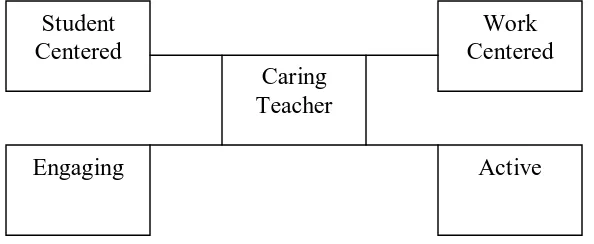
After the initial questioning of the preservice teachers was conducted by Nowak-Fabrykowski and Caldwell (2002), these same preservice teachers were asked to think about how they would demonstrate care in their classrooms based on four “windows of care” as determined by Caldwell. These four windows, as illustrated in Figure 1, defined a caring teacher as 1) being student centered, by being patient and listening for example, 2) work centered, such as providing extra time if needed to complete an assignment, 3) engaging, by providing time for discussion; and 4) active, for example relating learning to students’ lives.
Figure 1. Windows of Care (Nowak-Fabrykowski & Caldwell, 2002)
After this time of reflection, the researchers found that the preservice teachers were more aware of the importance of teacher care within the classroom as they were able to come up with ways that they could incorporate care into their future teaching, such as by actively listening to students. In addition, the researchers further emphasized the importance of the role of the teacher as care giver by modeling caring characteristics as an example of how these teachers would someday show care to their students. It is to be noted that this study occurred within one university in which the demographics of the student teachers were not described. Also, there was no mention of the students with which these preservice teachers
Caring Teacher Student
Centered
Engaging
Work Centered
had experience. These factors limit our understanding of care as these factors may impact how care is understood and manifested. The focus of this study was the reflection on care by the preservice teachers and the development of their understanding of how to provide care within the classroom.
In similar research on the importance of care in the role of a teacher, Collinson, Killeavy, and Stephenson (1998) also asked their participants to reflect on care, however their participants were experienced teachers. They surveyed and interviewed 12 teachers (seven females and five males) from England, Ireland, and the United States all of which had more than 15 years of experience teaching. There was little racial diversity among the
teachers and there was no mention of the diversity of the students that these teachers taught, which again could impact perceptions of care and its manifestation. The teachers were
chosen by administrators or peers because of their professional accomplishments and because they were considered models for their peers. Through the questioning of the researchers and comments by the experienced teachers, definitions of care emerged. These model teachers saw respect as foundational to care. The manifestation of this definition of care was considered to be effective teaching and ultimately the best learning for students. Also, the researchers saw another definition of care emerge wherein the teachers explained care as working hard to know students through multiple sources, such as observing, dialogue, or written work that revealed student thinking. Care, according to this definition, was
The Nowak-Fabrykowski and Caldwell (2002) study and the Collinson et al. (1998) study on the importance of care within the roles of classroom teachers are also similar in that they incorporate the theoretical views of Mayeroff (1971) who asserts that care is shown between the teacher and student when the teacher takes time to truly know the students. “Knowing a student” is defined as understanding what a student needs to grow and actualize him or herself, or finding how each child can feel competent in his or her talents. This feeling of competence is the same manifestation of care as defined by Noddings (1995). All of these studies on care seem to be getting at the same aspect of care, which is building relationships between care giver (the teacher) and care receiver (the student) and in turn facilitating the development of feelings of competence, respect, and understanding within care receivers. This further emphasizes the importance for teachers to demonstrate care within the classroom.
respect was felt due to the considerate tone of voice and receptive manner of the teachers. In addition, the students noted that they felt respected because discipline was used as a way to teach, not just to punish. One teacher expressed discipline as a problem solving method in which he sought the input of the students. Through respectful treatment of the students, the teachers were able to establish trusting relationships with their students. In turn the students felt cared for and therefore reciprocated respect back to their teachers. This study brings out the impact on students as teachers make demonstrating care an important part of the
classroom.
In another study describing the impact of care on students as teachers demonstrate care within the classroom, Samdal, Nutbeam, Wold, and Kannas (1998) explain that if students feel care, then they also feel more satisfied with school. These researchers
conducted a survey with a cluster sample of students aged, 11, 13, and 15 in four European countries. The sample size of students from each country was considerably large and there was a fairly equal representation of males and females. Again in this study, there was no mention of the ethnicity of the students. The survey included questions about student satisfaction with school as measured on a Likert scale. One of the conclusions that emerged was that a teacher’s way of caring for the students played a significant role in determining satisfaction with school. The caring interaction that the teachers had with students
students in rule making and teacher enforcement of the rules fairly and consistently also increased student satisfaction with school. Therefore these researchers inferred that students feel care when their teachers provide consistent, fair discipline. This feeling of care in return, manifests itself in students feeling secure and ultimately more satisfied with school. This study as well as the previous one emphasizes how teacher care impacts students.
Care Within the Realm of Elementary Education
The previous studies have provided an explanation of care, emphasized its importance in the role of a teacher, and shown how it is manifested by teachers and its impact on
students, however none of them focused specifically on elementary aged students. The work of the Child Development Project (CDP) over the past few decades has looked specifically at care as it is demonstrated in the elementary school setting. In an effort to define the concept of care, Solomon, Watson, Battistich, Schaps, and Delucchi (1992) synthesized research from the CDP. They report that care is established by building positive relationships within the classroom among students, and between students and the teacher. These relationships
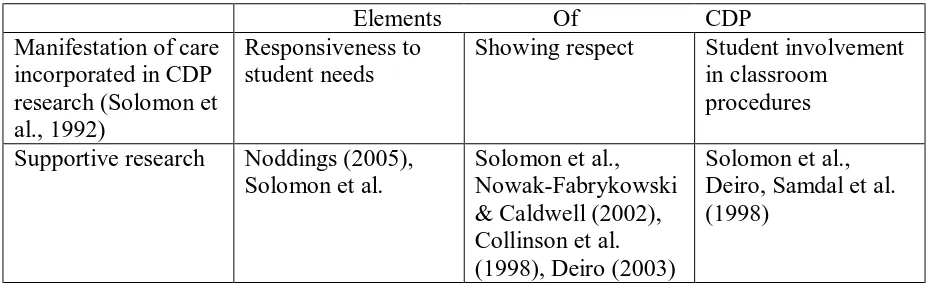
with the findings of Nowak-Fabrykowski and Caldwell (2002), Collinson et al. (1998), and Deiro (2003). Further, the inclusion of student involvement in classroom procedures within their definition of care reflects Deiro and Samdal et al.’s (1998) research. All of these connections between the work of the CDP and the previously mentioned researchers are illustrated in Table 1.1.
Table 1.1 Connections Between CDP and Previous Research
Elements Of CDP Manifestation of care
incorporated in CDP research (Solomon et al., 1992)
Responsiveness to student needs
Showing respect Student involvement in classroom
procedures Supportive research Noddings (2005),
Solomon et al.
Solomon et al., Nowak-Fabrykowski & Caldwell (2002), Collinson et al. (1998), Deiro (2003)
Solomon et al., Deiro, Samdal et al. (1998)
communities were positively related to academic motivation, achievement motivation, and self-esteem.
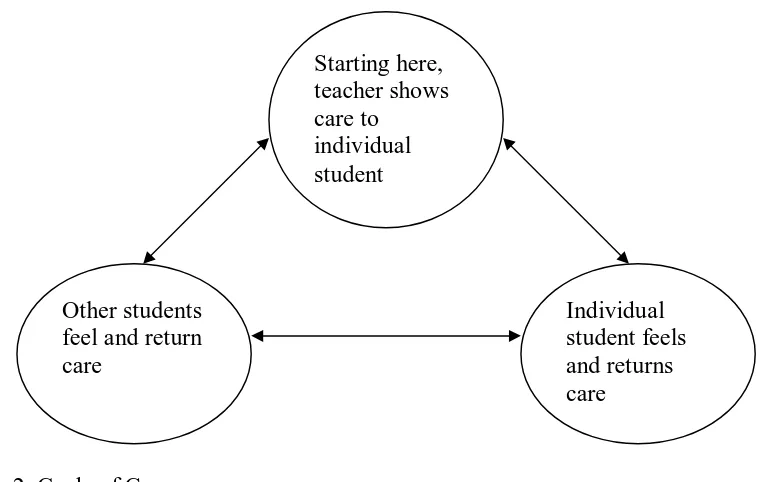
Motivation can be further explained by the research of Ryan and Deci (2000). They state that there is a greater personal commitment to be motivated when the motivation becomes internalized, or valued, as opposed to being externalized, such as by receiving a reward. The motivation to show care to others becomes internalized through the “cycle of care” as students become more personally committed to showing care as they continue to receive it.
Figure 2. Cycle of Care
Within caring communities students feel respected and engaged and ultimately cared for. As the students feel care, they in turn show care to others building a caring community. As they build this community they become committed to it and its well being. They therefore
internalize the values of care that are part of the community. In a caring classroom, learning is an implied part of the community. Therefore students, as a part of the community (if they
Other students feel and return care
Starting here, teacher shows care to
individual student
feel cared for), internalize the value of learning and are thus more motivated to learn. Additional impacts of being motivated to care as reported by Solomon et al. (1992) in their synthesis of the CDP’s research include students voicing higher educational aspirations as well as exhibiting less misconduct compared to students in classrooms that did not
implement “caring communities”.
Another study about “caring communities” within elementary classrooms was done by Solomon et al. (2000). In the early 1990’s this research team conducted a research project across six school districts to better understand the effects of implementing “caring
communities” within classrooms. For this research, Schaps, Battistich, and Solomon (2004) in association with members of the CDP developed a school improvement program for creating a “caring community” within the classroom which included using literature,
incorporating cooperative learning, engaging students in developing classroom management, increasing home-school interaction, and school service programs. Solomon et al. then
selected classrooms within certain schools in each district and helped them to implement these “caring communities”. The schools selected included student populations that
schools that did establish the “caring communities” there were clear gains in academic motivation by the students. This gain was explained by the fact that students in “caring communities” developed a relationship with others, including the teacher, in the community. According to the researchers, these relationships promoted the cyclical desire among the students to care for others and feel cared for in return. When students feel cared for, their desire to uphold the values of the community increases. Therefore within the classroom where learning is valued, students desire to uphold this value and become more academically motivated. This finding on the cyclical desire to care mirrors the findings of Solomon et al. (1992) and the work of Ryan and Deci (2000).
Additional research pointing to the importance of teacher care in elementary
Nowak-Fabrykowski and Caldwell (2002), Collinson et al. (1998), Deiro (2003), Samdal et al. (1998), Solomon et al. (1992), Ryan and Deci (2000), and Solomon et al. (2000).
Dalton and Watson (1997), through their research, found many additional
characteristics of caring elementary classrooms (though not seen as major themes) that had an impact on the feeling of care developed within the classroom. One such characteristic was that students felt comfortable to take risks. Students looked at challenges with confidence as they felt they would receive the necessary support that they needed from the teacher. Also, these classrooms were “friendly” places where students could trust the teacher and other students. The teacher made it a priority to connect with students, such as by sharing personal stories and listening to the stories of the students and by sharing feelings with students and allowing for open discussion of feelings. Students also felt care (i.e. secure) because they were familiar with expectations and routines within the classroom. These classrooms were marked by the value the teachers placed on student work as it hung on walls and was
displayed around the room. In addition, the students felt more relaxed in their classrooms and were therefore able to put more energy into their learning as they were not preoccupied with outside worries, such as being cared for.
classrooms were not described except for mentioning that they were from predominantly low socio-economic status and lower achieving. The researchers found that these caring teachers were supportive of student needs and provided instruction that was developmentally
appropriate for the students. These teachers also showed care by respecting the students as well as by being enthusiastic, good communicators, and by acting professionally. In their concluding remarks, the researchers stated that the teachers’ beliefs about their students, in that they cared for their students, influenced the students’ motivation to learn. This
conclusion was drawn from the researchers’ correlation between student achievement on a standardized test and the caring characteristics exhibited by the teachers during their observations. These caring characteristics, along with the aforementioned major themes of caring, observed by Dalton and Watson as well as the previously described researchers are the basis for the definition of care I used in my research. Specifically my definition of care within the context of the elementary classroom is the trusting, respectful and supportive relationship between the teacher (care giver), and the students (care receivers), within the classroom setting.
Culturally Responsive Teaching
In addition to defining care and understanding the impact of care on students, which is the emphasis of the above research, I sought to examine the impact that student ethnicity has on definitions of care and manifestations of care by the teacher. The research on
defined as, “using the cultural knowledge, prior experiences, frames of reference and
performance styles of ethnically diverse students to make learning encounters more relevant to and effective for them,” (Gay, 2000, p.29). In addition, classrooms teaching in culturally responsive ways are led by teachers that value and allow expression of each student’s cultural identity which makes connections between school and the students’ homes. This also allows students the freedom to express themselves and learn in meaningful ways. Gay continues by stating that culturally responsive teaching involves setting high, but manageable goals for students and supporting them as they work to achieve these goals. This aspect of culturally responsive teaching reflects the definitions of care stated by both Dalton and Watson (1997) and Thompson et al. (2005) who emphasized that care is felt when students feel supported by the teacher.
Ana Maria Villegas and Tamara Lucas (2002) further explain culturally responsive teaching in their writing on preparing culturally responsive teachers. They propose a
curriculum that can be used to prepare teachers to teach in culturally responsive ways. Their curriculum arose out of their study of culturally responsive teaching, observations in
ethnically diverse classrooms and through working with preservice teachers. They propose that culturally responsive teaching should include being socioculturally conscious, having affirming views of students, being responsible for educational change, understanding how learners construct knowledge, knowing about the lives of students, and using this knowledge to effectively teach students. Villegas and Lucas provide details for each of these
on students’ prior knowledge and their experiences outside of school making learning more relevant to students. Using students’ prior knowledge and life experiences to make learning relevant reflects the assertions by Gay (2000) on culturally responsive teaching.
Understanding students’ experiences outside of school relates to Dalton and Watson’s (1997) finding on building caring communities within elementary classrooms which states that caring teachers find ways to connect with students.
In a study by Dave Brown (2003) the connection between culturally responsive teaching and teacher care is made more explicit. He specifically studied classrooms that incorporated culturally responsive teaching and created caring communities. The thirteen participants in his study varied ethnically and taught in ethnically diverse communities at various grade levels from elementary to high school. Through his interviews with the participants he came to three major conclusions about creating caring, culturally responsive classrooms. He found that teachers in these classrooms were sincerely interested in knowing each student, they were assertive and made expectations explicit, and they respected their students by understanding and using the communication patterns of their students. These conclusions connect with several of the studies already described on teacher care and
culturally responsive teaching. The first major theme involving knowing students personally included knowing student needs and making connections between school and home.
teaching about setting high goals for students. Brown also found culturally responsive teaching occurred in classrooms that created caring communities in which students felt comfortable, supported, and safe. This concept of caring communities connects directly with the research by the Child Development Project as explored by Solomon et al. (1992),
Chapter 2: Methodology and Data Collection
According to Creswell (1998) a purpose statement for a study provides the major intent and direction in which the study will go. The purpose of this phenomenological study was to understand the conceptions and manifestations of care within the context of the elementary classroom as determined by caring teachers, and how these caring teachers respond to differences among student ethnicities within their conceptions and manifestations of care. The definition of care used in this study that arose out of the research literature is the trusting, respectful and supportive relationship between the teacher (care giver), and the students (care receivers), within the classroom setting. This purpose reflects a qualitative research design that consists of a phenomenological epistemology because it reflects the understandings of the participants within the context of their experiences. A
phenomenological approach is described in the literature by Lopez and Willis (2004) as “understanding unique individuals and their meanings and interactions with others” (p. 726). Racher and Robinson (2002) go on to explain phenomenology as a descriptive approach. They also go on in their writing to explain the goal of the “interpretive paradigm” as understanding the constructions of others from the view of those making the constructions. Therefore this study also reflected an interpretivist paradigm as I allowed the participants to make their own constructions about care and gained understanding about teacher care within the context of the teacher constructions. Using an interpretivist approach provided the
research process I attempted to understand the constructions of the teachers within the context of their experiences as well as employed methods, which will be explained in detail in subsequent sections, to be sure I accurately described the constructions of the participants. In addition to the purpose stated previously, several issue questions and topical questions guided the research. Creswell explains issue questions as those that address major concerns in the research whereas topical questions seek additional information to provide description for the study. Three issue questions addressed in this study include:
1. How do caring teachers define care within the context of their classrooms? 2. How do caring teachers manifest care within their classrooms?
3. How do they perceive care impacts their students? Two topical questions addressed in this study include: 1. How do students demonstrate that they feel care?
2. How do teachers demonstrate care in meaningful ways to all students in a culturally diverse classroom?
The methodology section is divided into parts to provide thick description of each step of the methodology of this research. The first section explains the semi-structured interview process employed for this research. Then I describe the method of participant selection and provide thick description of the participants. Additionally I describe the context in which each
participant is positioned, including their schools. Lastly, the interview protocol employed for this study is explained.
Semi-structured Interview Process
data. Rubin and Rubin (1995) further explain the semi-structured interview design as one that “takes shape gradually, as the researcher listens and hears the meaning with the data” (p. 43). The semi-structured interview process was employed in this study because it allowed the participants to construct their ideas based on the open-ended questions asked during the interviews while the interviews were guided by the direction of the interview protocol. Using this qualitative method of questioning allows “participants more freedom to structure their answers as they wish” (Ulin, Robinson, & Tolley, 2005, p. 38). Ulin et al. also propose one-on-one interviews with the participants as an effective method of data collection which allows the participants time to reflect and interact with the interviewer without the distraction and leading of others, therefore this method of questioning was used in this study.
I sat down with each participant and asked the same set of questions, which will be detailed in a subsequent section. These questions guided the interview process, but allowed the participants to construct their own responses to each question. As Schensul et al. assert, semi-structured interview questions are preformulated, but allow for the answers to be open-ended. In addition, as Rubin and Rubin assert, because of the flexible nature of qualitative interviewing, additional questions may arise during an interview that may help to clarify and further explain constructions of the participants, therefore probes were used when necessary during the interviews to provide deeper description by the participants.
and the interpretive thinking that is needed to make sense of the data” (p. 82). To guide my transcription process I followed the guidelines of Ulin et al. (2005) which include organizing the data by research questions, then reading and re-reading the transcripts to become familiar with the data. After transcribing the data and reading through it, I coded it using the process as described by Ulin et al. They suggest organizing with broad levels that reflect the research questions as well as having codes for smaller components of themes. I then organized the codes into those representing major themes and those representing smaller components with brief statements explaining each. From this data I was able to write this report of my findings and discuss the implications of the data.
Participant Selection
in which at least one-third of the student population were students of color. Two counties were chosen that contained the prescribed ethnic diversity in the student population. One county, Young County, was located in the north-eastern part of North Carolina. African American, Latino(a), and Native American students comprised most of the ethnically diverse (i.e. non-White American) population of this county. The other county selected, Roven County, was located in the southern Piedmont region of North Carolina. African American and Latino(a) students comprised most of the ethnically diverse population of this county. The research coordinator for these counties was contacted by telephone to request permission to conduct research within the public school system of the county. Additionally, the research coordinator was asked to specify schools with the student ethnic diversity described above within the county that may be willing to provide teachers for the research. Names of principals and telephone numbers were given by the research coordinator for schools that may be willing to participate. Each school that was suggested was contacted by telephone.
The second school that was contacted, Watts Elementary, was in Roven County. The student population at this school was over 40% African American, over 40% Latino(a), and slightly over 10% White. Well over 90% of students at this school participated in the free-reduced lunch program indicating that most of the students at the school were of low socio-economic status. Upon observation of the teacher population, White, African American, and Asian teachers were observed, however no statistical data was available on the ethnicity of the teacher population. Over 70% of the teachers at this school had more than four years of experience. The principal at Watts Elementary was a White male who was also eager to participate in this study.
Each of the two principals that indicated that his or her school would be willing to participate, Martin Elementary and Watts Elementary, was then sent an initial contact letter. (See Appendix A) This letter further explained the research and requested to meet with the principal personally to discuss participant selection. However, during the telephone
conversations both principals stated their preference for interviews with participants to be less than one hour, therefore it was agreed that interviews would be set at 45 minutes. Due to this change, a revised initial contact letter was sent to principals in place of the originally planned initial contact letter. (See Appendix B)
are used to enhance the validity and reduce bias within the research (Mathison, 1988). Therefore in participant selection, multiple sources were used to choose participants,
including the principal and various administrators. Using the definition or caring teachers, the principal was to make a list of several teachers who met this definition. Additionally, one or two other members of the school staff were to also independently create lists of teachers who met this definition of caring. Participants were to be chosen by me whose names appeared on all the independent lists. However, the principals of the schools participating in the research were eager to get started with participant selection. They each created a list of caring teachers and asked one or two of their administrators to independently create lists of caring teachers. The principals then collected each list created by the administrators. He or she created a master list of names of caring teachers from those names that appeared on each list collected from the administrators as well as appeared on his or her own list before I could view any of the independent lists. Therefore, based on their reports, the principals did allow for
triangulation by asking multiple sources to help with the participant selection. Specifically, I emailed each principal to confirm that lists of participant names were created independently and then used to create one master list of names. At Martin Elementary, the principal
selection is based on the word of the principals that triangulation was used. Originally, after the names of the participants were given to me, a letter was to be sent to each participant explaining the study and requesting her participation. (See Appendix C) However, because the principals were eager to move forward with the interviews, dates and times were arranged by the principals for conducting the interviews before I could send this initial letter to the participants. Due to this rapid progression by the principals, a revised initial contact letter was sent or given to the participating teachers. (See Appendix D)
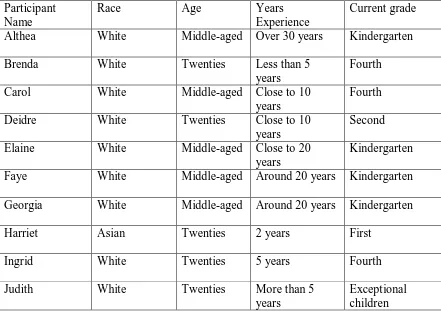
Five participants were chosen from Martin Elementary and five participants were chosen from Watts Elementary. A summary of participant demographic information is presented in Table 2.1. At Martin Elementary all five teachers were White females. The first teacher, Althea, was a middle-aged White woman. She had more than 30 years of experience teaching and currently taught in Kindergarten. Her demeanor was happy and she laughed at herself a lot. Althea talked fast and at times trailed off in laughter at herself and what she had said making it difficult to hear her final words in the statements she made. She continually expressed her love of teaching and being around children. The second teacher interviewed at Martin Elementary, Brenda, was a young, pregnant, White woman in her twenties that had less than five years of experience teaching and currently taught fourth grade. She seemed a little nervous and continually looked at me for approval of her answers. Her speech was fast and she did not elaborate much on her answers. Carol, the third teacher interviewed, was a middle-aged White woman with close to ten years of experience teaching who currently taught in fourth grade. She was overweight and expressed that she had several health
apparent. Her words were spoken slowly and carefully and provided very detailed answers to interview questions. She was open to discussing ethnic diversity in the classroom and
provided several examples and generalizations about the impact of student ethnicity on care. A younger White woman, Deidre, was the fourth teacher interviewed at Martin Elementary. She was in her twenties, had close to ten years of teaching experience, and currently taught in second grade. Her demeanor seemed relaxed throughout the interview and the flow of
conversation ran smoothly. She was open to discussing ethnic diversity in the classroom and provided elaboration for the interview questions asked, however her interview was the shortest one conducted. The fifth teacher from Martin Elementary, Elaine, was not able to meet with me on the day specified by the principal, therefore an alternate day was chosen to meet. She was a middle-aged White woman with close to 20 years of teaching experience and currently taught in Kindergarten. Her speech was fast as she seemed to have much to say and was very concerned about building lasting relationships with her students. Elaine
expressed frustration that the interviews were scheduled so quickly by the principal which was why she was unable to meet with me at original time set up by the principal.
Watts Elementary produced five teacher participants. The first participant, Faye, was a middle-aged White woman who currently taught in Kindergarten and had around 20 years of teaching experience, part of which occurred in New York before moving to North
had a high proportion of exceptional children in her classroom because she enjoyed teaching exceptional children and seemed very intuitive about what students need. Harriet, the third teacher from Watts Elementary, was a young Asian woman with just a couple of years of experience who currently taught in first grade. Harriet talked somewhat fast, but conveyed a real joy in teaching children. She expressed her concern over those that respond in negative ways to differences in student ethnicity. Ingrid was the fourth teacher interviewed at Watts Elementary. She was a White woman in her twenties with five years of teaching experience who was currently teaching fourth grade and had looped up with her class from third grade so she had better insight into her students. Ingrid was in the process of getting her Masters in Reading and seemed well spoken and comfortable during the interview. Like Georgia, she stated that she sought out to have exceptional students in her class. The last teacher
Table 2.1. Summary of Participant Demographics Participant
Name
Race Age Years
Experience
Current grade Althea White Middle-aged Over 30 years Kindergarten
Brenda White Twenties Less than 5
years
Fourth
Carol White Middle-aged Close to 10
years
Fourth
Deidre White Twenties Close to 10
years
Second
Elaine White Middle-aged Close to 20
years
Kindergarten Faye White Middle-aged Around 20 years Kindergarten Georgia White Middle-aged Around 20 years Kindergarten
Harriet Asian Twenties 2 years First
Ingrid White Twenties 5 years Fourth
Judith White Twenties More than 5
years
Exceptional children
Interview Protocol
On the days specified by the principals, I went to each school to conduct the interviews. Upon arriving at each school, I met each principal and then began the series of interviews that were pre-arranged by the principals. At Martin Elementary the first interview was conducted in the classroom of the teacher. Interruptions were minimal and Althea and I were alone. At one point, however, Althea’s teaching assistant came in and then left. The additional three interviews at Martin Elementary were conducted in a workroom.
local restaurant. The noise level at this location was somewhat high, however distractions were minimal and both Elaine and I were able to focus on the interview. At Watts
Elementary I conducted all five interviews in a conference room within the main office. Interruptions were minimal and I met alone with each teacher.
questions and probes were used to guide the interview, however the participants were free to express their thoughts, tell stories, and do most of the talking. The questions asked during the interview reflect the issue and topic questions stated previously. In addition, these questions reflect the semi-structured interview process described by Schensul et al. (1999). Schensul et al. advocate asking questions in language that is understandable to participants. In addition they state that questions should be of a reasonable length and should avoid leading the participant to provide a certain answer. For the ordering of questions they assert that simpler questions should lead the interview and work into more abstract topics with more sensitive question occurring at the end.
At the end of each interview the participants were asked for their email address so that I could email them the themes that emerged from all the interviews after they were analyzed. I invited each participant to look at the themes and provide feedback. (See Appendix G). This method of member checking is described in the work of Creswell and Miller (2000) who state that “it consists of taking data and interpretations back to the
participants in the study so that they can confirm the credibility of the information” (p. 127). They go on to assert that this method produces validity for the research.
After the interviews, I transcribed the recordings and read and re-read them looking for emergent themes. I coded the transcriptions by writing small notes, or codes, in the margins on each transcription. Ulin et al. (2005) support this practice by stating that these handwritten notes “remind you where you are and what you see” (p. 146). Continuing under the direction of Ulin et al., the codes were written in language used by the participants and then reviewed so as not to be too detailed yet provide adequate description of the
Chapter 3: Data Analysis, Conclusions, and Discussion
Results
Following the model of Schensul et al. (1999) the first three questions asked of the teachers during the interviews were simpler questions gathering demographic data on the teachers. The remaining seven questions asked the teachers to construct their understanding about care, how it is manifested within the classroom, and the impact of student ethnicity on the manifestations of care. To organize my analysis, I grouped major emergent themes according to the questions asked following the interview protocol that was used. (See
Appendix F) The two questions after the demographic questions asked teachers to define care and explain how they showed care to their students. For many teachers, the answers to each of these two questions were almost identical. From these two questions, 11 major themes arose about care, two of which were repeated by every participant. Care as defined by respect was one theme that was repeated by every teacher. By respect these teachers meant treating each student as an important individual by getting down on the student’s level, making eye contact with the students, and being polite. In my interview with Georgia she stated, “I try to look at my, the children in my classes, um, as little people, instead of just kids, with
stated in her interview that within the context of her classroom, defining care meant that she would, “try to boost their self esteem and self confidence as much as possible.” In Brenda’s interview she explained that she boosted a student’s confidence about taking the End of Grade test when she stated, “I gave him confidence saying, ‘You can do this.’” Deidre explained that boosting self esteem involves making students feel important when she stated that “even the small things I think you need to make a big deal about.” Judith mentioned that helping students feel comfortable and important included refraining from ridiculing students in front of the class. This major theme about care that emerged from the teachers’
constructions mirrors what each of the aforementioned researchers from the literature review also found about care which is that students feel care when they feel respected by their teachers. Harriett’s construction of respect as getting down on a child’s level was also specifically stated in the research by Nowak-Fabrykowski and Caldwell (2002). Dalton and Watson’s (1997) research and Brown’s (2003) study are reflected by the previously described minor theme which included helping students to feel comfortable in the classroom. In
Brown’s study, feeling comfortable in the classroom included being comfortable to express one’s culture. Carol reflected this piece of culturally responsive teaching when she told the story of a Muslim student she taught that would bring pictures of his mosque and would bring her food.
addition, Harriett said, “I haven’t really thought about putting it into a definition, but I just really love the kids.” Included in this major theme falls the minor theme that 5 participants mentioned which was that students are the priority and the participants love teaching. Althea explained in her interview, “I just love kids and I love teaching.” Carol emphasized that her students are the priority when she stated, “I have an obligation to teach them.” The
interpretation of care as being sensitive is also a part of the work of Solomon et al. (1992) and Noddings (2005) who assert that care is being sensitive to the needs of the care receiver, including the inferred need for love. Also under this major theme of care as being like love, is the minor theme that 4 participants mentioned. These teachers included going out of the way and taking a few extra minutes to care for students. Brenda explained, “I will go above and beyond what I need to do to help you out, and that just, it carries over, the way I was raised to be a caring person, it carries over to teaching.” Judith continues this thought by saying, “take a few extra minutes and you’ll see the difference.”
Knowing each student’s individual needs is another major theme that emerged as participants defined and described showing care. This theme was stated by 9 of the
to them, getting to know them, talking to their parents.” She also mentioned that she observed students to find out what they needed, which was stated by many of the other participants as well. Thompson et al. (2005) mirror this major emergent theme in their research as they found that caring teachers provided for students’ needs by using
developmentally appropriate instruction. Additional support of this theme of caring comes from the research of Collinson et al. (1998) who found that care emerged as teachers worked to know students through observation, dialogue with students, and viewing student work. Related to this, Mayeroff (1971) explained care as helping children feel competent with their own talents. In relation to defining care as knowing student needs, two minor themes
emerged. One of these themes stated by 4 participants was providing for students’ basic or physical needs so that they may concentrate on learning. This includes providing food, clothes, school supplies and cleaning students when necessary. Brenda reflected this in her comment, “I want to make sure they’re fed.” Harriet summarized this minor theme when she said:
felt as strongly at other schools. She reflects culturally responsive teaching in that she is aware of the lower socio economic status of her students and is willing to provide what they need to help them gain the most from their schooling. Similarly, Thompson et al. found that caring teachers were supportive of student needs. The other minor theme related to knowing student needs stated by 6 participants was the need to feel safe and secure. They explained this as students felt cared for in classrooms that were safe places to learn and take risks as well as safe physical environments. Georgia explained this theme in her comment, “I think that’s a blanket that covers, when you’re cared for, then you’re secure.” Faye also stated, “they are in a safe environment and then from there you can start to learn.” Participants in the study by Brown also stated that care was felt in classrooms that were comfortable, supported, and safe. The preservice teachers in the research by Nowak-Fabrykowski and Caldwell (2002) similarly described care as feelings of security. This was also in Dalton and Watson’s (1997) research who described care as students feeling secure and comfortable in classroom environments in which they felt supported and confident to take risks. Similar to knowing student’s individual needs is the major theme repeated by 7 participants which was spending time individually with students. This theme included non-academic interactions, such as greeting students in the morning, noticing things about the students such as new shoes and haircuts, and relating to the students. When asked how she showed care Deidre said, “notice if they have a new haircut, new clothes, new shoes on, something like that.” In her
construction of care Carol stated, “So as far as caring, I think they need to see you smile and really greet them warmly in the morning.”
words and having a positive outlook on the class. The research of Nowak-Fabrykowski and Caldwell (2002) supports this theme as they found their participants described care as giving positive reinforcement. Solomon et al. (1992) mention building positive relationships within the classroom as a demonstration of care. Althea had much to say about the impact of being positive in the classroom. In one explanation about being positive she said:
I always try to praise them. I try to always tell them that they’re doing a good job, or I like something they’re doing. I try to pick more positive because over the years you find that being negative, it doesn’t work. Trying to find that one thing all day that was a good thing and praising them for that, or “I like the way you sat,” or “I like the way you did that,” or “I like the way you were nice to so and so a while ago,” and try to bring out the positives trying to show that, you know, good feelings to each other. Closely related to this major theme of care is praising students which was a major theme stated by 8 participants. Participants described praise as making sure students know what they are doing well. They also emphasized being specific with praise, but being aware not to give too much praise or students would become desensitized to it. When probed about praise Ingrid said, “you also have to make sure they know what they’re doing well.” Harriett also said, “I’m trying to be very specific . . . I try and say, ‘Oh I really like the way you didn’t use your hands to problem solve that,’ for example so they know what they’re doing right.” Carol added, “some of them, they do get a lot of praise, but it’s not warranted praise, and I really try to balance the good things I say by being honest.” In addition, 7 participants specifically mentioned another major theme which was care meant encouraging students. By encouraging students the participants meant giving compliments. Closely related to this, but stated
affection in some physical way. The teachers described knowing how each individual student responded to physical demonstrations of care and showing care in that way to the student whether it was through a hug, high five, or pat on the back. Deidre explains this in her comments:
Some people like to be hugged, some people don’t like to be hugged, and I think different things work better with certain students, just like adults. Um, for example, I had a little boy this year, that he just, he did not like to be touched, and he made that very apparent to me from the very beginning, and so instead of giving him a hug or a half hug, I would say, ‘Hey, give me a high five,’ and he would be all in to that, and that was our thing and I just learned with him that, you know, was what to do instead. Also, 7 teachers reiterated that care means doing things that make the students feel good like displaying student work. Carol described showing care by displaying student work when she described one instance involving a student in her class. She said, “she would slip me things . . . and then I would display it and she would smile.” Noddings’ (1995) research reflects this assertion about care as she found that care is felt when people are recognized for doing their best and are appreciated for their work. Displaying student work as showing care was specifically mentioned by the participants in the research by Dalton and Watson (1997).
classroom. She stated, “I like to do home visits. Going to their home says ‘Hey, I’m important, she cares enough to come to my house and chat with mama or daddy or grandma.’” She further explains the importance of knowing students’ backgrounds in her elaboration on making home visits. She states:
So going to their home you get to see, it helps you get to understand where
they’re coming from because you may have no clue that daddy just got arrested, and there’s no money at home, mama’s pregnant, sick every day, and there’s no food on the table because mama’s too sick to cook it, and then daddy’s in jail. And so they come to school hungry and you’re fussing at them because they’re not doing something that they’re supposed to do, but when they’re hungry, they can’t, you know? So, I mean, it really let’s you know where the kids come from.
Elaine detailed multiple ways that she makes connections with a student’s family through phone calls, notes, newsletters, email, and parent involvement nights. In addition, teachers explained that these connections with students and their families lasted beyond the school year. Teachers kept in touch with families and inquired about students long after they left their classrooms. Elaine went further in her explanation about making connections with a student’s family explaining that teacher’s are really building long lasting relationships with students and their families. Her comments were:
because you have to get the whole community, you can’t just get that one kid and send them on because it just doesn’t fly.
Understanding students’ lives and relating learning to their lives was one of the four ways preservice teachers described showing care within the research of Nowak-Fabrykowski and Caldwell (2002). Culturally responsive teaching, as explained by Gay (2000) and Villegas and Lucas (2002) also emphasizes the importance of understanding each student’s ethnic background which connects school with the student’s home life. Judith’s comments about making home visits reflect culturally responsive teaching which includes understanding a student’s cultural background. Faye also emphasized the importance of understanding each student’s ethnic background in her comments on English Language Learners by saying:
They have to learn language, they have to learn skills and I guess the ethnic, they know these, you just have to bring the language alive and for them to be comfortable in it. If they’re not comfortable in their environment, they’re not going to try it.” This major theme is also a part of the study by Brown (2003) on caring, culturally responsive classrooms and is a goal of the Child Development Project that works on building “caring communities” which support an increase in home-school interactions and school service programs (Schaps et al., 2004). A minor theme repeated by 6 participants which can be encompassed by this major theme is that care is building a relationship or bond with students and making a commitment to this relationship. This relationship between care giver and care receiver is the emphasis of Bowlby’s research as explained by Bretherton (1992) who
One last major theme that emerged when asked to define care and how care is demonstrated was stated by 7 participants. This theme included making expectations known to students, setting high expectations, setting goals to reach expectations, and believing that students could reach the high expectations. This theme related to academic work as well as student behavior. Faye stated, “I do try to be careful to make everybody work at their expected, eh, to achieve higher levels.” Georgia went on to say:
I try to make sure that I’m having expectations that they can meet, which I think is part of care, and high expectations because I think a lot of times they’re told they can’t do certain things and they need people to stand behind them and say that they can.
research described care as coming from familiarity with classroom expectations and routines. Ingrid provides an example of this minor theme by stating:
You get to set procedures and you get to show, yes I do care about you and because I do care about you, these are the rules that you have to follow and the procedures that you’re going to use so that we can get on with our day at school.
In an extension of this, 4 participants went on to say that care is correcting behavior, but still loving the student, meaning that teachers separated the behavior from the student and guided the student towards more appropriate behavior. Deiro (2003) found this same specific
explanation of care that students felt respected when discipline was used to teach and not to punish. Deiro as well as Samdal et al. and Solomon et al. (1992) all included allowing students to help problem solve and valuing their input in rule making as part of showing care which was echoed by 5 participants in this study. Ingrid explained this point as she described how she used class meetings to allow students time to discuss solutions to problems that arose in class. She also sought the input of students when there were academic or behavior issues. Ingrid said:
If they are doing something wrong, explaining this is what you’re doing wrong and this is what you can do to make it better. And then also, like, what do they think that they can do to make things better, whether it’s a behavior issue or an academic issue.
Also related to showing care to students, 4 participants mentioned using tangible rewards with students, such as stickers, but not relying on them as students would become
students and helping them to enjoy learning and value it was also a minor theme expressed by 4 participants. An example of this theme is Brenda’s comments:
It’s more fun when they have someone caring about them, for them than, you know, a dictator saying, “We’ve got to do this, we’re going to do it now.” So we have a good time.
Lastly, in relation to the questions about defining care and how care is demonstrated within the classroom, 4 participants mentioned that the teacher is a model of care to students, meaning that the teacher demonstrated the caring behavior that was desired from the
students. Modeling care was a major part of the research by Nowak-Fabrykowski and Caldwell (2002) who modeled care for preservice teachers as the teachers prepared for their future classrooms. Additionally, Solomon et al. (1992) stated that teachers promote care by modeling care on which students may base their own caring behavior.
of emotions in their eyes.” They did state that some students need more care and therefore may receive more teacher attention, but the teachers did not identify any sub-group of the student population that may require more attention, they were willing to give more attention to any student that demonstrated behaviors that indicated the need for more care. Georgia exemplified this in her comments:
I try to have equal, equality there as far as how I love them and encourage them and I care for them. Some of them, some of them need more in some areas more than other areas, but oh no, I try to be as equal as I can with all the kids that I, come through my path.
However, some participants admitted that some students from certain backgrounds did need more attention, but they were sure to emphasize that they still cared for all the students in their classrooms. Georgia went on to explain this by saying:
Some children come from backgrounds that are much more needy. They need more interaction with me and some come from much more independent, they come much more independent into kindergarten. So, um, yeah, uh, certainly I do care, not care as far as emotional caring, but just the physical outreach more than others. That’s just, they’re all different.
I think that is one of the first things that show you that your kids know you care about them, it’s when they want to do what you ask them to do. This group of kids that were so low and had so many issues they worked harder than any group of kids that I’d had, and I think when they just, they show that Ingrid cares enough about me to want me to do this, I’m going to do this the best I can, and when they work really hard, I think that’s their number one way of showing . . . their work ethic and then that’s when you know.
Further, students feel more comfortable to take academic risks. Supporting this theme is the positive relationship found between caring classrooms and academic motivation in the research of Solomon et al. (1992). Ryan and Deci (2000) and Solomon et al. (2000) confirm this relationship between a caring classroom and academic motivation and further explain this correlation as students developing the value of learning in a caring classroom which drives the cycle of motivation to uphold this value.
Similar to this theme is the participant response repeated by 7 of the teachers that students show that they feel care by doing what is asked of them, including behaving
appropriately. Participants went on to explain that students desire to “be good” which in turn allows the classroom to function well which brings a sense of peace to the room. Georgia describes this by saying, “I think there is a peace that comes within the classroom.” She continues by saying:
This theme also supports the previously cited research about the cycle of care in which students feel care and desire to show care by doing what is asked of them which allows the classroom to function well and continue the cycle of care.
Several minor themes emerged dealing with the different ways that students respond to the care given by the teacher in relation to the questions about how students show that they feel care and the impact of teacher care. One of these responses stated by 4 participants was that students will call them “Mom”. By this teachers meant that the students felt comfortable enough with the teacher that they called her “Mom” whether on purpose or accidentally. This reflects the work of Bowlby as explained by Bretherton (1992) about the relationship
between a child and mother as a warm, continuous relationship with a care giver, which is similar to the relationship between caring teachers and their students.
When finally asked specifically about care within an ethnically diverse classroom, no major themes emerged. Both schools in which interviews took place contained at least one third students of color within the student population, however there were no consistencies in teacher responses in regards to student ethnicity. Only one minor theme emerged about ethnicity which was stated by 5 of the participants. They stated that ethnicity doesn’t matter when showing care to students. The teachers get to know each student, which also means understanding the background of each student, and then provide care that best meets the student’s needs. Elaine provides a distinct example of this minor theme. She explains:
The whole ethnic thing shouldn’t make a difference. I mean ideally in our world it does every day of the week, but it shouldn’t because kids are kids, and I mean, no matter where they come from they all like to eat Play Doh, and they’re all sneaky and you know what I mean? They have bad days just like we have bad days. So it
shouldn’t make a difference, the care, I mean the fact that you’re giving care, not the ways you do it.
Harriett also reflects this sentiment by saying, “I don’t care what you come in as, but you just need to do your best and I expect you to respect the other kids, I expect you to respect me and respect yourself.” No teacher stated that she attempts to show care in the same way to all students of a specific ethnic group.