Simulating Evolution
by Gene Duplication
Tomoko
Ohta
National Znstitute of Genetics, Mishima, 4 1 1 Japan
Manuscript received May 23, 1986
Revised copy accepted October 1 1, 1986
ABSTRACT
By considering the recent finding that unequal crossing over and other molecular interactions are
contributing to the evolution of multigene families, a model of the origin of repetitive genes was
studied by Monte Carlo simulations. Starting from a single gene copy, how genetic systems evolve was
examined under unequal crossing over, random drift and natural selection. Both beneficial and deteriorating mutations were incorporated, and the latter were assumed to occur ten times more frequently than the former. Positive natural selection favors those chromosomes with more beneficial
mutations in redundant copies than others in the population, but accumulation of deteriorating
mutations (pseudogenes) have no effect on fitness so long as there remains a functional gene. The
results imply the following: (1) Positive natural selection is needed in order to acquire gene families
with new functions. Without it, too many pseudogenes accumulate before attaining a functional gene
family. (2) There is a large fluctuation in the outcome even if parameters are the same. (3) When
unequal crossing over occurs more frequently, the system evolves more rapidly. It was also shown,
under realistic values of parameters, that the genetic load for acquiring a new gene is not as large as
J. B. S. HALDANE suggested, but not so small as in a model in which a system for selection started
from already redundant genes.
ENE duplication has evidently played a major role
G
in the evolution of complexity of higher orga-nisms. A long time ago, BRIDGES (1935) and MULLER
(1 936) recognized the importance of gene duplication for evolution, but rather little attention has been paid
to their theory until recently. OHNO (1 970) advocated
the significance of gene duplication from the stand- point of cytogenetics and biochemistry, and for more than 10 years, I have emphasized its role in the evo- lution of higher organisms in relation to the preva- lence of multigene families in eukaryote genomes (for
review, see OHTA 1980). In the model of gene dupli-
cation, it has been customarily assumed that, once redundant gene copies are available in a genome, useful mutations may accumulate in one of the copies while another copy is carrying out the original func-
tion (for review, see CHARLESWORTH 1985). In an-
other model that emphasizes natural selection, “per-
manent heterozygosity” is attained by duplication
when heterozygotes are advantageous (FINCHAM
1966), and SPOFFORD (1 969) formulated this model
as a deterministic process.
Recent developments in molecular biology, how- ever, have revealed that evolution by gene duplication is not such a simple process as the above models imply. T h e prevalence of multigene families and their con- certed evolution suggests that unequal crossing over, gene conversion and duplicative transposition are fre- quently occurring in genomes of higher organisms and are therefore providing ample opportunities for
Genetics 1 1 5 207-213 (January, 1987)
the origination of new genes (for reviews, see OHTA
1980, 1983). I have studied a model in which the more a multigene family contains genetic diversity, the more beneficial to an organism it is. I assumed an initial gene family with a few identical gene copies and then showed that the system is an extremely efficient
way to accumulate genetic diversity, or genetic infor-
mation in another expression (OHTA 1987). This
study is useful for understanding the origin of large multigene families with functionally diverse gene members, such as those of immunoglobulin, T-cell receptor and cytochrome P450.
In this report, a more general model of evolution
by gene duplication is analyzed, i.e., simulations were
carried out to find out how duplicated genes evolve starting from a single copy, if unequal crossing over is continuously occurring and if natural selection works in such a way that individuals with more diverse gene members than others in the population are se- lectively advantageous. One problem of such models is how the accumulation of deleterious mutations in repetitive gene copies is prevented. Indeed, the rate of deleterious mutation is usually much higher than that of useful mutations at the molecular level (e.g.,
see KIMURA 1983), and pseudogenes are commonly
208 T. Ohta
positive and negative natural selection than does the primary structure of DNA or proteins. It is also shown that the system nevertheless provides an efficient way to increase the number of alleles in a genome, and that stochastic differentiation among the genomes is
important
.
MODEL A N D S I M U L A T I O N PROCEDURE
In the present model, initially there is a single gene copy in each genome of the population, and all genes in the population are identical. With a constant rate,
7, per gene copy per generation, the chromosomal
region of this gene undergoes unequal intrachromo- soma1 (between sister-chromatids) crossing over, i.e.,
at the rate, y / 2 , a gene is duplicated to become two
tandem genes, and at the same rate, 7 / 2 , it is deleted
from the chromosome. This rate is assumed to be
constant per gene copy, and if there are n tandem
genes, the rate of unequal crossing over to produce
either ( n
+
1) or (n-
1) genes is n y . Unequal crossingover is assumed to be always one gene shift, with no bias in duplication or deletion.
With constant rate, U + , per generation, a gene mu-
tates to a new allelic type under the infinite allele
model (KIMURA and CROW 1964). With a different
constant rate, U-, per generation, a gene becomes
nonfunctional, and once it deteriorates, it remains as a pseudogene.
Both positive and negative natural selection are incorporated. A specific model of positive selection is
used that is similar to that of OHTA (1987), in which,
if genetic diversity (the number of different alleles in a genome in this study) is lower than the population average, the gamete is disadvantageous according to the fitness function,
( 1 ) W, = I for
k,
2d
W, = 1
-
s ( i-
k,)
fork,
<
&,
where the subscript, i, denotes the ith genome, K , is
the number of alleles in the ith genome,
d
is thepopulation average, and s is a positive selection coef-
ficient. This fitness function may seem rather arbi- trary, but it is based on the consideration that selection
coefficient should depend on genes at the loci con-
cerned in the population, since we are studying the
process of how novel genes not previously existing are
acquired. As the simplest function, 1 have chosen ( l ) ,
which is easy to handle in the simulations. Negative selection means simply that a gamete is lethal if all gene copies become nonfunctional, or if the copy number becomes zero by unequal crossing over.
T h e simulated population is made of 2N gametes,
and each generation undergoes unequal crossing over, mutation, sampling and selection in this order. Ac- tually, sampling and selection were done simultane- ously. Unequal crossing over was carried out, accord-
ing to the specified probability for each genome, by
using random numbers. Decisions about deletion or duplication, as well as chromosomal position, were determined by random numbers. Mutation was again performed by random numbers, and allelic states were stored as integers.
In each generation, the number of different alleles in each genome was counted in order to perform selection. T h e selective elimination of a sampled ga- mete was determined by the fitness function (I), i.e., a gamete is sampled randomly and it is eliminated
with probability, I-fitness. This is repeated until the
number of gametes retained becomes 2N. Thus, the
simulated population is haploid, but so long as the
fitness is multiplicative, the result may be extended to
the diploid situation (CROW and KIMURA 1970). N o
interchromosomal recombination is incorporated in this study.
After every N generation, several quantities, such
as the mean and variance of copy number, the actual number of different alleles, and the number of pseu- dogenes per genome, were counted and recorded. T h e number of deaths was counted every generation,
and the total was recorded so that the genetic load
could be examined. Each Monte Carlo experiment
was continued for 50N generations, and 15 replicate
runs were performed for each set of parameter values, except for one case of large population size. In the following section, some results will be presented which
were obtained under realistic combinations of param-
eters, i.e., the products of population size and rates of
unequal crossing over and of mutation,
Ny,
Nu+ andNu-, were chosen to be realistic.
RESULTS
Starting from a single gene, the experimental results show how copy number, pseudogene number and number of different alleles change with time under various intensities of selection. The mutation rate per
locus is usually very low, i.e., of the order of 1 0-6 per
locus per generation. The population size of higher
organisms may be often
IO4
-
lo5 (e.g., see KIMURA1983). Thus, I chose the product of population size
and deleterious mutation rate, 2Nu- to be 0.1. T h e
rate of useful mutation is likely to be much less than
that of deleterious mutation, and a value of one-tenth
of deleterious mutation rate was used, i.e., 2Nu+ =
0.01. This value may be too high for a protein coding
region, but may not be so for a noncoding region,
since a large proportion of DNA sequences in the
noncoding region appears to be irrelevant to tran-
scription or translation. The rate of unequal crossing
over may differ from locus to locus. Based on a recent
estimate on immunoglobulin V genes (OHTA 1984),
three values of unequal crossing-over rate were cho-
I
1 3 :
. . .
,. ...
/ . . .
10 2 0 30 4 0
t l m 0 i n u n i t s ot N genaratlons
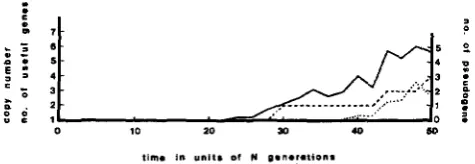
FIGURE 1.-A sample path of the simulation with no positive selection (s = 0). The copy number and the number of pseudogene increased, but the actual number of different alleles remained unity. The other parameters are, 2N = 100 and y = 0 . 0 0 2 5 .
Since very small populations of sizes, 2N = 50
-
200, were simulated, but with realistic values of prod-
ucts, N r etc., as above, large selection coefficients
were used: s = 0
-
0.8. Again, the product, 2Ns, isimportant, and it was given the values 0, 20 and 40.
When s is large, the effect of selection depends not
only on 2Ns but also on s itself, and the following
application to real populations is an approximation.
At any rate, in extrapolating the results to a real
population of 2N = lo4
-
lo5, the selection coefficientis very small. Figures 1-3 show some typical sample
paths under various sets of parameters; a solid line shows the change of copy number; dotted line, the number of pseudogenes; broken line, the number of
different alleles. Figure 1 is for the case of no positive
selection (s = 0), with 2Ny = 0.25. There is no increase
of functional genes, whereas pseudogenes gradually accumulate. At the 5ONth generation, there are three copies of pseudogenes, and only one functional gene remains.
Figure 2 shows a sample path for s = 0.4 (2Ns =
40), with 2Ny = 0.25. In this path, there is no increase
of copy number until the 22Nth generation, and after that it increases. Between the 28Nth and the 3ONth generation, a different allele accumulates, and at the 5ONth generation, three different alleles and almost
two copies of a pseudogene accumulate. In Figure 3,
a sample path for the same selection intensity, but
with a higher rate of unequal crossing over (2Ny =
0.5), is shown. As can be seen, the accumulation of
both useful and deleterious mutations is more rapid
here than in the previous case of low y .
Because the accumulation process is stochastic, a large variance is observed even if the parameters are
.
.
:_,’ ... *
[ I ,
...
......
0 10 20 30 40 so
tim. in u.11~ of N gener*tionm
FIGURE 2.-A sample path of the simulation with positive selec- tion (2Ns = 40). The copy number, the pseudogene number and the actual number of different alleles increased in this sample path. Parameters are, 2N = 100 and y = 0 . 0 0 2 5 .
time i n u n i t s of N ~ e n * r a t i o n s
FIGURE 3.-A sample path ofthe simulation with 2Ns = 40. The copy number, the pseudogene number and the actual number of different alleles increased more rapidly than in the path of Figure
2 , since unequal crossing-over rate is higher here ( 2 N = 100 and
= 0.005).
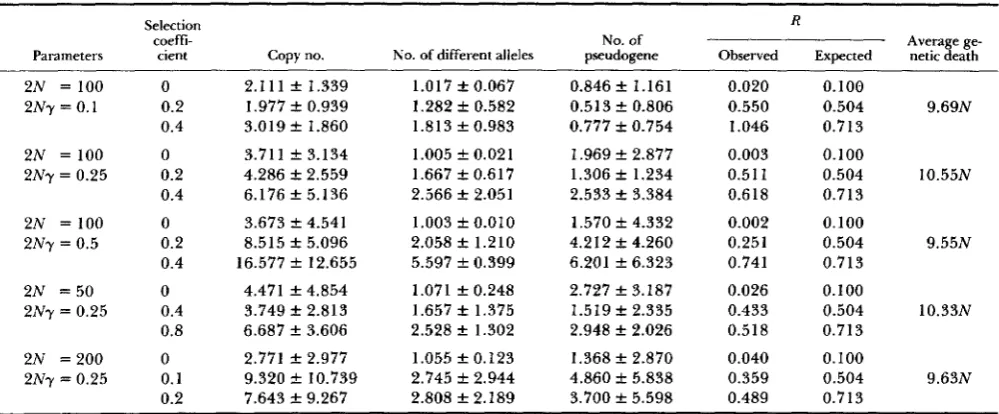
the same. Except for the case of 2N = 200, for each
set of parameters, 15 replicate runs were performed,
and Table 1 represents the mean and the standard
deviation of 15 replications for copy number, number
of different alleles, and pseudogene number at the 50Nth generation. In many cases, the standard devia- tion is almost as large as the mean. This means that
15 runs may differ greatly from each other, ranging
from no accumulation to rapid increase of different alleles.
However, there is a clear indication that positive selection is effective for increasing useful genes. In- deed, under the present sets of parameters, positive selection is necessary for the accumulation of func-
tional genes. When s = 0, the mean number of differ-
ent alleles is, at most, 1.071 from Table 1. It is noted
that, even if several redundant copies accumulate, all
extra copies deteriorate to become pseudogenes. This
is because v- = lOv+ in the present simulations, and
the chance for deterioration is ten times larger than that for functional differentiation, and once a gene deteriorates, it remains as a pseudogene.
Let us examine the relative rates of useful vs. non-
functional differentiation when positive selection is involved. Consider, for simplicity, the case where a single gene is present with the parameters, 2N7,2Nv+
and 2Nv-, much less than unity. Such a case is close
to the classical model of gene duplication in which a duplication becomes fixed in the population, presum- ably by drift, and then useful mutations accumulate by natural selection. In our case, a duplication also spreads in the population by drift, and chromosomes with two tandem genes increase. One of the two genes
deteriorates at the rate, v-, again by genetic drift,
whereas the rate at which a gene acquires a useful
mutation is enhanced by selection. Let x be the fre-
quency of the chromosomes in a population with
210 T. Ohta TABLE 1
Results of Monte Carlo experiments for the copy number, the number of different alleles, the pseudogene number and R (observed and expected) at the 5ONth generation, and the number of genetic death per one increase of different allele
Parameters
2N = 100
2Ny = 0.1
2N = 100 2Ny = 0.25 2N = 100 2Ny = 0.5
2N = 5 0 2Ny = 0.25
2N = 2 0 0 2Ny = 0.25
Selection R
coefti- No. of
cient Copy no. No. of different alleles pseudogene Observed Expected
0 2.111 f 1.339 1 .O 17 f 0.067 0.846 f 1.161 0.020 0.100
0.2 1.977 f 0.939 1.282 rt 0.582 0.513 f 0.806 0.550 0.504
0.4 3.019 f 1.860 1.813 f 0.983 0.777 rt 0.754 1.046 0.713
0 3.711 f 3.134 1.005 f 0.021 1.969 f 2.877 0.003 0.100
0.2 4.286 f 2.559 1.667 f 0.617 1.306 rt 1.234 0.511 0.504
0.4 6.176 f 5.136 2.566 f 2.05 1 2.533 f 3.384 0.618 0.7 13
0
0.2 0.4
0 0.4 0.8
0 0.1 0.2
3.673 rt 4.541 8.515 f 5.096 16.577 f 12.655
4.471 f 4.854 3.749 f 2.813 6.687 f 3.606
2.771 f 2.977 9.320 f 10.739 7.643 f 9.267
1.003 rt 0.010 2.058 f 1.210 5.597 f 0.399
1.071 f 0.248 1.657 f 1.375 2.528 f 1.302
1.055 f 0.123 2.745 rt 2.944 2.808 f 2.189
1.570 rt 4.332 4.212 k 4.260 6.201 f 6.323
2.727 f 3.187 1.519 f 2.335 2.948 f 2.026
1.368 f 2.870 4.860 rt 5.838 3.700 f 5.598
0.002 0.251 0.741
0.026 0.433 0.518
0.040 0.359 0.489
0.100 0.504 0.713
0.100 0.504 0.713
0.100 0.504 0.713
Average ge- netic death
9.69N
10.55N
9.55N
10.33N
9.63N
Results of 15 replications, except for the case of 2N = 200 with five replications. Other parameters: 2Nv+ = 0.01, 2Nv- = 0.1. genes (different alleles) as compared to the other
chromosomes that have only one useful gene. Then the fitness of the chromosomes with two useful genes is unity, whereas that of those with one functional gene is, from (l),
w, = 1
-
sx.Therefore, the change of x becomes the same as that
of a recessively advantageous mutant,
sx'(1
-
x)1
-
sx(1-
x)A x =
T h e fixation probability of a recessive mutant in finite
populations is approximately (KIMURA 1964),
/ ? \
1.128
U +
=
1.128Thus, the chance of spreading useful mutants on duplicated enes is enhanced roughly by the amount,
useful mutations to that of deteriorating mutations
becomes, for s > 0 ,
1.128
9
2Ns. T h e ratio, R, of the rate of spreading ofu+v+ 1 . 1 2 8 6 U +
R = - - - V - U -
Comparison of observed and expected values of R is
also given in Table 1. Although some of the assump-
tions do not hold in o u r simulations, data in the table show that the above prediction by (4) is roughly ap- plicable.
When s = 0 , mutants are no longer useful, and the
expected ratio is simply v+/v- = 0.1. Because of uni-
directional deterioration of redundant genes in our
simulations, the observed values of R are less than 0.1
f o r s = 0. For s
>
0, however, useful genes once fixedin the population are seldom lost because of selection.
Therefore, the average ratio would take similar values for a long period of time.
T h e validity of (4) depends on whether or not (2)
and (3) hold. When the products Ny, Nu- and Nu+ are much less than unity, the spreading of duplication, of deteriorating mutation and of beneficial mutation oc- cur separately and singly, and (2) and (3) adequately describe the process. However, when these products take larger values, the spreading of duplications and
mutations occurs simultaneously, and (2) and (3)
would become inappropriate. Under the present sets of parameters, in which the products are slightly less than unity, our approximations seem applicable.
More generally, the ratio is expressed as follows.
( 5 )
where U- is the fixation probability of a deteriorating
mutant, and can be much less than 1/2N if a nonfunc-
tional gene is disadvantageous to the organism. In the
next section, I shall discuss the meaning of this ratio
in relation to the observed facts.
21 1
that here, but the genetic system starts from a gene
family with several identical copies (OHTA 1987). It
was also possible, in the previous model, to estimate selection response under realistic values of parame- ters.
In the last column of the table, the average genetic death (load) needed for the increase of one useful gene (different allele) is given. Note that it does not
include death due to negative selection, i.e., lethals
caused by the total loss of functional gene. Thus, the above load corresponds to the cost of natural selection
(HALDANE 1957) or the substitutional load (KIMURA
1961). Genetic load per gene increase seems to be fairly uniform as a multiple of population size. We examine the implication of this and other findings for the evolution of complexity of higher organisms in the next section.
DISCUSSION
It has been shown in the previous section that the ratio of the rate of spreading of useful genes to that
of deteriorating mutations, R, is crucial for under-
standing the functional organization of eukaryote ge- nomes. Nonfunctional genes in our model correspond to DNA-mediated pseudogenes in many clusters of gene families, and are different from dispersed pseu- dogenes that arise through RNA intermediate. Thus, pseudogenes in our model should be called “junk”
(OHNO 1970), rather than “selfish,” since they accu-
mulate by drift (CAVALIER-SMITH 1985); and the ratio,
R, tells how much junk DNA accumulates in order to
acquire useful genes.
It should be noted that the quantity R is the ratio of the initial rates of accumulation of pseudogenes and beneficial ones. As it has been pointed out in the
previous section, however, R would remain un-
changed on the average because useful genes once
spread will be maintained by selection in the popula-
tion. In other words, their elimination either by de- teriorating mutation or unequal crossing over is pre-
vented by selection for s
>
0, provided that Ns issufficiently large. On the other hand, pseudogenes once fixed neither increase nor decrease on the aver- age, because they are assumed to be neutral, and their
average number will unchange. Thus, the average
value of R will remain stable for a long time.
In the simulations, I assumed that deteriorating mutation occurs ten times more frequently than useful mutation, and that its accumulation causes no delete- rious effect to the organisms so long as one functional gene remains. We do not know exactly the real situa-
tion, but R (equation 5) cannot be very small; other-
wise, only junk would accumulate. Actual examples
of multigene families, such as genes for hemoglobin a
and /3 ( JEFFREYS 1982) or human leukocyte interferon
(ALLEN and FANTES 1980), indicate that one in several
gene copies has deteriorated. Then it is likely that R
is considerably larger than unity or u+v+
>
u-v-. It ispossible that pseudogenes themselves are deleterious to the organism, particularly when they produce non- functional proteins. Then individuals with pseudo-
genes would be eliminated, and U- may be much less
than 1/2N. It should also be noted that the present
model is not appropriate for the cases in which the
copy number is selectively regulated with respect to
the amount of gene products. Several large multigene families with uniform gene members, such as histone or rRNA genes, apparently need to produce large amounts of protein or RNA, and copy number has increased because of such a requirement. The rate of
unequal crossing over is usually higher in these gene
families (FEDOROFF 1979) than that considered in this
study.
One important point of the present study is that gene organization of relatively young gene families of proteins reflects more faithfully the action of natural selection than the primary structure of DNA or pro-
teins. It is almost impossible to find out, or to estimate,
the advantageous amino acid and nucleotide substi- tutions that constitute only a minor fraction of the
total change by comparing primary structures (KI-
MURA 1983). On the other hand, the proportion of
DNA-mediated pseudogenes would reflect the ratio,
R I , and tell us how positive selection has acted, even
if not exactly. It may also be meaningful to relate the
present theory with the observed acceleration of
amino acid substitutions of some duplicated genes
(GOODMAN 1976; LI 1985). Although most nucleotide
substitutions in the long course of evolution since
duplication are likely to be selectively neutral (KIMURA
1983), during the short period just after duplication, positive selection as considered here may be respon- sible for accelerating the evolution of duplicated genes. Particularly noteworthy is the observation that amino acid substitutions at the surface of proteins that would result in minor modification of protein function
are accelerated after duplication (LI 1985). It should
be noted that my interpretation is different from that
of GOODMAN (1 976), who claims that most amino acid
substitutions occurred by positive natural selection. As for the positive selection scheme, the present model is only one possibility. If selection is dominant
or semidominant, it would be more effective, and U +
would be larger. The significance of the present scheme is that selection coefficients are not based on absolute genotypes but on relative frequencies of gen- otypes in the population.
Next, let us examine the genetic load for acquiring useful genes. As I pointed out in the previous report
(OHTA 1987), the important difference between my
approach and the classical model of gene substitution
212 T. Ohta
is stochastic, whereas the classical one is deterministic.
Therefore, the parameters, Nu+, Nu-, N r and Ns
determine the amount of genetic load for increase of one useful gene here, whereas the load depends on the initial frequency of advantageous mutants in the deterministic model. T h e present model is not very helpful for reducing genetic load as compared with
the previous one (OHTA 1987). From Table 1, the
load for the increase of one useful gene is around 1 ON
under the present sets of parameter values. This is
one-third of the famous estimate of HALDANE (1 957).
In the previous model, the load was only 2N
-
3N,for increase of genetic diversity that is almost equiva- lent to one useful gene, because the genetic system for selection contained five gene copies from the beginning and no deteriorating mutation was consid- ered. T h e previous model may be helpful for under- standing the origin of some large multigene families, such as genes of immunoglobulin or cytochrome P450, whereas the present model helps clarify the mechanism of evolution by gene duplication in gen- eral.
It is also interesting to compare the present model
with that of LOOMIS and GILPIN ( 1 986). These authors
simulated evolution of a single chromosome by assum-
ing that crossing over is nonhomologous. In my
model, crossing over is assumed to be unequal but homologous, except for the first production of two tandem genes from a single copy, and genes always
duplicate as units. But in LOOMIS and GILPIN’S model,
nonhomologous crossing over occurs, and junk DNA is created by the production of incomplete genes. In the present model, junk DNA accumulates by deteri- orating mutations in the redundant copies.
Another topic in evolution by gene duplication is concerned with other mechanisms recently shown to
be important but not considered here, i.e., gene con-
version and transposition. For example, by gene con- version, various “mosaic” genes could be produced
which may be useful for the organisms (GILBERT 1978,
1985; BALTIMORE 1981; MIYATA et al. 1980, SLIGH-
TOM, BLECHL and SMITHIES 1980). Also, such “re- shuffling” of exons between duplicated gene members may provide an opportunity for a pseudogene to become functional again. T h e effects of such mecha- nisms on the origin and evolution of genetic systems are left for future study.
Finally, I should like to emphasize that, in this model
and in the previous one (OHTA 1987), chance effects
are important, in that there are many different out- comes even if similar selection is responsible for in- creasing useful genes. This would accord with the quite variable organization of gene families among different species, such as found in genes of hemoglo-
bins (JEFFREYS 1982), or major uninary proteins of
Myomorpha (HASTIE, HELD and TOOLE 1979; GHA-
ZAL, CLARK and BISHOP 1985), or immunoglobulin
VH genes (HINDS and LITMAN 1986).
I thank B. S. WEIR, H. TACHIDA and an anonymous referee for
their many valuable suggestions and comments for improving the presentation. This work is supported by a grant-in-aid from the Ministry of Education, Science and Culture of Japan. Contribution no. 1699 from the National Institute of Genetics, Mishima, 411
Japan.
LITERATURE CITED
ALLEN, G. and K. H. FANTES, 1980 A family of structural genes for human lymphoblastoid (leukocyte-type) interferon. Nature
BALTIMORE, D., 198 1 Gene conversion: some implications for
BRIDGES, C. B., 1935 Salivary chromosomes maps. J. Hered. 26:
CAVALIER-SMITH, T. (Editor), 1985 The Evolution of Genome Size.
John Wiley & Sons, New York.
CHARLESWORTH, B., 1985 Recombination, genome size and chro- mosome number. In: The Evolution of Genome Sire, Edited by
York.
Genetics Theory. Harper & Row, New York.
287: 408-4 1 1 .
immunoglobulin genes. Cell 2 4 592-594.
60-64.
T. CAVALIER-SMITH. pp. 489-513. John Wiley & Sons, New
CROW, J. F. and M. KIMURA, 1970
FEDOROFF, N. V., 1979
FINCHAM,J. R. S., 1966
GHAZAL, P., A. J. CLARK and J. D. BISHOP, 1985
A n Introduction to Population
On Spacers. Cell 16: 697-710.
Genetic Complementation. Benjamin, Elms- ford, New York.
Evolutionary amplification of a pseudogene. Proc. Natl. Acad. Sci. USA 82: 4 182-4 185.
GILBERT, W., 1978
GILBERT, W., 1985
GOODMAN, M., 1976
Why genes in pieces? Nature 271: 501.
Genes-in-pieces revisited. Science 228: 823- 824.
Protein sequences in phylogeny. In: Molecu- lar Evolution, Edited by F. J. AYALA, pp. 141-159. Sinauer Associates, Sunderland, Massachusetts.
HALDANE, J. B. S., 1957 The cost of natural selection. J. Genet.
55: 5 11-524.
HASTIE, N. D., W. A. HELD and J. J. TOOLE, 1979 Multiple genes coding for the androgen-regulated major urinary proteins of mouse. Cell 17: 449-457.
HINDS, K. R. and G. W. LITMAN, 1986 Major reorganization of immunoglobulin VH segmental elements during vertebrate ev- olution. Nature 3 2 0 546-549.
Evolution of globin genes. pp. 157-176. In:
Genome Evolution, Edited by G . A. DOVER and R. B. FLAVELL. Academic Press, New York.
KIMURA, M., 1961 Natural selection as the process of accumulat- ing genetic information in adaptive evolution. Genet. Res. 2: 127-1 40.
KIMURA, M., 1964 Diffusion models in population genetics. J. Appl. Probab. 1: 177-232.
KIMURA, M., 1983 The Neutral Theory of Molecular Evolution.
Cambridge University Press, London.
KIMURA, M. and J. F. CROW, 1964 The number of alleles that can be maintained in a finite population. Genetics 49: 725-738. LE, W.-H., 1985 Accelerated evolution following gene duplication
and its implication for the neutralist-selectionist controversy. pp. 333-352. In: Population Genetics and Molecular Evolution,
Edited by T. OHTA and K. AoKI. Japan Scientific Society Press, Tokyo/Springer-Verlag, Berlin.
LOOMIS, W. F. and M. E. GILPIN, 1986 Multigene families and vestigial sequences. Proc. Natl. Acad. Sci. USA 83: 2143-2147.
and T. HONJO, 1980 Nucleotide sequence divergence of
JEFFREYS, A., 1982
mouse immunoglobulin 71 and ~ 2chain genes and the hypoth- b
esis of intervening sequence-mediated domain transfer. Proc. Natl. Acad. Sci. USA 77: 2143-2147.
MULLER, H. J., 1936 Bar duplication. Science 83: 528-530. OHNO, S., 1970 Evolution by Gene Duplication. Springer-Verlag,
Berlin.
OHTA, T., 1980 Evolution and Variation of Multigene Families,
Lecture Notes in Biomathematics, Vol. 37, Springer-Verlag, New York.
On the evolution of multigene families. Theor. Pop. Biol. 23: 216-240.
Population genetics theory of concerted evolu-
OHTA, T., 1983
OHTA, T., 1984
tion and its application to the immunoglobulin V gene tree. J.
A model of evolution for accumulating genetic information. J. Theor. Biol. In press.
Human fetal G ~and '7-globin genes: complete nucleotide sequences
-suggest that DNA can be exchanged between these duplicated genes. Cell 21: 627-638.
Heterosis and the evolution of duplication. Am. Nat. 103: 407-432.
Communicating editor: B. S. WEIR
Mol. EvoI. 2 0 274-280. OHTA, T., 1987
SLIGHTOM, J. L., A. E. BLECHL and 0. SMITHIES, 1980