An
Elevation of Image Compression Techniques
Nidhi Bansal
#1, Asst. Prof. Hariom Tyagi
#21Research scholar(CSE) , 2Associate professor (CSE)
R.D Engineering College Duhai ,Ghaziabad,India
Abstract— Image Compression is a mechanism in which we can reduce the memory space of images which will helpful to increase storage, transmit and rebuild the images without any loss of information. Basically, Image compression is the function of data compression technique on digital images. One of the best image compression techniques is performed by wavelet technique. In this research, Walsh discrete wavelet transform are used to perform the transform of a test image. In this thesis, we show Daubechies wavelet-based “An Elevation of Image Compression Techniques". The quantitative comparison is constructed using PSNR and the qualitative comparison is made using the Daubechies family (db2-d10) and Compression ratio factor through the quantization factor values (.05-.5).
Keywords—Image compression, PSNR, Walsh Wavelet, Wavelet family, MATLAB.
I. INTRODUCTION
Image compression is very important concept for efficient transmission and storage of images. Image Compression is an important aspect of the function of wavelet transform and its features is high compression ratio and compression speed, compressed signal. This paper present a comprehensive survey on different image compressions techniques based on 2D walsh wavelet transform. There are many image compression techniques exist ,but still there is need to develop faster, and more strong and strong techniques to compress images. In this research, we use Daubechies wavelet base which is represented by dB. From the last few decays, there has been a large number of technological Transformation. This transformation includes the ever present; accessing the data through the internet is explosively increasing and ever increasing with demand for multimedia data through the telecommunications networks. There are various applications of image compression, such as multimedia, internet, satellite imaging, remote sensing, and preservation of art work, etc.
An important element of Walsh functions is sequence which is resolute since the number of zero-crossings per unit time interval. After that use of quantization factor to quantize the image then involves Compression Ratio Factor which is depends in quality of an image. The compression algorithm will be evaluated on how closely the reconstructed image resemble the original, and how the performance measures, in terms of peak signal to noise ratio (PSNR) with the effect of compression ratio factor(CRF). Basically Images require much more memory space, large transmission bandwidth and large transmission time. The only way currently to get better on these resource requirements is to compress images, such
that they can be transmitted faster and then decompressed by the receiver. Image processing there are 256 intensity levels (scales) of grey. 0 is black and 255 is white
So the proposed methodology of this paper is to attain high compression ratio in images through implementing daubachies wavelet transform using software tools MATLAB. We works in a MATLAB computing environment .The amount of information maintained by an image after compression and decompression is known as the energy retained, and this is proportional to the sum of squares of the pixel values.. if the energy retained is 100% then the compression is known as the lossless. If any values are changed then energy will be lost and this is known as lossy compression.
II. PROBLEM STATEMENT
An image can be thought as a matrix of pixel (or intensity) values. An image consists of large amount of data that need the large memory space, large transmission bandwidths and long transmission times. One of the main applications of digital signal processing is the compression of signal. The signals can be two-dimensional (images) or one dimensional. Image compression refers to the reduction of the digital data to store or transmit images with less rate of distortion. Image compression means the reduction of the quantity of graphical data required to represent a digital image by removing the unnecessary data. It involves reducing the size of pictures files, while retaining necessary information. Thus, it is advantage for us to compress an image by storing the essential information needed to restructure the image. When we send an image we should convert it into digital form and this information is transmit in from of signals i.e wavelets. But there are many noises added into it. So it is necessary that when we gathering the information at the sink side it must be in the original form. By removing the noise or any other interrupt, image can be represented in little number of bits and that image can be compressed.
III. PROPOSED TECHNIQUE
This technique illustrates the overall technique of our proposed image compression. In this paper, we proposed ‘An Elevation of Image Compression Techniques ‘that reduce the noise from an image efficiently. Image compression is an important element of the solutions available for creating image files of convenient and communicable dimensions. Platform portability and performance are important factor in the selection of the compression/decompression process to be employed. The wavelet transform can be used the lossy compression so that the compressed image retains its quality. They can be used to process and get better signals ,in fields such as medical imaging where image degradation is not tolerated they are particular use. First, the compression ratio of an image is the ratio of the non zero elements in the compressed image. In this paper, we apply 2D Walsh wavelet transform technique on the chosen image .
3.1 Why compression is needed?
Image compression is one of the technological for each of the aspect of this multimedia resolution .Image compression is art and science for representing information in compact form. In spite of processor speeds, rapid progress in mass storage density and digital communication system performance demand for data storage capacity and data transmission bandwidth continues to outstrip the capability of existing technologies. In a distributed environment large image files remain a major bottleneck with in systems. Image compression is an important module of the solutions available for creating image file sizes of convenient and transmittable dimensions.
3.2 Principle behind Image compression
Image compression becomes more importantbecause of the fact that the move of uncompressed graphical data requires more bandwidth and more data transfer rate. An image is store in an uncompressed file format, such as the most popular BMP format can be huge. Images require higher storage requirement than text; Audio and video. An image with a pixel resolution of 640 by 480 pixels and 24-bit color resolution will obtain 640 x480 x2 4/8=921600 bytes in an uncompressed format. An image, 1024 x 1024 x 1024 bit, without compression, would require 3MB of storage and minutes for transmission, utilizing a high speed, 64Kbits /s, ISDN line.
3.3 Walsh Wavelet Transform
The Hadamard transform (also called the Walsh–Hadamard transform, Hadamard–Rademacher–Walsh transform, Walsh transform, or Walsh–Fourier transform) is an instance of a generalized category of Fourier transform.. It performs an orthogonal, symmetric, involution, linear operation on real numbers (or complex numbers, although the Hadamard matrices themselves are purely real).
The transform is titled for the French mathematician Jacques Hadamard, the German-American mathematician Hans
Rademacher, and the American mathematician Joseph L. Walsh. The Hadamard transform (Hm) is a 2m × 2m matrix, the Hadamard matrix (scaled by a normalization factor), that transforms 2m real numbers x
n into 2m real numbers Xk. The Hadamard transform can be delineate in two ways: recursively, or by using the binary (base-2) representation of the indices n and k. Recursively, we define the 1 × 1
Hadamard transform H0 by the identity H0 = 1, and then
define Hm where m > 0
where the 1/√2 is a normalization that is occasionally omitted. Equivalently, we can define the Hadamard matrix by
its (k, n)-th
and
Where the kj and nj are the binary digits (0 or 1) of k and n, respectively. Remember that for the element in the top left
corner, we define: . In this case, we have
Properties of Walsh Transforms
Three Observations:
By splitting constant 1/N between the forward and inverse 2-dimensional kernels, we have prepared them identical which works perfectly for image processing application.
It is possible to split two-dimensional transform into two one-dimensional ones.
Because the kernel matrix is symmetric, it is possible to use the same fast algorithm derived for Fourier on the base of successive-doubling method with the following modification.
IV. WAVELET FAMILIES
Wavelet:- A wavelet is a waveform of effectively limited interval that has an average value of zero and nonzero norm. Contrast wavelets with sine waves, which are the basis of Fourier analysis. Sinusoids do not have limited interval — they expand from minus to plus infinity. whereas sinusoids are smooth and predictable, wavelets tend to be irregular and asymmetric.
Sin Wave Wavelet and dB Wavelet
Fourier analysis consists of splitting a signal into sine waves of various frequencies. Similarly, wavelet analysis is the flouting up of a signal into shifted and scaled versions of the original (or mother) wavelet.
Just study at pictures of wavelets and sine waves, you can distinguish intuitively that signals with sharp changes might be enhanced analyzed with an irregular wavelet than with a smooth sinusoid.
One key advantage afforded by wavelets is the capability to perform local analysis. Because wavelets are localized in
time and scale, wavelet coefficients are able to localize abrupt changes in smooth signals and images.
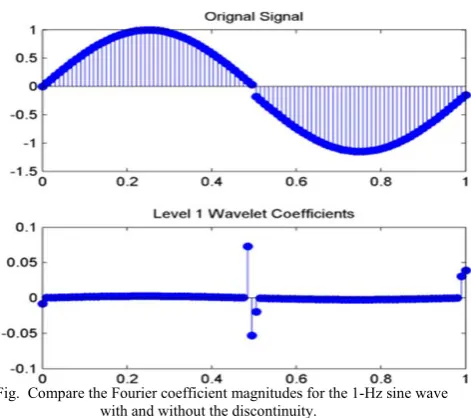
This illustration shows you how wavelet coefficients localize a discontinuity in a sine wave.
Create a 1-Hz sine wave sampled at 100 Hz. The sine wave has a discontinuity at t=0.5 seconds.
t = linespace(0,1,100)'; x = sin(2*pi*t);
x1 = x-0.15; y = zeros(size(x)); y(1:length(y)/2) = x(1:length(y)/2);
y(length(y)/2+1:end) = x1(length(y)/2+1:end); stem(t ,y ,'markerfacecolor', [0 0 1]); xlabel('Seconds');
ylabel('Amplitude');
Fig. Graph between Amplitude and Time
Discover the non decimated discrete wavelet transform of the sine wave using the 'sym2' wavelet and design the wavelet (detail) coefficients along with the original signal.
[swa,swd] = swt(y,1,'sym2'); subplot(211)
stem(t,y,'markerfacecolor',[0 0 1]); title('Original Signal');
subplot(212)
stem(t,swd,'markerfacecolor',[0 0 1]); title('Level 1 Wavelet Coefficients');
Fig. Compare the Fourier coefficient magnitudes for the 1-Hz sine wave with and without the discontinuity.
There is smallest difference in the magnitudes of the Fourier coefficients. Because the discrete Fourier basis vectors have support over the entire time interval, the discrete Fourier transform does not detect the discontinuity as capably as the wavelet transform. Compare the level 1 wavelet coefficients for the sine wave with and without the discontinuity.
[~,swdx] = swt(x,1,'sym2'); subplot(211)
stem(t,swd);
title('Sine Wave with Discontinuity (Wavelet Coefficients)');
subplot(212) stem(t,swdx);
dftsig = fft([x y]);
dftsig = dftsig(1:length(y)/2+1,:); df = 100/length(y);
freq = 0:df:50; stem(freq,abs(dftsig));
xlabel('Hz'); ylabel('Magnitude');
Wavelet analysis is often able of revealing characteristics of a signal or image that other analysis techniques ignore like trends, breakdown points, discontinuities in higher derivatives, and self-similarity. additionally, for the reason that wavelets offer a different view of data than those offered by Fourier techniques, wavelet analysis can often appreciably compress or de-noise a signal without appreciable degradation.
Transform based image compression schemes first involve the transformation of spatial in formation in to another domain. For instance, the DCT transforms an image into the frequency domain. The aim of the transformation is a compact, whole representation of the image. The transform should de-correlate the spatially distributed energy into a small number of data samples such that no information is lost. Orthogonal transforms have the characteristic of eliminating redundancy in the transformed image. Compression occurs in the second step when the transformed image is quantized (i.e. when several data samples, usually those with insignificant energy-levels.are discarded). The inverse transform reproduce the compressed image in the spatial domain. As the quantization process is not invertible, the reconstruction cannot perfectly reproduce the original image. This type of compression is called lossy. The Walsh Discrete wavelet transforms its applicability to image compression and a quantization technique that is used for
image compression in this thesis. In transform based image compression, entropy coding typically follows the quantization stage.
Wavelet families and family members and we use Daubechies wavelet.
Haar haar Daubechies db Symlets sym Coiflets coif BiorSplines bior Shannon shan
4 .1 Daubechies Wavelets
The Daubechies wavelets are orthogonal wavelets which is energy or norm preserving. There are a number of Daubechies wavelets. The simplest way to understand this transform is just to treat them as simple generations of the Daub4 transform through the scaling and translation factors. Daub4 wavelet is the same as the Haar wavelet. Daub4 wavelet conserves the energy caused by its orthogonality. Daub4 transform is suitable for identifying features of the signal that are related to turning points in its graph.Daub6 often generates smaller size fluctuation values than those produced by D4 transform. The types of signals for which this occurs are the ones that are obtain from the sample of analog signals that are at least three times continuously differentiable. . The curve graphs of quadratic functions permit then to provide superior approximations to the parts of the signal that are near to the turning points in its graph. As a result for signal compression Daub6 transform usually does a enhanced job. However, the fact that Daub4 being improved in approximating signals better approximated by linear approximation .
Fig. Daubechies Wavelet Families
With each wavelet type of this class, there is a scaling function (called the father wavelet) which creates an
4.2 Properties
.The Daubechies wavelets are not clear in terms of the resulting scaling and wavelet functions; actually, they are not possible to write down in closed form. The graphs below are produced using the cascade algorithm, a numeric technique containing of simply inverse-transforming [1 0 0 0 0 ... ] an appropriate number of times. Daubechies orthogonal wavelets D2-D10 (even index numbers only) are usually used. The index number refers to the number N of
coefficients. Every wavelet has a number of zero moments or vanishingmoments equal to half the number of coefficients. For instance, D2 (the Haar wavelet) has 1 vanishing moment, D4 has two, etc. In most cases the Daubechies wavelets are selected to have the highest number A of vanishing moments,
(this does not connote the best smoothness) for given support width N=2A, and among the 2A−1 feasible solutions the one is
chosen whose scaling filter has external phase. The wavelet transform is also easy to put into practice using the fast wavelet transform. Daubechies wavelets are broadly used in solving a wide range of problems, e.g. self-similarity properties of a signal or fractal problems, signal discontinuities, etc.
For example, D2, with one moment, efficiently encodes polynomials of one coefficient, or constant signal components. D4 encodes polynomials with two coefficients, i.e. constant and linear signal components; and D6 encodes 3-polynomials, i.e. constant, linear and quadratic signal components. This capability to encode signals is nonetheless subject to the phenomenon of scale leakage, and the lack of shift-invariance, which arise from the discrete shifting operation (below) during application of the transform. Sub-sequences which characterize linear, quadratic (for example) signal components are treated in a different way by the transform depending on whether the points align with even- or odd-numbered locations in the sequence. The lack of the important property of shift-invariance, has led to the development of several different versions of a shift-invariant (discrete) wavelet transform.
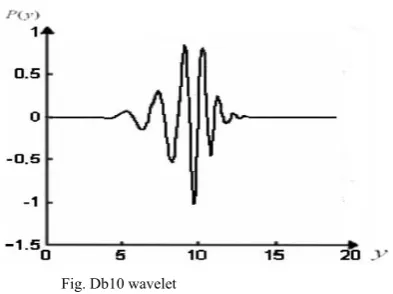
(a) Scaling function (b) Wavelet function
Fig. Db10 wavelet
V. PROPOSED METHODOLOGY AND ARCHITECHURE To prove the usefulness (qualities and robustness) of the proposed Image Compression Using Wavelet Transform, we perform several experiments with this procedure on several images. There are several steps of our proposed method are given below:
1. Select the input image from database which you want to compress.
2. Divide selected input image into 8x8 blocks. 3. Apply two levels discrete wavelet transforms.
4. Apply 2D Walsh Wavelet Transform on every 8x8 block of the low-frequency sub-band.
Apply Walsh Wavelet transform and then using arithmetic coding for compress an image.
Step 4 consists of the following:
4.1. Two Levels Discrete Wavelet Transform.
4.2. Apply 2D Walsh-Wavelet Transform on each 8x8 block of the low frequency sub-band.
4.3. Split all values form each transformed block 8x8. 4.4. Compress each sub-band by using Arithmetic coding,
the first part of Walsh Wavelet compression steps for high frequency, domains, and then second part of Walsh Wavelet compression steps for low frequency. 5. Split all DC values form each transformed block 8x8. 6. Apply for compression each sub-band by using Arithmetic coding
7. Output image obtained by the compression.
Fig: Shows 2D‐WWT compression algorithm steps for high frequency
Flow chart of 2D walsh wavelet transform:-
VI. EXPERIMENTAL ANALYSIS AND RESULT The Experiments presented in this thesis shows Daubechies wavelet-based “An Elevation of Image Compression Techniques". We present a comprehensive correlation analysis of the quantitative and qualitative results. In addition, we evaluate the quantitative and qualitative results to the original image and after decompression image. The quantitative comparison is prepared using PSNR and the qualitative comparison is made using the Daubechies family (db2-d10) and Compression ratio factor through the quantization factor values(.05-.5). The following summarizes the varying factors in the experiments. Here we supply MATLAB for the implementing our work.
MATLAB (matrix laboratory) is a numerical computing environment and fourth-generation programming language. Developed by Maths Works, MATLAB allows matrix manipulations, plotting of functions and data, implementation of algorithms, creation of user interfaces, and interfacing with programs written in other languages, including C, C++, Java, and FORTRAN. M ATLAB is widely used in academic and research institutions as well as industrial enterprises. Cleve Moler, the chairman of the computer science department at the University of New Mexico, started developing MATLAB in the late 1970s.
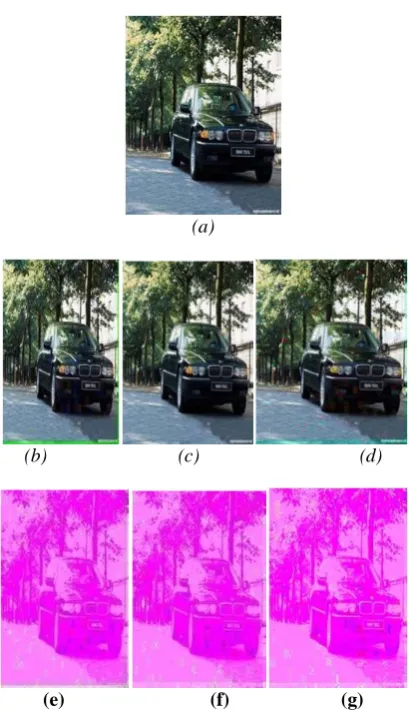
Result for car
In this figure we use db2 wavelet form on the input image of 1.00 Mb in size and QF form [.05-.5] with CRF value is 2, On compressing we got 113.82 kb and PSNR is 14.28 dB. We estimated the time during compression that is 116.10 sec . After that when we decompress the image the size is 236.39 kb and time during decompression is 236.84 sec. The compression ratio for that process is 9.07 .
Choose input image
Divide input image into 8 X 8 Block
Apply DWT
Apply 2 D WWT on low frequency Sub Bands
Compress each Sub Bands using Arithmetic coding
Spilt each DC Values of 8X8 Blocks
Apply Compression on Each Sub Bands Using Arithmetic coding
(a)
(b) (c) (d)
(e) (f) (g)
Fig 5.20 Car image tested outputs (a) original image (b) db2 with crf 2 (c) db5 with crf 2 (d) db10 with crf 2 (e) db2 with crf 5 (f) db5 with crf 5 (g)
db10 with crf 5
Table : Comparison of Car image PSNR values with different wavelet type(Db)
VII. CONCLUSION AND RESULT
The quality of compressed graphical image is also maintained. In this paper, we present an image compression framework that use Daubechies wavelets by using Walsh Transform to remove redundancy from images. Wavelet decomposes a signal into a set of basis functions. These basis functions are called wavelets. In this correspondence, we have proposed an improved image compression algorithm. The WT is a powerful tool to analyze signals. There are many applications of the WT, such as image compression. Daubechies wavelet transform for image compression is simple and crudest algorithm as compared to other algorithms it is more effective. . Due to the delivered assistant information, our presented framework is able to remove enough regions so that the compression ratio can be greatly increased. Our presented Daubechies wavelets with Walsh Transform method are capable in effectively restoring the removed regions for good visual quality, as well.
Our future work is to improve them. For example, we could improve the adaptive transform coding, including the shape of the sub images, the selection of transformation, and the quantizer design. They are all hot topics to be studied. In future we can expand the picture quality with the increasing compressed ratio factor also we can enhance this method for image compressing from input graphical image by using interactive compression techniques and different transform apply on these techniques as well as using different discrete wavelet like produce better results with minimizing noise to get better the compression.
REFERENCES
1. Liu Bo, Yang Zhaorong Harbin University of Science and Technology Harbin China Image Compression Based on Wavelet Transform ©2012 IEEE proceeding of International Conference on Measurement, Information and Control (MIC)
2. G Boopati, Dr.S. Arockiasamy “An Image Compression Approach using
Wavelet Transform and Modified Self Organizing Map” IJCSI
International Journal of Computer Science Issues, Vol. 8, Issue 5, No 2,
September 2011.
3. Myung-Sin Song Wavelet Image Compression1991 Mathematics Subject Classification. Primary 42C40.
4. Davis,G.Danskin,J and Heasman R wavelet image compression construction
,HTTP://www.cs.darthmouth.edu/gdavis/wavelet/wavelet.html> 2002 March12 .
5. Chin,C “An Introduction to wavelets,San Diego: Academic press Inc
6. Matthew C. Stamm and K. J. Ray Liu WAVELET-BASED IMAGE
COMPRESSION ANTIFORENSICS Proceedings of 2010 IEEE 17th International Conference on Image Processing September 26-29, 2010, Hong Kong
7. M. Saenz, R. Oktem, K. Egiazarian, , and E. Delp. Color image wavelet compression using vector morphology. Proc. of the European Signal Processing Conference, September. 8. http://en.wikipedia.org/wiki/quantization_
9. J. Shapiro, Dec. 1993. Embedded image coding using zero trees of wavelets coeNcients, IEEE Trans. Signal Processing, vol. 41,no. 12, pp. 3445–3462 10. J. M. Shapiro, April 1993,Application of the embedded wavelets
11. Smart Compression using the Embedded Zero tree Wavelets (EZW) Algorithm Jerome M. Shapiro David Sarnoff Research Center, CN5300, Princeton, NJ 08543-5300
12. F. W. Wheeler and W. A. Pearlman, Low-memory packetized SPIHT image compression, 33rd AsilomarN.
13. A. Said and W. A. Pearlman, Jun. 1996,A New, Fast and Efficient Image Codec based on Set Partitioning in Hierarchical trees, IEEE Trans. Circuits Syst. Video Technology, vol. 6, pp. 243–250
14. Lu and W. A. Pearlman, Dec.1998, An Efficient, Low- Complexity Audio Cider Delivering Multiple Levels of Quality for Interactive Applications, IEEE Workshop on Multimedia Signal Processing,. 15. Sprljan, S. Grgic and M. Grgic, , Aug. 2005,Modified SPIHT
Algorithm for Wavelets Packet Image Coding, Real-Time Imaging, Elsevier, vol. 11, pp. 378-388
16. Aditya Kumar et al.International Journal on Computer science and engineering (IJCSE),A Wavelets Transform algorithm for 2^n Shades Images.5-8 2000.
17. Dr. (Mrs.) R.Sukanesh, R.Harikumar,N.S.Balaji and S.R.Balasubramaniam , “Analysis of Image Compression by Minimum Relative Entropy (MRE) and Restoration through Weighted Region Growing Techniques for Medical Images” , Engineering Letters, 14:1, EL_14_1_16 , 2007.
18. K. Veeraswamy, S. Srinivas Kumar , “Adaptive AC-Coefficient Prediction for Image Compression and Blind Watermarking”, Journal of Mutltimedia, VOL. 3, NO. 1, MAY 2008.
19. Jagadish H. Oujar,Lohit M. Kadlaskar , “ A New Lossless Method of Image Compression and Decompression using Huffman Coding Techniques”, Journal of Theoretical and Applied Information Technology © 2005 - 2010 JATIT.
20. G.M.Padmaja, P.Nirupama , “Analysis of Various Image Compression Techniques”, ARPN Journal of Science and Technology ©2011-2012.. 21. S.Parveen Banu Dr.Y.Venkataramani , “An Efficient Hybrid Image Compression Scheme based on Correlation of Pixels for Storage and Transmission of Images”, International Journal of Computer Applications (0975 – 8887) Volume 18– No.3, March 2011.
22. Yu Shen, , Xieping Gao, Linlang Liu, Caixia Li, Qiying Cao , “Integer to Integer Multiwavelets for Lossless Image Compression”, Proceedings of IEEE IC-BNMT2011.
23. S.P. Raja , Dr. A. Suruliandi Analysis of Efficient Wavelet based Image Compression Techniques 2010 Second International conference on Computing, Communication and Networking Technologies Manonmaniam Sundaranar University, Tirunelveli, Tamilnadu, India
24. K. Sayood, Introduction to Data Compression, Second edition, Academic Press, 2000.
25. G.M. Davis, A. Nosratinia. “Wavelet-based Image Coding: An Overview. Applied and Computational Control”, Signals and Circuits, Vol. 1, No. 1,1998.
26. Internet.“PSNR”, http://en.wikipedia.org/wiki/PSNR_Page
27. Karen Lees Dr. Joab Winkler Image Compression Using Wavelets 2002
28. http://en.wikipedia.org/wiki/wavelet transform
29. Cédric Vonesch Generalized Daubechies Wavelet Families IEEE TRANSACTIONS ON SIGNAL PROCESSING, VOL. 55, NO. 9, SEPTEMBER 2007
30. http://en.wikipedia.org/wiki/
31. Yu Yanxin , Song Xue , “A Remote Sensing Image Compression Method Suited to Space-borne Application”, 2011 International Conference on Computer Science and Network Technology.
32. Baluram Nagaria , Mohammad Farukh Hashmi ,Imran Hussain ,Ravijeet Singh Chauhan ,” Comparative Analysis of an Optimal Image Compression using FDWT at Various Decomposition Level with Different Statistical Numerical Measures for Different Pixel Frame”, 2011 International Conference on Computational Intelligence and Communication System.
33. Abdmouleh, M., Masmoudi, A. and Bouhlel, M. (2012) A New Method Which Combines Arithmetic Coding with RLE for Lossless Image Compression, Journal of Software Engineering and Applications, Vol. 5 No. 1, Pp. 41-44.
34. Acharya T. and Tsai, T. (2005) JPEG2000 Standard for Image Compression: Concepts, Algorithms and VLSI Architectures, Introduction to Data Compression, Wiley InterScience, Online Journal, John Wiley & Sons, Inc.
35. Acharya, T. and Tsai, P.S. (2004) JPEG2000 Standard for Image Compression: Concepts, Algorithms and VLSI Architectures. WileyInterscience.
36. Veeraswamy, K. and SrinivasKumar, S. (2008) An Improved Wavelet based Image Compression Scheme and Oblivious Watermarking, Proc. of Intl. Journal on Computer Science and Network Security, Vol. 8, No. 4, Pp.170-177.
37. Venkatesan, M., MeenakshiDevi, P., Duraiswamy, K. and Thyagarajah, K. (2008) Secure Authentication Watermarking for Binary Images using Pattern Matching, IJCSNS International Journal of Computer Science and Network Security, Vol.8, No.2, Pp. 241-250.
38. Vetterli, M. and Kovacevic, J. (1995) Wavelets and Subband Coding, Englewood Cliffs, NJ, Prentice Hall.
39. Vijendrababu, D. and Alamelu, N.R. (2009) Wavelet Based Medical Image Compression Using ROI EZW, International Journal of Recent Trends in Engineering, Vol 1, No. 3, Pp. 97-100.
40. Walker, J.S. (1999) A Primer on Wavelets and Their Scientific 1Applications. Boca Raton, Fla. : Chapman & Hall/CRC. [222] Wallace, G. (1991) The JPEG still picture compression standard. Communications of the ACM, Vol. 34, No.4, Pp. 30-44.
41. Wallace, G.K. (1992) The JPEG Still Picture Compression Standard, IEEE Transactions on Consumer Electronics, Vol. 38, Issue I, Pp. xvii -xxxiv.
42. Wang, L., Wu, J., Jiao, L., Zhang, L. and Shi, G. (2008) Lossy to lossless image compression based on reversible integer DCT, 15th IEEE International Conference on Image Processing, ICIP 2008, San Diego, CA, Pp. 1037 - 1040
43. Wang, Z., Bovik, A.C., Sheikh, H.R. and Simoncelli, E.P. (2004) Image quality assessment: From error visibility to structural similarity, IEEE Transactions on Image Processing, Vol. 13, No. 4, Pp. 600-612. 44. Webster’s Encyclopedic Unabridged Dictionary of English Language
(1996).
45. Weinberger, M.J., Seroussi, G. and Sapiro, G (2000) The LOCO-I 235 lossless image compression algorithm: principles and standardization into JPEG-LS, IEEE Transactions on Image Processing, Vol. 9, Issue 8,Pp.1309-1324.
46. Weinberger, M.J., Seroussi, G. and Sapiro, G (2000) The LOCO-I lossless image compression algorithm: principles and standardization into JPEG-LS, IEEE Transactions on Image Processing, Vol. 9, Issue 8, Pp.1309-1324.