Available online: https://edupediapublications.org/journals/index.php/IJR/ P a g e | 266
Organic Pest Management Practices and Soil Biodiversity Conservation in
Budondo Sub County, Jinja District
1Tukamushaba J.W.*, 2 Otieno A.C., 3Bugenyi F.W. and Kibikyo D.L. 1Department of Agriculture,
Faculty of Agriculture, Science & Technology Busoga University, P.O. Box 154, Iganga-Uganda.
2Department of Geography & Social Development,
School of Humanities & Social Sciences,
JaramogiOgingaOdinga University of Science & Technology P. O. Box 210-40601, Bondo-Kenya.
3Department of Environment,
College of Agriculture & Environment,
Makerere University, P. O. Box 7062, Kampala-Uganda ABSTRACT
Biodiversity is at the verge of alarming decline globally, attributed to change in agricultural practices such as the use of inorganic pesticides. These agricultural practices have changed the distribution and quality of habitual biodiversity and their environment. A study of 340 households in Budondo Sub-County farming community, Jinja District revealed that pests destroyed their crops and caused significant yield losses. This was manifested in their score of responses viz. strongly agreed (1175) and strongly agreed (1075) respectively. Farmers demonstrated knowledge of soil macro fauna (96.2%), however, they claimed that termites and earthworms were pests (45.6%) because they ate and reduced their crop yield (86.8%) and constructed ant hills which were labourious to dig (60.3%). Farmers therefore sprayed their gardens with inorganic pesticides (81.8%) in order to eliminate pests quickly (86.5%). They also poisoned termites and earthworms with inorganic chemicals (77.9%) disregarding their long term economic benefits of decomposing organic matter and nutrient recycling among others. The study also revealed that organic pest management practices have not been adopted because of inadequate training, inadequate knowledge which was found significant at (χ² (77, n=340) =180.441, p< .001) and attitude significant at (χ² (99, n=340) =161.511, p< .001). The researcher therefore recommended the government of Uganda to make and adopt a policy and action plan on organic pest management for sustainable soil biodiversity conservation. Farmers in Budondo be sensitized and trained on how to mix plant extracts to form organic pesticides if any conservation measures were to be attained.
Key words: Soil, biodiversity, conservation, organic, inorganic, pesticides, households.
*Corresponding author: Tukamushaba, J.W., 1Department of Agriculture, Faculty of Agriculture,
Science & Technology Busoga University, P.O. Box 154, Iganga-Uganda. E-mail Address: [email protected] Phone: +256 782 597 504
INTRODUCTION
Biodiversity, the diversity of genes, organisms and ecosystems (Blouin et al., 2013) is at decline
Available online: https://edupediapublications.org/journals/index.php/IJR/ P a g e | 267 organisms in the soil - ranging from the myriad
of invisible microbes, bacteria and fungi to the more familiar macro-fauna such as earthworms and termites (Montanarella, 2016; Symondson, 2012).
The rapid growth of biodiversity started 540 years ago following 3.5 billion years of evolution (Sahney, Benton, & Falcon-Lang, 2010). It comprises of planned biodiversity (crops and livestock that the farmer wishes to produce) and unplanned biodiversity (all other biota in and entering the system) (Brussaard, de Ruiter, & Brown, 2007). Farmers plan biodiversity by applying a multitude of management practices which include agrochemical application and burning which change the distribution and quality of available habitat and resources both for plants and other biodiversity. Since before 2000 BC, humans have utilized pesticides to protect their crops against pests and this has since increased dramatically over the past 60 years (Isenring, 2010; Koul, 2012).
In Africa, agriculture is one of the major threats of biodiversity (Sileshi, Akinnifesi, Ajayi, Mng, & Nyoka, 2016). There is a growing realization worldwide that biodiversity is fundamental for agricultural production and food security as well as environmental conservation, which human wellbeing depends on (Thrupp, 2000). Therefore, his war against biodiversity is inevitably war against himself.
Several approaches to the intervention of pest management include cultural, biological, physical and chemical pest control measures. Pesticides though effective for the job but is broad spectrum rather than target oriented(Gurr, Wratten, & Snyder, 2012). Pesticides affect biological diversity, along with habitat loss and climate change. They have toxic effects in the short term on directly exposed organisms or long-term effects by causing changes in habitat and the food chain (Isenring, 2010). For example
insecticides kill insect pest, herbicides kill weeds, fungicides kill fungi, nematicides kill nematodes and termiticides kill termites (Manual, 2013).
In an awake to control garden pests and weeds in order to increase crop yields, farmers especially in Budondo Sub-County have increasingly used inorganic pesticides and herbicides respectively. However, the chemicals used are poisonous not only to pests but also to soil biodiversity. The inorganic chemicals reduce soil biodiversity population and impacting on the slow rate of soil nutrient recycling (fertility) and diversity degradation. Termite houses commonly known as anthills are left empty and road networks of termites, ants and earthworms are not commonly seen in Budondo Sub County due to inorganic pesticides.
Available online: https://edupediapublications.org/journals/index.php/IJR/ P a g e | 268 However, these have received little attention
(Winqvist, Ahnström, & Bengtsson, 2012)
Agricultural practices affecting soil microorganisms are of particular interest (Eisenhauer et al., 2009). Thus, human survival is inextricably linked to the survival of numerous other species on which intact ecosystems depend (Isenring, 2010). Many of the problems in conserving biodiversity are associated with the lack of recognition of the importance it plays in agricultural production. Although many farmers and the farming community have a profound knowledge of their agriculture, training and education is often needed to highlight the roles of the soil biota at various levels of the ecosystem/landscape (Tukamushaba, Mugonola, Otieno, Bugenyi, & Kibikyo, 2016)
The researchers’ specific objectives to this study were:
To establish the level of organic pest management practices in Budondo Sub county
To establish the level of soil biodiversity conservation in Budondo Sub county
To relate organic pest management practices and soil biodiversity conservation in Budondo Sub County
Description of study area: Budondo is one of the 12 sub counties (6 rural and 6 urban) in Jinja District in Busoga region and in Uganda. It has five (5) parishes and a total of thirty eight (38) villages. It is located in Kagoma County along River Nile west of Jinja Town. It is about 10 Km from Jinja town. Budondo Sub county community has a total population of 45,035 male and female who live in 8502 households. The average household is 5.3 with an average land holding of 1.5 acre per household (Statistics, 2005).
MATERIALS AND METHODS
This was a case study conducted through a descriptive survey research design. It was concerned with establishing the relationship between organic pest management practices and conservation of soil biodiversity in Budondo Sub County, Jinja District.
Descriptive approach was used in order to gather information about the present existing condition and utilize observations in the study (Creswell, 2003). The research study partially based its findings through both quantitative research methods in order to permit a flexible and iterative approach. It also employed qualitative research method in order to find and build theories that would explain the relationship of one variable with another variable through qualitative elements in research (Atomica, 2010). A total of 340 respondents was randomly determined using a probabilistic sampling design specifically simple random sampling from 8502 household in Budondo Sub County chosen in line with Strydom and De Vos sample determination table (De Vos & Strydom, 1998).
Researchers used both administered questionnaire, interviews, observations and documentary analysis as the main tools for collecting data. They were concerned with views, perceptions, opinions, attitudes and behaviours of the respondents (Otieno, Buyinza, Kapiyo, & Oindo, 2013). Questionnaires were administered by the interviewer especially where concepts were difficult to interpret by farmer respondents. The data obtained through a questionnaire was similar to that obtained through an interview because of the open ended questions (Burns & Grove, 1993).
Available online: https://edupediapublications.org/journals/index.php/IJR/ P a g e | 269 The socio-demographic characteristics of
respondents were tabulated from questionnaires describing bio-data, education background and occupation of respondents in the five parishes of Budondo Sub-County (Table 1).
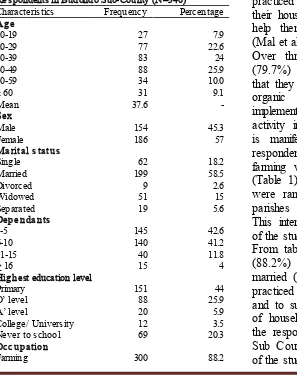
The mean age of 37.6 of household respondents authenticated the responses given the Ugandan age of consent of 18 years. This supports Segura et al (2004) who suggested that the youth emigrate from their farming communities and perhaps are less motivated to carry out farming. It also implies that pest management was carried out by the mature farmers who had knowledge and made farming decisions on the choice of farm inputs used (Lutap & Atis, 2013).
Tab le 1: Socio-demographic Characteristics of Res pondents in Budondo Sub-County (N=340)
Characteristics Frequency Percentage A g e
10-19 27 7.9
20-29 77 22.6
30-39 83 24
40-49 88 25.9
50-59 34 10.0
≥ 60 31 9.1
Mean 37.6 -
Sex
Male 154 45.3
Female 186 57
M arital s tatu s
Single 62 18.2
Married 199 58.5
Divorced 9 2.6
Widowed 51 15
Separated 19 5.6
Dep en d an ts
1-5 145 42.6
6-10 140 41.2
11-15 40 11.8
≥ 16 15 4
Hig h est education level
Primary 151 44
O’ level 88 25.9
A’ level 20 5.9
College/ University 12 3.5
Never to school 69 20.3
Occu p atio n
Farming 300 88.2
Trading 34 10
Civil servant 6 1.8
W o rkin g exp erien ce
1-2 years 48 11
3-4 years 61 17.9
5-6 years 46 13.5
≥ 7 years 185 54
Paris h
Ivunamba 83 24
Namizi 73 21.5
Kibibi 74 21.8
Buwaji 63 18.5
Nawangoma 47 13.8
More than a half of respondents were female (57%) indicating gender sensitivity and farming dominance by female. Over a half of respondents were married (58.5%) and had over six dependants (57.4%) (Mal et al., 2009) (Table 1). This indicates that the most of households practiced farming to produce food to survive their household members and generate income to help them fulfill their needs and responsibilities (Mal et al., 2009) .
Over three quarters of household respondents (79.7%) attended formal education. This shows that they had the capacity to be sensitized about organic pest management practices and implement them effectively. The major economic activity in rural communities was farming. This is manifested by the majority of household respondents (88.2%) whose occupation was farming with over 5 years’ experience (70.5%) (Table 1). The respondents (an average of 20%) were randomly selected from each of the five parishes that constitute Budondo Sub-County. This intended to ensure an equal representation of the study area.
Available online: https://edupediapublications.org/journals/index.php/IJR/ P a g e | 270 Over a half of respondents grew most of
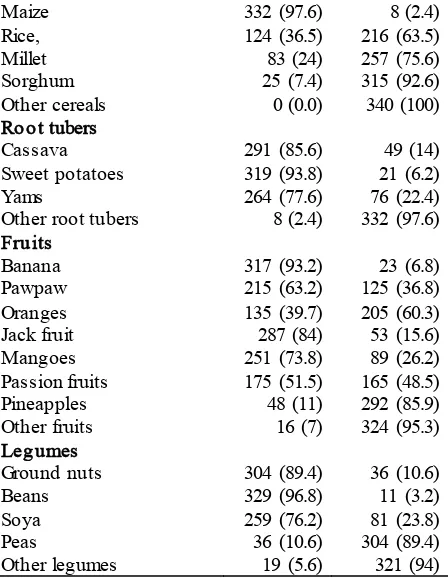
vegetables i.e. Cabbage (67.4%), Tomatoes (74%), Pumpkins (50.3%) and greens like dodo, sukuma etc. (87.1%) (Table 2). This was due to Budondo’s conducive ecology for vegetable growing enhanced by her location near River Nile and proximity to Jinja town. Respondents revealed that Ginger farming (27.1%) had just been introduced in the area whereas Onions (38.8%) and Carrots (40.6%) were progressing due to increasing demand in and neighboring markets (Table 2). This was in line with Pophiwa who urged that there was a growing demand for food globally most especially organically produced (Pophiwa, 2012).
Maize was the dominant cereal crop grown in Budondo Sub-County as agreed by (97.6%) (Table 2). This was because maize is the traditional food and cash crop in the study area and promotes food security. There was also a high demand of maize by schools, prisons and neighborhood countries. Rice growing was represented by (36.5%), millet (24%) and Sorghum 7.4% possibly due to their unfavourable ecological environment in the study area. More than three quarters of respondents agreed that cassava (85.6%), sweet potatoes (93.8%) and yams (77.6%) were grown by the majority households. This indicated that farmers in Budondo value the traditional staple foods.
Pest management practices and peasantry Tab le 2: Crops Grown in Budondo Sub-County (N=340)
Crops Yes (%) No (%)
Veg etables
Cabbage 229 (67.4) 111 (32.6) Carrots 138 (40.6) 202 (59.4) Tomatoes 253 (74) 87 (25.6) Onions 132 (38.8) 208 (61.2) Pumpkins 171 (50.3) 169 (49.7) Ginger 92 (27.1) 248 (72.9) Greens 296 (87.1) 44 (12.9) Other vegetables 23 (6.8) 317 (93.2) Cereals
Maize 332 (97.6) 8 (2.4) Rice, 124 (36.5) 216 (63.5) Millet 83 (24) 257 (75.6) Sorghum 25 (7.4) 315 (92.6) Other cereals 0 (0.0) 340 (100) Ro o t tubers
Cassava 291 (85.6) 49 (14) Sweet potatoes 319 (93.8) 21 (6.2) Yams 264 (77.6) 76 (22.4) Other root tubers 8 (2.4) 332 (97.6) Fru its
Banana 317 (93.2) 23 (6.8) Pawpaw 215 (63.2) 125 (36.8) Oranges 135 (39.7) 205 (60.3) Jack fruit 287 (84) 53 (15.6) Mangoes 251 (73.8) 89 (26.2) Passion fruits 175 (51.5) 165 (48.5) Pineapples 48 (11) 292 (85.9) Other fruits 16 (7) 324 (95.3) Leg umes
Ground nuts 304 (89.4) 36 (10.6) Beans 329 (96.8) 11 (3.2) Soya 259 (76.2) 81 (23.8) Peas 36 (10.6) 304 (89.4) Other legumes 19 (5.6) 321 (94)
Most households grow banana (93.2%), jack fruit (84%), mangoes (73.8%), pawpaw (63.2%) and passion fruits (51.5%) (Table 2). This was possibly due to high demand of fruits by urban dwellers around the study area. However, orange growing (39.7%) was still low while pineapple growing (11%) was left to isolated farmers possibly due to little awareness about their growing methods. Most of respondents agreed that legumes grown were beans (96.8%) followed by ground nuts (89.4%), and soya (76.2%). This is because they were consumed in different forms. Peas (10.6%) are grown by isolated farmers (Table 2) possibly due to little awareness about the value and growing methods of it.
Tab le 3: Knowledge about Pests in Budondo Sub-Co u nty (N=340)
Variables Yes (%) No (%)
Are you aware of pests 292 (85.9) 48 (11) Pests
Aphids 53 (15.6) 287 (84)
Available online: https://edupediapublications.org/journals/index.php/IJR/ P a g e | 271 Mealy bugs 36 (10.6) 304 (89.4)
Termites 155 (45.6) 185 (54) Cut worms 51 (15.0) 289 (85.0) Stem borers 88 (25.9) 252 (71) Hoppers and locusts 78 (22.9) 262 (77.1) African boll worm 24 (7.1) 316 (92.9) African army worm 24 (7.1) 316 (92.9) Thrips 37 (10.9) 303 (89.1) Leaf miners 60 (17.6) 280 (82.4) White grabs 42 (12.4) 298 (87.6) Others 182 (53.5) 158 (46.5) Pest management practice
Spray them using
pesticides 278 (81.8) 62 (18.2) Pick them by hands 48 (11) 292 (85.9) Weed crops to prevent
pests 113 (33.2) 227 (66.8) Crop rotation 142 (41.8) 198 (58.2) Intercropping 110 (32.4) 230 (67.6) Spray using a mixture of
any of urine, red pepper,
neem, onions etc. 103 (30.3) 237 (69.7) Use ash mixed with
pepper and urine 112 (32.9) 228 (67.1) Leave them 38 (11.2) 302 (88.8) Any other 10 (2.9) 330 (97.1)
It was found out that (85.9%) of household respondents were aware of pests (Table 3), very few could identify aphids (15.6%), whiteflies (7.6%), mealy bugs (10.6%), cut worms (15%), stem borers (25.9%), hoppers and locusts (22.9%), african boll worm (7.1%), african army worm (7.1), thrips (10.9%), leaf minors (17.6%) and white grabs (12.4%). Little knowledge about pests implies that farmers were unable to establish the growing habits and behaviours of the pests. This probably limited farmers’ ability to choose the appropriate method of control and possibly adapt to pesticides as the only solution. This contradicts the IPM approach which relies on knowledge and experience. To minimize losses to pests, farmers should have awareness about the types of pests which attack crops as well as their biology which is not the case in Budondo (Lutap & Atis, 2013)
Almost a half of respondents identified termites (45.6%) as pests. This indicates that some of the farmers in Budondo Sub County knew little
about other functions of termites. Most farmers in Budondo knew pests by local names (53.5%), others saw pests’ symptoms on their crops while others saw them physically but were not aware of their names. This indicated that pests were common in the study area. Table 3 also portrays that spraying with pesticides (81.8%) is the common method used towards managing pests in Budondo Sub-County. This justifies that crops in Budondo Sub-County were largely affected by pests and farmers try to prevent crop losses to insects and other pests by spraying with pesticides (Seymour, 2004).
As discussed by Lutap and Atis (2013) about organic methods of controlling pests, less than a half of households agreed that farming practices reduce on pest infestation for example picking pests by protected hands (11%), weeding crops to prevent pests (33.2%), rotating crops (41.8%), intercropping (32.4%), spraying with a mixture of any of urine, red pepper, neem or onions (30.3%), using a mixture of pepper and urine (32.9%) while others left them (11.2%) (Table 3). This little awareness could perhaps be due to little exposure to organic pest control measures (Sebastian, Joshi, Gergon, Catudan, & Desamero, 2003).
Measuring organic pest management practices and soil biodiversity conservation
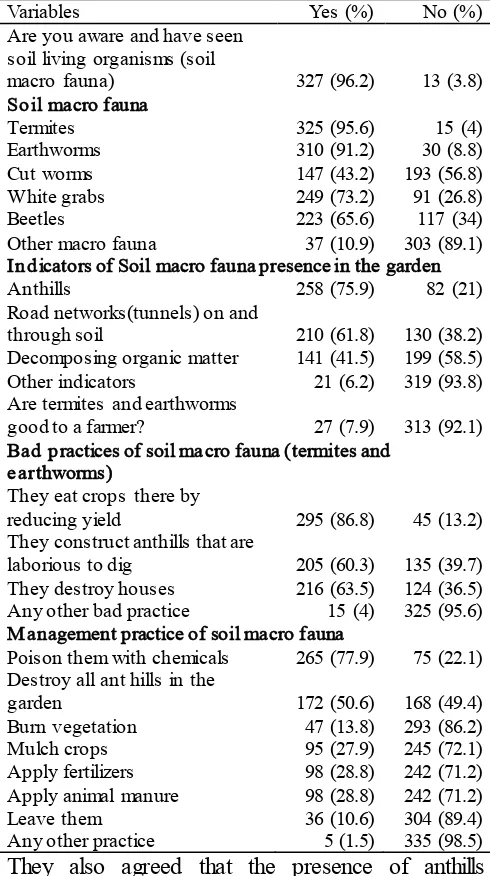
Almost all the household respondents in Budondo Sub-County were aware and had seen soil living organisms (96.2%).
Available online: https://edupediapublications.org/journals/index.php/IJR/ P a g e | 272 Tab le 6: Soil Macro Fauna and their Management in
Bu d ondo Sub-County (N=340)
Variables Yes (%) No (%)
Are you aware and have seen soil living organisms (soil
macro fauna) 327 (96.2) 13 (3.8) So il macro fauna
Termites 325 (95.6) 15 (4) Earthworms 310 (91.2) 30 (8.8) Cut worms 147 (43.2) 193 (56.8) White grabs 249 (73.2) 91 (26.8) Beetles 223 (65.6) 117 (34) Other macro fauna 37 (10.9) 303 (89.1) In d icators of Soil macro fauna presence in the garden Anthills 258 (75.9) 82 (21) Road networks(tunnels) on and
through soil 210 (61.8) 130 (38.2) Decomposing organic matter 141 (41.5) 199 (58.5) Other indicators 21 (6.2) 319 (93.8) Are termites and earthworms
good to a farmer? 27 (7.9) 313 (92.1) Bad p ractices of soil macro fauna (termites and
earthworms)
They eat crops there by
reducing yield 295 (86.8) 45 (13.2) They construct anthills that are
laborious to dig 205 (60.3) 135 (39.7) They destroy houses 216 (63.5) 124 (36.5) Any other bad practice 15 (4) 325 (95.6) M anagement practice of soil macro fauna
Poison them with chemicals 265 (77.9) 75 (22.1) Destroy all ant hills in the
garden 172 (50.6) 168 (49.4) Burn vegetation 47 (13.8) 293 (86.2) Mulch crops 95 (27.9) 245 (72.1) Apply fertilizers 98 (28.8) 242 (71.2) Apply animal manure 98 (28.8) 242 (71.2) Leave them 36 (10.6) 304 (89.4) Any other practice 5 (1.5) 335 (98.5) They also agreed that the presence of anthills (75.9%), road networks or tunnels on and
through soil (60.3%) and decomposing organic matter were indicators of soil living organisms (Table 6).
However, majority of them reported that soil living organisms were destructive to houses (63.5%), ate crops to reduce yield (86.8%) and constructed anthills which were laborious to dig (60.3%) among other bad practices of macro fauna (4%) (Table 6). The bad practices of macro fauna could not be compared to their long term benefits.
In an attempt to mitigate these bad practices, over a half number of household farmers resorted to poisoning soil macro fauna with chemicals (77.9%) and destroying anthills in the garden (50.6%)
This was in support of Seymour (2014) who stressed that pesticides were used to control organisms that are harmful. However, respondents registered minimal practices of burning vegetation (13.8%), mulching crops (27.9%), fertilizer and animal manure application (28.8%) which would help in conserving the soil living organisms (Table 6).
Available online: https://edupediapublications.org/journals/index.php/IJR/ P a g e | 273 Tab le 8: Organic Pest Management and Soil Macro Fauna Conservation in Budondo Sub-County (N=340)
Variables Yes (%) No (%)
Are termites and earthworms beneficial to a farmer 157 (46.2) 183 (53.8) Ben efits of soil macro fauna
They recycle nutrients into the soil 135 (39.7) 205 (60.3)
They add organic matter into the soil 87 (25.6) 253 (74)
They are the primary decomposer of plant remains 62 (18.2) 278 (81.8)
They modify soil structure 57 (16.8) 283 (83.2)
Any other benefit 3 (0.9) 337 (99.1)
Pesticides and herbicides once sprayed on crops will further kill termites and earthworms? 155 (45.6) 185 (54) Org anic methods of managing pests that help to conserve soil macro fauna
Good seed bed preparation to expose pests external natural enemies 35 (10.3) 305 (89.7)
Use of pest and disease free seeds 53 (15.6) 287 (84)
Crop rotation 103 (30.3) 237 (69.7)
Inter-planting with crops that repel pests like onions and garlic 40 (11.8) 300 (88.2)
Early planting at onset of rains 21 (6.2) 319 (93.8)
Hand weeding limits the host range of different pests that like weedy areas 59 (17.4) 281 (82.6)
Hand picking of pests 34 (10.0) 306 (90.0)
Pruning infected plant parts controls pests 54 (15.9) 286 (81)
Use ash and urine 61 (17.9) 279 (82,1)
Use neem, pepper and onion mixtures 35 (10.3) 305(89.7)
Any other 9 (2.6) 331 (97.4)
Are you aware of how to make organic pesticide that will help conserve soil macro fauna? 141 (41.5) 199 (58.5) Org anic pesticides that help to conserve soil macro fauna
A mixture of two or more of ash, neem extract, red pepper extract, urine, onion /garlic extract
and marigold 124 (36.5) 216 (63.5)
Cow urine mixed with Lantana camara kill banana weevil, leaf miners, caterpillars in beans
and army worms in millet 74 (21.8) 266 (78.2)
Kitchen ash control banana weevil, tomato blight, caterpillars and nematodes 68 (20.0) 272 (80.0)
Apply farm yard manure 50 (17) 290 (85.3)
Mulch crops 35 (10.3) 305 (89.7)
Any other organic pesticides 2 (0.6) 338 (99.4)
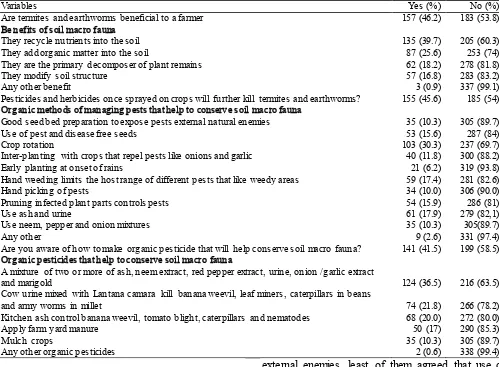
Only (39.7%) of respondents supported that soil macro fauna recycle nutrients into the soil whereas less than a third recognized their benefits of adding organic matter into the soil (25.6%), decomposing plant remains (18.2) and modifying soil structure (16.8) among other benefits. This supported the role of soil living organisms (Atina, 2007; Ayuke, 2010).
Less than a half of respondents agreed that Pesticides and herbicides once sprayed on crops would further kill termites and earthworms (45.6%). This indicated that farmers were ignorant about the effects of inorganic pesticides. Less than a quarter of household respondents were supportive of organic methods of pest management. For instance only (10.3%) agreed that good seed bed preparation exposed pests to
external enemies, least of them agreed that use of pest and disease free seeds (15.6%), inter-planting with repellant crops like onions and garlic (11.8%), Early planting (6.2%), Hand weeding limiting the host range of pests (17.4%), hand picking of pests (10.0%), pruning infested plant parts (15.9%), use of neem, pepper and onion mixtures (10.3) and use of ash and urine (17.9%) could greatly reduce and control pests from the garden. Only (30.3%) supported crop rotation as a pest management factor. This left a lot of questions why for a vast experience in farming more than a half respondents demonstrated lack of support for at least one organic method of managing pests.
Available online: https://edupediapublications.org/journals/index.php/IJR/ P a g e | 274 (36.5%) to make organic pesticide (Table 8). Less
than a half could tell that cow urine mixed with lantana camara kills banana weevils, leaf miner, caterpillars and army worms (21.8%) or that kitchen ash could control banana weevil, tomato blight, caterpillars and nematodes (20.0%). This revealed little knowledge about organic pest management control. Due to this, most farmers applied pesticides to increase yield and eliminate pests effectively (Lutap & Atis, 2013).
CONCLUSION
Most of household in Budondo Sub County who practice farming have faced the problem of crop pests. The pests have reportedly attacked farmers’ crops and caused significant losses. Soil macro fauna especially termites and earthworms have also been reported as pests by respondents there by disregarding their long term economic benefits of decomposing organic matter and nutrient recycling among others. Due to this pest problem farmers have resorted to use of inorganic pesticides as claimed by respondent (86.5%) because, they are easier to use and effective in eliminating pests.
RECOMMENDATIONS
Based on findings, it is recommended that the Government of Uganda should make and adopt a policy and action plan on organic pest management for sustainable soil biodiversity conservation. Farmers in Budondo should be sensitized about pest management practices in order to increase their knowledge. The sensitization training should explore the advantages and disadvantages of practicing organic pest management practices over inorganic pesticides. Organic pesticides should best alternate inorganic pesticide in the integrated pest management model when a level is determined to cause significant injury to the crop. Farmers should be trained on how to mix plant extracts to form organic pesticides. Adoption to organic pest management practices should be implemented with several approaches and strategies which
includes farmers’ participation if any success is to be registered.
REFERENCES
Atina, D. (2007). Soil Health and Biodiversity in Practice: Harnessing biology, ecology and resiliency on the farm. Article published by the Midwest Organic and Sustainable Education Service.
Atomica. (2010). Sample Research proposal on Methodology. study mode.com.
Ayuke, F. O. (2010). Soil macrofauna functional groups and their effects on soil structure , as related to agricultural management practices across agroecological zones of Sub-Saharan Africa.
Bengtsson, J., Ahnström, J., & Weibull, A. C. (2005). The effects of organic agriculture on biodiversity and abundance: A meta-analysis. Journal of Applied Ecology, 42(2), 261–269.
http://doi.org/10.1111/j.1365-2664.2005.01005.x
Blouin, M., Hodson, M. E., Delgado, E. A., Baker, G., Brussaard, L., Butt, K. R., … Brun, J. J. (2013). A review of earthworm impact on soil function and ecosystem services. European Journal of Soil Science,
64(2), 161–182.
http://doi.org/10.1111/ejss.12025
Brussaard, L., de Ruiter, P. C., & Brown, G. G. (2007). Soil biodiversity for agricultural sustainability. Agriculture, Ecosystems and Environment, 121(3), 233–244. http://doi.org/10.1016/j.agee.2006.12.013 Burns, N., & Grove, S. (1993). The Practice of
Nursing Research: Conduct, Critique, & Utilization: 9780721691770: Medicine & Health Science Books @ Amazon.com.
Retrieved from
http://www.amazon.com/The-Practice-
Nursing-Research-Utilization/dp/0721691773
Available online: https://edupediapublications.org/journals/index.php/IJR/ P a g e | 275 De Vos, A. S., & Strydom, H. (1998). Research at
Grass Roots: A Primer for the caring professions. Health SA Gesondheid. http://doi.org/10.4102/hsag.v2i3.337
Eisenhauer, N., Klier, M., Partsch, S., Sabais, A. C. W., Scherber, C., & Weisser, W. (2009). No interactive effects of pesticides and plant diversity on soil microbial biomass and respiration. Applied Soil Ecology, 42(1), 31– 36.
FiBl. (2000). Organic farming enhances soil fertility and biodiversity. FiBL Dossier. Gurr, G. M., Wratten, S. D., & Snyder, W. E.
(2012). Biodiversity and Insect Pests. Biodiversity and Insect Pests: Key Issues for Sustainable Management, 1–20. http://doi.org/10.1002/9781118231838.ch1 Hole, D. G. (2005). Does organic farming benefit
biodiversity ?, 122, 113–130. http://doi.org/10.1016/j.biocon.2004.07.018 Isenring, R. (2010). Pesticides and the loss of
biodiversity.
Koul, O. (2012). Plant b iodiversity as a r esource for n atural p roducts for i nsect p est m anagement, 85–105.
Lutap, L. A., & Atis, M. I. (2013). Pest Management in Vegetable Production : The Case of the Rainfed Lowlands in Ilocos Norte, 3(1).
Mal, E., Crozat, Y., Dupraz, C., Laurans, M., Makowski, D., Rapidel, B., … Makowski, D. (2009). Mixing plant species in cropping systems : concepts , tools and models . A review To cite this version : Review article Mixing plant species in cropping systems : concepts , tools and models .
Manual, C. (2013). P esticide A pplicator C ertification A pplicator C ertification P esticide.
Montanarella, L. (2016). Towards protecting soil biodiversity in Europe : The EU thematic strategy for soil protection Towards protecting soil biodiversity in Europe : The EU thematic strategy for soil protection, 8386(September).
http://doi.org/10.1080/14888386.2008.97128 89
Otieno, A. C., Buyinza, M., Kapiyo, R. ., & Oindo, B. . (2013). Local Communities and Collaborative Forest Management in West Bugwe Forest Reserve, Eastern Uganda. Environmental Research Journal, 7(4–6), 69– 78.
Pophiwa, N. (2012). Training them to catch fish? Farmer education and training programmes in Uganda’s organic agricultural subsector, (70), 1–8.
Sahney, S., Benton, M. J., & Falcon-Lang, H. J. (2010). Rainforest collapse triggered Carboniferous tetrapod diversification in Euramerica. Geology, 38(12).
Sebastian, L. S., Joshi, R. C., Gergon, E. B., Catudan, B. M., & Desamero, N. V. (2003). Knowledge, Attitudes, and Practices on Rat Management of Ifugao Rice Farmers, Philippines.
Seymour, N. (2004). Impacts of pesticides and fertilisers on soil biota .
Sileshi, G., Akinnifesi, F. K., Ajayi, O. C., Mng, S., & Nyoka, B. I. (2016). Towards sustainable management of soil biodiversity in agricultural landscapes in Africa Towards sustainable management of soil biodiversity in agricultural landscapes in Africa, 8386(September).
http://doi.org/10.1080/14888386.2008.97128 86
Statistics, U. B. of. (2005). 2002 Uganda Population and Housing Census Main
Report, 26. Retrieved from
http://www.ubos.org/onlinefiles/uploads/ubo s/pdf documents/2002 Census Final Reportdoc.pdf
Available online: https://edupediapublications.org/journals/index.php/IJR/ P a g e | 276 Thrupp, L. A. (2000). Linking Agricultural
Biodiversity and Food Security: The Valuable Role of Sustainable Agriculture. International Affairs (Royal Institute of International Affairs 1944-), 76(2), 265–281. http://doi.org/10.1111/1468-2346.00133 Tukamushaba, J. W., Mugonola, B., Otieno, A.
C., Bugenyi, F. W., & Kibikyo, D. L. (2016). Adoption of Soil Biodiversity Conservation measures and sustainable agriculture production in Wakisi and Nagojje subcounties.
Winqvist, C., Ahnström, J., & Bengtsson, J. (2012). Effects of organic farming on biodiversity and ecosystem services: Taking landscape complexity into account. Annals of the New York Academy of Sciences,
1249(1), 191–203.