Beyond 2
c/2Security in Sponge-Based
Authenticated Encryption Modes
?Philipp Jovanovic1, Atul Luykx2, and Bart Mennink2
1
Fakult¨at f¨ur Informatik und Mathematik, Universit¨at Passau, Germany
2 Dept. Electrical Engineering, ESAT/COSIC, KU Leuven, and iMinds, Belgium
[email protected], [email protected]
Abstract. The Sponge function is known to achieve 2c/2 security, wherecis its capacity. This bound was carried over to keyed variants of the function, such as SpongeWrap, to achieve a min{2c/2,2κ}security bound, withκthe key length. Similarly, many CAESAR competition sub-missions are designed to comply with the classical 2c/2 security bound. We show that Sponge-based constructions for authenticated encryption can achieve the significantly higher bound of min{2b/2,2c,2κ}asymptotically, withb > cthe permutation size, by proving that the CAESAR submission NORX achieves this bound. Furthermore, we show how to apply the proof to five other Sponge-based CAESAR submissions: Ascon, CBEAM/STRIBOB, ICEPOLE, Keyak, and two out of the three PRIMATEs. A direct application of the result shows that the parameter choices of these submissions are overly conservative. Simple tweaks render the schemes consider-ably more efficient without sacrificing security. For instance, NORX64 can increase its rate and decrease its capacity by 128 bits and Ascon-128 can encrypt three times as fast, both without affecting the security level of their underlying modes in the ideal permutation model.
Keywords. Authenticated encryption, CAESAR, Ascon, CBEAM, ICEPOLE, Keyak, NORX, PRIMATEs, STRIBOB.
1 Introduction
Authenticated encryption schemes, cryptographic functions that aim to provide both privacy and integrity of data, have gained renewed attention in light of the recently commenced CAE-SAR competition [15]. A common approach to building such schemes is to design a mode of operation for a block cipher, as in CCM [29], OCB1-3 [19, 22, 23], and EAX [8]. Nevertheless a significant fraction of the CAESAR competition submissions use modes of operation for
permutations.
Most of the permutation-based modes follow the basic design of the Sponge construc-tion [13]: their output is computed from a state value, which in turn is repeatedly updated using key, nonce, associated data, and plaintext by calling a permutation. The state is divided into a rate part of r bits, through which the user enters plaintext, and a capacity part of c
bits, which is out of the user’s control.
The security of the Sponge construction as a hash function follows from the fact that the user can only affect the rate, hence an adversary only succeeds with significant probability if it makes on the order of 2c/2 permutation queries, as this many are needed to produce a collision in the capacity [13]. Keyed versions of the Sponge construction, such as KeyedSponge [12] and SpongeWrap [11], are proven up to a similar bound of 2c−a, assuming a limit of 2a on online
complexity, but are additionally restricted by the key size κ to 2κ. The permutation-based CAESAR candidates are no exception and recommend parameters based on either the 2c/2
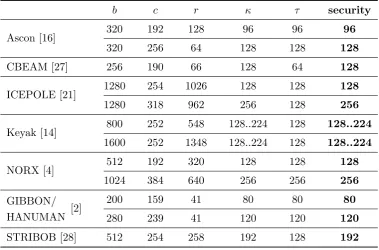
bound or 2c−a bound, as shown in Table 1.
Table 1: Parameters and the achieved mode security levels of seven CAESAR submissions. We remark that ICEPOLE consists of three configurations (two with security level 128 and one with security level 256) and Keyak of four configurations (one with an 800-bit state and three with a 1600-bit state)
b c r κ τ security
Ascon [16] 320 192 128 96 96 96
320 256 64 128 128 128
CBEAM [27] 256 190 66 128 64 128
ICEPOLE [21] 1280 254 1026 128 128 128
1280 318 962 256 128 256
Keyak [14] 800 252 548 128..224 128 128..224
1600 252 1348 128..224 128 128..224
NORX [4] 512 192 320 128 128 128
1024 384 640 256 256 256
GIBBON/
HANUMAN [2]
200 159 41 80 80 80
280 239 41 120 120 120
STRIBOB [28] 512 254 258 192 128 192
1.1 Our Results
Contrary to intuition, a wide range of permutation-based authenticated encryption schemes achieve a significantly higher mode security level: we prove that the bound is limited by approximately min{2(r+c)/2,2c,2κ} as opposed to min{2c/2,2κ}. The main proof in this work concerns NORX mode [4], but we demonstrate its applicability to the CAESAR submissions Ascon [16], CBEAM3 [26, 27], ICEPOLE [21], Keyak [14], two out of three PRIMATEs [2],
and STRIBOB4 [24, 28]. Additionally, we note that it directly applies to SpongeWrap [11] and DuplexWrap [14], upon which Keyak is built.
Our results imply that all of these CAESAR candidates have been overly conservative in choosing their parameters, since a smaller capacity would have lead to the same bound. For instance, Ascon-128 could take (c, r) = (128,192) instead of (256,64), NORX64 (the proposed mode with 256-bit security) could increase its rate by 128 bits, and GIBBON-120 and HANUMAN-120 could increase their rate by a factor of 4, all without affecting their mode security levels.
These observations only concern themode security, where characteristics of the underlying permutation are set aside. Specifically, the concrete security of the underlying permutations plays a fundamental role in the choice of parameters. For instance, the authors of Ascon, NORX, and PRIMATEs [2, 4, 16] acknowledge that non-random properties of some of the underlying primitives exist. Although these properties are harmless, a non-hermetic design approach for the primitives affects the parameter choices.
1.2 Outline
We present our security model in Section 2. A security proof for NORX is derived in Section 3. In Section 4 we show that the proof of NORX generalizes to other CAESAR submissions, as well as to SpongeWrap and DuplexWrap. The work is concluded in Section 5, where we also discuss possible generalizations to Artemia [1] andπ-Cipher [17].
2 Security Model
For n∈N, let Perm(n) denote the set of all permutations onnbits. When writing x←− X$ for
some finite setX, we mean thatxgets sampled uniformly at random fromX. Forx∈ {0,1}n, and a, b≤n, we denote by [x]a and [x]
b thealeftmost andbrightmost bits ofx, respectively.
For tuples (j, k),(j0, k0) we use lexicographical order: (j, k) > (j0, k0) means that j > j0, or
j =j0 and k > k0.
LetΠ be an authenticated encryption scheme, which is specified by an encryption function
E and a decryption functionD:
(C, A)←− EK(N;H, M, T) and M/⊥ ←− DK(N;H, C, T;A).
Here N denotes a nonce value, H a header, M a message, C a ciphertext, T a trailer, and A
an authentication tag. The values (H, T) will be referred to as associated data. If verification is correct, then the decryption function DK outputs M, and ⊥ otherwise. The scheme Π is also determined by a set of parameters such as the key size, state size, and block size, but these are left implicit. In addition, we define $ to be an ideal version of EK, where $ returns (C, A)←− {$ 0,1}|M|+τ on input of a new (N;H, M, T).
We follow the convention in analyzing modes of operation for permutations by modeling the underlying permutations as being drawn uniformly at random from Perm(b), where b is a parameter determined by the scheme. We note that irregularities in the underlying permutation may invalidate the underlying assumption.
An adversary A is a probabilistic algorithm that has access to one or more oracles O, denoted AO. By AO= 1 we denote the event that A, after interacting with O, outputs 1. We consider adversariesAthat have unbounded computational power and whose complexities are solely measured by the number of queries made to their oracles. These adversaries have query access to the underlying idealized permutations, EK or its counterpart $, and possibly DK. The key K is randomly drawn from {0,1}κ at the beginning of the security experiment. The
security definitions below follow [6, 18].
Privacy
Let p denote the list of underlying idealized permutations of Π. We define the advantage of an adversaryA in breaking the privacy ofΠ as follows:
AdvprivΠ (A) =
Prp,K
Ap±,EK = 1−Pr
p,$
Ap±,$ = 1
,
where the probabilities are taken over the random choices ofp,$, K, and the random choices of
A, if any. The fact that the adversary has access to both the forward and inverse permutations inp is denoted byp±. We assume that adversary Ais nonce-respecting, which means that it never makes two queries to EK or $ with the same nonce. By AdvprivΠ (qp, qE, λE) we denote
Integrity
As above, let p denote the list of underlying idealized permutations of Π. We define the advantage of an adversary A in breaking the integrity ofΠ as follows:
AdvauthΠ (A) =Prp,K
Ap±,EK,DK forges,
where the probability is taken over the random choices of p, K, and the random choices of A, if any. Here, we say that “Aforges” ifDK ever returns a valid message (other than⊥) on input of (N;H, C, T;A) where (C, A) has never been output byEK on input of a query (N;H, M, T) for some M. We assume that adversary A is nonce-respecting, which means that it never makes two queries to EK with the same nonce. Nevertheless,A is allowed to repeat nonces in decryption queries. By AdvauthΠ (qp, qE, λE, qD, λD) we denote the maximum advantage taken
over all adversaries that query p± at most qp times, that make at most qE queries of total length at most λE blocks to EK, and at most qD queries of total length at most λD blocks to
DK/⊥.
3 NORX
We introduce NORX at a level required for the understanding of the security proof, and refer to Aumasson et al. [4] for the formal specification. Let pbe a permutation on bbits. Allb-bit state values are split into a rate part of r bits and a capacity part of c bits. We denote the key size of NORX by κ bits, the nonce size byν bits, and the tag size byτ bits. The header, message, and trailer can be of arbitrary length, and are padded using 10∗1-padding to a length of a multiple ofr bits. Throughout, we denote ther-bit header blocks byH1, . . . , Hu, message
blocks by M1, . . . , Mv, ciphertext blocks byC1, . . . , Cv, and trailer blocks byT1, . . . , Tw.
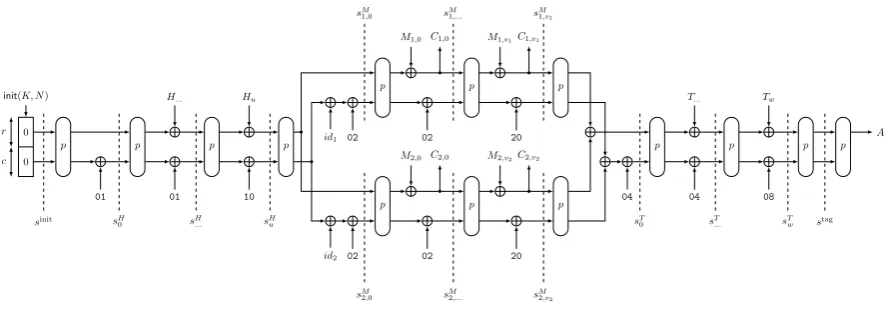
Unlike other permutation-based schemes, NORX allows for parallelism in the encryption part, which is described using a parameter D∈ {0, . . . ,255} corresponding to the number of parallel chains. Specifically, if D∈ {1, . . . ,255} NORX hasD parallel chains, and if D= 0 it has vparallel chains, where v is the block length of M orC.
NORX consists of five proposed parameter configurations: NORXW-R-D for (W, R, D) ∈ {(64,4,1),(32,4,1),(64,6,1),(32,6,1),(64,4,4)}. The parameter R denotes the number of rounds of the underlying permutation p, and W denotes the word size which we use to set
r = 10W and c = 6W. The default key and tag size are κ = ν = 4W. The corresponding parameters for the two different choices of W, 64 and 32, are given in Table 1.
Although NORX starts with an initialization function init which requires the parameters (D, R, τ) as input, as soon as our security experiment starts, we consider (D, R, τ) fixed and constant. Hence we can view init as a function that maps (K, N) to (KkNk0b−κ−ν)⊕const,
where const is irrelevant to the mode security analysis of NORX, and will be ignored in the remaining analysis.
After init is called, the header H is compressed into the rate, then the state is branched into D states (if necessary), the message blocks are encrypted in a streaming way, the D
states are merged into one state (if necessary), the trailer is compressed, and finally the tag
A is computed. All rounds are preceded with a domain separation constant XORed into the capacity: 01 for header compression, 02 for message encryption, 04 for trailer compression, and 08 for tag generation. IfD6= 1, domain separators 10and 20 are used for branching and merging, along with pairwise distinct lane indices idk for k = 1, . . . , D (if D = 1 we write id1 =0).
The privacy of NORX is proven in Section 3.1 and the integrity in Section 3.2. In both proofs we consider an adversary that makesqp permutation queries andqE encryption queries of total
init(K, N)
0
0 r
c
p p p p
p p p
p p p
p p p p
H... Hu
id1
id2
M1,0 M1,v1
M2,0 M2,v2
C1,0 C1,v1
C2,0 C2,v2
T... Tw
A
01 01 10
02
02
02 20
02 20
04 04 08
sinit sH
0 sH... sHu
sM 1,0
sM 2,0
sM 1,...
sM 2,...
sM 1,v1
sM 2,v2
sT
0 sT... sTw stag
Fig. 1: NORX with D= 2
of total length λD. To aid the analysis, we compute the number of permutation calls made via the qE encryption queries. The exact same computation holds for decryption queries with the parameters defined analogously.
Consider a query to EK, consisting of u header blocks, v message blocks, and w trailer blocks. We denote its corresponding state values by
sinit; sH0 , . . . , sHu ;
sM1,0, . . . , sM1,v1
..
. ...
sMD,0, . . . , sMD,vD
; sT0, . . . , sTw; stag
, (1)
as outlined in Figure 1. Here, PD
k=1vk=v. If there are no branching and merging phases, i.e. D= 1, then the state values corresponding to the branching and merging,{sM1,0, . . . , sMD,0}and
sT
0, are left out of the tuple. Note that the length of this tuple equals the number of primitive
calls made in this encryption query, as every state value corresponds to the input of exactly one primitive call. A simple calculation shows that if the jth EK query is of lengthu+v+w
blocks, it results inu+v+w+3 state values ifD= 1, inu+v+w+D+4 state values ifD >1, and in u+ 2v+w+ 4 state values if D = 0.5 We denote the number of state values by σE,j,
where the dependence on Dis suppressed as D does not change during the security game. In other words, σE,j denotes the number of primitive calls in the jth query to EK. Furthermore,
we define σE to be the total number of primitive evaluations via the encryption queries, and find that
σE :=
qE
X
j=1 σE,j ≤
2λE+ 4qE, ifD= 0, λE + 3qE, ifD= 1, λE + (D+ 4)qE, ifD >1.
(2)
This bound is rather tight. Particularly, for D = 0 an adversary can meet this bound by only making queries without header and trailer. For queries to DK we define σD,j and σD
analogously.
3.1 Privacy of NORX
Theorem 1. Let Π = (E,D) be NORX based on an ideal underlying primitive p. Then,
AdvprivΠ (qp, qE, λE)≤ 3(qp+σE)
2
2b+1 +
8eqpσE
2b
1/2
+rqp 2c +
qp+σE
2κ ,
where σE is defined in (2).
Theorem 1 can be interpreted as implying that NORX provides privacy security as long as the total complexity qp+σE does not exceed min{2b/2,2κ} and the total number of primitive queries qp, also known as the offline complexity, does not exceed 2c/r. See Table 1 for the
security level of the various parameter choices of NORX.
The proof is based on the observation that NORX is indistinguishable from a random scheme as long as there are no collisions among the (direct and indirect) evaluations of p. Due to uniqueness of the nonce, state values from evaluations of EK collide with probability approximately 1/2b. Regarding collisions between direct calls to p and calls via EK: while
these may happen with probability about 1/2c, they turn out not to significantly influence the bound. The latter is demonstrated in part using the principle of multiplicities [10]: roughly stated, the maximum number of state values with the same rate part. The formal security proof is more detailed. Furthermore, we remark that, at the cost of readability and simplicity of the proof, the bound could be improved by a constant factor.
Proof. We consider any adversaryA that has access to either (p±,EK) or (p±,$) and whose
goal is to distinguish these two worlds. For brevity, we write
AdvprivΠ (A) =∆A(p±,EK;p±,$). (3)
We start with replacing p± by a random function, as this simplifies the analysis. This is done with a PRP-PRF switch [3, 7], in which we make a transition from p± to a primitive f±
defined as follows. This primitive f± maintains an initially empty list F of query/response
tuples (x, y). For F, we denote its set of domain and range values by dom(F) and rng(F), respectively. For a forward query f(x) withx∈dom(F), the corresponding valuey =F(x) is returned. For a new forward query f(x), the responsey is randomly drawn from {0,1}b, then
ifyis in rng(F) the primitive aborts, otherwise the tuple (x, y) is added toF. The description for f−1 is similar. The usage of F will remain implicit in the remaining usage of f±. Now,
p± and f± behave identically as long as the latter does not abort. Given that the adversary triggers at most qp +σE evaluations of f, such an abort happens with probability at most
qp+σE 2
/2b ≤(qp+σE)2/2b+1. This PRP-PRF switch needs to be applied to both the real and
ideal world, to get
∆A(p±,EK;p±,$)≤∆A(f±,EK;f±,$) +(qp+σE)
2
2b . (4)
We restrict our attention to Awith oracle access to (f±, F), whereF ∈ {EK,$}. Without loss of generality, we can assume that the adversary only queries full blocks and that no padding rules are involved. We can do this because the padding rules are injective, allowing the proof to carry over to the case of fractional blocks with 10∗1-padding.
We introduce some terminology. Queries tof± are denoted (xi, yi) for i= 1, . . . , qp, while
queries to F are written as elements (Nj;Hj, Mj, Tj;Cj, Aj) forj = 1, . . . , qE. IfF =EK, the state values are denoted as in (1), subscripted with a j:
sinitj ; sHj,0, . . . , sHj,u;
sMj,1,0, . . . , sMj,1,v1
..
. ...
sMj,D,0, . . . , sMj,D,vD
; sTj,0, . . . , sTj,w; stagj
If the structure of (5) is irrelevant we refer to the tuple as (sj,1, . . . , sj,σE,j), where we use the
convention to list the elements of the matrix column-wise. In this case, we write parent(sj,k) to
denote the state value that lead to sj,k, with parent(sj,1) :=∅and parent(sTj,0) := (sMj,1,v1, . . . , sMj,D,vD). We remark that the characteristic structure of NORX, with the D parallel states, only becomes relevant in the two technical lemmas that will be used at the end of the proof. We point out that sj,1 corresponds to the initial state value of the evaluation, which requires
special attention throughout the remainder of the proof.
We define two collision events, guess and hit. Let i ∈ {1, . . . , qp}, j, j0 ∈ {1, . . . , qE}, k ∈ {1, . . . , σE,j}, and k0 ∈ {1, . . . , σE,j0}:
guess(i;j, k) ≡ xi =sj,k,
hit(j, k;j0, k0) ≡ parent(sj,k)6= parent(sj0,k0)∧sj,k =sj0,k0.
Event guess(i;j, k) corresponds to a primitive call in an encryption query hitting a direct primitive query, or vice versa, while hit(j, k;j0, k0) corresponds to non-trivial primitive calls colliding in encryption queries. We writeguess=∨i;j,kguess(i;j, k),hit=∨j,k;j0,k0hit(j, k;j0, k0), and set event=guess∨hit.
The remainder of the proof is divided as follows. In Lemma 1 we prove that (f±,EK) and
(f±,$) are indistinguishable as long as ¬event holds. In other words,
∆A(f±,EK;f±,$)≤PrAf±,EK setsevent. (6)
Then, in Lemma 2 we bound this term by qpσE+σ
2
E/2
2b +
8eqpσE
2b
1/2
+rqp 2c +
qp+σE
2κ . Noting
that qpσE+σ
2
E/2
2b ≤
(qp+σE)2
2b+1 , this completes the proof via equations (3,4,6). ut
Lemma 1. Given that event does not occur, (f±,EK) and (f±,$)are indistinguishable.
Proof. The outputs of f± are sampled uniformly at random in both (f±,EK) and (f±,$),
except when such an output collides with a state of an EK evaluation in the real world. However, this event is excluded by assuming ¬guess, hence it suffices to only consider queries to the big oracle F ∈ {EK,$}.
LetNj be a new nonce used in theF-query (Nj;Hj, Mj, Tj), with corresponding ciphertext
and authentication tag (Cj, Aj). Denote the query’s state values as in (5). Let u, v, and w
denote the number of padded header blocks, padded message blocks, and padded trailer blocks, respectively.
By the definition of $, in the ideal world we have (Cj, Aj) $
←− {0,1}|Mj|+τ. We will prove
that (Cj, Aj) is identically distributed in the real world, under the assumption thatguess∨hit
does not occur. Denote the message blocks ofMj byMj,k,` fork= 1, . . . , D and`= 1, . . . , vk.
We know thatsHj,u is new and thatf(sHj,u) does not collide with any otherf-query because otherwise ¬event would have been violated. SincesMj,k,0=f(sHj,u)⊕idk we conclude that sMj,k,0
is new for k= 1, . . . , D, as otherwise event would be set. Similarly,sM
j,k,` is new for all` >0.
The ciphertext blocksCj,k,` are computed as
Cj,k,` =Mj,k,`⊕[f(sMj,k,`−1)]r.
As the state value sMj,k,`−1 has not been evaluated by f before (neither directly nor indirectly via an encryption query), f(sMj,k,`−1) outputs a uniformly random value from {0,1}b, hence
Cj,k,` ←− {$ 0,1}r. We remark that similar reasoning shows that a ciphertext block corresponding
to a truncated message block is uniformly randomly drawn as well, yet from a smaller set. The fact that Aj
$
←− {0,1}τ follows the same reasoning, using that stagj is a new input to f. Thus,
Aj = [f(stagj )]τ $
Lemma 2. Pr
Af±,EK sets event
≤ qpσE+σ
2
E/2
2b +
8eqpσE
2b
1/2
+rqp 2c +
qp+σE
2κ .
Proof. Consider the adversary interacting with (f±,EK), and let Pr(guess∨hit) denote the probability we aim to bound. For i∈ {1, . . . , qp}, define
key(i) ≡ [xi]κ=K ,
and key = ∨ikey(i). Event key(i) corresponds to a primitive query hitting the key. Let j ∈ {1, . . . , qE}and k∈ {1, . . . , σE,j}, and consider any threshold ρ≥1, then define
multi(j, k) ≡ hmaxα∈{0,1}r
j0≤j,1< k0≤k : α ∈ {[sj0,k0]r,[f(sj0,k0)]r} i
> ρ .
Eventmulti(j, k) is used to bound the number of states that collide in the rate part. Note that state values sj0,1 are not considered here as they will be covered by key. We define multi =
multi(qE, σE,qE), which is a monotone event. By basic probability theory,
Pr(guess∨hit)≤Pr(guess∨hit| ¬(key∨multi)) +Pr(key∨multi). (7)
In the remainder of the proof, we bound these probabilities as follows (a formal explanation of the proof technique is given in Appendix A): we consider the ith forward or inverse primitive query (fori∈ {1, . . . , qp}) or thekth state of thejth construction query (forj∈ {1, . . . , qE}and
k∈ {1, . . . , σE,j}), and bound the probability that this evaluation makesguess∨hit satisfied,
under the assumption that this query does not setkey∨multiand also thatguess∨hit∨key∨multi
has not been set before. For the analysis of Pr(key∨multi) a similar technique is employed.
Event guess. This event can be set in the ith primitive query (for i = 1, . . . , qp) or in any
state evaluation of the jth construction query (for j = 1, . . . , qE). Denote the state values of thejth construction query as in (5). Consider any evaluation, assume this query does not set
key∨multiand assume thatguess∨hit∨key∨multihas not been set before. Firstly, note that
xi=sinitj for some i, j would implykey(i) and hence invalidate our assumption. Therefore, we can exclude sinitj from further analysis on guess. For i= 1, . . . , qp, let ji ∈ {1, . . . , qE} be the
number of encryption queries made before theith primitive query. Similarly, forj= 1, . . . , qE, denote by ij ∈ {1, . . . , qp} the number of primitive queries made before the jth encryption query.
– Consider a primitive query (xi, yi) fori∈ {1, . . . , qp}, which may be a forward or an inverse
query, and assume it has not been queried tof±before. If it is a forward queryxi, by¬multi
there are at most ρ state values s with [xi]r = [s]r, and thus xi = s with probability at mostρ/2c. Here, we remark that the capacity part ofsis unknown to the adversary and it guesses it with probability at most 1/2c. A slightly more complicated reasoning applies for
inverse queries. Denote the query byyi. By ¬multi there are at mostρ state values swith [yi]r = [f(s)]r, hence yi =f(s) with probability at most ρ/2c. If yi equals f(s) for any of
these states, thenxi =s, otherwisexi =swith probability at mostPjij=1σE,j/2b. Therefore
the probability thatguess is set via a direct query is at most qpρ2c +
Pqp
i=1
Pji
j=1 σE,j
2b ;
– Next, consider the probability that thejth construction query setsguess, forj∈ {1, . . . , qE}. For simplicity, first considerD= 1, hence the message is processed in one lane and we can use state labeling (sj,1, . . . , sj,σE,j). We range from sj,2 tosj,σE,j (recall thatsj,1=sinitj can be excluded) and consider the probability that this state setsguessassuming it has not been set before. Letk∈ {2, . . . , σE,j}. The state valuesj,k equalsf(sj,k−1)⊕v, wherev is some
value determined by the adversarial input prior to the evaluation of f(sj,k−1), including
input from (Hj, Mj, Tj) and constants serving as domain separators. By assumption,guess∨
(i∈ {1, . . . , ij}) with probability at mostij/2b. Next, consider the general caseD >1. We
return to the labeling of (5). A complication occurs for the branching statessMj,1,0, . . . , sMj,D,0
and the merging state sTj,0. Starting with the branching states, these are computed from
sHj,u as
sMj,1,0
.. .
sMj,D,0
=f(s
H j,u)⊕
v1 .. . vD ,
where v1, . . . , vD are some distinct values determined by the adversarial input prior to
the evaluation of the jth construction query. These are distinct by the XOR of the lane numbersid1, . . . , idD. Any of these nodes equals xi fori∈ {1, . . . , qp} with probability at most ijD/2b. Finally, for the merging node sTj,0 we can apply the same analysis, noting
that it is derived from a sum of D new f-evaluations. Concluding, the jth construction query setsguess with probability at most ijσE,j/2b (we always have in total at most σE,j
new state values). Summing over all qE construction queries, we get PqE
j=1ijσE,j/2b.
Concluding,
Pr(guess| ¬(key∨multi))≤ qpρ
2c + qp X i=1 ji X j=1 σE,j
2b + qE
X
j=1 ijσE,j
2b = qpρ
2c + qpσE
2b .
Here we use thatPqp
i=1
Pji
j=1σE,j+Pqj=1E
PσE,j
k=1ij =qpσE, which follows from a simple counting
argument.
Eventhit.We again employ ideas ofguess, and particularly that as long asguess∨hitis not set,
we can consider all new state values (except for the initial states) to be randomly drawn from a set of size 2b. Particularly, we can refrain from explicitly discussing the branching and merging
nodes (the detailed analysis of guessapplies) and label the states as (sj,1, . . . , sj,σE,j). Clearly,
sj,16=sj0,1for allj, j0 by uniqueness of the nonce. Any state valuesj,kfork >1 (at mostσE−qE
in total) hits an initial state value sj0,1 only if [sj,k]κ =K, which happens with probability at
most σE/2κ, assuming sj,k is generated randomly. Finally, any two other states sj,k, sj0,k0 for
k, k0 >1 collide with probability at most σE−qE
2
/2b. Concluding, Pr(hit| ¬(key∨multi)) ≤
σE 2
/2b+σ
E/2κ.
Event key. For i ∈ {1, . . . , qp}, the query sets key(i) if [xi]κ = K, which happens with
probability 1/2κ (assuming it did not happen in queries 1, . . . , i−1). The adversary makesqp
attempts, and hencePr(key)≤qp/2κ.
Event multi. We again use the principles from the analysis for guess of construction queries
(note that this part does not rely onmultiitself). Particularly, consider a new state valuesj,k−1;
then for a fixed state value x ∈ {0,1}b it satisfies f(s
j,k−1) = x or sj,k = f(sj,k−1)⊕v = x
for some predetermined v with probability at most 2/2b. Now, let α ∈ {0,1}r. More than ρ
state values hit α with probability at most σE
ρ
(2/2r)ρ ≤
2eσE ρ2r
ρ
, using Stirling’s approxi-mation (x!≥(x/e)x for any x). Considering any possible choice of α, we obtain Pr(multi)≤
2r2eσE
ρ2r
ρ
.
Addition of the four bounds via (7) gives
Pr(guess∨hit)≤ qpσE+σ
2
E/2
2b +
qpρ
2c +
qp+σE
2κ + 2
r
eσE ρ2r
ρ
Putting ρ= max
r,2eσE2c
qp2r
1/2
gives
Pr(guess∨hit)≤ qpσE+σ
2
E/2
2b + 2
2eqpσE
2b
1/2
+rqp 2c +
qp+σE
2κ ,
assuming 2eqpσE/2b < 1 (which we can do, as the bound would otherwise be void anyway).
This completes the proof. ut
3.2 Authenticity of NORX
Theorem 2. Let Π = (E,D) be NORX based on an ideal underlying primitive p. Then,
AdvauthΠ (qp, qE, λE, qD, λD)≤
(qp+σE+σD)2
2b +
8eqpσE
2b
1/2
+rqp 2c + qp+σE+σD
2κ +
(qp+σE+σD)σD
2c +
qD
2τ ,
where σE, σD are defined in (2).
The bound is more complex than the one of Theorem 1, but intuitively implies that NORX offers integrity as long as it offers privacy and the number of forgery attempts σD is limited, where the total complexityqp+σE+σD should not exceed 2c/σD. See Table 1 for the security
level for the various parameter choices of NORX. Needless to say, the exact bound is more fine-grained.
Proof. We consider any adversary A that has access to (p±,EK,DK) and attempts to make
DK output a non-⊥value. As in the proof of Theorem 1, we apply a PRP-PRF switch to find
AdvauthΠ (A) =Pr
Ap±,EK,DK forges
≤Pr
Af±,EK,DK forges
+(qp+σE+σD)
2
2b+1 . (8)
Then we focus on A having oracle access to (f±,EK,DK). As before, we assume without loss of generality that the adversary only makes full-block queries.
We inherit terminology from Theorem 1. The state values corresponding to encryption and decryption queries will both be labeled (j, k), wherejindicates the query andkthe state value within the jth query. If needed we will add another parameter δ ∈ {D,E} to indicate that a state valuesδ,j,kis in thejth query to oracleδ, forδ∈ {D,E}andj∈ {1, . . . , qδ}. Particularly,
this means we will either label the state values as in (5) with a δ appended to the subscript, or simply as (sδ,j,1, . . . , sδ,j,σδ,j).
As before, we employ the collision eventsguess and hit, but expanded to the new notation withδ =E. Next, we define twoD-related collision eventsDguessandDhit. Leti∈ {1, . . . , qp},
(D, j, k) be a decryption query index, and (δ0, j0, k0) be an encryption or decryption query index:
Dguess(i;j, k) ≡ xi=sD,j,k,
Dhit(j, k;δ0, j0, k0) ≡ parent(sD,j,k)6= parent(sδ0,j0,k0)∧sD,j,k=sδ0,j0,k0,
We write Dguess = ∨i;j,k Dguess(i;j, k) and hit = ∨j,k;δ0,j0,k0 Dhit(j, k;δ0, j0, k0), and define
event=guess∨hit∨ Dguess∨ Dhit. Observe that from (8) we get
PrAf±,EK,DK forges≤PrAf±,EK,DK forges| ¬event+PrAf±,EK,DK setsevent. (9)
The remainder of this proof centers on the probability thatAforges given thatevent does not happen. Such a forgery requires that [f(stagD,j)]τ = Aj for some decryption query j. By
¬event, we know thatstagD,j is a new state value for allj∈ {1, . . . , qD}, hencef’s output under
stagD,j is independent of all other values and uniformly distributed for allj. As a result, we know that thejth forgery attempt is successful with probability at most 1/2τ. Summing over allqD
queries, we get
Pr
Af±,EK,DK forges| ¬event
≤ qD
2τ ,
and the proof is completed via (8,9) and the bound of Lemma 3, where we again use that
qpσE+σ2E/2
2b ≤
(qp+σE+σD)2
2b+1 . ut
Lemma 3. PrAf±,EK,DK sets event
≤ qpσE+σ
2
E/2
2b +
8eqpσE
2b
1/2
+rqp 2c +
qp+σE+σD
2κ +
(qp+σE)σD+σ2D/2
2c .
Proof. Recall thatevent = guess∨hit∨ Dguess∨ Dhit. Employing events key and multi from Lemma 2, we find:
Pr(guess∨hit∨ Dguess∨ Dhit)≤Pr(guess∨hit∨ Dguess∨ Dhit| ¬(key∨multi)) +
Pr(key∨multi) . (10)
The proof builds upon Lemma 2, and in particular we will use the same proof technique of running over all queries and computing the probability that a query setsevent, assumingevent
has not been set before. The bounds on Pr(guess∨hit| ¬(key∨multi)) and Pr(key∨multi) carry over from Lemma 2 verbatim, where we additionally note that for a given query, the previous decryption queries are of no influence as by hypothesis Dguess∨ Dhit was not set before the query in question. We continue with the analysis of Dguess and Dhit.
Event Dguess.Note that the adversary may freely choose the rate part in decryption queries
and primitive queries. Indeed, the ciphertext values thatAchooses in decryption queries define the rate parts of the state values. Consequently, Dguessgets set as soon as there is a primitive state and a decryption state whose capacities are equal. This happens with probability at most
Pr(Dguess| ¬(key∨multi))≤qpσD/2c.
Event Dhit. A technicality occurs in that the adversary can reuse nonces in decryption.
To increase readability, we first state that any decryption state s satisfies [s]κ = K only
with probability at most σD/2κ, and in the remainder we can exclude this case. Next, we define an event innerhit. Let (δ, j, k) and (δ0, j0, k0) be two decryption query indices, and let
const∈ {0,01⊕02,01⊕04,01⊕08,01⊕10,02⊕04,02⊕08,02⊕20,02⊕20⊕idi,04⊕08}:
innerhit(δ, j, k;δ0, j0, k0;const) ≡ parent(sδ,j,k)6= parent(sδ0,j0,k0)∧ [sδ,j,k]c= [sδ0,j0,k0]c⊕const.
Note that for any choice of indices and const, we have Pr(innerhit(δ, j, k;δ0, j0, k0;const)) ≤
1/2c.
We consider the general case D 6= 1. Consider the ¯jth decryption query (N;H, C, T;A). Say it consists ofuheader blocks H1· · ·Hu,vciphertext blocks C1· · ·Cv, andwtrailer blocks
T1· · ·Tw, and write its state values as in (1). Let (Nδ,j;Hδ,j, Cδ,j, Tδ,j;Aδ,j) be an older
cipher-text tuple that shares the longest common blockwise prefix with (N;H, C, T;A). Note that this tuple may not be unique (for instance if N is new), and that it may come from an encryption or decryption query. Say that this query consists of uδ,j header blocks, vδ,j ciphertext blocks,
(1) (N;H, C, T) = (Nδ,j;Hδ,j, Cδ,j, Tδ,j) but A 6= Aδ,j. In this case the query renders no new states and Dhit cannot be set by definition;
(2) (N;H, C) = (Nδ,j;Hδ,j, Cδ,j) but T =6 Tδ,j. Let ` ∈ {1, . . . ,min{w, wδ,j},∞} be
minimal such thatT`6=Tδ,j,`, where`=∞means thatT is a substring ofTδ,j (ifw < wδ,j)
or vice versa (if w > wδ,j). We make a further distinction between`=∞ and ` <∞.
(a) `=∞. Note that sTmin{w,wδ,j} =sTδ,j,min{w,wδ,j}⊕04⊕08. If this input tof is old, it implies innerhit(δ, j,min{w, wδ,j};δ0, j0, k0;04⊕08) for some (δ0, j0, k0) older than the
current query (D,¯j,min{w, wδ,j}), which is the case with probability at most 1/2c(for
all possible index tuples). Otherwise, f generates a new value and new state value s
(sT
w+1 ifw > wδ,j orstag ifw < wδ,j), which sets Dhit if it sets innerhit with an older
statesδ0,j0,k0 underconst= 0. This also happens with probability at most 1/2c for any (δ0, j0, k0). This procedure propagates to stag. In total, the ¯jth decryption query sets
Dhitwith probability at mostPσD,¯j k=1
σE+σD,1+···+σD,¯j−1+(k−1)
2c ;
(b) ` <∞. In this case sT`−1 =sTδ,j,`−1 and sT` =sTδ,j,`⊕(T`k0c)⊕(Tδ,j,`k0c) 6=sTδ,j,`.6 As
before, sT` is a new input to f, except if innerhit(δ, j, `;δ0, j0, k0;0) for some (δ0, j0, k0) older than the current query (D,¯j, `). This is the case with probability at most 1/2c for all possible older queries. The procedure propagates tostagas before, and the same
bound holds;
(3) (N;H) = (Nδ,j;Hδ,j) but C 6= Cδ,j. The analysis is similar but a special treatment
is required to deal with the merging phase. Consider the ciphertext C to be divided into blocks Ck,` for k = 1, . . . , D and ` = 1, . . . , vk. Similarly for Cδ,j. For k = 1, . . . , D, let `k ∈ {1, . . . ,min{vk, vδ,j,k},∞} be minimal such that Ck,`k 6= Cδ,j,k,`k. Again, `k = ∞
means thatCk is a substring ofCδ,j,k (ifvk≤vδ,j,k) or vice versa (ifvk≥vδ,j,k). We make
a further distinction between whether or not (`1, . . . , `D) = (∞, . . . ,∞).
(a) (`1, . . . , `D) = (∞, . . . ,∞). As C 6=Cδ,j, there must be a k such that vk 6=vδ,j,k
and thus that Ck is a strictly smaller substring of Cδ,j,k or vice versa. Consequently, sC
k,vk =sCδ,j,k,vk⊕02⊕20⊕idk[min{vk, vδ,j,k}= 1] (or ⊕02⊕04 ifD= 1 and there is
no merging phase, or⊕02⊕08if there is furthermore no trailer). Then, this state is new tof except ifinnerhit(δ, j, k, vk;δ0, j0, k0;const) is set for theconstdescribed above
(we slightly misuse notation here in thatvk is input toinnerhit). This means that also sT0 will be new except if it hits a certain older state, which happens with probability 1/2c. The reasoning propagates up tostag as before, and the same bound holds; (b) (`1, . . . , `D) < (∞, . . . ,∞). Letk be such that `k <∞. Then, sCk,`k−1 =sCδ,j,k,`k−1
and sC
k,`k = Ck,`kk[s C
δ,j,k,`k]c 6= s C
δ,j,k,`k. The reasoning of case (2b) carries over for all
future state values;
(4) N = Nδ,j but H 6= Hδ,j. The analysis follows fairly the same principles, albeit using
const∈ {0,01⊕02,01⊕04,01⊕08,01⊕10};
(5) N 6=Nδ,j. The nonce N is new (hence the query shares no prefix with any older query). There has not been an earlier state s that satisfies [s]κ =K (by virtue of the analysis in
hit and key, and the first step of this event Dhit). Therefore, sinit is new by construction and a simplification of above analysis applies.
Summing over all queries:
Pr(Dhit| ¬(key∨multi))≤
qD
X
¯ j=1
σD,¯j
X
k=1
σE+σD,1+· · ·+σD,¯j−1+ (k−1)
2c +
σD
2κ
≤ σEσD+
σD 2
2c +
σD
2κ ,
6 Note that if (δ, j) were not unique, then we similarly havesT
where the last term comes from the exclusion of the event that any decryption state satisfies [s]κ =K.
Together with the bound of Lemma 2 we find via (10),
Pr(event)≤ qpσE+σ
2
E/2
2b +
8eqpσE
2b
1/2
+rqp 2c +
qp+σE+σD
2κ +
(qp+σE)σD+σD2/2
2c .
This completes the proof. ut
4 Other CAESAR Submissions
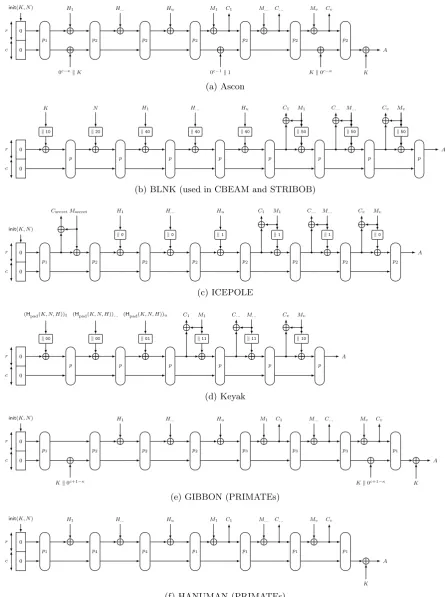
In this section we discuss how the mode security proof of NORX generalizes to the CAESAR submissions Ascon, the BLNK mode underlying CBEAM/STRIBOB, ICEPOLE, Keyak, and two out of the three PRIMATEs. Before doing so, we make a number of observations and note how the proof can accommodate small design differences.
– NORX uses domain separation constants at all rounds, but this is not strictly necessary and other solutions exist. In the privacy and integrity proofs of NORX, and more specifically at the analysis of state collisions caused by a decryption query in Lemma 3, the domain separations are only needed at the transitions between variable-length inputs, such as header to message data or message to trailer data. This means that the proofs would equally hold if there were simpler transitions at these positions, such as in Ascon. Alternatively, the domain separation can be done by using a different primitive, as in GIBBON and HANUMAN, or a slightly more elaborated padding, as in BLNK, ICEPOLE, and Keyak;
– The extra permutation evaluations at the initialization and finalization of NORX are not strictly necessary: in the proof we consider the monotone event that no state collides assuming no earlier state collision occurred. For instance, in the analysis of Dhit in the proof of Lemma 3, we necessarily have a new input to p at some point, and consequently
all next inputs top are new (except with some probability);
– NORX starts by initializing the state with init(K, N) = (KkNk0b−κ−ν)⊕const for some constant const and then permuting this value. Placing the key and nonce at different positions of the state does not influence the security analysis. The proof would also work if, for instance, the header is preceded withKkN or a properly padded version thereof and the starting state is 0b;
– In a similar fashion, there is no problem in defining the tag to be a differentτ bits of the final state; for instance, the rightmostτ bits;
– Key additions into the capacity partafter the first permutation are harmless for the mode security proof. Particularly, as long as these are done at fixed positions, these have the same effect as XORing a domain separation constant.
These five modifications allow one to generalize the proof of NORX to Ascon, CBEAM and STRIBOB, ICEPOLE, Keyak, and two PRIMATEs, GIBBON and HANUMAN. The only major difference lies in the fact none of these designs accommodates a trailer, hence all are functions of the form
(C, A)←− EK(N;H, M) and M/⊥ ←− DK(N;H, C;A),
except for one instance of ICEPOLE which accommodates a secret message number. Addition-ally, these designs have σδ≤λδ+qδ forδ∈ {D,E} (orσδ≤λδ+ 2qδfor CBEAM/STRIBOB).
We always write H = (H1, . . . , Hu) and M = (M1, . . . , Mv) whenever notation permits. In
init(K, N)
0
0
r
c
p1 p2 p2 p2 p2 p2 p2
H1 H... Hu M1 C1 M... C... Mv Cv
0c−κkK 0c−1k1 Kk0c−κ K
A
(a) Ascon
0
0
r
c
p p p p p p p p
k10 k20 k40 k40 k40 k50 k50 k50
K N H1 H... Hu C1 M1 C... M... Cv Mv
A
(b) BLNK (used in CBEAM and STRIBOB)
init(K, N)
0
0
r
c
p1 p2 p2 p2 p2 p2 p2 p2
Msecret Csecret
k0 k0 k1
H1 H... Hu
k1 k1 k0
M1 M... Mv
C1 C... Cv
A
(c) ICEPOLE
0
0
r
c
p p p p p p
k00 k00 k01
(Hpad(K, N, H))1 (Hpad(K, N, H))... (Hpad(K, N, H))u
k11 k11 k10
M1 M... Mv
C1 C... Cv
A
(d) Keyak
init(K, N)
0
0
r
c
p1 p2 p2 p2 p3 p3 p3 p1
H1 H... Hu M1 C1 M... C... Mv Cv
Kk0c+1−κ Kk0c+1−κ K
A
(e) GIBBON (PRIMATEs)
init(K, N)
0
0
r
c
p1 p4 p4 p1 p1 p1 p1
H1 H... Hu M1 C1 M... C... Mv Cv
K A
(f) HANUMAN (PRIMATEs)
4.1 Ascon
Ascon is a submission by Dobraunig et al. [16] and is depicted in Figure 2a. It is originally defined based on two permutations p1, p2 that differ in the number of underlying rounds. We
discard this difference, considering Ascon with one permutation p.
Ascon initializes its state using init that maps (K, N) to (0b−κ−νkKkN)⊕const, where
const is determined by some design-specific parameters set prior to the security experiment. The header and message can be of arbitrary length, and are padded to length a multiple of r
bits using 10∗-padding. An XOR with 1 separates header processing from message processing. From the above observations, it is clear that the proofs of NORX directly carry over to Ascon.
4.2 ICEPOLE
ICEPOLE is a submission by Morawiecki et al. [21] and is depicted in Figure 2c. It is originally defined based on two permutations,p1 and p2, that differ in the number of underlying rounds. We discard this difference, considering ICEPOLE with one permutation p.
ICEPOLE initializes its state as NORX does, be it with a different constant. The header and message can be of arbitrary length, and are padded as follows. Every block is first appended with a frame bit: 0for header blocks H1, . . . , Hu−1 and message block Mv, and 1 for header
blockHu and message blocksM1, . . . , Mv−1. Then, the blocks are padded to length a multiple
ofr bits using 10∗-padding. In other words, every padded block ofr bits contains at mostr−2 data bits. This form of domain separation using frame bits suffices for the proof to go through. One variant of ICEPOLE also allows for a secret message number Msecret, which consists of
one block and is encrypted prior to the processing of the header, similar to the message. As this secret message number is of fixed length, no domain separation is required and the proof can easily be adapted. From above observations, it is clear that the proofs of NORX directly carry over to ICEPOLE. Without going into detail, we note that the same analysis can be generalized to the parallelized mode of ICEPOLE [21].
4.3 Keyak
Keyak is a submission by Bertoni et al. [14]. The basic mode for the serial case is depicted in Figure 2d, yet due to its hybrid character it is slightly more general in nature. It is built on top of SpongeWrap [11].
Keyak initializes its state by 0b, and concatenates K, N, and H using a special padding rule:
Hpad(K, N, H) =keypack(K,240)kenc8(1)kenc8(0)kN kH ,
whereenc8(x) is an encoding ofxas a byte andkeypack(K, `) =enc8(`/8)kKk10−κ−1 mod (`−8).
The key-nonce-header combination Hpad(K, N, H) and messageM can be of arbitrary length,
and are padded as follows: first, every block is appended with two frame bits, being 00 for header blocks (Hpad(K, N, H))1, . . . ,(Hpad(K, N, H))u−1 and 01for (Hpad(K, N, H))u, and11
for message blocks M1, . . . , Mv−1 and 10 for Mv. Then, the blocks are padded to length a
4.4 BLNK (CBEAM and STRIBOB)
CBEAM and STRIBOB are submissions by Saarinen [24, 26–28]. Minaud identified an attack on CBEAM [20], but we focus on the modes of operation. Both modes are based on the BLNK Sponge mode [25], which is depicted in Figure 2b.
The BLNK mode initializes its state by 0b, compresses K into the state (using one or two permutation calls, depending on κ), and does the same with N. Then, the mode is similar to SpongeWrap [11], though using a slightly more involved domain separation system similar to the one of NORX. Due to above observations, our proof readily generalizes to BLNK [25], and thus to CBEAM and STRIBOB.
4.5 PRIMATEs: GIBBON and HANUMAN
PRIMATEs is a submission by Andreeva et al. [2], and consists of three algorithms: APE, GIBBON, and HANUMAN. The APE mode is the more robust one, and significantly differs from the other two, and from the other CAESAR submissions discussed in this work, in the way that ciphertexts are derived and because the mode is secure against nonce misusing adversaries up to common prefix [3]. We now focus on GIBBON and HANUMAN, which are depicted in Figures 2e and 2f. GIBBON is based on three related permutations p = (p1, p2, p3), where
the difference in p2, p3 is used as domain separation of the header compression and message
encryption phases (the difference ofp1from (p2, p3) is irrelevant for the mode security analysis). Similarly, HANUMAN uses two related permutations p= (p1, p2) for domain separation.
GIBBON and HANUMAN initialize their state using init that maps (K, N) to 0b−κ−νkKkN. The header and message can be of arbitrary length, and are padded to length a multiple of r bits using 10∗-padding. In case the true header (or message) happens to be a multiple of r bits long, the 10∗-padding is considered to spill over into the capacity. From above observations, it is clear that the proofs of NORX directly carry over to GIBBON and HANUMAN. A small difference appears due to the usage of two different permutations: we need to make two PRP-PRF switches for each world. Concretely this means that the first term in Theorem 1 becomes 5(qp+σE)2
2b+1 and the first term in Theorem 2 becomes
3(qp+σE+σD)2 2b+1 .
5 Conclusions
In this work we analyzed one of the Sponge-based authenticated encryption designs in de-tail, NORX, and proved that it achieves security of approximately min{2b/2,2c,2κ}, sig-nificantly improving upon the traditional bound of min{2c/2,2κ}. Additionally, we showed that this proof straightforwardly generalizes to five other CAESAR modes, Ascon, BLNK (of CBEAM/STRIBOB), ICEPOLE, Keyak, and PRIMATEs. Our findings indicate an overly conservative parameter choice made by the designers, implying that some designs can improve speed by a factor of 4 at barely any security loss.
It is expected that the security proofs also generalize to the modes of Artemia [1] andπ -Cipher [17]. However, they deviate slightly more from the other designs. Artemia is based on the JH hash function [30] and XORs data blocks in both the rate and capacity part. It does not use domain separations, rather it encodes the lengths of the inputs into the padding at the end [5]. Therefore, a generalization of the proof of NORX to Artemia is not entirely straightforward.
π-Cipher, on the other hand, is structurally different in the way it maintains state. A so-called “common internal state” is used throughout the evaluation. For the processing of the header (or similarly the message) the state is forked into u chains to process H1, . . . , Hu in parallel,
The results in this work are derived in the ideal permutation model, where the underlying primitive is assumed to be ideal. We acknowledge that this model does not perfectly reflect the properties of the primitives. For instance, it is stated by the designers of Ascon, NORX, and PRIMATEs that non-random (but harmless) properties of the underlying permutation exist. Furthermore, it is important to realize that the proofs of security for the modes of operation in the ideal model do not have a direct connection with security analysis performed on the permutations, as is the case with block ciphers modes of operation. Nevertheless, we can use these proofs as heuristics to guide cryptanalysts to focus on the underlying permutations, rather than the modes themselves.
Acknowledgments. The authors would like to thank their co-designers of NORX and
PRI-MATEs and the designers of Ascon and Keyak for the discussions. In particular, we thank Samuel Neves for his useful comments. This work was supported in part by the Research Fund KU Leuven, OT/13/071, and in part by the Research Council KU Leuven: GOA TENSE (GOA/11/007). Atul Luykx is supported by a Ph.D. Fellowship from the Institute for the Pro-motion of Innovation through Science and Technology in Flanders (IWT-Vlaanderen). Bart Mennink is a Postdoctoral Fellow of the Research Foundation – Flanders (FWO).
References
1. Alizadeh, J., Aref, M., Bagheri, N.: Artemia v1 (2014), submission to CAESAR competition
2. Andreeva, E., Bilgin, B., Bogdanov, A., Luykx, A., Mendel, F., Mennink, B., Mouha, N., Wang, Q., Yasuda, K.: PRIMATEs v1 (2014), submission to CAESAR competition
3. Andreeva, E., Bilgin, B., Bogdanov, A., Luykx, A., Mennink, B., Mouha, N., Yasuda, K.: APE: Authenti-cated permutation-based encryption for lightweight cryptography. In: Cid, C., Rechberger, C. (eds.) FSE. Lecture Notes in Computer Science, Springer (2014)
4. Aumasson, J., Jovanovic, P., Neves, S.: NORX v1 (2014), submission to CAESAR competition 5. Bagheri, N.: Padding of Artemia (2014), CAESAR mailing list
6. Bellare, M., Namprempre, C.: Authenticated encryption: Relations among notions and analysis of the generic composition paradigm. J. Cryptology 21(4), 469–491 (2008)
7. Bellare, M., Rogaway, P.: The security of triple encryption and a framework for code-based game-playing proofs. In: Vaudenay, S. (ed.) EUROCRYPT. Lecture Notes in Computer Science, vol. 4004, pp. 409–426. Springer (2006)
8. Bellare, M., Rogaway, P., Wagner, D.: The EAX mode of operation. In: Roy, B.K., Meier, W. (eds.) FSE. Lecture Notes in Computer Science, vol. 3017, pp. 389–407. Springer (2004)
9. Benaloh, J. (ed.): Topics in Cryptology - CT-RSA 2014 - The Cryptographer’s Track at the RSA Conference 2014, San Francisco, CA, USA, February 25-28, 2014. Proceedings, Lecture Notes in Computer Science, vol. 8366. Springer (2014)
10. Bertoni, G., Daemen, J., Peeters, M., Van Assche, G.: Sponge-based pseudo-random number generators. In: Mangard, S., Standaert, F.X. (eds.) CHES. Lecture Notes in Computer Science, vol. 6225, pp. 33–47. Springer (2010)
11. Bertoni, G., Daemen, J., Peeters, M., Van Assche, G.: Duplexing the sponge: Single-pass authenticated encryption and other applications. In: Miri, A., Vaudenay, S. (eds.) Selected Areas in Cryptography. Lecture Notes in Computer Science, vol. 7118, pp. 320–337. Springer (2011)
12. Bertoni, G., Daemen, J., Peeters, M., Van Assche, G.: On the security of the keyed sponge construction. Symmetric Key Encryption Workshop (SKEW 2011) (2011)
13. Bertoni, G., Daemen, J., Peeters, M., Van Assche, G.: Sponge functions (ECRYPT Hash Function Workshop 2007)
14. Bertoni, G., Daemen, J., Peeters, M., Van Assche, G., Van Keer, R.: Keyak v1 (2014), submission to CAESAR competition
15. CAESAR: Competition for Authenticated Encryption: Security, Applicability, and Robustness (May 2014),
http://competitions.cr.yp.to/caesar.html
16. Dobraunig, C., Eichlseder, M., Mendel, F., Schl¨affer, M.: Ascon v1 (2014), submission to CAESAR compe-tition
17. Gligoroski, D., Mihajloska, H., Samardjiska, S., Jacobsen, H., El-Hadedy, M., Jensen, R.: π-Cipher v1 (2014), submission to CAESAR competition
19. Krovetz, T., Rogaway, P.: The software performance of authenticated-encryption modes. In: Joux, A. (ed.) FSE. Lecture Notes in Computer Science, vol. 6733, pp. 306–327. Springer (2011)
20. Minaud, B.: Re: CBEAM Withdrawn as of today! (2014), CAESAR mailing list
21. Morawiecki, P., Gaj, K., Homsirikamol, E., Matusiewicz, K., Pieprzyk, J., Rogawski, M., Srebrny, M., W´ojcik, M.: ICEPOLE v1 (2014), submission to CAESAR competition
22. Rogaway, P.: Efficient instantiations of tweakable blockciphers and refinements to modes OCB and PMAC. In: Lee, P.J. (ed.) ASIACRYPT. Lecture Notes in Computer Science, vol. 3329, pp. 16–31. Springer (2004) 23. Rogaway, P., Bellare, M., Black, J., Krovetz, T.: OCB: a block-cipher mode of operation for efficient au-thenticated encryption. In: Reiter, M.K., Samarati, P. (eds.) ACM Conference on Computer and Commu-nications Security. pp. 196–205. ACM (2001)
24. Saarinen, M.: Authenticated encryption from GOST R 34.11-2012 LPS permutation. In: CTCrypt 2014 (2014)
25. Saarinen, M.: Beyond modes: Building a secure record protocol from a cryptographic sponge permutation. In: Benaloh [9], pp. 270–285
26. Saarinen, M.: CBEAM: Efficient authenticated encryption from feebly one-wayφfunctions. In: Benaloh [9], pp. 251–269
27. Saarinen, M.: CBEAM r1 (2014), submission to CAESAR competition 28. Saarinen, M.: STRIBOB r1 (2014), submission to CAESAR competition
29. Whiting, D., Housley, R., Ferguson, N.: AES Encryption and Authentication Using CTR Mode and CBC-MAC. IEEE 802.11-02/001r2 (2002)
30. Wu, H.: The Hash Function JH (2011), submission to NIST’s SHA-3 competition
A Proof Technique Used in Lemma 2
Formally, the proof technique used in Lemma 2 relies on the following paradigm. Note that there is an ordering of the qp+σE primitive queries, and we can reformulate guess(`), hit(`),
key(`), andmulti(`) for`= 1, . . . , qp+σE analogously. Definingevent(`) =guess(`)∨hit(`) and
help(`) =key(`)∨multi(`), then
Pr(event)≤Pr(event(qp+σE)| ¬event(1· · ·qp+σE −1)∧ ¬help(1· · ·qp+σE)) + Pr(event(1· · ·qp+σE −1)∨help(1· · ·qp+σE)),
and inductively Pr(event) ≤ Pqp+σE
`=1 Pr(event(`)| ¬event(1· · ·`−1)∧ ¬help(1· · ·`)) +
Pr(help(`)| ¬help(1· · ·`−1)). This formulation would however merely reduce the readability