Arguments of Knowledge for NP
Hongda Li, Qihua Niu, Guifang Huang
1
The Data Assurance and Communication Security Research Center 2State Key Lab of Information Security, Institute of Information Engineering
Chinese Academy of Sciences, Beijing 100093, China
Abstract. Garg, Jain, and Sahai first consider zero knowledge proofs in the presence of leakage on the local state of the prover, and present a leakage-resilient-zero-knowledge proof system for HC (Hamiltonian Cycle) problem. Their construction is called (1 +ε)-leakage-resilient zero-knowledge, for any constantε >0, because the total length of the leakage the simulator needs is (1 +ε) times as large as that of the leakage received by the verifier. In recent, Pandey provides a constant-round leakage-resilient zero-knowledge argument satisfying the ideal requirement ofε= 0. Whether there exist constant round leakage-resilient zero-knowledge arguments of knowledge for all NP languages is an interesting problem. This paper focuses on this problem and presents a constant-round construction of leakage-resilient zero-knowledge arguments of knowledge for the HC problem.
Key word: zero-knowledge proofs, proofs of knowledge, leakage-resilient, non-black-box simulation, constant-round.
1
Introduction
The zero-knowledge proofs, first introduced by Goldwasser et al. in [4], allow the prover to convince the verifier of the validity of a statement x∈L, while providing no additional knowledge to the verifier apart from the fact that the statement is indeed true. A fundamental variant, known as zero knowledge arguments, relaxed the soundness condition only with respect to efficient provers. The zero-knowledge property is formalized by requiring that for any probabilistic polynomial-time (PPT) verifier V∗ there exists a PPT simulator such that the view of V∗ interaction with the prover can be “indistinguishably simulated” by the simulator on inputx.
The conventional zero knowledge property assume that the prover’s internal state, including the witness and the random coins, is perfectly hidden from the verifier. The verifier is given only black-box access to the honest prover’s algorithm during the interaction. After a class of attack (known as side-channel attacks) is noticed, this idealized assumption becomes unreasonable and is often hard to satisfy in many real setting where an malicious verifier has the ability to obtain leakage of prover’s internal
0
state by launching a side-channel attacks. In order to deal with this problem, Garg et. al. [13] recently investigated zero knowledge proofs in such a leaking setting (known as leakage-resilient zero-knowledge proof, LR-ZKP), where the malicious verifier is able to learn an arbitrary amount of leakage on the internal state of the honest prover. Such a leakage attack is modeled as leakage-queries in the execution of the protocol, denoted as a series of polynomial-time computable functions f1, f2, .... There exist several model to restrict leakage functions. The most general one requires that leakage functions are hard-to-invert. Ideally, LR-ZKP require that no such malicious verifier can learn anything beyond the validity of the assertion and the leakage. Concretely, it is required that, for any malicious verifierV∗, there exists a simulator which is given access to a leakage oracle, such that the output of the simulator and the view ofV∗
are computationally indistinguishable. [13] definedλ-leakage-resilient zero knowledge, which allows the simulator to obtain at mostλ·l-bits leakage from the leakage oracle if
V∗ obtainsl-bit leakage. [13] provided super-constant-round (1 +ε
)-leakage-resilient-zero-knowledge proof for HC problem for any ε > 0. Very recently, Pandey in [20] presented a constant-round leakage-resilient zero-knowledge argument satisfying the ideal requirement ofε= 0.
If zero knowledge proofs or arguments are also “proof of knowledge”, it is known as zero knowledge proofs or arguments of knowledge (ZKPoK or ZKAoK). In fact, [13] discussed how to modify their protocol such that the modified protocol is a proof of knowledge. The presented method needs a public-coin zero knowledge proof of knowledge, in which the verifier proves to the prover that the previous commitment is “valid”. Concretely, the verifier first commit to a random challengech. At a later decommitment stage, the verifier prove, by a public-coin ZKPoK , that the committed value is indeedch. [7] first presented a simple construction of super-constant-round LR-ZKPoK for HC problem. An interesting problem left by [13, 20, 7] is how to con-struct constant-round leakage-resilient ZKPoK (or ZKAoK) for NP. In this paper, We focus on how to construct constant-round LR-ZKAoK for NP and give a construction for HC problem by means of non-black-box simulation techniques.
1.1 Related Works
[13], [7] showed a construction of leakage-resilient zero-knowledge proofs of knowledge. [20] presented a constant-round leakage-resilient zero-knowledge argument.
1.2 Our results
In this work, we adopt the basic model of [13] and present the first constant-round construction of LR-ZKAoK protocol.
Main result: Assume that collision-resistant hash functions and pseudorandom permutations exist, and DDH assumption holds. Then, there exists constant-round LR-ZKAoK system for HC.
The key problem in constructing LR-ZK protocol is how to respond to leakage queries in simulation such that the responses are consistent to the simulated view. To solve this problem, [13] adds a preamble to Blum’s 3-round zero knowledge proof. In the preamble, the verifier first commits to its random challengechand a random string
r0 using a extractable commitment scheme originally proposed by Prabhakaran et al. in [21], and then the prover sends a random stringr00. In subsequent Blum’s protocol, the prover uses r =r0⊕r00 as common random reference of Naor’s non-interactive commitment scheme to compute its commitments. There are many challenge-response slots in the extractable commitment scheme. This provides chances for the simulator to learn ch and r0 by rewinding the verifier’s program. By Learning ch in advance the simulator can prepare its commitment in Blum’s protocol according to ch and then can answer this challenge correctly. By obtaining r0 the simulator can control
r and then have the ability to respond leakage queries under the help of the leakage oracle. The construction in [20] use the same idea but the preamble use non-black-box methods. In this approach, however, black-box knowledge extractorsK cannot work efficiently. Therefore, the protocols in [13, 20] are no longer a proof of knowledge.
To obtain LR-ZKAoK, we modified the construction in [20] such that the follow-ing two condition hold: (1) the challenge ch is generated after the prover sends its commitments, as in [15, 16]; (2) the simulator has chance to control over the gener-ated challenge and the prover cannot. Thus, the simulator can simulate the prover’s commitments according to a-priori randomly selected challenge and the prover cannot break the soundness. On the other hand, black-box knowledge extractorsKcan work efficiently. To this end, we use a jointly coin-flipping protocol to generatechafter the prover sends its commitments. In order to let the simulator have ability to control overch, a preamble in which the simulator obtains the trapdoors is needed.
As in [20], we use Barak’s non-black-box techniques to construct such a preamble. The difference is that we use a new variant of Barak’s relation to define a NP-relation Rsim. In general Barak’s non-black-box simulation, the simulator needs the
descrip-tion of the verifier’s strategy, denoted asdesc(V), to accomplish a task that the prover cannot achieve no matter what it does. That is, the simulator’s advantage over the prover is that it is given the verifier’s program.
To improve the simulator’s ability, we permit the simulator to receive leakage queries apart from this advantage. We define a variant of Barak’s relation by simul-taneously usingdesc(V) and the received leakage queries. The simulator can take ad-vantage of knowingdesc(V) and the leakage queries to obtain an instanceσ∈LRsim
σ∈LRsim. This advantage over the prover enables the simulator to control over ch
andr. In the jointly coin-flipping protocols, we use the modified Yao’s garbled-circuit method, known as augmented garbled-circuit method, to achieve the conditional dis-closure of a random secret selected by the verifier. Thus, the verifier needs not use a zero-knowledge proof to convince the prover that the coin-flipping protocol is executed honestly.
2
Preliminaries
In this paper, we use some standard notations. If A(·) is a probabilistic algorithm,
A(x) is the result of runningAon inputxandy =A(x) (ory←A(x)) denote that
y is set toA(x). For a finite setS, we denote byy∈RS that y is uniformly selected
from S. Ul denotes uniform distribution on {0,1}l. We write [n] for any n ∈ N to denote the set{1,· · ·, n}andpoly(·) to denote an unspecified polynomial.
We use the following standard definitions and tools.
2.1 Leakage-resilient zero-knowledge proof
We first recall the definitions of leakage-resilient zero-knowledge.
LetP andV be a pair of randomized interactive Turing machines,hP, Vi(x) be a random variable representing the local output of Turing machineV when interacting with machine P on common input x, when the random input to each machine is uniformly and independently chosen. Customarily, machine P is called the prover and machineV is called the verifier. We denote byhP, Vi(x) = 1 (hP, Vi(x) = 0) that machineV accepts (rejects) the proofs given by machineP.
Definition 1. A pair of interactive Turing machines hP, Vi is called an interactive proof system for a language Lif machineV is polynomial-time and the following two conditions hold:
– Completeness: there exists a negligible function c (known as completeness error) such that for everyx∈L,
Pr[hP, Vi(x) = 1]>1−c(|x|)
– Soundness: there exists a negligible function s (known as soundness error) such that for everyx /∈L and every interactive machineB,
Pr[hB, Vi(x) = 1]< s(|x|)
In the execution of interactive proofs,P has the ability to select a random coinsri
at the beginning of roundiand uses it in roundi. In the interactionP synchronously update his current secret state. That is, let statedenoteP’s secret state (initialized to the private auxiliary input z), P updates state by setting state = state||ri in
leakage function fi, to which the prover responds withfi(state). We denote by`the
total number of leaking bits, i.e.`=P
i|fi(state)|.
General zero knowledge is formalized by requiring that for any polynomial-time verifierV∗there exists a polynomial-time algorithmS(a.k.a. the simulator) such that the view ofV∗, which consists of the random tosses of V and the messages received byV, can be simulated by S. Under the leakage attack setting, leakage information
fi(state) obtained byV∗ cannot be simulated by any polynomial-time algorithm S
only upon common inputx. To formulate leakage-resilient zero-knowledge,Sis given black-box access to an leakage oracle to respond the verifier’s leakage queries. The leakage oracle, denoted byLnz(·), is determined by the security parameternand the auxiliary input z (the witness). A query to the oracle is an efficiently computable function fj0(·), to which Lnz(·) responds with fj0(z). We denote by `0 the number of
bits that S receives from the leakage oracle, i.e. `0 = P
j|fj0(statej)|. The leakage
resilient zero-knowledge property essentially requires the condition `0 ≤` holds. [13]
defined (1 +ε)-LR-ZKP that require a relaxed condition, `0 ≤ (1 +ε)`, holds for a-priori fixed ε >0. This is reasonable and necessary for black-box zero knowledge. Recently, [20] presented a non-black-box zero knowledge protocol that satisfies the condition`0≤`.
The leakage-resilient zero knowledge proofs require that no malicious verifier, launching leakage attack, can learn anything beyond the validity of the assertion and the leakage. This is formulated by requiring that for any polynomial-time verifier
V∗ with any auxiliary input aux there exists a polynomial-time algorithm S such that the output ofSLnz(·)(x, aux) is indistinguishable from the view ofV∗. Since this
paper focuses on non-black-box zero knowledge, we refer to the definition of LR-ZKP in [20].
Definition 2 (Leakage-Resilient Zero Knowledge).An interactive proof system
(P, V) for a language L with a witness relation R is said to be leakage-resilient zero knowledgeif for every PPTmachine V∗that makes any arbitrary polynomial number of leakage queries onP’s state (in the manner as described above), there exists a PPT algorithmS such that the following two conditions hold:
– For every (x, z) ∈ R, and every aux ∈ {0,1}∗, {V iew
V∗(x, aux)}
x∈L,aux∈{0,1}∗
and
SLnz(·)(x, aux)
x∈L,aux∈{0,1}∗ are computationally indistinguishable.
– For every (x, z) ∈ R, every aux ∈ {0,1}∗, and sufficiently long r ∈ {0,1}∗, it
holds that `S,r(υ) ≤`V∗(υ), where `S,r(υ) is the number of bits that S receives
fromLn
z when generating the viewυ,`V∗(υ)is total length of leakage answers that V∗ receives in the viewυ.
2.2 Proof of knowledge
In a proof of knowledge for a relationship R, the prover, holding a secret input z
The concept of “knowledge” for machines is formalized by saying that if the prover can convince the verifier, then there exists an efficient procedure that can “extract” a witness from this prover (thus the prover knows the witness because it could run the extraction procedure on itself).
Definition 3. An interactive protocol hP, Vi is a system of proofs of knowledge for a (poly-balanced) relation R with knowledge errorκif the following conditions hold:
– (efficiency): hP, Viis polynomially bounded, andV is computable in probabilistic polynomial time.
– (non-triviality): There exists an interactive machineP such that for every(x, z)∈
R all possible interactions of V with P on common input xand auxiliary y are accepting.
– (validity with knowledge error κ): Denote by p(x, y, r) the probability that the interactive machineV accepts, on inputx, when interacting with the prover spec-ified by Px,y,r∗ (the prover’s strategy when fixing common x, auxiliary input y
and random taper). There exists an expected polynomial-time oracle machine K
and a polynomial q such that if p(x, y, r) > κ, on input x and access to ora-clePx,y,r,KPx,y,r(x) outputs z, satisfying(x, z)∈R, with probability of at least
(p(x, y, r)−κ(|x|))/q(|x|)
2.3 Universal arguments
The notion of universal arguments, introduced by Barak and Goldreich in [3], is used to present interactive proofs for language
LU ={(M, x, t) : non-deterministic machineM acceptsxwithintsteps}
The corresponding relation is denoted by RU, that is, RU((M, x, t), w) = 1 if and
only ifM (viewed here as a two-input deterministic machine) accepts (x, w) withint
steps. We can handle all NP language by a universal argument forLU, because every
language in NP is linear time reducible toLU.
For a super-polynomial functionT : N →N, define the relation RT
U as follows:
RT
U(y, w) = 1 ifRU(y, w) = 1 andt≤T(|y|), wherey= (M, x, t). The corresponding
language is denoted byLT U.
Definition 4. (Universal arguments)[3]. A universal-argument system forN time(T(n))
is a pair of strategies, denoted hP, Vi, that satisfies the following properties:
– Efficient verification: There exists a polynomialpsuch that for anyy= (M, x, t), the total time spent by the (probabilistic) verifier strategyV, on common inputy, is at mostp(|y|). In particular, all messages exchanged in the protocol have length smaller thanp(|y|). (Here,|y| is assumed polynomial bounded).
– Completeness by a relatively-efficient prover: For every ((M, x, t), w) in
RT U,
P r[hP(w), Vi(M, x, t) = 1] = 1
Furthermore, there exists a polynomialpsuch that the total time spent byP(w), on common input(M, x, t), is at mostp(TM(x, w))≤p(t), whereTM(x, w)denote
– Computational Soundness: For every polynomial-size circuit family{Pen}n∈N,
and every(M, x, t)∈ {0,1}n−L U,
P r[hPen, Vi(M, x, t) = 1]< neg(n)
– Weak Proof of Knowledge Property: There exists a probabilistic T(n)O(1) -time oracle machine E such that the following holds: For every polynomial-size circuit family{Pen}n∈N, and every sufficiently longy= (M, x, t)∈ {0,1}n
P r[EPne (y)∈LT
U]≥Pr
h
hPen(y), V(y)i= 1
i
−neg(n)
The oracle machineE is called a (knowledge) extractor.
2.4 Commitment Schemes
Commitment schemes are used to enable a party, known as the sender, to commit itself to a value while keeping it secret from another party, called the receiver. This property is called hiding. Furthermore, the commitment is binding, and thus at a later stage when the commitment is opened, it is guaranteed that the “opening” can yield only a single value determined in the committing phase. We sketch the two properties. General definitions can be found in [5].
– Statistically binding commitments: the binding property holds against un-bounded senders, while the hiding property only holds against computationally bounded receivers.
– Statistically hiding commitments: the hiding property holds against un-bounded receivers, while the binding property only holds against computationally bounded senders.
In this paper, we use two types of commitment schemes. One is Naor’s statistically binding commitment scheme[18], denoted by Commsb. This scheme is constructed
from pseudorandom generatorg:{0,1}n→ {0,1}3n. Recall that in the commitment
phase of this scheme, the receiver first selectsτ ∈R{0,1}3nand sends it to the sender.
To commit to bit b, the sender selects s ∈R {0,1}n, and then sends to the receiver
c=g(s) ifb= 0, or c=τ⊕g(s) otherwise. In the decommitment phase, the sender revealsb ands.
Obviously, whenτ ∈ {g(s0)⊕g(s1) :s0, s1 ∈ {0,1}n}, the commitment to b by sendingg(s0) to the receiver can be decommited to two different values. Concretely, the commitmentccan decommit to 0 by revealing (0, s0), or to 1 by revealing (1, s1). For convenience, we denote byCommτsb(v;r) the commitment tov with the random coinrwhen the receiver’s message isτ. To commit to a stringr=r1· · ·rk ∈ {0,1}k,
the sender and the receiver run k instances of this scheme in parallel. Concretely speaking, the receiver sends τ =τ1· · ·τk ∈ {0,1}k·3n, and the sender computes and
sendsci=Commτisb(ri;si) to the receiver, wheresi∈ {0,1}n,i= 1,· · ·, k. Similarly,
we denote byCommτ
sb(r;s=s1· · ·sk) the commitment tor=r1· · ·rk ∈ {0,1}k.
The other is a two-round statistically hiding commitment schemeCommsh(·;·). In
such a scheme, the first message denoted bymis from the receiver, and a correspond-ing commitment algorithm is denoted byCommm
sh(·;·). In particular, thisscheme can
3
Tools
3.1 Barak’s non-black-box preamble
Barak’s non-black-box simulation method enable the simulator to have access to “trapdoor” without using rewinding technique. By this “trapdoor”, the simulator can simulate the real interaction. Concretely, the simulator take the advantage of holding the description of the verifier’s strategy desc(V) to generate such a “trapdoor” by means of “generation protocol” and then it can work efficiently. The actual prover withoutdesc(V), however, cannot generate any “trapdoor”, and then the soundness of the protocol holds.
In the leaking setting, except fore interacting withPaccording to the protocol,V∗
has the ability to obtain additional informationf(state) (wherestateconsists of the witness and all used random value so far) by launching a leakage attack. The prover, however, is not aware of the leakage attack. The leakage query f(·) is a part of the strategy of V∗, and so the messages sent by the verifier may depend on the leaking
informationf(state). Therefore, to show leakage-resilient zero knowledge property, the simulator should “correctly” respondV∗’s leakage queries. However, owing to without any witness, the simulator does not have the ability to reply directly to any leakage queries by itself. In order to solve this problem, [13] introduced the leakage-oblivious simulation, in which the simulator directly receivesV∗’s leakage queries and responds each leakage query f(·) under the help of the leakage oracle holding the auxiliary input of P (a witness for x ∈ L). More precisely, after receiving a leakage query
f(·), the simulator constructs a new functionf0(·) only on the witness, and query the leakage oracle with f0(·). Finally, V∗ receivesf0(z) directly from the leakage oracle. Notice that, the simulator in leakage-oblivious simulation is authorized to receive the leakage query, and so it obtains an advantage over the prover who is not aware of the existence of the leakage attack. To use such the advantage, we consider a new variant of Barak’s relation.
For anyx∈L, letΨ be the verifier’s interactive strategy. Let{Hn}be a family of
hash functions, whereh∈ Hn:{0,1}∗→ {0,1}n. LetTnbe a family of pseudorandom
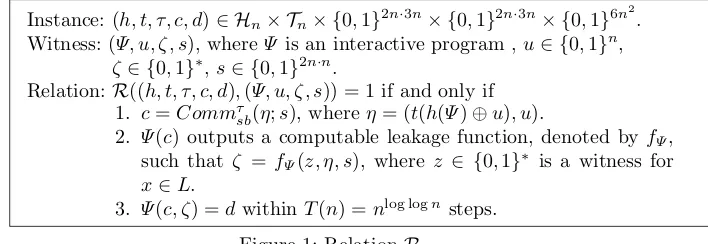
permutations on{0,1}n. Define relationRas follows (depicted in Figure 1).
Instance: (h, t, τ, c, d)∈ Hn× Tn× {0,1}2n·3n× {0,1}2n·3n× {0,1}6n
2
. Witness: (Ψ, u, ζ, s), whereΨ is an interactive program ,u∈ {0,1}n,
ζ∈ {0,1}∗,s∈ {0,1}2n·n.
Relation:R((h, t, τ, c, d),(Ψ, u, ζ, s)) = 1 if and only if 1. c=Commτ
sb(η;s), whereη= (t(h(Ψ)⊕u), u).
2. Ψ(c) outputs a computable leakage function, denoted by fΨ,
such that ζ = fΨ(z, η, s), where z ∈ {0,1}∗ is a witness for
x∈L.
3. Ψ(c, ζ) =dwithinT(n) =nlog logn steps.
Figure 1: RelationR
Denote byLR the language corresponding to the variant of Barak’s relation R.
generation protocol, denoted by Φ, for LR (depicted in Figure 2). It is similar to
Barak’s generation protocol.
Instance generation protocolΦ:
– V selectsh∈RHn,t∈RTn, τ∈R{0,1}2n·3n, and then sends (h, t, τ) toP.
– P selectsη∈R{0,1}2n;s∈R{0,1}2n
2
and sendsc=Commτ
sb(η;s) toV.
– V selectsd∈R{0,1}6n
2
and sends it to P.
Figure 2: Generation protocolΦ
The generation protocolΦis sound ifV honestly executes the protocol.
Lemma 1. For any T(n)O(1)-sizeP, letσ= (h, t, τ, c, d) be the transcript of
execu-tion ofΦ. IfV is honest, then the probability thatP outputswsuch thatR(σ, w) = 1
is negligible.
Proof. Define the event E to be “P outputs a witness f or σ ∈ LR”, and let ε =
P r[E]. SupposeHset={(h, t, τ) : P r[E|(h, t, τ)]≥ε/2}. That is, for any (h, t, τ)∈
Hset, it holds that P r[E|(h, t, τ)]≥ε/2. Then, the probability thatV randomly
se-lects (h, t, τ) such that (h, t, τ)∈Hset is at leastε/2. Without loss of generality, we
can assume that P is deterministic. Thus, for any fixed (h, t, τ), c and z (a witness for x) are also fixed. It follows that V’s leakage query f is determined if it exists. By the assumption that P obtains a witness for σ with probability ε, we have that
P∗, with probabilityε2/4, obtains two witness respectively for σ= (h, t, τ, c, d) and
σ0 = (h, t, τ, c, d0), whered6=d0. This means thatP∗ can find two different programs
Ψ, Ψ0 and random valuesη, η0∈ {0,1}n, such that
η= (t(h(Ψ)⊕u), u),η0= (t(h(Ψ0)⊕u0), u0)
Commτ
sb(η;s) =Comm τ sb(η
0;s0)
By the statistically binding property ofCommsb(·), we have thatP r[η6=η0] is
negligi-ble. This means thatP r[t(h(Ψ)⊕u)6=t(h(Ψ0)⊕u0)] and Pr[u6=u0] all are negligible. It follows thatP r[h(Ψ)6=h(Ψ0)] is negligible since tis a permutation. Therefore,P∗
can find a collision for hwith a non-negligible probability if εis non-negligible. This
contradicts with the assumption forHn.
In a leaking setting where V carries out leakage attacks, P is not ware of any leakage attacks. If the simulator is allowed to seeV’s leakage queries, it will get an extra advantage thanP. In other words,
Lemma 2. For any V∗ that possibly launches leakage attack, there exists an oracle PPT algorithm SV∗, on inputting the description of V∗ and being allowed to obtain V∗’s leakage queries, outputs (v, w)such that the following conditions hold:
– v is indistinguishable from the view ofV∗ interacting with an honestP. – Letσ be the transcript that is contained inv.wis a witness forσ∈LR.
Proof. For anyV∗, letΨ denote the description ofV∗. Define SV∗, which has
black-box access to the leakage oracle, as follows:
– Obtain (h, t, τ) by invokingV∗.
– Randomly select u ∈ {0,1}n and s ∈ {0,1}2n·n, compute c = Commτ sb(η;s),
whereη= (t(h(Ψ)⊕u), u).
– ExecuteΨ(c) and then obtain leakage query fΨ =Ψ(c). (If V∗ does not launch
leakage query,fΨ is the empty.)
– Query the leakage oracle with fΨ(·, η, s) (if fΨ is not empty) and obtain ζ =
fΨ(z, η, s).
– InvokeV∗ with (c, ζ) and it returns d. – Outputv= ((h, τ, c, d, RV∗), w= (Ψ, ζ, s).
It follows from the hiding property of Commsb that v is indistinguishable from the
view of V∗. Obviously, (h, t, τ, c, d) ∈ LR and the corresponding witness is w =
(Ψ, u, ζ, s).
Remark: Since the auxiliary input z ( witness for x ∈ L) is not given to Sv∗,
SV∗ cannot computefΨ(z, η, s) by itself even ifSV∗ has obtainedfΨ(·). Fortunately,
SV∗ here is given access to the leakage oracle. After obtainingfΨ(·),SV∗ queries the
leakage oracle withfΨ(·, η, s) and then receivesfΨ(z, η, s) from the leakage oracle.
The hardness condition ofRholds againstT(n)O(1)-size adversaries. Barak in [3] used an error correcting code (ECC)to relax the assumption such that the hardness condition holds under the existence of the standard collusion-resisted hash functions. LetECC be a polynomial-time computable function with polynomial-time encoding and with constant distance. If one replaces the condition η = (t(h(Ψ)⊕u), u) with
η= (t(h(ECC(Ψ))⊕u), u), the conclusion of lemma 1 holds for polynomial sizedP∗.
3.2 A new preamble
The fact thatRcan be verified inT(n) =nlog lognunder the help of the leakage oracle
implies thatLR does not lie in NP. Therefore, all the traditional proof systems for NP
cannot deal withLR. Barak and Goldreich in [3] introduced universal arguments for
the languagesN time(T(n)) and presented a 4-round public-coin protocol, denoted by hPua, Vuai, for such languages. Their construction is as follows:
Common input: (h, t, τ, c, d). Security parameter 1n. • Vuasends its first random massageαto Pua.
• Puacomputes the response, denoted byβ, and sends it toVau. Letl1=|β|. • Vuasends its second random massageγ toVua.
• Puacomputes the response, denoted byδ, and sends it toVau. Letl2=|δ|.
The above systemhPua, Vuaican be used to deal withLRalthough the verification
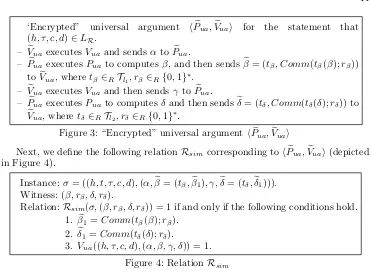
of the relationRneeds access to the leakage oracle. Suppose thatComm(·;·) is a non-interactive statistically binding commitment scheme. By combining Comm(·;·) with universal argumenthPua, Vuai, one can construct an “encrypted” universal argument,
‘Encrypted” universal argument hPeua,Veuai for the statement that
(h, τ, c, d)∈LR.
– Veuaexecutes Vuaand sendsαtoPeua.
– Peuaexecutes Puato computesβ, and then sendsβe= (tβ, Comm(tβ(β);rβ))
toVeua, wheretβ∈RTl1, rβ∈R{0,1}
∗.
– Veuaexecutes Vuaand then sendsγ toPeua.
– PeuaexecutesPuato computesδand then sendseδ= (tδ, Comm(tδ(δ);rδ)) to
e
Vua, wheretδ ∈RTl2, rδ∈R{0,1}
∗.
Figure 3: “Encrypted” universal argumenthPeua,Veuai
Next, we define the following relationRsim corresponding tohPeua,Veuai(depicted
in Figure 4).
Instance:σ= ((h, t, τ, c, d),(α,βe= (tβ,βe1), γ,δe= (tδ,eδ1))). Witness: (β, rβ, δ, rδ).
Relation:Rsim(σ,(β, rβ, δ, rδ)) = 1 if and only if the following conditions hold.
1. βe1=Comm(tβ(β);rβ).
2. eδ1=Comm(tδ(δ);rδ).
3. Vua((h, τ, c, d),(α, β, γ, δ)) = 1.
Figure 4: RelationRsim
Note thatVuais efficient. It follows thatRsimis an NP-relation. The corresponding
language is denotedLRsim∈N P. We construct the following preambleΣ forLRsim
(depicted in Figure 5).
PreambleΣ:
– P andV run Φ. Letσ0= (h, t, τ, c, d) be the transcript. – P andV run hPeau,Veauiforσ0.
• V sendsVua’s first massageαtoP .
• P sends βe = (tβ, Comm(β;rβ)) to V, where β ∈R {0,1}l1, tβ ∈R Tl1, rβ∈R{0,1}∗.
• V sendsVua’s second massageγ toP.
• P sends eδ = (tδ, Comm(δ;rδ)) to V, where δ ∈R {0,1}l2, tδ ∈R Tl2, rδ∈R{0,1}∗.
The transcript is denoted by σ00= (α,
e
β, γ,δe).
Figure 5: PreambleΣ
The preamble Σ is sound for LRsim. For any P∗ interacting with V, let σ be
the transcript of the protocol, then the probability that P∗ obtains a witness for
σ∈LRsim is negligible.
Lemma 3. No matter howP∗ does, the probability thatP∗ obtains a witnesswsuch that Rsim(σ, w) = 1 is negligible when V executes the protocol honestly, where σ is
the transcript of protocols.
Proof. Let σ = (σ0, σ00), where σ0 and σ00 are the transcript Φ and hPeua,Veuai,
– βe= (tβ, Comm(β;rβ)),eδ= (tδ, Comm(δ;rδ)),σ00= (α,β, γ,e δe). – Vua(σ0,(α, β, γ, δ)) = 1
It is easy to construct a prover of hPua, Vuai from P∗, denoted by Pau∗ , such that
Pr[hPua∗ , Vuai(σ0) = 1] is non-negligible. Therefore, from the proof of knowledge
prop-erty ofhPua, Vuai, there exist a probabilisticT(n)-time oracle machineE such that
P r[EPau∗ (σ0) ∈ LT
U] is non-negligible. It follows that P∗ can obtain w0 at the end
of Φ such that R(σ0, w0) = 1 with a non-negligible probability. By lemma 1, this is
impossible.
3.3 Augmented garbled-circuit
Garbled circuit method allows two parties,P0 andP1, to evaluate an arbitrary func-tionf(x, y) on their respective inputsx=x1· · ·xn andy =y1· · ·yn, without leaking
any information about their inputs beyond what is implied byf(x, y).
LetCbe a acyclic boolean circuit such thatC(x, y) =f(x, y) for anyx, y. The ba-sic idea of garbled-circuits is that one party generates an “garbled-circuit”CbofC, the second party then obliviously computes the output without learning any intermediate values.
Suppose thate=poly(n) is the number of wires (including input wires of C and output wires of every gate in the circuitC). All the wires are labeled byW1,· · · , We,
where (W1,· · ·, Wn) and (Wn+1,· · ·, W2n) correspond to xand y respectively. Let
OU T = {We−k+1,· · · , We} be all the output wires and Cg be all gates in C. Let
(G, E, D) be a symmetric encryption scheme that has indistinguishable encryptions under chosen-plaintext attacks. In addition, assume that (G, E, D) has elusive and efficiently verifiable range. Such a encryption scheme can be constructed from a family of pseudorandom functions. One party garbles the circuitC as follows:
1. For each wireWi, choose two independent keys (ki0, k1i) by a algorithmG(1n).
2. Given these keys, the four garbled values of each gateg, with input wiresWi, Wj
and output wireWm, are computed as follows:
ca,b=Eka i(Ekbj(k
g(a,b)
m ),a= 0,1;b= 0,1
where the inputs ofWi andWj areaandbrespectively, the output ofgisg(a, b).
LetTg= (c0,0, c0,1, c1,0, c1,1).
3. For eachTg, randomly choose a permutationπgand setTg∗=πg(Tg) 4
= (c0, c1, c2, c3). LetT∗={Tg∗}g∈Cg.
4. Construct decryption tables Tdec = {(0, k0i; 1, k
1
i)} i=e
i=e−k+1, and define garbled-circuitCb= (T∗, Tdec).
Garbled circuit method is formally denoted by two PPT algorithms (Garble, Eval). On inputting 1n and C, algorithmGarblefirst executes the above process and then
outputs (C, Kb 0, K1), where K0 =
k0 0,i, k10,i
n
i=1 is the keys of the input wires of x,
K1 =
k0 1,i, k11,i
n
i=1 is the keys of the input wires of y. LetKx =
kxi
0,i n
i=1, Ky =
kyi
1,i
2n
i=n+1. AlgorithmEval, on inputtingKx, KyandCb, outputsC(x, y) =f(x, y). Roughly speaking, for every gate g in C with input wires Wi, Wj and output wire
Tg∗=πg(Tg) = (c0, c1, c2, c3). If more than one decryption or no decryption succeed,
then fails and stops. Otherwise, obtain a keyKmg(a,b)correspondingWm. UsingKx, Ky
and starting from the input gates, Eval can obtain the keys of all the output wires and returnC(x, y) by requiring the decryption tables.
Notice that ifπg is omitted in garbling C, that is, Tg∗ = (c0,0, c0,1, c1,0, c1,1), the
keysKa
i andKjb (corresponding the inputs wires of the gateg) in fact will reveal the
real inputsaandb, since the subscript of the cipher that can be decrypted is (a, b). Here, assumed that|x|=|y|for simplicity. In fact, this condition is unnecessary. Garbled circuit method presents an approach for secure two-party computation. LetOT be 2-round 1-out-of-2 oblivious transfer protocol. Yao’s two-party protocol is described as follows:
Yao’s protocolΠcd
Common input:C(x, y) =f(x, y), security parameternandmofCommmsh(). Private inputs:P0’s input:x; P1’s input:y.
– P0 prepares a garbled-circuit (C, Kb 0, K1) by (C, Kb 0, K1) ← Garble(C,1n) for theC(x) as above. ThenP0 sendsCb andKxtoP1.
– P0 andP1 executeOT such thatP1 obtainsKy.
• P1computesv= (v1,· · ·, vn), whereviis the first message ofOTprotocol
using the inputyi and fresh randomnessri fori∈[n]. It then sendsv.
• P0 prepares v0 = (v01,· · · , vn0), where vi0 is the second message of OT
when taking (k0
1,i, k11,i) as sender’s input andvias receiver’s first message.
Finally,P0 sendsv0. • P1 computesKy fromv, v0.
– P1 obtainsf(x, y) by computingEval(C, Kb x, Ky).
The construction of LR-ZKA in [20] used Yao’s protocol to compute a conditional disclosure function such that the verifier reveals a random string only if the prover holds some special “witness”. In order to force the verifier to compute conditional disclosure function honestly, a public-coin statistical ZKAoK, in which the verifier plays the role of a prover, follows this conditional disclosure.
LetRsim be as above andσ ∈ {0,1}∗ be the transcript ofΣ. As in [20], we use
Yao’s protocolΠcdto compute the following conditional disclosure function:
fσ,Rsim(r, w) =
r, Rsim(σ, w) = 1
0|r|, others
The common input toP0andP1is the description of the functionfσ,Rsim or a circuit
C computingfσ,Rsim.
P0 (known as a sender, denoted by Scd) randomly selects input r∈ {0,1}poly(n)
and want to disclose r to P1 (known as a receiver, denoted by Rcd). The receiver
holdingwobtains r∗ after the computation has been performed. IfR(σ, w) = 1 then
r∗=r, otherwiser∗ = 0|r|. That is, the sender disclosesrto the receiver if and only ifRsim(σ, w) = 1. Here, we will use Naor’s 2-round OT protocol (presented in [19],
denoted asOTN P) inΠcd.OTN P is secure if the DDH assumption holds. In addition,
the receiver’s first message is indistinguishable from one selected uniformly from the specific message space. It follows from [17] thatΠcdsecurely computes the conditional
disclosure functionfσ,Rsim(r, w). Specially, the receiver takingwas the input does not
obtain any information about the sender’s inputrexcept forfσ,Rsim(r, w). Therefore,
the receiver can only obtain 0|r| whenwis not a witness forσ∈LRsim.
The computation of the conditional disclosure function fσ,Rsim(r, w) in our
con-struction of LR-ZKAoK, in fact, is a commitment stage, where the verifier acts as a sender to commit to a random value r0. If the prover does not have any witness for σ ∈ LRsim, it only obtains 0|r
0|
at the end of this commitment stage. So, the hiding property holds when the prover does not have any witness. In later stage when receiving a random value r00 from the prover, the verifier will reveal r0. Finally, the prover and the verifier obtain a common random valuer=r0⊕r00. Obviously, After receiving the revealment tor0 from the verifier the prover cannot verify whether it is correct. That is, the binding property is in doubt.
The binding property is unnecessary to real interaction, since the prover com-pletely ignores the computation offσ,Rsim(r0, w) and accepts anyr0 revealed by the
verifier. In simulation, however, simulator needs to learnr0by computingfσ,Rsim(r0, w)
such thatr0⊕r00 equals a specified value by selecting a specialr00. Therefore, if the verifier does not correctly reveal r0, the simulator will fail even though the prover does not abort in that case. In order to ensure that the simulator fails if and only if the prover aborts in real interaction, the prover needs to check weather the verifier correctly revealr0and aborts when the verifier does not. Therefore, we need to modify the algorithm Garble by replacing the step 3 of garbling circuit with the following process.
3’. For eachTg, choose randomly permutationπg, and computesCTg =Commmsh(πg)
andTg∗=πg(Tg) 4
= (c0, c1, c2, c3). LetT∗={Tg∗}g∈Cg andCT ={CTg}g∈Cg.
The augmented garbled-circuit is Cb = (T∗, CT, Tdec). It is easy to see that the
modified garbled-circuit can be evaluated by the algorithmEvalwhen givenKx, Ky.
Therefore, Yao’s protocolΠcdworks well in the context ofCb= (T∗, CT, Tdec) and the
proved security has not been impacted.
On the other hand,CT inCb= (T∗, CT, Tdec) contains the commitments of allπg’s
and can be used to verify the computation ofC(x, y). Recall that the receiver com-putes the garbled-circuitCbofCby executingEval(C, Kb x, Ky). Starting fromKx, Ky,
every gate in Ccan be “decrypted” correctly. Concretely, for every gateg Evaluses the keys corresponding the input wires of g to decryptTg∗ =πg(Tg) = (c0, c1, c2, c3) and then obtain the key corresponding the output wires of g. Notice πg is a
permu-tation over Tg = (c0,0, c0,1, c1,0, c1,1), where ca,b =Eka i(Ekbj(k
g(a,b)
m ). Therefore, if the
receiver obtains πg, it can recover Tg = (c0,0, c0,1, c1,0, c1,1) by computing π−g1(Tg∗).
By requiring which one of Tg can be decrypted correctly, the receiver can obtain the
inputs ofg. Therefore, if the sender opens correctly allπg’s, the receiver can verifies
the sender’s inputxandC(x, y).
In our construction, the prover and the verifier (playing the role of sender) jointly computefσ,Rsim(r0, w) by the augmented garbling circuit. This protocol, in
In subsequent opening phase, the verifier is required to revealr0 and all the commit-ments toπg’s. Since byπg’s the prover can verify weather the sender correctly reveal
r0, the binding property holds sinceCommm
sh is computationally binding.
4
Constant-round LR-ZKAoK for HC
LetHC be all directed graphs containing Hamiltonian cycles. Our goal in this section is to construct LR-ZKAoK for NP-relation RHC. Recall Blum’s protocol forHC.
Common input:G= (V , E)∈HC (containing a Hamiltonian cycleH),|V|=n. – Prover’s first step(P1): The prover selects a random permutationπ overV, and
sends the commitmentsto the adjacency ofGi=π(G) to the verifier.
– Verifier’s first step(V1): The verifier uniformly selects a challenge ch ∈R {0,1}
and sends it to the prover.
– Prover’s second step(P2): Ifch= 1, the prover reveals some commitments corre-sponding to the edges of the Hamiltonian cycleπ(H). If ch= 0 then the prover reveals all the commitments andπ.
– Verifier’s second step(V2): The verifierV checksP’s revealment.
Garg et al. in [13] first presented a LR-ZKP system for NP by adding a preamble to the paralleled Blum’s protocol. In the preamble, the verifier first commits to its random challengechand a random stringr0using a extractable commitment scheme,
and then the prover sends a random string r00. In subsequent Blum’s protocol, the prover uses r =r0⊕r00 as the first random message of Naor’s commitment scheme to compute its commitments. From the extractability of the commitment scheme, the simulator can learn ch and r0 in advance by rewinding the verifier’s strategy. Therefore, the simulator can answer this challenge correctly and has the ability to respond leakage queries under the help of the leakage oracle. More precisely, their construction consist of three stages. In Stage 1,V commits to its challengechand a random stringr0using a public-coin statistically hiding commitment scheme, followed by many challenge-response slots. In Stage 2, P selects a random string r00 and V
revealsr0. And then,P andV computer=r0⊕r00. Finally, in Stage 3,P andV run
nparallel repetitions of Blum’s protocol. In the first round,P uses Naor’s two-round commitment scheme, usingras the first message, to commit to the adjacency of the permuted graphs. In the second round,V reveals the commitment to its challengech. Finally,P responds to this challenge andV verifies the response. The construction of [13] is a black-box LR-ZKP, since the simulator needs to rewind the verifier’s program
V∗ such that it can extract the challengechand forcerto a special distribution. In the model of [13], cheating verifiers are allowed to launch a leakage query every time the prover sends its message. To obtainchandr0, the (black-box) simulator needs
The LR-ZK property requires that for any V∗ there exists a simulator (with a leakage oracle) that can simulate the view of V∗, while proofs of knowledge require that there exists a (black-box) knowledge extractorK to extract a witness fromP∗if
P∗’s proof is accepted. In the protocol of [13],V commit to its challengesch before
P sends its commitment. This implies that the permutation that P use to compute its commitments may depend on the challenge selected byV. This results in that the black-box knowledge extractors cannot work efficiently. Therefore, the protocol in [13] is no longer a proof of knowledge. The approach of requiring the verifier to commit to its challengeschin advance can ensure LR-ZK property, but then seemingly destroy the proof of knowledge property.
Recently, [20] presented a constant round leakage-resilient zero-knowledge proof for HC by combining the idea of [13] with Barak’s non-black-box simulation technique. Roughly speaking, the protocol of [20] replaced the stage 1 of the protocol of [13] with a constant round preamble consisting of four stage such that the simulator can extract the challenge ch and force r to a special distribution of its choice without rewinding the verifier’s algorithm V∗. Unfortunately, the protocol of [20] is not a proof of knowledge because of the same reason as mentioned above.
The key problem in constructing LR-ZKP is how to respond leakage queries in simulation such that the responses are consistent to the simulated view. To obtain LR-ZKAoK, we modified the construction in [20] such that the following two conditions hold: (1) the challengech is generated after the prover sends its commitments, as in [15, 16]; (2) the simulator have chance to control over the generated challenge and the prover cannot. Thus, the simulator can simulate the prover’s commitments according to a-priori randomly selected challenge. On the other hand, black-box knowledge extractors Kcan work efficiently. To this end, we use a jointly coin-flipping protocol to generate ch after the prover sends its commitments. In addition, we also need a preamble in which the simulator obtains “trapdoors”. As in [20], we use Barak’s non-black-box techniques to construct such a preamble. The difference between this preamble and that in [20] is that it use a new variant of Barak’s relation to define a NP-relationRsim. In general Barak’s non-black-box simulation, the simulator needs the
description of the verifier’s strategy to accomplish a task that the prover cannot. That is, the simulator’s advantage over the prover is that it is given the verifier’s program. Notice that apart from the description of the verifier strategy is allowed to see the verifier’s leakage queries. We define a variant of Barak’s relation by simultaneously using the description of the verifier’s strategy and leakage queries. The simulator can take advantage of knowing the description of the verifier’s strategy and leakage queries to obtain an instance σ ∈ LRsim and a corresponding witness w such that
Rsim(σ, w) = 1, and no prover can obtainσ∈LRsim. Therefore, the protocol is sound
and meanwhile the simulator have the ability to control overchandr.
Our protocol, denoted byΠ, consists of 5 stages (depicted in Figure 6). In Stage 0,P andV run preambleΣ. Stage 1 is a coin-flipping protocol to produce a random string r = r0⊕r00, wherer0 and r00 are randomly picked by P and V respectively. In this stage, V first commits to a random string r0 by means of computing the conditional disclosure function fσ,Rsim(r
0, w). Here, the augmented garbled-circuit
b
Subsequently, P sends a random string r00, and then V sets r=r0⊕r00 and reveals
r0 along with and the all permutations committed in CT. Ifr0 pass the verification,
P computer=r0⊕r00. In Stage 2, the prover commits nrandom permuted graphes using Naor’s commitment scheme with r as the first message. Stage 3 is another coin-flipping protocol to produce a random challengech. Similarly as in Stage 1, the augmented garbled-circuit method is used to achieve the conditional disclosure of a random secretchV selected byV. And then,P randomly selectschP andV reveals
chV. IfchV is passed the verification, the two parties obtain a common random string
ch=chP⊕chV. In Stage 4,P useschas challenge to execute prover’s second step of
Blum’s protocol P2. Then,V executes verifier’s second step of Blum’s V2 withch.
Π: LR-ZKAoK for HC
Common input:G= (V, E)∈HC,|V|=n. Lett= 3n4. Auxiliary input to the prover: A Hamilton cycleH inG. – Stage 0: Preamble.
• P andV runΣ. The transcript is denoted byσ= (σ0, σ00). – Stage 1: Jointly coin-tossing.
• P sends the first random message m to V. (The first message of the statistically hiding commitment schemeCommm
sh(·)).
• V (the sender) selects r0 ∈ {0,1}t, and run Π
cd with P to compute
fσ,Rsim(r
0, ρ), whereρis selected byP. Finally,P obtains r∗
• P selects and sendsr00∈R{0,1}ttoV.
• V opens r0 and the commitments in CT computed inΠcd. V sets r =
r0⊕r00.
• P verifiesr0 (verifying the decommitment toC
T and thatr0 isV’s input
inΠcd) and aborts if the verification fails. Otherwise,P setsr=r0⊕r00.
– Stage 2: The prover’s commitment.
• Suppose r = r1· · ·rn, whereri = ri,1· · ·ri,n2 satisfying|ri,j| = 3n for i ∈ [n] and j ∈ [n2]. For every i ∈[n], P picks a random permutation
πi and computes Ci =Commrisb(πi(G);θi) (Naor’s commitment scheme
withri as the first message), and sendsC= (C1,· · ·, Cn) to V.
– Stage 3: Jointly coin-tossing:
• V (the sender) selects chV ∈ {0,1}n and and runΠcd with P (the
re-ceiver) to computefσ,Rsim(chV, ρ), where ρis selected byP. Finally,P
obtainsch0V
• P selects and sendschP ∈R{0,1}n toV.
• V openschV and the commitments inCT.V sets ch=chP⊕chV.
• P verifies chV (as the verification of r0 in Stage 1) and aborts if the
verification fails. Otherwise,P setsch=chP ⊕chV ∆
=ch1· · ·chn.
– Stage 4:P responds to the challenge ch, andV verifies this response. • P reveals some commitments in Ci corresponding to the edges of the
Hamiltonian cycleπi(H) ifchi= 1, or reveals all the commitments inCi
andπi ifchi= 0.
• V verifies the decommitments according toch.
The presented protocol uses non-black-box techniques such that the total of the leakage information received by the simulator is as much as the verifier. Concretely, since the simulator holds the description of the verifier’s strategyV∗ and is allowed to receive leakage queries fromV∗, it can obtain a witness forσ∈LRsim, whereσis
the transcript of runningΣ. By this witness, the simulator has the ability to forcer
to a special distribution in Stage 1 and ensurechequal to a-priori randomly selected value. This results in that the simulator can interact with V∗ in later stages as an honest prover and correctly respond toV∗’s leakage queries.
Theorem 1. Let H be a family of collision-resistant pseudorandom hash function andT be a family of pseudorandom permutation. Assume that DDH assumption holds. ProtocolΠ is a LR-ZKAoK for HC with knowledge errorκ= 2−n, ifCommsb(·;·)is a
Naor’s 2-round statistically binding commitment scheme andCommsh(·;·)is 2-round
statistically hiding commitment scheme.
Proof. Completeness:Completeness is obvious.
Soundness: Suppose G /∈ HC. For any P∗, let ε∗ be the probability that P∗
successfully cheatsV. By Lemma 3, we have that for anyP∗ the probability thatP∗
holds a witness for σ ∈LRsim at the end of Stage 0 is negligible. Next, we need to
show that the jointly coin-tossing sub-protocol in Stage 1 is secure. To show this, define
B={r:∃s0, s1∈ {0,1}n, such that r=g(s0)⊕g(s1)}
forg:{0,1}n → {0,1}3n (pseudorandom generator used in Naor’s commitment). Let
r00 be a string that P∗ sends to V in Stage 1. Then, after V open r0, P∗ obtains
r=r0⊕r00=r1,1· · ·rn,n2 at the end of Stage 1. We show the following lemma holds.
Lemma 4. No matter what P∗ does, the probability that there exist i ∈ [n] and
j∈[n2] such thatr
i,j∈ B is negligible, ifV honestly executes the protocol.
Proof. Denote byE1the event that there existi∈[n] andj∈[n2] such thatri,j∈ B.
Denote byE2the event thatP∗holds a witness forσ∈LRsim at the end of Stage 0.
P r[E1] =P r[E1∧E2] +P r[E1∧E2]≤P r[E2] +P r[E1|E2]
First, it follows from Lemma 3 that P r[E2] is negligible. Next, under the condition that P∗ does not obtain a witness for σ ∈ LRsim in Stage 0, P∗ only obtains 0t
by means of executing Πcd and cannot learn r0 before sending r00 to V. Therefore,
r=r0⊕r00is uniformly distributed on{0,1}texcept for a negligible probability ifV
is honest. It follows thatP r[E1|E2] is negligible. Therefore,P r[E1] is negligible.
By the same reason as above, the following lemma holds.
Lemma 5. For any priori fixed ch0 ∈ {0,1}n, the probability that P∗ successfully
selects chP∗ such that ch = ch0 at the end of Stage 3 is negligible, if V honestly
executes the protocol.
By Lemma 4,rgenerated in Stage 1 is uniformly distributed except for a negligible probability. So, the commitment scheme Naor’s Commr
sb(·;·) is statistically binding.
If G /∈ HC, by the binding property of Commr
negligible probability, there is only one ch0 ∈ {0,1}n such that C = (C
1,· · · , Cn)
can be successfully opened accordingch0 no matter whatP∗ does.P∗ computes the commitmentsC= (C1,· · · , Cn) before the challengechis generated. Therefore, ifV
is convinced ofG∈HC with a noticeable probability, thenP∗ is able to selectchP∗
such thatchP∗⊕chV =ch0 in Stage 3. By Lemma 5, this is impossible. And then we
have thatε∗ is negligible.
Leakage-resilient zero knowledge:To prove leakage-resilient zero knowledge property, we need to construct a simulator which not only output a simulated tran-script but also respondsV∗’s leakage query. The key problem is that the leakage must conform to the simulated transcript.
We first show how the simulator answers the verifier’s leakage queries. The sim-ulator is permitted to directly receive leakage query f(state) from V∗, where state
consists of the witness and all used random value so far. Without holding any witness, however, the simulator cannot respond to leakage queryf directly. It is just well that the simulator has access to a leakage oracleLn
z that holds the witnessz. To respond
to a leakage query f, the simulator construct a new function f0 such that f0(z) is indistinguishable fromf(state), and then sendsf0 to the leakage oracleLn
z. The
leak-age oracleLn
z leaks f0(z) directly to verifierV∗, and does not leak any information
to the simulator.
Notice that leakage query f takes the form of f(z, R), where z is the prover’s witness (a Hamiltonian cycleH in G),R=R(z) is a function that, on inputting the prover’s witnessz, outputs the prover’s random coins. To create a new queryf0 after receiving a queryf(z, R(z)) from the verifier, the simulator first selects an appropriate random coins Rb, and then presents a strategy based onz to selectR0 from Rb such that f(z, R0) is indistinguishable fromf(z, R). Finally, definef0(z) =f(z, R0).
Non-black-box simulator:givendesc(V∗) and permitted to receive V∗’s leak-age query, the non-black-box simulation is very straightforward. Roughly speaking, the simulatorS plays the role of prover to interact withV∗ and then outputs a sim-ulated transcript. Concretely, in Stage 0, S can obtain a instanceσ = (σ0, σ00) and a corresponding witness w= (β, rβ, δ, rδ), whereσ0 = (h, τ, t, c, d), σ00 = (α,β, γ,e eδ),
σ= (σ0, σ00)∈LRsim. In Stage 1, S andV∗ jointly generater, which will be used as
the first message of Naor’s commitment scheme used in Stage 2. Using the witness
w,S is able to select a specialrin Stage 1, such that all the commitments generated in Stage 2 can be opened in two different manner. In Stage 2 and Stage 4,S acts as an honest prover. S completes Stage 3 using the same strategy as that in Stage 1, such that the generated challengechis equal to a specified one which depend on S’s response to the leakage query in Stage 2. The reason for this is that, in Stage 2, S must determine all random value of Naor’s commitment scheme in order to response
V∗’s leakage query. This results in thatS must specify the challengechin advance.
Lett= 3n4. We denote byS ←V∗thatSreceives a message fromV∗, byS →V∗
On inputting commonn-vertex graph G and the description of the code of the strategy of V∗ (denoted by desc(V∗)), the simulator SLn
z(desc(V∗), G, aux) (where
auxisV∗’s axuiliary. We omit auxsometimes) first selects uniformly random string
RV∗ forV∗ and then proceeds as follows.
IfV∗aborts at any point,S outputsV∗’s current View and stops.
Simulating Stage 0:SLn
z(desc(V∗), G) deals withV∗’s leakage queries as follows.
Initially, let R0 = ∅ be the empty bit string. At any point, S resets R0 = R0||R0, where R0 is the random coins used in the current process. When receiving a leakage
queryf(·,·) fromV∗,SLn
z(desc(V∗), G) setsf0(z)=4f(z, R0), and then queriesLn z(·)
with f0(·). Finally, V∗ obtains f0(z). It is easy to see that the leakage information,
f0(z) =f(z;R0), is indistinguishable from one obtained byV∗ in the real execution.
1.S V∗: S runsΦwith V∗: S first invokesV∗ and receives (h, t, τ). Thus,S randomly selectsu∈ {0,1}n, s∈ {0,1}2n2
and computes
c=Commτsb(η;s), whereη= (t(h(desc(V∗))⊕u), u) Finally,S invokeV∗ withc.
2.S ↔V∗: After receiving a new queryf, S sets R0 = t(h(desc(V∗))⊕u)||u.
Thus, S queries Lnz(·) with f0(·) =4 f(·, R). Finally, V∗ obtains
ζ=f0(z) returned fromLnz(·).
Remark 1:Notice thatR=t(h(desc(V∗))⊕u)||uis indistinguish-able fromθ||u(corresponding random value generated in real inter-action), where θ ∈R {0,1}n. It follows that ζ = f0(z) is
indistin-guishable from the leakage query in real interaction. 3.S ←V∗: S receivesdfromV∗.
4.S V∗: S executes Peau of hPeau,Veaui with the witness (desc(V∗), u, ζ, s).
First, after receiving α from V∗, S computes β as an honest Pua.
Then, sends βe = (tβ,βe1) to V∗, where βe1 = Comm(tβ(β);rβ),
tβ∈RTl1, rβ∈R{0,1}
∗.
5.S ↔V∗: After receiving a new query f from V∗, S prepares random string
R0=R0||tβ||tβ(β)||rβ. Then,Squeries the leakage oracleLnz(·) with
f0(·)=4f(·, R), andLzn(·) returns ζ=f0(z) toV∗.
Remark 2:In real interaction, the prover usestβ||β0||rβ as random
value to response leakage query, where β0 ∈
R{0,1}l1. Obviously, it
is indistinguishable fromtβ||tβ(β)||rβ used byS.
6.S V∗: SreceivesγfromV∗, and then computesδas an honestPau. Finally,
S sends eδ = (tδ,eδ1) to V∗, where δe1 = Comm(tδ(δ);rδ), tδ ∈R
Tl2, rδ ∈R{0,1}
∗.
7.S ↔V∗: After receiving a new leakage query f from V∗, S sets R0 =
R0||tδ||tδ(δ)||rδ. Then,S queriesLnz(·) withf0(·) 4
=f(·, R). Finally,
Ln
z(·) returnsζ=f0(z) toV∗.
Remark 3:Similar to Remark 2.
Letσbe the simulated transcript of Stage 0, f ake= (β, rβ, δ, rδ).
Simulating Stage 1: SLnz(desc(V∗), G) deals with V∗’s leakage queries as in
R0 is the random coins used in the current process. To respond to V∗’s query f,
SLn
z(desc(V∗), G) definesf0(·) 4=f(·, R1) and then queries the leakage oracle Ln z(·)
withf0(·). Finally,V∗ obtainsf0(z) fromLnz(·). The details are as follows.
1.S →V∗: S sends a random valuemto V∗.
2.S ↔V∗: After receiving a leakage queryf fromV∗,SsetsR1=R1||m. Thus, S queriesLn
z(·) withf0(·) ∆
=f(·, R). Thus,V∗obtainsf0(z) returned from Ln
z(·).
3.S V∗: S honestly executesΠcd takingf ake= (β, rβ, δ, rδ) as the input.S
first receivesCb= (T∗, CT, Tdec) andKr0. Then,S prepares the first
message v1= (v1,1,· · ·, v1,t) ofOTN P and sends it toV∗.
4.S ↔V∗: After receiving a leakage queryf fromV∗,SsetsR1=R1||R0, where
R0 is random coins used in preparing v. Thus,S queriesLn
z(·) with
f0(·)=4f(·, R1). Thus,V∗ obtainsf0(z) returned fromLn z(·).
5.S ←V∗: After receivingV∗’s responsev01= (v10,1,· · · , v01,t), S first computes
Kf ake fromv, v0. Finally,S computesEval(C, Kf ake, Kr0) and then
obtains r∗.
6.S →V∗: Assume r∗ = r01· · ·rn0, where r0i = r0i,1· · ·ri,n0 2 and |r0i,j| = 3n. For
i∈[n], j∈[n2],S selectsz0
i,j, zi,j1 ∈ {0,1}n and sets
ri,j00 =r0i,j⊕g(z0
i,j)⊕g(zi,j1 ),ri00=r00i,1· · ·ri,n00 2
Then, S sends r00 =r00
1· · ·r00n to V∗ and receives r0 along with the
decommitments to allCTg’s committed inCT fromV∗.
7. Output: S verifiesr0 as an honest prover. If the verification fails, S outputs (RV∗;c,β,e eδ, v1, r00) and then aborts. Otherwise, S sets r=r00⊕r∗ and proceeds the next step.
Simulating Stage 2: Assume r = r1· · ·rn , where ri = ri,1· · ·ri,n2 and
|ri,j| = 3n. Obviously, ri,j = g(zi,j0 )⊕g(zi,j1 ) for (i, j) ∈ [n]×[n2] if S does not
abort. In this stage,SLn
z(desc(V∗), G) completes the commitments as follows.
1.S →V∗: For everyi ∈[n], S picks a random permutation πi and sets Gi =
πi(G). Then, S sends to V∗ the commitments to the adjacency of
Gi using Naor’s commitment scheme with ri as the first message,
i∈[n]. Accurately, S setsCi ={g(zi,j0 )} j=n2
j=1 fori∈[n], and sends
C= (C1,· · ·, Cn) toV∗.
2.S ↔V∗: S usesLn
z(·) to answer the leakage queries. The detail is as follows.
Response to query leakage in simulating Stage 2: It is not easy to deal with leakage queries in this stage although S acts seemingly as the same as an honest prover. The witness for x ∈ L is a Hamiltonian cycle H in G. For simplicity, we replacezwithH in what follows. After receivingV∗’s leakage queryf(·),S needs to construct a new leakage query f0 such thatf0(H) is indistinguishable fromf(state). To this end, S selects random permutation πi0 and θei ∈ {0,1}n, i = 1,· · ·, n, such
that the following two conditions hold.
2) S is able to answer the challenge in Stage 4.
It is easy to see that if S has selected such (π0
1,eθ1),· · ·,(πn0,θen) and θei ∈ {0,1}n, it
can constructf0 by lettingf0(·) =f(·, R1||π0
1||eθ1|| · · · ||π0n||θen).
The condition 1) is easy to meet. But the condition 2), which is related to the witnessH, is not easy to meet owing to lack of the witness. To solve this problem,S specifies in advance the challengechto respond to in Stage 4, and then define a random function, denoted asSelect(H,{zi,j0 , z1i,j}), to determineπi0andθei(i= 1,· · · , n) from
chand the witnessH.Select(H,{z0
i,j, zi,j1 }) proceeds as follows:
– Randomly select a challengech=ch1· · ·chn ∈ {0,1}n.
– For everyi∈[n]
• Ifchi= 0, defineρ(0, H) andϕ(0, H,{zi,j0 , zi,j1 }) as follows:
(1) ρ(0, H) returns the permutation π0i = πi selected by S in Stage 2. Let
{gi,j}j∈[n2] be the adjacency matrix ofGi=πi(G).
(2) ϕ(0, H,{z0
i,j, z1i,j}) returnsθei=yi,1|| · · · ||yi,n2, whereyi,j=zi,jb ifgi,j =b
for eachj∈[n2].
Remark: Whenchi = 0, S will ask to revealπi and decommitCi to πi(G)
in Stage 4. ϕ(0, H,{z0
i,j, zi,j1 }) returns θi = yi,1|| · · · ||yi,n2 such that Ci =
Commri
sb(πi(G);θi).
• Ifchi= 1, select a random cycleHi, and define two functionsρ(1, H, Hi) and
ϕ(1, H, Hi,{z0i,j, z
1
i,j}) as follows:
(1) ρ(1, H, Hi) first selects a permutationπsuch thatHi=πi(πi(H)). Thus,
ρ(1, H, Hi) returnsπ0i=πi◦πi.
(2) ϕ(1, H, Hi,{zi,j0 , z1i,j}) computesπ0isuch thatHi=π0i(H). Let{gi,j0 }j∈[n2]
be the adjacency matrix of Gi = πi0(G). ϕ(1, H, Hi,{zi,j0 , zi,j1 }) returns
θi =yi,1|| · · · ||yi,n2, where yi,j=zbi,j ifg0i,j=bfor eachj∈[n2].
Remark: When chi = 1, S will ask to reveal a random hamiltonian cycle
committed inCi in Stage 4.S first selects randomlyHi and then the leakage
oracle can determine a permutation π0
i such that Hi =π0i(H) by executing
ρ(1,·, Hi) with H, and compute θei such that Ci = Commrsbi(π0(G);θei) by
executingϕ(1,·, Hi,{z0i,j, z
1
i,j}) withH.
– OutputR0=π0||θe1|| · · · ||πn0||eθn.
After receivingV∗’s queryf(·),S defines a new leakage query
f0(H) =f(H, R1||Select(H,{z0
i,j, zi,j1 }))
Then,SqueriesLn
z(·) withf0(·) andV∗obtainsf0(H) fromLnz(·). It is easy to see that
f0(H) is the same as one leaked fromP. Finally, letR2(H) =R1||Select(H,{zi,j0 , z1i,j}).
Simulating Stage 3: S honestly executes Πcd taking f ake as the inputs of
the garbled-circuit. S handles leakage queries as in simulating Stage 1. Initially, let
1.S V∗: S honestly executes Πcd taking f akeas the inputs of the
garbled-circuit. S first receives Cb = (T∗, CT, Tdec) and KchV (keys
cor-responding chV∗). Then, S prepares the first message v2 =
(v2,1,· · · , v2,t) ofOTN P and sends it toV∗.
2.S ↔V∗: After receiving a leakage queryf fromV∗,S setsR
3=R3(H)||R0, whereR0 is random coins used in preparingv. Thus,S queriesLn
z(·)
withf0(·)=4f(·, R). Thus,V∗ obtainsf0(z) returned fromLnz(·).
3.S ←V∗: After receivingV∗’s responsev02= (v20,1,· · · , v02,t), S first computes
Kf akefromv, v0. Finally,ScomputesEval(C, Kf ake, KchV) and then
obtains chV∗.
4.S →V∗: S setschP =ch⊕chV∗ and sendschP toV∗.V∗ returns the
decom-mitments to CTg to S.
5. Output: SverifieschV∗as an honest prover. If the verification fails,Soutputs
the view (RV∗;c,β,e δ, ve 1, r00, − →
C , v2, chP) and then aborts. Otherwise,
S sets ch=chP⊕chV∗ and proceeds the next step.
Simulating Stage 4:
1.S →V∗: S revealsπi and all the commitments ofCi whenchi = 0, or reveals
some commitments of Ci corresponding to the edges to Hi when
chi = 1, for everyi∈[n]. Formally,S sets
Ansi=
(
πi,{z g0i,j i,j }n
2
j=1
, chi = 0
z1i,j:h0i,j= 1,1≤j≤n2 , chi = 1
where {gi,j0 }n2
j=1 and{h0i,j} n2
j=1 are the adjacencies of Gi=π(G) and
Hi, respectively.S sendsAns= (Ans1,· · ·, Ansn) toV∗.
Outputting :Finally,S outputs (RV∗;c,β,e δ, ve 1, r00, − →
C , v2, chP, Ans) and stops.
Simulator’s output distribution: Next, we use the hybrid argument method to prove that
SLnz(·)(G, desc(V∗), aux)
x∈L,aux∈{0,1}∗ is indistinguishable from the
real view{V iewV∗(G, aux)}
x∈L,aux∈{0,1}∗.
For simplicity, we will omitV∗’s auxiliary auxin what follows.
First, the prover may abort in real interaction whenV∗ fails in revealingr0 cor-rectly in Stage 1(or chV∗ in Stage 3). Notice that S aborts in simulating Stage 1
(or Stage 3) under the same condition, and meanwhile outputs the current simulated view. For simplicity, we assumeS does not abort in simulating Stage 1 or Stage 3 in what follows.
Suppose there is a hybrid simulatorSbwhich receives a Hamiltonian cycleH⊆G as the input. We define hybrid experiments as follows:
Exp1: This experiment is the same as Exp0except that in Stage 0Sbinteracts with
V∗asS. Specially,Sbcomputesc=Commτsb(η;s) after receiving (h, t, τ) from
V∗, where u∈R {0,1}n, η =t(h(desc(V∗))⊕u, u), and then sends c to V∗.
After receiving a leakage queryffromV∗,Sbcomputes the leakage information
ζ=f(H, R). Finally,Sbcan computeβ,e eδas an honestPeua.
Exp2: This experiment is the same as Exp1except that in Stage 1Sbinteracts with
V∗ and responds to leakage queries asS.
Exp3: This experiment is the same asExp2 except in Stage 2 and Stage 4. In Stage 2, Sbinteract with V∗ as S to commit to πi(G) by Ci = {g(zi,j0 )}
j=n2 j=1 for a randomly selected πi. Letch =ch1· · ·chn be the challenge selected by Sein Stage 2,ch0=ch01· · ·ch0nbe the challenge generated in Stage 3. The probability that ch =ch0 is negligible sinceSbproceeds as the honest prover in Stage 3. Therefore,Sbshould use a special strategy to answer the challengech0. More precisely,Sbproceeds in Stage 4 as follows.
• Whenchi= 0∧ch0i = 0,Sbsimply revealsπi and{z g0i,j i,j }
n2
j=1to show Ci is
the commitments toπi(G) = (g0i,j).
• When chi = 0∧ch0i = 1, using H and πi (selected in Stage 2), Sb can open some commitments of Ci according to the Hamiltonian cycleπi(H)
in Stage 4. (BecauseSbreplies to the leakage query in Stage 2 as an honest prover (chi= 0),Sb’s respond toch0i is coincident with its leakage answer in Stage 2.)
• When chi = 1 ∧ ch0i = 0, Sb first invokes ρ(1, H, Hi) and
ϕ(1, H, Hi,{zi,j0 , z1i,j}) with H and Hi (selected by S in Stage 2) to
de-termineπ0i and the random coinszg 0 i,j
i,j for eachj∈[n
2], where {g0
i,j}j∈[n2]
be the adjacency matrix ofGi=πi0(G), and then revealsπiand{z g0i,j i,j }n
2
j=1 to show thatCi is the commitment toGi. (Here,Sbuses the same strategy
as in Stage 2 to determineπ0i and the random coinszg 0 i,j i,j .)
• if chi = 1, ch0i = 1, Sbopens some commitments of Ci according to the
Hamiltonian cycleHi (the Hamiltonian cycle picked in Stage 2).
Exp4: This experiment is the same as Exp3 except that in Stage 3 Sbinteract with
V∗ and responds to leakage queries asS.
Exp5: This experiment is the same as Exp4 except thatSbinteract withV∗ likeS in Stage 4. That is,SbinExp5 is the same asS .
LetDibe the output ofSbinExpi(i= 0,1,2,3,4,5). InExpi,V∗’s leakage queries
are dealt with asSfrom Stage 0 to Stagei−1. It is easy to see thatD0=V iewV∗(G)
andD5=SL
n
z(·)(G, desc(V∗)).
Notice the differences betweenExp0 andExp1are that the values committed by
c,βb1,bδ1 respectively are different. Thus, it follows from the hiding property of the commitment schemes thatD0andD1are indistinguishable.
Exp2 is different from Exp1 in two aspects: (1) the input to Πcd in Stage 1,
and (2) the distribution of r00 (and thenr). More precisely, SbcomputesΠcd with a