PERFORMANCE INCREASING APPROACHES FOR BINARY FILD INVERSION Vladislav Kovtun
Chair of Information Security
National Aviation University Kiev, Ukraine
Maria Bulakh
Chair of Information Security
National Aviation University Kiev, Ukraine
Authors propose several approaches for increasing performance of multiplicative inversion algorithm in binary fields based on Extended Euclidean Algorithm (EEA). First approach is based on Extended Euclidean Algorithm specificity: either invariant polynomial v remains intact or swaps with invariant polynomial u. It makes it possible to avoid necessity of polynomial v degree computing. The second approach is based on searching the "next matching index" when calculating the degree of the polynomial, since degree polynomial invariant u at least decreases by 1, then it is possible to use current value while further calculation the degree of the polynomial.
When based on the second approach, only significant terms are used in computation during modification of invariants, taking into account current degree of polynomial pairs (u,v) and (b,c)
as authors proposed. These approaches can increase performance of software implementation of inversion for 32-bit platforms by 15-20%.
Keywords: multiplicative inversion, Extended Euclidean Algorithm, binary field, polynomial. Introduction. The wide usage of information and telecommunication systems in modern society requires protection of information that circulates, is created, modified, stored and destroyed in these systems. For this purpose, information security subsystem is created in each such system. The core of information security subsystem is cryptographic subsystem. Among such cryptosystems, public key cryptosystems (directional encryption, secret sharing and digital signature) takes a special place.
Among the widely used public key cryptosystems, can be emphasized: cryptosystems on elliptic (EC) and hyperelliptic curves (HEC), in the fields and rings. While implementation of these
cryptosystems operations over field GF
p and GF
2m elements are widely used. It is known that fields GF
p and GF
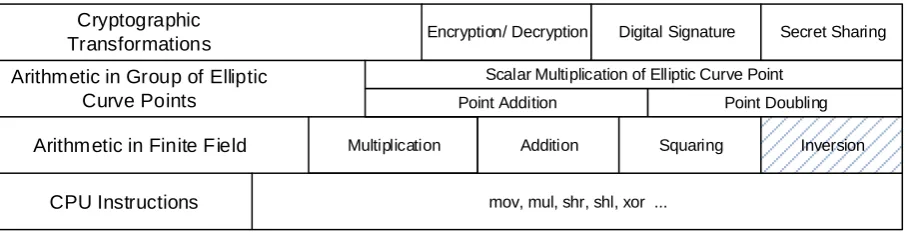
2m are used in EC cryptosystems (ECC) in the international standards IEEE P1363-2000 [1], ISO/IEC 15946-2 [2] and in national standards DSTU 4145-2002 [3], ISO/IEC 15946-2 [2].Encryption/ Decryption Digital Signature Secret Sharing
Cryptographic Transformations
Scalar Multiplication of Elliptic Curve Point
Point Addition Point Doubling
mov, mul, shr, shl, xor ...
Addition Squaring Inversion
Arithmetic in Group of Elliptic Curve Points
Arithmetic in Finite Field
CPU Instructions
Multiplication
Fig. 1. Hierarchy of operations in ECC
It is known [6-11] that the performance of symmetric cryptosystems substantially exceeds public key cryptosystems' performance, which makes it actual to increase public key cryptosystems' performance research. Among the areas for further improvements, the authors emphasized [6-11]:
Increase performance of group operations (EC points, the divisor in the Jacobian HEC, etc.).
Increase performance of operations over data structures used for group elements representation.
Increase performance of field operations.
Increase performance of operations over data structures used for field elements representation.
Optimization of operations over data structures for modern superscalar CPU [5].
At present, there are many publications in this field [6-11], that examines the algorithms of operations over polynomials, even in the context of libraries' software architecture [6-11]. It can significantly reduce the overhead cost of operations over polynomials implementation in general.
There can be distinguished several operations over GF
2m field elements [4]: addition, multiplication, squaring, multiplicative inversion and exponentiation. Researches show [4, 7] that execution time of inversion operation affects on ECC performance, in general. In order to reduce the inversion operation affect on performance [4] it is proposed to use projective representation of EC points. Similar arguments are applicable for divisors of HEC Jacobian. However, it is not possible to exclude inversion from operation over polynomials in public key cryptosystems implementation.Consequently, authors pay attention on performance increasing of inversion operation in binary
field GF
2m .Description of algorithm-prototype of the Extended Euclidean Algorithm and its modification. Algorithm of multiplicative inversion allows inverse of non-zero field element
mGF
a 2 computing, using Extended Euclidean Algorithm (EEA) for polynomials [4]. The
algorithm [4] based on invariants badf u and caef v for some d and e which are implicitly computed. At each iteration, if deg
u deg
v , then a partial distribution of u via v isperformed by subtracting xjv from u, where j deg
u deg
v . Hence, the degree of u isremained constant or decreased at least by 1, or on average by 2. Adding xjc to b preserves the invariant. The algorithm terminates when deg
u 0. In this case u1 and badf 1; hence
x f aAlgorithm 1. Extended Euclidean Algorithm for multiplicative inverse in GF
2m . Input: aGF(2m), a0.Output: a1mod f(x).
1. b1, c0, ua, v f . 2. While deg
u 0 do2.1. j deg
u deg
v .2.2. if j0 then: uv, bc, j j.
2.3. u uxjv, bbxjc.
3. Return
b .Analysis of Algorithm 1, allows selecting several aspects for further improvement of the EEA:
At the steps 2.2 and 2.3, polynomial uis modified, while polynomial v contains the previous value of the polynomial u. This allows refusing from polynomial v degree computing in step 2.1. As for
vdeg initial calculating at step 2.1, the degree is known as constant deg
v deg
f m.At step 2.1, degree of the polynomial u is calculated. According to general logic of algorithm, the degree of the polynomial u is permanently decreasing, at least by 1. This allows dismissing the
udeg degree computing on each iteration in a general case, and only extends current.
At step 2.3, polynomial v shift and addition with u are performed, but it should be noted, that degree of polynomials v and u is permanently decreasing while step 2 loop execution while the degree of polynomials b and c is growing. This allows to shift and addition not for all elements of field elements' representing array, but for significant only - which are certainly non-zero.
Let’s estimate complexity of Algorithm 1, on average case. Lets polynomial a degree
a kdeg and Hamming weight of polynomial a hweight
a k 2. Then count of loop iterations will be k, and number of truthful statements j0 will be 2k 3. In rest k 3 cases, the shift is not executed. The complexity of Algorithm 1 on average case is:
add shl
swp
avr A k I I I k I
I 1 2 deg 2 2 2 3 2 . (1)
where Ideg - complexity of algorithm for computing degree of polynomial; Iadd - complexity of
algorithm for adding two polynomials, Ishl - complexity of algorithm for shifting to an arbitrary
number of bits (may to exceed the length of machine word); Iswp - complexity of two polynomials
exchange algorithm (further, Iswp will be neglected, because pointers will be used).
In simplified form, formulae (1) can be presented:
add shl
avr A k I I I
I 1 2 deg2 2 (2)
Algorithm for degree computing of an arbitrary polynomial a requires detailed study.
Polynomial basis is used for representation of GF
2m field elements.Element bGF
2m in polynomial basis is represented as binary vector0 1 1 2
2 1
1x b x bx x
b m m
m
m
, that can be represented via array of machine words with binary
length w as w n w w w w n
w n w
n a a a
a 12 1 22 2 1 2 0 , where n
mw is number of machine wordsrequired for polynomial of binary length mrepresentation; bi- binary coefficients,
w j
a - computer
words of binary length w.
The main idea of algorithm for polynomial degree computing is to find the index of the most
significant array element a jw (MSE), and find the index of most significant bit (MSB) in already
found array elements a jw . Search of MSE element a jw is sequential search in array starting at the
end, as long as desired is found. There are many well-known algorithms [12] to determine the index of MSB in array element (machine word) that require sequential search.
In order to increase performance computing MSB in machine word, authors proposed to use a variety of well-known "tricks" [12], based on bit operations over machine words. Developments proposed by authors are presented in Algorithm 2.
Carry it out a more detailed consideration. At step 2, MSE (containing at least one non-zero bit) is searched in cycle. Search is performed from the end of array (highest machine word) to its beginning.
At step 3, MSE and its index are fixed. Element index will be used in further polynomial degree calculation.
Algorithm 2. Algorithm for polynomial degree calculation in GF
2m .Input: aGF
2m ; n
mw , where n- number of machine words, that occupies a polynomial; w-width of machine word, usually w32.
Output: deg
a .1. in1.
2. While
ai 32 0
&&
i0
2.1. ii1.
3. 32
i
a t .
4. t t|
t 1
, tt|
t 2
, tt|
t 4
, tt|
t 8
, t t|
t 16
.5. tt
t1
&0x55555555
, t
t&0x33333333
t2
&0x33333333
,
4 &0xf0f0f0f 0x1010101
24 t t
t .
At step 4, "trick" [12] are applied for creating a "mask", which allows filling all on-bits least significant bits from the most significant. Hereafter, counting a number of on-bits in a machine word is required, to determine the index of MSB.
In step 5, it is applied "trick" [12], for counting of all on-bits in machine word. Given number is greater than MSB on 1.
Polynomial degree is calculated at step 6, where the total number of bits in each machine word, index of MSE and index of MSB in MSE are taken into account.
Previously described results of Algorithm 1 analysis allows to make following modifications:
At each iteration of loop in step 2, polynomial v is constant, or it can be swapped with u, so it is not necessary to calculate polynomial v degree for each loop iteration: degree of polynomial v is either constant or equals polynomial u degree. Thus, it could be saved one operation of computing polynomial degree, at each iteration in step 2 loop. Number of loop
iterations at step 2 is comparable to degree of polynomial aGF
2m , which should be inverted. At step 2.1, polynomial udegree is computed. At step 2.3, its degree is decreased at least by 1. It means that it is not necessary to compute polynomial degree at each loop iteration, but only adjust: polynomial u degree reduces at least by 1. That makes it possible to use "the next fit" approach to fix the position of current array element. This approach allows to start search not from the ending array element, but from array element found at previous loop iteration. The number of checks while searching MSE, at step 2 cycle is decreased in 2 times.
At step 2.3, polynomial v shift and polynomial uaddition operations are performed. Degree of v and udecreases continuously throughout the step 2 loop, and degree of polynomials b and c is growing. Here it could be used "next fit" approach, to operate only with the significant elements of array. This allows shifting and adding not all elements of array, which represents field elements, but only significant. Note, number of additions and shifts of array elements at step 2 loop decreased almost in 2 times.
Applies results of analysis conducted by authors, In Algorithm 1, and algorithm itself to compute the degree of polynomial Algorithm 2, Modified EEA (MEEA) Algorithm for
multiplicative inversion in the field GF
2m was proposed. It is presented as Algorithm 3.Algorithm 3. Modified Extended Euclidean Algorithm for multiplicative inverse in GF
2m . Input: aGF(2m), a0, w m
n , where n is number of machine words that occupies a
polynomial; w is width of machine word, usually w32.
Output: a1mod f
x .1. b1, c0, ua,v f . 2. in1.
3. While
ui 32 0
&&
i0
4. 32
i
u t .
5. t t|
t 1
, tt|
t 2
, tt|
t 4
, tt|
t 8
, tt|
t 16
.6. t t
t 1
&0x55555555
, t
t&0x33333333
t 2
&0x33333333
,
4 &0xf0f0f0f 0x1010101
24 t t
t .
7. degU
i5
t1
.8. degV m.
9. While
degU 0
do9.1. if
degU degV
then kdegVdegU, uv. bc. 9.2. else k degUdegV.9.3. if
k0
then uuxkv, bbxkc. 9.4. else uuv, bbc.9.5. if
degU degV
then degV degU.9.6. While
ui 32 0
&&
i0
9.6.1. ii1.
9.7. 32
i
u t .
9.8. t t|
t 1
, t t|
t2
, t t|
t4
, tt|
t 8
, t t|
t 16
.9.9. t t
t 1
&0x55555555
, t
t&0x33333333
t2
&0x33333333
,
4 &0xf0f0f0f 0x1010101
24 t t
t .
9.10. degU
i5
t1
.10. Return
b .At step 1, initialization of polynomials b, c, u and v, that will be modified during algorithm
work, is performed. Then at step 2, an array MSE ui 32 index i of ending, non-zero of polynomial u machine word is determined. An index i search starts from MSE.
Desired array element ui 32 uses at steps 4-6 for calculation of MSB index t in word ui 32 , and
at step 7, for polynomial u degree calculation. The initial degree of polynomial v is already known and equals m. The "trick" [12] is used for MSB selecting. All LSB sets to 1. For on-bits counting in word another "trick" [12] is used.
The loop at step 9 is basal for whole algorithm and it is performed while polynomial u degree not equals 0. The average count of iterations is deg
a k. At step 9.1 of loop, it degree degU andV
deg checks of the polynomials u and v, respectively are performed. In case
degU degV
, it is necessary to swap contents of polynomials u, v and b, c respectively. At the average, number of events
degU degV
is k 3. The diminution
degUdegV
is used for polynomials v and celements that contain bits that are lower then deg
b and deg
v . The polynomial b degree isincreasing, the degree of u is decreasing, where deg
b deg
u m.Polynomial v degree calculation is performed at step 9.5, and degree of v changes if condition
degU degV
of exchange u and v polynomials is true. Next, at steps 9.6 and 9.7 MSE ui 32 index i of u is determined. Desired array element ui 32 is used on steps 9.8-9.9 for calculation ofMSB index t in word ui 32 and at step 9.10 while the degree degU of polynomial u calculation.
Upon completion of loop, the algorithm returns polynomial ba1mod f
x .Lets estimate complexity of Algorithm 3, on average. Lets degree deg
a k of polynomial a and Hamming weight hweight
a k 2. Then count of loop iterations will be k, and number of truth statements j0 will be 2k 3. Complexity of Algorithm 3, on average case is:
add shl
swp
avr A k I I I k I
I 21 2 2 2 3 2
deg
3 , (3)
Further, complexity Iswp can be neglected. In simplified form, formulae (3) can be presented:
add shl
avr A k I I I
I 3 deg . (4)
Software implementation notes. It is necessary to implement in software well-known EEA and proposed MEEA for confirmation of theoretical estimations of MEEA efficiency in comparison with
well-known algorithms. Software implementations of MEEA and well-known EEA should be tested on polynomials of different length [13] and average time estimations (timings) should be compared.
In software implementation, authors use polynomial presentation of GF
2m elements. Polynomial represents as array of fixed length for given m.While writing program, tailored the superscalar architecture of 32-bit CPU and the possibilities of modern compilers on branch prediction, parallel commands execution, loop unrolling, etc., in accordance with [5].
Software implementation was performed on high-level language C++ in Microsoft Visual Studio, in Release configuration with a compiler Microsoft Visual C++ 2010 (/O3, with SSE2 support) and Intel C++ Compiler XE2013 (/O3, with SSE4.2 support) on 32-bit platforms. For convenience, acronym of MCC and ICC, will be used respectively.
Comparison of well-known and proposed algorithms. In accordance of convenience mentioned in previous section, authors in software implemented both Algorithms 1 and 3 for estimation efficiency of proposed approaches for modification of multiplicative inversion algorithm
in GF
2m field. In software implementation averaged on runtime of 1 million inversion operations, and timings presented in Table 1. Experiments have taken into account that the degree of inverted polynomial, can affect on number of main loop iterations, so polynomials of degree near to maximum were used for fields that are used in cryptosystems DSTU 4145-2002 [3] and FIPS-186- 3 [13].Software implementations timing of inversion operation for different fields are presented in Table 1.
Timing for software implementations of inversion operation for different algorithms Table 1
m
Time, us
Intel Core i3-350M Intel Core i5-3570 Intel Core i5-4670 ICC XE2013 MCC2010 ICC XE2013 MCC2010 ICC XE2013 MCC2010
Inv Inv* Inv Inv* Inv Inv* Inv Inv* Inv Inv* Inv Inv* 89 6,71 5,44 6,27 5,10 2,53 1,95 2,76 1,84 2,53 1,95 2,37 1,84 163 16,08 11,34 14,38 11,96 6,85 4,05 6,33 4,65 6,85 3,95 6,13 4,05 191 18,17 14,52 17,38 14,71 7,73 5,46 7,85 5,48 7,73 5,26 7,65 5,48 233 27,13 22,12 24,57 19,39 11,80 7,04 11,59 7,65 11,80 7,02 11,02 6,90 257 31,56 25,18 27,93 24,54 13,21 7,99 13,33 8,56 12,17 7,81 12,33 7,60 307 37,72 30,45 34,24 26,11 17,98 11,11 17,64 12,41 17,68 9,58 17,54 11,41 367 53,18 42,17 46,05 33,81 23,35 14,78 21,84 16,63 22,35 13,18 21,64 14,63 409 61,31 40,18 54,48 47,76 26,41 16,97 26,81 18,51 25,97 14,93 26,41 17,51 431 67,75 54,24 59,10 44,03 28,99 17,86 29,29 19,25 28,27 17,00 28,99 18,25 571 103,44 64,86 94,42 70,26 46,46 25,47 44,87 26,98 43,39 24,64 44,67 26,83 * - modified algorithm with proposed optimization approaches.
Experimental results show that the degree of polynomial does not affect on time using EEA, while MEEA shows a linear decrease of time with degree decreasing. Experimental results for the
field elements GF
2m with less work degrees are given.CPU Intel Core i3-350M, MEEA shows gain in 18-21% (ICC) and 16-18% (MCC). At the same time, implementation of MCC is better on 2.2% then ICC. CPU Intel Core i5-3570, MEEA shows gain in 19-22% (ICC) and 17-22% (MCC). At the same time, implementation of ICC is better on 4.9% than MCC. CPU Intel Core i5-4670, implementation of MEEA shows gain in 18-25% (ICC) and 14-22% (MCC). At the same time, implementation of ICC is better on 14.7% than MCC.
The resulting timings are fully consistent with theoretical estimations of computational complexity in (2) and (4). Software implementation of proposed MEEA shows better performance by 20-50% (for mobile CPU Intel Core i3-350M with a lower clock frequency and desktop CPU Intel Pentium 4 530J with a twice-lower clock speed) than in [7], for corresponding fields.
MEEA software appliance for digital signature generation and verification in accordance with DSTU 4145-2002 [3] (with "left-to-right" scalar multiplication algorithm) [4]:
in affine points representation this has made it possible to increase performance by 16-20%, with field size rising;
in Lopez-Dahab projective points representation [4] this has made it possible to increase performance by 2-4%, with field size rising.
These comparisons are applicable to results obtained with the Intel C++ Compiler XE2013 and Visual C++ 2010 for architecture x86.
Conclusion. On given results of research, there are following conclusions:
1. Optimization techniques proposed of authors for multiplicative inversion algorithm in
m2
2. MEEA software implementation has higher performance by 15-20% than algorithm-prototype, on average.
3. Applying of modified inversion algorithm for digital signature generation and verification based on DSTU 4145-2002, has increased performance by 16-20% in affine point representation and by 2-4% in Lopez-Dahab projective representation, respectively.
4. Proposed implementation of MEEA inversion algorithm have not adjusted for multi-threaded execution. It does not allow realizing full potential of modern multicore CPU.
5. Modern CPU developments is focused on increasing of number of commands execution threads. This requires development of valuable algorithms for efficient software implementation on perspective CPU. At this rate, NVIDIA company already offers GPU with more than 512 cores, and user-friendly framework CUDA [14-18] for creation multithreading applications. Further direction of
researches will be focused on study and effective parallelizing of arithmetic algorithms in GF
2mfield.
Literature
1. IEEE Std 1363-2000: Standard Specifications For Public Key Cryptography. Institute of Electrical and Electronics Engineers, 2000. –228 p. UR: http://grouper.ieee.org/groups/1363/.
2. ISO/IEC 15946-2:2002. Information technology - Security techniques - Cryptographic techniques based on elliptic curves -Part 2: Digital signatures. –36 p.
3. DSTU 4145-2002, Information Technologies. Cryptographic Information Protection. Digital Signature based on Elliptic Curves. Creation and Verification, Dec. 28, 2002, Derzhspozhivstandart Ukrainy, Kyiv (2003) . –39 p.
4. D. Hankerson, J. Hernandez, A. Menezes. Software implementation of Elliptic Curve Cryptography over binary fields. Proceedings of Workshop on Cryptographic Hardware and Embedded System. –LNCS 1965. –2000. –pp. 1-24.
5. Intel® 64 and IA-32 Architectures Optimization Reference Manual. Order Number: 248966-025. –660 p. URL: http://www.intel.com/content/www/us/en/architecture-and-technology/64-ia-32-architectures-optimization-manual.html
6. Giorgi P. Izard T, Tisserand A. Comparison of Modular Arithmetic Algorithms on GPUs // ParCo'09: International Conference on Parallel Computing, France. –2009. –8 p. URL: http://hal-lirmm.ccsd.cnrs.fr/lirmm-00424288/fr/
7. Zhijie Jerry Shi and Hai Yan. Software Implementations of Elliptic Curve Cryptography // International Journal of Network Security. –Vol.7. –No.2. –2008. –pp. 57–166.
8. TinyECC: A Configurable Library for Elliptic Curve Cryptography in Wireless Sensor Networks. URL: http://discovery.csc.ncsu.edu/software/TinyECC/
9. Galois Field Arithmetic Library. URL: http://www.partow.net/projects/galois/
10. MPFQ: Fast Finite Fields Library. URL: http://mpfq.gforge.inria.fr/
11. LibTom Projects: LibTomPoly. URL: http://libtom.org
12. Sean Eron Anderson. Bit Twiddling Hacks. URL:
http://graphics.stanford.edu/~seander/bithacks.html
14. NVIDIA. NVIDIA CUDA Programming Guide 5.0. –2013. –214 p. URL: http://docs.nvidia.com/cuda/cuda-c-programming-guide/
15. M. Bluhm, S. Gueron. Fast Software Implementation of Binary Elliptic Curve Cryptography // Cryptology ePrint Archive. –Report 2013/741. –2013. –19 p. URL: http://eprint.iacr.org/2013/741.pdf
16. E. M. Mahé, J.-M. Chauvet. Fast GPGPU-Based Elliptic Curve Scalar Multiplication // Cryptology ePrint Archive. –Report 2014/198. –2014. –9 p. URL: http://eprint.iacr.org/2014/198.pdf
17. Aaron E. Cohen, Keshab K. Parhi. GPU accelerated elliptic curve cryptography in GF(2m) // 53rd IEEE International Midwest Symposium on Circuits and Systems (MWSCAS), 2010. –pp. 57–60.