Concurrent Zero Knowledge in the Bounded Player Model
VIPULGOYAL
Microsoft Research India
ABHISHEK JAIN
UCLA USA
RAFAILOSTROVSKY
UCLA USA
SILASRICHELSON
UCLA USA
IVANVISCONTI
University of Salerno ITALY
Abstract
In this paper we put forward theBounded Player Modelfor secure computation. In this new model, the number of players that will ever be involved in secure computations is bounded, but the number of computations has no a priori bound. Indeed, while the number of devices and people on this planet can be realistically estimated and bounded, the number of computations these devices will run can not be realistically bounded. We stress that in theBounded Player model, in addition to no a priori bound on the number of sessions, there is no synchronization barrier, no trusted party, and simulation must be performed in polynomial time.
In this setting, we achieve concurrent Zero Knowledge (cZK) withsub-logarithmicround complexity. Our security proof is (necessarily) non-black-box, our simulator is “straight-line” and works as long as the number of rounds isω(1).
1
Introduction
Zero-knowledge proofs, introduced in the seminal work of Goldwasser, Micali and Rackoff [GMR85], are a funda-mental building block in cryptography. Loosely speaking, a zero-knowledge proof is an interactive proof between two parties — a prover and a verifier — with the seemingly magical property that the verifier does not learn any-thing beyond the validity of the statement being proved. Subsequent to their introduction, zero-knowledge proofs have been the subject of a great deal of research (see, for example, [BSMP91, DDN91, Ost91, OW93, DNS98, CGGM00, Bar01, IKOS09]), and have found numerous applications in cryptography (e.g., [GMW87, FFS88]).
Concurrent zero knowledge. The original definition of zero knowledge is only relevant to the “stand-alone” setting where security holds only if the protocol runs in isolation. As such, unfortunately, it does not suffice if one wishes to run a zero-knowledge proof over a modern network environment, such as the Internet. Towards that end, Dwork, Naor and Sahai [DNS98] initiated the study ofconcurrent zero-knowledge(cZK) proofs that remain secure even if several instances of the protocol are executed concurrently under the control of an adversarial verifier. Subsequent to their work, cZK has been the subject of extensive research, with a large body of work devoted to studying its round-complexity. In the standard model, the round-complexity of cZK was improved from polynomial to slightly super-logarithmic in a sequence of works [RK99, KP01, PRS02]. In particular, the
˜
O(logk)-round construction of [PRS02] nearly matches the lower bound ofΩ(log˜ k)w.r.t. black-box simulation [CKPR01] (see also [KPR98, Ros00]).
Despite a decade of research, theO˜(logk)-round construction of [PRS02] is still the most round-efficient cZK protocol known. Indeed, the lower bound of [CKPR01] suggests that a breakthrough in non-black-box simulation techniques is required to achieve cZK with sub-logarithmic round complexity.1
Round-efficient cZK in relaxed models. While the round-complexity of cZK in the standard model still remains an intriguing open question, a long line of work has been dedicated towards constructing round-efficient cZK in various relaxations of the standard model. Notable mentions include the bounded-concurrency model [Bar01], the bare public key model [CGGM00], the super-polynomial time simulation (SPS) model [Pas03], timing model [DNS98], and, various setup models (such as common reference string [BSMP91], etc.). Below, we briefly discuss the state of the art on some of these models.
BOUNDEDCONCURRENCYMODEL. An interesting relaxation of the standard model (and related to our setting) that has been previously studied is the bounded-concurrency model [Bar01], where an apriori bound is assumed over the number of sessions that will ever take place (in particular, this bound is known to the protocol designer). It is known how to realize constant-round bounded cZK [Bar01], and also constant-round bounded-concurrent secure two-party and multi-party computation [Lin03a, PR03, Pas04].
Even though our model can be seen as related to (and a generalization of) the bounded concurrency model, the techniques used in designing round efficient bounded concurrent zero-knowledge do not seem to carry over to our setting. In particular, if there is even a single player that runs an unbounded number of sessions, the simulation strategies in [Bar01, Lin03a, PR03, Pas04] breakdown completely. This seems inherent because of the crucial difference this model has from our setting (which can understood by observing that general concurrent secure computation is possible in the bounded concurrent setting but impossible in our setting).
BARE PUBLIC KEY AND OTHER PREPROCESSING MODELS. The zero-knowledge pre-processing model was proposed in [KMO89] in the stand-alone setting and in [CO99] in the context of cZK. In [CO99], interaction is needed between all the involved players in a preprocessing phase. Then, after a synchronization-barrier is passed, the preprocessing is over and actual proofs start. Interactions in each phase can take place concurrently, but the two
1In this paper we only consider results based on standard complexity-theoretic and number-theoretic assumptions; in particular, we not
phases can not overlap in time. An improved model was later proposed in [CGGM00] where the preprocessing is required to be non-interactive, and the model is called “Bare Public-Key” (BPK) model, since the non-interactive messages played in the preprocessing can be considered as public announcements of public keys. In this model it is known how to obtain constant-round concurrent zero knowledge under standard assumptions [SV12].
The crucial restriction of the BPK model is that all players who wish to ever participate in protocol executions must be fixed during the preprocessing phase, and new players cannot be added “on-the-fly” during the proof phase. We donotmake such a restriction in our work and as such, the techniques useful in constructing secure protocols in the BPK model have limited relevance in our setting. In particular, constant round concurrent ZK is known to exist in the BPK model using only black-box simulation, while in our setting, non-black-box techniques arenecessaryto construct a sublogarithmic round concurrent ZK protocol.
OTHER MODELS. Round efficient concurrent zero-knowledge is known in a number of other models as well (which do not seem to be directly relevant to our setting). In the SPS model [Pas03], the zero-knowledge simulator is allowed to run in super-polynomial time, as opposed to running in polynomial time (as per the standard definition of [GMR85]). Indeed, this relaxation has yielded not only constant-round cZK [Pas03], but also secure computation [LPV09, CLP10, GGJS12]. This stands in contrast to the standard model, where concurrent-secure computation is known to be impossible to achieve [Lin04, Lin03b, CKL03, CF01]. Similarly, in the timing model [DNS98], where an upper-bound is assumed on the delivery time needed of a message (and therefore the adversary is assumed to have only limited control of the communication network), constant-round cZK is known [DNS98, Gol02, PTV10], as well as is multi-party computation secure w.r.t. general concurrent composition [KLP05]. Finally, note that similar results hold in popular models such as the common reference string [BSMP91, SCO+01, CLOS02], key registration [BCNP04], etc.
Our Question. While the above relaxations of the standard model discussed above have their individual appeal, each of these models suffers from various drawbacks, either w.r.t. the security guarantees provided (e.g., as in the case of the SPS model), or w.r.t. the actual degree of concurrency tolerated (e.g., as in the case of the timing model). Indeed, despite the extensive amount of research over the last decade, the round-complexity of cZK still remains open. In this work, we ask the question whether it is possible to construct cZK protocols with sub-logarithmic round-complexity in a natural model that does not suffer from the drawbacks of the previously studied models; namely, it does not require any preprocessing, assumes no trusted party or timing assumptions or an a priori bound on the number of protocol sessions, and requires standard polynomial-time simulation and standard complexity assumptions.
1.1 Our Results
In our work, we construct a concurrent (perfect) zero-knowledge argument system with sub-logarithmic round-complexity in a mild relaxation of the standard model; we refer to this as the Bounded Player model. In this model we only assume that there is an a priori (polynomial) upper-bound on the total number of players that may ever participate in protocol executions. We do not assume any synchronization barrier, or trusted party, and the simulation must be performed in polynomial time. In particular, we do not assume any a priori bound on the number of sessions, and achieve security under unbounded concurrency. As such, our model can be viewed as a strengthening of the bounded-concurrency model.2 Below, we give an informal statement of our main result. Theorem 1 Assuming dense crypto systems and claw-free permutations, there exists anω(1)-round concurrent perfect zero-knowledge argument system with concurrent soundness in the Bounded Player model.3
2
Note that an upper-bound on the total number of concurrent executions implies an upper-bound on the total number of players as well.
3
Our security proof is (necessarily) non-black-box (see below), and the simulator of our protocol works in a “straight-line” manner. Our result is actually stronger since we only require a bound on the number of possible ver-ifiers, while there is no restriction on the number of provers. We prove concurrent soundness since sequential and concurrent soundness are distinct notions in the Bounded Player model for the same reasons as shown by [MR01] in the context of the BPK model.
We stress that while our model bears some resemblance to the BPK model, known techniques from the BPK model are not applicable to our setting. Indeed, these techniques crucially rely upon the presence of the synchro-nization barrier between the pre-processing phase and the protocol phase, while such a barrier is not present in our model. As such, achieving full concurrency in our model is much harder and involves significantly different challenges.
We further show that the impossibility results of Lindell for concurrent-secure computation [Lin04] also hold in the Bounded Player model. This gives evidence that the Bounded Player model is much closer to the stan-dard model than the previously studied models, and the study of this model might shed light towards the goal of constructing round efficient concurrent zero-knowledge in the standard model as well.
1.2 Our Techniques
Recall that in the Bounded Player model, the only assumption is that the total number of players that will ever be present in the system is a priori bounded. Then, an initial observation towards our goal of constructing sub-logarithmic round cZK protocols is that the black-box lower-bound of Canetti et al. [CKPR01] is applicable to our setting as well. Indeed, the impossibility result of [CKPR01] relies on an adversarial verifier that opens a polynomial number `(k) of sessions and plays adaptively at any point of time, depending upon the transcript generated “so far”. The same analysis works in the Bounded Player model, by assuming that the adversarial verifier registers a new key each time a new session is played. In particular, consider an adversarial verifier that schedules a sessionsi to be contained inside another sessionsj. In this case, a black-box simulator does not gain
any advantage in the Bounded Player model over the standard model. The reason is that since the adversarial verifier of [CKPR01] behaves adaptively on the transcript at any point, after a rewind the same session will be played with a fresh new key, thus rendering essentially useless the fact that the session was already solved before. Note that this is the same problem that occurs in the standard model, and stands in contrast to what happens in the BPK model (where identities are fixed in the preprocessing and therefore do not change over rewinds).
From the above observation, it is clear that we must resort to non-black-box techniques. Now, a natural approach to leverage the bound on the number of players is to associate with each verifierVi a public keypkiand
then design an FLS-style protocol [FLS90] that allows the ZK simulator to extract, in a non-black-box manner, the secret keyskiof the verifier and then use it as a “trapdoor” for “easy” simulation. The key intuition is that once the
simulator extracts the secret keyski of a verifierVi, it can perform easy simulation ofallthe sessions associated
with Vi. Then, since the total number of verifiers is bounded, the simulator will need to perform non-black-box
extraction only an a priori bounded number of times (once for each verifier), which can be handled in a manner similar to the setting of bounded-concurrency [Bar01].
Unfortunately, the above intuition is misleading. In order to understand the problem with the above approach, let us first consider a candidate protocol more concretely. In fact, it suffices to focus on a preamble phase that enables non-black-box extraction (by the simulator) of a verifier’s secret key since the remainder of the protocol can be constructed in a straightforward manner following the FLS approach. Now, consider the following candidate preamble phase (using the non-black-box extraction technique of [BL02]): first, the prover and verifier engage in a coin-tossing protocol where the prover proves “honest behavior” using a Barak-style non-black-box ZK protocol [Bar01]. Then, the verifier sends an encryption of its secret key under the public key that is determined from the output of the coin-tossing protocol.
In order to analyze this protocol, we will restrict our discussion to the simplified case where only one verifier is present in the system (but the total number of concurrent sessions are unbounded). At this point, one may immediately object that in the case of a single verifier identity, the problem is not interesting since the Bounded Player model is identical to the bare-public key model, where one can construct four-round cZK protocols using rewinding based techniques. However, simulation techniques involving rewinding do not “scale” well to the case of polynomially many identities (unless we use a large number of rounds) and fail4. Moreover the use of Barak’s [Bar01] straight-line simulation technique is also insufficient since it works only when the number of concurrent sessions is bounded (even when there is a single identity), but instead our goal is to obtain unbounded concurrent zero knowledge. In contrast, our simulation approach is “straight-line” for an unbounded number of sessions and scales well to a large bounded number of identities. Therefore, in the forthcoming discussion, we will restrict our analysis to straight-line simulation. In this case, we find it instructive to focus on the case of a single identity to explain our key ideas.
We now turn to analyze the candidate protocol. Now, following the intuition described earlier, one may think that the simulator can simply cheat in the coin-tossing protocol in the “inner-most” session in order to extract the secret key, following which all the sessions can be simulated in a straight-line manner, without performing any additional non-black-box simulation. Consider, however, the following adversarial verifier strategy: the verifier schedules an unbounded number of sessions in such a manner that the coin-tossing protocols in all of these ses-sions are executed in a “nested” manner. Furthermore, the verifier sends the ciphertext (containing its secret key) in each session only after all the coin-tossing protocols across all sessions are completed. Note that in such a scenario, the simulator would be forced to perform non-black-box simulation in an unbounded number of sessions. Unfortunately, this is a non-trivial problem that we do not know how to solve. More concretely, note that we cannot rely on techniques from the bounded-concurrency model since we cannot bound the total number of sessions (and thus, the total number of messages across all sessions). Further, all other natural approaches lead to a “blow-up” in the running time of the simulator. Indeed, if we were to solve this problem, then we would essentially construct a cZK protocol in the standard model, which remains an important open problem that we do not solve here.
In an effort to bypass the above problem, our first idea is to use multiple (ω(1), to be precise) preamble phases (instead of only one), such that the simulator is required to “cheat” in only one of these preambles. This, however, immediately raises a question: in which of the ω(1) preambles should the simulator cheat? This is a delicate question since if, for example, we let the simulator pick one of preambles uniformly at random, then with non-negligible probability, the simulator will end up choosing the first preamble phase. In this case, the adversary can simply perform the same attack as it did earlier playing only the first preamble phase, but for many different sessions so that the simulator will still have to cheat in many of them. Indeed, it would seem that any randomized oblivious simulation strategy can be attacked in a similar manner by simply identifying the first preamble phase where the simulator would cheat with a non-negligible probability.
Towards that end, our key idea is to use a specific probability distribution such that the simulator cheats in the first preamble phase with only negligible probability, while the probability of cheating in the later preambles increases gradually such that the “overall” probability of cheating is 1 (as required). Further, the distribution is such that the probability of cheating in theithpreamble is less than a fixed polynomial factor of the total probability of cheating in one of the previousi−1blocks. Very roughly speaking, this allows us to prevent the adversary from attacking the first preamble where the simulator cheats with non-negligible probability. More specifically, for any session, let us call the preamble where the simulator cheats the “special” preamble. Further, let us say that the adversary “wins” a session if he “stops” that session in the special preamblebeforesending the ciphertext containing the verifier’s secret key. Otherwise, the adversary “loses” that session. Then, by using the properties of our probability distribution, we are able to show that the adversary’s probability of losing a session is less than 1/ntimes the probability of winning. As a consequence, by careful choice of parameters, we are able to show
4Indeed when the simulator rewinds the adversarial verifier, there is a different view and therefore the adversary will ask to play with
that the probability of the adversary winning more than a given polynomially bounded number of sessionswithout losing any sessionsw.r.t. any given verifier is negligible. Once we obtain this fixed bound, we are then able to rely on techniques from the bounded-concurrency model [Bar01] to handle the bounded number of non-black-box simulations. For the sake of brevity, the above discussion is somewhat oversimplified. We refer the reader to the later sections for more details.
Extension to concurrent-secure computation - an impossibility. Once we have a cZK protocol (as discussed above) in the Bounded Player model, it may seem that it should be possible to obtain concurrent-secure compu-tation as well by using techniques from [Pas04]. Unfortunately, this turns out not to be the case, as we discuss below.
The key technical problem that arises in the setting of secure computation w.r.t. unbounded concurrency is the following. We cannot a priori bound the total number of “output delivery messages” (across all sessions) to the adversary; further, the session outputs cannot be “predicted” by the simulator before knowing the adversary’s input. As such, known non-black-box simulation techniques cannot handle these unbounded number of messages and they inherently fail.5 We remark that the same technical issue, in fact, arises in the standard model as well.
While the above argument only explains why known techniques fail, we can also obtain a formal impossibility result. Indeed, it is not difficult to see that the impossibility result of Lindell [Lin04] also holds for the Bounded Player model. (See Appendix C for details.)
2
Preliminaries and Definitions
2.1 Bounded Player Model
In this paper, we consider a new model of concurrent security, namely, thebounded player model, where we assume that there is an a-priori (polynomial) upper bound on the total number of player that will ever be present in the system. Specifically, letndenote the security parameter. Then, we will consider an upper boundN =poly(n)on the total number of players that can engage in concurrent executions of a protocol at any time. We assume that each playerPi(i∈N) has an associated unique identityidi, and that there is an established mechanism to enforce that
partyPiuses the same identityidi in each protocol execution that it participates in. We stress that such identities,
do not have to be established in advance. New players can join the system with their own (new) identities, as long as the number of players does not exceedN.
We note that this requirement is somewhat similar in spirit to thebounded-concurrency model[Bar01, Lin03a, PR03, Pas04], where it is assumed that the adversary cannot start more than an a-priori fixed number of concurrent executions of a protocol. We stress, however, that in our model, there isnoa-priori bound on the total number of protocol sessions that may be executed concurrently. In this respect, one can view the Bounded Player model as a strengthening of the bounded-concurrency model.6 Indeed, one can argue that while the number of devices and people on this planet can be realistically estimated and bounded, the number of concurrent protocol executions on these devices can not.
Implementing the Bounded Player model. We formalize the Bounded Player model by means of a functional-ityFbpN that registers the identities of the player in the system. Specifically, a playerPithat wishes to participate in
protocol executions can, at any time, register an identityidiwith the functionalityFbpN. The registration
functional-ity does not perform any checks on the identities that are registered, except that each partyPi can register at most
one identityidi, and that the total number of identity registrations are bounded byN. In other words,FbpN refuses
5
We note that this problem does not occur in the case of zero knowledge because the adversary does not have any input, and the session outputs are fixed to be1.
to register any new identities onceN number of identities have already been registered. The functionalityFbpN is formally defined in Figure 1.
FunctionalityFbpN
FN
bpinitializes a variablecountto0and proceeds as follows.
• Register commands: Upon receiving a message(register,sid,idi)from some partyPi, the functionality checks
that no pair(Pi,id0i)is already recorded and thatcount< N. If this is the case, it records the pair(Pi,idi)and sets
count=count+ 1. Other wise, it ignores the received message.
• Retrieve commands: Upon receiving a message(retrieve,sid, Pi)from some partyPj or the adversaryA, the
functionality checks if some pair(Pi,idi)is recorded. If this the case, it sends(sid, Pi,idi)toPj(orA). Otherwise,
it returns(sid, Pi,⊥).
Figure 1: The Bounded Player FunctionalityFbpN.
In our constructions we will only require that the identities correspond to values in the range of a one-way function. We note that in this particular case, the functionalityFbpN bears much resemblance to thebulletin-board certificate authorityfunctionality [KL11], which suffices for obtaining authenticated channels [Can04]. We finally remark that our model is also closely related to theBare Public-Key model, introduced by Canetti et al. [CGGM00]. However, we stress that unlike the Bare Public-Key model, we do not assume any synchronization barrier between the registration phase and the protocol computation phase. In particular, we allow parties to register their identities even after the computation begins.
2.2 Concurrent Zero Knowledge in Bounded Player Model
In this section, we formally define concurrent zero knowledge in the Bounded Player model. Our definition, given below, is an adaptation of the one of [PRS02] to the Bounded Player mode, by also considering non-black-box simulation. Some of the text below is taken verbatim from [PRS02].
LetPPTdenote probabilistic-polynomial time. LethP, Vibe an interactive argument for a languageL. Con-sider a concurrent adversarial verifierV∗that, given inputx∈L, interacts with an unbounded number of indepen-dent copies ofP (all on the same common inputxand moreover equipped with a proper witnessw), without any restriction over the scheduling of the messages in the different interactions with P. In particular,V∗ has control over the scheduling of the messages in these interactions. Further, we say thatV∗ is anN-bounded concurrent adversary if it assumes at mostN verifier identities during its (unbounded) interactions withP.7
The transcript of a concurrent interaction consists of the common inputx, followed by the sequence of prover and verifier messages exchanged during the interaction. We denote byviewPV∗(x, z, N) the random variable
de-scribing the content of the random tape of theN-bounded concurrent adversaryV∗with auxiliary inputzand the transcript of the concurrent interaction betweenP andV∗on common inputx.
Definition 1 (cZK in Bounded Player model) LethP, Vibe an interactive argument system for a languageL. We say thathP, Viisconcurrent zero-knowledgein the Bounded Player model if for everyN-bounded concur-rent non-uniformPPTadversaryV∗, there exists aPPTalgorithmS, such that the following ensembles are compu-tationally indistinguishable,{viewPV∗(x, z, N)}x∈L,z∈{0,1}∗,N∈poly(n)and{S(x, z, N)}x∈L,z∈{0,1}∗,N∈poly(n).
7
2.3 Building Blocks
In this section, we discuss the main building blocks that we will use in our cZK construction.
Perfectly Hiding Commitment Scheme. In our constructions, we will make use of a perfectly hiding string commitment scheme, denotedCom. For simplicity of exposition, we will make the simplifying assumption that
Com is a non-interactive perfectly hiding commitment scheme (even though such a scheme cannot exist). In reality,Comwould be taken to be a 2-round commitment scheme, which can be based on collections of claw-free permutations [GK96]. Unless stated otherwise, we will simply use the notationCom(x)to denote a commitment to a stringx, and assume that the randomness (used to create the commitment) is implicit.
Perfect Witness Indistinguishable Argument of Knowledge. We will also make use of a perfect witness-indistinguishable argument of knowledge system for all ofN P in our construction. Such a scheme can be con-structed, for example, by parallel repetition of the 3-round Blum’s protocol for Graph Hamiltonicity [Blu87] in-stantiated with a perfectly hiding commitment scheme. We will denote such an argument system byhPpWI, VpWIi.
Perfect Witness Indistinguishable Universal Argument. In our construction, we will use a perfect witness-indistinguishable universal argument system, denotedhPpUA, VpUAi. Such an argument system can be constructed
generically from a (computational) witness-indistinguishable universal argument pUA by using techniques of [PR05b, PR05a]. Specifically, in protocol hPpUA, VpUAi, the prover P and verifier V first engage in an
execu-tion of pUA, where instead of sending its messages in the clear, P commits to each message using a perfectly hiding commitment scheme. Finally, P andV engage in an execution of a perfect zero knowledge argument of knowledge whereP proves that the “decommitted” transcript ofpUAis “accepting”. The resulting protocol is still a “weak” argument of knowledge.
Perfect (Bounded-Concurrent) Zero-Knowledge. Our cZK argument crucially uses as a building block, a vari-ant of the bounded cZK argument of Barak [Bar01]. Similarly to [PR05a], we modify the protocol appropriately such that it is perfectbounded cZK. Specifically, instead of a statistically binding commitment scheme, we will use a perfectly hiding commitment scheme. Instead of a computationally witness-indistinguishable universal argu-ment (UARG), we will use a perfect witness indistinguishable UARG, denotedhPpUA, VpUAi. Further, the length parameter`(N)used in the modified protocol is a function ofN, whereN is the bound on the number of verifiers in the system. ProtocolhPpB, VpBiN is described in Figure 3 and can be based on claw-free permutations.
Resettable Witness Indistinguishable Proof System. We will further use aresettablewitness-indistinguishable proof system [CGGM00] for all ofN P. Informally speaking, a proof system is resettable witness indistinguishable if it remains witness indistinguishable even against an adversarial verifier who can reset the prover and receive multiple proofs such that the prover uses thesamerandom tape in each of the interactions. While the focus of this work is not on achieving security against reset attacks, such a proof system turns out to be useful when arguing concurrent soundness of our protocol (where our proof relies on a rewinding based argument). We will denote such a proof system by hPrWI, VrWIi. It follows from [CGGM00] that such a proof system can be based on perfectly
hiding commitments.
Dense Cryptosystems [SP92]. We will use a semantically secure public-key encryption scheme, denoted as (Gen,Enc,Dec) that supports oblivious key generation (i.e., it should be possible to sample a public key without knowing the corresponding secret key). More precisely, there exists a deterministic algorithm OGen
pk ← OGen(1n, σ), wherepkis perfectly indistinguishable from a public key chosen by the normal key gener-ation algorithmGen. For simplicity of exposition, we will assume that theOGenalgorithm simply outputs the input randomnessσas the public key. Such schemes can be based on a variety of number-theoretic assumptions such as DDH [SP92].
3
Concurrent Zero Knowledge in Bounded Player Model
In this section, we describe our concurrent zero-knowledge protocol in the bounded player model.
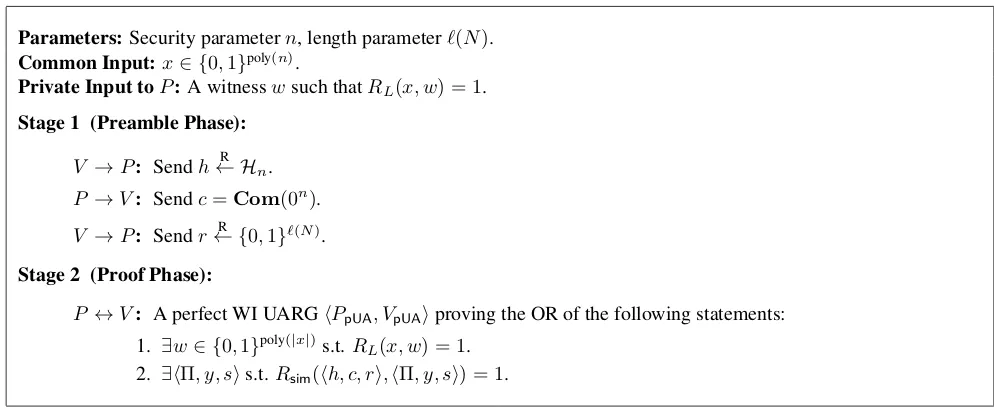
RelationRsim. We first recall a slight variant of Barak’s [Bar01]NTIME(T(n))relationRsim, as used previously
in [PR05a]. LetT :N→ Nbe a “nice” function that satisfiesT(n) =nω(1). Let{Hn}nbe a family of
collision-resistant hash functions where a function h ∈ Hnmaps{0,1}∗ to{0,1}n, and letCom be a perfectly hiding
commitment scheme for strings of lengthn, where for anyα∈ {0,1}n, the length ofCom(α)is upper bounded
by2n. The relationRsimis described in Figure 2.
Instance:A triplethh, c, ri ∈ Hn× {0,1}n× {0,1}poly(n).
Witness:A programΠ∈ {0,1}∗, a stringy∈ {0,1}∗and a strings∈ {0,1}poly(n). Relation:Rsim(hh, c, ri,hΠ, y, si) = 1if and only if:
1. |y| ≤ |r| −n. 2. c=Com(h(Π);s). 3. Π(y) =rwithinT(n)steps.
Figure 2:Rsim- A variant of Barak’s relation [PR05a]
Remark 1 The relation presented in Figure 2 is slightly oversimplified and will make Barak’s protocol work only when {Hn}n is collision-resistant against “slightly” super-polynomial sized circuits. For simplicity of
exposi-tion, in this manuscript, we will work with this assumption. We stress, however, that as discussed in prior works
[BG02, Pas04, PR05b, PR05a], this assumption can be relaxed by using a “good” error-correcting code ECC (with constant distance and polynomial-time encoding and decoding procedures), and replacing the condition c=Com(h(Π);s)withc=Com(ECC(h(Π));s).
3.1 Our Protocol
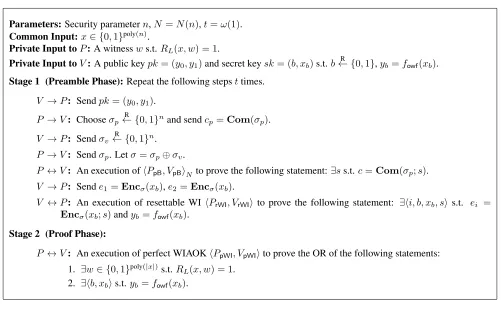
We are now ready to present our concurrent zero knowledge protocol, denoted hP, Vi. Let P and V denote the prover and verifier respectively. Let N denote the bound on the number of verifiers present in the system. Let fowf denote a one-way function, and (Gen,Enc,Dec) denote a dense public key encryption scheme. Let hPpB, VpBiN denote the perfect zero-knowledge argument system as described above. Further, let hPpWI, VpWIi
denote a perfect witness indistinguishable argument of knowledge, and lethPrWI, VrWIidenote a resettable witness indistinguishable proof system.
The protocolhP, Viis described in Figure 4. For our purposes, we set the length parameter`(N) = n3·N ·
P(n), whereP(n)is a polynomial upper bound on the total length of the prover messages in the protocol plus the length of the secret key of the verifier.
Parameters:Security parametern, length parameter`(N). Common Input:x∈ {0,1}poly(n).
Private Input toP:A witnesswsuch thatRL(x, w) = 1.
Stage 1 (Preamble Phase):
V →P: Sendh← HR n.
P →V: Sendc=Com(0n).
V →P: Sendr← {R 0,1}`(N). Stage 2 (Proof Phase):
P ↔V: A perfect WI UARGhPpUA, VpUAiproving the OR of the following statements: 1. ∃w∈ {0,1}poly(|x|)s.t.R
L(x, w) = 1.
2. ∃hΠ, y, sis.t.Rsim(hh, c, ri,hΠ, y, si) = 1.
Figure 3: ProtocolhPpB, VpBiN
i.e., we show that a computationally-bounded adversarial prover who engages in multiple concurrent executions ofhP, Vi(where the scheduling across the sessions is controlled by the adversary) cannot prove a false statement in any of the executions, except with negligible probability. We note that similarly to the Bare Public-Key model [CGGM00], “stand-alone” soundness does not imply concurrent soundness in our model. Informally speaking, this is because the standard approach of reducing concurrent soundness to stand-alone soundness by “internally” emulating all but one verifier does not work since the verifier’s secret keys are private. Indeed, Micali and Reyzin [MR01] gave concrete counter-examples to show that stand-alone soundness does not imply concurrent soundness in the BPK model. We note that their results immediately extend to our model.
We now turn to prove that protocolhP, Viis concurrent zero-knowledge in the Bounded Player model.
3.2 Proof of Concurrent Zero Knowledge
In this section, we prove that the protocol hP, Vi described in Section 3 is concurrent zero-knowledge in the bounded player model. Towards this end, we will construct a non-black-box (polynomial-time) simulator and then prove that the concurrent adversary’s view output by the simulator is indistinguishable from the real view. We start by giving an overview of the proof and then proceed to give details.
Parameters:Security parametern,N =N(n),t=ω(1). Common Input:x∈ {0,1}poly(n).
Private Input toP:A witnessws.t.RL(x, w) = 1.
Private Input toV:A public keypk= (y0, y1)and secret keysk= (b, xb)s.t.b R
← {0,1},yb=fowf(xb).
Stage 1 (Preamble Phase):Repeat the following stepsttimes.
V →P: Sendpk= (y0, y1).
P →V: Chooseσp R
← {0,1}nand sendc
p=Com(σp).
V →P: Sendσv R
← {0,1}n.
P →V: Sendσp. Letσ=σp⊕σv.
P ↔V: An execution ofhPpB, VpBiN to prove the following statement:∃ss.t.c=Com(σp;s).
V →P: Sende1=Encσ(xb),e2=Encσ(xb).
V ↔P: An execution of resettable WIhPrWI, VrWIi to prove the following statement: ∃hi, b, xb, si s.t. ei =
Encσ(xb;s)andyb=fowf(xb).
Stage 2 (Proof Phase):
P ↔V: An execution of perfect WIAOKhPpWI, VpWIito prove the OR of the following statements: 1. ∃w∈ {0,1}poly(|x|)s.t.R
L(x, w) = 1.
2. ∃hb, xbis.t.yb=fowf(xb).
Figure 4: ProtocolhP, Vi
following strategy: the simulator commits to an “augmented machine” that is able to simulate almost all of the simulator messages by itself; the remaining simulator messages are given as input to this machine. As discussed above, we are able to bound the total number of these messages, and thus by setting the challenge string r to be more than this bound, we ensure that the simulation is correct. More in details, the input passed by the simulator to the machine consists of transcripts of concurrent sessions where again the simulator had to use Barak-style simulation8and the (discovered) secret keys of the verifiers to be used by the machine to carry on the simulation by itself (without performing Barak-style simulation).
The Simulator. We now proceed to describe our simulator. The simulator SIM consists of two main parts, namely,SIMeasyandSIMextract. Loosely speaking,SIMextractis only used to cheat in a “special” preamble block
of a session in order to learn the secret key of a verifier, whileSIMeasyis used for the remainder of the simulation,
which includes following honest prover strategy in preamble blocks and simulating the proof phase of each session using the verifier’s secret key as the trapdoor witness. Specifically,SIMextractcheats in thehPpB, VpBiN protocol
by committing to an augmented verifier machineΠthat contains the code ofSIMeasy, allowing it to simulate all
of the simulator messages except those generated bySIMextract(in different sessions). As we show below, these
messages can be bounded to a fixed value. We now describe the simulator in more detail.
SETUP ANDINPUTS. Our simulatorSIM interacts with an adversaryV∗ = (V1∗, . . . , VN∗)who controls verifiers
V1, . . . , VN. V∗interacts with SIM inmsessions, and controls the scheduling of the messages. We giveSIM
non-black-box access toV∗. Throughout the interaction,SIM keeps track of a tupleβ~= (β1, . . . , βN)
represent-8The reason we pass this transcript as input is that in this way we can avoid the blow up of the running time of the simulator when
ing the secret keysSIM has learned so far. At any point during the interaction eitherβi =ski(more precisely,βi
is one of the coordinates of ski) orβiis the symbol⊥. Initially,SIMsets eachβito⊥, but it updatesβ~throughout
the interaction as it extracts secret keys. Additionally,SIM keeps a counter vector~a= (a1, . . . , aN),
increment-ingai each time it executes a preamble block usingSIMextract againstV∗. We haveSIM halt and output FAIL
if anyai ever surpassesn3. Our technical lemma shows that this happens with negligible probability. Finally, we
haveSIM keep track of a set of tuples
Ψ =
(i, j, k)γ;φγ:γ = 1, . . . , n3N}
where each (i, j, k)γ ∈ [N]×[m]×[t]andφγ is a string. The tuples(i, j, k)γ represent the preamble blocks
played bySIMextract; specifically, (i, j, k) corresponds to the k−th block of the j−th session againstV∗. The
stringφγ is the collection of simulator messages sent in block(i, j, k)γ. This set of tuplesΨ(along withβ) will
be the extra input given to the augmented machine. As we show below, the total size ofΨwill be a priori bounded by a polynomial inn.
Consider the interaction ofSIM with someV∗ impersonatingVi. Each timeV∗ opens a session on behalf of
Vi,SIM chooses a randomk∈ {1, . . . , t}according to a distributionDtwhich we define later. This will be the
only preamble block of the session played bySIMextractprovided thatβi=⊥when the block begins. IfSIM has
already learned the secret key ski, it does not need to callSIMextract. We now describe the parts ofSIMbeginning
withSIMeasy.
THE SUB-SIMULATORSIMEASY. Recall thatSIMeasyis run on inputβandΨ. WhenSIMeasyis called to execute
the next message of a preamble block, it checks if the message is already inΨ. If this is the case,SIMeasy just
plays the message. Otherwise,SIMeasyplays fairly, choosing a randomσpand sendingcp=Com(σp;s)for some
s. Upon receiving σv, it returns σp and completes hPpB, VpBi using sas its witness. Its receipt of encryptions
(e1, e2) and acceptance of hPrWI, VrWIi ends the preamble block. IfSIMeasy does not acceptV∗’s execution of
hPrWI, VrWIiit aborts the interaction, as would an honest prover.
WhenSIMeasyis called to executehPpWI, VpWIithen it checks if the secret key of the verifier is inβ. If yes,
SIMeasycompleteshPpWI, VpWIiusing ski as its witness. Otherwise,βi =⊥andSIMeasyhalts outputting FAIL.
Our technical lemma shows that the latter does not happen, except with negligible probability.
THE SUB-SIMULATOR SIMEXTRACT. WhenSIMextract is called to execute preamble block kof session j with
verifier Vi∗, it receives Ψ, β anda as input. We assume βi =⊥since otherwise, SIM would not have called
SIMextract. Immediately upon being called,SIMextractincrementsaiand adds the tuple (i, j, k);φtoΨ. Initially,
φis the empty string, but each timeSIMextract sends a message, it appends the message to φ. By the end of the
block,φis a complete transcript of the simulator messages in preamble block(i, j, k).
The preamble block begins normally, withSIMextractchoosing a random string and sendingcp, a commitment
to it. Upon receiving σv, however,SIMextract runsGenobtaining key pair(σ, τ)for the encryption scheme and
returns σp = σ ⊕σv. Next, SIMextract enters hPpB, VpBi which it completes using the already extracted secret
key. Formally, whenV∗sendsh, beginninghPpB, VpBi,SIMextract chooses a randomsand sends Com h(Π);s
, whereΠis the next message function ofV∗, augmented with the ability to compute all the intermediate messages sent bySIMeasy. The machineΠtakes inputy = (Ψ, β) and outputs the next verifier message in an interaction
between V∗ and a machineM who plays exactly like SIMeasy with the following exception. For each tuple
(i, j, k);φ
∈ Ψ,M reads its messages of block(i, j, k) from the stringy. In order to simulateSIMeasy in the
subprotocolshPpWI, VpWIi,M also uses the tupleβ~ = (β1, . . . , βN)received as input, where eachβi is the secret
key of thei0-th verifier (if available), and⊥otherwise.
After committing toΠ, and receivingr,SIMextractcompleteshPpUA, VpUAiusing witness(Π,Ψkβ, s)where
Ψandβ might have been updated by other executions ofSIMextract occurring between the timeSIMextract sent
Com h(Π);s
and receivedr. Our counter ensures that|Ψ|is a priori bounded, while|β|is bounded by definition. By construction, Π correctly predicts V∗’s message r, and so(Π,Ψkβ, s) is a valid witness for hPsUA, VsUAi.
ciphertexts usingτ thereby learning secret key ski ofVi∗. If the decrypted value is a valid secret key ski, then it
updatesβby settingβi =ski. Otherwise, it outputs the abort symbol⊥and stops. (It is easy to see that since the
proof systemhPrWI, VrWIiis sound, the probability of simulator outputting⊥at this step is negligible.)
Analysis. There are two situations in which SIM outputs fail: if some counter ai exceedsn3, or ifSIMeasy
enters an execution hPpWI, VpWIi without knowledge of sk. Note that the latter will not happen, as to enter an
execution of hPpWI, VpWIi, all preamble blocks, in particular the one played by SIMextract, must be complete,
ensuring thatSIMextractwill have learned sk. In our main technical lemma, we show that no counter will surpassn3
by proving that afterSIMhas runSIMextractn3times against eachVicontrolled byV∗it has, with overwhelming
probability, learned sk. Before stating the lemma, we introduce some terminology.
Now, focusing on a given verifier, we say thatV∗hasstoppedsessionjin blockkif thek−th preamble block of sessionjhas begun, but the(k+ 1)−th has not. We say thatV∗is playingstrategyk~0= (k0
1, . . . , km0 )if session
j is stopped in blockk0j for all j = 1, . . . , m. As the interaction takes polynomial time, V∗ only gets to play polynomially many strategies over the course of the interaction. Letkj ∈ {1, . . . , t}be the random number chosen
bySIM at the beginning of sessionjas per distributionDt. This gives us a tuple~k= (k1, . . . , km)where thekj
are chosen independently according to the distributionDt(defined below). At any time during the interaction, we
say thatV∗ haswon(resp. lost,tied) sessionjifk0j = kj (resp. kj0 > kj,kj0 < kj). A win forV∗ corresponds
toSIM having run SIMextract, but not yet having learned sk. AsSIM only gets to callSIMextract n3 times, a
win forV∗means thatSIM has used up one of its budget ofn3without any payoff. A loss forV∗corresponds to
SIM runningSIMextract and learning sk, thereby allowingSIM to callSIMeasyin all remaining sessions. A tie
means thatSIM has not yet calledSIMextractin the session, and therefore has not used any of its budget, but has
not learned sk.
Notice that these wins and ties are “temporary” events. Indeed, by the end of each session,V∗will have lost, as he will have completed the preamble block run by SIMextract. However, we choose to use this terminology
to better convey the key intuition of our analysis: forSIM to output FAIL, it must be that at some point during the interaction, for some identity, V∗ has won at leastn3 sessions and has not lost any. We will therefore focus precisely on proving that the probability that a PPT adversary V∗ runs in the experimentmsessions so that the counter for one identity reaches the valuen3is negligible.
For a verifier strategy k~0 and a polynomial m, let P(k~0,m)(W, L) be the probability that in an m−session
interaction between V∗ andSIM thatV∗ wins for some identity exactlyW sessions and loses exactlyL, given thatV∗plays strategyk~0. The probability is overSIM’s choice of~kwithkj ∈ {1, . . . , t}chosen independently
according toDt(defined below) for allj= 1, . . . , m.
THE DISTRIBUTIONDt AND THE MAIN TECHNICAL LEMMA. Define Dtto be the distribution on {1, . . . , t}
such that
pk0 =Probk∈D
t k=k 0
=εnk0,
whereεis such thatP
pk0 = 1. Note thatεis negligible inn.
Lemma 1 (Main Technical Lemma) Letk~0 be a verifier strategy andm=m(n)a polynomial. Then we have
P(k~0,m)(n3,0)
is negligible inn.
The above proves that any verifier strategy has a negligible chance of havingn3wins and no losses. AsV∗plays polynomially many (i.e., N) strategies throughout the course of the interaction, the union bound proves thatV∗
probability as desired. The main idea of the proof is similar to the random tape switching technique of [PRS02] and [MP07].
Proof. We fix a verifier strategyk~0 and a polynomialmand writeP(W, L)instead ofP(k~0,m)(W, L). Letpk0
(resp. qk0) be the probability thatV∗wins (resp. loses) a session given that he stops the session in blockk0. We
chose the distributionDtcarefully to have the following two properties. First, sincep1=εnis negligible, we may assume thatV∗ never stops in the first block of a session. And secondly, fork0 ≥2we have,
qk0 =
k0−1 X
i=1
pk0 =εn
k0−1
n−1 ≥
εnk0
2n = pk0
2n.
It follows that no matter which what block V∗ stops a session in, it will hold that the probability he wins in that session is less then 2ntimes the probability that he looses that session. We will use this upper bound on the probability ofV∗winning a single session to show thatP(n3,0)is negligible.
LetAbe the event,(W, L) = (n3,0),Bbe the eventW+L=n3and¬Bthe eventW +L6=n3. Since,A⊂B, and sinceP(A|¬B) = 0, we have that
P(n3,0) =P(A) =P(A|B)P(B) +P(A|¬B)P(¬B) =P(A|B)P(B)≤P(A|B),
and so it suffices to prove thatP(A|B)is negligible. We continue the proof for the caseW +L =n3 (and thus
m≥n3).
IfW+L=n3thenV∗ties all butn3of the sessions. LetC={C ⊂[m] :|C|=n3}.ThenCis the set of possible positions for the sessions which are not ties. We are looking to boundP (W, L) = (n3,0)
W +L=n3
and so we condition on theC ∈ C. Once a fixedCis chosen, the position of each session which is not a tie is determined. Each such session must either be a win or a loss forV∗. Letpbe the probability that some such session is a win. Since we proved already that the probability thatV∗ wins in a given session is less then2ntimes the probability thatV∗ looses in that session, we have thatp≤2n(1−p). Solving givesp≤ 1− 1
2n+1
. It follows that for any
C ∈ C, the probability that all sessions inCare wins is
1− 1
2n+ 1 n3
≤
1− 1
2n+ 1
2n+1n
≤e−n.
From the viewpoint of random tape switching, we have shown that for every random tape causing every session ofCto be a win, there are exponentially many which cause a different outcome.
We therefore have
P(n3,0) ≤ P (W, L) = (n3,0)W +L=n3
= X
C∈C
P (W, L) = (n3,0) C
P(C)
≤ e−nX
C∈C
P(C) =e−n,
as desired.
Bounding the length parameter `(N). From the above lemma, it follows easily that the total length of the auxiliary inputyto the machineΠcommitted bySIMextract(at any time) is bounded byn3·N·P(n), whereP(n)
We now show through a series of hybrid experiments that the simulator’s output is perfectly indistinguishable from the output of the adversary when interacting with honest provers.
Our hybrid experiments will beHifori= 0, . . . ,6. We writeHi ≈ Hj ifV∗ cannot distinguish between its
interaction withHiandHj.
H0. The experimentH0 is the fair prover. In each preamble block it sendscp = Com(σp;s) for randomσp,
receives σv and returnsσp. It completeshPpB, VpBi usingsas its witness. It receives the encryptions andV∗’s
proof ofhPrWI, VrWIicompleting the preamble block. We provideH0with a witness thatx ∈ Lwhich it uses to completehPpWI, VpWIiat the end of each session.
H1. The experimentH1 plays similarly toH0. However, the execution ofH1 takes exponential time. It begins by computing the verifier secret keys by inverting the one-way functions in exponential time. It will use knowledge of secret key in the protocolshPpWI, VpWIi. The perfect witness indistinguishability ofhPpWI, VpWIiensures that
H1 ≈H0.
H2. The experimentH3 plays similarly toH1. The only difference is that in all the preamble blocks where the simulator would have tried to extract, in its first message ofhPpB, VpBi, we commit to the augmented machineΠ.
As before, the augmented machineΠpredicts the next message ofV∗and is able to simulate all fair messages of
H2. It therefore must take as input only the prover messages of the preamble blocks whereH2does not play fairly. We haveH2 keep track of a set of tuplesΨ = (i, j, k)γ;yγ :γ = 1, . . . , n3N ,where the tuple (i, j, k);y
means that in thek−th preamble block of thej−th session againstVi∗,H2sent messagesy.Πalso receives a tuple
~
β = (β1, . . . , βN)whereβicould correspond to a secret key of thei-th verifier and to⊥otherwise. The simulated
prover will use them inhPpWI, VpWIidifferent than⊥. As the only difference between the output ofH2andH1 is that sometimesH2commits to a different value thanH1does, the perfect hiding of Com ensures thatH2≈H1.
H3. The experimentH3 plays similarly toH2. The only difference is that inhPpB, VpBi, instead of proving the
statement honestly, the simulator ofhPpB, VpBiis run by using in the underlyinghPpUA, VpUAivalues(Π,Ψ, β, s)
whereΠis the augmented machine committed in the chosen execution ofhPpB, VpBi,Ψis the record of all
mes-sages sent in the chosen preamble blocks where it deviates from fair play,β is the vector of known keys, ands
is the witness to be used in the non-chosen execution ofhPpB, VpBi. The reason that|Ψ|can be a priori bounded
by a polynomial innis that by the main technical lemma, we have thatΠneeds messages for at mostn3N cho-sen preamble blocks where H3 deviates from fair play. The perfect witness indistinguishability ofhPpUA, VpUAi
ensures thatH3≈H2.
H4. The experimentH4 plays similarly toH3. However, there is an update in all the preamble blocks where the simulator would have tried to extract by playing a fakeσp. The update consists in runningGentherefore obtaining
key pair(σ, τ)for the encryption scheme, and then in sendingσp = σ⊕σv. By the fact that the public key of
dense secure cryptosystem has the uniform distribution, we have thatH4 ≈H3.
H5. The experimentH5 plays similarly toH4. The only difference is that in all the preamble blocks where the simulator would have tried to extract, and where the adversary plays the resettable witness indistinguishable proof, if the extracted strings (obtained by decrypting the two encryptions) do not give a secret key then the experiment aborts. If the experiment does not abort, then it continues by using the extracted secret key instead of the one obtained by running in exponential time.
H6. This is our simulator. We no longer give it a witness thatx ∈ L, and we no longer allow it to run in exponential time, so it obtains ski only through decryptions. Again, by the main technical lemma, the probability
thatH6 successfully learns each ski before is needed is overwhelming. Our technical lemma shows thatH6 will not output FAIL except with negligible probability. Therefore we have thatH6 ≈H5.
References
[Bar01] Boaz Barak. How to go beyond the black-box simulation barrier. InFOCS, pages 106–115, 2001.
[BCNP04] Boaz Barak, Ran Canetti, Jesper Buus Nielsen, and Rafael Pass. Universally composable protocols with relaxed set-up assumptions. InFOCS, pages 186–195, 2004.
[BG02] Boaz Barak and Oded Goldreich. Universal arguments and their applications. InIEEE Conference on Computational Complexity, pages 194–203, 2002.
[BL02] Boaz Barak and Yehuda Lindell. Strict polynomial-time in simulation and extraction. InSTOC, pages 484–493, 2002.
[Blu87] Manuel Blum. How to prove a theorem so no one else can claim it. InProceedings of the International Congress of Mathematicians, pages 1444–1451, 1987.
[BSMP91] Manuel Blum, Alfredo De Santis, Silvio Micali, and Giuseppe Persiano. Noninteractive zero-knowledge. SIAM J. Comput., 20(6):1084–1118, 1991.
[Can01] Ran Canetti. Universally composable security: A new paradigm for cryptographic protocols. In
FOCS, pages 136–145, 2001.
[Can04] Ran Canetti. Universally composable signature, certification, and authentication. InCSFW, 2004.
[CF01] Ran Canetti and Marc Fischlin. Universally composable commitments. InCRYPTO, Lecture Notes in Computer Science, pages 19–40. Springer, 2001.
[CGGM00] Ran Canetti, Oded Goldreich, Shafi Goldwasser, and Silvio Micali. Resettable zero-knowledge (ex-tended abstract). InSTOC, pages 235–244, 2000.
[CKL03] Ran Canetti, Eyal Kushilevitz, and Yehuda Lindell. On the limitations of universally composable two-party computation without set-up assumptions. InEUROCRYPT, pages 68–86, 2003.
[CKL06] R. Canetti, E. Kushilevitz, and Y. Lindell. On the limitations of universally composable two-party computation without set-up assumptions. J. Cryptology, 19(2):135–167, 2006.
[CKPR01] Ran Canetti, Joe Kilian, Erez Petrank, and Alon Rosen. Black-box concurrent zero-knowledge re-quiresΩ (log∼ n)rounds. InSTOC, pages 570–579, 2001.
[CLOS02] R. Canetti, Y. Lindell, R. Ostrovsky, and A. Sahai. Universally composable two-party and multi-party secure computation. InSTOC, pages 494–503, 2002.
[CLP10] Ran Canetti, Huijia Lin, and Rafael Pass. Adaptive hardness and composable security in the plain model from standard assumptions. InFOCS, pages 541–550, 2010.
[CO99] Giovanni Di Crescenzo and Rafail Ostrovsky. On concurrent zero-knowledge with pre-processing. In
[DDN91] Danny Dolev, Cynthia Dwork, and Moni Naor. Non-malleable cryptography (extended abstract). In
STOC, pages 542–552, 1991.
[DGS09] Yi Deng, Vipul Goyal, and Amit Sahai. Resolving the simultaneous resettability conjecture and a new non-black-box simulation strategy. InFOCS, pages 251–260, 2009.
[DNS98] Cynthia Dwork, Moni Naor, and Amit Sahai. Concurrent zero-knowledge. InSTOC, pages 409–418, 1998.
[FFS88] Uriel Feige, Amos Fiat, and Adi Shamir. Zero-knowledge proofs of identity. Journal of Cryptology, 1:77–94, 1988.
[FLS90] Uriel Feige, Dror Lapidot, and Adi Shamir. Multiple non-interactive zero knowledge proofs based on a single random string (extended abstract). InFOCS, pages 308–317, 1990.
[GGJS12] Sanjam Garg, Vipul Goyal, Abhishek Jain, and Amit Sahai. Concurrently secure computation in constant rounds. InEUROCRYPT, 2012.
[GK96] Oded Goldreich and Ariel Kahan. How to construct constant-round zero-knowledge proof systems for np.J. Cryptology, 9(3):167–190, 1996.
[GMR85] Shafi Goldwasser, Silvio Micali, and Charles Rackoff. The knowledge complexity of interactive proof-systems (extended abstract). InSTOC, pages 291–304, 1985.
[GMW87] O. Goldreich, S. Micali, and A. Wigderson. How to play any mental game. InSTOC ’87: Proceedings of the 19th annual ACM conference on Theory of computing, pages 218–229, New York, NY, USA, 1987. ACM Press.
[Gol02] Oded Goldreich. Concurrent zero-knowledge with timing, revisited. InSTOC, pages 332–340, 2002.
[IKOS09] Yuval Ishai, Eyal Kushilevitz, Rafail Ostrovsky, and Amit Sahai. Zero-knowledge proofs from secure multiparty computation. SIAM J. Comput., 39(3):1121–1152, 2009.
[KL11] Dafna Kidron and Yehuda Lindell. Impossibility results for universal composability in public-key models and with fixed inputs. J. Cryptology, 24(3):517–544, 2011.
[KLP05] Yael Tauman Kalai, Yehuda Lindell, and Manoj Prabhakaran. Concurrent general composition of secure protocols in the timing model. InSTOC, pages 644–653, 2005.
[KMO89] Joe Kilian, Silvio Micali, and Rafail Ostrovsky. Minimum resource zero-knowledge proofs (extended abstract). InFOCS, pages 474–479, 1989.
[KP01] Joe Kilian and Erez Petrank. Concurrent and resettable zero-knowledge in poly-loalgorithm rounds. InSTOC, pages 560–569, 2001.
[KPR98] Joe Kilian, Erez Petrank, and Charles Rackoff. Lower bounds for zero knowledge on the internet. In
FOCS, pages 484–492, 1998.
[Lin03a] Yehuda Lindell. Bounded-concurrent secure two-party computation without setup assumptions. In
STOC, pages 683–692, 2003.
[Lin04] Yehuda Lindell. Lower bounds for concurrent self composition. In Moni Naor, editor,TCC, volume 2951 ofLecture Notes in Computer Science, pages 203–222. Springer, 2004.
[LPV09] Huijia Lin, Rafael Pass, and Muthuramakrishnan Venkitasubramaniam. A unified framework for concurrent security: universal composability from stand-alone non-malleability. In STOC, pages 179–188, 2009.
[MP07] Silvio Micali and Rafael Pass. Precise zero knowledge, 2007.
[MR01] Silvio Micali and Leonid Reyzin. Soundness in the public-key model. InCRYPTO, pages 542–565, 2001.
[Ost91] Rafail Ostrovsky. One-way functions, hard on average problems, and statistical zero-knowledge proofs. InStructure in Complexity Theory Conference, pages 133–138, 1991.
[OW93] Rafail Ostrovsky and Avi Wigderson. One-way fuctions are essential for non-trivial zero-knowledge. InISTCS, pages 3–17, 1993.
[Pas03] Rafael Pass. Simulation in quasi-polynomial time, and its application to protocol composition. In
EUROCRYPT, pages 160–176, 2003.
[Pas04] Rafael Pass. Bounded-concurrent secure multi-party computation with a dishonest majority. InSTOC, pages 232–241, 2004.
[PR03] Rafael Pass and Alon Rosen. Bounded-concurrent secure two-party computation in a constant number of rounds. InFOCS, pages 404–413, 2003.
[PR05a] Rafael Pass and Alon Rosen. Concurrent non-malleable commitments. InFOCS, pages 563–572, 2005.
[PR05b] Rafael Pass and Alon Rosen. New and improved constructions of non-malleable cryptographic pro-tocols. InSTOC, pages 533–542, 2005.
[PRS02] Manoj Prabhakaran, Alon Rosen, and Amit Sahai. Concurrent zero knowledge with logarithmic round-complexity. InFOCS, pages 366–375, 2002.
[PTV10] Rafael Pass, Wei-Lung Dustin Tseng, and Muthuramakrishnan Venkitasubramaniam. Eye for an eye: Efficient concurrent zero-knowledge in the timing model. InTCC, pages 518–534, 2010.
[RK99] Ransom Richardson and Joe Kilian. On the concurrent composition of zero-knowledge proofs. In
EUROCRYPT, pages 415–431, 1999.
[Ros00] Alon Rosen. A note on the round-complexity of concurrent zero-knowledge. In CRYPTO, pages 451–468, 2000.
[SCO+01] Alfredo De Santis, Giovanni Di Crescenzo, Rafail Ostrovsky, Giuseppe Persiano, and Amit Sahai. Robust non-interactive zero knowledge. InCRYPTO, pages 566–598, 2001.
[SP92] Alfredo De Santis and Giuseppe Persiano. Zero-knowledge proofs of knowledge without interaction. InFOCS, pages 427–436. IEEE Computer Society, 1992.
Appendix
A
Proof of Soundness
In this section, we prove the soundness of our cZK protocol described in Section 3. In fact, we will prove con-current soundnessofhP, Vi, i.e., we will show that a computationally-bounded adversarial prover who engages in multiple concurrent executions ofhP, Vi(where the scheduling across the sessions is controlled by the adversary) cannot prove a false statement in any of the executions, except with negligible probability. We note that similar to the bare-public key model [CGGM00], “stand-alone” soundness does not imply concurrent soundness in our model. Informally speaking, this is because the standard approach of reducing concurrent soundness to stand-alone soundness by “internally” emulating all but one verifier does not work since the verifier’s secret keys are private. Indeed, Micali and Reyzin [MR01] gave concrete counter-examples to show that stand-alone soundness does not imply concurrent soundness in the bare public key model. We note that their results immediately extend to our model.
We now proceed to formally prove the concurrent soundness of our protocolhP, Vi. We claim the following theorem.
Theorem 2 The protocolhP, Vipresented in Figure 4 is concurrently sound.
Proof of Theorem 2. We first introduce some notation. Recall that in our protocol, in the execution ofhPpWI, VpWIi,
the prover proves the OR of two statements. We will call a witness corresponding to the first (resp., second) part of the statement astrue(resp.,trapdoor) witness.
We first state a basic lemma related to the soundness of each instance ofhPpB, VpBiN across all executions
of hP, Vi. Its proof is essentially identical to [Bar01], hence below we only discuss a proof sketch, using the terminology of [DGS09].
Lemma 2 LetPˆbe any non-uniform probabilistic polynomial time adversarial prover that engages in any poly-nomial m = m(n)number of concurrent executions ofhP, Vi withN honest verifiers. Then, every instance of hPpB, VpBiN across all executions ofhP, Viis sound.
Proof (Sketch). Let us assume the contrapositive, i.e., with non-negligible probability, there exists at least one pair(i, k)such thatPˆ successfully convinces the verifier of a false statement in thekthinstance (out oft=ω(1) instances) ofhPpB, VpBiN in sessioni. LetSdenote the set of all such pairs(i, k)and letv=|S|.
Now consider any pair(i∗, k∗)∈S. Letxˆdenote the statement proved byPˆinhPpB, VpBii
∗,k∗
N . We have that
with probability at least/v,xˆisfalse. In this case, we will construct a super-polynomial time machineMthat finds collisions for the hash function.9 Without loss of generality, assume thatPˆis deterministic. Consider the transcript of messages (across all sessions) that occur beforePˆ sends the second protocol message inhPpB, VpBii
∗,k∗
N . Note
that this transcript, in particular, includes the hash function h that the verifier sends to Pˆ as the first message of hPpB, VpBii
∗,k∗
N . We will call this transcript as the prefix for the rest of the protocol. Let
0 = /v. Now it
must be the case that for at least 0/2fraction of the prefixes, the probability (over the rest of the verifier coins) that the adversarial prover Pˆ will succeed in hPpB, VpBiiN∗,k∗ is at least 0/2. We will call this set of prefixes to be good. The machine M works as follows. It first runs Pˆ and invokes the weak knowledge extractor E
for the universal argument system hPpUA, VpUAi. The probability (over all verifier random coins) of the prefix being goodandE succeeding (given that prefix is good) is at least 20 ·p(20), where pis a polynomial10. Now,
9As mentioned earlier, for simplicity of exposition, we are assuming that the hash function family is collision-resistant against
super-polynomial time adversaries. This assumption can be relaxed by use of good error correcting codes [BG02, Pas04, PR05b, PR05a].
10Recall that the success probability of the weak knowledge extractor is polynomially related to the success probability of the prover