On the Implausibility of Constant-Round Public-Coin
Zero-Knowledge Proofs
⋆Yi Deng♯, Juan Garay†, San Ling‡, Huaxiong Wang‡and Moti Yung♮ ♯SKLOIS, Institute of Information Engineering, Chinese Academy of Sciences, China
†Yahoo Research, USA
‡
School of Physical and Mathematical Sciences, Nanyang Technological University, Singapore
♮Snapchat and Columbia University, USA
July 18, 2016
Abstract. We consider the problem of whether there exist non-trivial constant-round public-coin zero-knowledge (ZK) proofs. To date, in spite of high interest in the problem, there is no definite answer to the question. We focus on the type of ZK proofs that admit a universal simulator (which handles all malicious verifiers), and show a connection between the existence of such proof systems and a seemingly unrelated “program functionality distinguishing” problem: for a natural class of constant-round public-coin ZK proofs (which we call “canonical,” since all known ZK protocols fall into this category), a session prefix output by the universal simulator can actually be used to distinguish a non-trivial property of the next-step functionality of the verifier’s code.
Our result can be viewed as new evidence against the existence of constant-round public-coin ZK proofs, since the existence of such a proof system will bring about either one of the following: (1) a positive result for the above functionality-distinguishing problem, a typical goal in reverse-engineering attempts, commonly believed to be notoriously hard, or (2) a major paradigm shift in simulation strategies, beyond the only known (straight-line simulation) technique applica-ble to their argument counterpart, as we also argue. Note that the earlier negative evidence on constant-round public-coin ZK proofs is Barack, Lindell and Vadhan [FOCS ’03]’s result, which was based on the incomparable assumption of the existence of certain entropy-preserving hash functions, now known not to be achievable from standard assumptions via black-box reduction. The core of our technical contribution is showing that there exists a single verifier step for constant-round public-coin ZK proofs whose functionality (rather than its code) is crucial for a successful simulation. This is proved by combining a careful analysis of the behavior of a set of verifiers in the above protocols and during simulation, with an improved structure-preserving version of the well-known Babai-Moran Speedup (de-randomization) Theorem, a key tool of independent interest.
1 Introduction
Goldwasser, Micali and Rackoff [24] introduced the fascinating notion of a zero-knowledge (ZK) interactive proof, in which a party (called the prover) wishes to convince another party (called the verifier) of some statement, in such a way that the following two properties are satisfied: (1) zero knowledge— the prover does not leak any knowledge beyond the truth of the statement being proven, and (2) soundness—no cheating prover can convince the verifier of a false statement except with small probability. A vast amount of work ensued this pioneering result. Shortly after the introduction of a ZK proof, Brassard, Chaum and Cr´epeau [3] defined a ZK proof system with relaxed soundness requirement, called a ZK argument, for which soundness is only required to hold against polynomial-time cheating provers.
The original ZK proof system for the quadratic residuosity problem presented in [24] is of a special form, in which the verifier simply sends independently random coins at each of his steps. Such a proof system is called a public-coin proof system, and has been found to be broadly applicable and versatile. Another notable feature of this type of proof systems is its round efficiency, as it consists of only 3 rounds, i.e., just 3 messages are exchanged in a session. This round efficiency, however, brings about a side effect of soundness error, which is too large to be used in cryptographic settings where typically a negligibly small such error is required. Indeed, there seems to be a tradeoff between round efficiency and soundness error for public-coin proof systems: we can achieve negligible soundness error by sequential repetition, but then the resulting system is no longer constant-round. This is in contrast with private-coin ZK proof systems, for which constant rounds and negligible soundness error can be achieved simultaneously.
In fact, whether constant-round public-coin ZK protocols (or even argument systems) with negligible soundness error exist for some non-trivial language was a long-standing open problem. In [22], Goldreich and Krawczyk showed that, for non-trivial languages, the zero knowledge property of such a proof system cannot be proven via black-box simulation. Black-box simulation was in fact the only known technique to demonstrate “zero-knowledgeness” for a long while, and hence the Goldreich-Krawczyk result was viewed as strong negative evidence against the existence of constant-round public-coin ZK proof systems.
A breakthrough result in 2001 changed the state of things. Indeed, in [2] Barak presented a non-black-box ZK argument in which the simulator makes use of the code of the malicious verifier in computing the prover messages (albeit without understanding it). Barak’s construction follows the so-called “FLS paradigm” [19], which consists of two stages. In the first stage the prover sends a commitmentcto a hash value of an arbitrary string, to which the verifier responds with a random string r; in the second stage, the prover proves using a witness indistinguishable (WI) universal argument that either the statement in question is true or c is a commitment to a hash value of some codeΠ, and, given inputc,Πoutputsrin some super-polynomial time. Note that this is a constant-round public-coin argument, and that its simulator does not “rewind” the malicious verifier (and it is hence called a straight-line simulator) and, furthermore, runs in strict polynomial time. These features have been proved impossible to achieve when using black-box simulation [22,7].
Barak’s argument system still left open the question whether non-trivial constant-round public-coin (non-black-box) ZK proof systems exist. At first sight, being able to extend his technique to a proof system seems challenging, mainly due to the fact that since a Turing machine or algorithm may have an arbitrarily long representation, a computationally unbounded prover may, after receiving the second verifier message r, be able to find a program Π (whose description may be different from the verifier’s with which the prover is interacting) such that,c= Com(h(Π)), and on inputc,Πoutputsrin the right amount of time.
In [9], Barak, Lindell and Vadhan showed further negative evidence for the above problem, by proving that if a certain class of entropy-preserving hash functions exist, then such a proof system cannot exist. Their formulation of entropy-preserving hash functions is mathematically simple, inspiring further research to base such hash functions on standard assumptions. Unfortunately, to our knowledge, we do not have a candidate for such functions thus far, and furthermore, as shown by Bitansky et al. [4], such functions cannot be based on any standard assumption via black-box reduction.
Our results and techniques. In this paper, we provide evidence of a different nature against the existence
simulator, i.e., ZK proof systems for which there is a single simulator that can handle all malicious verifiers. (To our knowledge, all constructions of ZK proofs in the literature are of this type.)
We uncover an unexpected connection between the existence of such proof systems and a seemingly unrelated “program functionality distinguishing” problem: for a natural class of constant-round public-coin ZK proofs (which we call “canonical,” as all known ZK protocols fall in this category), a universal simulator for such ZK proof system can actually be used to figure out some non-trivial property of a verifier’s program functionality. (Since we will always be talking about distinguishing verifiers’ programs, sometimes we will just refer to the problem as the “verifier distinguishing” problem.) More specifically, we show that, given a constant-round public-coin ZK proof system hP, Vi, there exist a step index k and a set of polynomial number of verifiers that share the verifier next-message functions up to the(k−1)-th step but have distinct
k-th next-message functions—say,t, forta polynomial, and denoted by(Vk1, Vk2, ..., Vkt)—such that for any polynomial-time constructible codeVk∗that is promised to have the same functionality as one ofVki’s in the above set, the universal simulator, takingV∗
k as input, can generate a session prefix before thek-th verifier step that enables us to single out aVkj in the set which is functionally different fromVk∗.
In more detail, we construct an distinguishing algorithmU which, taking only (V1
k, Vk2, ..., Vkt)and the session prefix output by the simulator as input, is able to pin-point an elementVkj in the set which behaves differently fromVk∗, with probability negligibly close to 1. This means that the universal simulator must have encoded some non-trivial property ofV∗
k’s functionality in the session prefix prior to the verifier’sk-th step, since otherwise if the session prefix is independent of Vk∗, the success probability of U will never exceed
1− 1t (note that U does note takeVk∗ as an input). In the case of private-coin ZK protocols, encoding the functionality of the next verifier step in a session prefix is typically done by having the simulator executeV∗ k first and then redo the prefix prior to thek-th verifier step such that it can now handle the challenge fromVk∗. It should be noted that, for constant-round protocols, such a rewinding strategy seems to work only for the cases where the functionality ofV∗
k is bound to some of the verifier’s previous steps, and this is not the case for public-coin protocols1.
This is in a sharp contrast with Barak’s public-coin argument system, in which the simulator does not need to “predict” the verifier’s next-message functionality when computing a session prefix. Think of the first two steps in the simulation of Barak’s argument, where the verifier sends a random hash function (h) and the prover replies with a commitment to a hash value of the code (instead of its functionality) of the next message function of the verifier’s second step (Com(h(V∗
2))). Note that when the simulator computes this
session prefix it does not need to figure out the functionality ofV2∗, and in fact the functionality ofV2∗ is not bound to the history prefix(h,Com(h(V2∗))). Indeed, when the commitment schemeCom(h(·))is a perfectly hiding scheme (which is allowed in Barak’s argument), the messagec= Com(h(V∗
2))can be interpreted as a
commitment to any code of any functionality, and thus it contains zero information aboutV2∗’s functionality. Thus, our result can be viewed as further evidence against the existence of constant-round public-coin ZK proof systems. On one hand, devising a rewinding technique (to figure out the next-step functionality of the verifier) that could be used in the simulation of such a public-coin proof appears to be fairly inconceivable, as in these proofs the message (challenge) from each step of the verifier is long and hard for a cheating prover to pass, and, intuitively, in this setting the rewinding behavior of a simulator (given the code of a malicious verifier) is akin to learning an arbitrarily complicated and obfuscated verifier’s next-step function (which is, as a code, independent of any previous step functions) by just sampling a few input-output pairs of this function. On the other hand, if such a proof does admit a straight-line simulator, then our “functionality distinguish-ing” result described above shows that one would be able to figure out some non-trivial functionality/property ofVk∗ without executing it (since “straight-line” typically means that in producing the session prefix before
thek-th verifier step, the simulator does not runVk∗), a problem commonly considered notoriously hard. We
1We note that the rewinding technique used for simulating the known public-coin protocols simply exploits the “guessing the next
note that exactly how hard the problem is in our concrete setting we leave as an interesting research ques-tion. (Indeed, although we do not give a definite answer to the question, we view our work as providing new negative evidence from a different angle and suggesting directions for further studies towards that goal.)
One key tool in our reduction is an improved structure-preserving version of the well-known Babai-Moran Speedup (derandomization) Theorem [1,10,11], which is of independent interest. Essentially, our result says that for a constant-round public-coin interactive proof system in which the verifier sends m messages and each of the prover messages is of lengthp, if the cheating probability for an unbounded prover isǫ, then there exist(p/O(log1ǫ))m verifier random tapes such that the cheating probability for the unbounded prover over these tapes is bounded away from 1—and this holds even when the prover knows this small set of random tapes in advance. In contrast, in our setting the original Babai-Moran theorem would yield a much larger size (namely, (O(p))m) of such set of verifier random tapes. In addition, we show that this result is tight with respect to round complexity, in the sense that there are public-coin proof systems with a super-constant number of rounds for which the prover’s cheating probability is 1, over any polynomial number of verifier random tapes.
The way our derandomization lemma helps in the reduction to the verifier-distinguishing problem is as follows. Intuitively, for a proof system, it seems that there should be a verifier stepkfor which computing a session prefix prior to this step in the simulation requires the simulator to classify the codes of the “residual” verifiers according to their functionality, since by unconditional soundness a fixed session prefix can (even for an all powerful prover) make only a few (as opposed to all efficiently computable functions) of the residual verifiers accept. Derandomization allows us to focus on those few verifiers on which the cheating probability of an all powerful prover is still bounded away from 1, and then prove the existence of the above critical verifier step.
Related work. As mentioned above, Barak, Lindell and Vadhan [9] conjectured the existence of certain
entropy-preserving hash functions and proved that the conjecture’s veracity would rule out the possibility of existence of constant-round public-coin ZK proof systems. Recent work by Bitansky et al. [4], however, showed that this conjecture cannot have a black-box reduction from any standard assumption.
A somewhat related problem to our functionality-distinguishing problem is program obfuscation, the the-oretical study of which was initiated by Barak et al. [6]. At a high level, an obfuscator is an efficient compiler that takes a program as input and outputs an “unreadable” program with the same functionality as the input program. Hada [26], in particular, showed that the existence of a certain type of ZK protocol is tightly related to the existence of an obfuscator for some specific functionality. Unfortunately, for a large class of function-alities, it has been shown that obfuscators do not exist, and it is not clear whether the recent and exciting formulation and constructions of indistinguishability obfuscators (cf. [21] and numerous follow-ups) imply a negative answer to our problem2.
Organization of the paper. Preliminaries, notation and definitions that are used throughout the paper are
presented in Section 2. Definitions of canonical ZK proofs and of the verifier-distinguishing problem are formulated in Section 3. The improved derandomization lemma is presented in Section 4, and the reduction of constant-round public-coin ZK proofs to the verifier-distinguishing problem, which makes use of it, in Section 5. For the sake of readability, some of the proofs presented in the main body are only sketches; the full proofs can be found in the appendix, as well as a counterexample for superconstant-round proof systems.
2 Preliminaries
In this section we recall some definitions and introduce notation that will be used throughout the paper.
2
We say that functionneg(n)is negligible if for every polynomialq(n)there exists anN such that for all
n ≥ N,neg(n) ≤ 1/q(n). Throughout this paper, polynomials always refer to polynomials in the security parameternof a proof system.
When referring to a Turing machineM, we will slightly abuse notation and useM to represent both its code and its functionality. Specifically, if we writeM ∈ G for some setG, we will mean that there is a Turing machine inGwhose code is identical to the code ofM; on the other hand, if we say thatM∗is “functionally equivalent” toM(as defined below), bothM∗andMwill clearly refer to their functionality.
We think of an interactive Turing machine as a machine that computes a collection of next-message functions. (We refer the reader to [20] for a rigorous definition.)
Definition 1. For two deterministic (interactive) Turing machines M1 and M2, we say M1 and M2 have
the same functionality, or are functionally equivalent if they compute the same collection of next-message
functions. That is, for any inputhist, the next message produced byM1 is identical to the one produced by
M2—i.e.,M1(hist) =M2(hist).
We will useM1 f=M2as a shorthand for the above, andM1 6=f M2as its negation.
An interactive proof systemhP, Vifor a languageLis a pair of interactive Turing machines in which the proverP wishes to convince the verifierV of some statementx ∈L. In an interaction betweenP andV, the
view ofV, denoted byViewPV, consists of the common inputx,V’s random tape, and all the prover messages it received. The round complexity of an interactive proof systemhP, Viis the number of messages exchanged in an execution of hP, Vi. Without loss of generality, in this paper we assume that the verifierV sends the first message; thus, if the verifier sendsmmessages in total, the round complexity of this proof system is2m.
Definition 2 (Interactive Proofs). A pair of interactive Turing machineshP, Viis called an interactive proof
system for language LifV is a probabilistic polynomial-time (PPT) machine and the following conditions hold:
COMPLETENESS: For everyx∈L,Pr[hP, Vi(x) = 1] = 1.
SOUNDNESS: For everyx /∈L, and every (unbounded) proverP∗,Pr[hP∗, Vi(x) = 1]<neg(|x|).
Public-coin proof systems and verifier decomposition. An interactive proof system is called public-coin if
at every verifier step, the verifier sends only truly random messages.
We will use boldface lowercase letters to refer to the verifier’s random tapes (e.g., r), and italic for each verifier message (e.g., r). Thus, for a2m-round public-coin interactive proof system hP, Vi, we have r = [r1, r2, ..., rm], where ri is the i-th verifier message. We use superscripts to distinguish different verifier’s random tapes; e.g., ri, rj, etc.
Given a random tape r = [r1, r2, ..., rm], we can “decompose” the verifier V(r) into a collection of
next-message functions,V = [V1, V2, ..., Vm], with eachVibeing defined as:
ri or⊥ ← Vi(hist, r1, r2, ..., ri),
wherehistrefers to the current history up to the(i−1)-st prover step ; that is, givenhist,Vi(hist, r1, r2, ..., ri) outputsri ifhistis accepting, or aborts if not. Note that the next message functionVineeds the randomness
[r1, r2, ..., ri−1]of previous verifier steps in order to check whether the current history is accepting or not.
We will sometimes abbreviate and use superscripts to distinguish verifiers running on different random tapes; that is, given two random tapes ri = [r1i, ri2, ..., rmi ]andrj = [r1j, r
j
2, ..., r
j
m], we will useVi andVj as a shorthand forV(ri)and V(rj), respectively. Similarly, we will useVki to denote thek-th next-message function of the verifierV(ri).
with the following partial strategies:
prefix strategy:V[1i,k],[V1i, V2i, ..., Vki];
suffix strategy:V[ik,m],[Vki, Vki+1, ..., Vmi].
ZK proofs with universal simulator.We first present the standard definition of ZK proofs.
Definition 3 (Zero-Knowledge Proofs). An interactive proof systemhP, Vifor a language Lis said to be
zero-knowledge if for any probabilistic polynomial-timeV∗, there exists a probabilistic polynomitime al-gorithmSsuch that the distribution{ViewPV∗}x∈Lis computationally indistinguishable from the distribution
{S(x, V∗)}x∈L.
The standard simulation process for a malicious verifier V∗ is typically as follows. The PPT simulator
S, taking the common input x and V∗’s code as inputs, is to output a session transcript. S treats V∗ as a subroutine, interacting (with possible “rewinds”) with it internally, and outputting a view ofV∗ as the result of the interaction. Without loss of generality, one can think of the output of the simulator as the final (internal) interaction betweenS(x, V∗) and V∗. In this paper, we wish to be able to obtain prover messages fromS one by one, rather than obtaining the entire session transcript at once. For this purpose, we make the above (final) internal interaction “external,” by casting the simulation process for a malicious verifierV∗ as a real interaction betweenS(x, V∗)(playing the role of the prover) and an externalV∗, and wheneverSwants to rewindV∗, it does it on its own copy ofV∗. We denote this interaction by(S(x, V∗) ⇔ V∗), and the view ofV∗resulting from this interaction by{ViewVS(∗x,V∗)}x∈L. (For brevity, we will sometimes dropxfrom the
above notation.)
The following fact is easy to verify.
Fact 1. For anyxand anyV,V∗such thatV =f V∗,(S(x, V∗)⇔V∗)generates the same session transcript
as(S(x, V∗)⇔V).
We conclude this section with the following definition of ZK proof with universal simulator, which differs from the standard ZK definition in the order of quantifiers (“∃S∀V∗” instead of “∀V∗∃S”).3
Definition 4 (Zero-Knowledge Proofs with Universal Simulator). An interactive proof system hP, Vi for
a languageLis said to be zero-knowledge with universal simulator if there exists a probabilistic polynomial-time algorithmS such that for any probabilistic polynomial-timeV∗, the distribution{ViewPV∗}x∈Lis com-putationally indistinguishable from the distribution{ViewSV(∗V∗)}x∈L.
Remark 1. By definition, a simulator for a ZK proof system needs to handle arbitrary verifiers. Throughout
the paper we just deal with the arbitrary code of an honest verifier, which strengthens the result.
3 Canonical ZK Proofs and the Verifier-Distinguishing Problem
In this paper we will focus on ZK proof systems with a certain property, which we call “canonical,” since all known constructions (see below) fall in this category. We first give some intuition behind it. (To simplify notation, from here on we will drop the common inputxfrom(S(x, V∗) ⇔ V∗), and write the simulation as(S(V∗)⇔V∗).) We observe that for many ZK protocols, if the simulation is formulated as an interaction betweenS(V∗)andV∗, as in the previous section, then for a successful simulation to take place it is sufficient to feedSwith only the partial code ofV∗, rather than with its entire code.
Examples are those ZK proofs following the popular “FLS paradigm” [19], and Blum’s ZK proof systems for Graph Hamiltonicity [8]. We elaborate on those systems in detail in Section 3.2, but as an illustrative warm-up, recall that in the FLS paradigm, a ZK proof consists of two stages: in the first stage, the prover and
3
the verifier set up a trapdoor (which is useful for the simulation), and then, in the second stage, the prover proves that either the statement being proven is true or that he knows the trapdoor in a WI protocol. Hence, it is easy to see that if the code V∗ of a malicious verifier is given by two separate specifications VI∗ and
VII∗, representing the first and second stages ofV∗, respectively, then the simulator can perform a successful simulation given only V∗
I , since it can extract the trapdoor from it, which, no matter what VII∗ is, enables
it to simulate the second stage in a straight-line fashion. That is, using the notation from last section, for any second-stage honest verifierVII(which may have a different functionality fromVII∗’s), both interactions (S(V∗) ⇔ [V∗
I , VII]) and (S(VI∗) ⇔ [VI∗, VII]) are accepting. This, in a nutshell, is what the canonical
property says—if the former interaction is accepting for anyVII, so is the second interaction. We now state
this more formally.
3.1 Canonical ZK proofs
We mentioned partial code ofV∗above. The following definition about session prefixes of proof systems will become handy.
Definition 5 (Good/bad session prefix). LethP, Vibe a2m-round public-coin proof system for a language
L, and letV[1,ℓ]denote the set of verifiers that share the same verifier prefix strategyV[1,ℓ], for some1≤ℓ≤ m. We call a session prefix(r1, p1, ..., pℓ)good with respect toV[1,ℓ]if there is a residual (unbounded) prover
strategy with auxiliary inputV[1,ℓ]which, based on this session prefix, can make a verifier randomly chosen fromV[1,ℓ]accept with probability1. Otherwise, we call the session prefix bad with respect toV[1,ℓ].
A more detailed formulation and properties of good/bad prefixes, as well as an illustration (Figure 3), are presented in Appendix A.
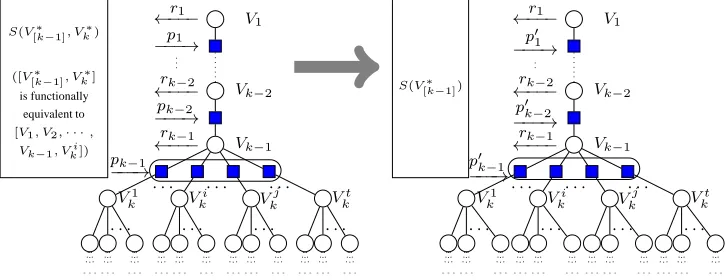
We are now ready to define what we call canonical ZK proofs; these proofs are defined conditionally, predicated on the existence of a good prefix. Roughly speaking, the property states that if a simulator
S([V[1∗,k−1], Vk∗]), taking the partial code[V[1∗,k−1], Vk∗]as input, can generate a session prefix up to the(k−1) -th prover step -that is good for verifiers wi-th ak-th step function different fromVk∗, thenScan do the same
without being given verifier codeV∗
k. Next, we present the definition of a canonical ZK proof system with an arbitrary (constant) number of rounds; in Section 3.2 we analyze concrete examples (e.g., 3-round proof systems).
Definition 6 (Canonical ZK Proofs). Let hP, Vi be a 2m-round universally simulatable ZK proof system
for a language L(Definition 4), S be the associated simulator and t be some polynomial. We call hP, Vi canonical if for any common inputx (not necessarily inL), every setV[1,k−1] of verifiers that share prefix strategy V[1,k−1],2 ≤ k≤ m(as in Definition 5), but withtdistinctk-th step strategiesV1
k, Vk2, ..., Vkt, the
following holds.
For any verifier codeV[1∗,k−1]satisfyingV[1∗,k−1] =f V[1,k−1], if, for some1≤i≤t, there existsVk∗ =f Vki
such that the session prefix(r1, p1, ..., pk−1) ← (S([V[1∗,k−1], Vk∗]) ⇔ [V[1∗,k−1], Vk∗])is good with respect to
V[1,k−1], thenS, taking only V[1∗,k−1] as input, can also produce a session prefix (i.e., (r1, p′1, ..., p′k−1) ←
(S(V∗
[1,k−1])⇔V[1∗,k−1])) which is good with respect toV[1,k−1].
A canonical ZK proof is depicted in Figure 1.
Remark 2. We stress that, for a zero knowledge proof, the canonical property above makes a demand on
the simulator only when the condition of the if clause holds. We also note that the ability of the simulator
S([V[1∗,k−1], Vk∗])to produce a good session prefix may depend on the common inputx(see the examples in the next section).4
4
Further, looking ahead, the only place where this property will be used is in the proof of Lemma 3, where we fix a false statement
.. . ... ... ... ... ... ... ... ... r1 ←−−− p1 −−−→
rk−2
←−−−
pk−2
−−−→
rk−1
←−−−
pk−1
−−−→
V1
Vk−2 Vk−1 V1
k Vki V
j k V t k · · · · · · · · S(V∗
[k−1], Vk∗)
([V∗
[k−1], Vk∗]
is functionally equivalent to
[V1, V2,· · ·,
Vk−1, Vki])
.. . ... ... ... ... ... r1 ←−−− p′ 1 −−−→
rk−2
←−−−
p′
k−2
−−−→
rk−1
←−−−
p′
k−1
−−−→
V1
Vk−2 Vk−1 V1
k Vki V
j k V t k · · · · · · · · S(V∗
[k−1])
Fig. 1. A canonical ZK proof.
3.2 Canonical ZK proofs: Examples
To our knowledge, all constructions of ZK proofs enjoy this property—cf. the FLS proof system [19] example at the beginning of the section, as well as those protocols that do not follow the FLS paradigm, such as, for example, Blum’s 3-round ZK proof for Graph Hamiltonicity [8] (and its sequential repetition version), which we now analyze in more detail.
Blum’s Graph Hamiltonicity ZK proof. Consider Blum’s 3-round ZK proof system for Graph Hamiltonicity
(with soundness error 12). In this case, we denote by V11andV12the verifiers that produce challenges 1 and 0, respectively5. Suppose that when the verifier sends challenge 1, the prover needs to reveal the isomorphism between the common input graph and the graph committed in the first prover messagep1. Note that when the
simulator S takes any V1∗ that is functionally equivalent to V11, then it will simply choose an isomorphism and commit to a new graph isomorphic to the common input graph in the messagep1(i.e., it acts as an honest
prover in the first prover step). For this proof system, the “if” clause of Definition 6 holds depending on whether the common input graph is Hamiltonian or not:
If the common input graph is Hamiltonian, then the “if” clause holds: Given a verifier code V1∗ that is functionally equivalent toV11 as input (i.e., i = 1in Definition 6), S(V1∗) will generate a first prover messagep1, for which an unbounded prover can answer both challenges 1 and 0 (fromV11andV12, resp.),
since the graph committed by S(V1∗) in p1 is also Hamiltonian. In this case, the simulator S, without being given the codeV1∗, can also act as an honest prover in the first prover step and generatep1that will
enable an unbounded prover to answer both challenges 1 and 06—i.e., prefixp1 is good with respect to
the verifier set{V1 1, V12}.
If the common input graph is not Hamiltonian then the “if” clause does not hold: Fort∈ {1,2}, given a verifier codeV1∗that is functionally equivalent toV1tas input,S(V1∗)will generate the first prover message
p1for which an unbounded prover can only answer a challenge fromV1t, since the graph committed inp1
is either a graph isomorphic to the common input graph or a Hamiltonian graph (which is not isomorphic to the common input graph)—i.e.,p1 is bad with respect to the verifier set{V11, V12}.
In sum, Blum’s 3-round ZK proof system for Graph Hamiltonicity is canonical according to Definition 6: whenever the definition’s “if” clause is satisfied, i.e., the simulatorS(V1∗)can generates p1that is good with
respect to both verifier challenges, thenS, without being given the codeV1∗as input, can also generate a good prefixp1.
5
To match our definition, we can think of these protocols as being of even number rounds by letting the verifier send a dummy message in the first step of the protocol, and denote byV2ithe challenge step of the verifier.
6
FLS-type ZK proofs. The classical FLS-type ZK proofs [19] are also canonical. Recall how these proofs
work. In the first stage, the verifier sends a perfectly hiding commitmentc1 to a random string, followed by
a perfectly binding commitment c2 to a random string from the prover, after which the verifier opens the
commitment sent at its first step. In the second stage, the prover proves that the common input x ∈ L or that the random string committed inc1matches the random string committed inc2via a Blum 3-round proof
system as above (but with negligible soundness error). We view the two verifier steps in the first stage as a single step7, and denote it byV1, and denote byV2the verifier step in stage 2. We now analyze what happens
at each step.
It is easy to verify that the second verifier step (k = 2) satisfies the definition, based on the following observation. Fix a codeV1∗ of the first verifier step (recall that, by definition, we consider only on the set of verifiers sharing the same first verifier step that is functionally equivalent toV∗
1.) Observe that the simulator,
given only a codeV1∗of a first stage verifier that is functionally equivalent to someV1as input, can generate a good first stage prefix (by rewinding the first stage verifierV1∗) that will enable an unbounded prover answer any challenge from the second verifier step (since an unbounded prover can always recover the corresponding trapdoor from the transcript of the first stage and carry out the second stage in a straight-line fashion). I.e., the unbounded prover will, based on the first stage transcript output byS(V1∗), make a random verifier that share the same prefixV1accept.
For the first verifier stepV1, the “if” condition is satisfied depending on whetherx∈Lor not:
Whenx ∈ L, the “if” clause holds, since an unbounded prover can, based on any first stage transcript output by the simulatorS(V1∗), make a random verifier (that may have a prefix functionally different from
V∗
1) accept with probability 1 by finding the witness forx∈Land acting as an honest prover in the second
stage. In this case, the simulatorS, without being given the codeV1∗, can also act as an honest prover in the first prover step and generate a random first stage transcript (which does not form a trapdoor), and based on this transcript, an unbounded prover can always find a witness forx ∈ Lto make a random verifier accept with probability 1.
Whenx /∈L, the “if” clause does not hold: For every two different first verifier stepsV1
1,V12, and every
two different second verifier steps V21, V22 (that will output different challenges in Blum’s protocol), whereV1t(t∈ {1,2}) commits tortand then opens the commitment, andV2b (b∈ {1,2}) simply sends
challengeeb, the simulatorS, given a codeV1∗that is functionally equivalent toV1i (i∈ {1,2}) as input,
will generate a first stage transcript for which an unbounded prover cannot make a random verifier from the set of four verifiers{V1t, V2b}accept with probability 1, since for verifier prefixV1j different fromV1i, the first stage transcript output by S(V∗
1) will not form a valid trapdoor for the prover, and thus, if the
random verifier is chosen from the verifier set{V1j, V2b}, based on this first stage transcript, an unbounded prover cannot make the random verifier accept with probability greater than 12.
In sum, FLS-type ZK proofs are also canonical according to Definition 6: Whenever Definition 6’s “if” clause holds for a verifier stepk, the simulator can generate a good prefix prior to thek-th verifier step without being given the code of this verifier step.
Barak’s argument system. Finally, one may wonder where Barak’s argument system (not known to be a proof
system) fits in all this. We view the first three messages in the system (the hash function selected by the verifier, the commitment computed by the prover, and the verifier’s random challenge—recall the description in Section 1) as the first stage, and the remaining WIUA (Witness Indistinguishable Universal Argument) as the second stage. Thus, following the same reasoning as above, for k > 2, the canonical property is satisfied at thek-th verifier step. However, for the second verifier step (at which the verifier outputs a random challenge), whenx /∈L, we do not know if Definition 6’s “if” clause holds.
Canonical ZK proofs are used in the next section to formulate the “verifier-distinguishing problem,” to which the existence of constant-round public-coin ZK proofs is reduced.
7
Note that the second verifier message is bound to the first verifier messagec1, and that, when considering the canonical property
3.3 The verifier-distinguishing problem
In a nutshell, given a set of distinct verifierk-th next-message functions, the problem resides in constructing a distinguishing algorithmU which, given a session prefix (prior to thek-th verifier step) output by simulator
S, such that for any polynomial-time constructible programVk∗that is promised to be functionally equivalent to one of the next-message functions, is able to discern one from the set that is functionally different fromV∗
k. Formally:
Definition 7 (The Verifier-Distinguishing Problem). LethP, Vibe a2m-round canonical ZK proof system
for a languageL(Definition 6),Sbe its simulator,pthe length of each prover’s message, andta polynomial in the security parameter n. Given are a set V[1,k−1] of deterministic honest verifiers that share the same prefix verifierV[1,k−1], but havetdistinctk-th next-message functionsVk1, Vk2, ..., Vkt, denoted by setVk, and
an auxiliary inputaux8. The verifier-distinguishing problem is to find a non-uniform algorithmU, running in time2O(p), such that for every polynomial-time algorithmC, the following holds:
First,Cpicks a machineVki ∈ Vkat random and outputs a polynomial-time Turing machineVk∗such that
V∗ k
f
=Vi k.
Next,U, taking(V[1,k−1],Vk)and a session prefix(r1, p1, ..., pk−1)output byS(aux, Vk∗), outputsVkj ∈
Vksuch thatVkj
f
6
=Vk∗with probability negligibly close to1. I.e.,
Pr
Vk∗←C(Vk, i); (r1, p1, ..., pk−1)←S(aux, Vk∗);
j←U(V[1,k−1],Vk, r1, p1, ..., pk−1)
:Vk∗6=f Vkj
>1−neg(n),
where the probability is taken over the random choiceiand the randomness used byC,U andS.
Remark 3. We note that in the definition, algorithm U is not givenV∗’s code as input. This means that if
U is able to carry out its task, then the simulator must encode some non-trivial functionality of V∗
k in such a session prefix. As mentioned before, this is in sharp contrast with known straight-line simulators such as Barak’s, which are oblivious to the verifier’s functionality in computing a session prefix. We elaborated on some of the difficulties in solving this problem in Section 1, overcoming which (if at all possible) would require a technical breakthrough in simulation techniques.
4 An Improved Derandomization Lemma for Interactive Proofs
In this section we prove a structure-preserving version of the well-known Babai-Moran “Speedup Theo-rem” [1,10] with improved parameters for our application, which we will then use in the proof of our main result (Theorem 2). Essentially, the result says that for any constant-round public-coin interactive proof sys-tem with small soundness error, there exists a polynomial set of random verifier tapes such that the cheating probability for the unbounded prover over these verifier tapes is bounded away from 1—and this holds even when the prover knows this small set of random tapes in advance.
We first recall the Babai-Moran theorem. LetAM[k]denote the set of languages whose membership can be proved via ak-round public-coin proof system.
Theorem 1 ([10]). For any polynomialt(n),AM[t+ 1] = AM[t]. In particular, for any constantk,AM[k] =
AM[2].
For our application, we wish to de-randomize the verifier while keeping the original proof system structure intact (that is, without “collapsing” the round complexity). TheAM[k] = AM[2]proof—and its randomness-efficient variant in [11]9—actually yield such a result: for any2m-round public-coin proof system with small
8
This auxiliary input is given toS; in our main theorem (Theorem 2) it will be the code of some verifier prefix strategy. 9
soundness errorǫ, there exist(O(p))m verifier random tapes over which the cheating probability of an un-bounded prover is still un-bounded away from 1, wherepis the length of the prover’s messages.
Next, we present an improvement to this result, in which the number of such verifier random tapes reduces to(p/O(log1ǫ))m. In addition, we show that this de-randomization lemma is essentially tight with respect to the round complexity, as there are super-constant-round public-coin proof systems for which the prover’s cheating probability is1, over any polynomial number of verifier random tapes.
Before stating the lemma, we introduce some additional notation:
V|(r1,
r2...,rt)denotes the honest verifier that is restricted to choose uniformly at random one ofr
1,
r2...,rt
as its random tape, wheretis a polynomial; we use V|(r1,r2...,rt)(r
i)to denote the verifier that takes
ri, 1≤i≤t, as its random tape.
P∗(r1,r2...,rt)denotes the unbounded cheating prover with auxiliary input(r1,r2...,rt), indicating that
it will interact withV|(r1,r2...,rt).
We now state the result formally. For simplicity, we assume that all the prover messages are of equal length.
Lemma 1. Letmbe a constant andhP, Vibe a2m-round public-coin interactive proof system for language
Lwith negligible soundness errorǫ. Letpdenote the length of the prover’s messages. Then for everyx /∈L, there existq= (p/O(log1ǫ))mdifferent random tapes,r1,r2, ...rq, such that for every unbounded proverP,
Pr[hP(r1,r2, ...rq), V|(r1,r2,...rq)i(x) = 1]≤1− 1
q .
Here we present the intuition and basic inequalities that yield the proof for the case of a 3-round proof system10(similar ideas also appeared in [1,10]), and defer the full proof of the lemma to Appendix B.1.
Let us consider a 3-round public-coin proof system hP, Vi with negligible soundness error for some languageL11, in which the prover sends the first messagep1 and the last messagep2, and the verifier sends
the second messager(its public coins). Without loss of generality, we assume|p1|=|p2|=p, and|r|=n.
We now prove that there exists a numberpof verifier random tapes12 (r1,r2, ...,rp)over which the cheating
probability is at most1−1/p.
For the sake of contradiction, assume that for some false statementx /∈ Lthere is an unbounded prover
P⋄such that for anyp-tuple(r1,r2, ...,rp),P⋄(r1,r2, ...,rp)can cheatV|(r1,r2,...rp)with probability 1. Now
note that the number of such successful cheating provers is 2pn, and that there are at most2p different first prover messagesp1. Thus, there is a number of at least 2
n p
/2pP⋄(
r1,r2, ...,rp)’s that produce the same first
prover message, denote itp∗1, for which if the verifier is using a random tape in any of thep-tuples {(r1,r2, ...,rp) :p∗1←P⋄(r1,r2, ...,rp)},
we have an unbounded prover that can produce a second prover messagep∗
2 to make the verifier accept.
On the other hand, the number of p-tuple choices (r1,r2, ...,rp) out of a 1/2e fraction of all possible
verifier random tapes is at most 2 n 2e p
. Since
2n
2e
p
<(2
n
2p)
p <
2n p
2p ,
to specify roughlyO(p)verifier messages in the original proof system. Their proof, however, yields almost the same result as the Speedup Theorem in our setting where we want to maintain the structure of the original proof system, and only care about the number of original verifier random tapes that are needed to make sure the resulting protocol after derandomization is still a proof system.
10
The basic reasoning here applies to a proof system of even number (4) of rounds as well, by having the verifier send a dummy message first.
11
For example, then-folded parallel version of Blum’s 3-round proof for Graph Hamiltonicity [8], or the 3-round proof for Graph Isomorphism [23].
12
we have that the set{(r1,r2, ...,rp) : p∗1 ←P⋄(r1,r2, ...,rp)}covers at least a1/2efraction of all possible
verifier random tapes.
In sum, we are able conclude that there is an unbounded prover, which sends p∗1as its first message, that can make the verifier accept the false statement with probability at least1/2e. This contradicts the negligible soundness error ofhP, Vi.
The proof of the lemma for the general (arbitrary constant rounds) case can be found in Appendix B.1, and the tightness result, i.e., the counterexample for superconstant-round proof systems, in Appendix C.
5 Constant-Round Public-Coin Zero-Knowledge Proofs Imply Distinguishing Verifiers’ Programs
We are now ready to present our main result, which exhibits a reduction from constant-round public-coin canonical ZK proofs to the functionality-distinguishing problem (Definition 7), a problem seemingly quite different in nature. We first fix some parameters and revisit notation:
hP, Vi: A2m-round public-coin canonical ZK proof sytem for some constantm. We letnbe the security parameter andpbe the length of each prover’s message.
V[1,k−1]: A set of deterministic honest verifiers that share the same (honest) prefix verifierV[1,k−1], but
havetdistinctk-th step functionsV1
k, Vk2, ..., Vkt;|V[1,k−1]| ≤q, wheretandq are polynomials (defined
in Lemma 1)13.
Vk: The set{Vk1, Vk2, ..., Vkt}, as above.
V′
[1,k−1]: The auxiliary input to S, which is the code of a prefix verifier such that V[1′,k−1] f
= V[1,k−1]. (Whenk= 1, it is set to the empty string.)
We now show that ifhP, Viadmits a universal simulatorS, then there is an algorithmU, takingV[1,k−1], Vkand a session prefix as inputs, which can solve the functionality-distinguishing problem (cf. Definition 7) with respect to verifier setVk. Formally:
Theorem 2. LethP, Vi be a 2m-round, public-coin canonical ZK proof system with negligible soundness
error for a non-trivial language L /∈ BPP, and S be its universal simulator. Then, there exist an infinite set I, a sequence of false statements x /∈ L of length nfor each n ∈ I, a constant k, 2 ≤ k ≤ m, sets
V[1,k−1] andVk, a verifier codeV[1′,k−1] as above, and an algorithmU, running in time2O(p), such that, for
any polynomial-time algorithmCthat on input(Vk, i),1 ≤i≤toutputsVk∗ satisfyingVk∗
f
=Vki ∈ Vk, the
following holds:
Pr "
Vk∗ ←C(Vk, i); (r1, p1, ..., pk−1)←(S([V[1′,k−1], Vk∗])⇔V[1′,k−1]) j←U(V[1,k−1],Vk, r1, p1, ..., pk−1)
:Vk∗ 6=f Vkj ∈ Vk
#
>1−neg(n),
where the probability is taken over the random choiceiand the randomness used byC,UandS.
We now give a high-level sketch of proof of the theorem, which mainly consists of three steps. (Refer to Figure 2.)
1. The first step is Lemma 1 from the previous section. LetV1, V2, ..., Vqdenote theqdeterministic verifiers given by the lemma. The various trees in Figure 2(a) correspond to theseqverifiers.
2. Next, we show that there exists a sequence of infinitely many false statementsxsuch that for every verifier
Vi,1 ≤ i ≤ q, and any polynomial-time constructible codeV∗ which is functionally equivalent toVi, the session (S(V∗) ⇔ V∗) (which, by Fact 1 is identical to (S(V∗) ⇔ Vi)) is accepting except with negligible probability. This is shown in Figure 2(a).
13
At thek-th verifier step, the number of distinct next-message functions should in fact betk. For simplicity, we assumet=tkfor
3. For any false statement x in the above sequence, we prove that among theseq verifiers, we can find a (sub)tree V[1,k−1] that has the same prefix strategy [V1, V2, ..., Vk−1]up to the (k−1)-th verifier step
but “splits” at the k-th verifier step, and a code V[1′,k−1] that is functionally equivalent to V[1,k−1] =
[V1, V2, ..., Vk−1], such that, for any polynomial-time constructible codeVk∗ that is promised to be func-tionally equivalent to one of thoseVi
k’s (nodes) at levelk, the following two conditions hold:
The session prefix(r1, p1, ..., pk−1)produced by(S([V[1′,k−1], Vk∗])⇔ V[1′,k−1])(or equivalently, by
(S([V′
[1,k−1], Vk∗]) ⇔ V[1,k−1])) is bad with respect to V[1,k−1](cf. Definition 5). This implies that
there is a subtree (refer to Figure 2(b)) inV[1,k−1], with respect to which(r1, p1, ..., pk−1)is bad.
However, the session prefix(r1, p1, ..., pk−1)is good with respect to the subtree that shares the same
prefix strategy[V[1,k−1], Vi
k](refer to Figure 2(b)).
This enables us to construct an algorithm that is able to “understand” the codeVk∗, by pin-pointing another verifier code, say,Vkj, such thatVkj 6=f V∗
k.
The proof in detail. Given Lemma 1, we now present the remaining details of the proof of Theorem 2. Again,
let hP, Vi be a2m-round public-coin canonical ZK proof for some non-trivial (outside BPP) languageL, andSbe its associated simulator. We first prove the following lemma, where Lemma 1 is used.
Lemma 2. LethP, Vibe as above. Then there exist an infinite setI, a sequence of false statementsx /∈Lof
lengthnfor eachn∈I, andqhonest verifiersV1, V2, ..., Vq(recall that we useVias a shorthand forV(ri), 1≤i≤q), such that given the description of any polynomial-time constructibleV∗ =f Vi for a randomias
input, the interaction(S(V∗)⇔V∗)14will produce an accepting transcript with probability negligibly close to1, while the unbounded prover can cheat only with probability at most1−1/q.
Proof. We first prove that there is an infinite setI of security parameters and a sequence of false statements
x /∈Lof lengthnfor eachn∈I so that for every PPT algorithmCwhich takes picks a randomV from the set of verifiers and outputsV∗such thatV∗ =f V, the simulation(S(V∗)⇔ V∗)will generate an accepting transcript with probability negligibly close to 1 (over the randomness used byS and the random choice of verifier). Suppose otherwise, for sufficiently large n, there is no false statement x of length n and a code
V∗ output by some PPT algorithmC on which(S(V∗) ⇔ V∗) will generate an accepting transcript with probability less than1−1/poly(n)for some polynomialpoly, then the following simple algorithm could be used to decide membership inLefficiently15: Pick a verifier at random and run C to constructV∗ =f V as above, and then haveSon inputxandV∗interact withV∗; ifV∗accepts, output “x∈L,” otherwise output “x /∈L.”
Now fix a false statementx /∈ Lin the above sequence, and setQto be the set of verifier random tapes such that for anyr ∈ Qand any polynomial-time constructible V∗ =f V(r), (S(V∗) ⇔ V∗) will generate
an accepting transcript with probability negligibly close to 1. We now show that the size ofQis larger than a
(1−neg(n))fraction of all possible random tapes. Assume the verifier’s random taperandS’s random tape
Rare uniformly distributed over{0,1}l and{0,1}s, respectively, whereland sare some polynomials, and denote byEthe event that the simulation(S(V∗)⇔V∗)generates an accepting transcript. We have
14Recall that this interaction is identical to(S(V∗)⇔Vi) (Fact 1).
15
..
. ... ... ... ... ...
r1
←−−−
p1
−−−→
rk−2
←−−−
pk−2
−−−→
rk−1
←−−−
pk−1
−−−→
V1
Vk−2 Vk−1 V1
k Vki Vkj V t k
· · · ·
· · · ·
S(V′
[k−1], Vk∗)
([V′
[k−1], Vk∗]
is functionally equivalent to
[Vk−1, Vki]) pk−1is the same
Denote byV[1,k−1]the
prefix strategy
[V1, V2,· · ·, Vk−1]
Let hist be the prefix
(r1, p1,· · ·, pk−1)
(a)
(b) ..
. ... ... ... ...
· · · · · · · ·
· · ·
V1V2 · · ·
..
. ... ... ... ...
· · · · · · · ·
· · ·
· · · ·
· · · ·
..
. ... ... ... ...
· · · · · · · ·
· · ·
S(V∗)
−−→ ←−− −−→ ←−− −→ ←−− −−→ ←−− −−→ ←−−
Vq−1Vq
hist is good w.r.t this subtree
hist is bad w.r.t this subtree
hist is bad w.r.t this tree
Fig. 2. Pictorial depiction of the proof of Theorem 2. Figures (a) and (b) correspond to Lemma 2 and Lemma 3, respectively. In Figure
(b), the prefix(r1, p1, ..., pk−1)is bad w.r.t. the entire tree, which implies that there is a subtree for which this session prefix is bad;
however, the prefix is good w.r.t. the subtree that shares the same prefix strategy[V[1,k−1], Vki]for whichVk∗ f
Pr r←{0,1}l R←{0,1}r
[V∗ ←C(r) :E] (1)
= Pr
r←{0,1}l R←{0,1}r
[V∗←C(r) :E|r∈Q] Pr[r∈Q]
+ Pr
r←{0,1}l R←{0,1}r
[V∗ ←C(r) :E|r∈/ Q] Pr[r∈/ Q]
≤ Pr[r∈Q] + (1− 1
poly(n)) Pr[r∈/ Q] = |Q|
2l + (1−
1
poly(n))(1−
|Q|
2l )
= 1− 1
poly(n)(1−
|Q|
2l ).
Given that the probability in expression(1)is greater than1−neg(n), so is the quantity |Q|2l .
Thus, givenx /∈L, for any unbounded prover, the cheating probability, taken over the choices of verifier random tapes inQ, is still negligible. Applying now Lemma 1, we can findqrandom tapesri∈Q,1≤i≤q, such that the probability, taken over theseqrandom tapes, that the unbounded prover makes the verifier accept
is at most1−1/q. This completes the proof of the lemma. ✷
The next lemma, where Lemma 2 is used, is the key step in establishing our main theorem.
Lemma 3. LethP, Vibe as above. Fix the infinite setI and the sequence of false statementsx /∈L
guaran-teed by lemma 2. Then there exists a triplet(k,V[1,k−1], V[1′,k−1]), where:
2≤k≤m;
V[1,k−1] is a subset of verifiers that share the same prefix strategy V[1,k−1] but havetdistinct k-th step strategiesVk1, Vk2, ..., Vkt, denoted byVk(we letV[1i,k]denote the subset of verifiers inV[1,k−1]that share
the same prefix strategy[V[1,k−1], Vki]); and
V[1′,k−1]is a prefix verifier code functionally equivalent toV[1,k−1],
such that, for any1≤i≤tand any polynomial-time constructible codeVk∗satisfyingVk∗=f Vki,(S([V[1′,k−1], Vk∗])
⇔[V[1′,k−1], Vk∗])will generate a session prefix(r1, p1, ..., pk−1)satisfying the following two conditions:
1. (r1, p1, ..., pk−1)is bad with respect toV[1,k−1];
2. (r1, p1, ..., pk−1)is good with respect toV[1i,k].
Fix a security parameter n and a false statement x /∈ L of length n in the sequence guaranteed by Lemma 2. We prove the lemma by examining the next-message functions of theqhonest verifiersV1, V2, ...Vq
guaranteed by Lemma 2, step by step. At a high level, the structure of the proof is as follows: 1. First, show that there exists a triplet(2,V[1], V[1]′ )satisfying condition 1.
2. Show that any (m−1,V[1,m−1], V′
[1,m−1])satisfies condition 2.
3. Show that, for any2≤k≤m−1, if a given(k,V[1,k−1], V[1′,k−1])satisfes condition 1, but not condition
2, then we have a triplet(k+ 1,V[1,k], V′
[1,k])that satisfies condition 1.
This reasoning guarantees that we can find a triplet(k,V[1,k−1], V′
[1,k−1]), for some2≤k≤m, which satisfies
both conditions. The detailed proof of the above three steps is presented in Appendix B.2.
Let the output of an arbitrary PPT algorithmCon input(Vk, i)for randomibeVk∗ such thatVk∗
f
=Vki∈ Vk. AlgorithmU works as follows.16
The distinguishing algorithmU.
Input toU:V[1,k−1],Vk,(r1, p1, ..., pk−1)←(S([V[1′,k−1], Vk∗])⇔V[1′,k−1])and an initially empty setT.
1. For eachj,1 ≤ j ≤t, exhaust all possible prover messages after thek-th verifier step, checking if the session prefix(r1, p1, ..., pk−1)is good with respect toVkj. If not, addjto setT.
2. Output an arbitraryjinT.
As mentioned before, in its second step, U can check whether the given session prefix is good in time
2O(p), which overwhelmingly dominates its the running time.
Condition 1 of Lemma 3 guarantees that there existsjsuch that the session prefix(r1, p1, ..., pk−1)
pro-duced inU’s step 1 is bad with respect toV[1j,k−1], which implies thatT is not empty. Condition 2 of Lemma 3 guarantees that if(r1, p1, ..., pk−1)is bad with respect toV[1j,k−1], thenVk∗
f
6
=Vkj. In other words, algorithmU
was able to pin-point a program (Vkj) functionally different fromVk∗. This concludes the proof of Theorem 2.
6 Conclusions
A natural question which arises from our reduction is: How hard is the functionality-predicting problem (Defi-nition 7)? As mentioned before, since our predicting algorithmU does not take the target codeV∗
k as input, the simulator must encode some non-trivial functionality ofVk∗ in the session prefix(r1, p1, ..., pk−1). However,
if the simulator runs in a straight-line manner such as Barak’s [2], it does not execute V∗
k in computing the history prefix prior to the verifier’sk-th step, and this means it is able to discern some non-trivial property of
Vk∗’s functionality and encode it in the session prefix(r1, p1, ..., pk−1)without executingVk∗, which seems to be highly unlikely. We leave the exact characterization of this problem’s hardness as an interesting research question.
Since, as also argued in the introduction, rewinding seems to be out of the picture, this leads us to think of our main theorem as strong evidence against the existence of such proof systems, and safely conclude that constructing non-trivial constant-round public-coin ZK proofs (if they exist) requires a paradigm-shifting simulation technique.
Acknowledgements
The authors would like to thank Susumu Kiyoshima, Sanjam Garg, and the anonymous reviewers for SCN ’16 for their valuable comments.
References
[1] L. Babai: Trading Group Theory for Randomness. STOC 1985, pp. 421-429, 1985. [2] B. Barak: How to go beyond the black-box simulation barrier. FOCS 2001, pp.106-115.
[3] G. Brassard, D. Chaum, and C. Cr´epeau: Minimum disclosure proofs of knowledge. J. Comput. Syst. Sci., 37(2):156-189, 1988. [4] N. Bitansky, D. Dachman-Soled, S. Garg, A. Jain, Y. Kalai, A. Lpez-Alt, D. Wichs: Why ”Fiat-Shamir for Proofs” Lacks a
Proof. TCC 2013: 182-201.
[5] B. Barak, O. Goldreich, S. Goldwasser, Y. Lindell: Resettably sound ZK and its Applications. FOCS 2001, pp. 116-125, 2001. [6] B. Barak, O. Goldreich, R. Impagliazzo, S. Rudich, A. Sahai, S. P. Vadhan, K. Yang: On the (Im)possibility of Obfuscating
Programs. CRYPTO 2001, pp.1-18, 2001.
[7] B. Barak, Y. Lindell: Strict polynomial-time in simulation and extraction. STOC 2002, pp.484-493. 2002.
[8] M. Blum: How to prove a theorem so no one else can claim it. Proceedings of theInternational Congress of Mathematicians, pp.444-451, 1986.
16
[9] B. Barak, Y. Lindell, S. P. Vadhan: Lower Bounds for Non-Black-Box Zero Knowledge. FOCS 2003, pp.384-393,2003. [10] L. Babai, S. Moran: Arthur-Merlin Games: A Randomized Proof System, and a Hierarchy of Complexity Classes. J. Comput.
Syst. Sci. 36(2): 254-276, 1988.
[11] M. Bellare, J. Rompel: Randomness-Efficient Oblivious Sampling. FOCS 1994, pp.276-287.
[12] R. Canetii, Y. Chen and L. Reyzin: On the Correlation Intractability of Obfuscated Pseudorandom Functions. TCC(A) 2016, pp.389-415.
[13] R. Canetti, O. Goldreich, S. Goldwasser, S. Micali. Resettable Zero Knowledge. STOC 2000, pp.235-244, 2000.
[14] R. Canetti, J. Kilian, E. Petrank and A. Rosen. Concurrent Zero-Knowledge requiresΩ(logn)rounds. STOC 2001, pp.570-579, 2001.
[15] I. Damgaard. Efficient Concurrent Zero-Knowledge in the Auxiliary String Model. EUROCYPT 2000, pp.174-187, 2000. [16] Y. Deng, V. Goyal, A. Sahai: Resolving the Simultaneous Resettability Conjecture and a New Non-Black-Box Simulation
Strategy. FOCS 2009, pp.251-260.
[17] G. Di Crescenzo, Ivan Visconti. Concurrent ZK in the Public-Key Model. ICALP 2005, pp.816-827, 2005. [18] C. Dwork, M. Naor and A. Sahai. Concurrent Zero-Knowledge. STOC 1998, pp.409-418, 1998.
[19] U. Feige, D. Lapidot and A. Shamir: Multiple Non-Interactive Zero Knowledge Proofs Under General Assumptions. SIAM J. on Computing 29 (1999) 1C28.
[20] O. Goldreich: The Foundations of Cryptography - Volume 1, Basic Techniques. Cambridge University Press 2001.
[21] Sanjam Garg, Craig Gentry, Shai Halevi, Mariana Raykova, Amit Sahai and Brent Waters: Candidate Indistinguishability Ob-fuscation and Functional Encryption for all Circuits. FOCS 2013, pp.40-49.
[22] O. Goldreich and H. Krawczyk: On the Composition of Zero-Knowledge Proof Systems. SIAM J. Comput. 25(1), pp.169-192, 1996.
[23] O. Goldreich, S. Micali and A. Wigderson. Proofs that yield nothing but their validity or All languages in NP have zero-knowledge proof systems. J. ACM, 38(3), pp.691-729, 1991.
[24] S. Goldwasser, S. Micali, and C. Rackoff. The knowledge complexity of interactive proof systems. SIAM. J. Computing, 18(1):186-208, February 1989.
[25] O. Goldreich, S. Vadhan and A. Wigderson. On Interactive Proofs with a Laconic Prover. ICALP 2001, pp. 334-345. [26] S. Hada: Zero-Knowledge and Code Obfuscation. ASIACRYPT 2000, pp.443-457, 2000.
[27] R. Pass, A. Rosen: New and improved constructions of non-malleable cryptographic protocols. STOC 2005: 533-542. [28] M. Prabhakaran, A. Rosen, A. Sahai: Concurrent Zero Knowledge with Logarithmic Round-Complexity. FOCS 2002,
pp.366-375, 2002.
A Good/Bad/Session Prefixes (cont’d)
In this section we provide a more detailed formulation of the notion, as well as an illustration of good/bad prefixes. Recall Definition 5. Equivalently, we call a session prefix(r1, p1, ..., pℓ)“good” with respect toV[1,ℓ]
if the following holds, which can be decided in time exponential in the length of the prover’s messages. Let
polybe the size ofV[1,ℓ]. Then there arepolynumber of session continuations of the form(rℓ+1, ..., pm), each assigned to a verifier inV[1,ℓ], such that the following conditions hold:
1. Every verifier inV[1,ℓ]will accept the transcript(r1, p1..., pℓ, rℓ+1, ..., pm)assigned to it.
2. If two verifiers in V[1,ℓ]share the same prefix strategy up to the ℓ′-th step,ℓ ≤ ℓ′ ≤ m, then the two transcripts assigned to them share the same session prefix(r1, p1..., rℓ′, pℓ′).
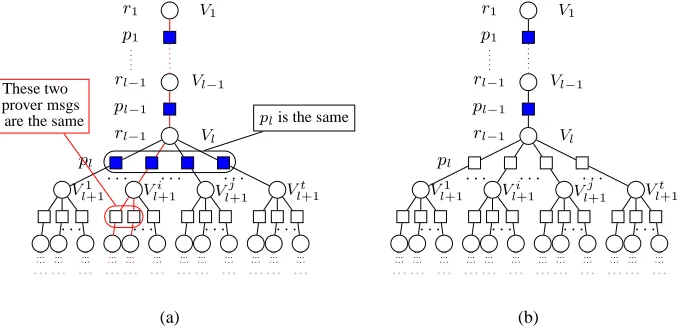
A good session prefix is pictorially depicted in Figure 1(a). In the figure, if (r1, p1, ...pℓ) is good with respect to the tree, then for every edge below Vℓ, we can assign a prover message to it such that: (1) each path is accepting, and (2) for every two paths that share the same prefix strategy up to theℓ′-th verifier step,
ℓ ≤ ℓ′ ≤ m(e.g., the red paths), the session prefixes of these two paths up to theℓ′-th prover step are the same.
In addition, one can easily verify the following “robustness” fact about a good session prefix: if a session prefix(r1, p1, ..., pℓ)is good with respect toV[1,ℓ], then for any1≤i≤ℓ, the session prefix(r1, p1, ..., pi)is also good with respect toV[1,ℓ]. See Figure 1(b). The figure illustrates the fact that if(r1, p1, ..., pℓ−1, rℓ, pℓ)is good, so is the (sub)prefix(r1, p1, ..., pℓ−1)with respect to the same tree. This is because all prover messages
..
. ... ... ... ... ... ... ... ...
r1
p1
rl−1
pl−1
rl−1
pl
V1
Vl−1
Vl
Vl+11 Vi
l+1 Vl+1j V t l+1
· · · ·
· · · ·
plis the same These two
prover msgs are the same
..
. ... ... ... ... ... ... ... ...
r1
p1
rl−1
pl−1
rl−1
pl
V1
Vl−1
Vl
Vl+11 Vi
l+1 Vl+1j V t l+1
· · · ·
· · · ·
(a) (b)
Fig. 3. A good session prefix (a) and its robustness (b). Each node (circle) represents a verifier next-message function, or equivalently
(in our case of public-coin proof systems), a random string that is used in this step. Each path represents a (complete) interaction with an honest verifier.
B Proofs
B.1 Proof of Lemma 1
We first introduce some definitions and additional notation that will be used in the proof.
We assume that the length of each prover message is greater than any constant, in particular,p >10. Note that this assumption is without loss of generality because if the length of the prover message in a constant-round interactive proof for a language L is constant, then Lis trivial (see [25]), which in turn implies our lemma immediately.
Throughout this subsection, we consider only structured q-tuples of verifier’s random tapes, which are selected in the following way:
1. For each verifier stepi,1 ≤i≤m, if|{0,1}li|> 2 logm2p1 ǫ
, setti = m 2p
2 log1 ǫ
∈p/O(log1ǫ); otherwise, set
ti = 2li, whereliis the length of thei-th verifier message; 2. Chooseti distinct stringsr1i, r2i, ..., rtiifrom{0,1}li;
3. Choose ani-th verifier messagerjii ∈ (r1ii, r2i, ..., rtii),1 ≤ ji ≤ ti for each step i, and set random taperj = [rj11, rj22, ..., rjmm].
4. Aq-tuple of random tapes is now the set of all possible random tapes set in step 3,(r1,r2, ...,rq). Note
that the sizeqof this set isQm
i=1ti, which is determined by Step 2.
We identify(r1,r2, ...rq)with(rπ(1),rπ(2), ...rπ(q))for any permutationπon{1,2, ..., q}. Twoq-tuples, (r1,r2, ...rq)and(r′1,r′2, ...r′q), are said to be distinct if there exists at least onerisuch thatri∈(r1,r2, ...rq)
butri ∈/(r′1,r′2, ...r′q), or vice-versa. Thus the number of all possible distinct such structuredq-tuples is
m Y i=1 2li ti .
Some more basic notation before the proof:
prefixi(rj): the first imessages from the verifier using random taperj, that is, forrj = [rj1, r
j
2, ..., r
j m],
prefixi(rj) = [r1j, r
j
2, ..., r
j i]. −
→